News
Ngā rongo

As accidents / incidents occur within the transport sector in New Zealand, TAIC endeavours to keep the regulators, operators and general public informed. This is achieved by many different methods, including but not limited to: radio, news releases, media conferences, social media updates and publication here. If you want to be kept abreast of the latest news etc, click the link at the bottom of the page.

Search Results

1-12 of 169 results
17-metre catamaran passenger ferry Black Cat photographed in Akaroa Harbour. No obvious major structural deformation above the waterline is visible. Vessel is listing to starboard by approximately 10° with starboard main-deck stern near to awash. Numerous people wearing orange lifejackets are visible on the main and upper deck on the port side, with some transferring on to one of three boats attending the stricken vessel's port side. Harbour headlands form the background.

The Commission is investigating the accident involving commercial passenger vessel Black Cat grounding in Akaroa Harbour on 31 January 2026. At the start of the inquiry, the Commission is appealing for witnesses who saw, photographed or videoed the vessel and/or the accident.

Vertical slice diagram showing South-to-North profile of the North Sector airspace near Whenuapai and Whangārei. The chart plots altitude (in thousands of feet) against distance in nautical miles. Shaded blocks show controlled Class C airspace at higher levels, and uncontrolled and MBZ (mandatory broadcast zone) airspace lower down. Two aircraft flight paths are shown: the Q300 ZK-NES in a green dotted line, level at about 6000 ft in cloud, and the Beech ZK-JED in a red dotted line descending

Two aircraft passed too close in uncontrolled airspace in cloud over Northland in August 2023. TAIC makes recommendations for CAA and Ministry of Transport to resolve systemic safety issues in design of the North Sector airspace and absence of a clear agency responsible for comprehensive airspace reviews.

The accident helicopter. File shot 2023. (c) Cody Forward | Jetphotos

a Robinson R66 helicopter crashed on coastal land near the Makara Wind Farm, to the West of Wellington. The reported circumstances were that activation of the helicopter’s Emergency Locator Transmitter alerted emergency services

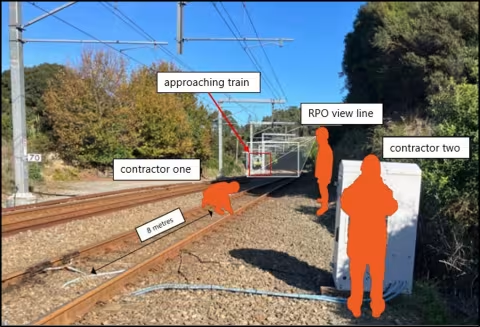
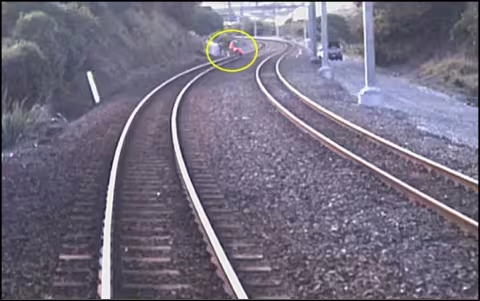
Workers in orange high-vis on a train track near a level crossing

TAIC reinforces importance of effective supervision of trainees undertaking safety-critical tasks and robust engineering risk controls for complex systems. Lessons for all industries where the supervision of safety-critical tasks performed by inexperienced or unqualified staff is necessary to maintain safety.

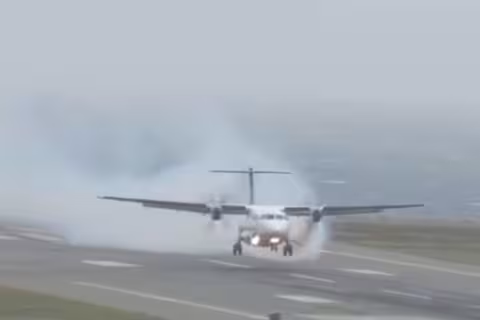
Fig 4 from the report shows the damaged right landing gear with deflated tyre

Heavy rain contributed to late transition from autopilot to manual control. Lessons for all aircraft operators: ensure crews know and understand the operator’s and aircraft manuals and procedures and are thoroughly briefed. Operator Air New Zealand has amended operational procedures and information and provided pilot training. No new safety recommendations.

Air New Zealand Airbus A320 aircraft ZK-OXJ in flight with landing gear extended, approaching for landing against a blue sky. The aircraft features a distinctive black-and-white koru fern livery.

A drone likely came close to an passenger jet on approach to a major NZ airport, the drone being in breach of NZ civil aviation rules. TAIC recommends drone registration, remote ID, and geo-fencing, calls on Ministry of Transport and CAA to modernise drone regulations in line with international best practice.

Aerial view of the Japanese longline fishing vessel Chokyo Maru aground on rocks near a steep coastline, with a harbour tug made fast to the vessel’s stern via a tow line. The tug is manoeuvring to refloat or reposition the grounded vessel. A group of support craft is visible in pontoon at anchor in deeper water some 60m off the starboard bow of the grounded vessel. The surrounding area features submerged hazards and clear turquoise water, indicating shallow depths and rocky outcrops

Grounding near Auckland: why the basics always matter. This is a real-world case study and useful training material for what can go wrong when safety critical staff overlook the basics.