TAIC's report into a Q300 that descended below minimum safe altitude on approach to Timaru finds crew, training, and regulatory factors. Most safety issues are already addressed; two recommendations remain, covering aircraft systems and cockpit voice recorders.
Executive summary Tuhinga whakarāpopoto

What happened
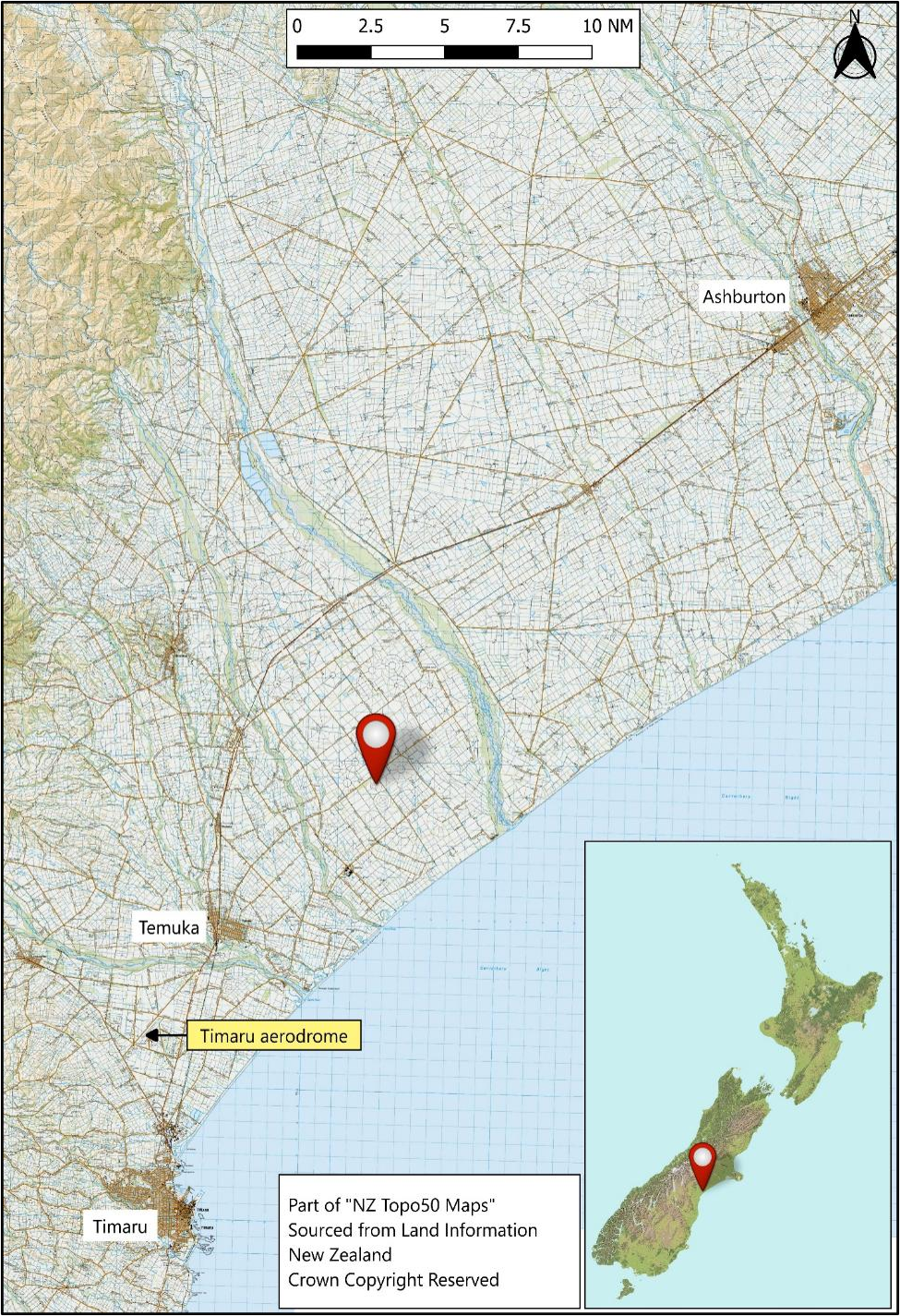
- On Tuesday 13 June 2023, a De Havilland Canada DHC-8-311 (Q300) aeroplane ZK‑NEM, operated by Air New Zealand, was flown below the minimum safe altitude at night while conducting an instrument approach procedure into Timaru. On board were 33 passengers and three crew, consisting of two pilots and one flight attendant.
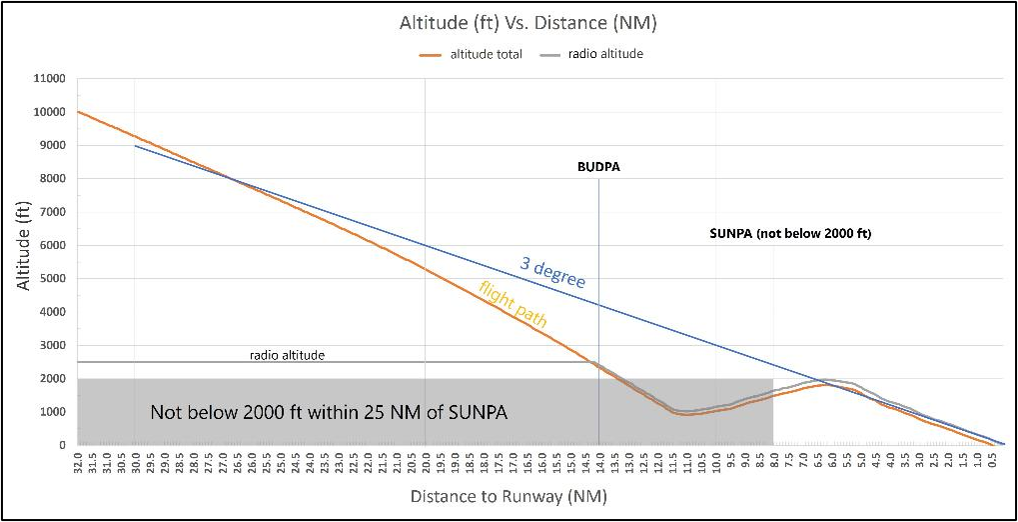
- The departure from the planned descent profile occurred when the aeroplane was descending through 8000 feet (ft) and around 27 nautical miles (NM) from the Timaru aerodrome. As the descent continued, the flight path continued to deviate until the aeroplane was approximately 2500 ft below the flight path that was programmed by the crew. At this point, the aeroplane was approximately 11 NM from the runway and within an area where the minimum safe altitude was 2000 ft. The aeroplane continued to descend to a lowest recorded altitude of 1156 ft (1022 ft above ground level).
- Had the captain not taken corrective action, the Enhanced Ground Proximity Warning System would have sounded to alert the crew to their situation.
- Upon realising that they were not at the correct altitude in relation to the airport, the captain initiated a level-off and then a gradual climb back to 2000 ft to regain the flight profile before continuing the approach. The aeroplane landed uneventfully with no damage or injuries.
Why it happened
- The flight crew had become fixated on visual acquisition of the Timaru aerodrome lights. The preoccupation with sighting the lights led to degraded instrument scanning and a lack of appropriate flight path monitoring by both flight crew members. Because of this, they were unaware that the aeroplane was descending at a higher rate than usual. While an error was made by the flight crew, the Commission identified multiple systemic factors that contributed to this event.
- The captain changed the aeroplane’s descent mode to complete the altimetry setting procedure through transition altitude. Without an explicit prompt to reselect the intended mode required for the descent, the change back relied on pilot memory and was overlooked. Had either of the flight crew members been effectively monitoring and cross-checking the aeroplane’s profile, it is very likely that the flight mode error would have been discovered and corrected before the vertical deviation from the intended flight path became as significant as it did.
- Crew resource management within the cockpit was not effective; this very likely contributed to the length of time that the error remained unnoticed by the flight crew and influenced the recovery action taken. The Commission found deficiencies in Air New Zealand’s training and oversight of pilots with comparatively less multi-crew experience, as well as differences in safety culture between the Q300 fleet and other Air New Zealand fleets.
- Air New Zealand’s response to six previous incidents involving flight path deviations that had taken place before the incident at Timaru did not adequately address the risks associated with the operation of the Q300 fleet. It is very likely that the timeframe in which Air Nelson and Mount Cook airlines were brought onto Air New Zealand’s operating certificate, and the subsequent impact of Covid-19, affected Air New Zealand’s ability to appropriately recognise and address the differences in organisational culture within the Q300 fleet.
- The Commission considered that the regulatory oversight of Air New Zealand by the Civil Aviation Authority of New Zealand (CAA) was not effective in responding to issues with the Q300 fleet. A higher level of regulatory surveillance was warranted, particularly given the recent changes the operator had undergone. The manner of the CAA’s approval of the regional airline fleets onto Air New Zealand’s operating certificate in 2019, deficiencies with recertification, and an inability to accurately assess the performance of the operator’s safety management system all indicated that regulatory oversight of the operator was not effective.
- The Commission found that the way in which both the integration and the subsequent Air Operator Certificate recertification were conducted, and evidence collected from CAA staff tasked with overseeing Air New Zealand, indicated a regulatory relationship that was too close in nature. It is likely this impeded the regulator’s ability to impartially oversee Air New Zealand’s safety management system.
What we can learn
- Procedures or actions that rely on memory are vulnerable to human error. Engineering solutions, where available, provide more robust defences against risk and should be prioritised wherever possible.
- Task fixation is a risk to flight crew, particularly when alertness levels are low. The ability for pilots to access and utilise their crew resource management knowledge is an important risk control to guard against the consequences of preoccupation, such as not monitoring an aircraft’s flight profile.
- When a non-normal situation arises late in the approach, executing a go-around provides an opportunity for flight crew to re-establish their situational awareness and confirm that the aircraft is appropriately configured for landing.
- Time and effort are required to align differences in safety culture between fleets.
- Proactive risk management is a core tenet of safety management. Central to this is the ability to identify and address hazardous patterns that can be indicative of precursor events, before they lead to a serious incident or accident.
- Performance-based regulation differs from traditional prescriptive or compliance-based regulation. The ability of a regulator to accurately assess the performance of an operator’s safety management system can be challenging within a complex sociotechnical environment (sociotechnical relates to an interconnectedness of humans and technology within a system. Complex systems have multiple individual, but interrelated, components that interact. Within complex systems, safety is considered to be an emergent property of the system as a whole, not the result of individual components acting in isolation) such as aviation.
- Regulatory bodies should remain attentive to signs of regulatory capture within the industry they are responsible for overseeing. Suitable protections should be in place to guard against the risk of undue organisational influence.
Who may benefit
- Pilots, operators, organisations that are integrating functions that have safety-critical roles and regulatory agencies may all benefit from the findings and recommendations in this report.
Factual information Pārongo pono
Narrative
- At 1805 on Tuesday 13 June 2023, ZK-NEM, a De Havilland Canada DHC-8-311 aeroplane (the aeroplane) operated by Air New Zealand (the operator) as flight NZ8199, departed Wellington on a scheduled flight to Timaru. On board were 33 passengers and three crew, consisting of two pilots and one flight attendant. The captain was the pilot flying (the pilot responsible for controlling the aeroplane) and the first officer was performing the duties of pilot monitoring (the pilot responsible for monitoring the flight management and the aeroplane control actions of the pilot flying and carrying out support duties such as radio communications and checklist reading).
- The flight to Timaru was the final sector of a four-sector duty for the captain and a five-sector duty for the first officer. The two pilots had operated together from New Plymouth to Auckland, and then to Gisborne and Wellington before departing to Timaru. The departure, climb and cruise phases of the flight were uneventful.
- Prior to leaving the cruise altitude of FL180 (within New Zealand, altitudes above 13,000 ft are reported as flight levels (FLs). FL180 represents approximately 18,000 ft above mean sea level (AMSL)), the flight crew prepared for arrival into Timaru. This included programming the RNAV (RNAV (aRea NAVigation). See Glossary for further explanation) arrival for runway 20 into the on-board flight management system (FMS) (an integrated navigation, performance and aeroplane operation computer that supports a variety of in-flight tasks, reducing the workload for the crew).
- At 1846, air traffic control (ATC) instructed the crew, ‘When ready, descend 11,000 feet, Canterbury QNH 1021.’ (the pressure to be set on the subscale of the altimeter so that the instrument indicates aeroplane height above sea level). In preparation for the descent, the first officer wound the altitude alerter (see paragraphs 2.44 and 2.48 for description and use of the altitude alerter) to 11,000 feet (ft) (all altitudes are above mean sea level (AMSL) unless otherwise stated).
- At about 1855, ATC cleared the aeroplane to leave controlled airspace via waypoints ELDAK and SUNPA (waypoints are positions, used for navigation, defined by latitude and longitude coordinates. ELDAK and SUNPA are waypoints used on the RNAV approach to Timaru). Given that the autopilot was engaged in vertical navigation (VNAV) mode and there were no further altitude restrictions, the captain set the altitude alerter to 400 ft. At 1856 the aeroplane commenced descent toward Timaru (when operating in VNAV mode, the aircraft will automatically begin the descent when it intercepts the precalculated approach profile from its current cruising altitude).
- Approximately two minutes after leaving FL180, the aeroplane reached the transition level (the altitude on descent at which an aeroplane’s reference pressure datum on the altimeters is required to be changed from 1013 hPa to the local area or aerodrome pressure (QNH). Transition level is FL150 (approximately 15,000 ft) in New Zealand. See Glossary for further explanation). At this point the captain engaged the Vertical Speed (V/S) function of the autopilot flight director system (see paragraph 2.37 for description of Vertical Speed mode). The subscales on all three altimeters were then changed from 1013 hectopascals (hPa) to 1021 hPa and the approach checklist was executed.
- At 1901, the aircraft passed overhead ELDAK waypoint at approximately 11,000 ft. It was around this time that the captain, who was familiar with flying over the South Island at night, visually identified the city lights of Timaru and pointed these out to the first officer. Shortly after that, the first officer informed the captain that they could see the precision approach path indicators (PAPI) (Precision Approach Path Indicators (PAPI) is a type of lighting system that provides visual information to the pilot as to whether the aeroplane is above, below or on the correct approach profile) and aerodrome beacon.
- At approximately 7000 ft, the captain reduced thrust in order to slow the aeroplane to 160 knots indicated airspeed (KIAS). The captain had not yet identified the runway lights, PAPI or aerodrome beacon. The first officer attempted to point out the PAPI to the captain, but the captain was unable to positively identify them.
- The captain, who was having difficulty slowing the aeroplane, questioned whether there was a tailwind affecting their approach speed. At approximately 3500 ft, they instructed the first officer to increase the propeller revolutions per minute (RPM) to slow the aeroplane down, as the speed was still about 170 KIAS. The captain also asked the first officer to confirm that the runway lights were on. As Timaru aerodrome is an unattended airfield with no ATC, the first officer contacted the operator’s Timaru ground staff who stated that the runway lights were on and at full intensity.
- While the first officer informed the captain that they could still see the PAPI, the captain was becoming increasingly concerned that they did not yet have any visual reference to Timaru aerodrome. The captain continued the approach and selected the landing gear down at approximately 1500 ft. At this point the aeroplane was crossing waypoint BUDPA, approximately 14 NM from Timaru aerodrome and 6 NM from waypoint SUNPA (see Figure 3).
- The RNAV approach for runway 20 contained minimum altitudes that had to be adhered to in order to ensure that the aeroplane remained at a safe distance from surrounding terrain (see Aerodrome information, paragraph 2.56). While the minimum safe altitude (MSA) (the lowest altitude, rounded up to the nearest 100 ft, that provides the terrain clearance required by Civil Aviation Rules (CARs) 91.423) on the direct track between ELDAK and Timaru was 1600 ft, the minimum initial approach altitude was 2000 ft. The clearance issued by Christchurch Control (the air traffic control for that area) meant that NZ8199 could deviate from its flight plan track to commence the approach. However, in doing so the aircraft needed to remain above 2000 ft within 25 NM of waypoint SUNPA (Aeronautical Information Publication New Zealand ENR 1.5 (4.4 Minimum Initial Approach Altitude)).
- Within a few seconds of the landing gear being lowered, the captain commented to the first officer that the aeroplane appeared low in relation to their distance from Timaru and requested a reference height check. Before the first officer could respond, the captain checked the aeroplane’s lateral position on the electronic horizontal situation indicator (EHSI) (a map display. See paragraph 2.42 for an explanation of the EHSI) and realised that the aeroplane still had approximately 3.5 NM to run before crossing waypoint SUNPA. The captain immediately realised the aeroplane must have descended below the VNAV profile. A check of the advisory display unit confirmed that the aeroplane was not in VNAV mode but descending in V/S mode at a rate of 1400 feet per minute (ft/min).
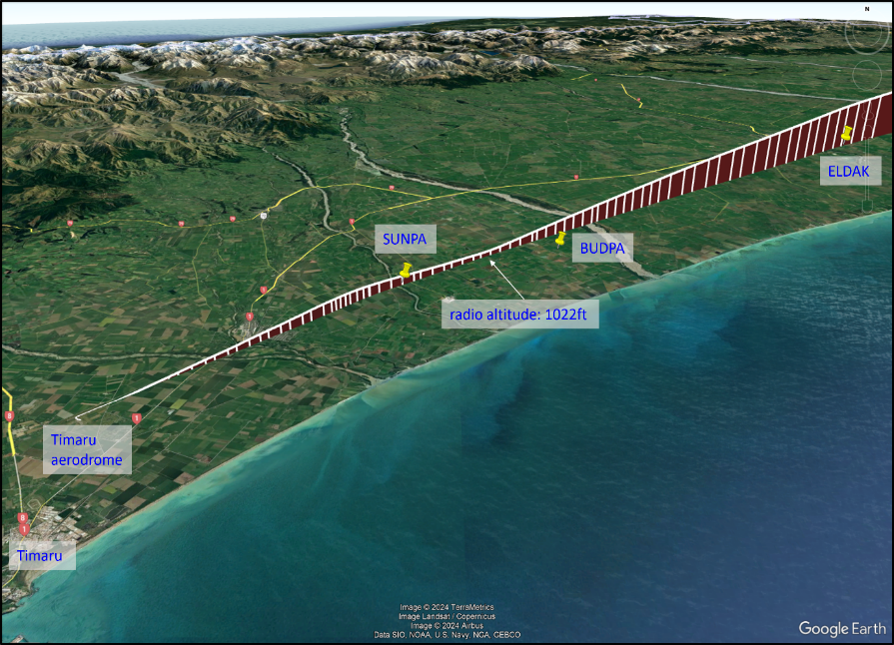
- Upon realising that they were below the approach profile (at this point close to 2500 ft below), the captain levelled the aeroplane. Information from the flight data recorder (FDR) shows that the autopilot was disconnected at 1908:14 and approximately two seconds later engine torque increased. The aeroplane continued to descend to a lowest recorded altitude of 1156 ft (1022 ft above ground level) and then began a gentle climb. As the aeroplane was climbing, the captain sighted the PAPI and elected to continue the approach.
- During the climb to re-establish the correct descent profile, the aeroplane crossed SUNPA at an altitude of 1668 ft (see Figure 4). The captain continued the climb to 2000 ft, where the correct profile was regained, and proceeded to land without incident, touching down at 1913.
Post-incident details
- At 1941, the captain submitted an internal safety report using the operator’s electronic portal. The captain described the aeroplane as being ‘in V/S mode, at 1400 ft/min and about 2–300 ft below the minimum altitude at SUNPA, whilst still being
1–2 NM north of SUNPA.’ - The cockpit voice recorder (CVR) circuit breaker was not isolated (to remove the power supply to the CVR to retain the data stored up to that point for evaluation) by the flight crew.
- Once at the crew accommodation, the captain phoned a Q300 fleet safety officer who advised them to contact the rostered duty pilot to discuss the incident. The result of that phone call was a decision that the crew were deemed fit to operate their duty the following day, provided that they felt adequately rested for their early start.
- The crew departed Timaru early the next morning, 14 June 2023. The captain flew a four-sector day, and the first officer flew a three-sector day.
- The internal safety report was reviewed by the operator’s Operational Safety team on 14 June 2023. One of the investigators emailed the captain with a request to speak with them about the incident. Following a phone call with the captain, the investigator recognised that the aeroplane may have been lower than the initial impression they had. This resulted in the investigator requesting that the flight data be prioritised for analysis.
- Once the flight data had been processed and reviewed, both pilots were stood down from duties on 15 June 2023, and an internal safety investigation was initiated.
- The Civil Aviation Authority (CAA) was notified of the incident at around 0600 on 16 June 2023. The CAA subsequently notified the Commission at around 1030 the same day.
Personnel information
Captain
- The captain held an airline transport pilot licence (aeroplane) and a current class 1 medical certificate. The captain had joined the operator as a first officer in February 2018 before upgrading to captain in January 2023. At the time of the incident, the captain had accrued 4598 hours total flying time, 870 hours instrument flying and 2277 hours on the aircraft type.
- The captain’s most recent flight check (a flight check with an approved flight examiner) was their command upgrade flight test on 19 January 2023. The captain had flown 107 hours in the preceding 90 days. In the week leading up to the incident flight, the captain’s rostered duties were as follows:
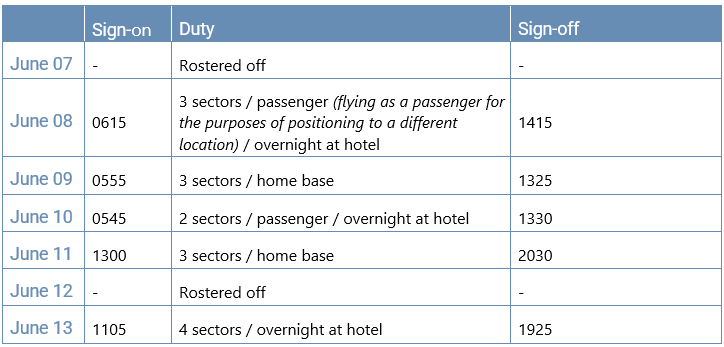
- In the 72 hours before the incident flight, the captain had three periods of sleep, totalling approximately 25 hours. The night before the incident flight the captain reported sleeping approximately 8.5 hours, although the sleep quality was broken and described as ‘average’. At the time of the incident, the captain had been awake for around 12.5 hours.
First officer
- The first officer held a commercial pilot licence (aeroplane) and a current class 1 medical certificate. They had joined the operator in November 2019 and were approximately one week away from completing their check-to-line (a flight check with an approved flight examiner) when Covid-19 disrupted the airline and they were furloughed until September 2021. They subsequently completed the full training syllabus again before being check-to-line in March 2022. At the time of the incident, the first officer had accrued 2630 hours total flying time, 600 hours instrument flying and 640 hours on the aircraft type.
- The first officer’s most recent check was a simulator session on 20–21 March 2023. They had flown 63 hours in the preceding 90 days and had had several weeks off work, requiring a return-to-line flight with a training captain (leave in excess of 35 days requires a pilot to be rostered for a recurrency simulator session or fly two sectors with a training captain). In the week leading up to the incident flight, the first officer’s rostered duties were as follows:
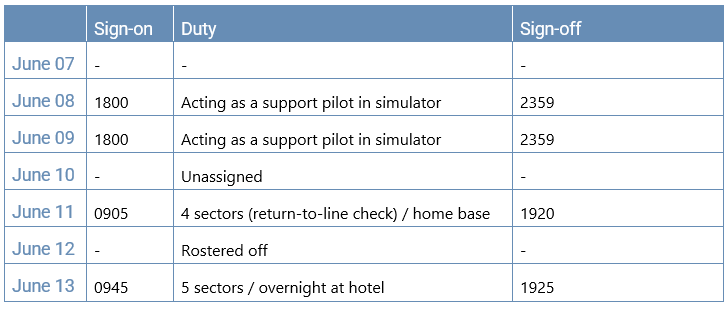
- In the 72 hours before the incident flight, the first officer had three periods of sleep, totalling approximately 25.5 hours. The night before the incident flight the first officer reported sleeping approximately 8.5 hours and described the quality of sleep as ‘good’. At the time of the incident, the first officer had been awake for around 12 hours.
Aircraft information
- ZK-NEM was a DHC-8-311 twin-engine turboprop aeroplane manufactured by De Havilland Aircraft of Canada (DHC). This aircraft is operated by two pilots and has a seating capacity of 50. Within the family of ‘Dash-8’ aeroplanes, this model is referred to as the Q300 (in 1992 the company was purchased by Bombardier. The Dash-8 series in production were the -100, -200, 1ne and -300 series. Bombardier renamed the Dash-8 as the Q300 (for ‘quiet’). Bombardier ceased production of the Q300 in 2009, and in 2018/2019 Longview Aviation Capital bought the Dash-8 and Q400-type certificates and re-established their production under De Havilland Canada Limited (DHC). From this date, all DHC model-type certificates were held by the same company. The manufacturer (type certificated model) is listed as Bombardier on the CAA aircraft register. While the Q300 is now more correctly called the DHC Dash-8, this report refers to the aircraft as a Q300 in keeping with the nomenclature used by Air New Zealand). At the time of the incident, there were 23 Q300 aeroplanes in the operator’s fleet.
- The operator took ownership of the Q300 fleet in November 2019. The previous operator, Air Nelson Limited (Air Nelson), had purchased the 23 Q300 aeroplanes for delivery between 2005 and 2009.
Flight management system
- Upon delivery to Air Nelson, each Q300 aeroplane had provision for a dual FMS but only one was necessary to meet the navigation requirements at the time: a UNS-1E manufactured by Universal Avionics.
- With the introduction of required navigation performance (RNP) operations (a type of performance-based navigation (PBN) that utilises satellite technology and allows aircraft to fly routes along virtual waypoints as opposed to ground-based navigation aids) within New Zealand, it became necessary to install a dual FMS in each Q300 aeroplane. The two options for installation were either to use an existing Supplemental Type Certificate (STC) (type of certificate issued when an applicant has received approval to modify an aeronautical product from its original design. The STC approves not only the modification but also how that modification affects the original design) or to request DHC to design the change for Air Nelson. Air Nelson chose the latter option, and DHC issued a Service Bulletin (SB 8-34-250) with the design change. Air Nelson selected a dual United Avionics model UNS-1Ew with software version SCN 1000.8 as their FMS equipment.
- A DHC avionics support engineer came to New Zealand to assist Air Nelson with the FMS installation, testing and verification flights. During this time, three minor revisions were made to the Service Bulletin to resolve problems the support engineer had discovered, and the final version (D) was effective from 12 June 2013.
- The DHC design solution included an interface device called an air data converter unit (ACU) provided by Universal Avionics. The purpose of the ACU was to convert an analogue barometric-corrected altitude signal from the digital air data computer (DADC) into a digital format suitable for the FMS. The digital signal could then be transmitted to the FMS along with several other digital signals via an ARINC 429 communication bus.
- The FMS could accept two separate altitude signals with configuration options of ‘baro-corrected altitude’, ‘pressure altitude’ or ‘both’. The DHC design solution with the ACU only allowed for one altitude signal connection to the FMS so the configuration instructions selected the baro-corrected altitude signal to match the analogue altitude signal from the DADC.
Vertical navigation – descent modes
- The Q300 has two descent modes that can be used during an approach: VNAV and V/S.
- The VNAV mode of the FMS commands the aeroplane to follow a vertical flight profile in accordance with a preprogrammed flight plan that is entered by the flight crew. Instrument approaches can also be selected from a preprogrammed database. When flown in VNAV mode, the FMS will adhere to the various waypoints, tracks, distances and altitude requirements for that approach. When engaged, the autopilot will take its vertical guidance from the FMS, follow the programmed descent path and not allow the aeroplane to go below any altitude constraints on the approach (minimum altitudes at waypoints on the approach to ensure terrain clearance).
- The V/S mode is more basic. When operating in V/S mode, the aeroplane will descend at a constant rate, regardless of any altitude constraints that may be associated with the approach being flown. If V/S mode is selected while the aircraft is already established in a descent, it will capture the current rate of descent and maintain that figure. The flight crew can also manually adjust the rate of descent.
- To engage V/S, pilots select a button on the flight guidance and control panel located in the centre panel of the glareshield. To engage VNAV, each pilot has a pushbutton switch on their respective sides of the glareshield panel (see Figure 5). See Appendix 1 for the full flight deck layout of the relevant Q300 instrument displays.
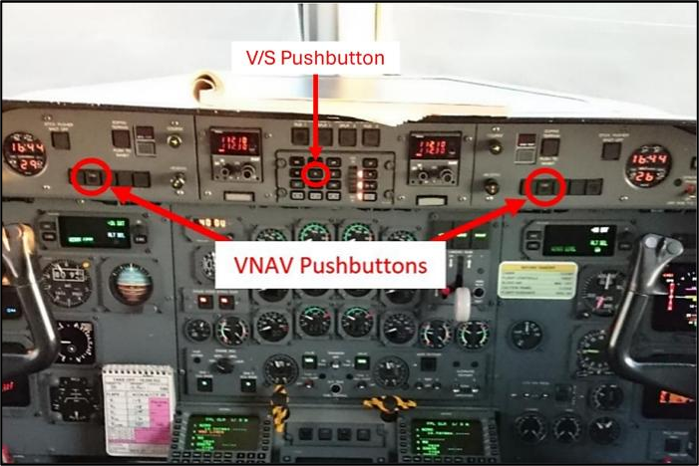
- When pushed, VNAV will be ‘armed’ as indicated by an amber ARM on the pushbutton switch. When the VNAV path is captured, this changes to a green ‘capture’ (CAP) indication. Descent mode indications are also shown on the two advisory display units (ADUs) located on the captain’s and first officer’s instrument panels (see Figure 6).
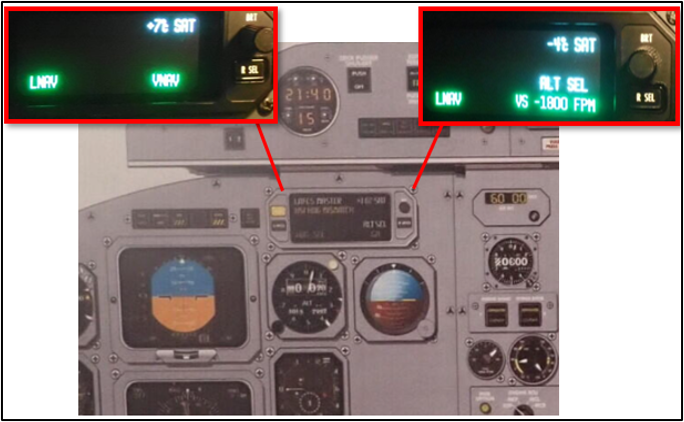
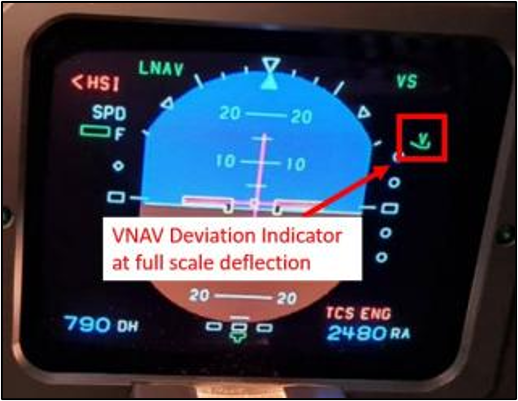
- In addition to the mode annunciations on the ADUs, each pilot’s flight director will display whether VNAV or V/S is engaged. When the FMS is operating in VNAV mode, a vertical deviation annunciator (a green boxed ‘V’ symbol) will indicate whether the aeroplane is above or below profile (see Figure 7).
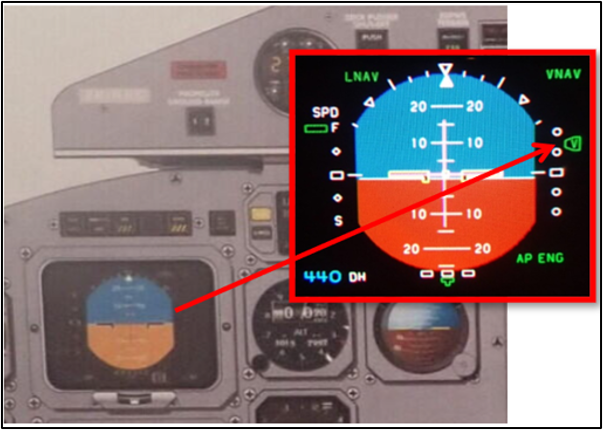
- When the aeroplane is significantly below profile, the vertical deviation annunciator will remain displayed at the maximum scale deflection. However, the box around the ‘V’ symbol is only a half depiction (see Figure 8).
Lateral navigation
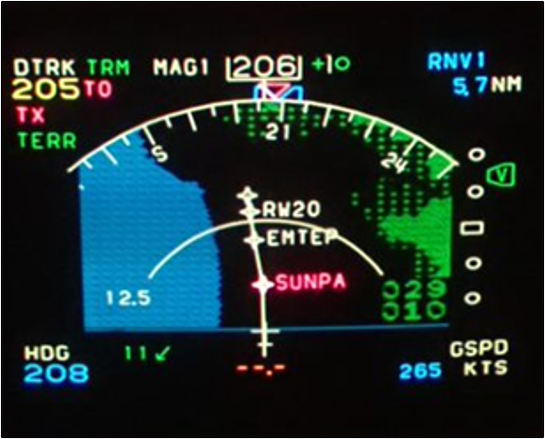
- Two EHSI provide each pilot with horizontal situational information, including distance to run until the next programmed waypoint (see Figure 9). The VNAV path is also shown here by the boxed ‘V’ indication.
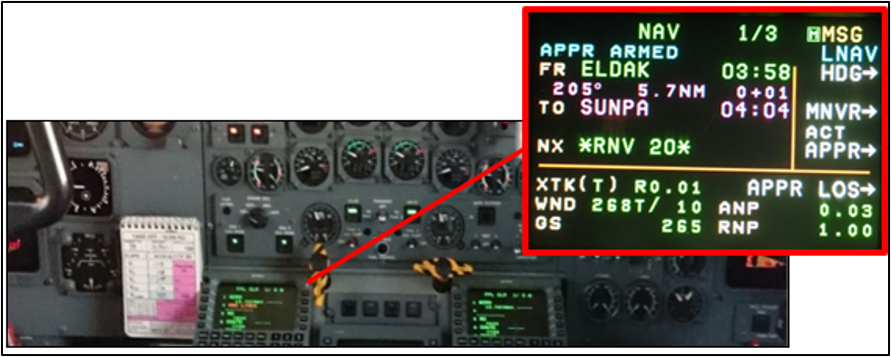
- Two multifunctional control display units (MCDUs) allow each pilot to input the programmed route according to their flight plan into the FMS. The navigation pages of the display indicate distance and time to run until the next waypoint (see Figure 10).
Altitude selector and alerter function
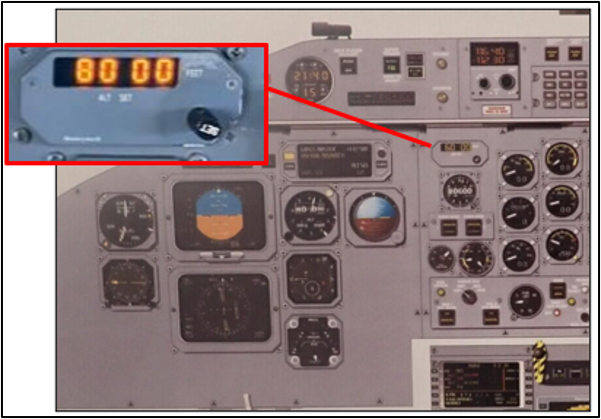
- The altitude selector allows flight crew to programme an altitude which, when engaged, provides an alert that the aeroplane is nearing the selected altitude. The aeroplane will not automatically level off at a programmed altitude unless the autopilot is engaged and the ‘ALT SEL’ (altitude select) button has also been pushed. The altitude selector is positioned near the captain’s-side ADU (see Figure 11).
Operational information
Management of descent through transition altitude
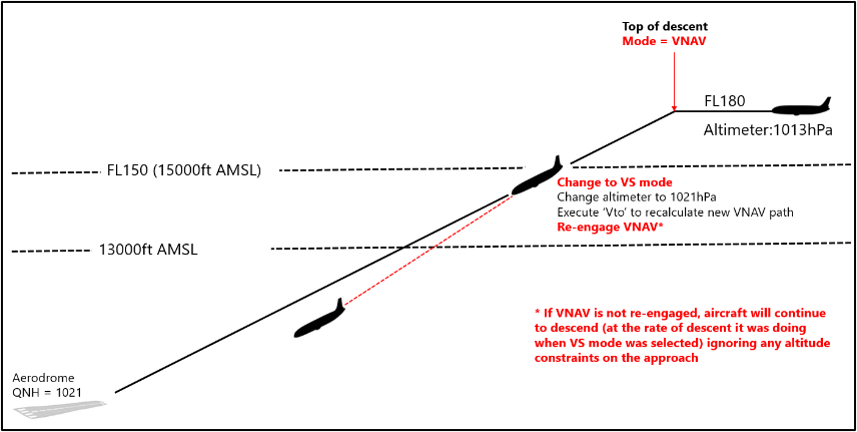
- If the Q300 is in VNAV mode when the flight crew adjusts their altimeter subscales at the transition altitude, the aeroplane will react to this as it changes the altitude the aeroplane ‘thinks’ it is at. For example, if the aeroplane is descending to an aerodrome where the local QNH is 1023 hPa, winding the altimeter subscale from the cruise standard setting of 1013 hPa to 1023 hPa would increase the aeroplane’s indicated altitude, relative to the vertical approach path that the FMS had calculated, by 300 feet (a change of 1 hPa equates to approximately 30 ft of altitude). Changing the QNH, particularly large changes, results in the aeroplane either pitching up or pitching down (depending on whether the local QNH is higher or lower than 1013 hPa) as it hunts for the previously programmed VNAV descent path in the FMS. This can be disconcerting for passengers and can adversely affect the aeroplane’s speed.
- To avoid this occurring during descent, Q300 flight crew would temporarily engage V/S mode while the altimeter subscales were changed through transition. This allowed the aeroplane to remain at its current rate of descent without reacting to the change in altimeter setting. Once the local QNH was set, the crew could then execute a ‘VERTICAL TO’ (Vto) function on the FMS. This action would recalculate the VNAV descent profile from the aircraft’s current position/altitude. VNAV could then be re-engaged without any pitch up or down (see Figure 12).
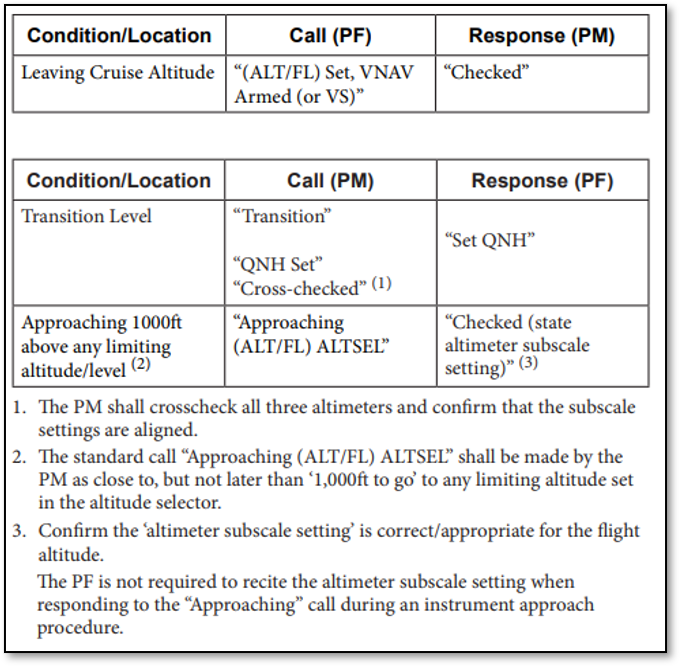
- Standard calls required by the Q300 fleet during descent through transition were prescribed in the standard operating procedures (SOP) (see Figure 13) (Air New Zealand Q300 Standard Operating Procedure 2.7.3 Standard Calls (6 February 2014)).
Use of the altitude alerter system
- The operator’s SOP for the Q300 contained the following instructions for use of the altitude alerter system (Air New Zealand Q300 Standard Operating Procedure 2.6.2 Altitude Alerter System (6 October 2022)):
The altitude select-and-alert system is to be used throughout the flight.
- Departure/Climb/Cruise/Descent: Upon receipt of clearance, set the altitude alerter to the clearance limit. For a conditional altitude clearance, reset the altitude alerter once the conditions have been satisfied.
- Descent using V/S or VNAV mode: For descent via DME or TAA steps, set step altitude or cleared altitude, whichever the higher. For distance-step procedures using ground based NAVAIDs, the DME defining steps shall be tuned, identified and displayed.
-
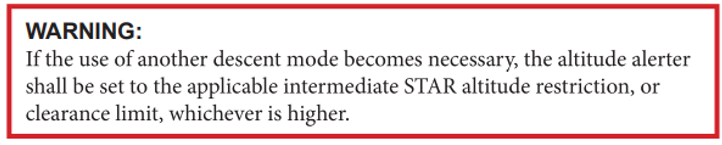
Descent on an RNAV/RNP STAR in VNAV mode: Set the altitude alerter to the ATC clearance limit. Intermediate RNAV/RNP STAR altitude restrictions need not be set in the altitude alerter providing VNAV is annunciated and the aircraft remains on the STAR.
-
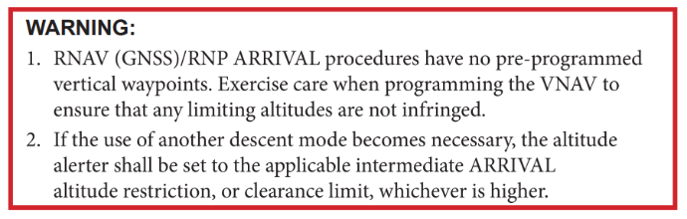
Descent on an RNAV (GNSS)/RNP ARRIVAL in VNAV mode: For RNAV(GNSS)/RNP ARRIVAL procedures, set step altitude, or cleared altitude, whichever is higher. For RNAV (GNSS)/RNP ARRIVAL procedures with manually programmed vertical waypoints, set the altitude alerter to the ATC clearance limit.
- Visual Approach: If no ATC clearance limit exists, the alerter may be set at pilots’ discretion.
- Instrument Approach: When cleared for the approach, and assured that no limiting altitudes will be infringed; set the alerter to MDA, DA (Q300 – do not select ALTSEL when setting MDA/DA).
- Missed approach: When 1000ft above MDA/DA, set the altitude alerter to the missed approach altitude. To assist with workload management this action may be completed prior to 1000ft above MDA/DA if necessary. (Q300 – do not select ALTSEL when setting missed approach altitude).
Monitoring philosophy
-
The Q300 SOP contained the following information regarding the operator’s expectations of crew as part of their flight deck management (Air New Zealand Q300 Standard Operating Procedure 2.1.1. Monitoring Philosophy (7 February 2013)):
To ensure the highest levels of safety, each crew member must effectively monitor and cross-check aircraft performance (flight path and systems) and the performance of all crew members.
Any crew member observing a deviation from expected aircraft or crew performance must challenge the other crew members to ensure the situation is resolved.
Inadequate monitoring occurs not only during periods of high workload, but also during low-workload periods, when complacency and boredom may affect monitoring performance. It is essential that low probability but highly critical errors are trapped. Effective monitoring, cross-checking and challenging by crew members can break the chain of events that may lead to an aircraft accident and may literally be the last line of defence.
Monitoring is a primary task and core skill of each crew member. All crew members are expected to:
- Recognise threats to effective monitoring (such as all crew members being involved with the same task) and manage accordingly (at least one crew member must always monitor).
- Actively monitor the aircraft during critical phases of flight. This means monitoring performance as if you are hand-flying, even when the auto pilot or other pilot is flying.
- Endeavour to improve monitoring skills through practice.
Use of automation
-
The Q300 SOP contained the following information regarding the operator’s expectations for the use of automation (Air New Zealand Q300 Standard Operating Procedure 2.2.1 Use of Automation (7 February 2013)):
The following activity cycle (VVM principle) allows both pilots to be aware of changes so monitoring and cross-checking can be actively implemented. Make changes and:
- Verbalise: Verbalise the change.
- Verify: Both pilots must visually check the mode, or information before accepting the change.
- Monitor: Both crew members actively monitor the aircraft response to inputs and must be aware of all automatic modes selected at any time. Active monitoring requires a constant and systematic scan of flight deck systems.
-
Additionally, the Q300 Flight Crew Operations Manual stated the following regarding autopilot flight director system procedures (Air New Zealand Q300 Flight Crew Operations Manual Volume 1 Normal Procedures NP.1.3 (4 April 2013)):
The crew must always monitor:
- Airplane course
- Vertical Path
-
Speed
When selecting a value on the FGC, verify that the respective value changes on the flight instruments as applicable. The crew must verify manually selected or automatic AFDS changes. Use the FMA to verify mode changes for the:
- Autopilot
-
Flight director
During LNAV and VNAV operations, verify all changes to the airplane:
- Course
- Vertical path
-
Speed
Announcing changes on the FMA when they occur is good CRM practice.
Stable approach policy
- The Q300 SOP contained a stable approach policy that included information about how the aeroplane should be configured for landing. If certain parameters were not met at preset altitudes, flight crew were required to abandon the approach and perform a go-around (the act of aborting an approach to land; typically followed by a full-powered climb to a higher altitude and either repositioning the aircraft to conduct another approach or diverting to another aerodrome) (see Appendix 2).
-
Of note from the SOP is the following:
A significant number of approach and landing accidents result from unstable approaches. Fixation on completing the landing may tempt the crew to continue an approach beyond the point at which executing a go-around would be the best course of action. A decision to go-around is an indication of good judgement, rather than an admission of poor performance.
Meteorological information
- The flight was operating during night visual conditions. Both pilots described the conditions as dark with no moon, but clear with good visibility and no cloud cover. Given the darkness, there was no terrain definition. However, the flight crew reported that all South Island township lights as far as Invercargill were visible during the cruise.
- Hourly observations indicate that the surface wind at Timaru aerodrome at the time of landing was a light northwesterly. The reported visibility was 20 kilometres, with no cloud detected at any level (provided by MetService New Zealand for the purpose of this inquiry).
Aerodrome information
- Timaru is a certificated (an aerodrome is required to be certificated when it is used for regular international flights or regular air transport involving aeroplanes with a seating capacity greater than 30 passenger) unattended (no air traffic control service provided at the airfield) aerodrome situated 6 NM north of Timaru and 89 ft AMSL. Lighting of the aerodrome consists of a white aerodrome beacon that flashes at 2.5-second (s) intervals, white runway edge lights spaced 60 metres (m) apart, taxiway lights and PAPI. The runway lights can be operated remotely from the aeroplane’s flight deck, or by airport personnel. The PAPI are set for a 3-degree (°) approach profile at a threshold crossing height of 47 ft.
Minimum safe altitudes for the Timaru approach
- To ensure obstacle and terrain clearance during an approach, CAA Rules (CARs Part 91, Rule 91.423) require instrument flight rules (IFR) operations to remain at or above the minimum altitudes specific to the area they are flying in. These altitudes are published in the applicable instrument approach procedures for each aerodrome (see Appendix 3).
- The Terminal Approach Altitude (TAA) provides a minimum safe altitude from an approach reference point that gives a minimum terrain clearance of 1000 ft at the TAA altitude. The applicable TAA for NZ8199 was 2000 ft within a 25 NM radius of waypoint SUNPA.
- The minimum commencement altitude for the RNAV approach for runway 20 was 2000 ft at waypoint SUNPA.
- The minimum descent altitude (MDA) for a Q300 aeroplane on the approach was 480 ft (see Appendix 3). When flying the approach in VNAV (as opposed to LNAV as depicted on the Timaru approach plate) the SOP (Air New Zealand Q300 Standard Operating Procedure 3.7.5 Derived Decision Altitude (6 October 2022)) required crew to add 50 ft to the MDA, giving a ‘derived decision altitude’ of 530 ft. This meant that if the flight was not visual at that altitude, the missed approach procedure (specific heading and altitude instructions to be followed whilst climbing to avoid obstacles and other aircraft) had to be commenced immediately.
Recorded data
- The aeroplane’s FDR was secured by the Commission. The operator provided the Commission with a raw data file of the incident flight that had been downloaded following the incident (unlike other aeroplane types in the operator’s fleet, the Q300 does not have a Quick Access Recorder (QAR) or the ability to download flight parameters via cellular or wireless communication to safety analysts for the purpose of the operator’s flight data monitoring programme. Instead, engineers manually download the flight data on a 5–7-day cycle. Once the operator was aware of the significance of this incident, a prioritised data retrieval was made outside of the normal download cycle, and that information was provided to the Commission). Commission investigators then verified the accuracy of the file using the FDR at the operator’s engineering facility in Nelson.
- The CVR system fitted in the aeroplane was capable of recording two hours of crew communications in a continuous loop format with previous recordings being progressively overwritten by the next two-hour period. Following the incident flight, the CVR in the aeroplane was not isolated and information pertaining to the flight was overwritten.
- At the Commission’s request, Airways New Zealand provided for analysis recorded surveillance data compiled from Secondary Surveillance Radar (SSR) and Automatic Dependent Surveillance-Broadcast (ADS-B) flight tracking data and audio recordings.
Other occurrences
Previous occurrences – other operators
- On 9 June 1995, a DHC-8 aeroplane operated by Ansett New Zealand had a controlled flight into terrain (CFIT) accident while on approach to Palmerston North. One crew member and three passengers lost their lives, and two crew members and 12 passengers were seriously injured. The Commission’s inquiry identified that the aeroplane had inadvertently been allowed to descend below its instrument approach profile while the crew were attending to an undercarriage malfunction (Transport Accident Investigation Commission, 1997). Safety issues identified included:
- deficiencies in flight path monitoring
- use of the altitude alerter as a protection
- the inability for crew to utilise their crew resource management (CRM) training
- crew decision-making regarding continuation of the approach
- reduced crew experience levels due to expansion of the operator
- capability of the airline’s safety department
- CAA oversight with respect to flight operations auditing.
- On 26 April 2019, the crew of an Air Nelson-operated Q300 intentionally selected V/S mode to facilitate an anticipated visual approach (whereby an IFR flight can proceed clear of cloud using visual references to navigate) into Nelson. However, while in V/S mode, the aeroplane descended below a programmed arrival altitude restriction during the daytime approach. The aeroplane was flying in clear conditions, and the crew continued the approach to land.
Previous occurrences – Air New Zealand
- As part of the current investigation, the Commission obtained information about other incidents that, while having different causes and circumstances, involved Air New Zealand-operated aeroplanes deviating from the intended vertical flight path on approach to landing (taken from a 5-year CAA data set and 2-year Air New Zealand data set):
- On 20 June 2020, a Q300 was on approach to Rotorua in instrument meteorological conditions (IMC) (weather conditions where pilots must rely on their flight instruments to navigate because of cloud cover or poor visibility) when the Bay Sector approach controller observed the flight on their radar screen (Bay Sector was no longer controlling the flight as they had previously transferred it to the Rotorua tower controller, and the aeroplane was now operating on a different frequency). The aeroplane was approximately half a mile laterally off track and descended to 3200 ft in an area where the minimum safe altitude was 3900 ft. The approach controller telephoned the Rotorua tower controller to alert them to the situation and ask them to instruct the flight crew to go-around. This instruction was not passed on; however, the tower controller queried the crew about their position and a sharp correction back on track was observed. The flight continued to land. The flight crew had programmed the approach to be used in the FMS but had not selected VNAV and the aircraft was descending in V/S mode.
- On 27 December 2021, a Q300 was descending into Nelson in clear daylight conditions. The crew were utilising V/S mode for their initial descent but, following a clearance from ATC for a standardised arrival, set their altitude alerter to the segment MSA. As the aeroplane was still in V/S mode it did not adhere to the FMS’s altitude restrictions pertaining to the crew’s cleared arrival instructions. The aeroplane descended to 7300 ft at a point on the approach path where 8000 ft was the minimum segment altitude requirement.
- On 12 June 2022, the crew of a Q300 elected to descend to Nelson initially in V/S mode in order to achieve an ATC altitude instruction, but they subsequently forgot to select VNAV for the approach sequence. The aeroplane was in IMC at the time. As they turned the aircraft onto final approach, the crew became aware that the aircraft was below profile. The captain levelled the aeroplane and regained the glideslope to continue the approach to land. The flight crew later reported that the aeroplane had possibly breached some programmed altitude restrictions for the approach whilst in V/S mode. The operator stated that their review of the flight data showed there had been no breaches of altitude restrictions.
- On 13 July 2022, a Q300 was on approach to Rotorua in IMC conditions. The flight crew had forgotten to change the FMS mode back to VNAV following transition, and the aeroplane was descending in V/S at 1500 ft/min. The crew were unaware that they had descended below profile: the aeroplane descended to 2800 ft where the minimum safe altitude was 3400 ft. The Rotorua tower air traffic controller received a minimum safe altitude warning (MSAW) (a ground-based system that provides an audible warning to an air traffic controller when an aircraft under their control is detected or predicted to be lower than the defined minimum safe altitude for the sector in which the aircraft is operating) alert that the aeroplane was low on approach, and the flight crew received an Enhanced Ground Proximity Warning System (EGPWS) (an aircraft system that provides alerts and warnings to pilots if an aeroplane’s trajectory is predicted to become too close to terrain) ‘terrain’ warning. At around the same time, the aeroplane became visual and upon realising their situation the flight crew continued to land.
- On 16 August 2022, a Q300 was on approach to Tauranga at night. The crew forgot to select VNAV and remained in V/S mode. The aeroplane descended to 2800 ft in an area where the minimum safe altitude was 3200 ft. The air traffic controller informed the flight crew of the situation, and the crew initiated a climb to regain the correct profile and then proceeded to land.
- On 6 March 2023, a Q300 was on descent to Gisborne in day visual conditions. The aeroplane was in V/S mode and descended below the intended vertical flight path. As they were just about to breach the minimum approach commencement altitude, the pilot monitoring alerted the pilot flying of the situation. The flight crew levelled the aircraft, regained the vertical profile and continued the approach to land.
Occurrences after the opening of this inquiry
- On 27 July 2023, the CAA notified the Commission of the following incident:
- On 21 July 2023, one of the operator’s Q300s was on approach to Nelson in visual meteorological conditions. As the aeroplane descended through 200 ft, it encountered windshear (a sudden change in wind velocity and/or direction over a short distance. This can cause a loss of airspeed and/or altitude and needs to be responded to immediately, particularly if the aeroplane is in close proximity to the ground) and the EGPWS ‘sink rate’ warning sounded. The captain counteracted the sink with an increase in power and continued to land the aircraft. Information from the FDR shows that the aeroplane had descended to an altitude of 45 ft above ground level while still approximately 280 m short of the runway threshold.
- On 7 December 2023, the operator notified the Commission of the following incident:
- On 4 December 2023, a Q300 was on approach to New Plymouth in IMC. The aeroplane broke clear of cloud at approximately 400 ft, at which point the flight crew observed that the PAPI were indicating four red lights (four red is interpreted as ‘too low ’or ‘well below’ the correct approach profile). The flight crew elected to adjust their flight profile and continue the approach to land.
- The initial safety issue identified in the Timaru investigation of Q300s deviating from the intended vertical flight path, and not using the recovery action of the go-around, was also noted in the two events above. This led to the Commission issuing an urgent safety recommendation to the CAA on 21 February 2024 regarding the operator’s Q300 fleet (see Section 5).
Organisational information
- Air New Zealand Limited operated a mixed fleet of jet and turboprop aeroplanes. Prior to December 2019, Air New Zealand and its regional airline subsidiaries, Air Nelson and Mount Cook, operated under separate Civil Aviation Rules (CARs) Part 119 Air Operator Certificates (AOC). From a regulatory perspective, this meant that while the Q300 and ATR turboprop aeroplanes shared the same company branding as the jets, they were regarded as owned by individual entities, with each organisation holding their own AOC and senior person appointees and being treated as separate airlines by the CAA.
- Before 2019, Air New Zealand had begun the process of aligning its regional airlines to integrate with Air New Zealand (the Regional Airports teams had aligned in 2016, and Air New Zealand provided other services to the regional airlines such as human resources, marketing, and sales functions). In 2019, a request was made to, and granted by, the CAA to absorb Mount Cook and Air Nelson into Air New Zealand’s operating certificate. Mount Cook operated ATR aircraft and Air Nelson operated Q300 aircraft. From a regulatory perspective, this effectively meant that Mount Cook and Air Nelson would cease to exist; their AOCs would be revoked, and the ATR and Q300 aircraft fleets would be incorporated onto Air New Zealand’s CARs Part 119 AOC.
Crew resource management (CRM) and human factors (HF) training
- The operator’s CRM/HF training programme for Q300 pilots was conducted in four parts:
- Introduction course (one day) – completed as part of the pilot’s initial aircraft technical course
- Awareness course (two days) – completed within the first year of line flying
- Refresher training (90 minutes) – conducted annually
- Upgrade course (one day) – completed as part of command upgrade training
- Training covered the typical human factors topics required for airlines operating under CARs Part 121 and detailed in CAA advisory circular AC121-4 (Civil Aviation Authority of New Zealand, 2013, December). These included information processing, situational awareness, leadership and teamwork, decision-making, communication, threat and error management, stress and fatigue, social influences, and just culture.
- The ability for pilots to operationalise their CRM/HF knowledge is also assessed during simulator and line training exercises. Non-technical skills are core components of flight training and checking. Pilots are graded on their non-technical skills ability, and poor scores against behavioural markers (application of procedures, communication, flight path management – automation, flight path management – manual, knowledge, leadership and teamwork, problem solving and decision-making, situational awareness, and workload management) can lead to failing a check, even if the aeroplane is flown within technical tolerances.
Safety management system (SMS)
-
CARs Part 100 Safety Management was introduced in 2016 to reflect the requirements of the International Civil Aviation Organization (ICAO) Annex 19 Safety Management. The objective of Part 100 was to:
improve New Zealand’s aviation safety performance in a way that embeds an effective safety culture in aviation organisations; and to ensure New Zealand meets its international obligations as a signatory to the Convention on International Civil Aviation (CARs Part 100 Safety Management).
- CARs 100.3 requires an organisation to have an SMS in place for hazard identification and risk management, safety performance targets and measures, safety reporting, safety investigations, safety assurance functions, safety education and safety promotion. Associated documentation to provide assurance that an organisation has appropriate management commitment to and resourcing for safety is also required.
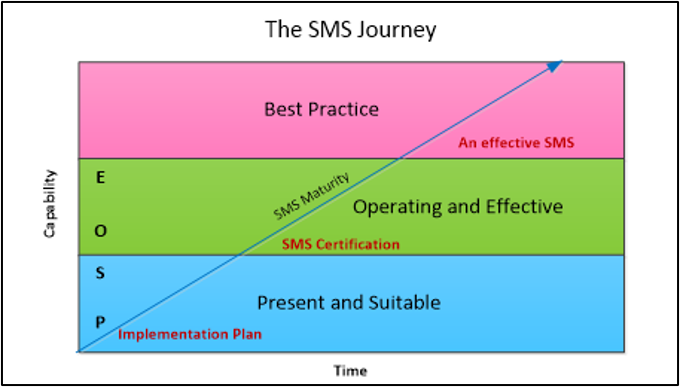
- The operator’s SMS was certified by the CAA in December 2017. Air Nelson and Mount Cook, both still separate airlines at that point, received SMS certification around the same time. On the CAA’s SMS maturity scale (see Figure 14), the operator’s SMS was assessed as ‘present and suitable’ by the CAA. This meant there was evidence that the individual performance indicators were clearly visible and documented within the organisation’s SMS, and that the indicators were suitable based on the size, nature, organisation complexity, and the inherent risk in the activity, including consideration of the industry sector. Mount Cook and Air Nelson were also assessed by CAA as having ‘present and suitable’ SMSs.
Regulatory information
State safety oversight and assurance (the documents referred to in this section, including the State Safety Programme 2018 and the Civil Aviation Act 1990, have since been superseded; however they were current in the lead-up to and time of this incident)
-
The CAA was responsible for promoting the safety and security of the aviation system in accordance with New Zealand’s international obligations (see section 72B(2)(a) and (b) of the Civil Aviation Act 1990 (now repealed but in force at the relevant time). This is also reflected in the State Safety Programme 2018 (signed by the then Director of Civil Aviation), at paragraph 1.2.2. This also has been carried thorough into the Civil Aviation Act 2023 at section 23(a)). As a signatory state to the ICAO, New Zealand had an obligation to comply with the standards set by the ICAO to the highest degree practicable. ICAO Annex 19 required the implementation of a state safety programme that facilitates risk-based regulatory oversight to achieve an Acceptable Level of Safety Performance (ALoSP) in the civil aviation system (International Civil Aviation Organization, 2013). New Zealand’s state safety programme (Civil Aviation Authority of New Zealand, 2018) defined ALoSP as:
i) low and reducing numbers and costs of air accidents, and
ii) no security incidents that compromise safety.
- The CAA’s regulatory priorities were determined by the nature of the operational activity and the potential consequence of an accident. To this end, CAA prioritised regulation of passenger air transport operations above other aviation sectors (Civil Aviation Authority of New Zealand, 2022).
- As outlined in the state safety programme, the Civil Aviation Act 1990 provided a legislative framework that embodied the construct of a shared responsibility between the regulator and aviation participants for safety performance. Regulatory oversight included a combination of both traditional prescriptive-based and risk-based approaches to safety management, including a requirement for aviation participants to have an SMS.
-
Participants’ SMSs required effective regulatory oversight (International Civil Aviation Organization, 2013). To reflect the philosophy of shared responsibility between the regulator and participants, the CAA worked with certified operators and service providers to ensure that the objectives of their SMS aligned with and supported New Zealand’s ALoSP:
Certified service providers’ operating expositions set out their safety goals and practices. These are assessed and approved by the CAA who then conducts regular monitoring and surveillance to ensure expositions are met. Expositions reflect the level of risk in a service provider’s operation as well as the complexity of their organisation, as does CAA’s oversight of that organisation.
It is up to the organisation to determine how they will achieve the agreed safety goals and manage their safety risks, subject to CAA approval and oversight as appropriate. A service provider’s safety goals and practices will also require regular revision and review as goals are achieved or new hazards and risks are identified, and to ensure alignment to safety indicators (International Civil Aviation Organization, 2018).
- In the lead-up to the introduction of SMS, the CAA provided extensive guidance for the aviation industry on how to comply with CARs Part 100. This included dedicated resource within CAA developing a wide range of education material, particularly for smaller organisations regarding scalability. Implementation of the rule was phased, with the operator, Air Nelson and Mount Cook airlines being the first organisations required to implement an SMS towards the end of 2017.
Risk-based regulatory approach
-
A risk-based approach to oversight enables a regulator to prioritise its resources according to the safety risk profile of an organisation and/or sector. ICAO provided the following guidance on safety risk-based surveillance (SRBS):
The foundation of effective safety risk-based surveillance is reliable and meaningful data. Without reliable and meaningful data, it is difficult to defend adjustments to the surveillance scope or frequency.
States should develop or reinforce their data management capabilities to ensure they have reliable and comprehensive data upon which to base their (data-driven) decisions. Individual sector safety risk analyses may also allow the State to evaluate common safety risks that affect multiple service providers with similar types of operations (for example, short-haul airlines) (ibid).
-
The CAA promoted an intelligence-led, risk-based regulatory approach, that relied on a range of data and intelligence sources to inform and assess risk within the civil aviation system:
In recent years the Authority’s regulatory approach has undergone a considerable shift from audits and inspections focused on compliance and individual cases, to a mix of performance and risk-based approaches to regulation, sophisticated risk management, and other regulatory tools…
…Performance and risk-based regulation enable us to target specific risks in the aviation system more effectively. An outcome of targeted intervention is that the number of interventions may decline. For example, more time might be spent monitoring and inspecting those organisations that present as high risk, rather than monitoring and inspecting all operations to determine their compliance with Civil Aviation Rules (Civil Aviation Authority of New Zealand, 2019a).
- At the time of this incident, CAA maintained an internal risk assessment system to support its oversight, whereby certified organisations were assigned a ‘risk score’. Scores could be adjusted by CAA inspectors following surveillance-based activities. The system allowed inspectors to assess an organisation according to categories such as the size and type of operation, as well as recent safety history information pertaining to oversight and investigation activity.
- CAA also developed an initiative entitled Sector Risk Profiles as a way of examining the various underlying influences on safety within a given sector. This was based around capturing the knowledge, experience and perceptions of as many sector participants as possible. The resulting mix of fact and opinion was then combined with evidential data, such as industry studies and demographics, and expressed as a set of risk statements that describe the risk. The profiles for the 13 sectors were not intended to identify all risks, controls and actions, but were a snapshot of what the sector considered important at the time. In 2019, the CAA used this method to determine that the safety and performance of the large aircraft (airline) sector was ‘excellent’, while that of commercial helicopter and private recreational aviation was ‘quite poor’. Risk profiling then informed their regulatory focus and guided operators about where to concentrate their SMS response and resources. (Civil Aviation Authority of New Zealand, 2019b).
-
ICAO provided the following caution regarding SRBS activity:
SRBS comes at a cost. It requires ongoing interactions between the State and the aviation community beyond compliance-based audits and inspections. An SRBS approach uses the safety risk profile of the service provider to adapt its surveillance activities.
Importantly, safety risk-based surveillance may not necessarily reduce the amount of surveillance conducted or the resources; the quality of the surveillance and the quality of the interaction between the regulator and the service provider will, however, improve greatly.
States may wish to develop organizational safety risk profiles that are consistent across each aviation sector to support the process of modifying the scope and frequency of their surveillance activities. Such tools should aim to capture and aggregate information that should already be available for service providers and may include factors such as:
a) the financial health of the organization;
b) number of years in operation;
c) turnover rate of the key personnel such as the accountable executive and safety manager;
d) competence and performance of the accountable executive;
e) competence and performance of the safety manager;
f) results of previous audits;
g) timely and effective resolution of previous findings;
h) measures of relative level of activity (exposure to safety risk);
i) indicators of the relative scope and complexity of the activities being performed;
j) maturity of the hazard identification and safety risk assessment process; and
k) measures of safety performance from State safety data analysis and performance monitoring activities (International Civil Aviation Organization, 2018).
Regulatory guidance on senior persons
- The CAA required all air operators to have a single person identified as the chief executive (accountable executive) who had the authority within the organisation to ensure that all the activities undertaken by the organisation could be financed and carried out in accordance with the requirements and standards of CARs Part 119. With the introduction of SMS, the chief executive also had ultimate accountability for the implementation and effectiveness of the SMS.
-
ICAO guidelines stated the following about an organisation’s accountable executive (Equivalent to the Chief Executive within CAA Rules):
The accountable executive, typically the chief executive officer, is the person who has ultimate authority over the safe operation of the organization. The accountable executive establishes and promotes the safety policy and safety objectives that instil safety as a core organisational value. They should: have the authority to make decisions on behalf of the organisation, have control of resources, both financial and human, be responsible for ensuring appropriate actions are taken to address safety issues and risks, and they should be responsible for responding to accidents and incidents.
There might be challenges for the service provider to identify the most appropriate person to be the accountable executive, especially in large complex organisations with multiple entities and multiple certificates, authorizations or approvals. It is important that the person selected is organizationally situated at the highest level of the organisation, thus ensuring the right strategic safety decisions are made…
…In cases where an SMS applies to several different certificates, authorizations or approvals that are all part of the same legal entity, there should be a single accountable executive. Where this is not possible, individual accountable executives should be identified for each organisational certificate, authorization or approval and clear lines of accountability defined; it is also important to identify how their safety accountabilities will be coordinated (International Civil Aviation Organization, 2018).
- The CAA also required air operators to have senior persons in place to provide safety assurance for certain functions (an organisation cannot become the holder of a certificate without senior persons in place or continue to carry out its planned activities if a senior person position remains vacant). Senior persons manage all the functions associated with the operation and foster the safety culture of the organisation. They exercise an appropriate level of control, direction and responsibility to ensure the continued safety and effective running of the varying operations.
- The operator had senior person positions for: air operations, supporting ground operations, training and competency assessment, the control and scheduling of maintenance activity, the system for safety management, air operator security, and conducting occurrence investigations under CARs Part 12.
-
CAR Part 119.101(b) stated the following regarding overlaps of senior person responsibilities:
1. Unless otherwise acceptable to the Director as a consequence of the size and expected scope of the applicant’s organisation, each [senior person] be responsible for no more than one of the following functions:
i. air operations including the flight operations and supporting ground operations
ii. crew training and competency assessment
iii. the control and scheduling of maintenance
iv. the system required for safety management required under rule 119.124
v. conducting occurrence investigations in accordance with part 12
The exception to this is that the senior person for training and competency assessment may be assumed by the senior person for air operations.
-
In relation to potential conflicts of interest between senior person portfolios, ICAO noted the following:
In most organisations, an individual is appointed as the safety manager. Depending on the size, nature and complexity of the organization, the safety manager role may be an exclusive function or it may be combined with other duties. Moreover, some organizations may need to allocate the role to a group of persons. The organization must ensure that the option chosen does not result in any conflicts of interest. Where possible the safety manager should not be directly involved in the product or service delivery but should have a working knowledge of these. The appointment should also consider potential conflicts of interest with other tasks and functions. Such conflicts of interest could include:
a. Competition for funding (e.g. financial manager being the safety manager);
b. Conflicting priorities for resources; and
c. Where the safety manager has an operational role and the ability to assess the SMS effectiveness of the operational activities the safety manager is involved in. (International Civil Aviation Organization, 2018).
Analysis Tātaritanga
Introduction
- Any aircraft descending significantly below its approach profile has an increased likelihood of a controlled flight into terrain (CFIT) accident, particularly at night when the aeroplane is below the minimum safe altitude and the crew is unaware of their position. If the pilots do not respond promptly and appropriately, the margin of safety reduces even further. The EGPWS provides the last line of defence. Understanding how a flight came to be below the minimum safe altitude on approach during a scheduled passenger air transport operation is the focus of this inquiry.
- Commercial aviation is one of the safest modes of public transportation because there are multiple safety barriers acting as layers of defence and protection within its system. Airlines are heavily regulated and aeroplanes are generally equipped with sophisticated technology. Flight crew are licensed and must continue to undergo training and pass examinations throughout their careers. Therefore, when an incident such as this occurs on a commercial passenger flight, it means that multiple layers of defence have failed.
- The Commission’s purpose of avoiding similar accidents and incidents in the future is achieved by making findings and recommendations to improve future transport safety. The error made by the flight crew could have been foreseen as it was known to have happened previously on this fleet. Human performance is variable and therefore always vulnerable to error. To this end, a safe system relies on the protections in place at an organisational and regulatory level.
- The following section analyses the circumstances surrounding the incident to identify those factors that increased the likelihood of the incident occurring or increased the severity of its outcome. It also examines six safety issues that have the potential to adversely affect future transport operations.
- Three other non-contributory safety issues that have the potential to adversely affect future transport safety are also discussed.
What happened
- Flight NZ8199 departed Wellington and proceeded uneventfully until descending through transition altitude. The flight had been cleared by ATC to leave controlled airspace via ELDAK and SUNPA, which meant that the crew could fly the published approach into Timaru with no further ATC requirements. The only restrictions the crew would have to abide by were adherence to the MSAs enroute to Timaru and the MSAs attached to the RNAV approach procedure.
- The track the aeroplane was on remained to the east of any high terrain, therefore the minimum safe altitudes were relatively low. The VNAV descent profile that the crew had programmed would stay above any enroute MSAs and, provided that the descent profile was adhered to, the flight would not breach the 2000 ft limitation that marked the beginning of the approach. This was the Initial Approach Fix (IAF) located at waypoint SUNPA.
- The aeroplane was in the cruise at FL180 when ATC cleared the flight to descend to 11,000 ft, and this was set in the altitude alerter. The crew then received their next clearance, allowing them to leave controlled airspace and fly the approach. At that point the captain set the altitude alerter to 400 ft. The altitude alerter should have been set to 530 ft as this was the derived decision altitude, however the flight crew did not notice the discrepancy.
- Once the aeroplane intercepted the required VNAV descent path that was programmed for the approach, the descent from FL180 began. At FL150, the captain initiated the transition checks, which required the altimeters to be changed from 1013 hPa to 1021 hPa. To avoid the aeroplane pitching up, the captain changed the descent mode from VNAV to V/S, the altimeters were reset and a recalculation of the VNAV path was performed utilising the Vto function.
- As the flight progressed, rather than remaining above the minimum safe altitudes programmed for the approach, the aeroplane descended below. The captain eventually discovered that the descent mode was V/S, not VNAV.
- With 400 ft set in the altitude alerter, the crew received an alert 1000 ft above this at 1400 ft. However, by this point the aeroplane was already below the required minimum safe altitude of 2000 ft. The technique employed by the flight crew for setting the altitude alerter did not provide an adequate degree of protection for approaches in uncontrolled airspace (see Safety issue 2).
Why was the aeroplane in Vertical Speed mode?
- During the captain’s interview, they stated they were unaware that the aeroplane had been in V/S mode until very late in the approach when they became aware of their position, approximately 12 NM from the airfield. Flight data shows that V/S was engaged at an altitude of 14,946 ft, which corresponds to the aeroplane reaching the transition level and the transition checks being conducted. However, it is clear from the flight data that VNAV was not re-engaged following the adjustment of the altimeter subscales to the local pressure, 1021 hPa.
- Remembering to re-engage VNAV relies on prospective memory (the process of storing future intentions and remembering to recall them at the correct time). The greater the delay between forming an intention to do something (encoding) and carrying out the intention (recall), the greater the reduction in prospective memory performance. When tasks are closely linked there is a better likelihood of recall; however, being interrupted or becoming distracted increases the risk that the task will not be recalled (Wickens et al, 2021). When the consequences of forgetting to do something can be serious, such as in aviation, robust risk controls are required, particularly in situations where concurrent task management (multitasking) is involved.
- The captain could not offer any reason why they did not re-engage VNAV. They had experienced this happening before, but on those occasions the error had been discovered much earlier. During interviews, neither the captain nor the first officer could recollect the specific details of the transition checks or whether the descent modes had been verbalised or not. Immediately after the incident, however, the captain wrote in their internal safety report that they thought they had re-engaged VNAV and remembered the first officer saying ‘checked’ in response.
- While there was no evidence of any obvious distractions on this occasion, it is virtually certain that the aeroplane was descending in V/S mode because VNAV was not reselected following the transition altimeter checks.
Why was the error not detected during the descent?
- The aeroplane remaining in V/S mode created a situation whereby the flight crew needed to detect the error. In terms of detectability, errors of omission (forgetting to do something) are much more difficult to notice than execution errors such as slips (doing something incorrectly) (Wickens et al, 2021). When a person intentionally makes an input to a system, they typically monitor (consciously or unconsciously) both their motor input (‘have I executed this correctly?’) and the system feedback (‘is it doing what I expect it to do?’). If an action is wrong, such as selecting the flap lever instead of the undercarriage lever, it is often easily detectable. This differs from omission errors; there is no cue to monitor reaction in the system as nothing has been done. Omissions can therefore lie dormant in a system for long periods of time before they are detected.
- Although the aeroplane was in V/S, the crew’s mental model was that they were flying in VNAV and this presented the challenge of discovering a ‘non-event' (situations in which flight crew are not aware of the state of a system and believe it to be operating in a different way. This can occur with an unexpected automation mode change which is not picked up at the time it occurs, making it difficult to recognise later). During the initial stages of the descent, the aircraft was behaving as they expected. Though there were cues available on their flight instruments that indicated the aeroplane was in V/S, those cues were not noticed or acted upon by the flight crew. This highlights the difference between data availability and data observability – just because visual cues are present, they may still not be recognised (data observability implies a cognitive process and that a person has extracted meaning from the data).
- One factor that can influence data observability within the flight deck is a pilot’s mental model. Research indicates that rather than relying on automation cues such as flight mode annunciations, pilots tend to judge the state of automated systems by the aeroplane’s resultant behaviour; that is, whether it is doing what is expected (Sarter & Woods, 1997) (Sarter, 2000). Similarly, it is the pilot’s expectation of the automation that tends to direct visual attention – what is termed a ‘knowledge-driven’ search. As a result, the way in which flight crew observe and respond to flight mode annunciations in the cockpit can differ from what procedurally might be considered best practice (this is an example of how the way in which work is prescribed, or imagined to be done, differs from how it is actually conducted).
- Another factor that influences whether cues will be observed is the operating environment. Task demands can draw a flight crew’s attention away from the instruments that are displaying pertinent information – in this case, the fact that the aeroplane was operating in a different descent mode than expected. Once the aeroplane was established on its descent, the crew’s workload was relatively light and normal instrument scanning procedures as part of flight path monitoring activity should have captured the error. However, the flight crew became distracted by trying to visually identify Timaru aerodrome.
Fixation on visual acquisition of Timaru aerodrome
- Following the descent through transition, the crew’s attention became increasingly focused on visually identifying Timaru aerodrome at the expense of monitoring their instruments. As the descent progressed, both pilots' scans continued to degrade further. This made it increasingly unlikely that they would notice the cues on their instruments indicating that they were in the wrong descent mode. That the crew also failed to notice the aeroplane had diverged significantly below the planned flight profile illustrates the extent to which their instrument scanning was compromised.
- Attention is a limited resource. Task fixation, or attentional tunnelling, describes situations in which an individual allocates attention to a certain task for a duration that is longer than optimal, thereby neglecting the performance of other tasks. Task fixation is a well-known safety issue in aviation. Many airline accidents have been attributed to pilots focusing their attention on a particular situation occurring in the cockpit, only to neglect attending to other critically important tasks. As an example, the Commission identified that the flight crew’s diversion away from their primary task of flying the aircraft whilst rectifying an undercarriage malfunction was a causal factor in the Ansett Dash-8 accident in 1995 (Transport Accident Investigation Commission, 1997).
- Both the captain and first officer spoke at length during their interviews about their focus on visually acquiring the aerodrome lights. The captain stated that they were confused at the time when the first officer said they had the aerodrome beacon in sight; the aerodrome beacon is white, but the first officer had said words to the effect of ‘it’s flashing red’. The captain then pointed out that there were many flashing red sprinkler lights and assumed the first officer had misidentified the beacon. The first officer recalled that they could see the PAPI and, according to the captain’s account, attempted to point them out. The captain accepted this on the basis that the first officer was indicating in the direction the captain believed the runway to be and that the PAPI lights would not be easily mistaken. However, the captain noted that ‘I was comfortable that [they] could see the runway; I was uncomfortable that I couldn’t.’
- As the captain’s preoccupation with sighting any of the aerodrome lights grew, their instrument scan decreased to the point where their focus was primarily outside the windshield, followed by a check of the altimeter and the flight director bars. The captain recalled moving their head position around and leaning forward in case there were reflections in the windshield interfering with their vision. The first officer was also looking outside in an attempt to explain to the captain what they were seeing. However, as pilot monitoring, their primary task at that time was to monitor the aeroplane’s flight path. The flight crew was not conducting a visual approach so there was no need to be searching for the runway lights whilst flying under instrument flight rules, further illustrating a fixation on a non-essential task.
- During this time, the captain believed that the aeroplane was on the correct profile because the flight director bars were centred, confirming their mental model. However, the flight director bars did not reflect the VNAV profile; they were centred because they were programmed for a 1400 ft/min descent in V/S mode which, with the autopilot engaged, the aeroplane was maintaining.
- There were identifying cues available to both pilots to indicate that the aeroplane was descending below the VNAV profile. One was the ‘V’ symbols signifying to ‘fly up’ on both the captain’s and the first officer’s flight directors and their EHSIs. As the divergence from the planned VNAV profile increased, the ‘V’ symbols rose to full deflection (see Figure 7). While this symbol at full deflection may not be particularly obvious (‘obvious’ in this context refers to salience; that is the attention-attracting properties of a cue), there were other cues available.\
- One of these was the annunciation on the ADUs, which would have been displaying ‘VS -1400 FPM’. Another cue was on the EHSIs, which indicated the distances to run, first to BUDPA and then to SUNPA. The captain described their instrument scan as being ‘very limited’, checking only the altimeter and flight director cross bars before looking outside again. The captain also had their EHSI set on the 100-NM scale, making it more difficult to see the aeroplane depiction in relation to the next waypoint (for example, the EHSI display shown in Figure 9 is set to a 25 NM range and clearly shows where the aeroplane is in relation to SUNPA).
- As the aeroplane continued to descend, another opportunity to correct the error was missed. When the captain noticed that the aeroplane was not slowing down, they assumed it was because of a tailwind and questioned this. However, with V/S set at a rate of descent of 1400 ft/min, the airspeed stayed higher than what would be expected with a usual VNAV descent rate of around 700 ft/min. The captain later requested the first officer use propeller RPM to increase drag but could not process why the aeroplane would be fast when there was no tailwind. This illustrates the extent to which task fixation can affect cognitive function.
- With the aeroplane now approximately 1000 ft below its programmed VNAV profile, the captain became increasingly concerned that something was not right. During their interview, the captain described that they felt their anxiety level beginning to rise. It was around that point that the first officer stated, ‘I can see the PAPIs’. The captain recalled that they may have verbalised to the first officer, ‘I feel like we’re really low’ or words to that effect. The captain’s decision to then continue the approach was due to placing precedence on the first officer seeing the PAPI above any concern they had about not being able to identify the runway lights, or the flight profile relationship to the IFR procedure they were flying.
- Having made the decision to continue, the captain began to configure the aeroplane for landing. The landing gear was selected down when the aeroplane was overhead waypoint BUDPA. At that point the aeroplane was 14 NM from the airfield and approximately 1500 ft below profile. Shortly thereafter, the aeroplane descended below the minimum safe altitude of 2000 ft. The aeroplane continued to descend; the last altitude that the captain recalled seeing on the altimeter was 1600 ft, at which point they looked at their EHSI and realised the aeroplane was still approximately 4 NM from the IAF. The captain described a feeling of alarm and immediately looked at the ADU realising that the aeroplane was still in V/S mode.
- The first officer still had the PAPIs, which were indicating four red, in sight but could not see the runway lights. Despite the four red PAPI indicating ‘well below’ profile, they did not realise the aeroplane had descended below the VNAV path until the captain took action. Once the aeroplane began to climb, the first officer was then able to see the green threshold lighting that marked the beginning of the runway.
- While the captain was unable to sight the aerodrome lights early on in the descent, this would have become more difficult as the aeroplane descended further below profile. The perspective of the aerodrome from the flight deck would also have been different from that which would normally be expected when flying a 3° approach profile.
- Had the captain not taken corrective action when they did, the EGPWS would have sounded to alert the flight crew to their situation, providing an opportunity to break the sequence of events. The EGPWS is a final defence against a CFIT accident, but it relies on the crew taking immediate action in response.
The decision to continue the approach
- Once aware of the aeroplane’s position in relation to the airfield, the captain elected to continue to land rather than execute the missed approach procedure. During their interview, the captain explained that at the time they felt that continuing the approach was the safest course of action, and that once the aeroplane was back on profile, the approach itself met the stable gate criteria.
- Continuing an unstable approach is the leading cause of runway excursions and overruns and there is a large body of research dedicated to understanding the reasons why this occurs (Blajev & Curtis, 2017). Strong psychological influences, such as plan continuation bias, confirmation bias and outcome bias play a key role in the way pilots perform when faced with the decision to either continue an approach or conduct a go-around and fly the published missed approach procedure.
- By the time the captain became aware that the aeroplane had descended below profile, they were already experiencing cognitive overload. The first officer’s situational awareness was also compromised, affecting their ability to perform appropriately as pilot monitoring. The captain recalled initially pushing the altitude selector in an attempt to level off. Almost immediately, they thought they should climb instead and disengaged the autopilot to fly manually. That the captain did not verbalise that they were going to disengage the autopilot or announce their intention to begin a climb is evidence of cognitive overload. This is supported by the first officer’s recollection that the captain said, ‘What’s that?’ when the altitude alerter ‘1000 feet above’ sounded at 1400 ft.
- During their interview, the first officer recalled resetting the altitude alerter to a figure that may have been 2000 ft to silence the chime, and that once the flight profile had been regained, the landing checklist was run. However, flight data shows that the altitude alerter remained set at 400 ft until after touchdown, indicating that both flight crew’s situational awareness had reduced significantly. This illustrates that a go-around is the best course of action to give the crew the opportunity to establish that the aeroplane is safely configured to land and that checklist items have not been missed.
- When flight crew are faced with a situation where they need to decide whether to commence a go-around, a pilot’s cognitive capacity can already be overwhelmed, and the easier decision is to continue the current course of action by continuing to land. However, at that point, the risk of continuing is not being viewed objectively, which increases the likelihood of an unsafe outcome (see Safety issues 3 and 4).
Was fatigue or crew alertness a factor?
- The Commission sought information from both the captain and first officer to determine whether fatigue adversely affected their performance as an operating flight crew. The operator also considered fatigue as part of its internal safety investigation into this incident. The operator has a long-running and well-established Fatigue Management System for its crew, and pilot rosters are constructed under international best-practice guidelines.
- The Commission determined that while neither pilot was subject to a degree of fatigue that would have prevented them from operating, this did not preclude temporal factors (temporal factors are those that influence fatigue levels and can lead to reduced alertness) reducing their individual alertness levels and therefore overall performance as a flight crew.
- Both flight crew reported feeling fit for duty on the morning of the flight. The first officer, who had a period of extended time off leading up to this duty, had an earlier start that day and one more sector to fly than the captain. However, both pilots had been relatively well rested the night before and in the 72-hour period leading up to this duty. Both crew members reported eating and hydrating regularly throughout the day.
- While it was a relatively long day, particularly for the first officer who was flying five sectors, compared to the four sectors flown by the captain, meal rests were scheduled and taken. However, in their interview the first officer discussed feeling tired during the Wellington to Timaru flight. This was not immediately apparent to the first officer until getting airborne from Wellington. On reflection, they stated, ‘I was relieved I was not pilot flying on the last sector because it was at night, I was not very familiar with Timaru, it had been a long working day, and I was rostered an early start the next day.’
- Both crew members made errors during the approach. The captain programmed the incorrect derived MDA on the altitude alerter, forgot to re-engage VNAV following transition and their instrument scan deteriorated significantly as a result of becoming task fixated. The first officer’s instrument scan also degraded, they misidentified an aerodrome beacon as being red rather than white and, in their role as pilot monitoring, they did not pass on pertinent information to the captain that the PAPI were indicating the aeroplane was below profile. With vigilance and communication being reduced within the flight deck, it is likely that both flight crew members were experiencing reduced levels of alertness during the flight from Wellington to Timaru (see Safety issue 2).
Flight management system/avionics interface
Safety issue 1: Due to an avionics design compatibility issue that had not been resolved in the 10 years since installation, the Universal Avionics flight management system installed in the Q300 was only supplied with baro-corrected air data. Without the provision of pressure altitude data, the full functionality of the FMS was not being utilised as there was no ability for the FMS to calculate a smooth descent when QNH is set during transition.
-
As part of this inquiry, the Commission contacted the FMS manufacturer, Universal Avionics, and described the Q300 aircraft behaviour through transition. The Commission queried whether there was any software solution or update for the FMS that could mitigate the aircraft pitching up or down when the altimeters were adjusted on descent through transition. The response provided to the Commission indicated that the issue the operator was experiencing was because of the way the FMS had been configured during installation:
From the description of the system behavior, we infer that the FMS is being provided only with baro-corrected altitude from the ADC. VNAV reacts as it does because changes in the correction are indistinguishable from changes in altitude and vertical speed. If the FMS is provided with both baro-corrected and pressure altitude, the existing FMS software is designed to automatically detect changes to the difference between them and smooth the transition over about a 30 second period (correspondence received via the United States National Transport Safety Board (NTSB) accredited representative to this inquiry).
- The Q300 standard instrumentation set uses Honeywell equipment. An adjustment knob on the pilot’s altimeter allows the pilot to set the area QNH, for example when they pass through transition altitude. This manually inputted signal is then fed to the DADC, which calculates the ‘baro-corrected altitude’ signal that then drives the altimeter display. There is a second DADC for the right-hand side co-pilot’s instrument set. The original Honeywell documentation for the DADC, provided to the Commission by the operator, showed that the baro-corrected and pressure altitude signals were also available in a digital format. Honeywell has since advised that this was incorrect.
- The DHC design solution for the initial single FMS used a separate ACU to convert an analogue output signal from the DADC into the correct digital format for the FMS. This arrangement could only manage one air pressure signal, and the design solution selected the baro-corrected altitude signal.
- When the second FMS was fitted to the Q300 aircraft fleet, the DHC Service Bulletin repeated the existing design solution, so instructed that only the baro-corrected altitude signal was to be connected. Without a pressure altitude signal being supplied, the FMS could not calculate a smooth VNAV descent path through transition when the altimeter was changed from 1013 hPa (above transition flight level setting) to the local area QNH. As a result, and to avoid the aircraft pitching up and down for large QNH changes, Q300 pilots selected V/S mode while the FMS calculated a new descent profile.
- Following the serious incident on 13 July 2022, in which a Q300 descended below minimum safe altitude at Rotorua while the aircraft was being flown in V/S mode, the operator conducted an internal safety investigation. As part of that investigation, the operator emailed Universal Avionics, informing them that they had experienced recent safety incidents that involved flight crew trying to manage descent in VNAV mode. The operator asked the following question: ‘Does Universal have a VNAV function that allows flight crews to enter QNH into the FMS so that the FMS calculates a stable VNAV path through the transition layer?’ The email included a screenshot of the FMS installed on a Boeing 737NG aircraft as an example.
- On 11 November 2022, Universal Avionics responded: ‘Universal’s FMSs do not include a feature of updating the QNH into the FMS.’ Universal Avionics specified that there had been some software modifications over the years to improve the VNAV performance but acknowledged that these did not specifically address the operator’s issue.
- Universal Avionics also informed the Commission that it was not aware of any other operators experiencing these types of incidents and that it would expect pilots to use the altitude alerter function to prevent descent below safe altitudes.
- The Commission engaged with both the operator and DHC to further clarify the configuration of the FMS and to understand why the issue had not been addressed, either during installation or when the problem first became apparent to the operator. DHC informed the Commission that it had no record of either Air Nelson or the operator contacting it regarding this issue, and that it had no reports of any other operators having similar issues.
- The query from the operator to Universal Avionics as part of their Rotorua investigation was not technically clear. It would have been more appropriate to direct the question to the aircraft manufacturer, DHC, because it held the aircraft type certificate.
- The operator has since engaged with DHC, Honeywell and Universal Avionics multiple times to seek a solution. They have also raised the issue with other operators in formal flight operations steering committee meetings coordinated by DHC for operators with the same aircraft type.
- Having exhausted these options and with just the operational technique remaining, the operator made a formal request to DHC in June of 2026 to develop an engineering solution to the FMS vertical path guidance through transition level. DHC responded the same month with a message from Honeywell that the DADC does not have the pressure altitude signal available in a digital format. They further advised that production of the model DADC fitted to the Q300 was discontinued from 2022. This means that a technical solution is not possible with the existing avionics suite.
- DHC’s modification design change to fit the FMS into the Q300 specified that it would only be supplied with a baro-corrected altitude signal from the DADC. This inhibited the full functionality of the FMS that would have calculated a smooth descent through transition. Had the FMS also been provided with a pressure altitude signal, it is very unlikely that this incident would have occurred.
- The operator did not initially seek an engineering solution to fix the issue with the descent through transition level from DHC. Instead, flight crew would temporarily select V/S mode when changing their altimeters to avoid the aircraft pitching. However, this introduced an additional and unnecessary element of risk whereby pilots needed to remember to reselect VNAV, which the Timaru flight crew did not do (see Safety issue 2).
The management of descent through transition
Safety issue 2: The practice used on the Q300 fleet to manage the aeroplane’s vertical flight path through transition did not provide an adequate level of protection against the potential consequences of an automation mode selection error. This increased the risk that flight crew could inadvertently allow the aeroplane to descend below the minimum safe altitude during approaches to land.
- To avoid abrupt pitching movements during large QNH changes at transition, the practice of changing from VNAV to V/S while the crew reset the altimeters was used on the Q300 fleet. The SOP prescribed for transition required flight crews to verbalise that the QNH had been set and cross-checked. However, aside from the overarching ‘Verbalise, Verify and Monitor’ philosophy for flight mode changes, which was not followed here, there was no specific requirement within the transition SOP to ensure that the aeroplane was back in the correct descent mode. This was highlighted in the operator’s internal safety investigation report following the serious incident in Rotorua in 2022 (see Figure 15).
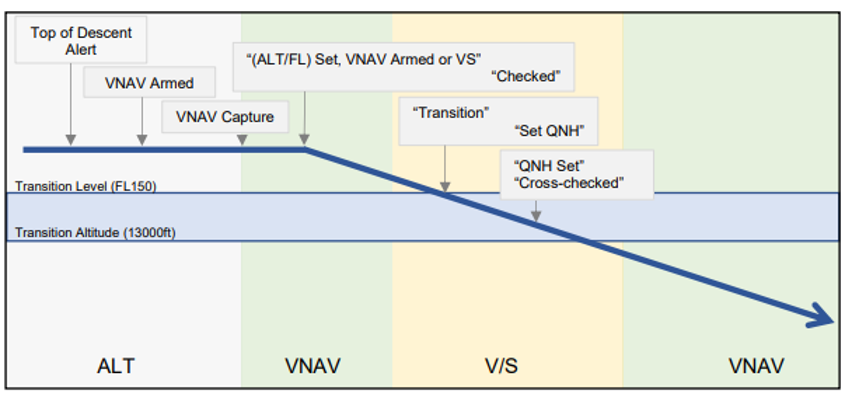
- The operator’s safety investigation report for the Rotorua incident in 2022 drew attention to the fact that flight crew having to remember to reselect VNAV was reliant on prospective memory (Air New Zealand, 2022). The report pointed out that prospective memory is the least reliable part of human memory and noted that a 2006 study attributed 20 per cent of airline accidents to failures of prospective memory (Dismukes, 2006). The report noted parallels to an Australian Transport Safety Bureau (ATSB) investigation into an A320 that descended below altitude constraints (Australian Transport Safety Bureau, 2014).
- If a pilot forgot to reselect VNAV, two protections were available. The first relied on human intervention: the flight crew may have noticed at some point during the descent and corrected the error, or, if the deviation became significant, ATC may have noticed an altitude discrepancy on radar and informed the flight crew. However, ATC is not available at unattended aerodromes such as Timaru.
- The second protection was technology. The altitude alerter system, if used appropriately, could have alerted the flight crew if the aeroplane was nearing an altitude that should not have been infringed. On their flight to Timaru, Q300 SOPs allowed the flight crew to put MDA/DA in the altitude alerter while the aeroplane was still at its cruising level of FL180, provided the crew were sure that no limiting altitudes would be infringed. As the aeroplane was flying in VNAV at that time, there was no reason for the crew to think that there could be an infringement. Later, when the captain changed from VNAV to V/S mode through transition, the protection provided by VNAV was removed.
- Requiring a higher altitude limit, such as the MSA for the IAF, to be programmed into the altitude alerter would have provided a greater degree of protection in these circumstances. This would have required the flight crew to set 2000 ft in the altitude alerter through transition. While not preventing the aircraft descending below the planned flight profile when the captain forgot to reselect VNAV, a warning would have been provided to the flight crew before descent below the minimum safe altitude of 2000 ft.
-
Utilisation of the altitude alerter is a procedural defence and therefore reliant on flight crew adherence to be effective. When interviewed, personnel from the operator’s safety (Operational Safety), training (Standards & Training) and flight operations (Flight Operations) departments, informed the Commission that pilots on the Q300 fleet were not always compliant with the altitude alerter SOP. This was because of the short time the aeroplane would be in V/S mode during descent through transition as described in the SOP supplement issued to the Q300 fleet two days after this Timaru incident (see Appendix 4):
To manage [descent through transition], pilots commonly utilise V/S mode… this use of V/S is often accompanied by a routine non-compliance with the SOPs for altitude alerter setting, likely because pilots intend to re-engage VNAV mode imminently.
-
The use of V/S mode introduced risk associated with prospective memory failure during transition. This can be a busy period, particularly if external distractions such as an ATC call or a cabin crew interruption occurs, and there are no protections in place to capture an error. The captain noted during their interview that they had experienced this type of error before and it tended to be more likely at aerodromes such as Gisborne, New Plymouth and Napier, where ATC requires a position report that often coincides with descent through transition. However, use of the altitude alerter as a risk control was not robust, as evidenced by the widespread drift by pilots away from its use. This was identified by the operator in its internal safety investigation of the Timaru incident:
The investigation concludes that although the technique of selecting V/S mode through transition is intended to minimise large and abrupt pitch changes, it introduces risk of omission leading to the aircraft continuing to descend in V/S mode and possibly below MSA. This is also true given the majority of crew did not reset the altitude alerter to the next appropriate MSA constraint. This technique is considered a non-compliance but routine in nature as it applied across the Q300 fleet (Air New Zealand, 2024a).
- The problematic nature of using V/S mode through transition had previously been identified by the operator. Three months prior to the Timaru incident, a flight safety bulletin was issued to Q300 pilots reminding them of the importance of ‘Verbalise, Verify, Monitor’ to ensure the active awareness of flight guidance modes. This was a proactive step. However, reminding people to follow procedures is rarely an effective method of changing human behaviour and was not effective in preventing the incident at Timaru.
- No pilot will ever be immune to making a flight mode selection error. Training people to not forget is ineffective and what is required are robust risk controls.
Training
Crew resource management
- Many airline accidents have been attributed to pilots becoming so focused on a single task that their situational awareness reduced to the point where they could no longer safely control the aeroplane. The frequency of these accidents throughout the 1970s became the global catalyst for civil aviation regulators to mandate cockpit resource management training within airlines (specifically, the recommendation made by the NTSB following their investigation into the United Airlines DC-8 accident in 1978 in Portland Oregon, in which the captain became preoccupied with a landing gear malfunction, resulting in fuel exhaustion and engine flame out (National Transport Safety Board, 1979)). Over the subsequent decades this expanded to include flight attendants, and the term changed to crew resource management (CRM).
- CRM refers to the effective use of all resources available to crew members, including each other, to achieve a safe and efficient flight (Civil Aviation Authority, 2013). It is designed to act as both a preventive and recovery risk control and is a central tenet of flight crew error management. Based on the premise that human error occurs in 60 to 80 per cent of incidents and accidents (International Civil Aviation Organization, 2021), CRM training focuses on error prevention, detection and recovery.
- While CRM training has evolved considerably since the 1970s, contextually it can be viewed as a tool for pilots to draw on to effectively utilise the non-technical skills that influence crew dynamics on the flight deck. These skills include teamwork, communication, decision-making, leadership, workload management and situational awareness, including the ability to identify and manage potential threats such as fatigue. In essence, CRM acts as a conduit for the overall combined technical and non-technical performance of all the pilots on a flight deck.
- A key CRM technique that could have helped prevent this incident was increased communication. During their interviews, both crew members recalled that there had been very little conversation during the climb and cruise phase of flight, aside from what was operationally necessary. This was a key indicator of low arousal levels. Both pilots also reflected that they had been aware that it was the last sector of a long day, and more discussion should have taken place about how to manage this.
- The fact that the captain was not aware that the first officer was feeling tired until after they were on the ground at Timaru indicates that CRM was not effective in managing this potential threat. The captain stated they would have questioned the first officer more carefully had it been mentioned before the flight they were feeling tired. However, at that time the first officer was feeling more refreshed, having just completed the walk around the aeroplane to conduct the preflight in Wellington. Had their CRM training been more effective, when the first officer did begin to feel tired, this would have been a cue for them to speak up.
- Once the initial error of not re-engaging VNAV had been made, the aeroplane remained in the incorrect descent mode for 10 minutes and eventually descended to around 2500 ft below profile before the error was discovered. By that time, the captain was experiencing cognitive overload, as evidenced by their actions during the recovery sequence: there was no communication regarding the autopilot disconnection nor what their intention was to recover the situation. The first officer, as pilot monitoring, had not communicated pertinent information, such as the fact that the PAPI was showing all four red lights, which indicated they were well below profile, nor had they realised that the aeroplane had been descending in V/S mode.
- Had CRM been effective, the initial error may still have occurred. However, it should have been captured much earlier and before the situation had escalated to a serious incident. The inability of either crew member to access their CRM knowledge and skills, to intercede and prevent the situation becoming more serious, highlights the vulnerability of CRM as a safety barrier. For this reason, CRM training must be designed and delivered in such a way that allows crew to utilise it when required. The fact that this crew could not do so indicates that their training may not have been effective.
- It is virtually certain that the combination of a degraded instrument scan and fixation with visual acquisition of the airfield lights resulted in the crew not recognising the vertical deviation below profile until the aeroplane was almost 2500 ft below the intended flight path.
- Had either of the flight crew members been appropriately monitoring and cross-checking the aeroplane’s profile, it is very likely that the flight mode error would have been discovered and corrected before the vertical deviation from the intended flight path became as significant as it did.
- There have been other examples on the Q300 fleet where CRM has not been effective and flight crews have shown deficiencies in communication, decision-making and adherence to SOPs. This included the pattern of continued approaches by Q300 flight crew when the safest course of action was to execute a go-around.
- On 11 June 2025, the operator presented a briefing to the Commission investigators outlining how human factors aspects of CRM have been further integrated into all aspects of Q300 training, covering classroom, simulator, and line training and assessment.
CRM training for pilots
Safety issue 3: The number of Q300 occurrences involving technical and non-technical flying skills (CRM) deficiencies indicated that the training for Q300 flight crew was not sufficient to address the risk of a serious incident or accident occurring.
- The rate at which airlines employ pilots will vary in response to factors such as organisational growth and pilot attrition through retirement. When there is a high demand for pilots, there can be a decrease in the relevant operational experience levels of pilots available to be selected. In this situation, airlines need to employ pilots with fewer hours and less experience compared to previously.
- When the captain and first officer were employed by Air Nelson, they had approximately 2300 hours and 2000 hours total flight time respectively. The operator’s training management advised the Commission that this was comparatively less experience than pilots previously employed on the Q300 fleet.
- In 2015, Mount Cook introduced a ‘command development course’ to support the training of first officers with comparatively less turboprop experience when they became eligible to become captains. Air Nelson followed suit in 2017 for those pilots who were joining the airline without any previous CARs Part 121 command time.
- Just prior to Covid-19, the operator was experiencing the tail-end of a ‘hiring boom’. The Commission was informed that this was followed by a stable period immediately after Covid-19 in which there was no hiring and experience levels on the fleets were building up. However, as the operator began returning to its pre-Covid level of operations, pilot turnover rapidly increased to approximately 25 per cent. This resulted in a significant number of seat changes (pilots moving to different aircraft types and first officers upgrading to captains) and an overall lowering of experience levels across all ranks on the Q300 fleet, including training personnel. Figures provided to the Commission during interviews indicated that some pilots were entering the airline with between 500 and 1000 total hours, while the length of time for a first officer to become a captain was averaging around three and a half years. In response to this, the operator put measures in place to encourage pilots who were involved in training, such as line training captains, to stay on their fleets to provide some stability.
- During interviews with the operator’s Flight Operations, Operational Safety and Standards & Training departments, the Commission was informed that there had been challenges associated with the comparatively less experienced pilots. While pilot currency had been problematic during Covid-19, the issue was now related to multi-crew experience levels. Comments made during interview included:
- Most pilots joining the fleet did not have multi-pilot experience and therefore being in a ‘pilot monitoring’ role was new for them; and training may not be habitualising the required behaviours well enough.
- Pilot inexperience had been found to be a factor in some incidents that had occurred whilst first officers were conducting visual approaches and new captains did not intervene in a timely manner.
- The amount of movement on the fleet may have created a situation in which pilots did not appreciate the significance of command upgrades and the requirements that come with a captain’s role.
- The amount of movement on the fleet also created a situation where there was less opportunity for Standards & Training pilots to be flying normal line operations and thereby observing the behaviours of first officers.
- In early 2023, the operator incorporated an additional simulator session following the initial clearance to line flying. Training sessions were provided for pilots who required them. The Standards & Training department had observed that more support in the form of extra simulator sessions and line training sectors was being required, putting additional pressure on Q300 trainers.
- Neither the captain nor the first officer involved in the Timaru incident had any indications on their training records that suggested there were problems with their technical or non-technical skills. However, like other incidents on the Q300 fleet in which the flight crew allowed the aeroplane to descend below profile, there was a significant deficiency in basic flight path monitoring. Neither flight crew member conducted any distance/altitude ‘rule of thumb’ calculations to check their profile; the first officer stated they generally dispense with giving profile checks to the pilot flying if the aeroplane is in visual conditions.
- During interview, two turboprop training managers informed the Commission that, in their view, both the captain and the first officer had experienced a behaviour drift away from the required performance standards, and when paired together this inherently created a low-performing crew. Given the history of incidents on the Q300 fleet, the Commission does not consider this was an isolated incident but rather a systemic issue. The operator’s training for flight crew did not address comparatively lower experience levels.
- Information provided to the Commission by the CAA showed that, around the time of this incident, the operator was experiencing a higher than usual training failure rate on turboprop command upgrades. In August 2022, the operator began moving from a traditional training syllabus to a new evidence-based training (EBT) programme (EBT is a training philosophy that focuses on the specific flight skills and competencies that are required by an air operator. It utilises the operator’s own flight data as well as other evidence sources (such as incident trends and operational feedback) to develop up-to-date training scenarios that are tailored to the current needs of a particular fleet/operation. EBT marks a global move away from traditional airline training that primarily focuses on a set list of manoeuvres and skills that must be demonstrated in order to satisfy the regulatory requirements of the pilot licence) to enhance the effectiveness of training. The EBT programme focused on realistic scenarios with no predetermined responses to enhance decision-making under a variety of operational conditions. The EBT programme was delayed in September 2022 for six months because of what the operator described to the CAA Monitoring and Inspection Unit (MIU) as a ‘spike in [training] failures.’ The MIU noted that single-engine handling by first officers on the turboprop fleets had also been identified by the operator as ‘below the required standard’, which the operator addressed by implementing an additional non-jeopardy simulator session (a non-jeopardy simulator session is a training event designed to develop core competencies without the pressure of evaluation by a flight examiner).
- At interview, personnel from the CAA Safety and Investigation Unit (SIU) informed the Commission that they had concerns and had discussed training and go-around decision-making with the operator, specifically whether the initial and recurrent training for new pilots was adequately covering these skills. Prior to a flight crew training and competency audit shortly after the Timaru incident in October 2023, the SIU corresponded with the MIU stating that they had ‘raised themes in relation to training/competency in the past with MIU’ and noted CRM, flight mode awareness and pilot experience levels as examples. Personnel from within the CAA Certification Unit (CU) also informed the Commission that they had concerns regarding the standard of training from their observation of a Q300 simulator session (CAA inspectors certify Air New Zealand flight examiners, allowing flight examiners within the operator to train and examine its own pilots on behalf of the CAA).
- Part of the operator’s safety management assurance function was their internal audit programme, which adopted a combination of risk-based and prescriptive methodology. The operator’s audit schedule was targeted to areas of the operation that were deemed to have a higher safety risk, while also incorporating audits required at certain frequencies by the operator’s customers and third-party service providers (in the case of maintenance, this also includes foreign regulatory requirements).
- The operator’s SMS stated that the internal audit function covers all operational areas and activities covered by the air operator, maintenance, design, manufacturing and Aviation Training Organisational certificates. However, the Senior Manager Operational Safety informed the Commission that at the time of the Timaru incident the internal audit programme had, until recently, not covered flight operations, instead relying on IATA IOSA audits (the International Air Transport Association (IATA) is a global trade organisation that represents around 350 airlines and over 80% of total air traffic. Part of IATA’s role is setting industry standards; membership is only available to airlines that are participants of IATA’s Operational Safety Audit (IOSA). The IOSA audit programme measures airline safety performance against recognised IOSA Standards and Recommended Practices (ISARPs) as published in the IOSA Standards Manual. Air New Zealand holds IOSA registration and was audited in 2020, 2022 and 2024) to cover this area. This included each department conducting a self-assessment against IOSA standards in the lead-up to each two-year audit. The self-assessments were reviewed by the operator’s Operational Safety department.
-
While this had been previously acceptable to IATA, the 2022 IOSA audit of the operator made a finding against it that their internal audit programme did not cover flight operations. The finding stated:
Although documented, it was confirmed that the Operator’s quality assurance programme does not provide for the auditing of the flight operations management system to ensure compliance with applicable external regulations and internal standards.
- Part of ICAO’s recommended practices is for airlines to conduct Line Operation Safety Assessments (LOSA) (LOSA is a proactive, non-punitive, safety management tool based on CRM and Threat and Error Management (TEM) principles. It involves trained observers who are situated in the cockpit during normal line operations. The purpose is to gather data about how crews perform, particularly regarding the utilisation of non-technical skills, for example crew adherence to procedures, error mitigation, situational awareness and communication. Operators can then use the data to proactively identify potential areas of weakness and implement measures to improve safety). This is not a requirement; however, many airlines voluntarily adopt a LOSA programme as part of their SMS for safety assurance purposes. While the operator previously conducted LOSA as a best practice, this ceased in 2008. This was a lost opportunity for the operator to have increased oversight of the way its pilots were operating in a normal line flying environment. This would have been particularly beneficial for a fleet such as the Q300 to assess the utilisation and effectiveness of CRM.
- The Commission considers it is very likely that inadequacies in the operator’s CRM training programme contributed to the flight crew’s performance during the descent into Timaru, specifically their collective inability to recognise the situation that was developing and take appropriate action to recover.
Safety issue 4: The integration of the two regional airlines into Air New Zealand in 2019 merged three different organisational cultures. The safety culture of the Q300 fleet was not aligned to the expectations of Air New Zealand regarding risk appreciation and mitigation.
- Organisational culture refers to the characteristics and value systems of a particular organisation and sets the boundaries for accepted operational performance in the workplace. While the tone of a culture will be created and influenced by leadership, other factors that shape organisational culture include policies and procedures, training, supervisory practices, safety standards, actions in response to unsafe behaviour, and employee engagement and involvement (‘buy-in’) (https://skybrary.aero/articles/organisational-culture).
- ICAO Annex 19 requires that both states and operators promote a positive safety culture. The guidance recognises that organisations may have different cultures, particularly with respect to safety:
- Whether an organization realizes it or not, it will have a number of different “safety cultures” that reflect group-level attitudes and behaviours. No two organizations are identical, and even within the same organization, different groups may have various ways of thinking about safety, talking about safety and acting on safety issues (International Civil Aviation Organization, 2018).
- The operator and the CAA were both aware that the integration of Air Nelson and Mount Cook would present challenges when combining three organisational cultures. Information obtained by the Commission included CAA records of regulatory interviews with the operator’s senior persons for the purposes of approving the new organisational structure for the integration in 2019. The CAA specifically questioned the operator about the challenges of fostering a single culture and that they were concerned about two recent incidents: an ATR icing incident involving an aeroplane operated by Mount Cook, and an Air Nelson Q300 pilot mishandling incident in Tauranga. Another interview record noted that the senior person (Part 12 occurrence reporting) had ‘identified a number of areas where the integration would enhance the safety of the Q300 and ATR operation’. One of the areas was that investigation of turboprop incidents would have the same robust safety investigation process that the jet fleet had, and there would be an adoption of best practice across the whole group.
- A large part of the integration process, which would assist in fostering a shared organisational culture, was an alignment of SOPs across the three organisations. The performance of a turboprop aeroplane differs from that of a jet, and the performance capability of the Q300 meant that it was a lot more manoeuvrable than the operator’s Boeing and Airbus aircraft. For this reason, when operated under the Air Nelson AOC, the Q300 had some operating procedures that were more permissive than those in place for the operator’s jet fleets.
- Following the integration, the operator introduced more restrictive limits and SOPs to the Q300 fleet. Examples included disallowing visual approaches to be flown at night and in Palmerston North circling approaches were prohibited. Other changes related to how the Q300 was to be configured, for example increasing the altitude at which the landing gear had to be selected on approach.
- Evidence analysed by the Commission, including interviews, documentation and correspondence pertaining to the integration, indicated that the operator had underestimated the amount of work involved in aligning the Q300 fleet operation to that of the operator’s other fleets. The evidence also indicated that the management of the integration did not always facilitate a positive cultural integration between the different organisations. Some Air Nelson flight crew considered that changes were being imposed on the fleet, leading to resistance.
- The operator was aware that not all Q300 pilots were receptive to the changes following integration. Some personnel within the Operational Safety and Flight Operations departments were concerned with Air Nelson’s legacy culture and described it as a misalignment between how Q300 pilots understood and perceived operational risk when compared to those on other fleets.
Go-around as a risk control
- One factor that can be indicative of risk misperception amongst groups of pilots is the willingness to execute a go-around when required. The go-around manoeuvre is an important recovery control when an aircraft is not positioned or configured correctly for landing. It is also used during other potentially unsafe conditions, such as when an aircraft receives a windshear warning or a close proximity terrain warning. The objective is for the flight crew to avoid a potentially unsafe situation on approach near the ground by establishing the aircraft in a climb.
- Conducting a go-around places the aircraft in a safe position relative to the terrain and allows situational awareness to be re-established. In circumstances where a flight crew is uncertain of the aircraft’s position relative to the published approach profile, such as occurred during the approach into Timaru, a go-around also provides an opportunity to confirm that the aeroplane is correctly configured for landing. As described earlier in this report, there are many human factor considerations that influence why a flight crew may elect to continue an approach. However, patterns of behaviour, such as multiple occurrences of pilots continuing to land instead of conducting a go-around, are indicative of a systematic issue pertaining to safety culture.
- Shortly after opening this inquiry, the Commission was notified that another of the operator’s Q300 aircraft had descended below its approach profile into Nelson in July 2023 (see paragraph 2.67). The aircraft had encountered windshear at around 200 ft. The windshear recovery manoeuvre for the Q300 involves setting maximum take-off power and pitching the aircraft up to a go-around attitude of 9°. If the aircraft continues to descend, the power levers must be set to the firewall (the highest physical position power levers can be set to in order to achieve maximum engine power). Rather than conducting the windshear manoeuvre required by the operator’s procedures, the pilot flying increased power to regain their approach profile and continued to land. The standard runway threshold crossing height programmed into the aircraft is 50 ft. At its lowest point, the aeroplane was 45 ft above ground level, approximately 280 m away from the runway threshold.
- In December 2023, the Commission was notified of an incident involving a Q300 descending below approach profile at New Plymouth (see paragraph 2.68). The aeroplane had commenced the approach in cloud from a holding pattern and was above the required VNAV descent profile. The crew elected to descend in V/S mode to regain the profile and then continue in V/S mode while monitoring the VNAV profile. At around 1000 ft, the aeroplane descended below the VNAV profile and became visual with the runway at approximately 400 ft. At that time, the PAPI indicated four reds, meaning the aircraft was well below profile. The operator’s procedures required that a go-around manoeuvre be performed; however, the flight crew continued the approach.
- While aviation warning systems, such as EGPWS and MSAW, provide visual and aural alerts to warn of an imminent threat to the safety of an aircraft, they are often the last line of defence to prevent an accident. They also rely on the flight crew responding appropriately and initiating a go-around manoeuvre (that is typically more challenging than one conducted earlier on the approach, given that startle factor (the introduction of a sudden, unexpected and intense stimulus that creates an involuntary reflex affecting both psychomotor and cognitive ability and therefore affecting performance) can delay a pilot’s response). If the appropriate recovery control of a go-around manoeuvre is not conducted in a timely manner, the risk of either a controlled flight into terrain or a runway excursion accident is increased. Both these accident types are highlighted and monitored as part of the global high-risk categories of occurrences under the ICAO Global Aviation Safety Plan 2023–2025 (International Civil Aviation Organization, 2022).
- The Commission identified that while the incidents in Nelson and New Plymouth had causal factors different from the Commission’s current inquiry, they shared commonality with both the Timaru incident and the Rotorua incident in 2022: all four flight crews continued the approach to land in situations where the safest course of action and/or the operator’s procedure was to execute a go-around. The Commission considered this to be indicative of a more widespread pattern of behaviour on the Q300 fleet and due to the difference in safety culture between the Q300 fleet and the operator’s other fleets. It demonstrated that four years after integration, the operator had still not influenced the culture of the Q300 fleet to fully enhance operational safety.
- It is very likely that the timeframe in which Air Nelson and Mount Cook were brought onto the operator’s operating certificate, and the subsequent impact of Covid-19, affected the operator’s ability to appropriately recognise and address the differences in organisational culture within the Q300 fleet.
-
The Commission produced a preliminary report in February 2024, identifying the following safety issue:
There have been four events in the 18 months from July 2022 to December 2023 in which Q300 flight crew descended below the correct flight path profile, and in two cases below the minimum sector altitude, during approach to land. In each of these events, the flight crew continued the approach instead of conducting a go-around manoeuvre. This pattern of non-adherence to recovery procedures for terrain proximity warnings and/or other indications that an aircraft is below the correct flight path profile increases the risk of a controlled flight into terrain or runway excursion accident (Transport Accident Investigation Commission, 2024).
- Following the incident at Timaru, the operator initiated a ‘cultural reset’ programme for the Q300 fleet, led by senior management including the Head of Flight Operations/Deputy Chief Pilot. The Commission acknowledges this safety action but was concerned with the time taken to influence culture change and so issued an urgent safety recommendation (003/24) to the CAA on 21 February 2024 (see Section 5).
Management of a known safety issue within Air New Zealand’s SMS
Safety issue 5: Errors associated with the use of Vertical Speed mode were a known hazard for the Q300 operation, and there was knowledge that these errors were not always captured by the flight crew in a timely manner and/or recovered from appropriately. However, despite a number of precursor events being captured within Air New Zealand’s safety management system, the risk of a serious incident or accident was not managed effectively.
- This incident was not a ‘black swan’ event (an impactful event that lies outside the realm of regular expectations because nothing in the past can convincingly point to its possibility (Taleb, 2007)). There had been other incidents on the Q300, including two serious incidents at Rotorua in 2020 and 2022. In the 12 months leading up to the incident at Timaru, there had been four incidents reported to Operational Safety regarding V/S mode selection errors on approach. There had also been another incident on 19 June 2022, in which a Q300 was on approach to Auckland at night in visual conditions and descended below profile. At 300 ft with four red indications on the PAPI, and having received three EGPWS glideslope cautions indicating that the aeroplane was low, the flight crew regained profile and elected to continue the approach.
- These previous incidents were all reported as part of the operator’s SMS. They therefore should have signalled systemic issues, and that there was a likelihood that another potentially serious incident, or even accident, could occur. There was considerable evidence across multiple departments of the operator demonstrating that the Q300 fleet was not performing as they might expect:
- Q300 pilots were at risk of making flight mode selection errors because of how descent was being managed through transition.
- These flight mode selection errors were not always picked up in a timely manner by the flight crew.
- Pilots were routinely not setting the altitude alerter in accordance with the SOP, thereby diminishing its effectiveness as a risk control.
- The Q300 operation was not yet aligned with the jet fleet in terms of verbalising automation mode changes to assist flight crew with mode awareness.
- Flight path monitoring was not always reliable, and it was sometimes ATC that alerted the flight crew to an altitude excursion or unsafe situation.
- Flight crew were not always executing a missed approach as a recovery manoeuvre.
- When interviewed, a manager from Flight Operations stated that they did not have the capacity for proactive risk identification, and the information provided by the Operational Safety team was not particularly helpful in identifying emerging trends. Instead, they would read the details of each occurrence report to assess the risk for each fleet. The Senior Manager Operational Safety, who held the senior person role for the management of safety, stated to the Commission that proactive and predictive risk analysis could be better and that their systems were continually improving.
- The Commission was informed by the operator’s Investigation and Assurance Manager, who held the CAA regulatory role of senior person (Part 12 occurrence reporting), that risk classification scores were assigned to all occurrence reports that were submitted by flight crew. However, when the Commission reviewed the occurrence reports (occurrence reports for the B777, B787, A320, ATR and Q300 that related to flight events, not including maintenance, cabin or ground-related incidents) received by Operational Safety for the period 1 January 2020 to 31 August 2023, approximately 40 per cent of the reports had not been assigned a risk classification score. The requirement to do so had been removed from the operator’s SMS manual in 2019. At the beginning of 2022, the requirement to assign a risk classification score to occurrence reports was reinstated by the Investigation and Assurance Manager once they had been appointed to the role. When considering all the flight safety reports across all fleets that had been assigned a score (all reports that were assigned a risk score had been classified as either ‘very low,’ ‘low,’ or ‘medium’), the Q300 fleet had proportionally more incidents with higher risk classification scores (approximately 60% of the Q300 risk scores were rated as ‘very low’ and approximately 40% of the risk scores were rated as either ‘low’ or ‘medium.’ Comparatively, when combined, the other four fleets had an average of 74% of risk scores that were rated as ‘very low’ and 26% that were rated as either ‘low’ or ‘medium').
- The Commission asked the operator whether any of the previous Q300 incidents had been escalated within the SMS via weekly, monthly or quarterly safety meetings. Both the 2022 Rotorua incident and the 2023 Gisborne incident had been discussed at the weekly Operational Integrity & Safety Operation Safety Report Review meetings. These meetings were attended by personnel working within the operational investigation and audit teams.
- The 2022 Rotorua incident was discussed at the weekly Operations Integrity Review meeting on 26 July 2022, during the Turboprop Pilot Safety Review meeting in September 2022, and again in January 2023 (which was the 2022 year-in review).
- Documentation provided by the operator to the Commission included a selection of papers from quarterly meetings of the Group Safety Review Board. The Safety Performance Indicator for CFIT was noted as showing an adverse trend in July to September 2020 because of approach programming errors on the turboprop fleets. This was attributed to low currency as pilots returned to flying following Covid-19. The report also noted that ‘the Standards & Training team continue to manage and monitor the risk closely’ and that a crew memo had been published to ‘remind crew to be vigilant and use procedures and checklists as mandated by standard operating procedures.’
-
In the final quarter of the 2022 financial year (April to June 2022), the commentary against the CFIT safety performance indicator stated that there had been:
An upswing in the rate of precursor events over the last quarter, though the occurrence number is small. Most of these pertain to crew programming and/or selection errors and all have been classified as ‘Low’ risk. Three approach programming error events were reported this quarter which did not result in adverse outcomes. In all cases, the recovery controls were seen to be effective whereby the errors were either picked up by the crew early in the approach or by the controller.
- In summary, during the three and a half years that the Q300 had been operating on the operator’s AOC, there were numerous indicators that there was a risk of a serious incident occurring on the Q300 fleet. These indicators took the form of safety occurrence data, anecdotal information and institutional knowledge regarding how the Q300 was operated. However, it was not until the end of 2023, six months after the Timaru incident, that ‘Q300 continued approaches’ was added as a risk to the operator’s operational risk register. The Commission considers that the risk of a controlled flight into terrain (CFIT) accident on the Q300 should have been more proactively managed.
Safety action following the serious incident at Rotorua in 2022
- The serious incident at Rotorua in July 2022, in which a Q300 descended below profile in IMC and received both an ATC warning (MSAW) and an aircraft cockpit warning (EGPWS), represented a significant ‘near miss’. Even if this had been an isolated event, it provided an opportunity for the operator to take preventive action to avoid a future reoccurrence.
- The internal safety investigation conducted by the operator was completed in early March 2023 and identified eight safety actions to be taken. These (paraphrased below) were assigned to the Flight Operations, Standards & Training and Operational Safety departments. The status of each safety action at the time of the Timaru incident, 11 months after the Rotorua incident, is given below:
For Flight Operations:
- Contact Universal Avionics to determine whether there is any facility for pilots to input area QNH to improved VNAV path management through transition (completed).
- Provide a technical description of the Q300 VNAV system and behaviour in the Flight Crew Operating Manual (ongoing).
- Consider changing the verbalisation of V/S from ‘vee-s’ to ‘vertical speed’ to reduce the risk of miscommunication (ongoing).
- Align Q300 SOPs with the other fleets to require approach deviation calls to begin from inside the IF or IAF, whichever occurs first (completed).
For Standards & Training:
- Create a training presentation about this incident to educate flight crew (ongoing).
- Consider including the receipt of, and expected response to, a MSAW alert as part of simulator recurrent programme (ongoing).
For Operational Safety:
- Publish a safety article detailing the phraseology pilots can expect if ATC issues a MSAW alert during flight (completed).
- Publish an occurrence briefing and presentation for this incident for pilot education (ongoing).
- The action for Operational Safety to publish an occurrence briefing for the purposes of pilot education did not occur until after a subsequent incident at Gisborne on 6 March 2023, eight months after the incident in Rotorua. The action for Standards & Training to create a training presentation did not begin until late 2023 following the incident at Timaru; this was then rolled out to pilots in July 2024, two years after the Rotorua incident.
- Timeliness of implementation notwithstanding, safety actions identified by the Rotorua investigation were not sufficiently robust to provide assurance that another similar incident would not occur. This is demonstrated by the subsequent incidents that took place. While there was an attempt to explore a more rigorous risk control by reaching out to Universal Avionics, the way in which the question was worded appears to have influenced the response the operator received. Further involvement would have been required from the operator’s engineering department, DHC and Universal Avionics to understand the reason why the FMS behaved the way it did and then explore what a potential solution could be.
- In interview, the Flight Operations managers raised a concern with the internal safety investigation of the Rotorua incident. The concern was about a delay in escalation by the operator once the seriousness of the incident became known and the lack of follow-up with the flight crew who were involved in the incident. The Flight Operations managers also believed that more needed to come out of the investigation to prevent a reoccurrence in the future. They viewed the incident as serious and requested to meet with Operational Safety to discuss their concerns. However, six months after the request was made, Flight Operations had not received a response from the Operational Safety department.
- The incident that occurred at Timaru could have been foreseen. In the time leading up to the incident, there had been seven reported Q300 incidents that involved descending below the designated descent or approach profile. The operator’s SMS did not adequately respond to these incidents and address the underlying safety issues.
- The purpose of introducing a regulatory requirement for an SMS in the aviation industry was to assist operators to manage their risks. Safety performance is a shared responsibility between the regulator and the operator, and such incidents occurring on the Q300 fleet indicates CAA’s oversight of the operator’s SMS was not adequate. The CAA had a responsibility to ensure that the operator was managing its risks appropriately, and that it had adequate resources to do so.
Regulatory oversight of Air New Zealand
Safety issue 6: The Civil Aviation Authority’s regulatory oversight of Air New Zealand’s safety management system was not effective; it was not commensurate with the level of organisational change experienced by the operator following the integration of its two regional subsidies, nor with the additional impact of managing and recovering from Covid-19. Despite deficiencies in Air New Zealand’s safety performance being known to the regulator, these concerns were not appropriately addressed, increasing the risk of a serious incident or accident occurring.
-
On 21 February 2024, the Commission issued an urgent safety recommendation to the CAA as part of this inquiry (provisions within the TAIC Act allow for this in cases where the Commission determines it is necessary to do so in the interests of transport safety). The Commission was concerned about the safety of the operator’s Q300 fleet operations and recommended that:
The Civil Aviation Authority require Air New Zealand to provide evidence to the Civil Aviation Authority’s satisfaction that they are adequately addressing recent safety-related events involving the Q300 and that they are adequately managing the risk associated with flight crew not adhering to correct recovery control actions (Transport Accident Investigation Commission, 2024).
- Performance-based regulation in the form of an SMS is explicit in that operators are responsible for managing their own risks. However, this does not absolve the regulator from its role within the aviation system of assuring itself that operators are managing their risks appropriately and that transport safety is not compromised. The operator’s management of the risk associated with the Q300 fleet and the series of incidents that occurred indicate that oversight of the operator had not been effective.
- The following section describes the deficiencies the Commission has identified in the CAA’s regulatory oversight of the operator. These are issues pertaining to:
- CAA oversight and acceptance of the regional airline integration in 2019
- CAA recertification of the operator’s Air Operator Certificate in 2020
- CAA change to risk-based oversight of performance-based regulation
- capability within the operator’s Operational Safety department
- the relationship between the CAA and the operator
CAA oversight and acceptance of the regional airline integration in 2019
- Part of the supporting documentation submitted by the operator to the CAA for the purpose of the integration was a risk management plan entitled AOC Unification Project – Safety & Compliance Workstream. The purpose of the plan was to demonstrate that the unification project would manage the safety risk of integrating Air Nelson and Mount Cook to ALARP/SFARP (As Low As Reasonably Practicable/So Far As Reasonably Practicable) through the planning, delivery and ‘post-go-live’ phases.
- The preface to the document noted that the risk management plan was developed based on the assumption that all three airlines had AOCs that were compliant and approved by the regulator. In terms of risk criteria, the plan stated that ‘it was determined by the company it is unable to accept any’:
- decrease in the current level of safety
- non-compliance with the rules and regulations set by the regulator
- non-compliance with current company policy
- identified risks with a post-treatment residual risk assessed as ‘high’ or ‘very high’.
- However, documentation reviewed by the Commission and support information from interviews with CAA personnel, indicate that there were concerns within the CAA that the integration of Mount Cook and Air Nelson into Air New Zealand was undertaken in a compressed timeframe that compromised the intent of the unification project.
- The operator proposed the project timing to the CAA. They wanted it to coincide with the date that Air Nelson’s CARs Part 119 AOC was due to expire on 19 November 2019 (CARs Part 119 Air Operator Certificates may be granted or renewed for a period of up to five years).
- The operator’s project plan had two formal milestones: T-60 days and T-30 days before the ‘go-live’ date of 19 November 2019. The intent was to transfer all the Air Nelson Q300 aeroplanes, and those personnel (senior persons and flight examiners) within the airline requiring regulatory approval, onto the operator’s AOC. Mount Cook would follow shortly after in December 2019, although their CARs Part 119 AOC was not due to expire until April 2020.
- During interview, a CAA inspector involved with the integration stated that they were only given a matter of weeks and therefore could only do the minimum required to bring Air Nelson and Mount Cook onto the operator’s operating certificate. They further stated that the CAA certification team focused on the legalities of dissolving the two airlines and transferring all the staff and aircraft over to the operator’s AOC whilst ensuring regulatory compliance was maintained. They did not have the capability to also ensure that the operator would be unified and operating under the same standards within the timeframe.
- Documentation provided to the Commission from the CAA supports the finding that CAA inspectors were concerned that they could not meet the operator’s timeframe because the operator had not provided all the necessary documentation to the certification team in an expeditious manner, including the operator’s detailed operational risk management plan.
- The CAA identified that the operator had not appointed a full-time project manager to lead the integration and had suggested to the operator that they do so for the second phase of the integration.
- On 15 October 2019, approximately one month before the go-live integration date, CAA wrote to the operator, detailing the regulator’s concerns that:
- there was a significant body of work still to be produced by the airline and subsequently assessed by CAA
- several of the elements were well behind schedule compared to the operator’s nominated delivery dates.
-
The letter from CAA to the operator stated that:
These factors are raising some concern within the CAA as to the achievability of the target dates Air New Zealand proposed. One of the most significant work pieces that raises a great deal of concern is the recently submitted Air NZ Regional Airline Integration change plan. This document is only a very high-level overview of the change management plan (CMP) and not the detailed plan expected for a change process of this significance.
Further, the CMP was not accompanied by any of the supporting documentation referenced and necessary for a robust CAA review. When this concern was raised during a recent catch-up meeting, CAA was assured that the documents would follow ‘in the next few days.’ To date none of these documents have been received.
…
A revised and detailed certification plan which includes delivery dates of missing material is required before CAA can agree to a certification date. This plan should also consider Air New Zealand current BAU workload and its impact on the timely delivery of Integration elements. Further to the above, CAA agreement with the aforementioned certification plan must ultimately drive the integration date(s).
Based on our review of the documentation received thus far and the long list of documentation yet to be received and reviewed, the CAA is no longer confident that the proposed amalgamation target dates remain achievable. As such, consideration must now be given to either urgently addressing all open issues, or refocussing CAA staff efforts on recertification of the existing certificates, with amalgamation target dates being shifted to 2020 once a detailed change management plan has been finalised.
- The operator responded to the CAA, informing them that they would review and provide a response to the issues that were raised with urgency, as well as provide any further updates at the T-30 meeting that was scheduled on 18 October 2019.
- The final signed change management plan document was provided to the CAA on 12 November 2019, one week before the project deadline and the expiry of Air Nelson’s operating certificate.
- Email correspondence between CAA and the operator discussed how to transfer all the turboprop flight examiners onto the operator’s operating certificate. The operator’s proposed method was sent to the CAA on 31 October 2019, approximately three weeks before the integration. In a letter dated 21 November 2019, two days after Air Nelson’s certificate had ceased, the operator requested CAA recognise the validity of all the Air Nelson and Mount Cook pilots’ competency assessments.
- The CAA granted approval for the turboprop flight examiners to shift onto the operator’s operating certificate with 28 provisions, which included the statement, ‘While multi-fleet operations are acceptable, “multi-standards” are not.’
- CAA also stipulated that at the time that the operator’s CARs Part 119 AOC recertification became due in five months, all the operator’s fleets had to have identical operating standards, including the non-technical skills (CRM/HF) assessment and standards.
- However, over three years on from the integration, and despite the operator continuing to align the turboprop operation, the Q300 operating standards were not identical to the other fleets. While Covid-19 had a role to play (see following section), the compressed timeframe for the integration of the Q300 and ATR fleets onto the operator’s AOC contributed, as did an underestimation of the work required to address the differences in the way the Q300 fleet operated.
- During interviews, the Commission received evidence that the CAA was aware that the integration had been problematic. Integrating one airline into another inherently increases risk because of the amount of change and the challenges of combining different organisational cultures.
- The United States Federal Aviation Administration (FAA), having overseen a number of airline mergers, recognises that these are complex undertakings and therefore require what they describe as a ‘lengthy six-phase process’ to establish safety as a centrepiece. Subsequent to a merger, the FAA undertakes an in-depth examination of an airline’s operations to see how effectively the transition plan was managed and to reveal any issues that need further attention. The CAA did not follow such a process, nor was safety established as the centrepiece. The compressed nature of the operator’s integration meant that the CAA had to focus on the minimum requirements necessary to achieve regulatory compliance.
- The CAA had an opportunity following the integration to determine whether the operator’s transition had been successful, and to follow up on any potential deficiencies due to the compressed timeframe. This opportunity was during the recertification of the operator’s CARs Part 119 Air Operator Certificate, which was due to expire on 26 May 2020.
CAA recertification of the operator’s Air Operator Certificate in 2020
- The recertification (recertification of an operator’s certificate is now referred to by CAA as a ‘renewal') of the operator’s Air Operator Certificate (AOC) in May 2020 provided an opportunity for CAA to assess the effectiveness of the regional airline integration. The AOC recertified by the CAA may be granted or renewed for a period up to five years. Operators are required to make an application for the renewal of an AOC not less than 60 days prior to the certificate expiring (CARs Part 119.21).
-
The CAA began planning for the operator’s recertification early in 2020. Following several meetings between the regulator and the operator, a high-level internal recertification plan was drawn up by CAA. This document, dated 11 February 2020, stated:
Given the size and complexity of Air New Zealand’s airline operations, an early application by Air NZ and a coordinated certification pathway between Air NZ and CAA would facilitate a successful outcome…
…CAA personnel should look at recertification as an opportunity to: (a) provide assurance that the operator has the required capability for good safety performance; (b) identify areas of operation that represent safety deficiencies or ‘latent risk’ that need to be addressed prior to certification renewal; and (c) identify areas for improvement, and encourage the participant to embrace and implement these changes as part of the certification process (Air New Zealand CARs Part 119 AOC Recertification 11 February 2020).
- On 28 February 2020, the first case of Covid-19 was discovered in New Zealand. By mid-March, the CAA had taken steps to limit staff contact with aviation participants. Government-mandated ‘Level 2’ restrictions came into force on 21 March 2020.
- On 16 March 2020, the operator advised CAA that it would be reducing its operating capacity by approximately 85 per cent. Because of the significant impact that Covid-19 was having on the airline, the operator requested that CAA reconsider its AOC recertification plan. In response, CAA re-scoped the original plan to be a pared-down audit of regulatory compliance.
- The new plan recognised the recertification could not comply with all the requirements of the CAA’s certification policy and would therefore require approval from the Director of Civil Aviation (the Director). Several potential non-compliances were identified, primarily how the operator could demonstrate compliance with the CAA Rules and conformance with its exposition. To mitigate the potential non-compliances, the recertification plan would include an ongoing monitoring and inspection phase following the recertification. The new plan was disseminated to the CAA personnel involved with the recertification on 17 March 2020 (see Appendix 5).
- Covid-19 ‘Level 4’ restrictions came into force on 25 March 2020. The CAA required that its staff have no face-to-face contact with aviation participants, other than with specific approval by the Director. This precluded CAA inspectors from carrying out physical inspections of aviation organisations, limiting CAA’s ability to conduct on-site verification of operator compliance.
- Due to the re-scoped recertification for the operator, Phase Two Item D of the plan could no longer be actioned (item D stated that there would still be the opportunity for some inspection and demonstration of activities. However this would be limited to safety-critical areas (see Appendix 5)). However, one in-person workshop meeting was held from 19 to 22 May 2020 to address the remaining compliance items that were outstanding prior to recertification.
- The CAA had requested an early application from the operator for recertification. The operator submitted its application 62 days prior to the expiry of its AOC on 26 March 2020.
- The Commission requested and received from the CAA all documentation relating to the operator’s recertification, including internal CAA email correspondence and correspondence between the CAA and the operator. This documentation indicated that CAA was experiencing difficulties sighting all the documentation needed to satisfy themselves that the operator was compliant with the relevant rule requirements for recertification. This was similar to what had happened in the lead-up to the integration.
- At the time of the Covid-19 lockdowns, there were 38 aviation organisations due for their AOC recertification by 30 June 2020 (this included two CARs Part 121 operators (Air New Zealand and Air Chathams), both of which would require a significant amount of regulatory resource). Given the implications, both for operators and for CAA inspectors with on-site inspections, CAA initiated a Regulatory Relief Programme and provided this to operators throughout the pandemic.
- The Regulatory Relief Programme was a desktop exercise whereby operators could provide CAA with key organisational information (for example, whether their senior persons were still in place, or the scope of their operation (including bases and aircraft) had changed) along with a declaration that they were financially viable and operating in compliance with the CAA Act, Rules and their own exposition requirements. CAA would then perform a risk assessment of the organisation and, should this be acceptable, the organisation would be reissued their AOC for a short-term period (six to twelve months).
-
In early April, CAA held discussions with the operator regarding whether they would utilise the Regulatory Relief Programme. On 17 April 2020, the operator wrote to inform the Director that they would prefer to continue to complete their existing recertification leading to a five-year renewal. The letter stated that:
…the Civil Aviation Authority has raised the point that this planned recertification will only assess Air New Zealand’s capability now and may not validate or fully represent the capability of Air New Zealand in the future as it makes changes to its organisation and operation as a result of the Covid-19 pandemic.
[…] strongly believe that there are several existing and proposed controls that will ensure that Air New Zealand continues to maintain a safe operation including:
- The leadership and capability of Air New Zealand’s Senior Persons to continue to meet their safety accountabilities and responsibilities.
- Air New Zealand’s SMS which includes a robust change management and risk management process.
- Ongoing compliance with Existing Rules and Exposition requirements
- CAA utilising a ‘capability’ focus during and post recertification, which will examine capabilities listed on the Operations Specifications to ensure that these capabilities continue to be supported.
- Significant Exposition changes require ‘prior acceptance from the Director’ under Part 119.165, which ensures CAA certification assessment of any significant future Air New Zealand changes.
- CAA ongoing (and improved) inspection and monitoring activity of Air New Zealand to ensure continued safety.
- The Director accepted the operator’s position. This meant that the operator would receive a five-year operating certificate based on a desktop exercise. This was six months after the integration of the three airlines into one.
-
On 1 December 2025, the CAA informed the Commission in its submission that the reason for approving the five-year recertification rather than a shorter period under the Regulatory Relief Programme was because:
The CAA was satisfied based on the information provided; considering the circumstances of COVID-19 at the time, and the need to signal internationally that NZ has a functioning aviation system. These were all relevant factors the regulator was entitled to and did allow appropriate weight to.
-
Following an internal CAA meeting on 13 May 2020 regarding the operator’s recertification progress, five inspectors wrote a letter outlining their concerns to CAA personnel leading the process. The letter was entitled Regulatory Concern – Air New Zealand Recertification. The signatories to the letter stated they wanted ‘this to be a record of our concerns in an attempt to preserve our integrity and reputations as professional regulators’. The following excerpts from the 13 May 2020 letter highlight the concerns:
Due to a just in time application, followed by the Covid-19 crisis, ‘full certification’ for the Air New Zealand recertification has turned into just a basic desktop rule compliance check.
For a mature international airline this should have been straightforward, but it is not… Air New Zealand delivery of compliance has been poor… there is little understanding from Air New Zealand in many areas of what is required to meet compliance, and widespread evidence of policy and procedures presented by them that do not demonstrate compliance with the rules.
It is not certain that Air New Zealand will achieve demonstration of rule compliance by the certification renewal date.
Due to Covid-19, the CAA has no ability to carry out a ‘full certification’ programme. Hence there will not be any checking of their exposition to ensure they are following the conformance documentation that flows from their compliance matrices or any inspections of the airline prior to recertification such as ensuring the different parts of the organisation have been following their exposition procedures and processes.
By continuing we are not adhering to our own recertification policies and procedures. If we are required to continue, we risk recertification not being achieved by the expiry date.
- The inspectors, noting that ‘we fully understand in every sense the importance of Air New Zealand to New Zealand and our economy’, requested that the recertification process should be immediately reassessed, and the operator granted a 12-month AOC using the Regulatory Relief Programme granted by the Director.
- CAA correspondence back to the five inspectors outlined that the policies and procedures describing how certification activity was to be undertaken were not mandatory, and that the Director or appropriately delegated officers may review and modify those procedures to suit the circumstances. It also noted that the Director had agreed in March 2020 to recertify the operator for five years without the inspection component of the procedures on the basis that a close monitoring of the operator would follow recertification.
-
Another CAA inspector who informed the Commission that they were satisfied that the recertification plan would address the risk of non-compliance against CAA’s certification policy, noted their concern in an email, stating:
It is imperative that the on-going monitoring and inspection piece in the recertification plan is not compromised as a result of CAA resource limitations or for any other reason. …The absence of this activity post-recertification (and when enabled by Covid-19 restrictions) would not be acceptable.
- On 13 May 2020, the CAA created an addendum to the original operator recertification planning document. The purpose of this was to provide more detailed guidance on how the identified risks arising from not following CAA’s certification policy would be addressed during the proposed monitoring and inspection part of the recertification programme (Phase Three).
- The operator was not going to have all the required documentation ready before the AOC expired, and on 19 May 2020 wrote to the CAA stating that they were committed to having all the outstanding items that were required for compliance completed on or before 30 June 2020.
- On 21 May 2020, a CAA delegate of the Director signed the operator’s recertification plan and the next day the AOC was issued (the AOC was due to expire on 26 May 2020. However, Air New Zealand requested that the CAA have the recertification completed a week earlier. The CARs Part 119 AOC was signed on 22 May 2020 and came into force on 26 May 2020. It remained in force until 26 May 2025).
-
The CAA recertification record noted:
Despite regulatory relief provided by the Director of Civil Aviation, ANZ wishes to complete full recert. Due to personnel contact restrictions under Level 4 and 3 mandated by the Government, the CAA is not able to conduct inspection. Only document compliance (present and suitable) with some limited practical examples are to be inspected.
Acceptance of Exposition: Only basic operational desktop rule compliance completed. No in-depth operational compliance/conformance checks or inspections completed due to Covid 19.
Relevant Factors: Compliance with applicable Rule parts, nil Flight Operations inspection, limited Airworthiness inspection. This is due to the impact of Covid 19 restricting access. This modified recertification plan was approved by the Director.
- The recertification of the AOC was a lost opportunity for the CAA to assess the integration of the Q300 fleet. While the arrival of Covid-19 was unforeseen, the Regulatory Relief Programme was available to provide an extension of the operator’s AOC for a further 12 months, after which time a comprehensive recertification could be undertaken. This would have provided the CAA an opportunity to assess how effectively the operator was managing the integration during its recovery from Covid-19. Instead, a five-year AOC was issued on the basis that the CAA would closely monitor the operator.
- The 2020 recertification of the operator’s AOC did not fully assess the implementation of the integration as intended.
CAA change to risk-based oversight of performance-based regulation
- Performance-based regulation refers to a focus on desired measurable outcomes, rather than a prescriptive means by which to achieve regulatory compliance. The global move toward performance-based regulation was intended to make aviation safer, more efficient, robust and flexible (European Aviation Safety Agency, 2016). For international civil aviation, the conduit for performance-based regulation was the requirement for aviation participants to have a safety management system (SMS).
-
ICAO provides the following caution for states regarding oversight of performance-based regulation:
Performance-based regulations also demand more of the regulator, requiring them to not only check for compliance, but to also be able to evaluate systems and assess safety performance taking into account the specific operational context of each service provider. States need to ensure that they are able to continue to oversee and manage the industry, noting that higher levels of expertise, as well as more resources, are required.
Performance-based regulations also have an impact on enforcement. Enforcement of prescriptive regulations is straightforward as non-compliance can be easily determined. Enforcement is more challenging with performance-based regulations. For example, a service provider may be able to show that it has a process in place that meets the regulation (for example, it has a hazard reporting system in place) but is unable to show that the process can deliver the intended outcome (for example, whether the hazard reporting system is effective). This could lead to the establishment of systems or processes that merely meet the “letter of the law” but do not deliver on the required safety outcome (International Civil Aviation Organization, 2018).
-
CARs Part 100 (Safety Management Systems) came into effect in New Zealand in February 2016. The CAA recognised that the shift from traditional compliance-based regulation to performance-based regulation, including the implementation of SMS, would be challenging, as highlighted by the following excerpts from its 2019–2024 Statement of Intent (Civil Aviation Authority of New Zealand, 2019a):
As aviation regulation becomes more performance-based, the cultural change required to implement and support it is often as great for the regulator as it is for those subject to it.
SMS is a significant change and will take time to implement.
The next five years will be some of the most challenging experienced by the Authority as we continue to respond to an increased need for our regulatory and security services to keep people safe and secure. The major changes and challenges ahead of us are: … [3] Ensuring our regulation keep people safe by better managing risks in the system, along with focusing more on performance and outcomes than on ‘ticking the boxes’.
- In the lead-up to the introduction of performance-based regulation and SMS, the CAA worked closely with industry on a safety initiative entitled ‘Sector Risk Profiles’. The purpose was to develop a risk profile for each aviation sector. This would be beneficial to both the regulator and the industry by informing CAA where it should focus its regulatory activity as well as supporting aviation participants to manage the safety risks within their sector.
- The sector risk profile report that was published for the medium and large aircraft transport sector identified 11 risk themes (undesirable safety outcomes) (Civil Aviation Authority of New Zealand, 2019b). Two of these were ‘reduction in terrain separation’ and ‘unintended flightpath deviation’. Two of the causes that were identified as potentially contributing to an unintended flight path deviation were ‘mismanagement of aircraft automation’ and ‘non-compliance with standard operating procedures.’ Several risk controls that required further strengthening or development within this sector were also identified, including effective CRM and competency-based training for pilots.
- In addition to the 11 risk themes, participants also identified three overarching factors that posed a threat to the airline sector: a lack of regulator agility (defined by the CAA as meaning that the regulatory system fails to provide safety assurance to the sector, and/or failure of government identification, facilitation and implementation of change in the interest of aviation, and/or rules and regulations are outpaced by technological advances creating incomplete practices), human performance limitations and ineffective safety culture within organisations.
- Sector risk profiling was intended to assist the CAA to meet one of its key objectives: ‘to improve the targeting of its safety oversight and the effectiveness of its interventions’. However, despite having identified the risk of a CFIT accident on a medium to large aeroplane because of the same contributing causes that were occurring in the operator’s Q300 fleet, safety oversight was not targeted, nor was there effective intervention. Additionally, the three overarching threats had been identified as part of CAA’s sector risk profiling and all three contributed to the incident in Timaru, demonstrating the foreseeability of this type of incident.
- During interview, CAA personnel made the following statements to the Commission, indicating that in their opinion CAA was ill-prepared to conduct performance-based oversight:
- A lot of [auditors] didn’t have a good understanding of it… you need to have a way of assessing people’s performance under SMS or why have performance-based rules... a lot of the decisions are being made by people with not a good understanding of safety risks, SMS or performance-based rules.
- There were some people that thought ‘this is great, this is a way we can just sort of step back – all the risk now sits with the operator, it’s up to them to manage it’, but at the same time they’ve forgotten that their role, our role is actually as safety regulators is to have oversight… I don’t think the CAA fully understood themselves what SMS meant before it was rolled out, and when it comes to [our] own processes round safety assurance, auditing I just don’t think it aligns.
- I was involved in the [recent renewal of an operator’s certificate]. I’m going ‘how do I do a risk-based certification?’ No one knew, no one was trained, we’re still not trained… we need training. You want us to do a risk-based certification – what does that mean?
- I think we were really effective [in getting industry up to ‘present and suitable’]… my understanding all the way through that process was we were going to continue the development of tools and techniques to assess ‘operating and effective.’ The wheels fell off in 2020, we had a change of senior leadership, we had Covid… so the momentum we had gained, we’ve lost it… we’ve got a little bit of momentum back… but we’ve lost our way for a number of reasons… it was basically disbanded and there was no real organisational drive to reinstate it or do something different…
- We haven’t necessarily formalised the way we look at SMS, certainly not to the stage where I want it to be formalised… I don’t have the confidence that we are consistent at [assessing] it.
- Certainly, in terms of our ability to assess SMS, it’s not at the state where I would want it. I don’t have the confidence that CAA is consistent in our ability to assess SMS.
- In the lead-up to the incident in Timaru, the operator had undergone a significant amount of organisational change. In addition to senior person changes, the chief executive resigned in September 2019 and there had been a reduction of capability within Operational Safety following Covid-19 (this is discussed further in the following section). The addition of approximately 50 turboprop aeroplanes effectively doubled the operating fleet and, when pilots were eventually brought back to fly following Covid-19, many were required to change aeroplane type. Between February 2022 and August 2023 there had been 814 seat changes across the fleets, putting a significant demand on the Standards & Training department (for context, during interviews in October 2023, the Commission was informed by managers within Standards & Training that the current annual pilot turnover was approximately 25%).
-
The operator identified Covid-19 as a risk to safety and was tracking this on the operator’s operational risk register:
Risk that Covid-19 impacts on the airline’s operational safety culture due to the high volume and pace of change, commercial pressures on operational performance, and degraded supervisory and checking capacity results in significant operational incidents and financial losses due to significant damage to aircraft.
- This assessment was subject to review and discussion through the operator’s senior governance forums, including the Group Safety Review Board and the Safety Leadership Group.
- At the beginning of 2022, the operator’s internal risk level was assigned as ‘medium’ and the overall risk control level was noted as being ‘partially effective’.
- The Commission obtained the CAA’s organisational risk profile scores for Air Nelson, Mount Cook and the operator, both prior to the integration and following. CAA personnel interviewed by the Commission all considered that the risk rating for the operator should theoretically be higher following the integration of two airlines that had higher risk ratings than the operator itself. However, immediately following integration the operator’s organisational risk score reduced, which would indicate that the operator was now ‘safer’, despite 1) absorbing two airlines with a higher risk score, and 2) the amount of organisational change that was taking place during the integration. Commission interviews with CAA personnel involved with assigning or assessing the risk rating scores of industry participants, agreed that the system was of limited value as it was not always updated and was also somewhat subjective.
-
The Commission obtained records of CAA’s audits of Air Nelson before the integration and any operational audit reports for the operator after integration. Of note was a 2019 enroute audit (where a CAA flight operations inspector sits in the jump-seat to observe normal line flying operations) of Air Nelson that provided an opportunity for the CAA to observe a new procedure the operator had adopted because of a spate of occurrences in which pilots were inadvertently retracting the flaps instead of the landing gear through a selection error. The audit report noted that the series of flights was useful. The flight inspector observed in the audit report that the new procedure was ineffective:
On the vast majority of occasions, the crew members operating the landing gear or flap lever operated the commanded lever and then verbalised the action after (emphasis in the original) the event. This will not reduce the likelihood of an inadvertent selection of a lever in any way. So in this instance, the procedure is rendered ineffective, and it is felt that the operational notices have not been successful.
- This is illustrative of an enroute audit providing valuable information and information that should prove useful to the operator. However, on 30 April 2024, the CAA informed the Commission that the 2019 enroute audit had been the last and that they no longer conducted enroute audits as the ‘…value and insights gained from these in the past has been low...’
-
An audit of the operator’s safety assurance for its CARs Parts 119/145/146 and 148 operating certificates was conducted in February 2022 by the CAA MIU. The objective was to:
Obtain assurance that the organisation is complying with its Safety Management System documented in the Exposition, and to confirm that the organisation’s processes are managing safety risk to as low as reasonably practicable (CAA Safety Audit Report 22/ROUA/13, 14–18 February 2022 (CAA Safety Audit Report 22/ROUA/13, 14–18 February 2022).
This was a desktop exercise conducted remotely; the scope was the operator’s internal safety investigation and audit processes. There were no findings and the audit concluded:
The audit did not identify any evidence where there was a compromise in the level of safety performance of the processes sampled. The audit samples show there is extensive use of investigative and audit practices to a high level. Personnel displayed a sound knowledge of audit and investigation processes and the related management of those procedures.
- CAA’s ability to effectively audit flight operations was investigated by the Commission in response to the Ansett New Zealand accident in 1995 (see paragraph 2.64). At that time the Commission determined that there was a deficit in the level of oversight, specifically that the CAA did not have an appropriate level of surveillance of flight operations. The Commission noted that while audits were being conducted on the operator, the discrepancies detected by CAA were ‘of a minor nature and gave no indication of the potential for an accident of the type which occurred.’
- The way that the CAA now conducts surveillance of airline flight operations is different from what it was 30 years ago. However, it is the Commission’s view that, regardless of how the CAA undertakes its regulatory surveillance, it must be commensurate with the level of risk a flight operation poses. This requires the ability to accurately assess the performance of an operator’s SMS. Following the CAA’s shift from compliance-based regulation to risk-based oversight, the CAA’s maturity in conducting risk-based oversight very likely contributed to CAA’s inability to identify and respond to the Q300 safety issues in a timely manner.
Capability within the Air New Zealand Operational Safety department
- As part of the 2019 integration, the CAA conducted several senior person interviews. Some individuals that held senior person roles were being replaced as part of the organisational restructure that occurred as part of the integration. Other individuals remained in their senior person positions but were reinterviewed because their role was increasing in accountability as a result of the airline’s expansion. The interviews with senior persons within Operational Safety were an opportunity for the CAA to determine whether the SMS would be appropriately resourced.
- During these interviews the CAA was informed that the current investigation capability within Operational Safety would need to increase because the aircraft fleet was doubling in size and there would be a significant increase in the number of safety occurrences and investigations to be managed. Additional resource was being provided by way of safety personnel from the regional airlines. The CAA was informed that, in the six-month period following the integration, there would be a requirement to upskill personnel within the department with formal investigation and human factors training. The CAA specifically questioned whether Operational Safety had enough flight operations resource (investigators who could investigate occurrences involving flight crew). The senior person responded that it was only themself and two other investigators who were relatively inexperienced, but that recruitment for junior roles was underway.
- When queried as to whether the operator was meeting its obligations for CARs Part 12 occurrence reporting, the senior person acknowledged that timeliness of investigations was an issue they needed to focus on; the SIU was aware of this and monitoring overdue investigations.
- The CAA was satisfied with the information provided during the interview. They informed the senior person that they were confident, given their previous experience leading the operator’s safety investigation and assurance team, they would be a ‘solid figure’ to advocate for safety during the integration, should they see that things were not working.
-
The CAA also conducted an interview with the senior person (for the system of safety) who was responsible for the management of the operator’s SMS. The interview record noted that CAA identified some areas of the SMS that would need specific focus by the senior person, specifically:
- the change management plan for the integration
- proactive hazard identification and risk management (for example, systematic reviews) and thematic safety investigations
- SMS training – enhancing team capability with respect to SMS and making sure the ‘integrated’ Air New Zealand had a common approach
- progression of an effective and integrated SMS from ‘operating’ to ‘effective’ and a clear plan/action for how this would be achieved.
The CAA conducted a follow-up discussion with the senior person and confirmed the areas of the SMS that would need specific focus.
-
In early May 2020, as a result of Covid-19, the associated reduction in operational activity, reduced flying, and associated reduction in occurrence reporting and investigation activity, the operator conducted an organisational restructure. The Operational Safety team was reduced by approximately 60 per cent, with around 12 roles disestablished, including the one that was held by the senior person (Part 12 occurrence reporting). This raised concerns for CAA inspectors in the lead-up to the operator’s 2020 AOC recertification, as expressed by the certification team leader to their manager:
My team (and others) have expressed great concern over the pending departure of [senior person Part 12]. We heard through informal channels last week that [they] had been made redundant. Air NZ have not officially advised us of [the] pending departure from the Senior Person role…
…this is an important position and whilst the number of flights is low, there are considerable other risks (Change, HF) that need experienced impartial oversight and management. Whilst they will have [senior person Part 12] still in the role on recertification date (26 May) we are concerned that a) we have not been informed, and b) there will not be an experienced person in the role within days of recertification.
- Following the recertification, the operator nominated an investigator who had previously led its engineering and maintenance safety team to hold the senior person (Part 12 occurrence reporting) position; CAA accepted the nomination. That individual left the operator in October 2021. The operator then nominated the previous leader for flight operations investigations for the senior person (Part 12 occurrence reporting) position; CAA accepted this individual (this individual was in the role at the time of the Timaru serious incident). The senior person (for the system of safety) also left the operator in November 2021.
- The senior person (Part 12 occurrence reporting) informed the Commission that in the lead-up to, and at the time of, the Timaru incident, the team was operating with reduced staffing levels and attempting to increase its capability. The experience levels of those investigators who could investigate flight operations occurrences were relatively limited; the upskilling of capability that had been discussed with the CAA as part of the integration had not occurred.
- Challenges with occurrence investigation capability had been noted by the operator’s Flight Operations, particularly regarding risk assessment. A manager described to the Commission that they looked through individual occurrence summaries to identify risk and that information was slow to come through when requested.
- The CAA’s SIU, who were tasked with overseeing the operator’s occurrences and investigations, also had concerns about the capability and resourcing of Operational Safety. An indicator of this was the time taken by the operator to investigate their occurrences. Operators are required to submit an investigation report to the CAA no later than 90 days after an incident (CARs Part 12.59 Investigation and Reporting). During interview, an SIU investigator stated that of the operator’s 19 investigations they were currently overseeing (at the time of their interview with Commission investigators for this inquiry in October 2024), only three investigation reports had been received within the 90-day timeframe. At that time, the SIU and the operator had a quarterly meeting to review progress of investigations. Any deviations from the 90-day requirements were reviewed, and if appropriate agreed based on rationale. More recently, CAA has taken steps to centralise this process and to make it easier for both CAA and the operator to track the progress of investigations against the 90-day requirement.
-
The SIU had also noticed a reduction in the quality of the operator’s internal investigations. There was little in-depth analysis taking place to understand all the contributing factors, particularly human factors and non-technical skills. The SIU attributed this to high turnover within the Operational Safety team, a lack of human factors resource and a reliance on utilising operational pilots in the role of fleet safety officers to undertake investigations. In interviews with the Commission, SUI investigators described the outcome of this as: reports with good technical information around the aircraft and how it operated, but not why the incident happened. The importance of operators having appropriate human factors capability within the SMS is highlighted by ICAO:
The consideration of human factors has particular importance in safety risk management as people can be both a source and solution of safety risks… it is therefore important to involve people with appropriate human factors expertise in the identification, assessment and mitigation of risks. Safety risk management requires all aspects of safety risk to be addressed, including those related to humans. Assessing the risks associated with human performance is more complex than risk factors associated with technology and the environment… [the variability in human performance] complicates how the probability and the severity of risk is determined. Therefore, human factors expertise is valuable in the identification and assessment of safety risk. (ICAO, 2018)
-
The issues within the Q300 fleet in the lead-up to the incident at Timaru were human factors-centric as they related to crew resource management and non-technical skills. However, without an appropriate level of flight operations and human factors capability, the ability to accurately assess the potential for a more serious incident was limited. On receipt of the operator’s internal investigation report into the Timaru incident, the SIU remained concerned about the operator’s investigation capability. The SIU’s concern was further highlighted to the operator when the CAA undertook a thematic review of the operator’s turboprop occurrences (Civil Aviation Authority of New Zealand, Regulatory Intervention Unit, 2024):
On 31 July 2024, Air New Zealand provided the CAA with their internal investigation report into the Timaru approach event that triggered the TAIC investigation and this thematic review. This was over thirteen months after the event occurred. Review of the investigation report by the Investigation and Response Unit has highlighted numerous concerns about the current capability within the Air NZ investigation unit to complete timely investigations and effectively identify the contributory factors to such events…
…In consideration of the analysis and research provided in this [thematic review] report, Air New Zealand would benefit from utilising human factors subject matter expertise to determine the common factors influencing Air New Zealand flight crews when making go-around decisions. This analysis would enable more effective targeting of safety actions to address the identified issues.
- In response to the CAA’s thematic review, the operator informed the Commission that they had accepted and addressed the recommendation in the review report, namely, to utilise human factors subject matter experts (SMEs) to determine the common factors influencing the operator crews when making go-around decisions. The recommendation acknowledged that the analysis would enable more effective targeting of safety actions to address the identified issue.
- ICAO guidance is clear that the status of an operator’s safety department is an indicator of risk when profiling organisations under performance-based regulation. A reduced headcount, loss of capability in the form of experienced personnel and multiple senior person changes all increased risk to the operator, and these issues were known to the regulator. The circumstances in which the integration and subsequent AOC recertification were carried out were not conducive to providing a sufficient degree of reassurance that all risks within the Part 119 AOC were being managed appropriately.
- Commission investigators interviewed multiple personnel at various levels within the CAA as part of this inquiry to understand why, with the knowledge the regulator had that indicated the operator required more oversight, this did not occur. While the global Covid-19 pandemic presented an unforeseen and significant barrier to normal regulatory operations, the Commission identified another factor affecting the CAA’s ability to oversee the operator effectively: the nature of the relationship between CAA and the operator.
The relationship between CAA and the operator
- During the course of the Commission’s inquiry, CAA personnel referred to the closeness of the relationship between the regulator and the operator. This included frontline staff who interacted with the operator regularly, such as those responsible for investigation oversight (SIU), monitoring and inspection (MIU) and certification (CU), as well as those higher up within the CAA overseeing these functions.
- Senior person positions are ‘specifically approved by the CAA to be held accountable for safety at the highest levels of the organisation’ (Civil Aviation Authority of New Zealand, 2021/2022).
- With the significant amount of change that the integration would bring to the operator, acceptance into senior person roles would be central to providing safety leadership. Those who hold regulatory positions within an airline have significant influence on safety culture.
- An example is CAA’s approval of the operator’s nominated senior person (crew training/competency assessment) appointment at the end of 2019. Within the operator’s organisational structure, this position was responsible for the development, documentation and monitoring of all flight crew performance for the operator. The operator’s exposition required the individual in this role to hold a regulatory position for the CARs Part 119 AOC – the senior person (crew training/competency assessment). Given the challenges that the Q300 fleet would present, both in terms of standardising to the jet fleet and addressing the legacy culture of Air Nelson, this position would be one of significance. The operator had stated to the CAA within their integration risk management plan that it would not accept any decrease in the current level of safety as a result of merging the regional carriers.
- When a vacancy became available due to a resignation, the operator appointed a new Senior Manager Standards & Training. Being a senior person was an expectation of this role, as specified in the operator’s exposition. The newly appointed Senior Manager Standards & Training did not have all the specific competencies listed in the operator’s exposition, nor did they meet all the regulatory requirements. They had no international airline flying experience or airline flight examiner rating, which were specific competencies listed in the exposition (see CARs Part 119 Appendix B), nor were they currently flying as a pilot at the time of the appointment, which was a regulatory requirement for the role (currency to act as pilot-in-command of one type of operator’s aircraft (CARs Part 119 A.2)). With these gaps, in order to receive senior person acceptance from the regulator, the individual would require exemptions.
- The operator announced the appointment of the Senior Manager Standards & Training on 11 November 2019, before the application to CAA for senior person acceptance had been made or approved and before the required exemptions had been granted.
- The New Zealand Airline Pilots’ Association (NZALPA) raised concerns about this appointment, specifically about the amount of discretion CAA was affording the operator not to adhere to its own exposition. On 13 November 2019, NZALPA wrote to the Director stating it had ‘grave safety concerns’ that the individual did not meet specific competencies required for the position, and as set out in the operator’s Standards and Training Procedures manual: holding an airline flight examiner rating, airline check and training experience, and pilot experience with the international airline. NZALPA informed the Director that it had raised these concerns with the operator but that these had been ignored. CAA responded, stating that they would consider NZALPA’s concerns and that a full response would be forthcoming. In August 2020, NZALPA received a reply from the Director, confirming that the nominated senior person had been assessed as acceptable in accordance with CAA policy and with reference to the applicable CARs by senior managers within the CAA.
- When considering whether holding a flight examiner rating was appropriate for the role, the CAA noted that the operator’s exposition did not explicitly require an airline flight examiner rating. However, they also noted that ‘while not stated this way [in the exposition] it is implied as such being in the 121 Rule’.
- CAA subsequently granted the nominee a ‘conditional acceptance’ as senior person (crew training/competency assessment) with the proviso that the operator petition the Director for an exemption from the requirement to be current on an aircraft type. This was for a limited period, to 1 September 2020, to allow the applicant time to regain their flying currency. Prior to Covid-19, the operator anticipated that it would be straightforward for the individual to regain their flying currency.
- On 26 August 2020, the operator informed CAA that the senior person had not regained their currency on the ATR due to Covid-19 and other unforeseen circumstances. Consequently, another nominee, who was already designated as the senior person (Chief Executive) for the CARs Part 119 AOC, was appointed to also hold the crew training/competency assessment accountabilities to the CAA.
-
Throughout the integration and at the time of the Timaru incident, the nominated senior person (Chief Executive) of the airline’s CARs Part 119 AOC was not the operator’s chief executive officer (CEO). Its two previous CEOs did hold the regulatory senior person (Chief Executive) position; however, in preparation for the departure of the CEO in September 2019, the operator made a request to CAA to allow one of the CEO’s direct reports to take this role. The CAA considered there was flexibility under their rules for this operator. CAA outlined its regulatory opinion on the matter in an email to the operator in July 2019, stating:
I believe the Rules do provide some flexibility here as long as the designated CE truly has authority and accountability for safety [as described and outlined in the email]. In regards to other industry participants (in case anyone might view this as a precedent), we would always expect the highest ranking manager in the company to be the CE unless the participant can demonstrate a strong case otherwise and we are satisfied that it is in the public interest and “is not contrary to the interests of aviation safety” (s9 Act).
- Five years later, in 2024, the arrangement allowing the senior person (Chief Executive) to continue to be senior person (crew training/competency assessment) was still in place. This was despite the appointment of a new Senior Manager Standards & Training in 2022. When interviewed, a CAA inspector described the situation as being totally inappropriate given the length of time it had been in place.
- A recurring theme during interviews with CAA staff was that the operator had an expectation that nominated senior persons would be accepted by the regulator. If there were gaps in the nominee’s experience and requirements for the role, exemptions would be given.
- Given the ICAO guidance (ICAO Doc 9859 Safety Management Manual) covering the accountable executive position and the CARs about holding multiple senior person positions, the Commission found this was not a preferred practice, particularly given the size of the organisation (CAA CARs Part 119.51(c) gives one listed exemption, that being for the senior person (training and competency) to also hold senior person (air operations). This is a pragmatic approach to accommodate smaller organisations in which an individual such as the chief pilot may need to fill both roles).
- In addition to the senior person concerns, evidence provided to the Commission indicated that the CAA experienced challenges when requesting documentation from the operator for audit purposes. During interview, one inspector stated to the Commission that they were currently preparing for an upcoming audit, but the operator had not been forthcoming with providing its risk documentation.
-
A safe transport system requires an independent effective regulator. Evidence provided to the Commission during this inquiry has raised a concern for the Commission regarding the CAA’s ability at the time to regulate the operator impartially and without regulatory capture. When this safety issue was presented to CAA, its response included:
CAA submits that assumptions about what drives our behaviour towards Air NZ should be approached with caution. Actions may take into consideration a range of other factors such as reducing unnecessary regulatory burden. Senior-level decisions often involve discretion and pragmatism. In any case, the relationship with Air NZ has shifted, recognising that trust and verification was out of balance.
-
Regulatory capture describes regulatory agencies being unduly influenced by those they are supposed to be regulating. It is a challenge for all regulators, as described by Riches (2023):
Regulators must carefully navigate the need to positively engage with the sector they regulate while also ensuring standards are enforced… the risk of grooming and capture is ever present within regulatory organisations… a regulator may experience such a sense of obligation or loyalty to an industry member that regulatory decisions are compromised.
-
On 1 September 2024, the Ministry for Regulation issued a Regulatory Practice Essential quick guide: Engaging as a Regulator, which included the following:
A note on the danger of Regulatory Capture
Regulators balance the need to engage with groups in the regulated community and keep their professional boundaries. There is a risk that over time this gets out of balance. Regulatory capture happens when a regulator puts the interests of a group above the public interest and the outcomes of the regulatory system. The result is the regulator acting in ways that disproportionately benefit parts of an industry it is regulating.
Regulatory capture can creep up when people aren’t aware. For example, a regulator may put too much effort into engaging and educating regulated parties instead of enforcing the law. Or they might prioritise guiding regulated parties at the expense of monitoring their compliance with the law.
Regulators take steps to prevent regulatory capture. They do this by adhering to policies such as a code of conduct and conflict of interest. They have organisational standards, guidelines and decision-making panels that support people doing regulatory work to keep their professional boundaries.
- During interview, the Commission heard the following comments from CAA inspectors and investigators:
- The frustration we’ve had internally is that every avenue that we’ve ever escalated any issue to, it comes to nothing. I suspect it’s not willing to have the difficult conversation with Air New Zealand.
- There were certainly a couple of periods – or years – there where we weren’t quite sure who was regulating who. It’s a little bit better now, but it’s still very controlled.
- Our ability to say “no” to Air New Zealand is limited.
- There’s always pushback from operators, but Air New Zealand seem to have more ‘sway’. The industry thinks Air New Zealand runs the CAA and… well, they’re not right but they do have a level of influence that is uncomfortable.
- It’s the political influence. It shouldn’t be there, but it is there… I think the political weight that they put against us is probably a bit of an obstruction.
- That’s the level of influence that Air New Zealand has and it’s unfortunate, but they do.
- We are aware of the circumstances under which the airline exists, and we do live within a political environment.
- The way in which both the integration and the subsequent AOC recertification were conducted, and evidence collected from CAA staff tasked with overseeing the operator, indicated a regulatory relationship that was too close in nature. It is likely this impeded the regulator’s ability to impartially oversee the operator’s SMS.
Other safety issues that increase risk
- The following section details safety issues that were not contributory to this incident but that the Commission considers important in the interests of increasing transport safety.
Limited capability of the cockpit voice recorder
Safety issue 7: New Zealand regulations mandate a recording capability of only two hours for those aircraft required to be fitted with a cockpit voice recorder under Civil Aviation Rules Part 121. This limited time period increases the likelihood that critical evidence pertaining to an accident or incident is overwritten, limiting the evidence available in a transport safety investigation.
- A thorough investigation is fundamental to preventing future accidents and incidents. CVRs are one of the most valuable tools for accident investigation agencies charged with making safety recommendations. In the case of an accident where the flight crew do not survive, the CVR is an essential part of reconstructing the incidents that took place, both in the lead-up to and during the accident sequence. The CVR also provides crucial evidence when investigating accidents and incidents in which the flight crew survive. A flight crew’s memory is perishable evidence and having access to a cockpit recording provides a much richer understanding of a flight crew’s performance, including their intentions, coordination, management of workload and situational awareness.
- In 2013, The European Union Aviation Safety Agency (EASA) proposed an amendment to their legislation to increase CVR capability from a two-hour duration to a 15-hour duration. This was done to reduce the likelihood that critical safety information would be overwritten, as would frequently occur with the two-hour solid-state recorders. The rule would apply to newly manufactured commercial and non-commercial aircraft with a certified maximum take-off weight greater than 27,000 kilograms (kg) and become effective in 2019. After receiving comments on the proposed 15-hour rule, EASA proposed to the European Union (EU) that the duration be extended to 20 hours and go into effect in 2020. The EU technical committee, of which EASA is an observer, decided to extend this to 25 hours with effect in 2021. This requirement was published by the EU in December 2015. At about that same time, ICAO adopted the 25-hour rule for newly manufactured commercial aircraft (greater than 27,000 kg take-off weight) starting in 2021 (due to the effect Covid-19 was having on new aircraft delivery schedules, ICAO and EASA delayed the implementation of the 25-hour CVR to 1 January 2022).
-
The NTSB remained concerned that these requirements did not address CVR preservation on smaller aircraft, nor on pre-existing large aircraft. In October 2018, the NTSB recommended that the FAA require the retrofitting, by 1 January 2024, of all CVRs on all airplanes required to carry both a CVR and a flight data recorder with a CVR capable of recording the last 25 hours of audio. The NTSB’s Safety Recommendation Report stated:
We recognize that the scope of these recommendations exceeds ICAO’s standard (which applies only to airplanes that weigh more than 27,000 kg engaged in commercial transport), but the risk of lost CVR data is equal in accidents and incidents involving airplanes with a maximum takeoff weight under 27,000 kg, which include many regional airplane models (National Transportation Safety Board, 2018).
- In December 2023, the FAA published a notice of proposed rulemaking (NPRM), 25 Hour Cockpit Voice Recorder Requirement, New Aircraft Production that proposed the requirement for 25-hour CVRs to be installed on newly manufactured aircraft that required a CVR under Rule Parts 91, 121, 125 and 135. While this would address longer CVR capacity for smaller aircraft, it did not propose a requirement to retrofit existing aircraft (Federal Aviation Authority, 2023).
-
Following the overwrite of the CVR on the Air Alaska B737-Max incident (door loss in-flight) on 5 January 2024, NTSB again pressed for FAA to mandate CVR retrofitting:
Since 2018, at least 14 NTSB investigations have been hampered because cockpit voice recorder, or CVR, data were overwritten, including seven serious runway incursions that occurred in early 2023. In the recent Alaska Airlines door plug blowout accident, our investigators don’t have the CVR audio to fully understand all of the challenges the flight crew faced in response to the emergency. Any investigation in which the CVR audio is overwritten and unavailable to us, means that we may miss opportunities to address safety issues identified on recordings. And that’s unacceptable (https://www.ntsb.gov/news/press-releases/Pages/NR20240213.aspx).
- In May 2024, the FAA Reauthorization Act of 2024 passed. The Act included 25-hour CVR carriage requirements for newly manufactured US aircraft and a retrofit for existing airplanes by 2030. The new requirements apply to aircraft operated by a Federal Aviation Regulations (FARs) Part 121 air carrier and other transport category aircraft type certificated with a passenger seating capacity of 30 or more, and all-cargo or cargo derivatives of such aircraft operated under other Parts. The Act requires that the FAA update applicable regulations for the 25-hour CVR retrofit requirement for existing airplanes within 3 years (the rulemaking for 25-hour CVRs for newly manufactured aircraft and existing airplanes has not yet been finalised by the FAA, and the NTSB classifies their recommendation regarding CVR retrofitting as ‘Open – unacceptable response’).
- Unlike EASA and FAA, New Zealand rules only require CVRs to be of 2-hour duration (CARs Part 121.371(a), Appendix B.5(3) details the technical requirements for cockpit data recorders).This puts New Zealand out of step with the ICAO recommendation that newly manufactured aircraft with a maximum take-off weight greater than 27,000 kg have a 25-hour recorder. There is also no requirement within New Zealand to retrofit 25-hour recorders on any of the aircraft that currently require a CVR under CARs Part 121 (that is, smaller passenger aircraft such as the Q300 and ATR).
- This means that most aircraft registered in New Zealand and used to conduct passenger or cargo operations in large and medium capacity aeroplanes only have CVRs with a two-hour capacity. Managing the preservation of CVRs with such a small recording window is problematic and increases the likelihood that invaluable safety evidence will be overwritten and not available (see Safety issue 8).
Management of CVR preservation following serious incidents
Safety issue 8: The operator’s post-incident procedures were not effective, resulting in the loss of critical safety evidence. The limitations of a two-hour cockpit voice recorder are such that prompt recognition is required by operators to determine whether an occurrence necessitates preservation of the recording under Civil Aviation Rule Part 12.103.
-
In 2019, the Commission investigated a loss of separation incident between two Air Nelson-operated Q300 aeroplanes near Wellington (Transport Accident Investigation Commission, 2022). The report detailed that, following the incident, both aeroplanes involved flew a subsequent sector before intervention and therefore the two-hour-capacity CVRs had both been overwritten. As a result of that incident, and of another incident the Commission had investigated in which the CVR on a Mount Cook ATR-72 had been overwritten (Transport Accident Investigation Commission, 2019), the Commission identified the following safety issue:
Potentially critical information on a serious incident, recorded on two separate CVRs, was lost because the recordings were not protected.
-
On 15 December 2021, the operator responded as follows:
Air New Zealand submitted that since this occurrence Air Nelson, the operator of the two Dash-8 aircraft, has been integrated with Air New Zealand and now come under one common Air Operator Certificate (AOC). Air New Zealand has reviewed procedures and training requirements as part of this transition. Flight crew technical refresher and recurrent training and new flight crew training for the Dash-8 (Q300) aircraft from 2022 will include specific reminders to pilots about isolating the CVR after a serious incident. Examples of serious incidents that match those recommended in Attachment C of Annex 13 to the Convention on International Civil Aviation are listed in the new training instruction.
The operator also stated that all new Airbus A321 and Boeing 787 aircraft delivered to them would have 25-hour recorders installed (Transport Accident Investigation Commission, 2022).
- Following that response, there have been at least five serious incidents involving Q300 aircraft in which the CVR data was not protected:
- 1 July 2022, descent below profile on approach to Rotorua
- 13 June 2023, descent below profile on approach to Timaru
- 21 July 2023, descent below profile on approach to Nelson
- 4 December 2023, descent below profile on approach to New Plymouth
- 22 January 2024, descent below profile on approach to Gisborne.
- This highlights the difficulties faced by operators with aircraft fitted with two-hour capacity recorders. Unless it is immediately apparent to a crew that they have been involved in what is classified as a serious incident, the CVR data may not be preserved. While some incidents are easily recognised as serious incidents others, such as descents below profile, are more subjective. A minor deviation from the aircraft’s flight path would not generally necessitate an investigation or, if necessary, only by the operator themself, and therefore the CVR is not required. The ICAO Convention on International Civil Aviation Annex 13 and CAA AC12-1 both define a serious incident as a ‘controlled flight into terrain narrowly avoided’, which is dependent upon several factors, including consideration of the remaining risk controls. This may be subjective.
-
Relying on the flight crew to determine the seriousness of an incident, or assuming pilots will remember to pull the CVR circuit breaker, at a time when they may be preoccupied with or distracted by the incident itself, is not a reliable means of providing assurance that the CVR will be preserved. The operator has previously highlighted to the Commission the challenges flight crew members sometimes have in identifying an in-flight occurrence as a serious incident (Air New Zealand response to Transport Accident Investigation Commission (2022)). This is recognised by the NTSB who advocate for multiple layers of CVR protection:
The NTSB recognises that preserving CVR data is often challenging because the significance of an event is not readily apparent to the flight crew or air traffic controllers when it occurs. In some cases, the aircraft operation time between the event’s occurrence and NTSB notification or the NTSB’s full awareness of the nature of the event exceeds 25 hours, so even an extended duration CVR wouldn’t retain the pertinent data. However, such cases highlight the need for layers of protection in mitigating the loss of CVR information. (National Transport Safety Board, 2018).
- One method of assisting flight crew is by providing a prompt, such as a checklist to consult following a non-normal event. At the time of this inquiry, unlike the ATR and jet fleets, the Q300 fleet did not have an incident follow-up guide for pilots. It was not until some months later that the operator’s internal safety investigation into the windshear incident at Nelson identified that the Q300 fleet did not have an incident follow-up guide (Air New Zealand, 2024b). This was at odds with the operator’s 2021 submission in the Commission’s inquiry AO-2019-002 into the Q300 loss of separation incident that all the requirements for occurrence reporting and protection of information had been standardised.
- The operator’s post-incident procedures were not sufficiently robust to ensure that the CVR was preserved. This reduced the evidence available to the Commission to conduct its inquiry.
- The safety action taken by the operator in response to the Q300 loss of separation incident in 2019 was not effective at preventing the loss of CVR data that would have been of considerable value to the current inquiry. At the time of this inquiry, only seven of the operator’s 108 aircraft are fitted with 25-hour recorders. Without robust procedures in place to assist flight crew, the likelihood remains that CVR data will continue to be lost.
Notification of serious incidents by the CAA to the Commission
Safety issue 9: Two previous Q300 incidents in the two years before the Timaru incident were similar in nature to this incident and met the ICAO Annex 13 definition of a serious incident. This required them to be notified to the Commission by the regulator in accordance with section 27 of the Civil Aviation Act 1990, but no notifications were made. This omission by CAA prevented the Commission from investigating to determine the circumstances and causes of the incidents with a view to avoiding similar incidents in the future.
-
Section 27 of the Civil Aviation Act 1990 describes when the CAA must notify the Commission of any accident or serious incident:
(1) As soon as practicable after any accident or incident is notified to the Authority under section 26, the Authority shall notify the Transport Accident Investigation Commission that the Authority has been notified of the accident or incident, if it is—
(a) an accident involving aircraft; or
(b) a serious incident in accordance with the provisions of the Convention
- The same requirements are reflected in section 50 (1) of the current Civil Aviation Act 2023.
-
CAA CARs Part 1 defines a serious incident as ‘An incident involving circumstances indicating that an accident nearly occurred.’ The ICAO Convention on International Civil Aviation Annex 13 defines a serious incident as:
An incident involving circumstances indicating that there was a high probability of an accident and associated with the operation of an aircraft
Annex 13 Attachment C provides guidance for determining what constitutes a serious incident (see Figure 16). The classification is based on an event risk analysis whereby there is consideration of how the incident could have escalated into an accident and how effective any remaining defences were at preventing the potential accident.
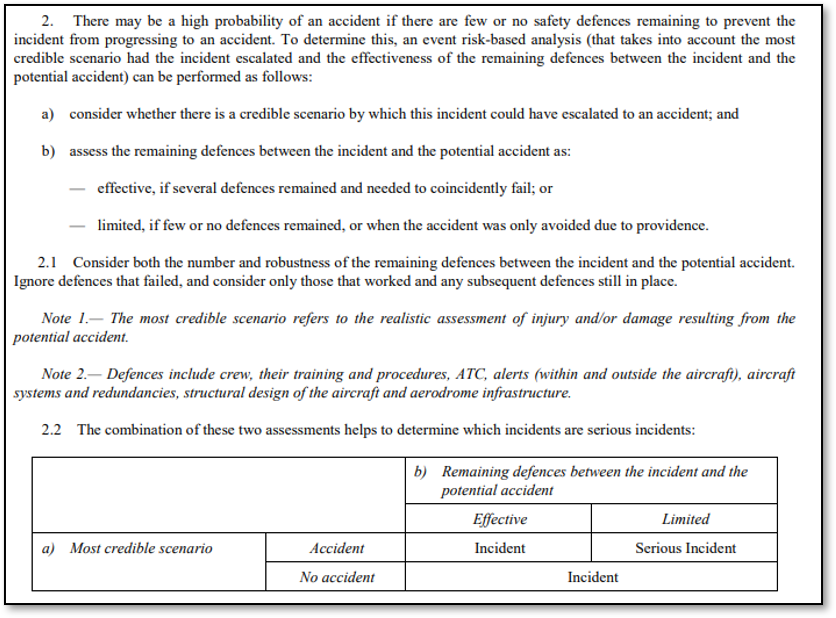
- Annex 13 Attachment C also provides examples of what might constitute a serious incident, but notes that the list is not exhaustive. ‘Controlled flight into terrain only marginally avoided’ is listed as an example of a serious incident. The CAA guidance in AC12-1 reflects this wording.
- The two incidents that occurred in Rotorua in 2020 and 2022 are examples of a serious incident. In both cases the flight crew were alerted to their situations by either ATC and/or the aircraft ground proximity warning system, both of which represent the last remaining defences that can be considered effective. These situations, when escalated to a credible accident scenario, result in a CFIT accident. The only remaining defences rely on human performance; that is, for the flight crew to become aware of their location and respond rapidly. Reestablishing situational awareness and responding appropriately takes time, as does changing an aeroplane’s flight trajectory. Situations in which flight crew inadvertently descend below minimum safe altitude are serious, as acknowledged by the operator itself: ‘With minimal remaining risk controls to prevent a controlled flight into terrain (CFIT) accident, these incidents are assessed as critical by Flight Operations (Air New Zealand Standard Operating Procedures, Supplement Q300 23/17, effective 15 June 2023).
- As part of this inquiry, Commission investigators asked CAA why they had not notified the Commission of the 2022 serious incident in Rotorua. CAA responded that the operator had reported the occurrence to the CAA on 20 July 2022, six days after the incident (operators are required to notify the CAA of serious incidents as soon as practicable under CARs Part 12) and the occurrence was categorised by CAA as ‘minor’ instead of ‘major’. Without the appropriate categorisation, a serious incident notification to the Commission did not occur and the opportunity to investigate the circumstances and causes of the incident was lost.
- There have been other instances of CAA not notifying the Commission of serious incidents. The Q300 descent below profile into New Plymouth on 4 December 2023 was not notified to the Commission as soon as practicable by the CAA and instead the Commission was made aware of the incident via a phone call from the operator on 7 December 2023. While the operator had also called the CAA to notify them of the incident, CAA did not in turn notify the Commission.
- While the CAA may not initially receive sufficient information from an operator’s report to determine whether an event constitutes a ‘serious incident’ requiring an as-soon-as-practicable notification to the Commission, this does not absolve the regulator from fulfilling its obligations under the Civil Aviation Act 1990 (or under the current Civil Aviation Act 2023). It is incumbent on the regulator to have sufficient capability to seek further information from an operator, and to triage reports accurately and efficiently so that the Commission can be notified of all serious incidents and accidents in a timely manner.
- These examples (the Rotorua events in 2020 and 2023 and this event in New Plymouth) show that at that time the regulator was unable to reliably triage reported aviation occurrences and to notify the Commission of serious incidents as soon as practicable. This limited the Commission’s ability to conduct independent inquiries to prevent future risk to transport safety in New Zealand.
- However, CAA has since made enhancements to its triage and reporting processes to ensure that incidents are properly categorised and reported to the Commission where required.
Appendix 1. Q300 instrument displays
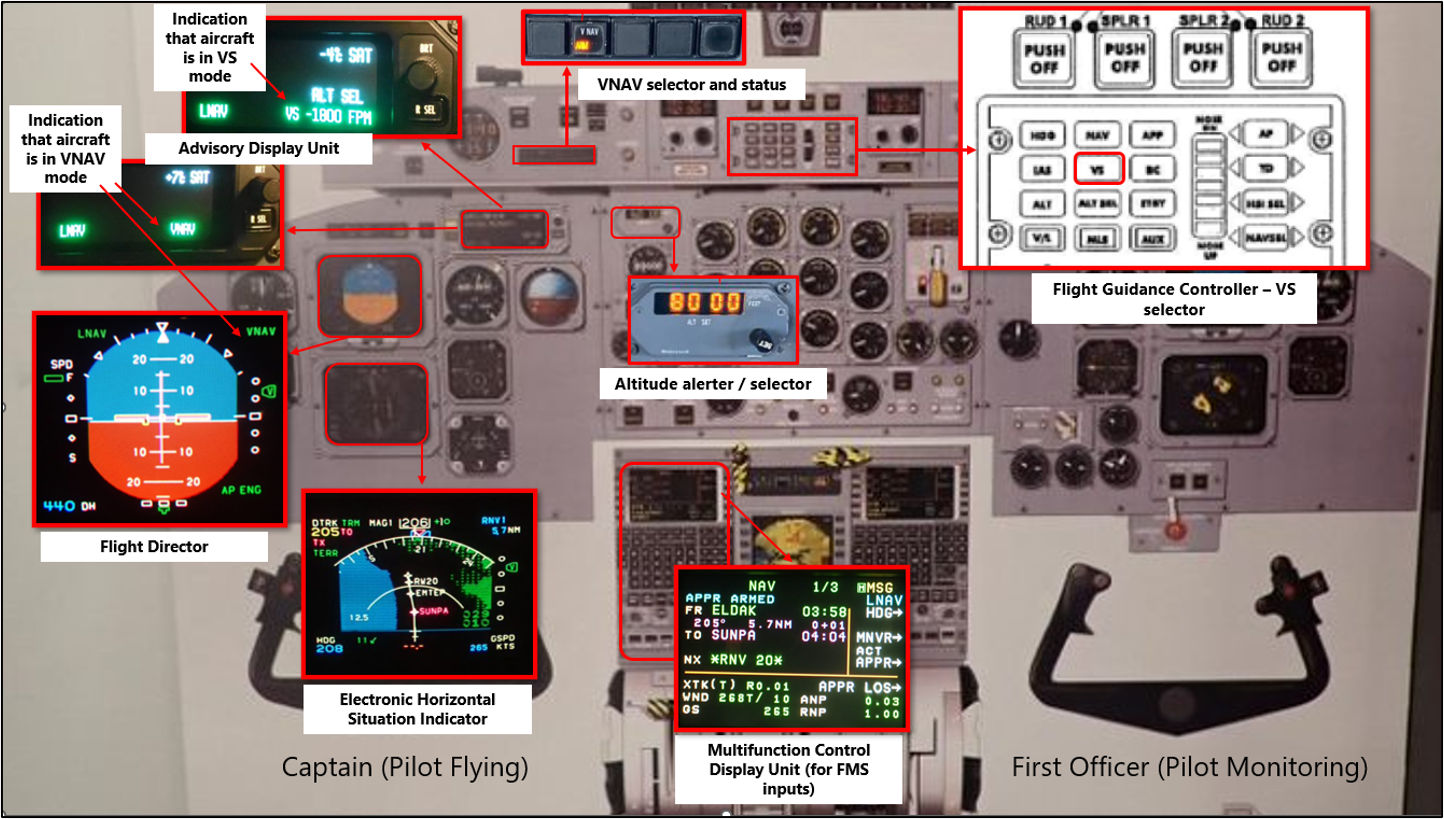
Appendix 2. Q300 Stable Approach Policy
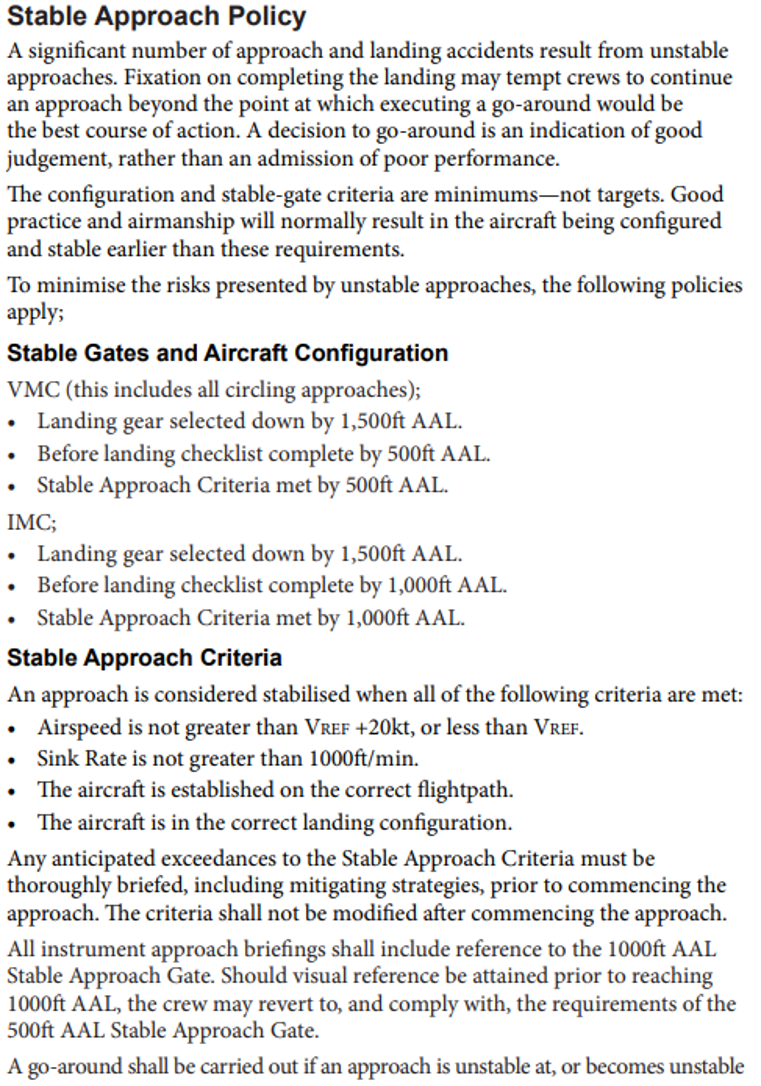
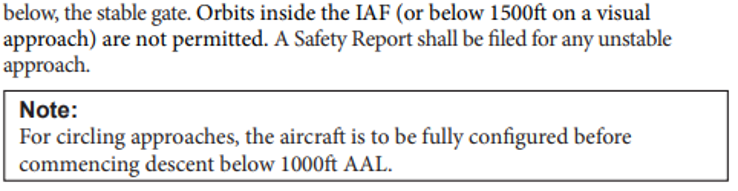
Appendix 3. Timaru approach plate
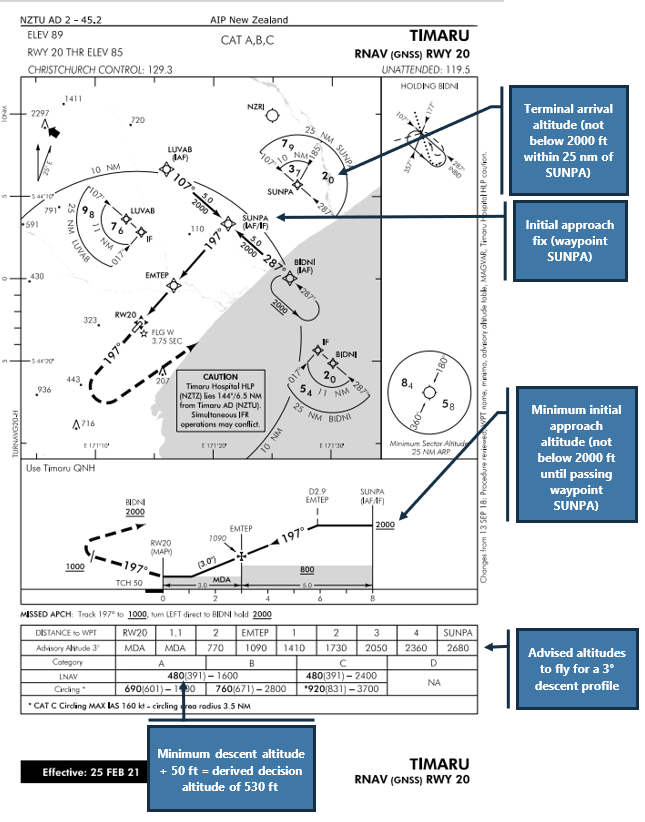
Appendix 4. Q300 Supplement
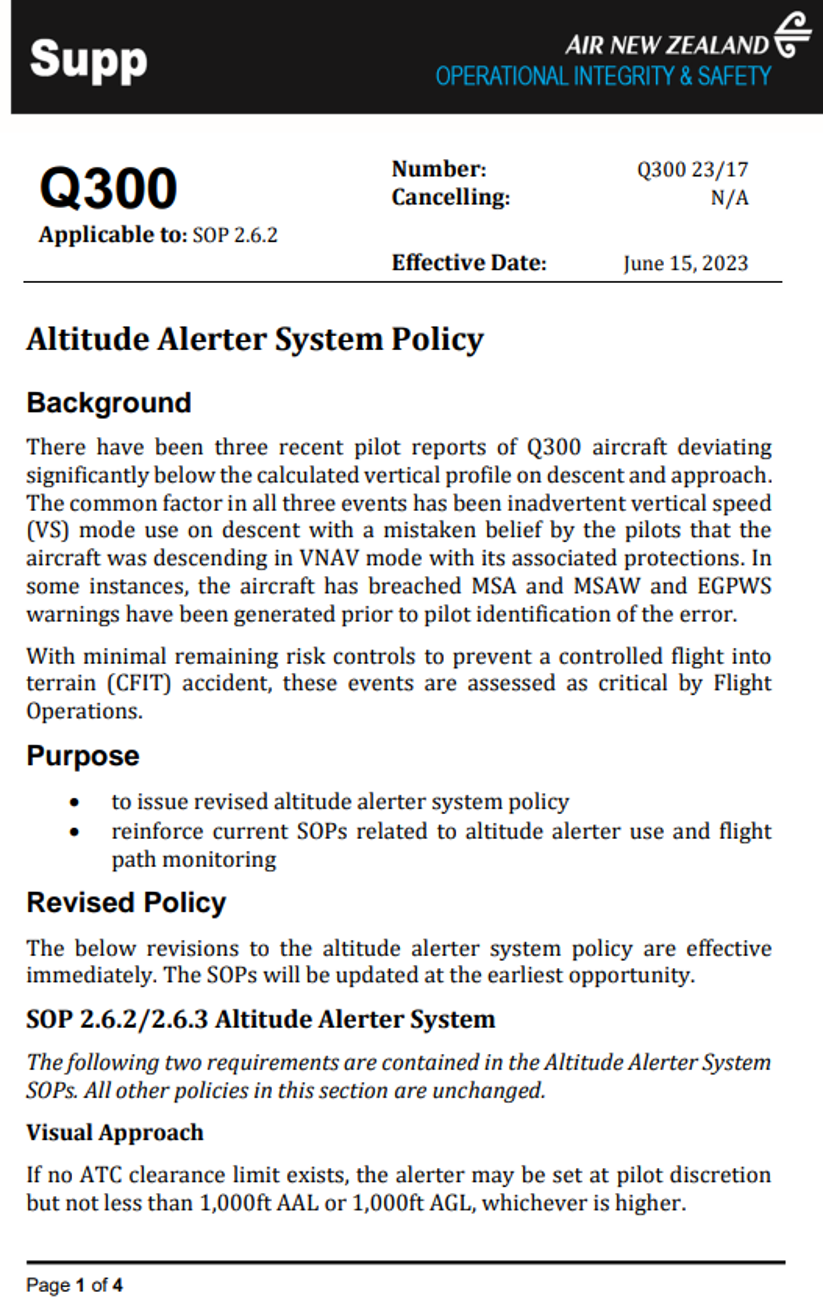
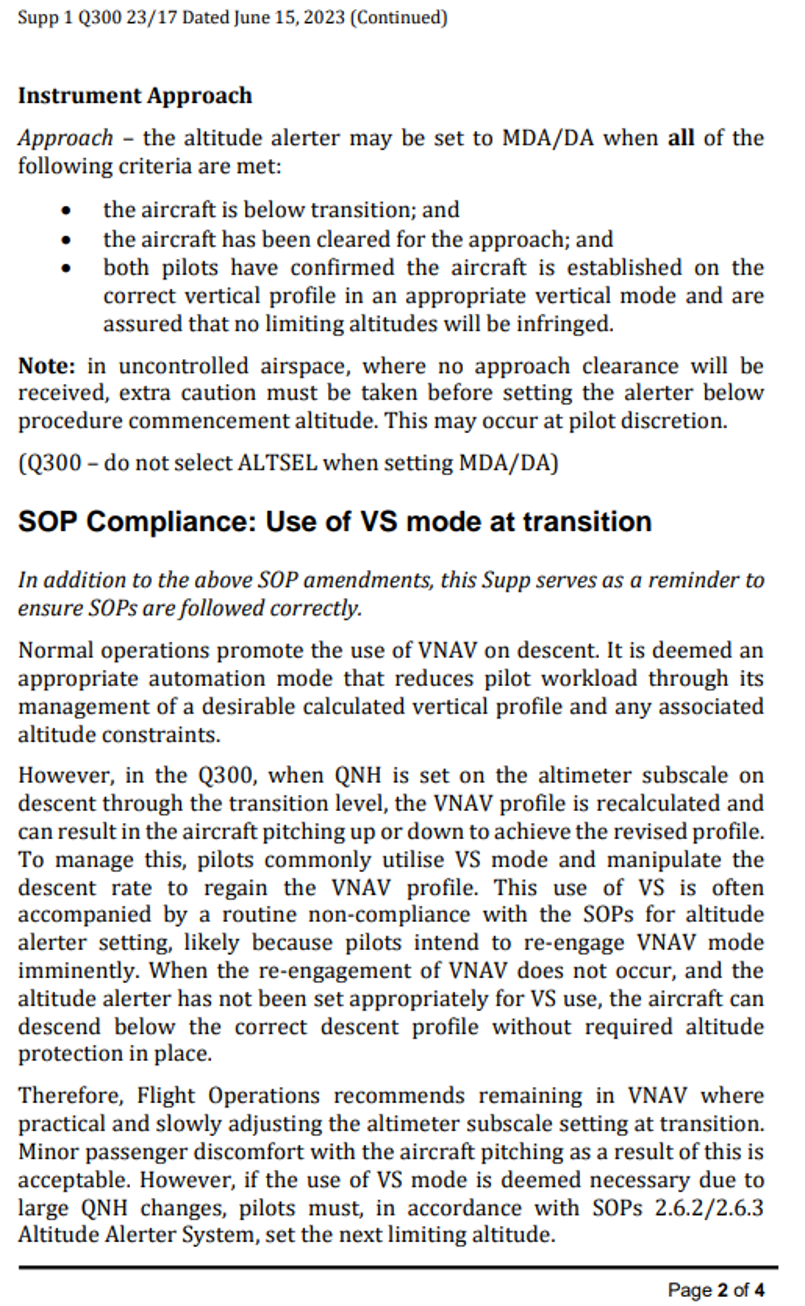
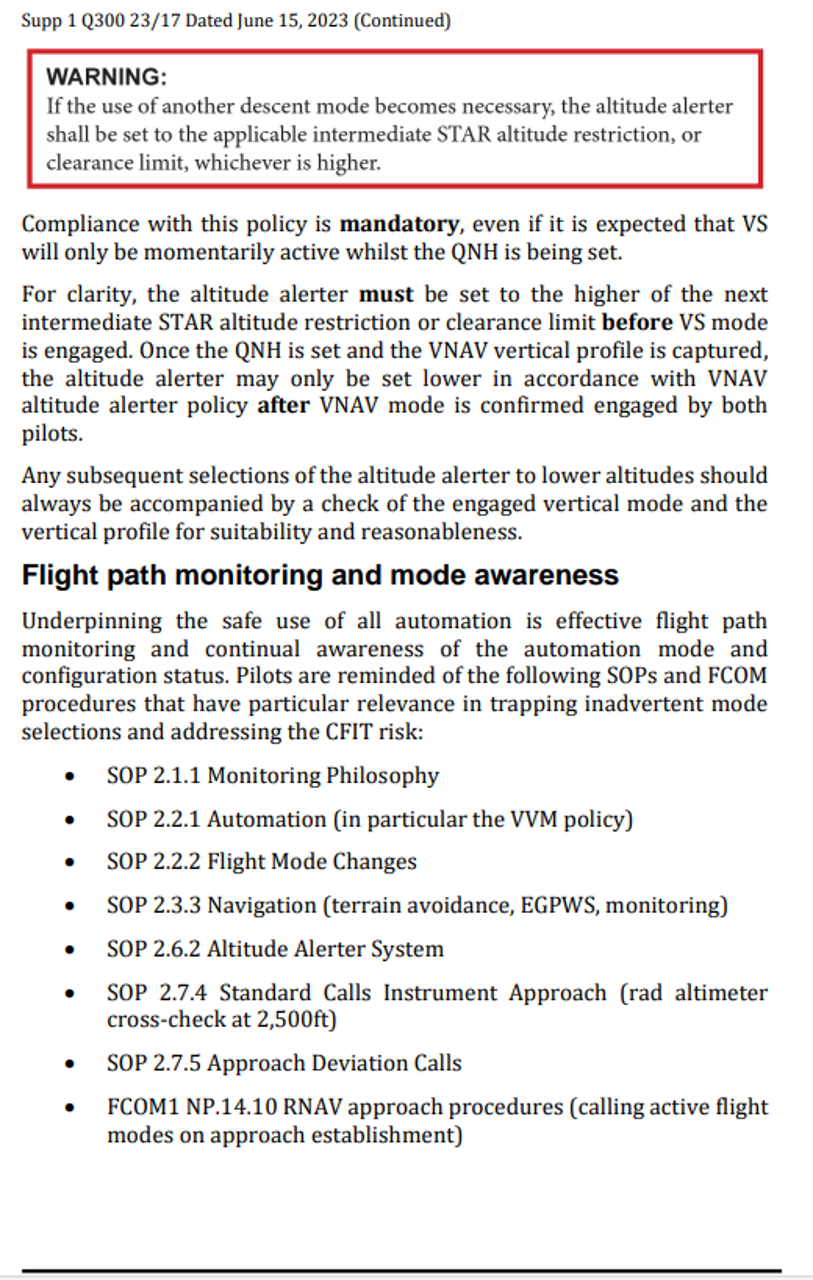
Appendix 5. Air New Zealand recertification plan