
What happened
In June 2023, an Air New Zealand Q300 was flown below the minimum safe altitude at night on approach into Timaru, with 33 passengers and three crew aboard. It descended around 2500 ft below its programmed profile, into airspace with a 2000 ft minimum safe altitude, reaching the lowest recorded altitude of 1156 ft (1022 ft above ground level). Once the captain became aware of the situation, they levelled off, climbed back to profile and continued the approach to land with no damage or injuries.
Why it happened
Cause
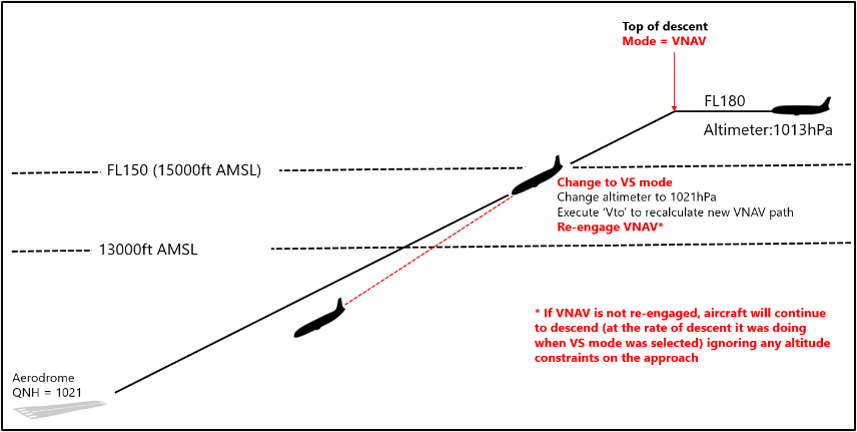
The flight crew were unaware that the aircraft was descending much faster than they were expecting. This was because the autopilot was operating in a different mode than the flight crew thought it was – earlier in the flight, the captain had selected the autopilot to descend in a way that allowed for a smoother approach, but subsequently forgot to change it back to allow the aircraft to follow the approach they had programmed (and were expecting).
In the meantime, both pilots became fixated on visually identifying the Timaru aerodrome lights, which degraded their instrument scanning and flight path monitoring, so neither noticed the faster-than-expected descent. The pilots eventually discovered and corrected the error, but the aircraft was already below the minimum safe altitude for that approach.
TAIC found that other Q300 pilots had experienced similar occurrences, including occasions of breaching minimum safe altitudes. Other Q300 flights that had been significantly low on approach for different reasons, but the crews had not taken appropriate recovery actions.
Other factors
Detection failure: task fixation and ineffective CRM meant that neither pilot noticed the error, and neither took corrective action until the deviation below minimum safe altitude became significant.
Aircraft design: The Q300's flight management system relies on flight crew manipulating different autopilot modes to ensure a smooth descent and then remembering to return to the correct mode -- but that workaround was vulnerable to pilot error.
Procedural protection: the crew didn't set the altitude alerter to warn them before breaching the minimum safe altitude. Air New Zealand's own investigation found this was routine across the fleet; pilots expected to switch back to VNAV almost immediately, so didn't reset it.
Pattern of prior occurrences: the Commission found six earlier Q300 events where crews inadvertently stayed in the wrong descent mode or didn't monitor the descent properly and ended up below the approach profile. Two more happened after this inquiry opened — again without a go-around. This led the Commission in February 2024 to issue an urgent recommendation to the CAA (see below)
Training and experience: The number of Q300 incidents that involved deficiencies in crew resource management was attributed to Air New Zealand’s training programme not adequately addressing the risks associated with Q300 pilots who were joining the airline with comparatively less multi-crew experience.
Organisational culture: four years after Air Nelson and Mount Cook were integrated into Air New Zealand in 2019, the Q300 fleet's safety culture still wasn't aligned with Air New Zealand's expectations on risk. This was likely due to the integration's timeframe and the impact of Covid-19.
Regulatory oversight: impartial oversight by the CAA of Air New Zealand’s safety management system likely impeded by regulatory relationship that was too close in nature.
Safety issues already resolved
The Commission was satisfied safety action already taken addressed each of these, so made no recommendation.
On 21 February 2024, the Commission recommended the CAA require Air New Zealand to show it was adequately addressing recent Q300 safety events and managing the risk of flight crews not following correct recovery actions.
Management of descent: the fleet's practice for managing vertical flight path through transition didn't adequately protect against a mode selection error.
- Two days after the incident, the operator changed its altitude alerter policy so minimum descent altitude can only be set once below transition. From February 2024, it required pilots to say out loud mode changes for cross-checking and revised its emergency ground proximity warning policy.
Training: the number of occurrences involving technical and CRM deficiencies showed training was insufficient.
- Air New Zealand reports improved go-around behaviour and fewer unstable approaches since changes to go-around decision-making, high-workload scenarios, CRM and deviation-call training.
Q300 fleet safety culture: integrating three cultures left the Q300 fleet's safety culture misaligned with Air New Zealand's.
- From September 2023, Air New Zealand management led a cultural reset programme for all Q300 pilots covering, procedure compliance, threat and error management, and risk decision-making.
Known safety issues not managed effectively: V/S mode errors were a known hazard on the Q300 fleet. Despite a number of precursor events, prevention controls were ineffective
- Air New Zealand reports improved safety monitoring ) and increased capability within their Operational Safety Team.
Regulatory oversight: CAA oversight was ineffective and didn't match the scale of change.
- Oversight is now more risk-based: one manager controls monitoring, certification, triage and risk assessment; the 2025 AOC renewal was risk-based and intelligence-led (unlike the 2020 desktop exercise); a structured policy now guides licensing decisions to reduce subjective calls and capture risk; occurrence triage now looks for systemic patterns.
Cockpit voice recordings: post-incident procedures didn't reliably preserve CVR data.
- Following the July 2023 Nelson event, Q300 incident follow-up guides were aligned with the ATR fleet's, instructing pilots to pull the CVR circuit breaker after any serious incident in the preceding 30 minutes.
CAA notifications to TAIC: two prior serious Q300 incidents should have been notified to TAIC but weren't.
- CAA's triage and reporting processes now ensure incidents are properly categorised and reported where required.
Safety issues yet to be addressed
The Commission has made recommendations on two issues not yet resolved by safety action taken so far (please refer to report for exact working).
FMS/avionics: the FMS couldn't calculate a smooth descent through transition, driving the V/S workaround. Air New Zealand is working with De Havilland Canada and Universal Avionics on a fix, and DHC has begun work — but the issue remains unresolved.
- TAIC has recommended that Air New Zealand continue working with De Havilland Canada toward a technical solution enabling the FMS to calculate a smooth descent through transition, removing the need for the workaround.
CVR capability: NZ rules require only two hours' recording, risking evidence being overwritten. CAA has identified this and plans to raise it at a fI’ve added a new fact sheet on p.3 of the crib sheetuture ICAO forum but hasn't yet acted.
- TAIC has recommended that the CAA, through the International Civil Aviation Organisation, promote the extension of CVR recording requirements to all transport aircraft required to carry a recorder.