
Safety issues and recommendations
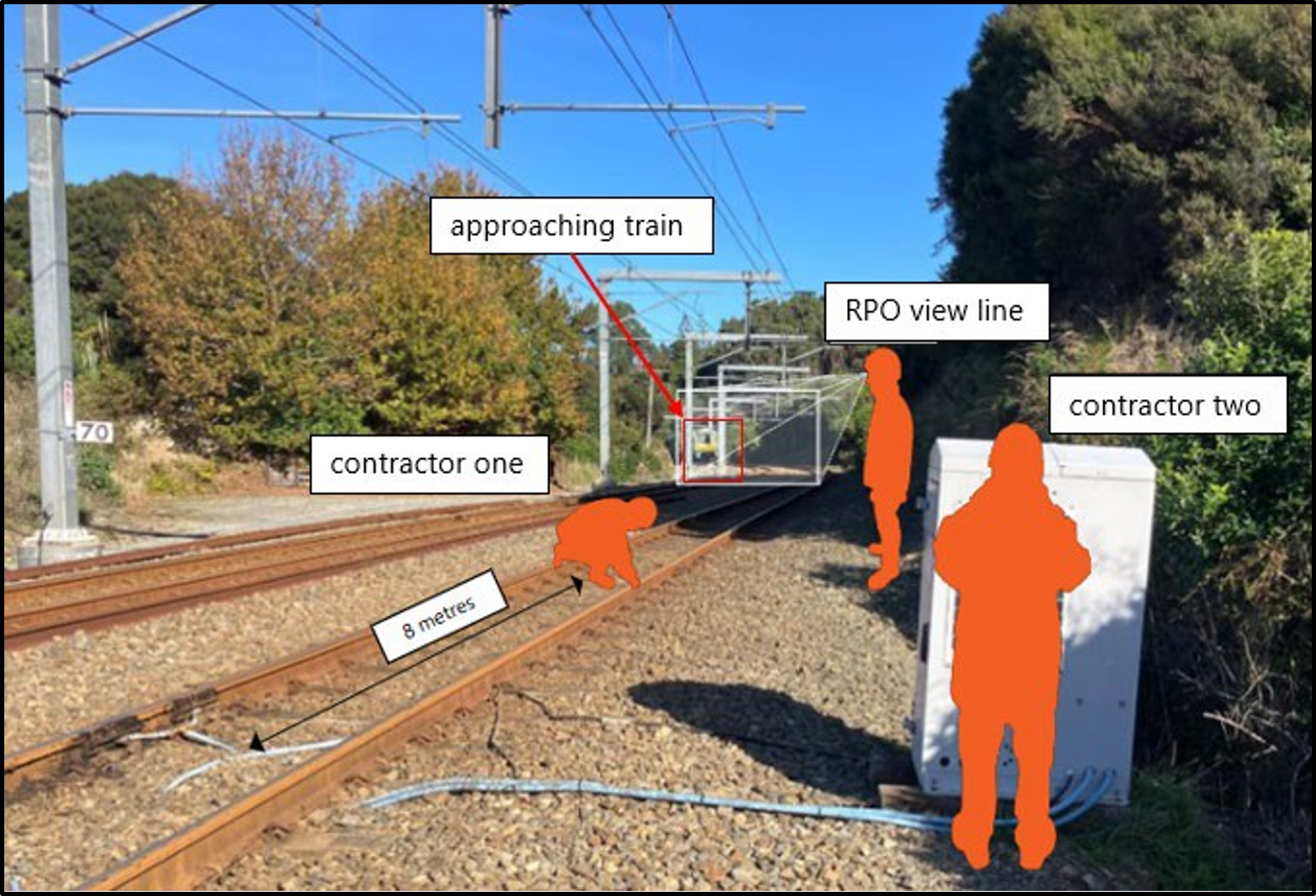
1. KiwiRail’s process for determining worksite protection did not identify all the relevant risks nor consider the practicality of the protection. In this case the applied protection method differed from the approved method.
- KiwiRail has accepted the Commission’s recommendation to address this issue. [Recommendation 024/26]
2. Contractor management. Neither of the two subcontractors held the competencies or medical certification required to work in the rail corridor, and there was no effective system to verify this. KiwiRail’s management and oversight for contractors in the rail corridor was inadequate and increased the likelihood of unqualified contractors working there unsafely.
- KiwiRail has set up auditing oversight and a system to alert RPOs, managers and elected staff about expiration of certifications.
3. KiwiRail’s assurance processes inadequate - did not identify unsafe work practices, increasing the risk of unsafe working in the rail corridor. In this case, we saw that non-compliant use of Individual Train Detection may have become normalised in some locations. The RPO had repeatedly completed worksite documentation incorrectly, but there was no robust audit system for checking this documentation or the ITD records.
- KiwiRail has accepted the Commission’s recommendation to implement procedures to formally audit worksite rail protection measures being used by RPOs to ensure they are complying with protection requirements. [025/26]
4. Emergency braking on Wellington passenger trains: Transdev’s trains do not send an automatic radio call to train control when emergency braking is applied. This could result in a delay in implementing an emergency response.
- The Commission has previously identified this issue in a report on the derailment of a passenger train on the Kāpiti Line and recommended that Transdev Wellington adopt systems to automatically notify train control when emergency braking is activated.
-
Transdev Wellington has addressed this issue. Greater Wellington Regional Council has agreed to modify the Matangi fleet to incorporate the automatic alert system. The project is scheduled for completion by June 2027.
The lesson for all leaders of safety-critical work
The lessons are not limited to rail. Safety-critical work depends on more than having rules and procedures. Organisations need to ensure their controls fit the practical circumstances of the work, that everyone understands what is expected and who is responsible, that agreed procedures are followed, and that there is effective assurance that the controls are working.
Leaders and managers can ask four straightforward questions of their own safety systems:
- Are our controls practical?
- Does everyone understand them?
- Does everyone follow them?
-
Do we check that they are working?
A recurring Watchlist safety challenge - seven reports, one safety message
The TAIC Watchlist identifies recurring issues including procedures that do not meet national standards, procedures not being followed, miscommunication and fatigue-related impairment. These issues have repeatedly put people working in the rail corridor at risk.
https://taic.org.nz/watchlist/safety-workers-rail-corridor
Plimmerton is the seventh TAIC report in 15 months examining safety issues involving workers in the rail corridor. The seven incidents occurred in different circumstances and across New Zealand. But taken together, the reports show recurring weaknesses in systems intended to protect workers — including procedures, communication, competence, supervision and management assurance.
Together they point to a straightforward message: Rules, procedures and safety controls only protect people if they are practical, understood, followed and checked.
- Plimmerton: the required protection method was not practical for the circumstances in which the work was being carried out. The result was a workaround that was not permitted. RO-2025-106
- Kaimai, Waikato: a freight train collided with a stationary hi-rail vehicle. The crew jumped clear before the collision. TAIC highlighted weaknesses in arrangements for protecting track workers and preventing rail traffic entering an occupied worksite. RO-2025-105
- Morrinsville, Waikato: a freight train passed two stop signals and entered a section of track where track workers and a hi-rail vehicle had permission to be. Key factors included driver distraction, workload management and signalling-system issues. RO-2025-104
- Port Chalmers, Dunedin: wagons that had not been properly secured rolled from a marshalling yard and struck a locomotive being worked on. Limited radio communication and failure to follow the approved process were factors. RO-2025-102
- Hornby, Canterbury: four track workers cleared the worksite just before a train passed through. An ineffectively supervised trainee RPO had mistakenly authorised them onto the worksite while the train was still approaching. RO-2024-102
- Mataura, Southland: a freight train travelled at 77 km/h through a worksite where a 10 km/h temporary speed restriction was in place. The driver had not been told about the restriction in time. RO-2025-101
- Purewa, Auckland: a track machine derailed inside the tunnel after being authorised to enter a worksite where track had been removed. Key safety information had not been shared and staff were under-resourced. RO-2023-105