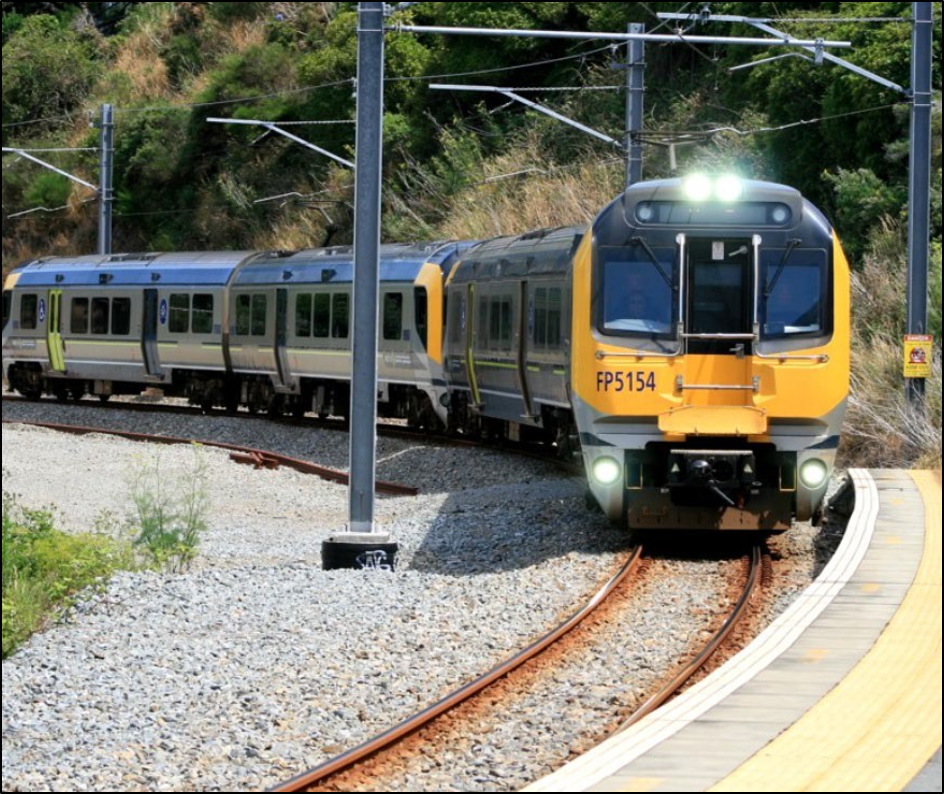
A passenger train came within 5 metres of two track workers at Plimmerton in May 2025. TAIC found the required protection was difficult to use in the circumstances, while weaknesses in contractor management and assurance allowed unsafe practices to go undetected. The report highlights a wider lesson for all safety-critical organisations.
Executive summary Tuhinga whakarāpopoto
What happened
- At about 0900 (times in this report are in New Zealand Standard Time (Universal Coordinated Time +12 hours) expressed in a 24-hour format) on 8 May 2025, a KiwiRail rail protection officer (RPO) (certified person who establishes worksite protection within the rail corridor) and two subcontractors met at Plimmerton Domain car park, north of Wellington. They travelled north for about one kilometre along the North Island Main Trunk (NIMT) (the main rail network between Auckland and Wellington) access road to conduct planned maintenance work on a track grease applicator (applies grease automatically to the inside of the rail head to reduce wear and noise).
- At about 0920, they arrived at the worksite. The RPO established protection (to protect workers from moving rail traffic) for the worksite and the subcontractors started work under the supervision of the RPO.
- At 1014, an empty passenger train travelling north rounded the curve at 62 kilometres per hour on approach to the worksite. The trainee locomotive engineer observed two people on the track ahead and immediately applied the train’s emergency brake.
- The two workers cleared the track as the train came to a stop only metres from the workers location. No injuries to individuals or damage to rail vehicles or infrastructure occurred.
Why it happened
- The RPO did not use the planned worksite-protection system as documented. This allowed rail traffic to continue running as normal.
- The subcontractors were unaware of the type of worksite protection established and were working under the direction of the RPO.
- KiwiRail did not regularly audit RPO worksite-protection documentation to ensure RPOs were applying the correct method of worksite protection.
What we can learn
- Following prescribed safety rules and procedures is important. They apply risk-based safety control measures to prevent accidents and incidents and ensure a safe and secure working environment for everyone.
- Implementing a just-culture working environment (an organisational approach that balances accountability and learning when dealing with errors, incidents or near misses) and strong safety leadership, with internal auditing and regulatory assessment oversight, ensures that safety-critical worker-protection systems are correctly applied and adequately managed.
Who may benefit
- Rail personnel and organisations that conduct safety-critical operations may benefit from the findings in this report.
Factual information Pārongo pono
Background
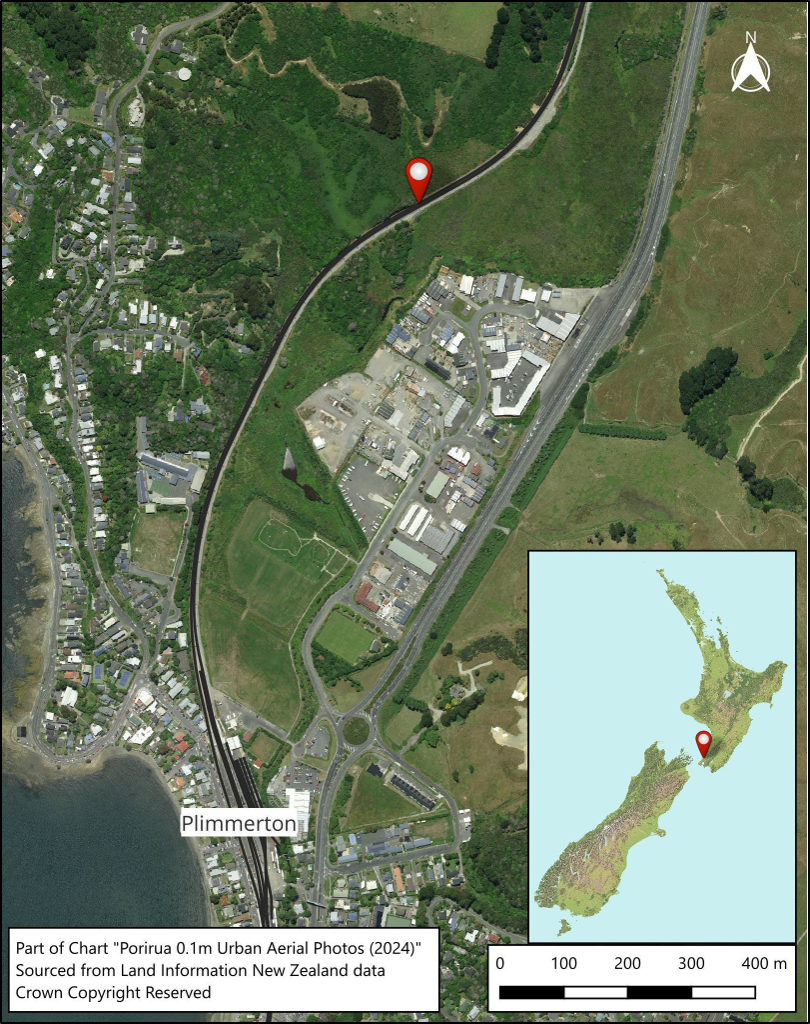
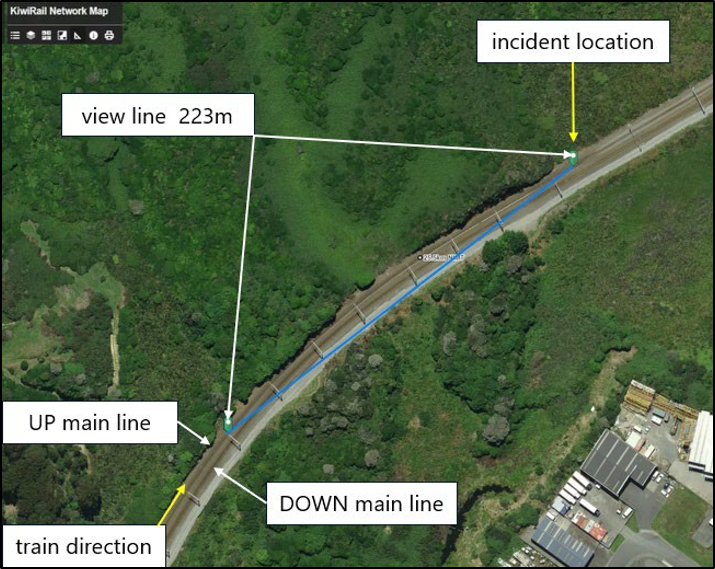
- The incident occurred on the NIMT, north of Plimmerton, Wellington, at the 25.65 kilometre (km) location. The track layout consisted of two tracks: the UP main for rail traffic travelling towards Auckland and the DOWN main for rail traffic travelling towards Wellington.
- The track leading into the incident area featured a slight upward gradient and a right-hand curve rated for a maximum speed of 70 kilometres per hour (km/h). Visibility along this curve was restricted; line of sight was limited to approximately 223 metres (m) from the approach to the incident location on the UP main line (see Figure 3).
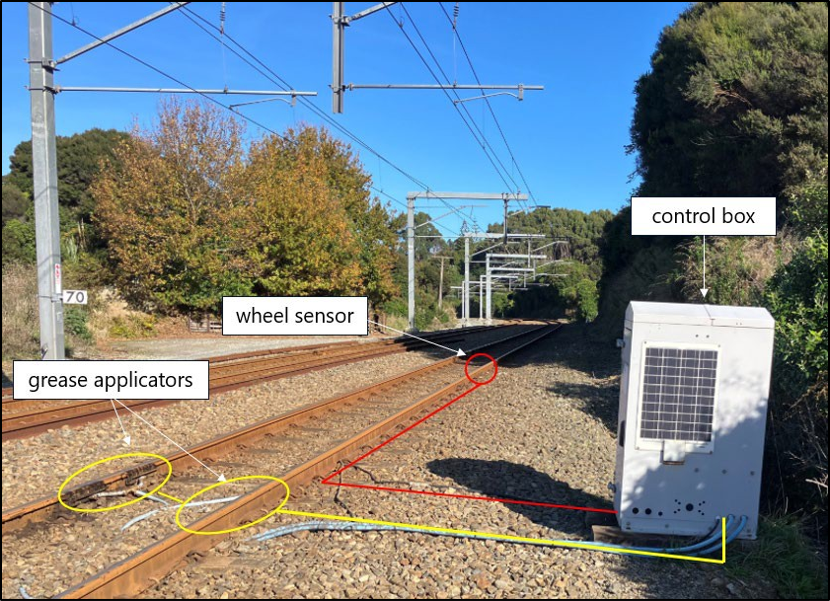
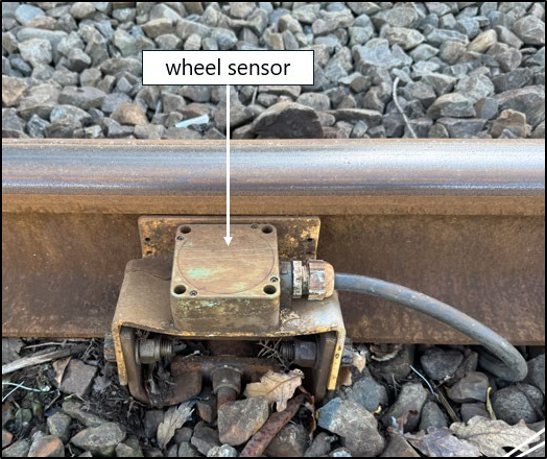
- The worksite included an automatic grease-dispenser control box, a track grease applicator and a train wheel sensor. The wheel sensor was positioned 8 m south of the track grease applicator (see Figure 4).
- The automatic grease-dispenser system was fitted in October 2014 by Industrial Lubricants and Services Limited (ILS).
Track workers involved
- KiwiRail rail protection officer (the RPO) was assigned to the job to ensure the contractors had adequate protection from rail traffic.
- Subcontractor one (SC1) was subcontracted by ILS to complete regular maintenance on the grease-dispenser equipment in the Wellington rail corridor (the land between the legal boundaries of railway land, or land within 4 m of the centreline of any operational track where the land boundary is less than this distance).
- Subcontractor two (SC2) was subcontracted by ILS to fix the grease dispenser’s missing wiring and electrical components and inspect the solar-panel system.
Repair work and protection
- ILS had a contract with KiwiRail to fit and maintain grease dispensers and trackside friction applicators to assist with rail adhesion at locations identified throughout KiwiRail’s rail network.
- On 18 January 2025, approximately three months before the incident, routine maintenance at the site identified that the grease dispenser had possibly been vandalised and parts from the control box were missing.
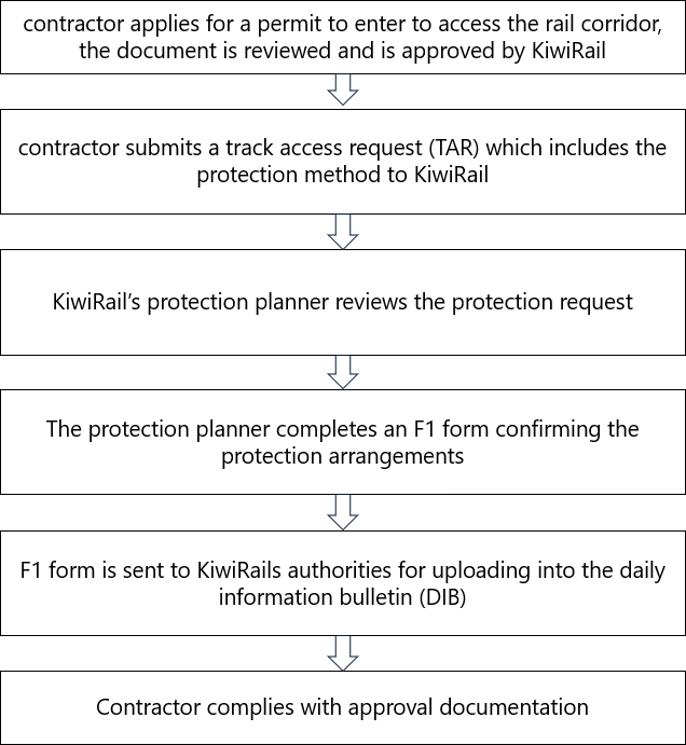
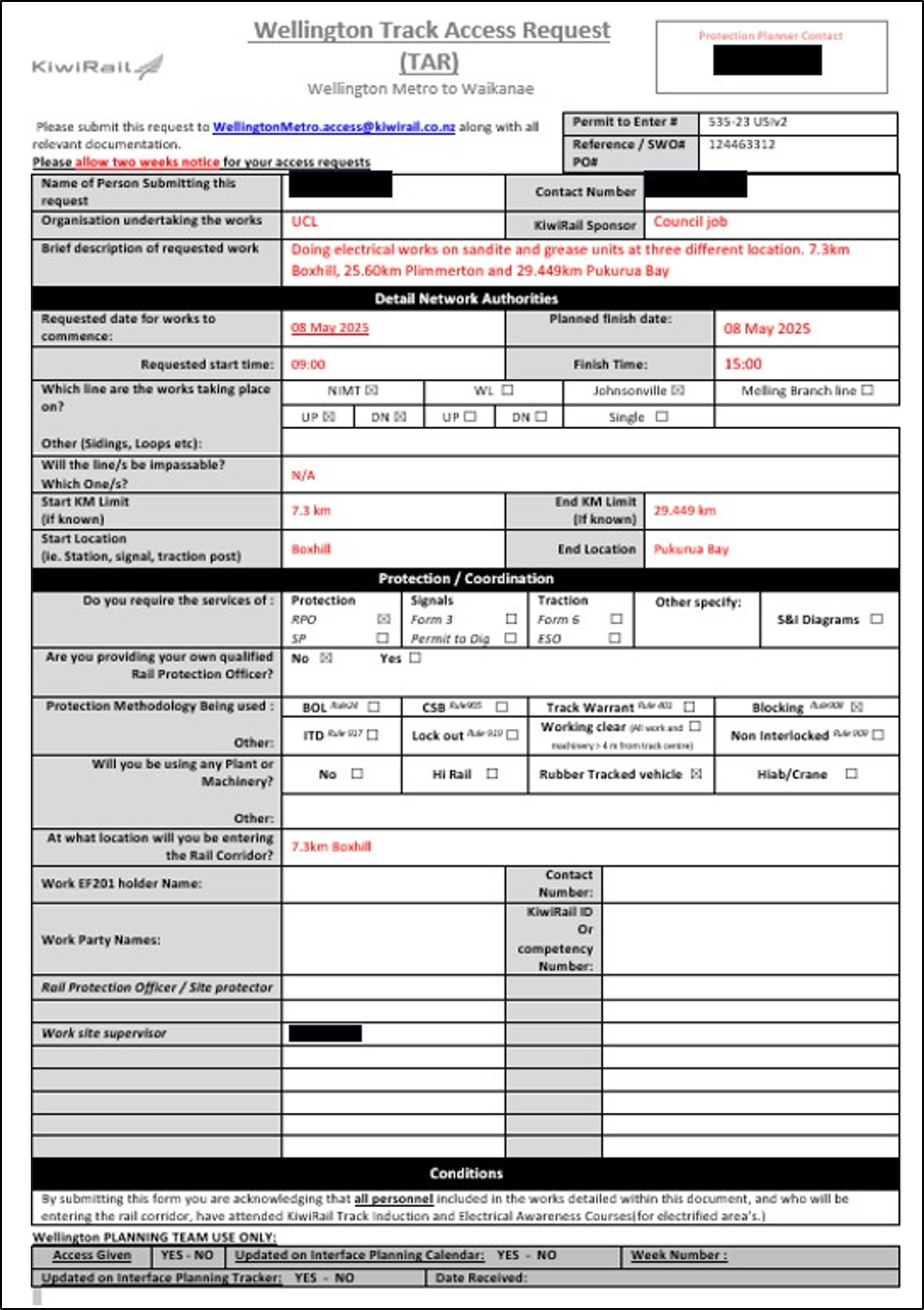
- ILS submitted a Track Access Request (TAR) (a formal request made to KiwiRail to secure specific dates and times for access to the rail network so that work can be carried out safely on or near the tracks) form to KiwiRail’s Wellington metro protection planning group. The form requested blocking protection at the worksite to prevent rail traffic entering the worksite area, allowing the contractors to maintain and fix the grease applicator.
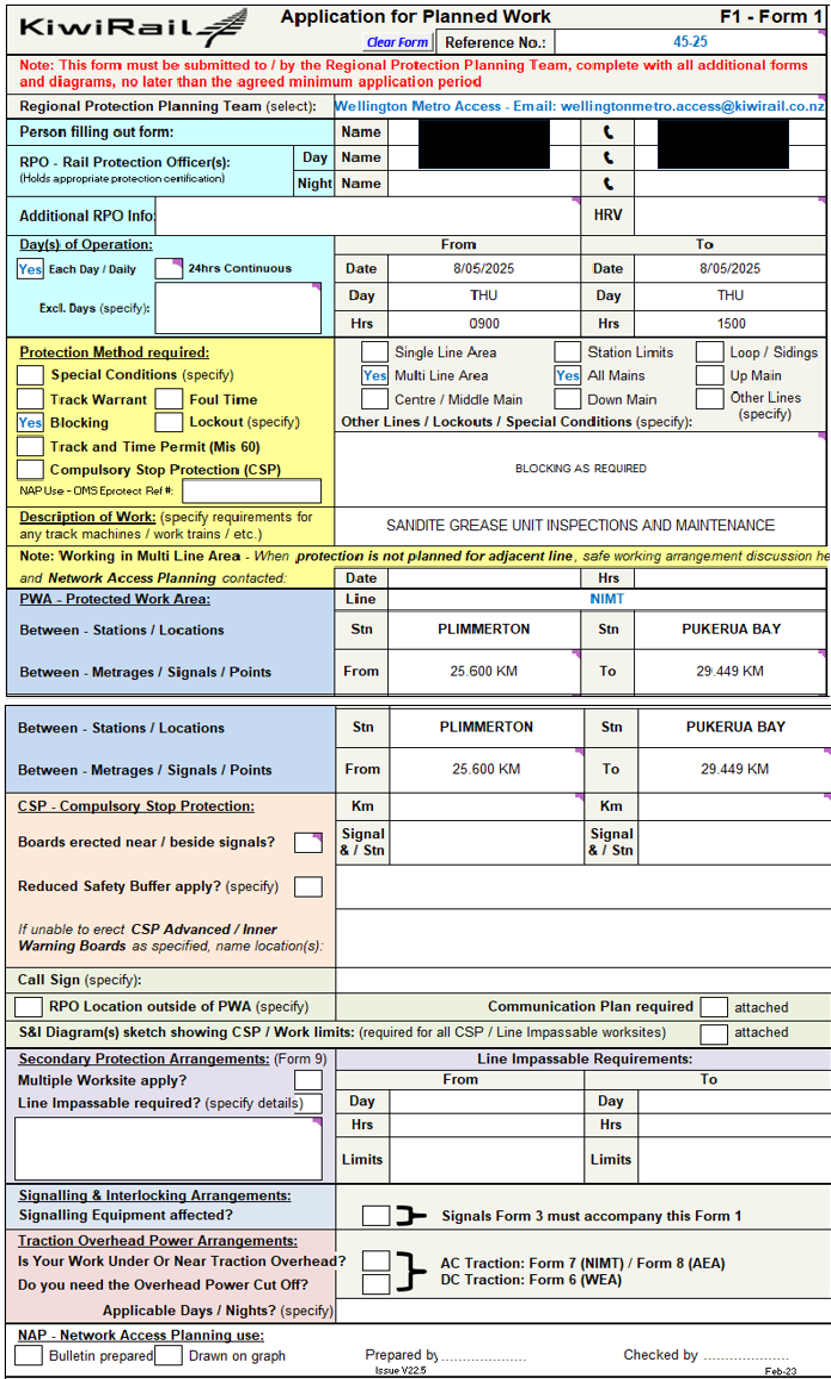
- KiwiRail’s Wellington metro protection planning group reviewed and approved the TAR request. The planner completed an F1 form (the F1 form records the approval process followed by KiwiRail’s planning protection and records the details of the TAR) to approve the protection method. This allowed the next stage of the request to be processed by KiwiRail’s authority department and to be recorded and published in the Daily Information Bulletin (DIB) (a document that contains information about worksites locations, protections to be used and train movements on the rail network).
- The work was classified as light maintenance and therefore did not require the protection group to undertake a train frequency assessment.
- SC1 was subcontracted to ILS to complete the scheduled repairs and maintenance. SC2 was subcontracted to ILS to install the missing wiring loom and batteries, and to inspect the solar-panel system.
Narrative
- At about 0830 on 8 May 2025, a KiwiRail RPO arrived at Plimmerton Domain car park. They were to meet SC1 and SC2, who were assigned to repair a trackside grease-dispenser control box located approximately 1 km north of the car park.
- By about 0918, both subcontractors had arrived. The RPO opened the access gate so the contractors could follow them, in separate vehicles, to the worksite along anaccess road next to the rail corridor.
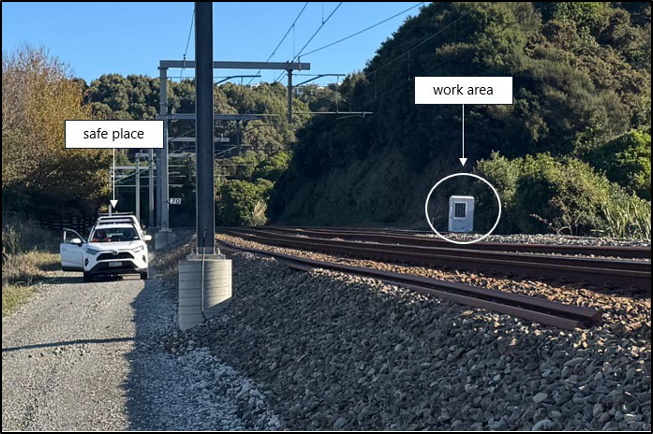
- At 0921, they arrived at the worksite and parked their vehicles on the access road (see Figure 5). The RPO then realised they did not have their work-issued iPad or reading glasses. They attempted to use their iPhone to complete the Individual Train Detection (ITD) (a safe working system that does not prevent rail vehicles from entering an occupied section of track. It is a safety check process that enables workers to access specific areas of the rail corridor as individuals, or as a group. An observer must identify train movements and alert track workers to move to the designated safety place) protection arrangements.
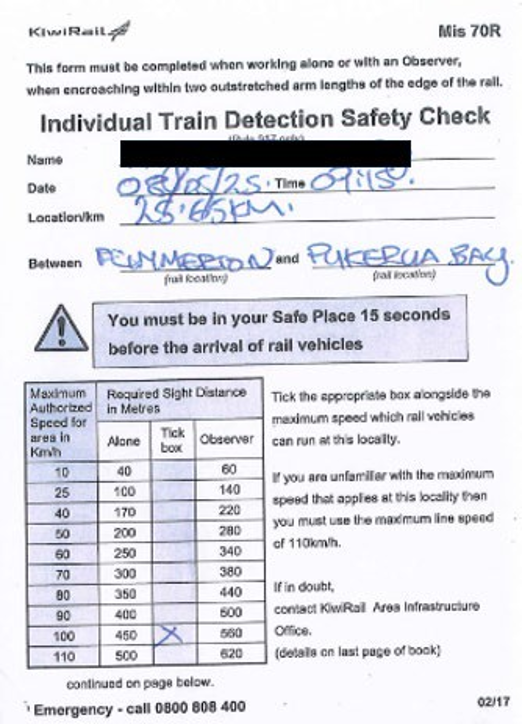
- The RPO could not complete the ITD digital form using their iPhone, so instead used a paper-based Mis 70R form (see Figure 6). KiwiRail rules and procedures did not permit ITD at this location. It was also not the protection system outlined on the DIB dated 8 May 2025. For additional information on the use of ITD see Section 3 of this report.
-
Following the completion of the Mis 70R, the subcontractors began unloading tools and equipment from their vehicles. The RPO and the two subcontractors crossed the two tracks to the other side of the rail corridor where the control box was located.
-
SC1 accessed the top of the control box to refill the grease tank. They could see that it was already full as the dispenser had not been working.
- SC2 opened the front access door on the control box and started to replace the missing wiring loom. In this position they had their back turned to any approaching rail traffic.
- The RPO stood next to the control box to alert the two subcontractors of any approaching rail traffic.
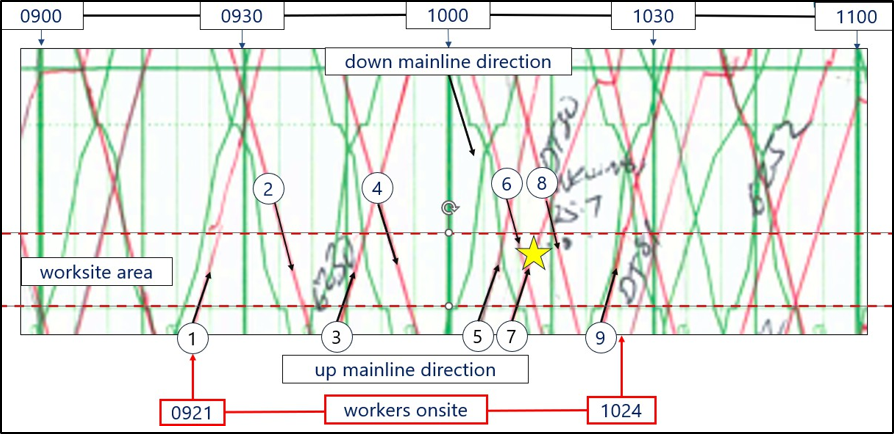
- During the period that they were at the worksite (63 minutes), nine trains passed (see Figure 7). The green lines represent the scheduled train movements as per the timetable, while the red line indicates the actual time each train passed.
- SC2 installed the missing components and saw that when the last train passed over the track grease dispenser it had failed to activate. They spoke to SC1 about the fault and continued with additional checks of the solar panel on the side of the control box.
- SC1 walked south, away from the control box, alongside the UP main line outer track. They were inspecting for damage to the wire that ran from the control box to the wheel sensor (the sensor), approximately 8 m away.
- On arriving at the sensor, they determined that the supporting bracket had dropped downwards. This meant the sensor was not functioning correctly when train wheels passed over it (see Figure 8).
- SC1 walked back to the control box and retrieved the tools needed to lift the sensor to the correct height.
- On arriving back at the sensor, SC1 knelt between the tracks and started lifting the sensor into its correct location. As they were doing this, a northbound empty passenger train (DT80) (used to oversee on-job training and supervision of locomotive engineers), operated by Transdev Wellington, approached the worksite on the UP main track.
- The train was travelling at 62 km/h and rounded the curve approximately 220 m away from SC1’s location (see Figure 9).
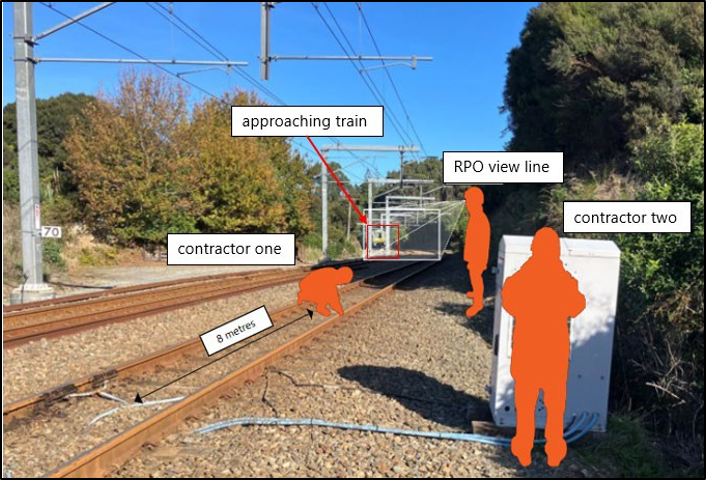
- The RPO saw the train approaching and called out to alert SC1. SC1 did not respond because they were focused on removing a ring spanner that had become stuck vertically on the sensor equipment. The RPO moved towards SC1 to get their attention.
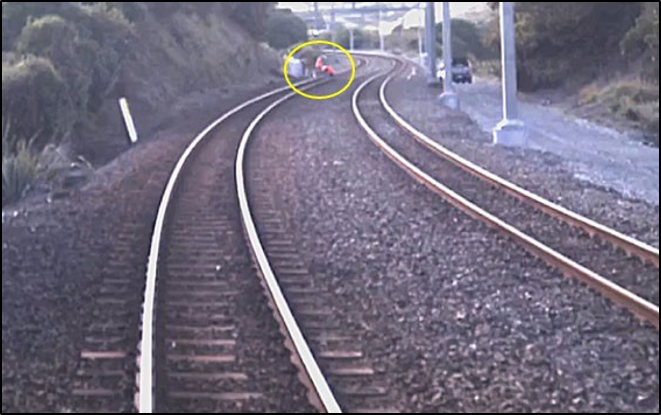
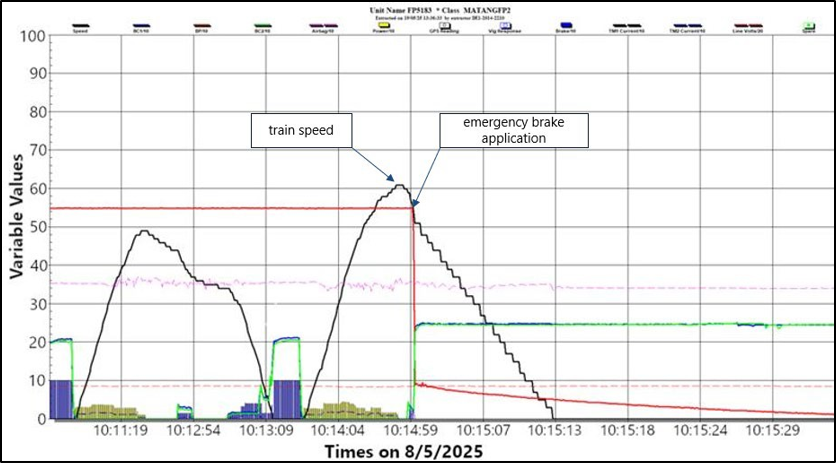
- The trainee locomotive engineer (TLE) (a locomotive engineer undertaking on-job training as part of their certification process) of DT80 saw the two workers wearing orange high-visibility vests in the middle of the UP mainline (see Figure 10). At 1014:55 the TLE took swift action and applied the train’s emergency brake, approximately 180 m from the workers’ location.
- The RPO reached SC1 and pulled them upward and away from the track. At the same time the ring spanner was dislodged.
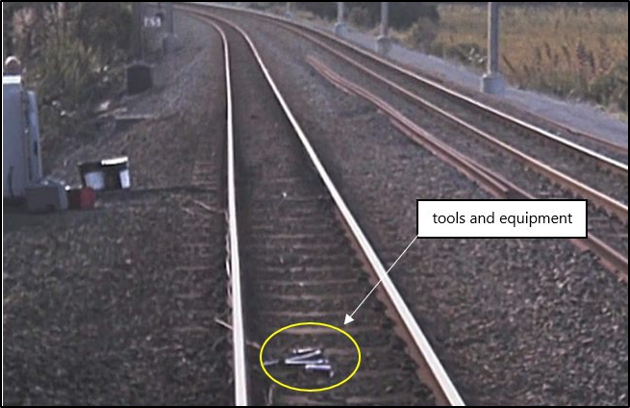
- At 1015:11, the train stopped approximately 5 m before where SC1 had been working. Their tools and equipment remained in the centre of the track (see Figure 11).
After the incident
- The locomotive-engineer supervisor (LES), who was supervising the TLE, opened the train’s cab window to check on the wellbeing of the RPO and SC1. They asked whether the train could proceed over the remaining hand tools and equipment left inthe centre of the track.
- The RPO responded that neither of them was injured and that the tools would not pose a hazard to the train's movement.
- The train continued north to Pukerua Bay station. As the train departed the incident site, a Transdev Wellington employee (a total of four Transdev staff were on the train: two driver supervisors and two trainee locomotive engineers who were sharing the driving and supervision duties on the day of the incident) on the train used their mobile phone to contact train control (a certified person who controls the movement of trains on the rail network) to report the near miss.
- Train control was unaware of any scheduled work at that location and initially thought the workers were trespassers.
- Train control notified the network control manager (rail personnel who oversee rail network operations and responses to rail incidents or accidents) of the incident, then contacted the RPO. The RPO confirmed that their work group had been involved in the near miss and had since completed work at the site. They acknowledged that they had notreported the incident.
-
The RPO informed their manager of the incident and returned to the Wellington depot to undergo post-incident impairment testing, which produced a negative (clear) result.
Personnel information
KiwiRail rail protection officer
- The RPO had been employed by KiwiRail since 2021. They had 20 years of industry experience as an RPO and were certified for the role at the time of the incident.
Subcontractor one
- SC1 had previously worked as an employee for ILS and had recently retired and become a contractor. They did not have all the required KiwiRail qualifications to undertake work in the rail corridor at the time of the incident.
Subcontractor two
- SC2 was an automotive electrician who was contracted by ILS to fix the grease dispensers. They did not have all the required KiwiRail qualifications to undertake work in the rail corridor at the time of the incident.
Trainee locomotive engineer
- The TLE was employed by Transdev Wellington and certified for the role at the time of the incident.
Locomotive engineer supervisor
- The LES was employed by Transdev Wellington and was supervising the TLE in the cab of the train at the time of the incident. They had the correct certification to supervise on-job training at the time of the incident.
Train information
- The train DT80 was a Wellington-based electric multiple unit (EMU). The train consist (the configuration of a train’s wagons or carriages, connected for a specific journey) was a two-unit set comprised of four carriages. The train was a non-revenue service for training purposes and was recorded on the DIB.
Recorded data
Train data recorders
- Tranzlog data (records and stores the trains operational inputs, location, speed and braking configuration) was extracted and obtained by the Commission and used in this report (see Figure 12).
Other data sources
- The Commission obtained the following data sources, which are used in this report:
- forward-facing video footage from DT80
- train control signal logs (reply data of the signals aspects and train movements between stations)
- train graph (graph completed by train control that shows the position of each train as it travels along the track) from the NIMT on the day of the incident
- train control voice logs (recordings of radio and phone transmissions to train control) between the RPO and train control
- GPS data from the RPO’s vehicle.
Previous occurrences
RO-2023-103 Safe-working irregularity 3.85 km mark Johnsonville line – tunnel 5, 04 May 2023
- In 2023, a passenger train had a near miss with two track workers as they were exiting tunnel 5 on the Johnsonville Line, Wellington. The Commission investigation identified that the workers did not have permission to enter the corridor and communication was via a mobile telephone, not the open radio channel. Further, the train controller incorrectly recorded the location and applied protection at the wrong points.
- No recommendations were issued by the Commission because of the safety actions taken by KiwiRail, namely:
- working with relevant teams to update the Rail Operations Rules and Procedures
- radios must be used for communication with train control
- alternative methods are only to be used in the event of radio failure
- train control will decline any track access request if radio communication is not attempted in the first instance
-
review of the train control track occupancy authority matrix to ensure it aligns with the Mis 71 form, and to investigate the practicability of developing a Train Control Rule 908 paper authority template.
RO-2024-102 Freight Train 882, near miss with track workers, Main South Line, Hornby 27 km, 7 March 2024
- In 2024, a trainee RPO authorised workers to start work on the Main South Line in Hornby before a scheduled train had passed through. The workers realised a train was approaching when nearby level-crossing bells started ringing and were able to get off the track in time. The Commission found that available engineering controls (which physically reduce hazards) were not being used.
-
On 30 April 2025, the Commission recommended that KiwiRail utilise engineering controls on track worksites to mitigate the risk of human error by track workers carrying out safety-critical tasks. KiwiRail replied:
This recommendation is accepted. KiwiRail is working on a number of projects including the Mobile Radio Warning System (MRWS), and other engineering controls to keep track workers safe; along with opportunities to expand use of the Machine Avoidance System which is currently approved for use.
Organisational information
- KiwiRail Holdings Limited (KiwiRail) is a New Zealand state-owned enterprise. It operates trains and rail vehicles, controls rail movements on the national rail network and maintains the railway infrastructure as the rail access provider.
- Industrial Lubricants and Services Limited (ILS) is an importer and distributor of industrial and marine lubricants in New Zealand. They supply and fit trackside grease and traction-gel applicators on the rail network and are contracted by KiwiRail to maintain them on a regular basis.
- Transdev Wellington Limited operates passenger train services throughout the Wellington metropolitan region under a lease agreement with Greater Wellington Regional Council. The Council owns the electric multiple units.
Analysis Tātaritanga
Introduction
- On 8 May 2025, a non-revenue passenger train undertaking locomotive driver training rounded a bend north of Plimmerton on the NIMT, travelling at 62 km/h. The TLE sighted two track workers positioned on the track and immediately applied the emergency brake. The train came to a stop approximately 5 m from the workers’ location.
- Section 3 analyses the circumstances surrounding the event to identify those factors that increased the likelihood of the event occurring or increased the severity of its outcome. The inquiry identified the following safety issues:
- selecting the correct type of worksite protection
- KiwiRail’s management of subcontractors’ competencies
- auditing and assurance of RPOs
- emergency-brake alert system.
Selecting worksite protection
Safety issue 1: KiwiRail’s process for determining the appropriate worksite protection did not identify all the relevant risks nor consider the practicality of the protection. This meant the applied protection method differed from the approved method, increasing the risk to the safety of track workers.
Planning and selecting worksite protection
- The selection of appropriate worksite protection requires effective planning. Having clear rules and procedures in place to support this process is important to ensure the safety of all personnel working within the rail corridor.
- All contractors working in the rail corridor must complete KiwiRail’s six-stage protection request and approval process before the work can be undertaken (see Figure 13).
- KiwiRail had four worksite protection options available, as set out in its Track Safety Rules, Section 5.1. The protection options were:
- Individual train detection (ITD) – certified personnel detect approaching rail vehicles and move to a safe place 4 m from the centre of the track, 15 seconds before the vehicle reaches them. Working under ITD does not need to be acknowledged on the DIB. Personnel must comply with rules and guidelines.
- Blocking protection – train control holds controlled signals at stop for approaching rail traffic at each end of the worksite. It requires the certified person to contact train control, fill out a Mis 71 document with train control, and then cancel the protection within an agreed time.
- Compulsory stop protection – certified personnel erect a series of trackside warning and stop boards each side of the worksite. Once a train has stopped at the board, the locomotive engineer (LE) and RPO communicate over radio to allow the train to enter the worksite area when it is safe to do so.
- Track and time permit – certified personnel close a portion of the main line to complete planned maintenance work. This type of protection can also be used for multiple activity worksites or in emergency situations where the track must be closed for safety.
-
ILS had requested and was given blocking protection for the maintenance work. This created a challenge for the RPO: the frequency of scheduled train movements on the UP and the DOWN main lines only allowed short work windows of 6 to 11 minutes.
- A further challenge was that, during these short time periods between train movements, the RPO was required to call train control, complete the Mis 71 blocking document, clear the tracks and carry out the cancellation process.
- During interviews with KiwiRail track maintenance staff, they commented that obtaining blocking in high-frequency train periods on the Wellington passenger network ‘is near impossible’.
Why was a lower form of protection used on the day?
-
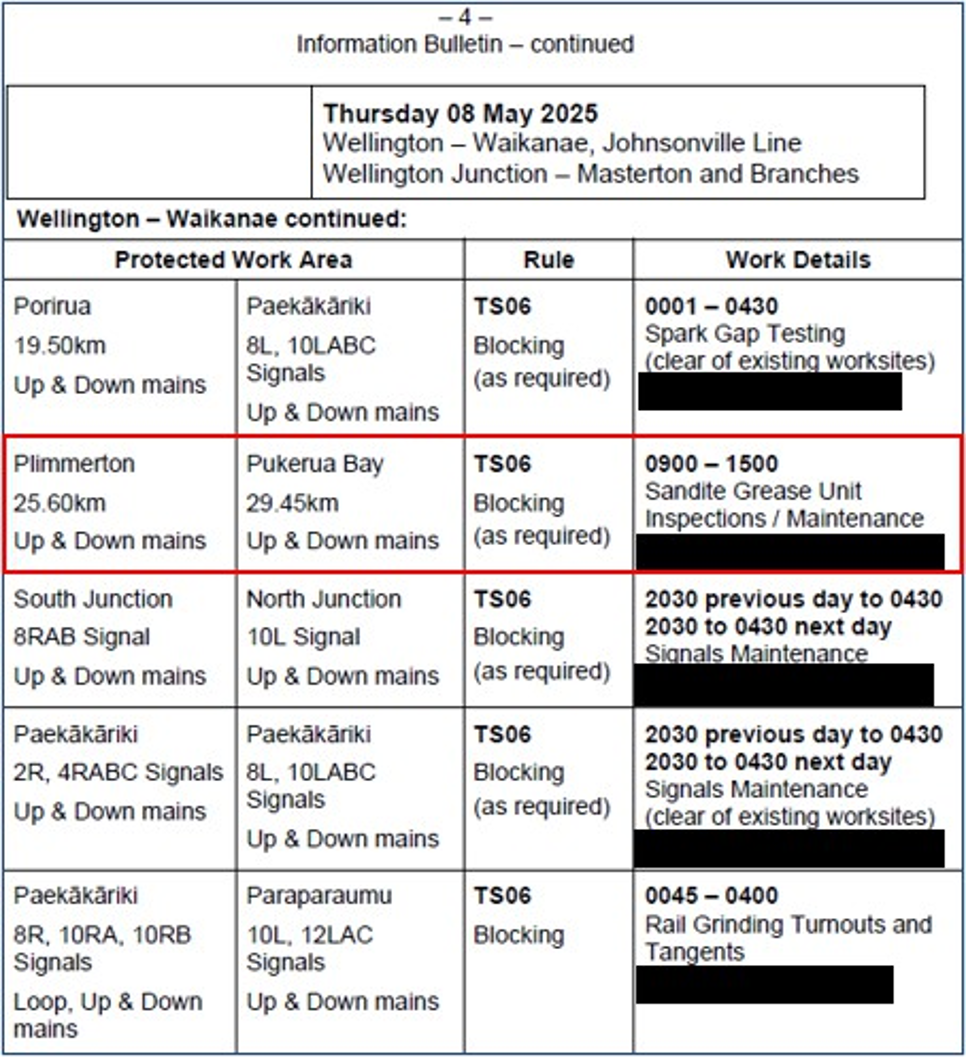
On the day of the incident, the DIB included ‘TS06 Blocking (as required)’ (see Figure 14), giving autonomy to the RPO to select a suitable option of worksite protection at the Plimmerton site.

- The Commission requested documentation from KiwiRail to understand how the RPO determined what blocking was required, but they were unable to provide any.
- KiwiRail informed the Commission that the ‘(as required)’ wording has since been removed from the DIB to prevent any confusion about the blocking process.
- During interview, the RPO commented that the time restrictions on implementing blocking at the worksite because of train frequency, meant they had elected to use ITD protection.
Use of individual train detection
- Under ITD protection, trains continue to operate through a worksite, and at normal line speed. The RPO was responsible for alerting the subcontractors when trains were approaching.
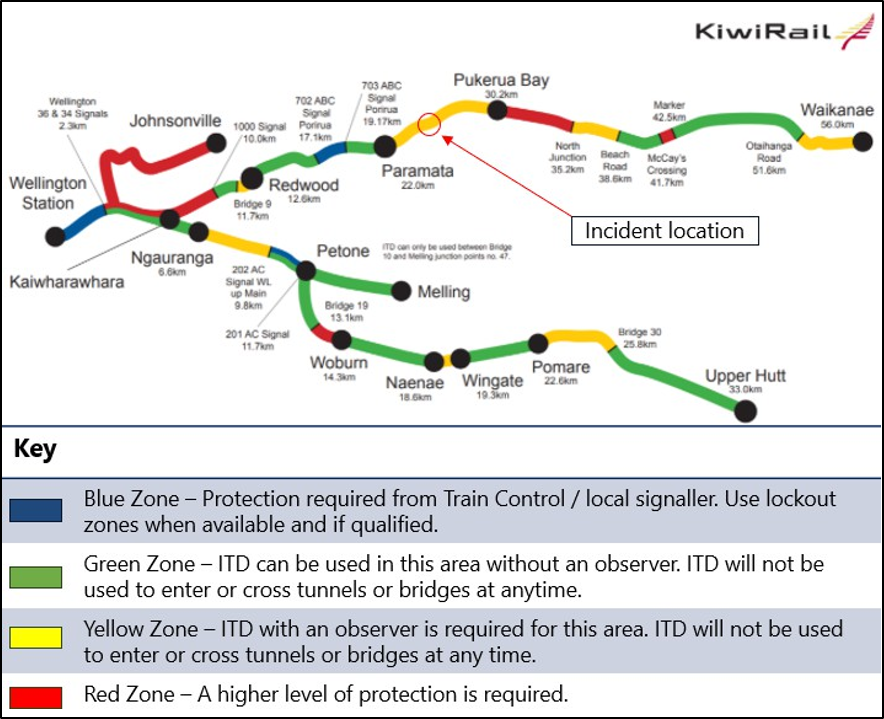
- The use of ITD is only permitted in certain parts of the rail network, and different conditions apply depending on the location, sightline rules and safe place rules (see Figure 15).
- KiwiRail discontinued the use of the paper‑based ITD pads in April 2025 and transitioned to a digital application. However, the paper‑based pads remained in circulation and some RPOs continued to use them.
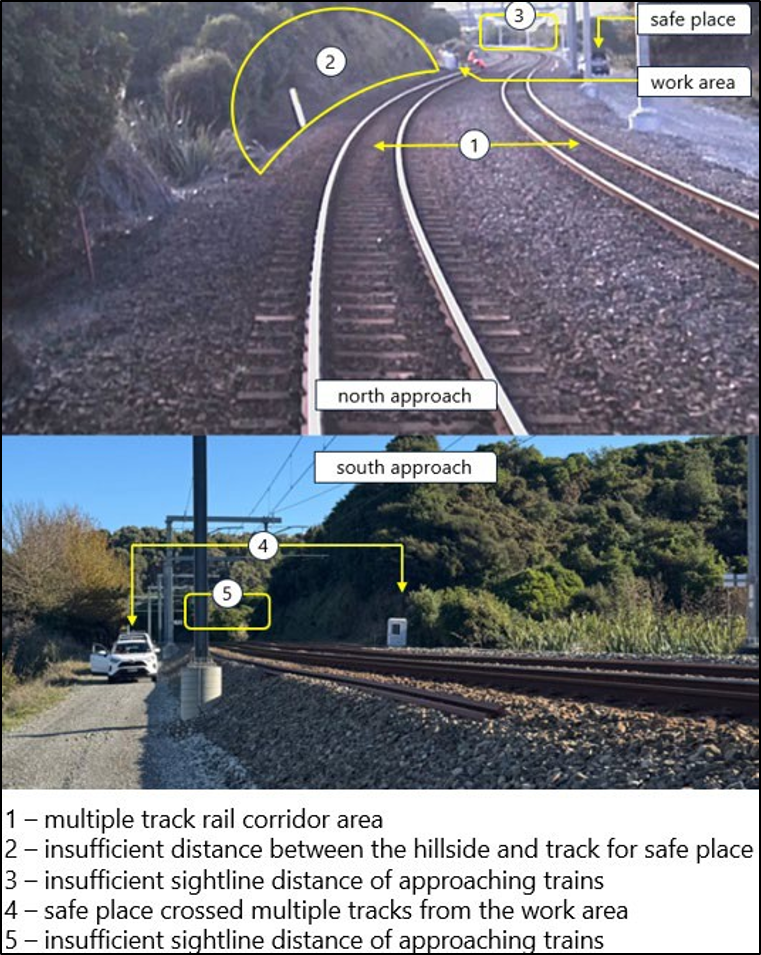
- The location of the worksite did not allow the use of ITD, and this was known to the RPO (see Figure 16).
- In addition, when using ITD the RPO is required to have a sounding device, such as a whistle or air horn. The RPO informed Commission investigators during their interview that they had carried a whistle, but did not use it on the day of the incident.
Rule violations
- Research shows that people are more inclined to follow rules when the rules are easy to comply with, and when they see other people doing so (Kuiper, M. et al, 2022) (The Behavioural Insights Team, 2024).
- The RPO informed Commission investigators during interview that they believed blocking would be difficult to attain in this situation because they needed to call train control to request it. They also believed that using blocking would make it difficult to complete the planned work because they did not expect to be granted a sufficient block of time (approximately an hour) because of frequent train movements.
-
In comparison, ITD could be applied without a request to train control. The RPO perceived that this would allow the workers to conduct their work more flexibly between train movements.
-
It is virtually certain that the RPO opted to use ITD even though they knew it was not allowed. They perceived it to be both a simpler and more practical method of protection than blocking, given the location and timing of the planned work.
-
The RPO’s decision is an example of a ‘situational breach’: an intentional action that results in non-compliance with known rules or procedures, resulting from organisational and environmental factors that make it difficult for employees not to commit violations (Hudson, P. T. W. et al., 1998)
-
The Commission investigators were informed it was common for RPOs to use ITD in this location and other locations with limited sightlines (for example the Johnsonville Line) for similar reasons. This indicates that non-compliant use of ITD may be perceived by some as normalised, and that the misalignment between planned work and compliant protection methods may not be isolated to this incident.
-
The Commission also found that the maintenance work programme for grease applicators had not been risk assessed by KiwiRail or ILS at this or any other locations with restricted view lines or busy network rail movements. Therefore, although the challenges of using blocking in certain locations was known to RPOs, the issue had not been assessed at a higher level.
-
Had KiwiRail conducted a risk assessment for maintenance tasks at each grease applicator site, the RPO likely would have applied a more appropriate and effective track protection control method.
Contractor competencies
Safety issue 2: The level of management and oversight by KiwiRail of contractors working within the rail corridor was inadequate. This increased the likelihood of unqualified contractors carrying out work within the rail corridor in an unsafe manner.
- Without a clear and consistent contractor management process, established safety protocols may be bypassed. Effective oversight ensures that all contractors operate under approved accreditations and that every party complies with the required safety conditions and contractual obligations. This structured approach reduces risk, strengthens accountability and supports a safer working environment.
- Rail-based and civil contractors are commonly used on KiwiRail’s rail network to perform critical maintenance and infrastructure upgrades.
- The Railways Act 2005 (the Act) establishes a duty on rail participants and persons working for rail participants to ensure the health and safety of persons so far as is reasonably practicable (Railways Act 2005, Section 7). The Act further requires certain rail participants to be licensed (Railways Act 2005, Section 10).
- Operators and rail access providers that are required to be licensed have to develop safety cases, which must be submitted to and approved by the Rail Regulator, New Zealand Transport Agency Waka Kotahi, as a prerequisite to the issuing of a licence.
-
Section 30 of the Act specifies, among other requirements, that a safety case must contain a statement or description, as appropriate, of the following:
(a) the arrangements in place to ensure that —
(b) safety-critical tasks and activities are clearly identified; and
(c) rail personnel carrying out safety-critical tasks and activities have received appropriate training and instruction; and
(d) the competence of rail personnel carrying out safety-critical tasks and activities has been appropriately tested.
-
Section 22 of the Act imposes a licence condition on licensed rail operators and rail access providers that:
If the rail activities are carried out by another person who does not hold a licence, the licence holder must take all reasonable steps (including providing necessary monitoring personnel and resources) to ensure that the person carries out those rail activities in accordance with the licence, the approved safety case and safety system and any relevant rules.
-
These sections of the Act require KiwiRail to provide appropriate training, supervision and testing of all personnel who conduct safety-critical tasks within its rail operation, including contractors and their subcontractors.
-
Specifically, Section 11(b)(i) of the Act states in part:
A licence holder must: …provide appropriate training and supervision of all rail personnel who do anything for, or on behalf of, it in respect of its rail activities, and ensure that those persons comply with … the conditions of its licence.
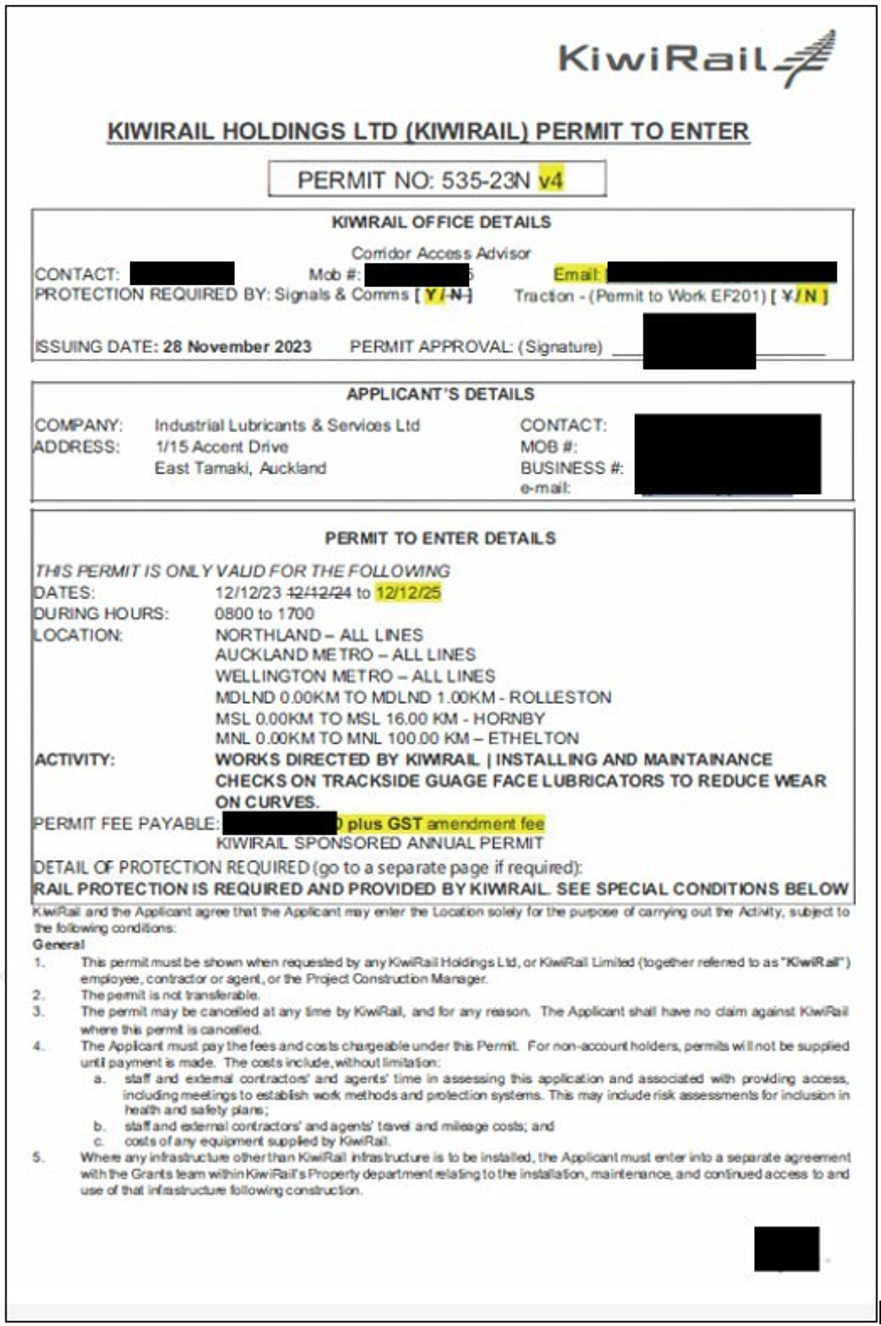
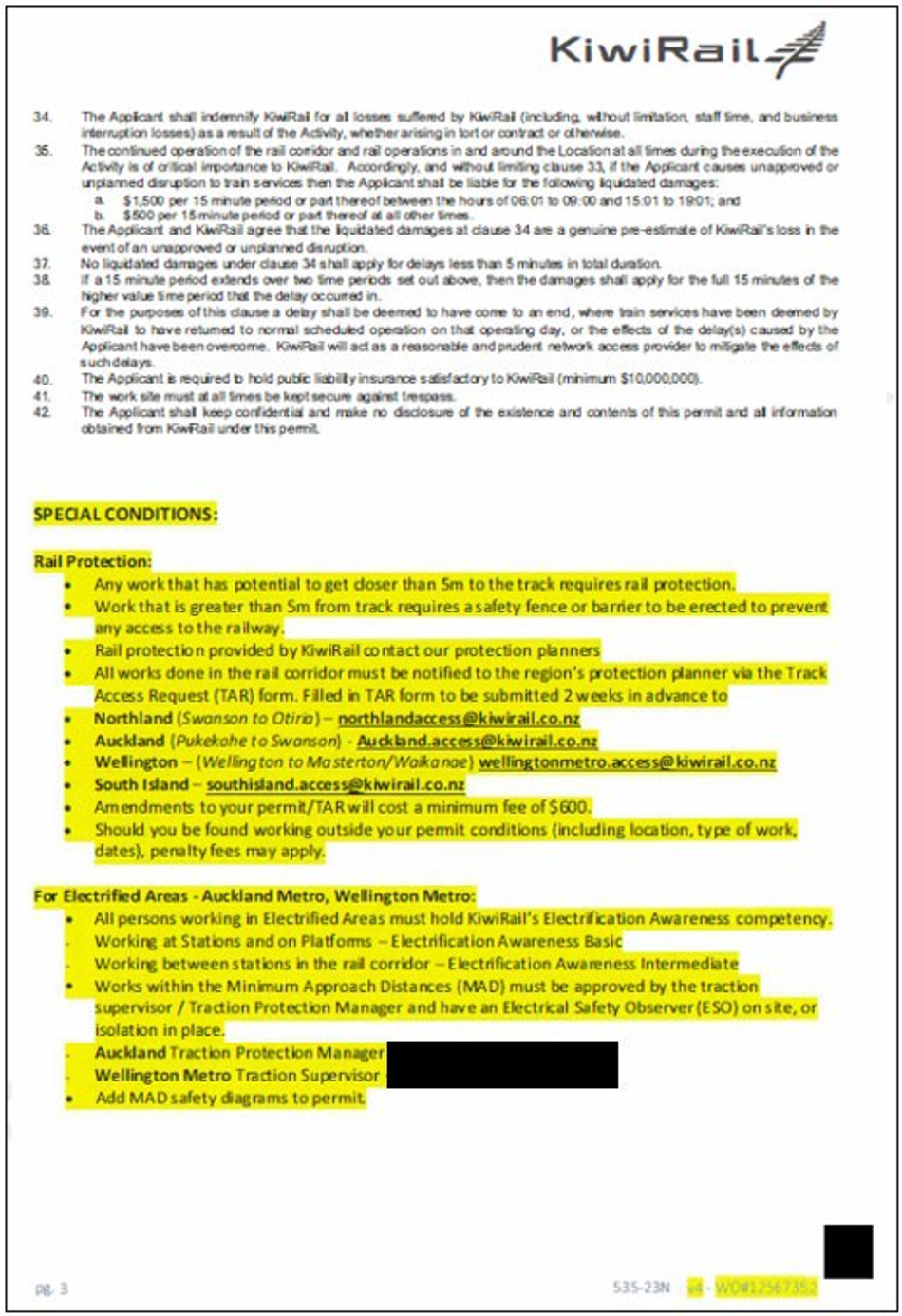
- KiwiRail had a system in place to identify and record contractors that conducted work in the rail corridor. KiwiRail required all contractors to have a current ‘permit to enter’ document, which outlined special conditions they must meet to conduct work in the rail corridor. (See Appendix 2 for permit and see Figure 17 for special conditions).
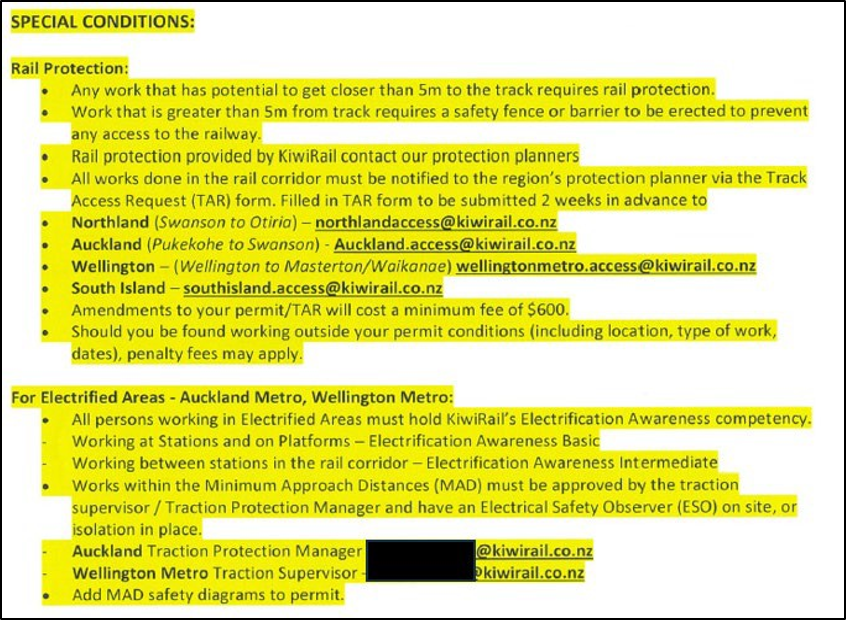
- KiwiRail’s Track Access Request (TAR) planning document required the contractor to record a competency number for each worker as evidence of ability to work in the rail corridor. However, the TAR relating to the maintenance work was approved without the details being supplied. The TAR did not require the contractor to confirm competency or fitness for duty. The process was reliant on the contractor meeting KiwiRail’s obligations or the RPO checking them on the day of work.
- On the day of the incident, the RPO asked SC1 and SC2 if they had the necessary competencies, but did not specify whether they were referring to the competencies required to allow them to work in the rail corridor under the special conditions or to do the work needed to fix the control box.
- SC2 questioned what the RPO meant by ‘competent’ and both subcontractors said they were competent to do the work on the control box.
- The RPO then wrote the letter ‘C’ in the column in the Job Plan Book (JPB) to mark them as ‘Competent and Current’ (see Figure 18).
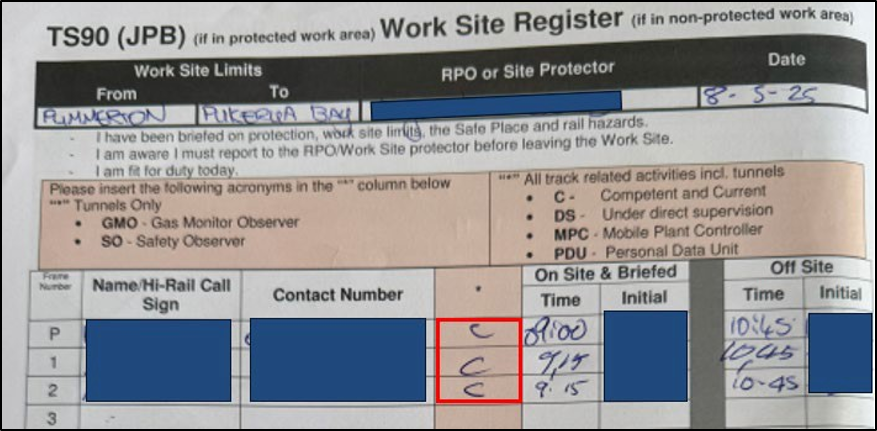
- The RPO had no means of verifying the subcontractor’s competencies as they did not have authorised access to any individual’s training certifications other than their own.
- KiwiRail requires the following competencies and medical certification to be completed before work can be undertaken in the rail corridor (see Figure 19).
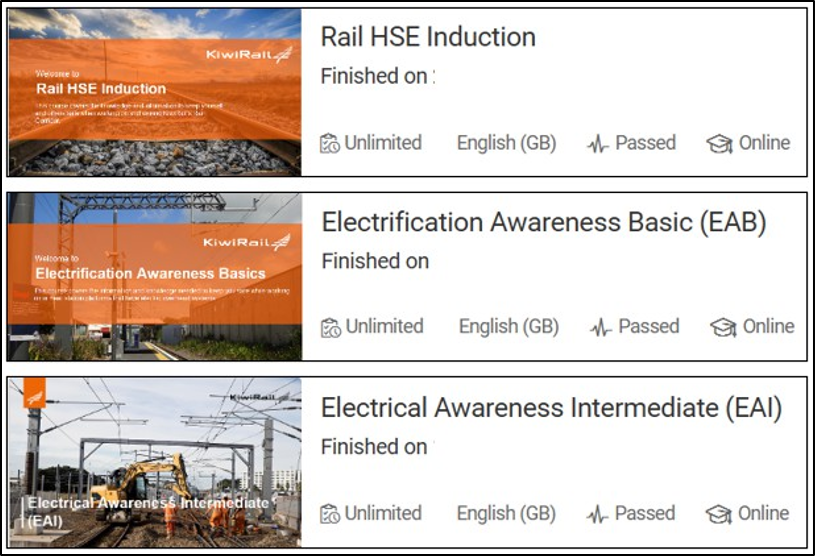
- The Commission found that neither subcontractor held the required competencies or a current medical certification from a Rail Medical Officer to enable them to work in the rail corridor.
- Neither the RPO nor ILS were aware that the workers did not hold all required competencies to work in the rail corridor. ILS did not hold or maintain records of subcontractors’ competencies or their current medical certification.
- KiwiRail advised the Commission that this was not an isolated case. Following this incident, KiwiRail had identified other contractors with missing or lapsed training and medical certifications.
- Had there been a system in place to verify contractors’ competencies, it is likely that both ILS and KiwiRail would have identified that the contractors did not hold the required competencies or current medical certification to work within the rail corridor.
Worksite protection and compliance-assurance processes
Safety issue 3: KiwiRail’s process to assure itself that rail protection work is being carried out safely and as required is not adequate. This increases the risk of unsafe work being undertaken within the rail corridor.
- Rail corridors are high-risk zones with live tracks, moving trains and heavy equipment. Rail protection systems (eg, blocking protection, lookout systems, warning technology) are the last lines of defence for workers, and their implementation relies on workers completing the right actions at the right time.
- Audits and external assessments provide regular and independent verification and assurance that these systems are being implemented correctly and that risks are being mitigated.
- At the time of the incident, KiwiRail had a rail protection system in place that required the worksite to have an RPO present while the subcontractors completed the scheduled work on the grease-dispenser unit.
- KiwiRail required the RPO to be certified and to carry out work in accordance with the organisation’s rule‑based requirements
-
Before starting any work within the rail corridor, the RPO is required to complete the JPB. The book provides information and prompts designed to ensure that risks have been identified, assessed and mitigated before work starts. Each job plan consists of five pages:
i. Job Plan Form and Pre-Start Meeting Record
ii. Work Site Register (form TS90)
iii. Worksite Plan
iv. Job Safety & Environment Analysis
v. Job Plan Debrief.
- The Commission found that the RPO involved in the incident had completed the JPB incorrectly on several occasions. The book was missing mandatory safety information that should have been recorded and communicated to rail workers.
- Furthermore, there was no robust audit system in place for the JPBs or the ITD pads that RPOs completed. The auditing process relied solely on RPOs voluntarily presenting their JPBs to a health and safety representative for review, and this occurred on an ad hoc basis.
- Had KiwiRail completed regular auditing of worksite protection, ITD paper-based pads and JPBs, it is likely non-compliance with the required work practices, including the use of a non-compliant and unsafe protection method, could have been identified.
Automatic emergency alert
Safety issue 4: Wellington passenger trains do not send an automatic radio call to train control when emergency braking is applied. This could result in a delay in implementing a response to an emergency situation.
- Engineering controls are mechanisms that respond when human performance and time-based controls are insufficient. An example of an engineering control is an automatic emergency alert (such as an automatic radio emergency response alert) (automatic radio emergency response alerts are sent to train control when brakes are placed in the emergency position, or the braking system loses air) to train control when a train’s emergency brake is applied.
- Automatic emergency alerts are widely used elsewhere in the rail industry, both in New Zealand and internationally. The absence of such systems on metropolitan passenger trains could delay an emergency response and notification to other rail vehicles operating on the same network.
- At the time of the incident, Wellington metropolitan passenger trains were equipped with a manually activated emergency radio button (the button) located on the LE’s control console (see Figure 20). Activation required the LE to intentionally depress the button during an emergency.
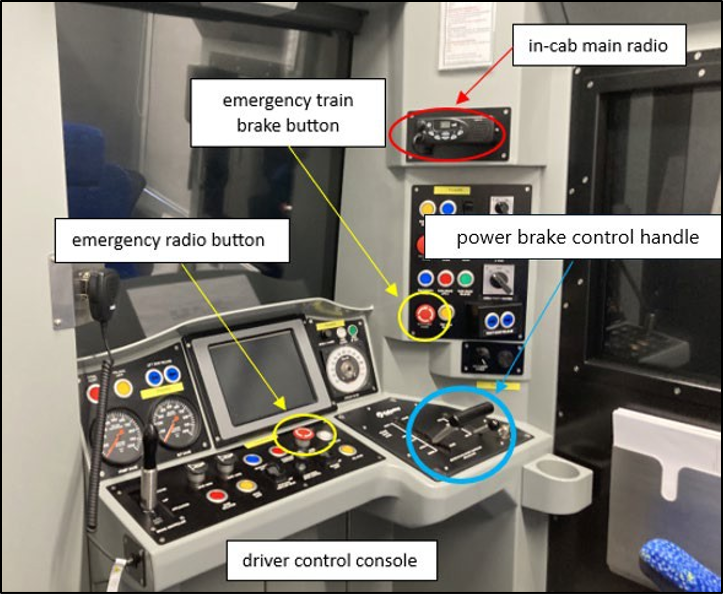
- In this incident, after the TLE applied the emergency brake, they did not activate the emergency radio button, nor were they instructed to do so by the LES. As a result, train control was not immediately alerted to the incident, and the appropriate post‑incident procedures were not initiated.
- When the Transdev Wellington staff member on board the train contacted train control by mobile phone, there was initial confusion about which work group was involved. During the delay this caused, the work group continued operating at the incident site while train control carried out its enquiries. This increased the workers’ exposure to risk by keeping them in the rail corridor without appropriate protection measures.
- Had an automatic emergency alert been fitted to the train, train control would have received an immediate notification when the TLE activated the emergency brake. This would have enabled train control to recognise the incident in real time and initiate the appropriate after‑incident procedures without delay.
-
The Commission has previously identified this safety concern in the Kāpiti passenger train derailment report RO-2021‑104 (Transport Accident Investigation Commission, 2024).
In that inquiry, the Commission issued a recommendation to Transdev Wellington calling for the adoption of systems that automatically notified train control when emergency braking is activated. Transdev Wellington replied:
This recommendation is Under Consideration. Transdev Wellington will raise an engineering change request to implement this recommendation and submit it to Metlink for approval and funding. Greater Wellington Rail Limited via Metlink, own the rolling stock and approve and fund any alterations. We note there may be occasions where an emergency radio call would be appropriate, a trackside fire for example, but the use of the emergency brake would not be applied. Similarly, testing the emergency brake (a frequent occurrence) would not require an emergency notification to train control.
- On 4 February 2026, the Commission met with Transdev Wellington to determine whether progress had been made toward the recommendation under consideration and whether the engineering change request had been submitted to Metlink and Greater Wellington Rail Limited.
- On 5 February 2026, Transdev Wellington updated the Commission on the safety action taken in response to this recommendation. In the Commission’s view, the safety action taken addresses the safety issue. The details of this safety action are discussed in Section 5.
Appendix 1. DIB on the day of the incident
Appendix 2. Permit to enter and special conditions
Appendix 3. Track Access Request (TAR)
Appendix 4. Planning application for work F1 Form