
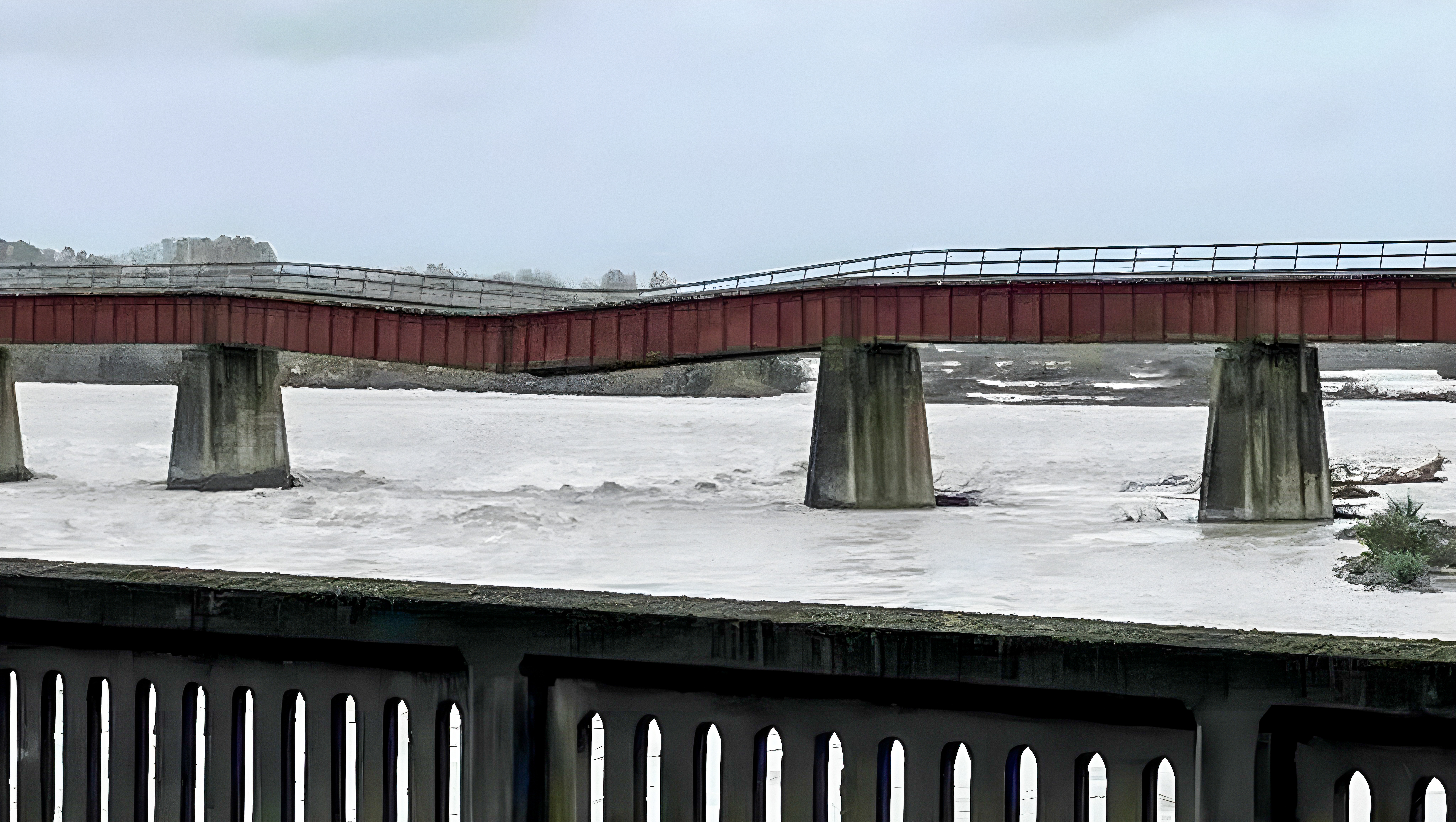
A bridge collapse on KiwiRail's Main South Line has exposed weaknesses in how scour risk is identified, managed and responded to across the rail network.
In a report published today [eds: 0500, 11 June 2026] the Transport Accident Investigation Commission says KiwiRail's systems for bridge inspection, asset management and severe-weather response did not adequately translate known risks into operational controls.
The Commission examined the collapse of Pier 8 of Bridge 57 over the Rangitata River in April 2024. Floodwater scoured away riverbed material supporting the pier, causing it to collapse. No train was on the bridge at the time, but the line remained open until a member of the public on the adjacent road bridge reported the damage.
Chief Investigator of Accidents Louise Cook says the case has lessons for rail infrastructure across New Zealand as severe weather events become more frequent.
“Bridge 57 is a reminder that severe weather can quickly turn a known risk into a serious hazard,” said Louise Cook, “KiwiRail knew this bridge was vulnerable to scour. The problem was not just the weather. It was the lack of clear, bridge-specific controls to match that risk.”
The Commission found KiwiRail’s inspections did not consistently record riverbed profiles and their audit processes were not picking up the gaps. KiwiRail's asset-management system ranked scour risk across the national rail network, but did not prescribe the mitigation measures or operational controls that should follow for bridges identified as high risk.
“For a track ganger or structures inspector who is sent to inspect a bridge during a flood, they know the river is high, they know the bridge has some level of scour risk, but they have no documented threshold that says ‘above this flow rate the bridge is unsafe,’ or ‘if you see X, close the line,’ or ‘at red alert, impose these restrictions’.”
And when severe weather hit, the response relied too heavily on general procedures and individual judgement.
“If a bridge has a known scour risk, you need to know what to look for, what action to take, and when to stop traffic. You cannot leave that to guesswork when the river is rising.”
The Commission made three recommendations to KiwiRail. These cover inspection and audit compliance, risk-based asset management for flood and scour risk, and reviewing Trigger Action Response Plans for high-risk assets.
Ms Cook said the lessons apply well beyond one bridge.
“Rail bridges across the country face flooding, scour and other weather-related hazards. As severe weather becomes more frequent, infrastructure owners need stronger systems for individual assets, not broad rules that miss the detail.”
The Commission said bridges are complex assets and visual inspection alone may not be enough to determine whether they are safe.
“Communities and commerce rely on these structures every day,” Ms Cook said. “The job is to make sure the systems around them are strong enough to spot the risk, understand it, and act on it before something fails.”
The Commission’s full report is available on its website at taic.org.nz