
The Commission has released an interim report as part of its ongoing investigation into the 6 June 2026 passenger rail incident. It has so far been established that the train departing Khandallah Station was diverted onto a runaway line because the signalling system detected the track ahead was occupied. The train passed a red signal and while the emergency brake was activated it was not able to stop before striking the large concrete stop block, severely damaging the train and injuring people on board.
Factual information Pārongo pono
Background information
- The Johnsonville Line (JVL) is a passenger-only rail line running between Wellington Railway Station and the Wellington suburb of Johnsonville, about 10 kilometres (km) north.
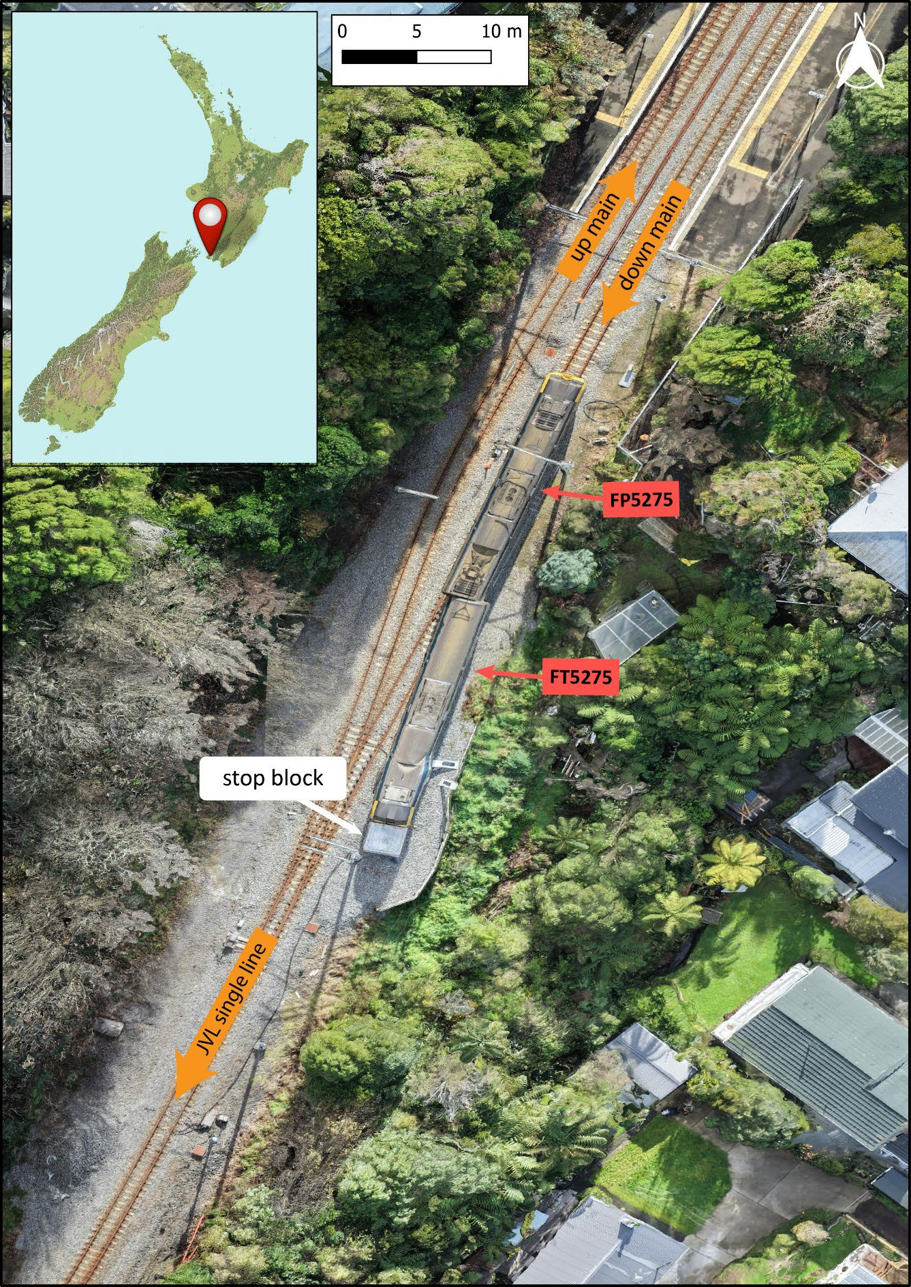
- The JVL is single-line track between stations and double-line track within station limits at Wadestown, Ngaio and Khandallah. When northbound trains enter these stations, they travel on the ‘up’ main, whereas southbound trains travel on the ‘down’ main (see Figure 2).
- Transdev Wellington Limited (Transdev Wellington) operates the passenger trains under contract to the Greater Wellington Regional Council (GWRC). Greater Wellington Rail Limited (GWRL) own the trains. GWRL is a wholly owned subsidiary of Wellington Regional Council Holdings Limited, which in turn is a wholly owned subsidiary of GWRC. KiwiRail Holdings Limited (KiwiRail) maintains the infrastructure and operates the train control (train control is responsible for track authorisations and the safe movement of rail traffic. Train controllers can use an electronic train control system to remotely operate the network within their specific area. Train control is part of the Wellington Regional Operations Centre, formerly the National Train Control Centre, located in Wallaceville, Upper Hutt) system for the JVL.
- The JVL train control system can be placed into ‘automatic mode’. This means that signals (visual display devices that convey instructions for authority to pass using illuminated coloured lights (aspects). Simplified, these aspects are red=stop, yellow=proceed with caution, green=proceed at normal speed) and points (a movable part of the rail that enables rail vehicles to be guided from one track to another) are automatically changed by the control system to keep trains running to schedule without the need for intervention from a train controller. The JVL was in automatic mode at the time of the accident.
Narrative
- At 1045 (times in this report are in New Zealand Standard Time (Universal Coordinated Time +12 hours) expressed in a 24-hour format) on Saturday 6 June 2026, the train manager (a designated person who is responsible for the welfare and comfort of passengers, assists with emergency working on a passenger train and is in charge of any ticket collectors on the train) started their shift at Wellington Railway Station.
- At 1805, the locomotive engineer (a person qualified by certification to drive trains on the main line) (LE) started their shift at Wellington Railway Station.
- Both the train manager and the LE were employed by Transdev Wellington.
- At about 1830, the LE and the train manager boarded Train 9378 for the journey north towards Johnsonville on the JVL.
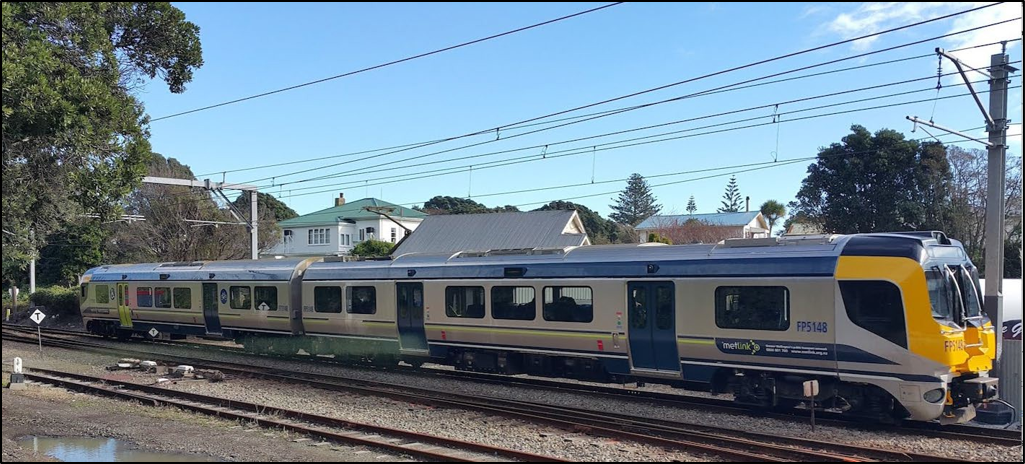
- Train 9378 was a two-car ‘Matangi’ electric multiple unit (EMU) comprised of an ‘FP’ power unit leading an ‘FT’ trailer unit (the manufacturer identified the Matangi series by the letter ‘F’, so FP and FT denote the units as Matangi power and Matangi trailer respectively. Matangi trains are arranged with the FP car at the northern end, so ‘up’ trains are driven from the FP car and ‘down’ trains are driven from the FT car). The LE was seated in the driver’s cab of the FP power unit at the northern end.
- After departing Wellington Station at about 1832, Train 9378 was scheduled to stop at all stations along the JVL as it journeyed towards Johnsonville.
- At 1850:31 (where timings are described in seconds, information has been obtained from verifiable data sources such as train control signal logs and the train’s Tranzlog ‘black box’ data-recording system) as Train 9378 was approaching Khandallah Station heading north towards Johnsonville, the train control system registered a ‘dropped track’ (can happen for several reasons, including, but not limited to, a broken rail, faulty electrical connection or excessive moisture on the track), which occurs when the signalling system interprets the track as being occupied. The dropped track caused the signalling system to determine that there were multiple trains in the same section, and this resulted in an error message being displayed on the train control mimic screen (a monitor displaying the graphical user interface of the train control system) (see Figure 3).
- The error message was a visual warning only and did not generate an audible alarm to alert the train controller. (Note: to reduce visual clutter on the train controller’s mimic screen, signals at red display as grey on the mimic screen and signals at yellow or green display as green on the mimic screen.)
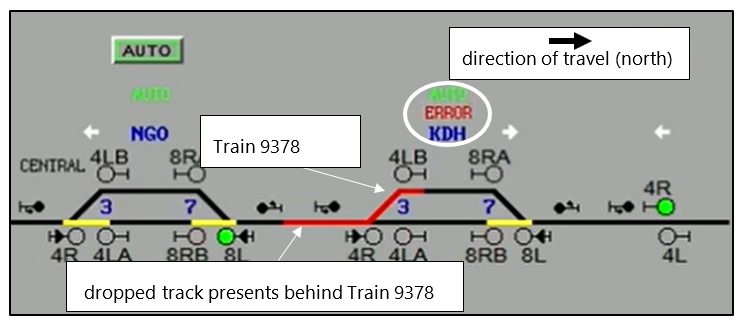
- The error message remained visible for 25 seconds until, at 1850:56, Train 9378 entered Khandallah Station. The error message then stopped displaying on the mimic screen because the system no longer detected multiple trains in one section.
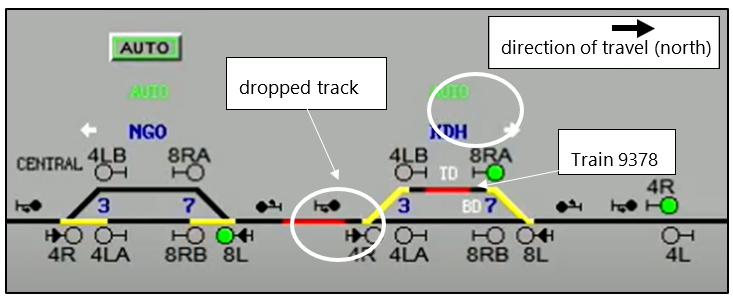
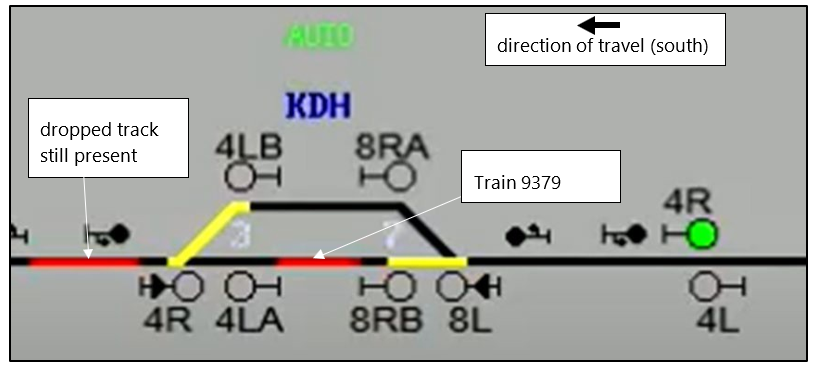
- However, because of the dropped track, the signalling system was still interpreting the section south of Khandallah as being occupied by a train (see Figure 4).
- As a result, the signalling system interlocking (points and signalling that are electrically or mechanically arranged to prevent conflicting train movements) acted as designed, holding all signals governing entry into the occupied section at stop (red).
- At about 1856, Train 9378 arrived at Johnsonville Station. The LE left the driver’s cab in the FP unit and walked to the driver’s cab in the FT unit at the southern end of the train in preparation for the return journey to Wellington. As the train was now southbound, the service number (the number assigned to a train for identification purposes. Generally, northbound (up) trains end in even numbers, while southbound (down) trains end in odd numbers) changed from Train 9378 to Train 9379 (the train).
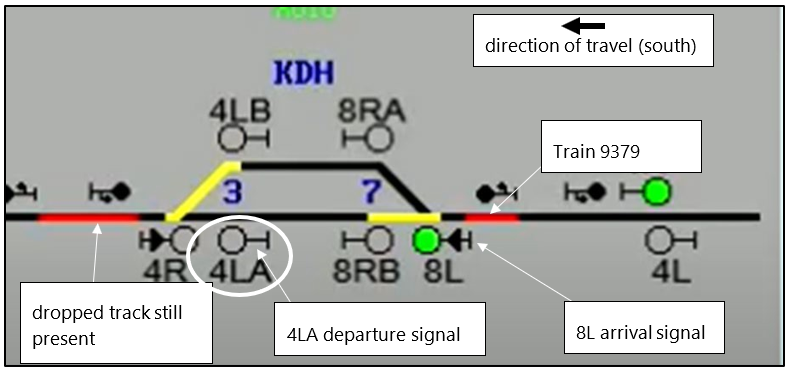
- After departing Johnsonville Station on schedule at about 1858, the train stopped briefly for passengers at Raroa Station at 1902, before travelling to Khandallah Station. The train passed the 8L arrival signal (a signal governing entry into station limits) showing a ‘caution to stop’ (a signal aspect which advises the train crew that the next signal may be at stop. It is indicated by a yellow over red aspect) (see Figure 5), entering the down main at Khandallah Station at about 1905.
-
Because of the dropped track south of the station, the interlocking system held the 4LA departure signal at stop ahead of the train. Because the signal was at stop, the track in front of the train was automatically set for the runaway line at the southern end of Khandallah Station (see Figures 6 and 7).
- On arrival at Khandallah Station, the train manager exited the train and waited on the platform to check all passengers were safely clear.
- At 1905:49, once the doors were clear, the train manager entered the train and pressed the ‘all close’ (to close and secure all passenger doors, and illuminate a white light in the drivers cab to confirm) and ‘right of way’ (the authority required for passenger trains to depart a platform) buttons on the train’s operation panel.
- In the driver’s cab, a green light illuminated on the dash and an audible alarm sounded to indicate that the doors were closed and that the train manager had pressed the right of way button. The train’s brakes were released, and the train was placed into power to start departing Khandallah Station. Power was gradually increased over the next 8 seconds while the train moved away from the platform along the down main towards the southern end of Khandallah Station.
-
At 1906:12, the train passed the 4LA departure signal (the signal controlling entry into the section of track beyond a station. A written authority is required to pass departure signals at stop. Any signal passed without authority is referred to as a signal passed at danger (SPAD)) at stop (red) at the south end of Khandallah Station. The signal was displaying a red aspect because of the dropped track.
-
At 1906:12, the emergency brake was activated.
- Because the departure signal was at stop (red), the track in front of the train diverted to the left onto a runaway line. The runaway line diversion was designed to prevent trains from entering the JVL single line in potential conflict with another train coming from the opposite direction (see Figure 7).
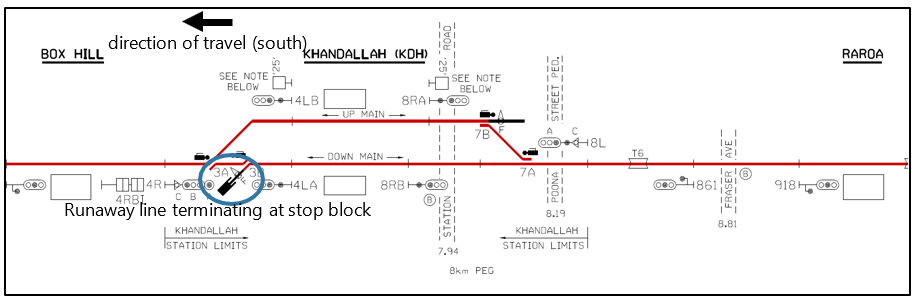
- At 1906:14 the train passed a fixed train stop (lineside equipment designed to automatically apply a train’s brakes by tripping an external lever on the train when activated by a train passing a signal at stop) that was fitted to the rail on the runaway line, but the train’s trip lever (a lever connected to Transdev trains that is activated when it comes into contact with a fixed train stop and, in turn, activates the train’s braking system. It was designed to interact with equipment at selected signal locations to mitigate trains running past signals at stop) did not activate.
- At 19:06:16 the train lost all power when the pantograph (a device mounted on the roof of electric trains that draws power from the overhead lines) disconnected from the overhead power lines. Immediately after this the train, travelling at 33 kilometres per hour (km/h), collided into a concrete stop block (a structure fixed at the termination of a running line or siding to arrest slow-moving vehicles (as defined in KiwiRail’s online New Zealand Rail Operating Rules and Procedures glossary, accessed in July 2026). The Khandallah stop block was installed during major maintenance works in April 2025) as it reached the end of the runaway line.
- The lead unit, FT5275, sustained substantial damage in the accident.
- Both the LE and train manager were incapacitated by injury and four of the eight passengers received minor injuries.
- No emergency alert was received by train control following the accident. Passengers and members of the public from nearby homes alerted emergency services to the collision. Emergency services then notified train control.
Train/vehicle information
-
Train 9379 was a two-car Matangi EMU used on Wellington’s suburban rail network. It consisted of an FP power unit and an FT trailer unit and was being driven from the FT trailer unit at the time of the accident. Matangi units were built in South Korea by Hyundai Rotem. FP5275 and FT5275 were 5000 series units, built between 2015 and 2016 with minor design modifications from the original 4000 series.
Personnel information
- The train was crewed by an LE and a train manager. Both personnel had been employed by Transdev Wellington since 2016 and held full and current certifications for their roles. As a result of the accident both personnel received injuries requiring hospitalisation.