
The Commission has released an interim report as part of its ongoing investigation into the 30 May disablement of a TranzAlpine passenger train in a tunnel near Springfield. It has so far been established that an engine fault caused the electrical system to overheat, the train to lose power and come to a stop. The train was secured, an emergency declared and a locomotive from Springfield sent to recover it. None of the crew or 177 passengers were harmed.
Factual information Pārongo pono
Background
- The TranzAlpine passenger train service was a daily tourist service owned by KiwiRail Holdings Limited (KiwiRail) and operated by Great Journeys New Zealand, KiwiRail’s tourism business. The service departed Christchurch in the morning and travelled to Greymouth before returning to Christchurch in the evening.
Narrative
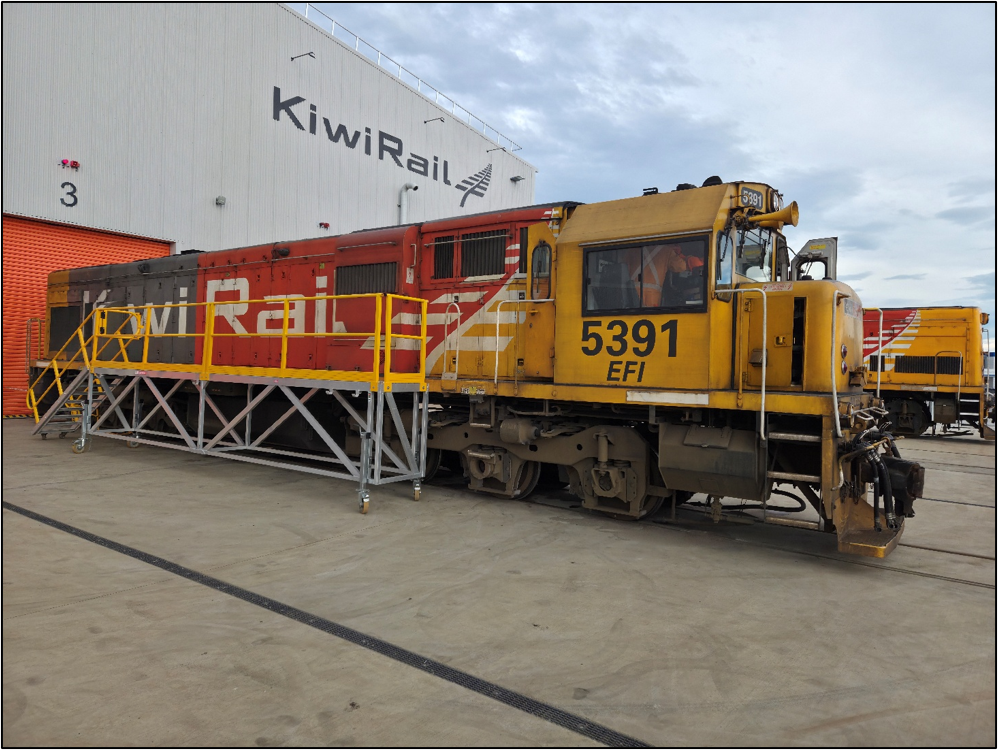
- At 0815 (times in this report are in New Zealand Standard Time (Universal Coordinated Time +12 hours) expressed in a 24-hour format) on 30 May 2026, Train 803 (the train), operating as the TranzAlpine service, departed Addington Station with 162 passengers, one locomotive engineer and six on-board crew. The train was being hauled by locomotive DXC 5391 (the locomotive). At 0835 the train stopped at Rolleston Station to pick up a further 15 passengers.
- At 0845 and 0847, the locomotive experienced ground relay (a ground relay is a protective device that detects an unintended electrical connection between a locomotive’s traction-power circuit and its frame. It responds by removing traction power and indicating a fault to the driver) faults in one traction motor (electric motor that converts electrical energy into mechanical energy, which is applied to the locomotive wheels) (TM6) while travelling between Rolleston and Springfield stations. The ground relays reset automatically, without the train stopping, and the train continued its journey.
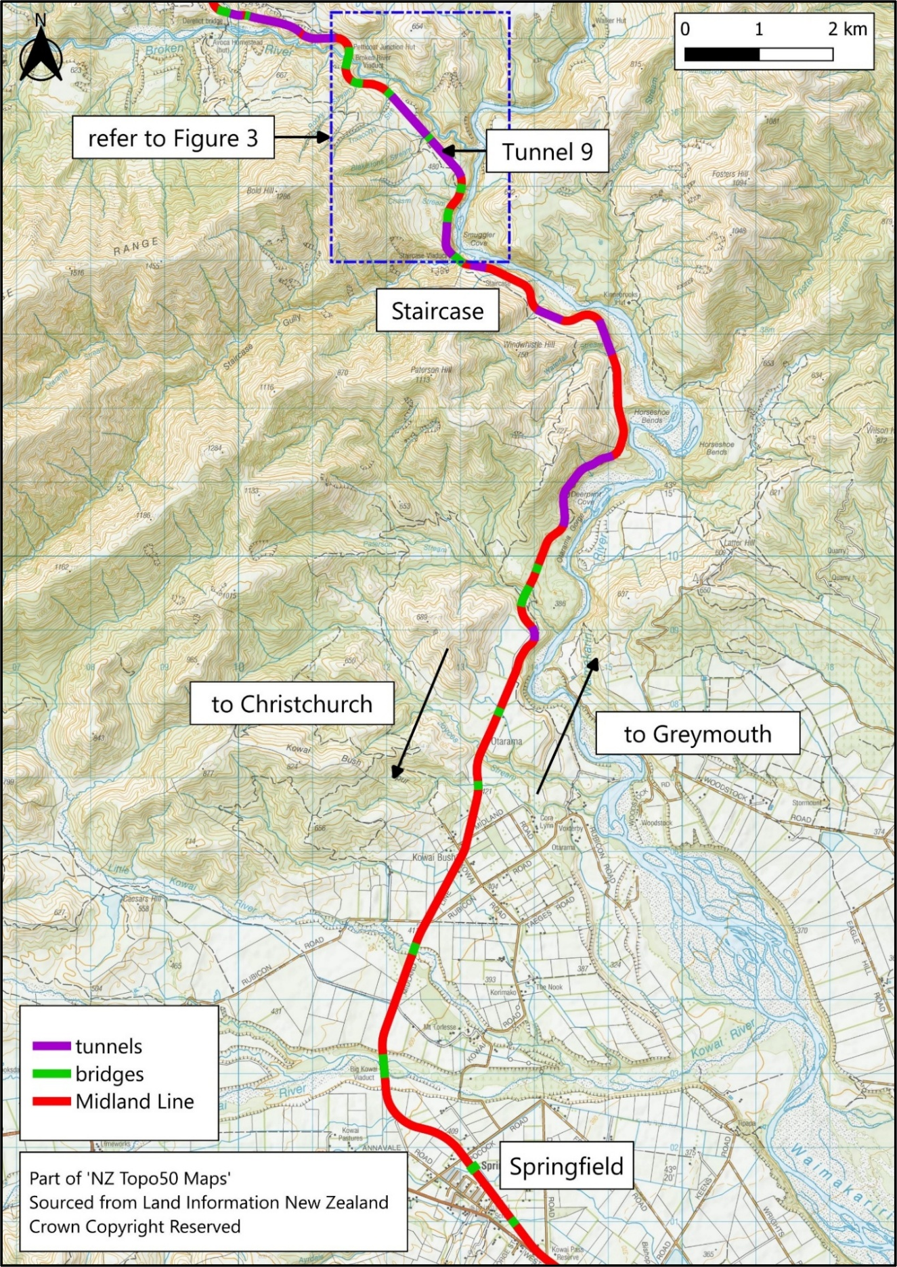
- At 0927 the train entered an isolated section of the Midland Line (the rail line between Rolleston (Christchurch) and Stillwater (Greymouth) in the South Island of New Zealand). From the 5‑kilometre (km) to the 70-km meterage (kilometre meterage is the location defined from a fixed reference point. On the Midland Line that reference point is Rolleston) the line follows the Waimakariri and Broken River gorges. Along these sections there is no road access to the track.
- At 0944, the locomotive experienced a rectifier fault (a failure or malfunction of the rectifier, which is an electrical device that converts alternating current (AC) to direct current (DC)) while travelling at 30 kilometres per hour (km/h), causing it to stop providing the tractive effort (the pulling force a locomotive exerts on a train) to the train. Because of this loss of tractive effort, the train began to slow down.
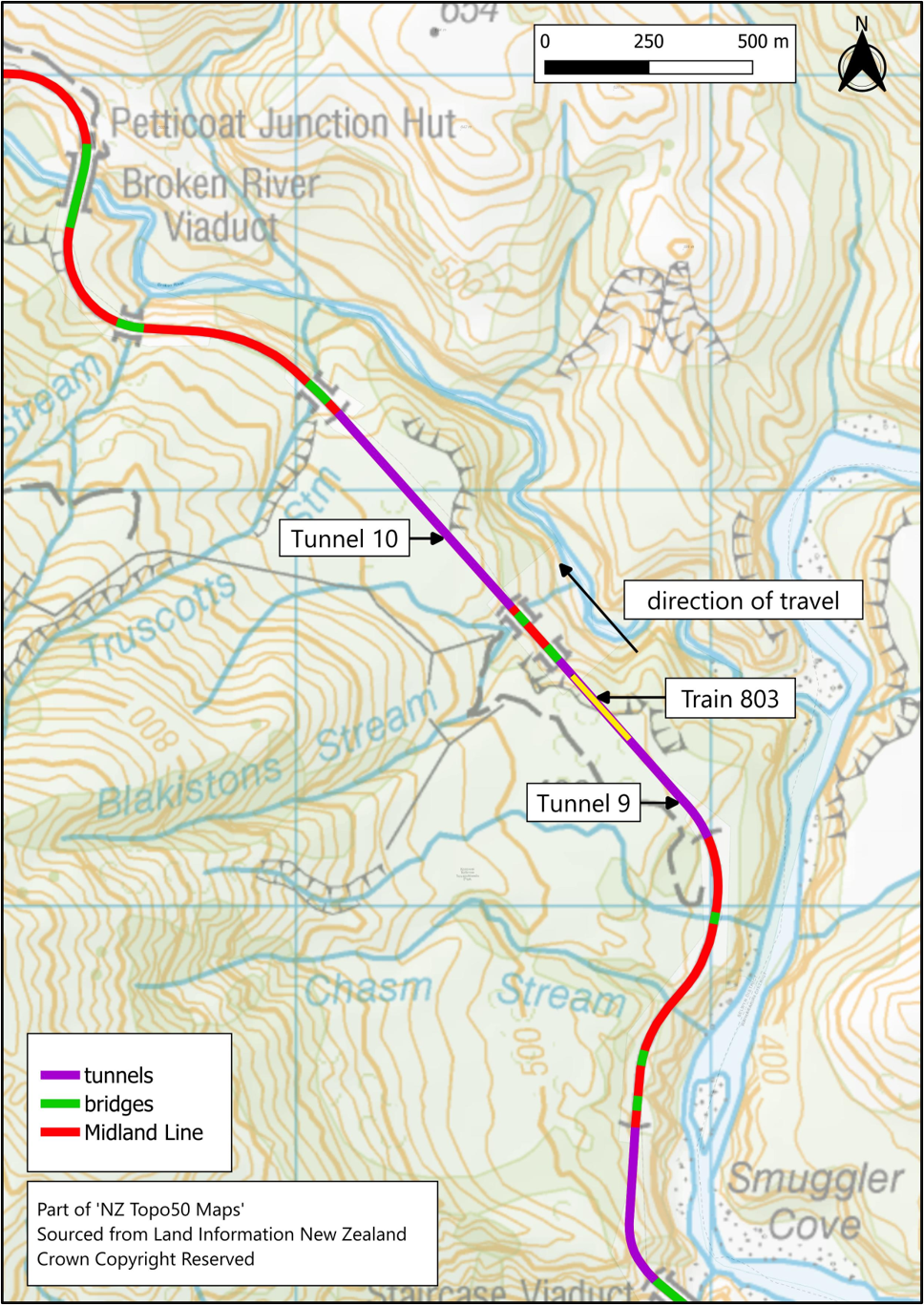
- At 0946, the train entered Tunnel 9 (see Figures 2 and 3) travelling at 22 km/h.
- At 0947, the train came to a stop inside Tunnel 9 at approximately 65.73 km on the Midland Line. Based on data obtained by the Commission , the front of the train was approximately 100 metres (m) from the western portal (the structural entrance or exit of a tunnel) of Tunnel 9 and the rear of the train was approximately 250 m from the eastern portal when it came to a stop. The whole train, with 177 passengers, one locomotive engineer (LE1) and six on-board crew, was inside Tunnel 9.
- The fault code ‘Hot Diode’ was displayed on the diagnostic information display on the engine control panel inside the locomotive cab.
- After stopping, LE1 secured the train by applying the brakes to the train and placed an emergency call to train control on the radio. LE1 then shut down the locomotive to limit the emission of diesel fumes while inside the tunnel. While shutting down the locomotive, LE1’s gas monitor (a device that continually tests and monitors the air quality) sounded an alarm indicating increased toxic gases in the air.
- LE1 established communication with train control at 0957 and informed the train controller that the train was disabled inside Tunnel 9 because of a ‘Hot Diode’ fault.
- On receipt of this information, KiwiRail declared a Level 3 emergency (in accordance with KiwiRail’s emergency response plans. A Level 3 emergency includes establishing a crisis management team and external assistance) and initiated the recovery operation for the train.
- Freight train 850 was at Springfield at the time of the incident. The locomotives (the recovery locomotives) and the locomotive engineer (LE2) from this train were directed to recover the disabled train back to Christchurch.
- At 1035, a safe-working authority (a form used to authorise rail traffic movements and instructions not otherwise permitted under the normal system of safe working) (SWA) was issued to LE2 to proceed from Springfield to Staircase (see Figure 2) with the recovery locomotives.
- At 1102, LE1 was able to restart the locomotive of the train inside Tunnel 9. With approval from train control, the locomotive pulled the passenger train clear of Tunnel 9 and proceeded through Tunnel 10 in search of a suitable place to stop the train safely.
- The 177 passengers had been inside Tunnel 9 for approximately 76 minutes.
- The recovery locomotives arrived and stopped at Staircase at 1105.
- The train came to a controlled stop at 66.8 km on the Midland Line at 1107.
- At 1124, an SWA was issued to the train to not move from its location to facilitate the rescue.
- At 1129, an SWA was issued to the recovery locomotives to travel from Staircase to the new location of the train.
- At 1145, the recovery locomotives arrived at the stationary train to complete the recovery operation. LE1, LE2 and one member of the on-board crew coupled the recovery locomotives onto the train.
- At 1219 the recovered train, with the failed locomotive running dead (moving a shut-down locomotive using the power of another locomotive rather than its own engine power), departed from 66.8 km on the Midland Line back towards Christchurch. The recovered train stopped to leave the failed locomotive on the Staircase crossing loop at 1228.
- The recovered train continued its journey back to Christchurch, making stops at Springfield and Rolleston at 1314 and 1401 respectively, to allow passengers to disembark. The recovered train arrived at Christchurch station at 1423, where the remaining passengers were disembarked.
- The failed locomotive was separately hauled from Staircase back to Christchurch by another recovery locomotive. It departed Staircase at 1617 and arrived at Waltham Mechanical Hub at 1844.
The fault
- The ‘Hot Diode’ fault code indicated that the diodes within the rectifiers of the locomotive were overheating. The locomotive control system (an electronic system that monitors the operation and condition of locomotive equipment) was programmed to stop supplying power to the rectifiers if they overheated to prevent further damage to the locomotive or an electrical fire.
- The rectifiers transfer alternating current (AC) power, generated by the locomotive’s alternator, into direct current (DC) power, which is provided to the TMs that provide tractive effort to the locomotive.
- In order to prevent overheating of electrical equipment, the locomotive contained an equipment blower. The locomotive equipment blower was a fan system. The function of the equipment blower was to provide cooling, low-pressure air to the following electrical equipment of the locomotive (see Figure 4):
- traction motors (TMs)
- rectifiers
- batteries.
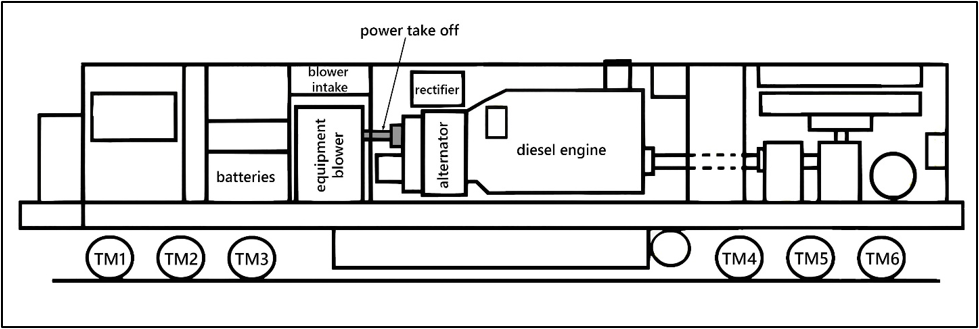
- The equipment blower was driven by a power take-off system (see Figure 5). The power take-off used the rotation of the alternator drive shaft to rotate the equipment blower fan and provide cooling air. The power take-off translated the rotation of the alternator drive shaft to the equipment blower through a gear train (a set of connected gears that transfer movement and power from one rotating part of a machine to another). The location of the power take-off is also shown in Figure 4.
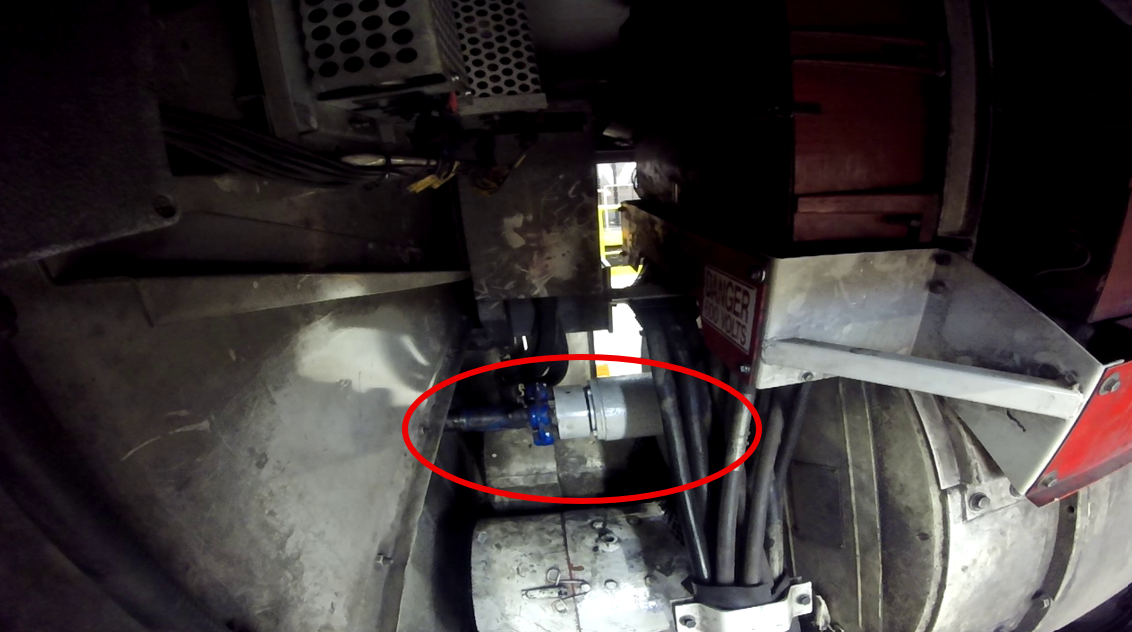
- The gear train of the power take-off failed which led to the equipment blower not operating. This meant no cooling air was provided to the electrical equipment during operation of the locomotive.
- The electrical equipment overheated and the system stopped supplying power to the rectifiers. This resulted in no power being provided to the locomotive’s traction motors and the train came to a stop.
Train information
- Train 803 was operating as a passenger service. It was comprised of 10 carriages, was 208 m long and weighed 380 tonnes (t) on the day of the incident. It was powered by locomotive DXC 5391. There were 177 passengers on board, one locomotive engineer and six on-board crew members.
Personnel information
- LE1 had been employed by KiwiRail since 2012 and started locomotive driving in 2014. They had been certified to drive passenger trains since September 2025. Their safety observations (in-field assessment of rail personnel carrying out the application of practical skills for the activities specified on their Licence to Operate) were current at the time of the incident.