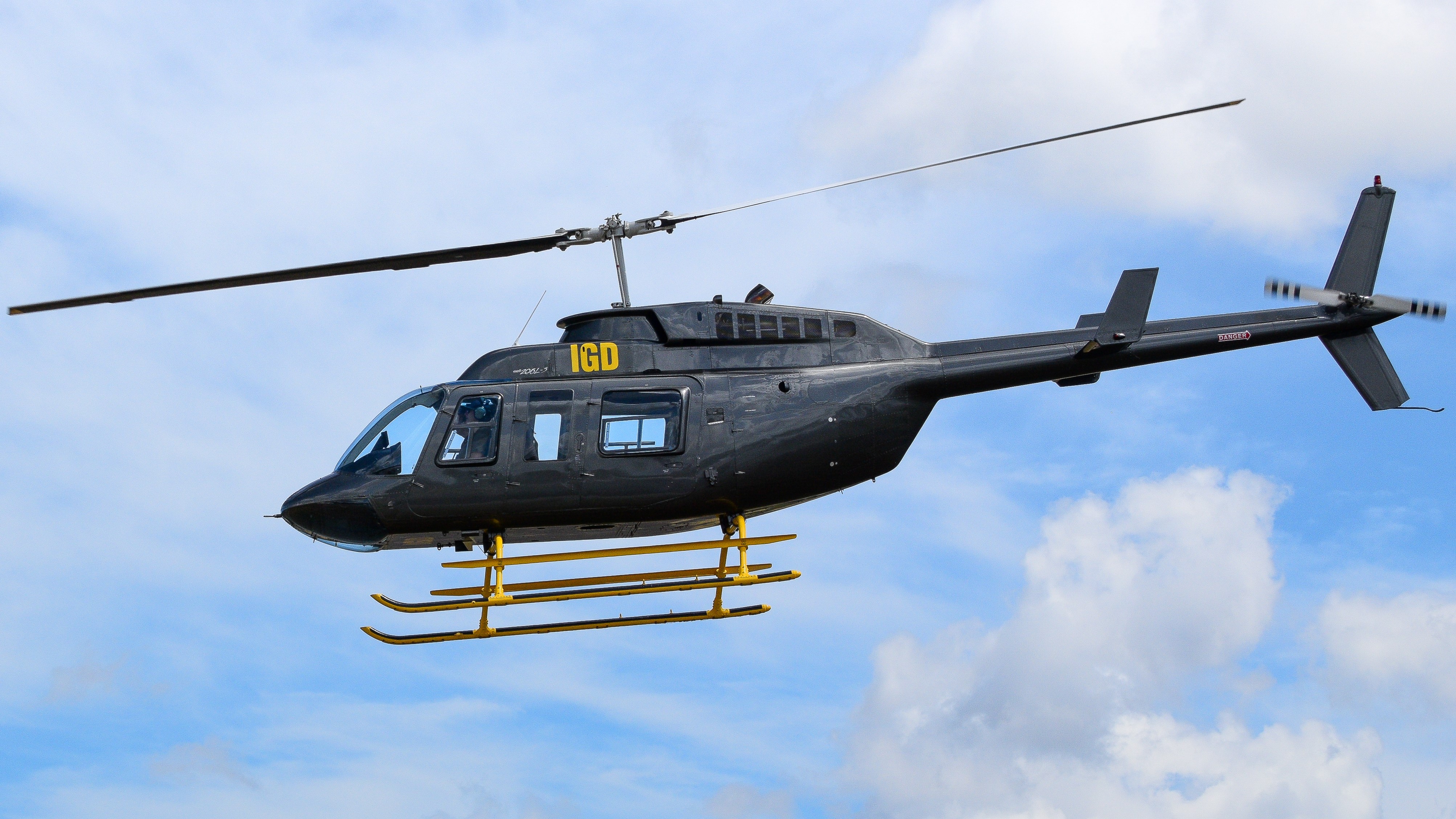
A Bell Longranger helicopter overturned during take-off, injuring the pilot and two passengers. Key factor was dynamic rollover after the rear of a skid remained in contact with the ground as the helicopter moved sideways. Dynamic rollover is a well-known hazard in helicopter operations. No new safety issues, no new recommendations.
Executive summary Tuhinga whakarāpopoto
What happened
- On 27 July 2025, the owner/pilot of a Bell Textron Canada Limited 206L-3 Longranger helicopter (the helicopter) was taking off from their property near Whakatāne to fly back to Ardmore aerodrome, where the helicopter was usually based. The pilot regularly flew between Ardmore aerodrome and the property. On board were the pilot and two family members.
- As the pilot applied left cyclic (the cyclic control is held in the pilot’s right hand and adjusts the pitch of each rotor blade individually during its rotation to direct the helicopter forward, backward, or laterally) to move the helicopter away from a nearby low retaining wall, the helicopter rolled to the left. The main rotor blades struck the concrete to the left-hand side of the fuselage. A main rotor blade passed through the tail boom, and the main fuselage came to rest on its left-hand side, facing 180 degrees from its initial position, all within a few seconds.
- The pilot suffered a head injury and was rendered unconscious for about five minutes. The pilot and both passengers were taken to hospital for treatment.
Why it happened
- The nose attitude (the angle of the helicopter’s nose relative to the horizon, indicating whether the nose is pitched up, level or down) of the helicopter was slightly higher than normally experienced during takeoff, very likely giving the pilot the impression that the helicopter was higher off the ground than it was.
- It is virtually certain that the rear of the left skid was still in contact with the ground as the helicopter started to move left. There was sufficient friction between the rear of the left skid and the concrete to cause the helicopter to roll around the point of contact. The pilot attempted to counter the roll by lowering the collective (the collective is the control in the pilot’s left hand that adjusts the pitch of all the main rotor blades simultaneously, allowing the pilot to adjust the height of the helicopter); this was not successful and the helicopter continued to roll onto its left side, in a condition known as dynamic rollover.
- Dynamic rollover is a critical phenomenon in helicopter operations, where the helicopter can roll uncontrollably around a pivot point (a fixed point around which an object rotates or balances), often leading to an accident if not corrected early.
What we can learn
- Owing to the dangers of dynamic rollover, it is important when manoeuvring a helicopter close to the ground that the pilot ensures there is no contact between the landing gear and the ground before attempting to move the helicopter sideways or backwards.
- All helicopter movements close to the ground need to be slow and controlled in order to recognise any unusual or unexpected movements and to apply the appropriate corrective action in a timely manner.
Who may benefit
- All helicopter pilots and maintenance organisations may benefit from this report.
Factual information Pārongo pono
Narrative
- At about 1514 on 27 July 2025, the owner/pilot (the pilot) of ZK-IGD, a Bell Textron Canada Limited (Bell) 206L-3 Longranger helicopter (the helicopter) was taking off from their property near Whakatāne to fly back to Ardmore aerodrome, where the helicopter was normally based. On board were the pilot and two family members who regularly flew between Ardmore aerodrome and the property.
- The pilot advised Commission investigators that they did their usual pre-flight (checking the condition and airworthiness of the helicopter) inspection of the helicopter alone to avoid distractions, then the passengers boarded the helicopter. The pilot did a final walk-around to check the helicopter, including checking that all doors were closed securely and that the passengers’ seatbelts were properly fastened, before strapping themself in. The pilot and passengers all stated that this was the normal routine.
- The pilot reported that there was nothing eventful or out of the ordinary in the starting sequence and checks.
- The pilot reported that after completing their after-start and pre-takeoff checks, the intention was to take off into a 2–3 feet (ft) hover and then move the helicopter to the left a short distance, away from the small retaining wall and gently sloping ground on the right of the helicopter (see Figure 3). They then planned to move the helicopter backwards into a clear space and turn into the wind before climbing above obstacles and transitioning to forward flight.
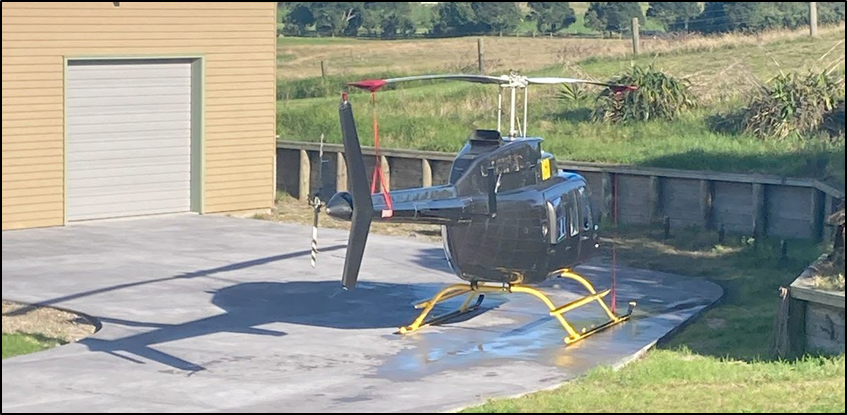
- The initial portion of the takeoff was considered normal by all on board. The pilot recalled that once in the hover the helicopter was in a slightly higher nose attitude than they normally experienced, though not to a degree that would raise concerns for them. They thought this was because of the light tailwind they were experiencing.
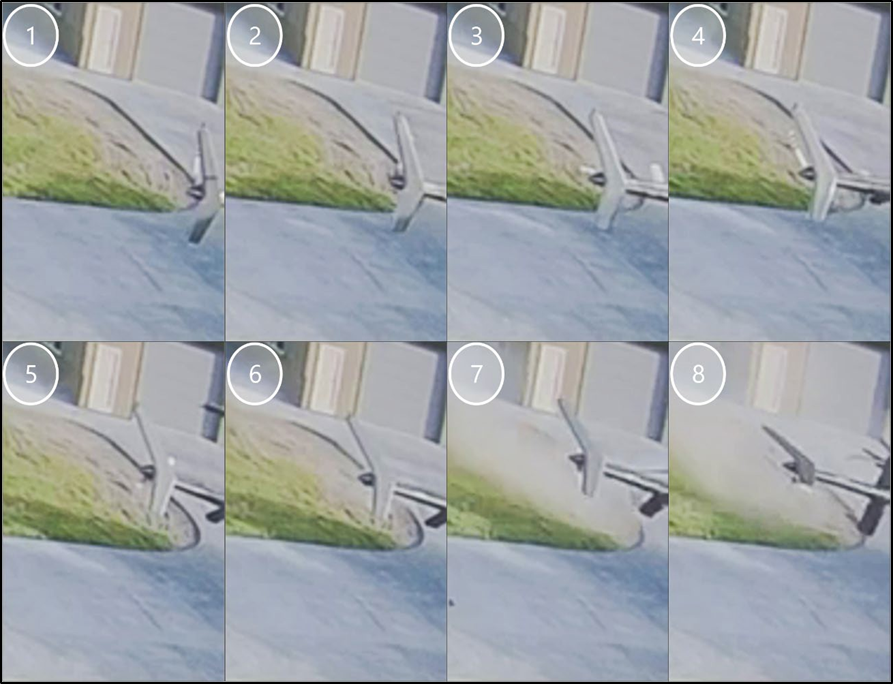
- As the helicopter started to move left away from the retaining wall, it began rolling to the left (see Figure 4). The main rotors struck the concrete ground, destroying the blades and causing the helicopter to shake violently and the tail to separate.
- After the helicopter stopped moving, the passengers extricated themselves and then, with the help of a neighbour, they pulled the unconscious pilot out of the helicopter. The pilot lost consciousness for about five minutes as a result of the accident, was kept in hospital overnight for observation and discharged the next day. The two passengers sustained minor injuries and were not admitted to hospital.
- Neither the pilot nor passengers recalled shutting off the helicopter engine; however, neither they nor other witnesses recalled the engine running after the occupants had evacuated the helicopter.
Personnel information
- The pilot had held a Private Pilot Licence (Helicopter) (PPL(H)) since March 2008 and had accrued about 611 total flying hours including 99 hours on the B206L-3 type of helicopter.
- The pilot began helicopter training in 2006, having previously accrued 55 hours’ training in aeroplanes in 1990 to 1991. Initial helicopter training was conducted in a Robinson R22. The pilot purchased a Bell 206B Jetranger (B206B) in September 2015, for personal use. After completing conversion training, they accumulated 361 hours on the B206B before purchasing ZK-IGD in November 2021.
- The pilot completed a biennial flight review in December 2024, and their pilot’s logbook showed that at the time of the accident they had flown 4.7 hours in the preceding 90 days, including multiple flights. The pilot met the currency requirements to exercise the privileges of their PPL(H) licence.
- The pilot reported being well rested at the time of the accident, and that they were in good health and fit to fly.
Pilot medical
- The pilot held a valid and current DL9 (From 5 April 2021, Private Pilot Licence holders were able to exercise a wide range of licence privileges on a current medical certificate issued in accordance with clause 44(1) of the Land Transport (Driver Licensing) Rule 1999. That is applicable for a class 2, 3, 4 or 5 driver licence with passenger endorsement, known as a DL9 driver licence medical certificate (see Civil Aviation Rules Part 61.35(a)(1)(ia))) medical certificate. There was no evidence that the accident was the result of a medical event or pre-existing condition.
Aircraft information
- ZK-IGD was a Bell Textron Canada Limited Helicopters 206L-3 helicopter, serial number 51221, manufactured in 1987. It was powered by a single Rolls-Royce 250-C30P turboshaft engine.
- The helicopter was imported into New Zealand in 2021 and issued with a non-terminating certificate of airworthiness in the standard category on 4 August 2021. The helicopter was to be maintained in accordance with the manufacturer’s maintenance instructions.
- Commission investigators reviewed the maintenance records, which showed that there were helicopter components that were overdue for maintenance action (see paragraph 3.10). The helicopter was booked in for maintenance on 1 August 2025, which was the week after the accident. Part of that maintenance was for those overdue components.
- The Bell 206L-3 is a 7-seater helicopter with a maximum permissible weight of 4150 pounds (lb) (1882 kilograms (kg)). The basic weight of ZK-IGD was recorded as 2505.8 lb (1136.6 kg). Using the known weights and positions of the three occupants and the measured fuel load, the helicopter was calculated to be within its weight and balance limits at the time of the accident. The fuel was drained and measured at the scene. The check of the fuel for water and impurities identified no contamination.
Meteorological information
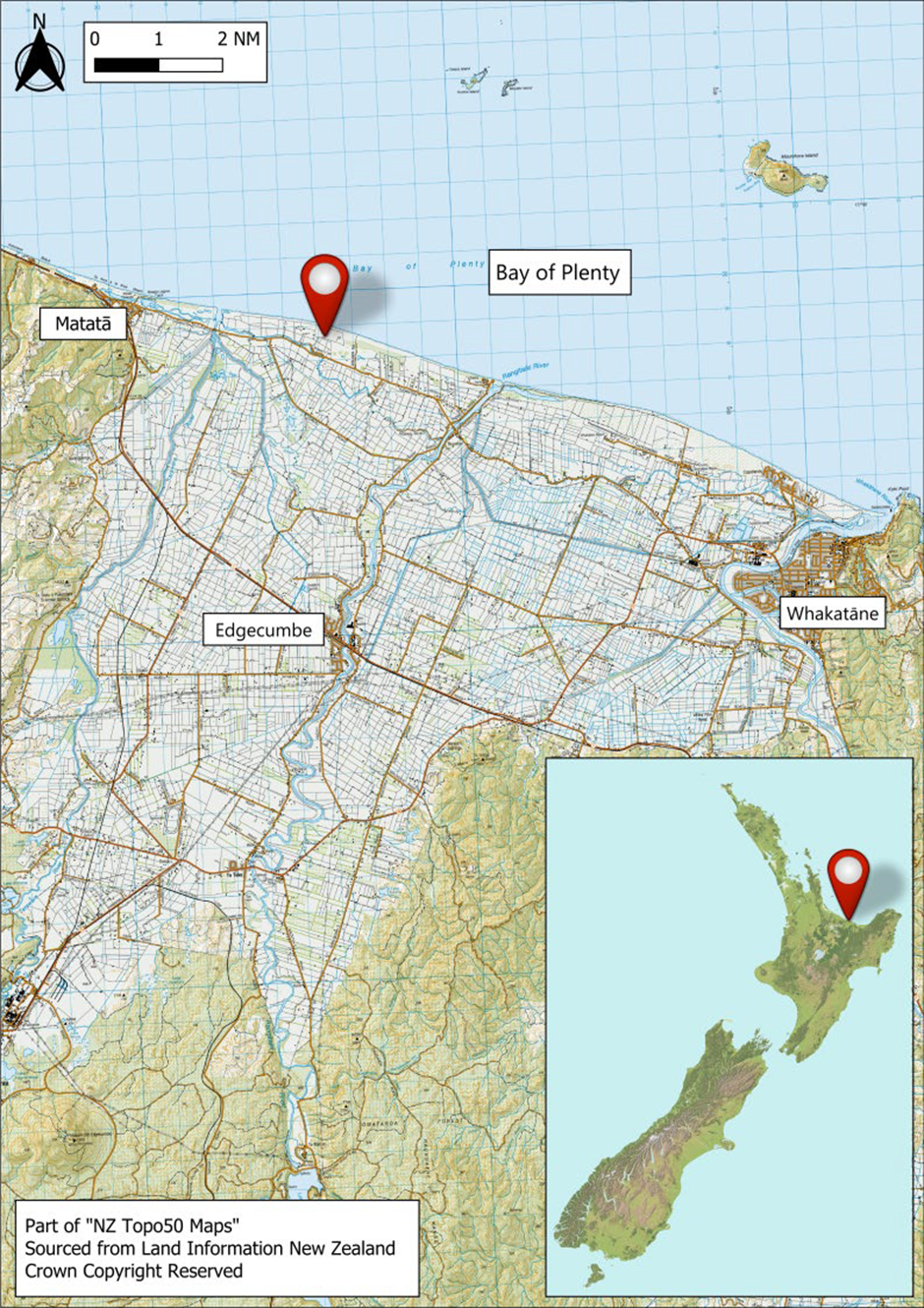
- The METAR AUTO (aerodrome routine meteorological report provided from an automatic weather station) for Whakatāne aerodrome (4.5 nautical miles (NM) east of the accident site) issued at 1530 was:
- wind from 060 degrees true at 6 knots (kt)
- visibility 20 kilometres
- cloud broken at 4200 feet
- temperature 14°C and dew point 8°C
- atmospheric pressure at sea level 1030 hectopascals (hPa)
- A local pilot who arrived at the scene soon after the accident told investigators that they estimated the wind at the time was light at about 4–5 kt, from the east. It was a generally clear day.
Recorded data
- The helicopter was fitted with a Garmin aera 760 GPS navigation system that recorded its flights. Data points from the accident flight were analysed as part of the investigation. Owing to the short timeframe and relative lack of distance covered, the data did not assist the investigation into the accident flight. It did provide independent corroboration of the flight times recorded in the pilot’s logbook.
Flight recorders
- The helicopter was not fitted with a flight data recorder or a cockpit voice recorder and was not required to be.
Other data sources
- The pilot provided closed-circuit television (CCTV) footage from a nearby building with partial coverage of the accident site.
- Mobile phone records were checked for possible relevance to pilot distraction. There were no calls or messages to or from the pilot in the period leading up to or during the accident.
Table 1: Timeline from other data sources
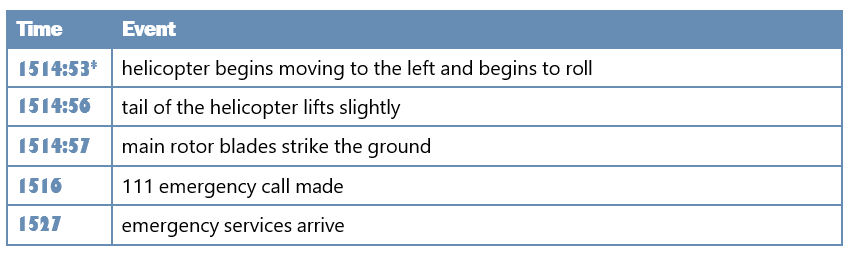
*1514 and 53 seconds.
Site and wreckage information
- The accident occurred on a flat concrete pad, with slightly raised terrain nearby. Some trees were located behind low retaining walls to the right of the helicopter during takeoff and there was a large shed to the left.
- The main rotor blades disintegrated during the accident sequence with only the root of each blade remaining connected to the main rotor hub (attachment point for the main rotor blades), which in turn was still connected to the mast (see Figure 5). The remaining parts of the blades were found spread across the accident site.
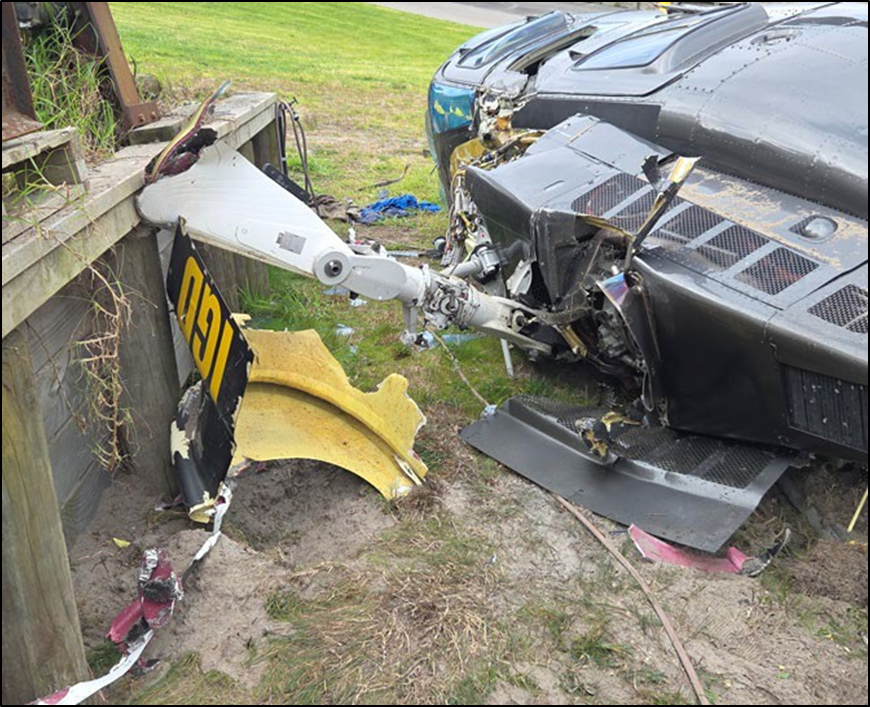
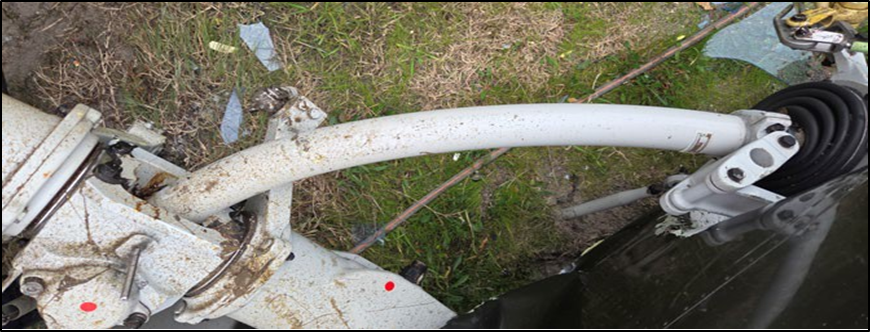
- The helicopter’s mast was bent through about 90°, although still attached to the transmission (transfers power from the engine to the main rotor, tail rotor and other accessories during normal flight conditions) (see Figure 6).
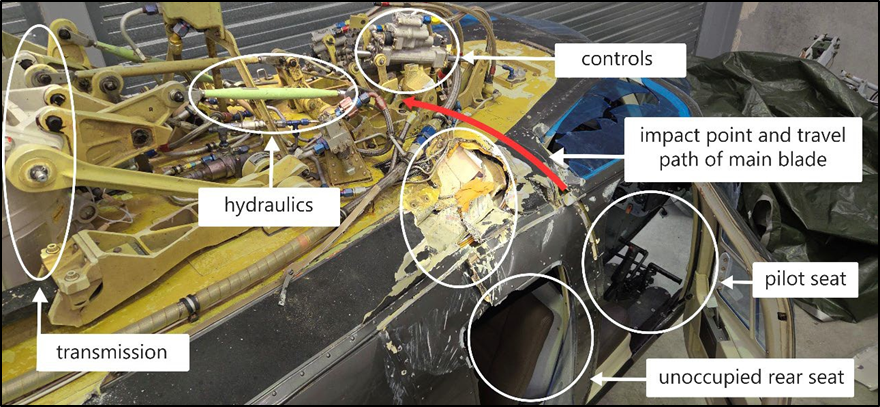
- Strike marks on the right-hand side of the main cabin, next to the unoccupied rear-facing seat position, were consistent with a main rotor striking the cabin and then travelling across the top of the helicopter cabin and through the control linkages (used to control the helicopter attitude and direction of travel), where the hydraulics are located (see Figure 7).
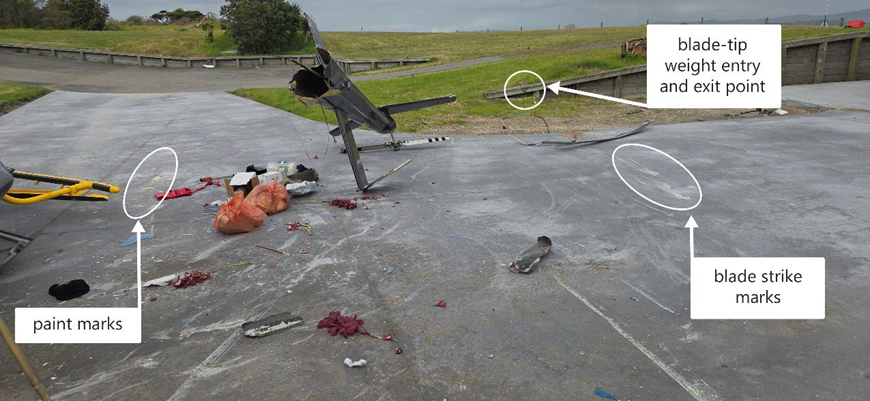
- Evidence marks on the concrete include a divot (a small indentation, gouge or disturbance caused by an impact), consistent with the location of the end of the main rotor blade when it first struck the ground (see Figure 8). A small hole in the retaining wall, in line with the concrete strike marks, is consistent with a blade-tip weight penetration.
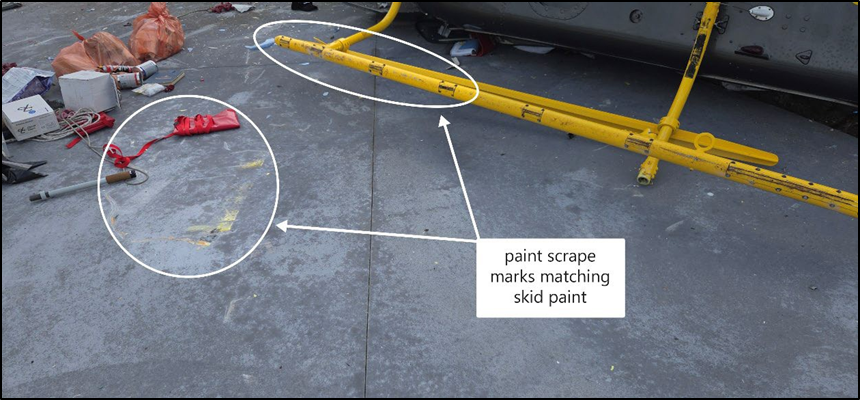
- There were several paint marks consistent with various parts of the helicopter. Of note are the yellow and orange paint marks in the approximate position of the left skid during the accident sequence (see Figure 3, Figure 8 and Figure 9).
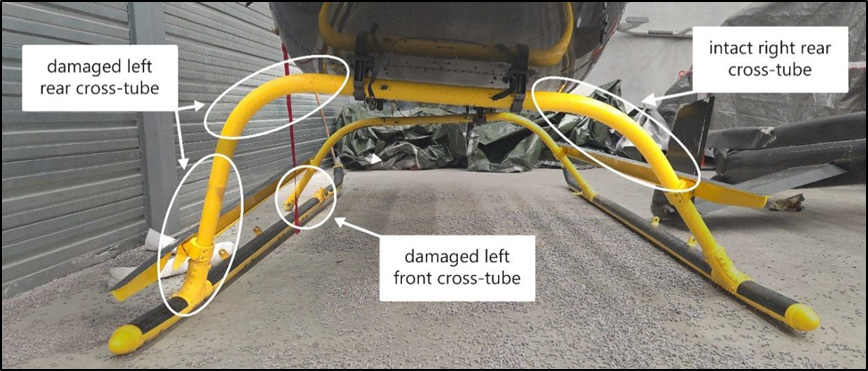
- The left-rear cross-tube was bent inwards (see Figure 10), consistent with heavy side loading during the accident sequence. The paint on the outer section of the left rear skid was missing, through the outer yellow layer and an underlying orange layer, showing the bare metal below (see Figure 11).
- There was no fire before, during or after the accident sequence, and the fuel tank remained intact.
Survival aspects
- The helicopter was fitted with an emergency locator transmitter (ELT) designed to activate in a heavy impact. The ELT activated and automatically notified the Rescue Coordination Centre New Zealand (RCCNZ) at 1517. The RCCNZ then called emergency services to attend; the emergency services arrived at the accident scene about 10 minutes later.
- The rear passenger was wearing a three-point lap and sash style seatbelt. The front passenger and pilot both had four-point harnesses that remained secure throughout the accident sequence. Both passengers received minor bruising. The main cabin remained intact during the accident sequence, protecting the occupants as it was designed to do.
- During the accident sequence, the pilot’s head contacted the aircraft cabin roof, resulting in loss of consciousness and bleeding. The pilot was not wearing a flight helmet; nor were they required to do so.
Analysis Tātaritanga
Introduction
- Helicopter pilots are taught to lift from the ‘skids light’ (when the pilot raises the collective just enough for the landing skids to lose full contact with the ground without actually completing a full takeoff or hover) condition to a low hover before going to normal hover height to preclude dynamic rollover (dynamic rollover is discussed in paragraph 3.17 onwards) (Civil Aviation Safety Authority Australia, 2012).
- This means that the helicopter should lift slowly into a low hover for the pilot to check controllability, and to assess the attitude of the helicopter when hovering. A check of the engine and flight instruments is also undertaken to ensure that there is sufficient power available to continue, noting that the power required increases as the hover height increases. If any of these factors are not suitable, the pilot can land the helicopter and reassess before committing to further flight.
- If the helicopter aligns with the anticipated take-off characteristics, it is standard practice to lift to a normal hover height, as appropriate to the type of helicopter, before manoeuvring in the hover.
- The following section analyses the circumstances surrounding the event to identify factors that increased the likelihood of the event occurring or increased the severity of its outcome.
What happened
- The position of the helicopter at the time of takeoff, combined with the direction of the wind and the local topography, meant that the relative wind was almost a direct tailwind.
- The pilot’s plan was to take off into a 2–3 ft hover, then move left, away from the low wall they were parked next to, and then move backwards into a clearer space before turning into the wind and climbing vertically above the surrounding trees and flying away. The pilot later reported a nose-high attitude on takeoff, very likely the result of needing to counter the effect of the tailwind. This meant that as power was applied, the front of the skids would have left the ground first and the rear of the skids would have remained lower.
- With the nose higher than usual it is very likely that the pilot had the impression that the helicopter was higher off the ground than it was. As the pilot input cyclic control to move the helicopter to the left, it is virtually certain that the heel of the left skid was still in contact with the concrete. Paint scrape marks on the concrete show that there was enough friction between the skid and the concrete to prevent the skid from moving at the same rate as the rest of the helicopter. As a result, the helicopter began to roll to the left because of the horizontal component of the thrust from the main rotor.
- This phenomenon, known as dynamic rollover, is discussed in paragraph 3.17 onwards.
Why did the helicopter roll over on takeoff?
Pilot medical event
- There was no evidence that the accident was the result of a medical event or medical condition.
Helicopter maintenance
- Examination of the helicopter and engine logbooks identified some discrepancies in component life limits and maintenance requirements. However, the components in question remained intact during the accident sequence and were not causal to the accident.
- While the airworthiness of the helicopter did not contribute to the accident, aircraft operators should be aware of their responsibilities. Civil Aviation Rules (CARs) Part 91.603(a)(1) states that the operator of an aircraft must ensure that the aircraft is maintained in an airworthy condition.
Mechanical failures
- Examination of the engine confirmed it was operating at high power at the time the main rotor blades struck the concrete. The damage to the main rotor and tail rotor blades confirm they were also rotating at high speed at the time of impact.
- External damage to the engine and engine mounts sustained during the accident was virtually certain to have caused the engine to shut down during the accident sequence. This is consistent with witness reports that the engine had stopped when the passengers evacuated.
- Examination of the flight controls showed that they had retained continuity and function until damaged during the accident. The controls had been assisted by hydraulics up to the point of impact.
- When interviewed, the pilot said that the helicopter was performing normally and there were no aural or visual warnings leading up to the accident.
- Based on the following evidence, it was exceptionally unlikely that a mechanical failure contributed to this accident.
Dynamic rollover
-
Dynamic rollover is a well-known phenomenon and is taught to all helicopter pilots early in their training.
The United States Federal Aviation Administration (FAA) Helicopter Flying Handbook provides this description of dynamic rollover:
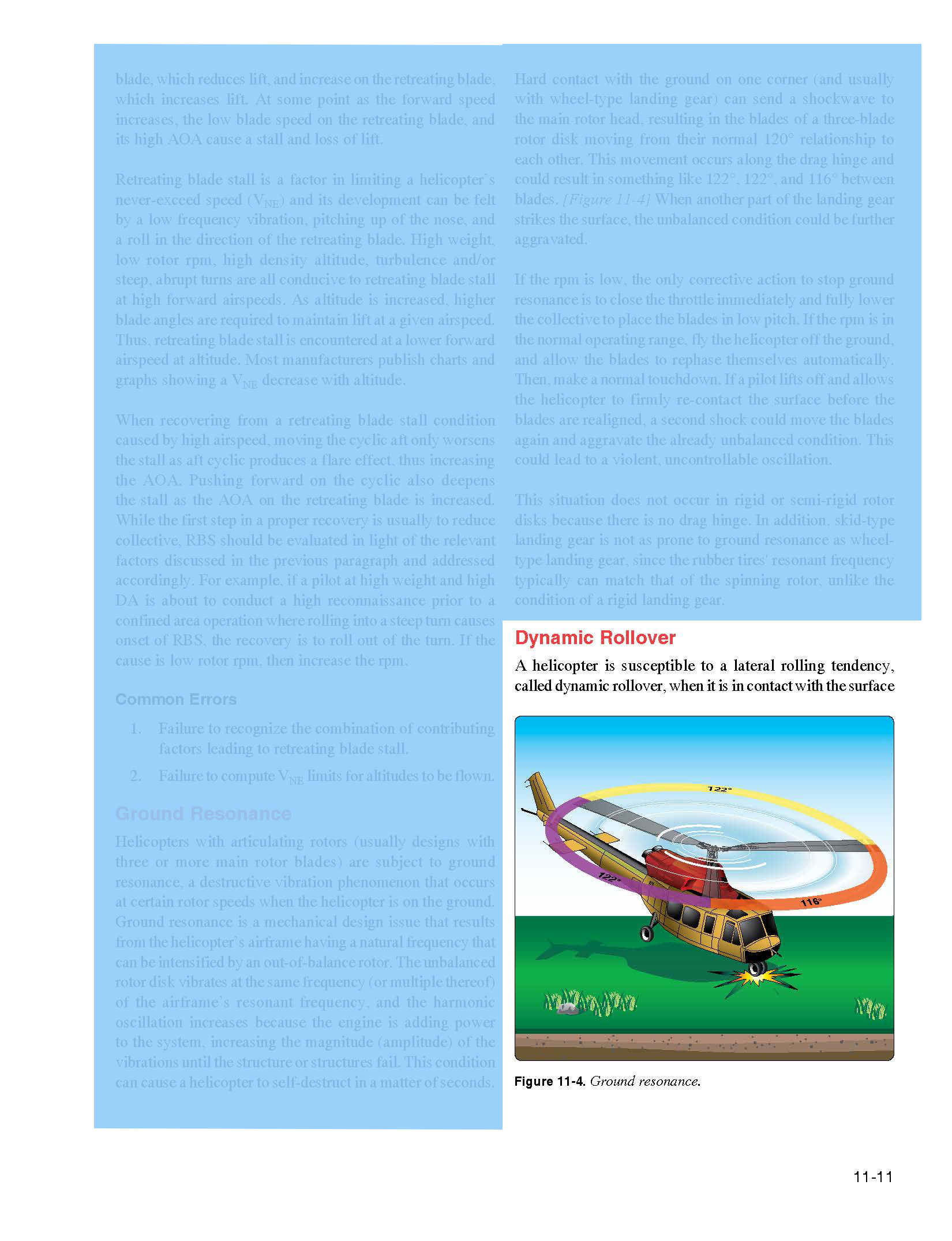
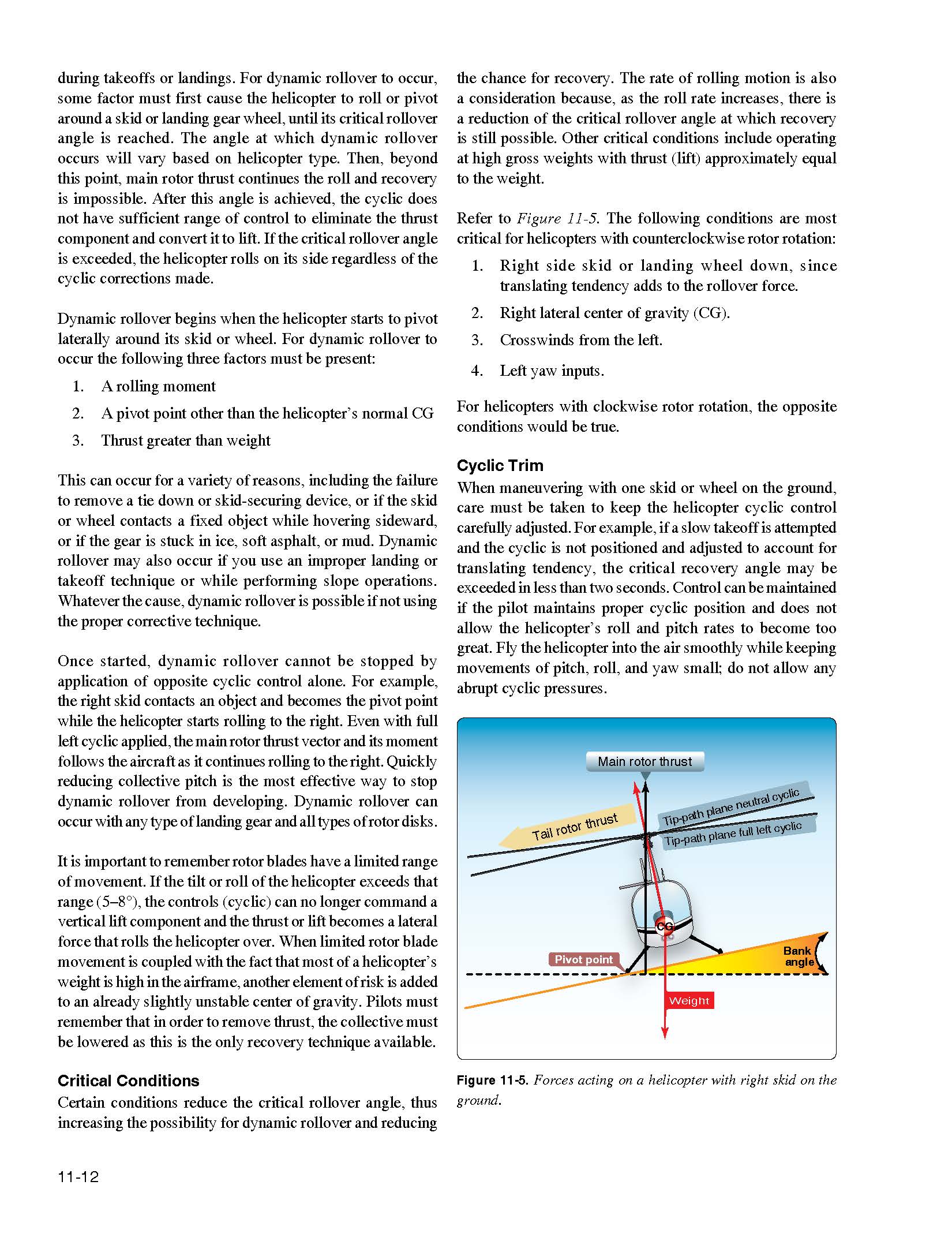
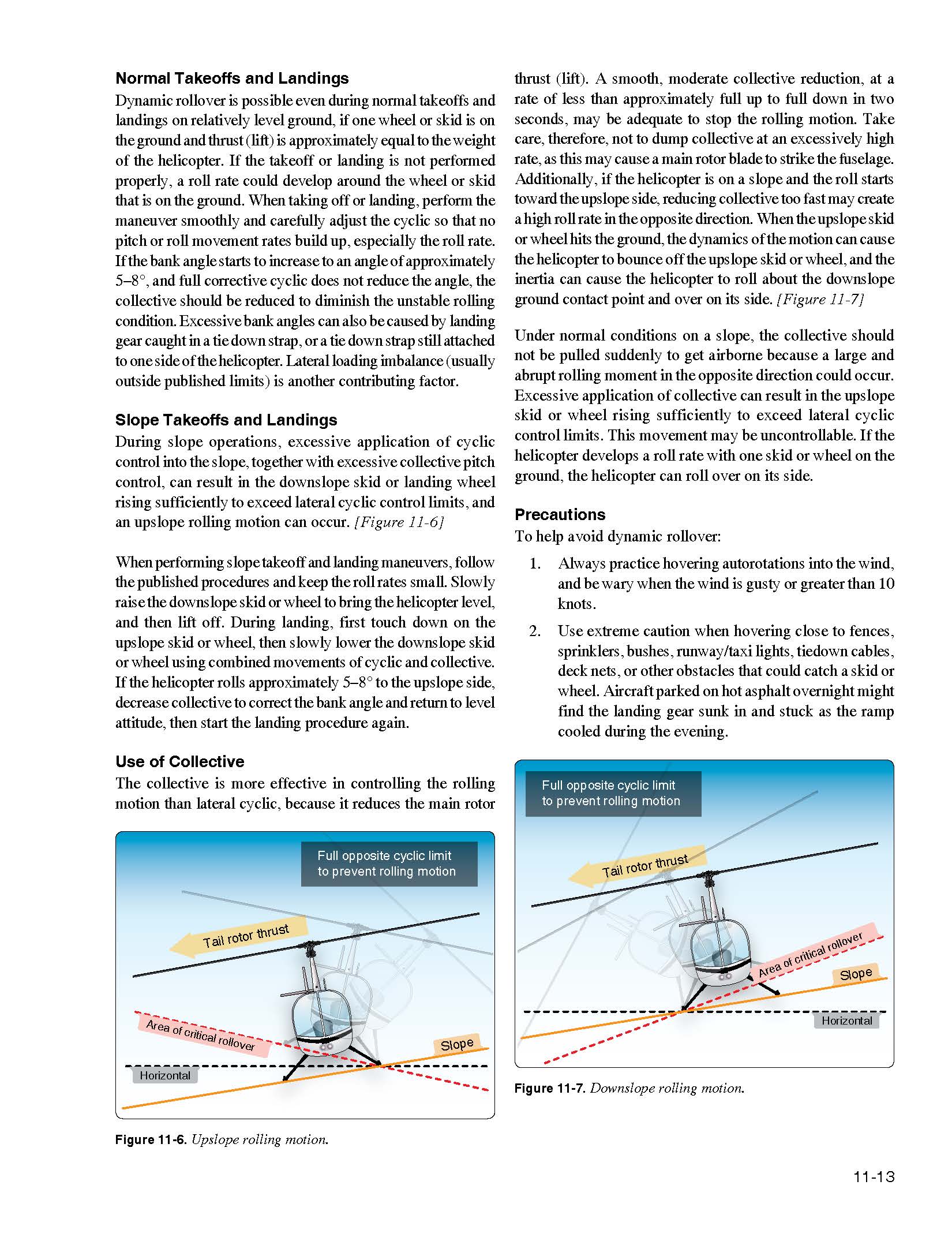
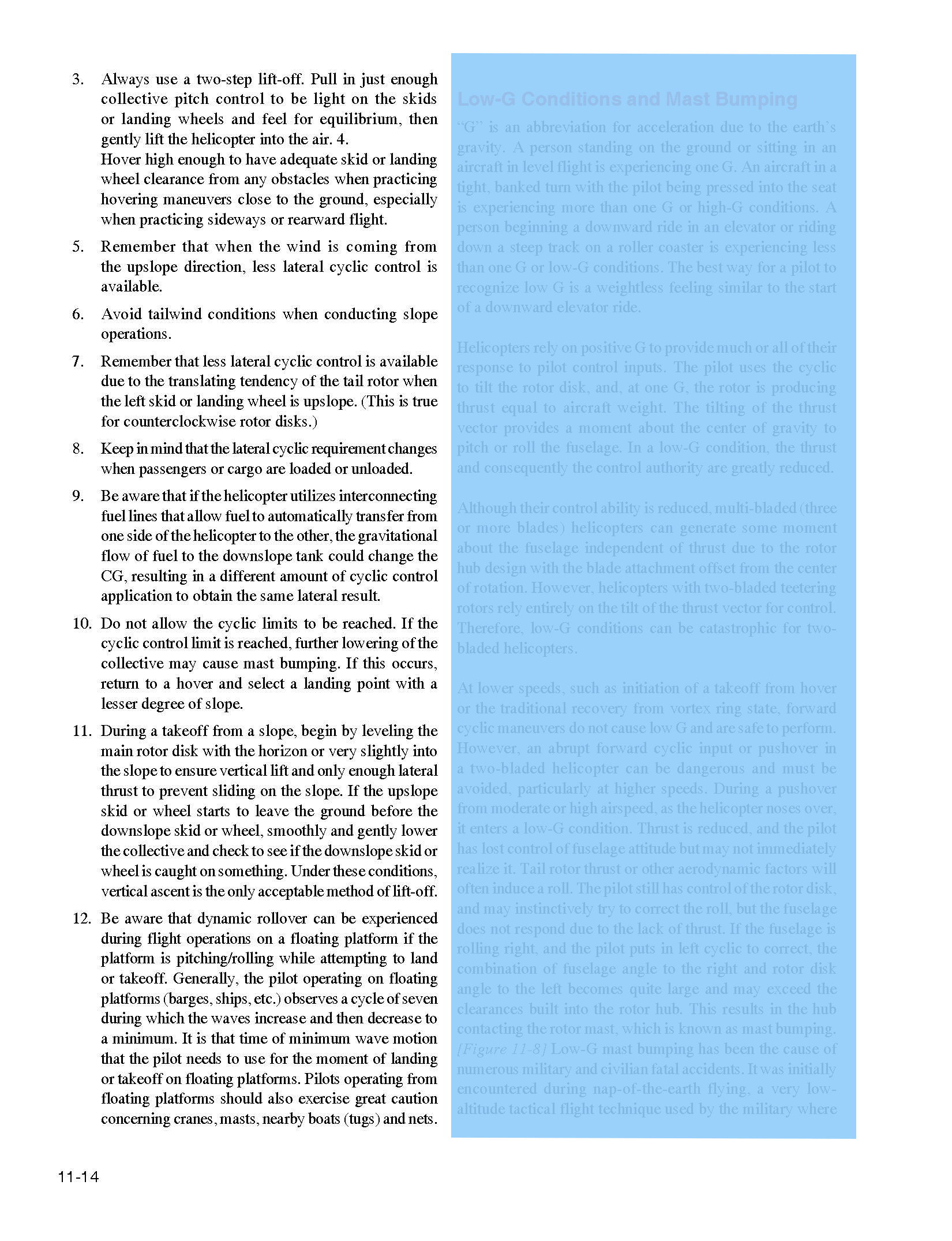
A helicopter is susceptible to a lateral rolling tendency, called dynamic rollover, when it is in contact with the surface during takeoffs or landings. For dynamic rollover to occur, some factor must first cause the helicopter to roll or pivot around a skid or landing gear wheel, until its critical rollover angle is reached. The angle at which dynamic rollover occurs will vary based on helicopter type. Then, beyond this point, main rotor thrust continues the roll and recovery is impossible. After this angle is achieved, the cyclic does not have sufficient range of control to eliminate the thrust component and convert it to lift. If the critical rollover angle is exceeded, the helicopter rolls on its side regardless of the cyclic corrections made. (United States Department of Transportation Federal Aviation Administration, 2019)
- The recovery technique for dynamic rollover is to lower the collective before reaching the critical angle, which is between 5° and 8°, depending on the helicopter design. Often, the natural instinct for pilots when rolling left is to apply opposite direction cyclic input; however, unless it is applied before the helicopter reaches the critical angle, it will not be sufficient by itself to recover the helicopter. (See Appendix 1 for the full FAA Helicopter Flying Handbook guidance on dynamic rollover).
- When interviewed, the pilot said that they attempted to correct the roll to the left by lowering the collective. CCTV footage captured from the nearby house supports the pilot’s recollection. However, by the time the pilot had recognised and attempted to recover from the roll, the critical angle had already been passed, and the main rotor blades then made contact with the ground.
- It is virtually certain that the helicopter was beyond the critical angle when the pilot lowered the collective while attempting to recover the helicopter, preventing the successful execution of the recovery technique.
Factors affecting safety
Flight helmets
- The pilot was not wearing a flight helmet. This was not unusual, as most private, and some commercial, helicopter pilots do not routinely wear flying helmets, especially when carrying passengers, and there is no requirement to do so.
- The benefits of wearing an appropriate flight helmet are well documented, especially for pilots during accidents and incidents, when they need to maintain awareness and act quickly. Unlike the passengers, the pilot is unable to protect their head during an accident, as their hands are occupied on the flight controls trying to maintain, or regain, control of the helicopter. Flight crew head protection can increase safety for all occupants. A pilot’s head injury can compromise their ability to control the aircraft, safely shut down the aircraft once on the ground and assist with evacuation.
-
In Commission report AO-2018-005 on the engine control malfunction and forced landing of MD Helicopters 600N, ZK-ILD, the Commission made a recommendation (005/21). to the Director of Civil Aviation to promote education awareness of the benefit of aircraft pilots and occupants wearing appropriate helmets when practicable and when operational conditions indicate a potential benefit (Transport Accident Investigation Commission, 2021). Ongoing education on the benefits of wearing helmets would continue to improve transport safety.
Helmets provide protection to the head and assist in combatting two different types of emergency; protection from a penetrating bird strike and protection during a crash event (Flight Safety Foundation, 2024, p. 199).
Flight data and cockpit video recorders
- The helicopter was not fitted with a flight data recorder or a cockpit voice recorder; nor was it required to be. Although voluntary in this type of aircraft, the use of cockpit video recorders can aid transport safety investigations in the event of an accident. They can also be useful tools for training and pilot feedback for normal operations.
Findings Ngā kitenga
- The pilot was appropriately qualified, trained and capable of performing the flight.
- As part of its inquiry, the Commission determined that this accident was not the result of a mechanical failure, distraction, or medical condition or event.
- The nose-high attitude was very likely the result of the pilot needing to counter the effect of the tailwind.
- The nose attitude of the helicopter was slightly higher than the pilot normally experienced during takeoff, very likely giving the pilot the impression that the helicopter was higher off the ground than it was.
- It is virtually certain that the rear of the left skid was still in contact with the ground as the helicopter started to move left, and there was sufficient friction between the rear of the left skid and the concrete to cause the helicopter to roll around the point of contact, in a condition known as dynamic rollover.
- It is virtually certain that the helicopter was beyond the critical angle when the pilot lowered the collective while attempting to recover the helicopter, preventing the successful execution of the recovery technique.
- External damage to the engine and engine mounts sustained during the accident was virtually certain to have caused the engine to shut down during the accident sequence.
Safety issues and remedial action Ngā take haumaru me ngā mahi whakatika
General
- Safety issues are an output from the Commission’s analysis. They may not always relate to factors directly contributing to the accident or incident. They typically describe a system problem that has the potential to adversely affect future transport safety.
- Safety issues may be addressed by safety actions taken by a participant; otherwise the Commission may issue a recommendation to address the issue.
- No new safety issues were identified.
Recommendations Ngā tūtohutanga
General
- The Commission issues recommendations to address safety issues found in its investigations. Recommendations may be addressed to organisations or people, and can relate to safety issues found within an organisation or within the wider transport system that have the potential to contribute to future transport accidents and incidents.
- In the interests of transport safety, it is important that recommendations are implemented without delay to help prevent similar accidents or incidents occurring in the future.
- No new recommendations were issued.
Other safety lessons Ngā akoranga matua
- Pilots need to be aware of the wind conditions and how this will affect the performance of the helicopter, including in light and benign conditions when the performance of the helicopter can be affected in subtle but significant ways.
- All pilots and private owners need to be vigilant with the maintenance requirements of their aircraft.
- Flight helmets protect occupants’ heads during accidents and reduce the likelihood and severity of head injuries that may prevent the pilot from taking action to reduce the severity of the accident. Flight crew head protection can increase safety for all occupants. A pilot’s head injury can compromise their ability to control the aircraft or safely shut down the aircraft once on the ground and assist with evacuation.
- Civil Aviation Rules define the minimum levels of safety required. Pilots must determine their own safety requirements relative to their operations and consider the use of appropriate helmets for themselves and occupants.
- On 27 May 2021, the Commission recommended that the Director of Civil Aviation promote education awareness of the benefit of aircraft pilots and occupants wearing appropriate helmets when practicable and when operational conditions indicate a potential benefit.
- Cockpit video recorders can be useful tools for training and pilot feedback during routine operations. They can also provide valuable information for transport safety investigations to assist with determining the circumstances and causes of accidents and incidents, to avoid similar occurrences in the future.
- Aircraft operators are responsible for ensuring that their aircraft are maintained in an airworthy condition.
Data summary Whakarāpopoto raraunga
Details
37° 53.8´ south
176° 49.4´ east
Conduct of the inquiry Te whakahaere i te pakirehua
- At 1619 on 27 July 2025, the CAA notified the Commission of the occurrence. The Commission subsequently opened an inquiry under section 13(1) of the Transport Accident Investigation Commission Act 1990 and appointed an Investigator-in-Charge.
- A protection order was issued covering the wreckage and surrounding areas. The property owner provided CCTV footage.
- At 1210 on 28 July 2025, two Commission investigators arrived at the accident site
- On 29 July 2025, the helicopter wreckage was removed from the accident site and transported to the Commission’s technical facility in Wellington for further detailed examination.
- On 30 July 2025, Commission investigators interviewed the pilot and both passengers.
- On 31 July 2025, Commission investigators visited the maintenance organisation that provided the maintenance of the helicopter and gathered the relevant maintenance records.
- On 29 October 2025, the Commission approved a draft report for circulation to three interested parties for their comment.
- One interested party provided a detailed submission and two interested parties replied that they had no comment. Any changes as a result of the submission have been included in the final report.
- On 25 March 2026, the Commission approved the final report for publication.
- 4.5 NM west of Whakatāne. Investigators conducted a site examination and recording on 28 and 29 July 2025.
Glossary Kuputaka
- Collective
- One of the flight controls used by a helicopter pilot to ‘collectively’ adjust the pitch angle of all main rotor blades at the same time to alter the amount of thrust/lift being produced.
- Cyclic
- The control which changes the pitch angle of the rotor blades individually during a cycle of revolution and as a result tilts the main rotor disc to control the direction and velocity of flight.
- Dynamic rollover
- Uncontrolled lateral rolling tendency when a helicopter is in contact with the ground with only one skid or wheel
- Knot
- A measurement of speed in nautical miles per hour, equivalent to 1.85 km/h.
- Nose attitude
- Angle of the helicopter’s nose relative to the horizon, indicating whether the nose is pitched up, level, or down
- Pivot point
- Fixed point around which an object rotates or balances
Citations Ngā tohutoru
Civil Aviation Safety Authority Australia. (2012, March). Helicopter flight instructor manual.
Retrieved October 01, 2025, from aviation.govt.nz: https://www.aviation.govt.nz/assets/licensing-and-certification/flight-training/helicopter-flight-instructor-manual.pdf
Flight Safety Foundation. (2024, May). The BAR Standards. Retrieved September 16, 2025, from Flight Safety Foundation: https://flightsafety.org/bars/the-bar-standards-and-manuals/
Transport Accident Investigation Commission. (2021). AO-2018-005 MD Helicopters 600N, ZK-ILD, Engine control malfunction and forced landing, Ngamatea Station, 14 June 2018. Transport Accident Investigation Commission. Retrieved from https://www.taic.org.nz/inquiry/ao-2018-005
United States Department of Transportation Federal Aviation Administration. (2019). Helicopter Flying Handbook. Retrieved October 08, 2025, from Federal Aviation Administration: https://www.faa.gov/regulations_policies/handbooks_manuals/aviation/helicopter_flying_handbook
Appendix 1. Excerpt from FAA Helicopter Flying Handbook – Dynamic Rollover