
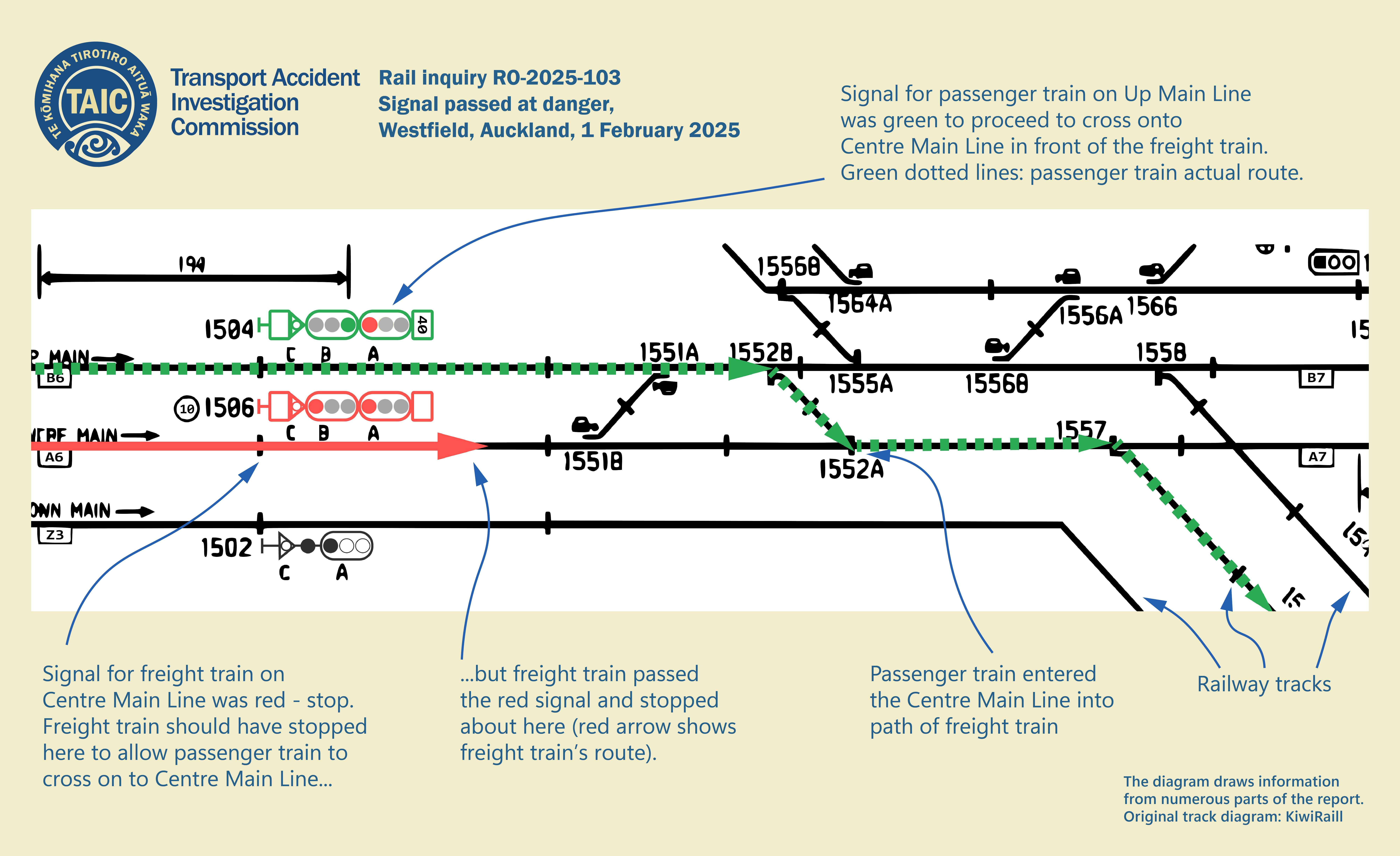
A freight train passed a stop signal in Auckland’s Westfield rail yards and stopped only about 250 metres behind a passenger train on the same track.
No one was injured and there was no damage, but the Transport Accident Investigation Commission (TAIC) says the event shows how quickly things can go wrong when several safety barriers fail at once.
The Commission’s final report described how on 1 February 2025, Train 170S was operating as a regular freight shunt service between Wiri and the Port of Auckland.
At about 12.07 pm, it passed a signal at stop. The signal had been set to stop to protect a passenger train crossing onto the same track ahead of the freight train. The locomotive engineer applied the emergency brake before the signal, but the train still stopped about 50 metres beyond it. The passenger train cleared the track and continued without incident.
TAIC Chief Investigator of Accidents Louise Cook said the close call shows the importance of layered safety defences.
“This was close enough to matter. The train stopped in time, but in railway terms, only just. It’s the kind of event rail safety systems are designed to stop before it gets that far.”
TAIC found that three factors combined to reduce the crew’s ability to stop the train before the signal. The freight train crew were not sufficiently familiar with this complex area of operation. The locomotive engineer also became distracted and recognised the need to stop too late. And there were limited trackside cues to help the crew monitor their approach to the stop signal.
“This isn’t about one mistake; it’s about what happens when several risk controls are weak at the same time,” said Ms Cook.
Route knowledge matters because safe train operation depends on train crews knowing and recalling the location of signals, track layout, gradients and speed restrictions. They develop that knowledge through route familiarisation and training in live operations or simulators.
Distraction is a common transport safety risk. In rail, risk-triggered commentary driving is a professional driving practice where the locomotive engineer speaks aloud what they are seeing and doing. It can help crews maintain focus and spot developing risk earlier.
“Good rail safety depends on people and systems working together. Commentary driving is one such example. It gives crews another chance to catch a problem before it turns into a close call.”
TAIC also found that there were no trackside signs or markers dedicated to helping the crew monitor their speed profile toward the stop signal and to recognise early if their approach was not going to plan.
KiwiRail have acted on the lack of route knowledge, with a new route familiarity tool and a route knowledge standard for locomotive engineers. They have accepted TAIC’s recommendation to include risk-triggered commentary driving in training and ensure it is used.
TAIC has recommended that KiwiRail install trackside signage to help train crews respond appropriately to signals and monitor train speed and progress.