A passenger train leaving Wellington station ran a red light because a radio call distracted its driver. The red signal protected an inbound passenger train. Both trains stopped just in time. TAIC reminds KiwiRail of 2017 TAIC recommendation to urgently minimise risks for trains in Wellington rail yards. In the meantime, Train drivers must be more cautious, concentrate.
Executive summary Tuhinga whakarāpopoto
What happened
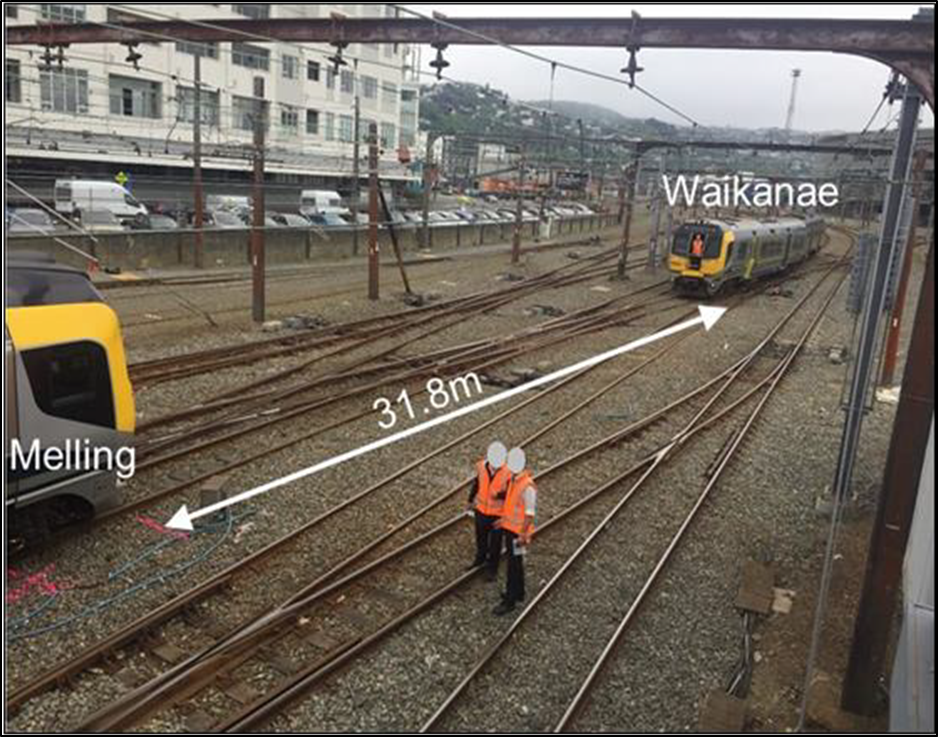
- On Wednesday 6 November 2019, the train driver of the 1317 off-peak Melling service failed to stop at a ‘Red–Stop’ signal in the Wellington Railway Station area and continued towards an oncoming returning Waikanae service. Both train drivers realised what was happening and stopped their trains 31.8 metres apart.
- There was no collision, and no-one was injured in the incident. However, the passengers on both services were held in their trains for more than an hour and considerable disruption was caused to services into and out of Wellington Railway Station.
Why it happened
- The Transport Accident Investigation Commission (Commission) found that the driver of the Melling service was distracted by an overheard radio call and did not stop at the Red–Stop signal as required. The signal was at Red–Stop to prevent unauthorised entry into the section of track occupied by the authorised Waikanae service.
-
The Commission found that there were no additional mitigations in place to prevent a train passing the Red–Stop signal and colliding with another train when the train driver did not react correctly to the signal and stop the train. This safety issue had been previously identified by the Commission in the Commission’s inquiry RO-2016-101, which resulted in recommendation (034/17 – Dec 2017) being issued.
[that] KiwiRail conduct a review of current arrangements and take any opportunities it can to further reduce the risk of train operations in the area until a more suitable longer-term solution can be made.
This recommendation is still open. Therefore, the Commission has not issued a further recommendation.
What we can learn
- Key areas of the Wellington rail network pose higher risks than others and therefore require more caution and concentration from train drivers. Drivers must also prioritise their focus on the most important issues at any one time.
- The Commission issues recommendations with a view to avoiding similar occurrences in the future. If recommendations are not promptly addressed, the risk to the transport system will remain.
Who may benefit
- Drivers may benefit from the details around focus and avoiding distraction in this report. Similarly, all stakeholders involved in the operation of the Wellington rail network may benefit from the details in this report.
Factual information Pārongo pono
Narrative
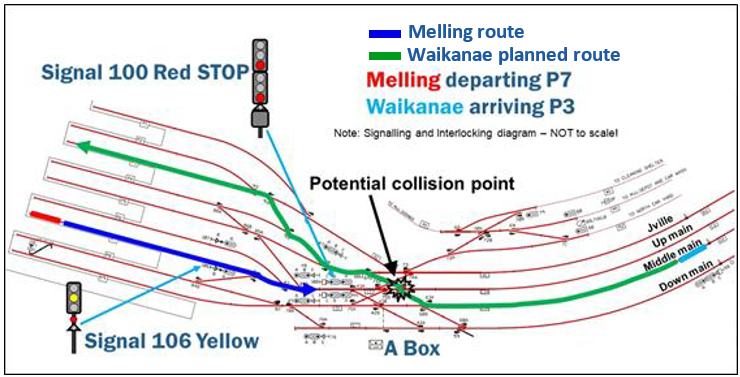
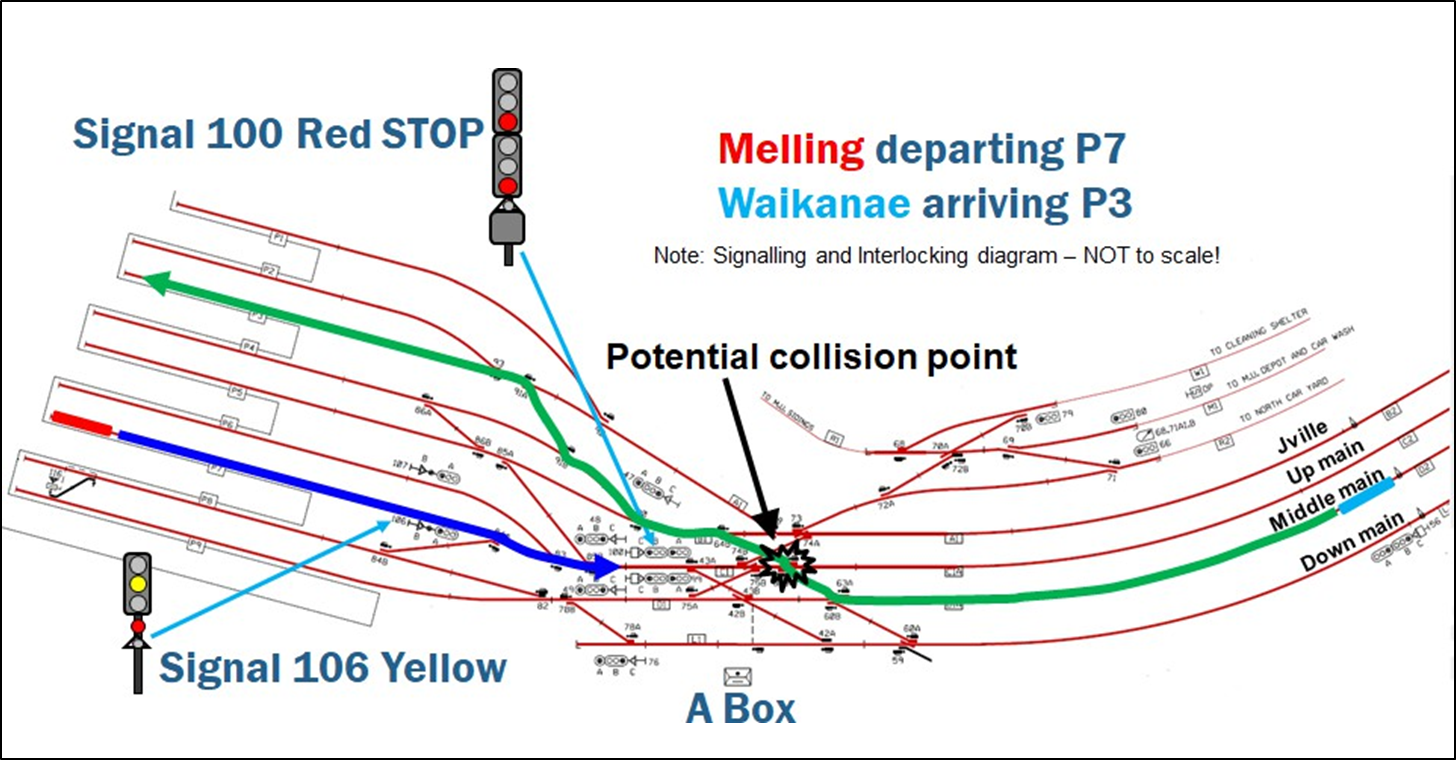
- On Wednesday 6 November 2019, an inbound Melling service arrived at Wellington Railway Station (Wellington Station) at 1257. The train crew stayed on board to take the same train back to Melling as the 1317 outbound service. The train departed on time from platform 7 of Wellington Station. While departing, the driver noted that the signal (signal 106, see Figure 3) at the end of the platform was displaying a ‘Yellow–Caution’ (yellow) aspect, indicating the next signal (signal 100, see Figure 3) was displaying a ‘Red–Stop’ (red) aspect and would require the train to stop at the signal.
- At the same time, the 1220 service from Waikanae to Wellington was approaching Wellington Station. The train driver of the Waikanae service noted that the signals into Wellington were all at proceed, which meant the train could continue to Wellington Station.
- During this off-peak portion of each day, the Wellington Signal Box (locally known as A Box) was manned by a single signaller, who at the time had set the signals to prioritise the arriving Waikanae service ahead of the departing Melling service (see Figure 3).
- As the Waikanae service approached Wellington Station, the driver noticed the Melling service depart from platform 7. This was not unusual and did not alarm the Waikanae driver. Observing that the points directly ahead were set correctly, the Waikanae driver continued towards the platforms, complying with the 20-kilometres-per-hour speed limit.
- Around the same time, the driver of the departing Melling service was approaching the next signal (signal 100, see Figure 3) and overheard a radio call between a train and a worksite on the Johnsonville line. The Melling service driver focused on the radio call, which was similar to the Melling service driver’s worksite radio call the previous day, when they had operated a Johnsonville service. The Melling service driver later recalled at interview being temporarily distracted by the radio call, resulting in a loss of concentration while approaching the signal.
- The Melling service driver next observed the points ahead were not correctly set for the Melling service and that the returning Waikanae service was approaching. This made the Melling service driver realise that their train had likely passed the previous signal at Red–Stop, and the driver applied the train brakes and brought the train to a halt.
- The driver of the Waikanae service had already started to brake after noticing that the opposing train was approaching the same set of points that were not set for the departing train. Both trains came to a halt 31.8 metres apart, adjacent to A Box (see Figure 4).
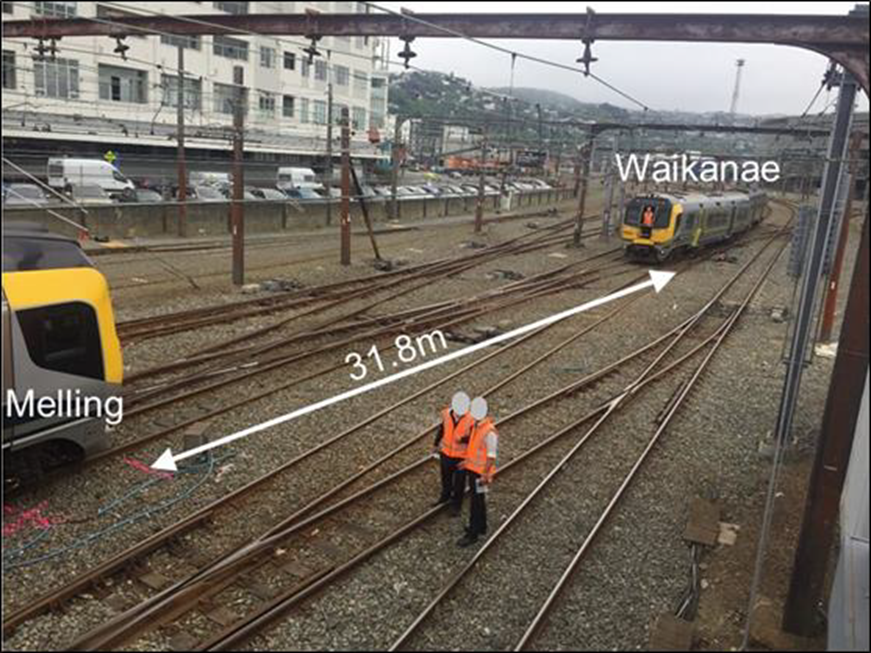
- There was no collision, and no-one was injured in the incident. However, the passengers on both services were held in their trains for more than an hour and considerable disruption was caused to services into and out of Wellington Station.
- The driver of the Melling service was relieved of duty and taken for a drug and alcohol test, returning a negative (clear) result.
Personnel information
- The Melling service train driver worked for Transdev Wellington and had seven years’ rail experience. Working previously as a passenger operator, a train manager and a train examiner, they had started to train as a driver in February 2019. They had been certified to drive Wellington commuter trains on 14 October 2019, just over three weeks before the incident. The driver reported being well rested in the 72 hours prior to the incident and their roster showed no cause for concern regarding potential fatigue.
- The Waikanae train driver worked for Transdev Wellington and had 15 years’ experience driving trains in Wellington.
- The A Box signaller worked for KiwiRail and had 36 years’ rail experience, with 25 years’ experience in signalling
- All personnel detailed above had current certification for their roles.
Additional information
Transdev Wellington training and support to assist drivers in managing distraction
- During their training, trainee train drivers are made aware of the risks of distraction and provided with several anti-distraction techniques. Also, higher-risk areas of the Wellington rail network are highlighted to them as requiring additional concentration. These higher-risk areas include the approaches to Wellington Station for both arrivals and departures.
- Such anti-distraction techniques include utilising the Signal Alert button, which once pressed sounds an audible alarm after a train has travelled a further 50 metres. Drivers are also made aware of other anti-distraction techniques during their training. While these anti-distraction techniques are not mandatory, drivers are encouraged to determine or develop the ones that work best for themselves.
- Transdev Wellington monitors train drivers with a support programme for a minimum of 12 months from certification. This support programme is broken down into three stages (see Figure 5).
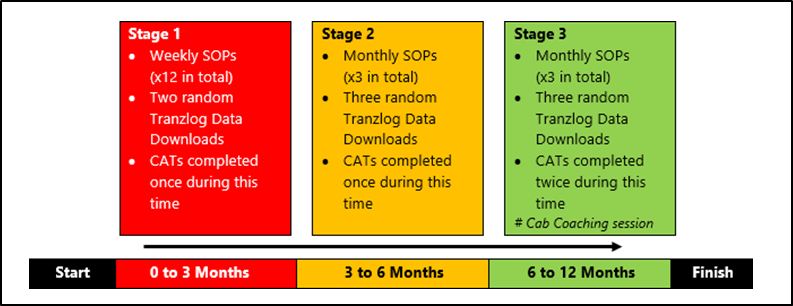
- The support programme includes safety observation procedures conducted while the drivers complete normal daily train train-driving activities, analysing Tranzlog data downloads to confirm good train-handling skills, and Competency Assessment Tests to ensure the drivers are proficient in the rules and procedures that apply to driving commuter trains.
Wellington Station approaches
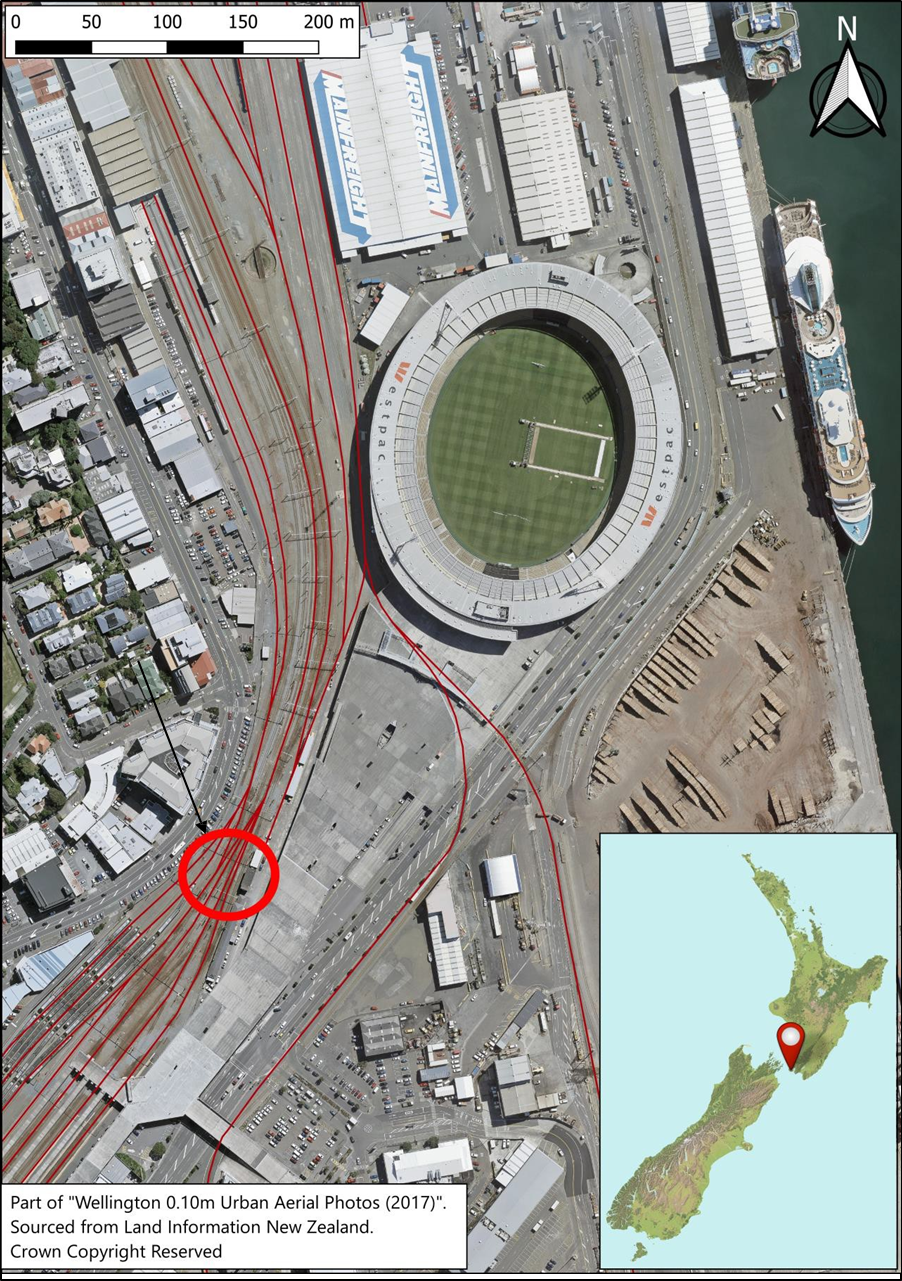
- The section of track approaching Wellington Station is complicated and congested. The nine platforms at Wellington Station are serviced by three main lines, the Down main (incoming trains), the Up main (outgoing services) and the Middle main (switchable from incoming to outgoing services for the morning and evening peak services). Additionally, there is a dedicated single line servicing Johnsonville that is bi-directional.
- The number of passenger services into and out of Wellington Station, combined with rail traffic to and from the adjacent train storage yard and maintenance facilities, require a high number of crossover points in a relatively limited area.
- The departures and arrivals of trains in and out of Wellington Station are controlled by the manually operated A Box. During peak service times all the train movements in this congested area are controlled by two signallers from A Box. This reduces to a single signaller for the off-peak portions of the timetable.
- Due to the congested nature of the approach to Wellington Station, a number of risk-mitigation elements are in place, including:
- all train drivers MUST stop at Red–Stop signals (Signals Rules section of the New Zealand Rail Operating Rules and Procedures)
- a 20-kilometres-per-hour speed restriction (Section L4 1.5.2 of the New Zealand Local Network Instructions) gives drivers more time to react to potential issues and ensures that any collision is at a relatively low speed
- the crashworthiness (a vehicle’s ability to protect its occupants during a collision) of the various rail vehicles is designed to minimise the impact damage and vehicle incursion into the passenger compartment in the event of a train-to-train impact (Matangi Electric Multiple Unit specification documentation).
- train-stops are fitted to some signals.
Previous occurrences
- This incident was not the first time a ‘Signal Passed at Danger’ (SPAD) (passing a Red–Stop signal without authorisation) in this area had brought two passenger trains into a potential collision. In 2016 an empty passenger train being relayed to the train storage yard had departed from platform 7 on a Yellow-Caution signal but failed to stop at the next Red–Stop signal. In this case an Upper Hutt-bound service passed within 12 metres and only 13 seconds after the relay train stopped 30 metres beyond the Red–Stop signal. The Transport Accident Investigation Commission (Commission) published Rail Inquiry Report RO-2016-101 in relation to this incident.
- In the 10 years preceding this incident there had been 23 SPADs in the Wellington Station limits.
Analysis Tātaritanga
Introduction
- The encroachment of an unauthorised train into a section of track occupied by an authorised train is a serious incident. While the likelihood of a head-on collision at Wellington Station has been assessed as low, the potential consequences have been assessed as major. A head-on collision between two opposing trains, even at relatively low speeds, has the potential for serious injury to persons and significant damage to equipment.
- The following section analyses the circumstances surrounding the event to identify those factors that increased the likelihood of the event occurring or increased the severity of its outcome. It also examines any safety issues that have the potential to adversely affect future operations.
Experience and distraction
- The Melling driver had recently successfully completed an eight-month-long commuter train driving course that included the appropriate training for managing distraction. Also included as part of the driving course were 250 hours of supervised Matangi train driving around the Wellington rail network. With just over three weeks of solo driving experience, the newly certified driver was still relatively inexperienced in the role.
- Key attributes of a good train driver include their being able to focus and avoid distraction at critical times successfully, and an ability to prioritise at high-risk areas such as platforms, level crossings and signals, especially in complex areas like the approaches to Wellington Station.
- Anti-distraction techniques demonstrated to drivers during training included utilising the Signal Alert button, However, it was not mandatory to use the Signal Alert button.
- As the 1317 Melling service departed Wellington, the driver correctly noted that the train was departing on a Yellow–Caution signal and expected to have to stop the train at the next signal, which would likely be Red–Stop.
- However, the driver recalled that after the train passed the Yellow–Caution signal they become distracted by an overheard radio conversation between a train and a worksite on the Johnsonville line.
- Distraction can lead to prioritising the wrong thing. In this incident the distraction was at a critical time when the train was approaching a Red–Stop signal in the congested Wellington Station area.
Controls to minimise the risk of a SPAD leading to a collision in the Wellington Station area
- The purpose and design of railway signalling is to direct rail traffic, to prevent unsafe conditions, to provide adequate separation between trains, and to prevent conflicting movements. Signalling systems incorporate controls to prevent collisions occurring.
- The congested nature of the Wellington Station track layout means there is a higher risk of trains colliding in this area compared with other areas of the network.
- On 15 January 2019, partly in response to the Commission’s 2017 recommendation (Transport Accident Investigation Commission report RO-2016-101, Recommendation (034/17)), Waka Kotahi NZ Transport Agency (Waka Kotahi) advised KiwiRail and Transdev Wellington that no increase in the frequency of services would be allowed into and out of Wellington above the existing peak service level without a safety case (an approved safety case for a licensed rail operator that details its safety approach and overarching safety management documentation) variation approved by Waka Kotahi. The safety case variation application would have to address the current risks of train collisions within the Wellington approaches.
- Of the risk controls in place at the time of the incident, both the speed limit and the crashworthiness of the vehicles reduced the severity of the consequences should a collision occur. The signals reduced the likelihood of a SPAD occurring, but were dependent on a train driver responding to them. As such, the controls in place to prevent a collision were primarily dependent on train drivers observing and responding to the circumstances. With distraction and incapacitation being known and foreseeable risks, these controls have the potential to be ineffective.
- Another control commonly used to minimise the risk of collision is a fail-safe back-up system that automatically activates train brakes in situations like SPADs; this may include simple mechanical devices like train-stops used elsewhere in the Wellington Station approaches. Fail-safe systems require safety overlaps to function effectively, providing adequate space for trains to stop between signals. Some of the signals in the Wellington approaches had these systems, but signal 100 was not one of them. Many of the signals without these systems in the Wellington approaches do not have enough safety overlap to allow them to be effective.
- At Wellington Station there is a relatively high number of signals and points in a small and geographically constrained area, providing insufficient space to facilitate the required overlaps readily. Due to the complex and congested nature of the approaches to Wellington Station, retro-engineering safety overlaps into the existing track layout is not easy or straightforward, and requires significant thought, evaluation and investment.
- As a result of previous recommendations made by the Commission in relation to the risks surrounding the Wellington Station approaches, a number of key signals in the Wellington Station area have already been fitted with fail-safe mechanisms such as train-stops that prevent or minimise the severity of a train passing a signal at Red–Stop. In addition, since 2016 (see Section 5) KiwiRail and Greater Wellington Regional Council have undertaken work to determine the best long-term solution in the complex and congested approaches to Wellington Station.
- However, this incident highlights that more needs to be done in the short term to ensure that other key signals within the section of track approaching Wellington Station, such as signal 100 (the signal that was overrun by the Melling service), have appropriate engineering solutions to mitigate the risk of collisions.
Findings Ngā kitenga
- The Signal Passed at Danger (SPAD) occurred as a result of the outbound Melling train service entering a section of track already occupied by an inbound Waikanae service.
- The Melling train entered the section of track as a result of the train driver becoming distracted by an overheard radio call as their train approached signal 100 at Red–Stop and passed the signal before realising the mistake.
- The Melling train driver and the Waikanae train driver both realised the potential for a collision and stopped their trains 31 metres apart.
- Distraction can lead train drivers to focus on the wrong thing at critical times, like approaching a Red–Stop signal.
- There are currently no engineering controls to prevent a collision occurring if a train passes signal 100 at Red–Stop.
Safety issues and remedial action Ngā take haumaru me ngā mahi whakatika
General
- Safety issues are an output from the Commission’s analysis. They typically describe a system problem that has the potential to adversely affect future operations on a wide scale.
- Safety issues may be addressed by safety actions taken by a participant, otherwise the Commission may issue a recommendation to address the issue.
Controls to minimise the risk of a SPAD occurrence potentially leading to a collision
- The measures that were in place to minimise the risk of a SPAD occurrence that would potentially lead to a collision within the Wellington approaches were not enough to reduce the risk as far as reasonably practicable.
-
The Commission has issued a previous recommendation (034/17 – December 2017) (https://www.taic.org.nz/recommendation/03417) as a result of Commission inquiry RO-2016-101, which recommended that:
KiwiRail conduct a review of current arrangements and take any opportunities it can to further reduce the risk of train operations in the area until a more suitable longer-term solution can be made.
- This recommendation remained open at the time of the occurrence and was directly related to this safety issue. Therefore, the Commission does not intend to make a further recommendation.
- KiwiRail informed the Commission that it had completed or commissioned several studies to understand improvement options for the Wellington approaches area. These studies can be broken down into three categories – short term (less than five years), medium term (five to 10 years) and long term (more than 10 years).
- Short term measures include a current 2020 study to confirm relocating some signals will create sufficient space to be able to utilise mechanical train-stops to prevent a collision in the event of a SPAD. Additionally, a separate study has been commissioned to explore potential medium- term flexibility and capacity options. Both studies are ongoing at the time of this report.
- In the medium term there is a clear desire and need to increase both flexibility and capacity, and any potential actions will be developed from the previously mentioned current study. There remain a number of challenges yet to be resolved around how to upgrade the Wellington Signalbox [sic] and amalgamate it with the computerised National Train Control Centre, whilst simultaneously aligning with the long term aims.
- The long-term goal remains to emulate the Auckland commuter rail network and implement a European Train Control System (ETCS) (an integrated automatic signalling system that alerts train drivers to the status of signals ahead, moderates train approach speeds automatically for specific locations, and automatically applies the train brakes in a SPAD (does not prevent SPADs but does minimise the possible distance a train can go past a Red–Stop signal)) which will require significant investment, plus major re-signalling and infrastructure upgrades. The additional challenge will be how to maintain an operating commuter rail network throughout the significant disruption of such a large-scale project.
- KiwiRail indicated that the significant investment required to achieve the long-term goal would require additional funding. In 2018 the Ministry of Transport released a Government Policy Statement on Land Transport (Transport, 2018), which covered public transport and set out key objectives that included resilience and safety – key issues within the approaches to Wellington.
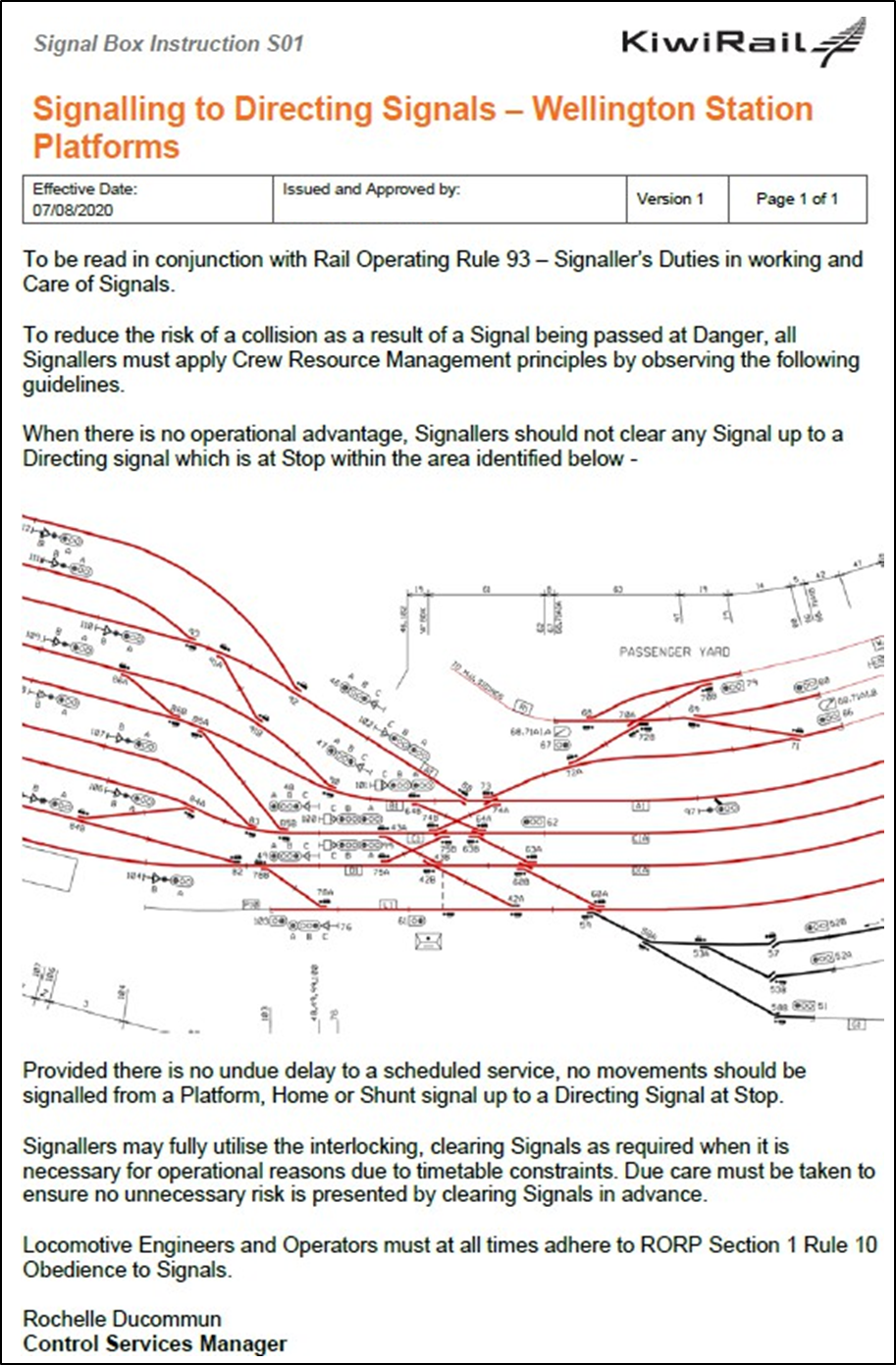
- On 7 August 2020 KiwiRail issued a Signal Box Instruction (see Appendix 2) that aims to reduce the risk of a collision as a result of a SPAD. When there is no operational advantage, signallers should not clear any signal up to a Directing signal that is at Stop. Provided there is no undue delay to a scheduled service, no movements should be signalled from a Platform, Home or Shunt signal up to a Directing signal at Stop.
- On 6 October 2020 KiwiRail informed the Commission that a business case for the provision of ETCS in Wellington had passed the Point of Entry phase with Waka Kotahi.
- On 6 October 2020 KiwiRail informed the Commission that a project to replace the A Box and the re-arrangement of the track in the Wellington Station approaches is currently in the initiation phase.
- While the measures proposed would address the identified safety issue, the risk of a collision will remain high until they are implemented.
Recommendations Ngā tūtohutanga
General
- The Commission issues recommendations to address safety issues found in its investigations. Recommendations may be addressed to organisations or people, and can relate to safety issues found within an organisation or within the wider transport system that have the potential to contribute to future transport accidents and incidents.
- In the interests of transport safety, it is important that recommendations are implemented without delay to help prevent similar accidents or incidents occurring in the future.
New recommendations
- No new recommendations were issued.
Key lessons Ngā akoranga matua
- Drivers must prioritise their focus on the most important issues at any one time.
- Key areas of the Wellington rail network pose a higher risk than others and therefore require more caution and concentration from train drivers.
Data summary Whakarāpopoto raraunga
Details
Conduct of the inquiry He tikanga rapunga
- On 6 November 2019 Waka Kotahi notified the Commission of the occurrence. The Commission subsequently opened an inquiry under section 13(1) of the Transport Accident Investigation Commission Act 1990 and appointed an investigator in charge.
- The Commission’s investigators interviewed:
- the train driver of the Melling service
- the train driver of the Waikanae service
- the train manager of the Melling service
- the signaller on duty at A Box at the time of the incident.
- The Commission obtained the following documents and records for analysis:
- closed-circuit television coverage from both the Melling and the Waikanae services
- Tranzlog data from the Melling service
- signals data from the Wellington Station signalling system
- training records for the driver of the Melling service
- historical SPAD data for the Wellington Station area
- radio communication recordings between A Box, the Melling service and the Waikanae service at the time of the incident.
- Additionally, the Commission spoke to Greater Wellington Regional Council, Waka Kotahi and KiwiRail to establish the status of the current and future plans for the Wellington Station approaches in response to Commission report RO-2016-101.
- On 19 August 2020 the Commission approved a draft report for circulation to five interested persons for their comment.
- The Commission received submissions from three interested persons. Any changes resulting from those submissions have been included in this final report.
- On 18 November 2020 the Commission approved the final report for publication.
Glossary Kuputaka
- A-Box signaller
- The signaller in A-Box, who is remote from the centralised national train control centre, is responsible for managing all track occupations and train movements within Wellington Station limits.
- Crashworthiness
- A vehicle’s ability to protect its occupants during a collision.
- Points
- Points can be in either ‘Reverse’ or ‘Normal’. Reverse is the position of points set for a less commonly used route. Normal is the position of points set for a more commonly used route, usually straight running.
- Proceed signal
- A signal aspect that authorises a train to pass the signal.
- Signal aspect
- A combination of coloured lights a train driver sees, conveyed by the position of the lights relative to each other and the combination of colours or flashing colours.
- Signal box
- A building that houses one or more signallers and equipment used for the control of points and signals, and communication with other signallers.
- Signaller
- A person engaged in operating a signal box or the operational supervision of a signalling system.
- SPAD
- Rail terminology for the act of a signal having been passed at danger. This occurs when a train should have stopped for a red signal but has continued past it.
- Train manager
- Train managers are responsible for rail passenger comfort and safety. They manage passenger loading and unloading, provide passengers with information and may issue tickets, handle money and operate emergency equipment. They are supported by the train attendants in this function.
- Train-stops
- Trackside mechanical devices that activate the train brakes after a train has passed the signal at Red–Stop.
Citation Ngā tohutoru
Transport, M. o. (2018). Government Policy Statement on Land Transport. Retrieved from Ministry of Transport NZ: https://www.transport.govt.nz/multi-modal/keystrategiesandplans/gpsonlandtransportfunding
Appendix 1. Route and signals for Melling train and clear route for Waikanae service
Appendix 2. Signal Box Instruction S01