A KiwiRail Holdings Limited freight train (Train 229) consisting of two locomotives hauling 33 wagons was travelling from Auckland to Wellington overnight on 2 and 3 May 2012. At 0034 on 3 May one of four sets of wheels on the fifth wagon derailed. The wagon was dragged for nearly three kilometres in that state to a rail junction at Maewa, about 22 kilometres north of Palmerston North, where it and five other wagons completely derailed.
Executive summary Tuhinga whakarāpopoto
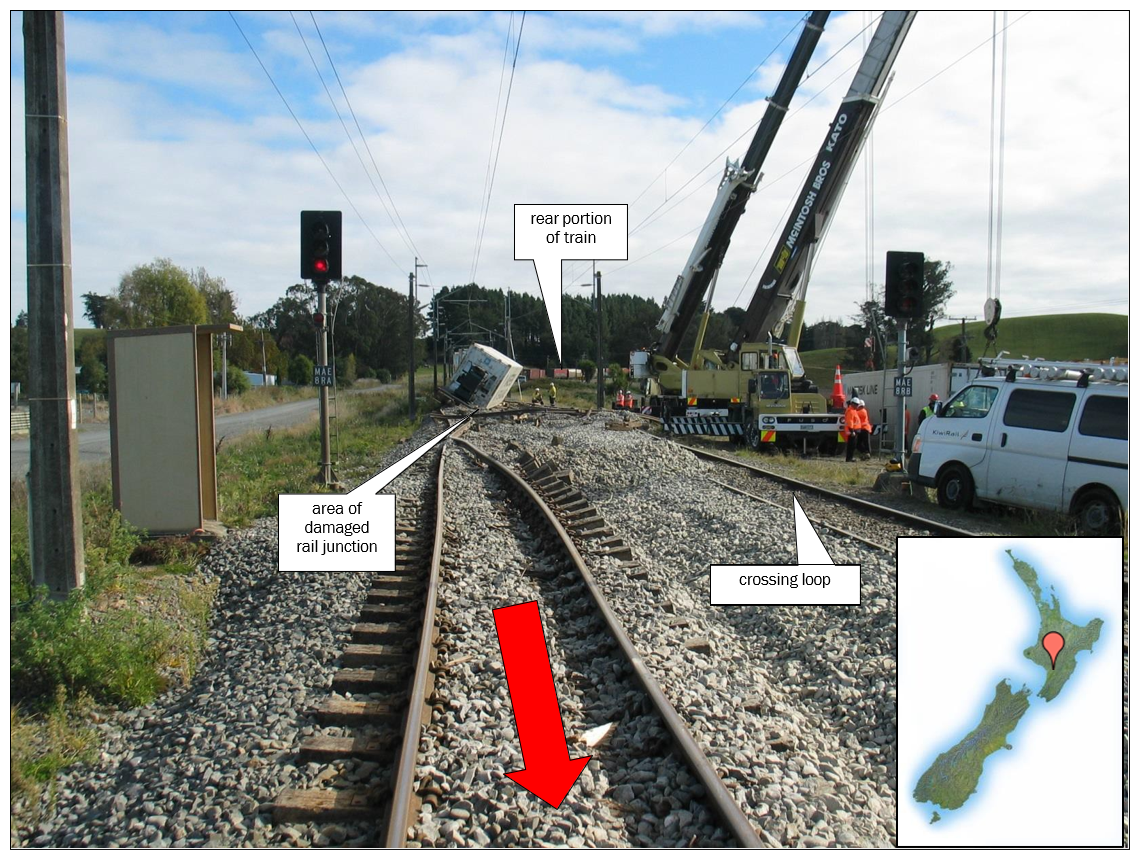
- A KiwiRail Holdings Limited freight train (Train 229) consisting of two locomotives hauling 33 wagons was travelling from Auckland to Wellington overnight on 2 and 3 May 2012.
- At 0034 on 3 May one of four sets of wheels on the fifth wagon derailed. The wagon was dragged for nearly three kilometres in that state to a rail junction at Maewa, about 22 kilometres north of Palmerston North, where it and five other wagons completely derailed.
- Another freight train that was waiting in the Maewa crossing loop escaped damage. However, there was substantial damage to the six derailed wagons and track infrastructure at Maewa. The train was not conveying any dangerous goods cargo and no one was injured in the derailment.
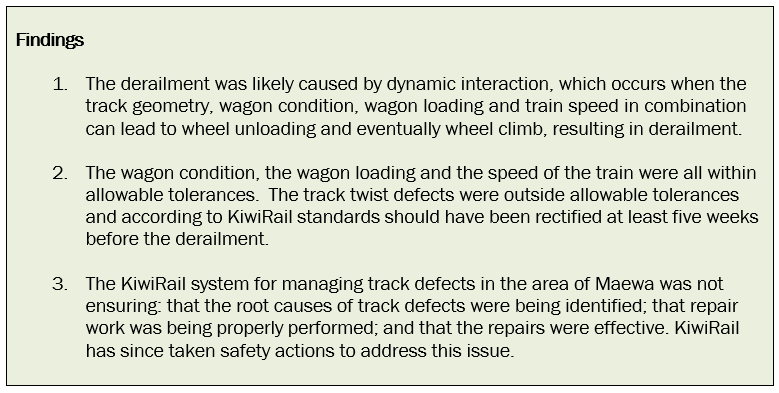
- The Transport Accident Investigation Commission (Commission) found that the most likely cause of the derailment was a phenomenon called dynamic interaction, when the track geometry, wagon condition, wagon loading and train speed in combination can cause a wagon to rock from side to side. One or more wheels then lift and climb the rail, resulting in a derailment.
- The wagon condition, wagon loading and speed of the train were all found to be within KiwiRail’s maximum permissible limits. However, a series of track defects approaching the derailment site was outside KiwiRail’s permissible limits.
- The Commission also found that there had been a history of track defects approaching the derailment site that had not been effectively repaired, which had highly likely contributed to a derailment at the same location six and a half weeks prior to this accident.
- The KiwiRail system for managing track defects in the area of Maewa was not ensuring: that the root causes of track defects were being identified; that repair work was being properly performed; and that the repairs were effective. KiwiRail has since taken safety actions to address these issues.
- Noting the safety actions taken by KiwiRail and the trend of decreasing mainline derailments in that period and since, the Commission has made no new recommendations.
- A key lesson arising from this inquiry is that any action taken to address track defects must be conducted properly, then checked and monitored to ensure the desired results have been achieved.
Factual information Pārongo pono
Narrative
- On 2 May 2012 at 1240, a KiwiRail freight train (Train 229) consisting of two locomotives hauling 33 wagons departed Auckland on its southbound overnight journey, using the North Island Main Trunk line to Wellington. The train passed over a wheel-condition-monitoring system at Auckland and no defects were identified.
- The train also travelled over several dragging-equipment-detection sites, of which the last was located near Rangitawa (see Figure 1). Dragging-equipment detectors are designed to detect derailed wheels and equipment hanging down onto the track. No anomalies were detected as the train passed the Rangitawa site.
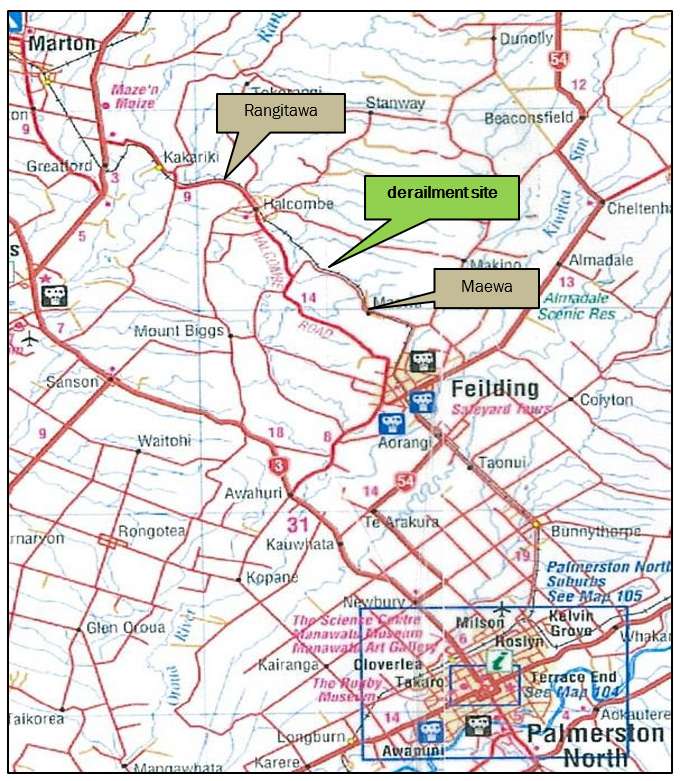
- At 0030 on 3 May 2012, the train driver reduced power and applied braking to slow the train down from 76 kilometres (km) per hour for a 40 km per hour (km/h) temporary speed-restricted area. The speed restriction extended over 620 m of track between Rangitawa and Maewa.
- The train was travelling at 35 km/h (times and speeds were obtained from the locomotive’s event recorder) through the speed-restricted area when the second set of wheels on the fifth wagon behind the locomotives derailed to the left-hand side of the track, followed shortly afterwards by the first set of wheels. The third and fourth sets of wheels remained on the track (see Figure 2).
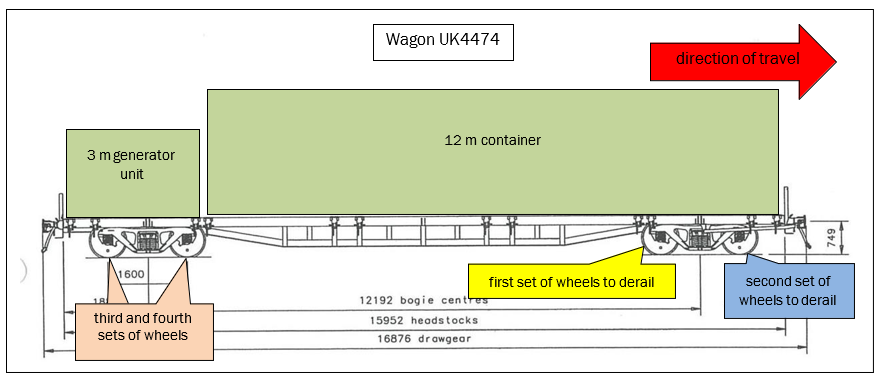
- The wheels ran derailed over the ballast (ballast is graded crushed-stone material laid 300 mm deep to form a drainable road bed to carry a railway track above the ground formation. The ballast spreads the load from passing trains that has gravitated through the rails and sleepers. The ballast allows the track geometry to be maintained to KiwiRail’s track code standards), sleepers and two level crossings for 2.275 km until they reached a diverging left-hand rail junction at Maewa. There they were forced farther away from the main line, causing the wagon to derail totally as well as five other wagons. The locomotives did not derail. The train’s continuous air-brake pipe pulled apart, which caused the train brakes to apply automatically and stop the train.
- Six wagons derailed and the track infrastructure in the vicinity of the rail junction at Maewa was extensively damaged. No one was injured.
The first derailed wagon
- The first wagon to derail was a KiwiRail standard container wagon from its fleet of 1,460 wagons. The most recent mechanical examination of the wagon had resulted in all eight wheel treads being re-profiled on a lathe. This work had been completed 11 weeks prior to the derailment. A post-accident examination showed that all the measured features on the wagon, including the eight wheels, were within KiwiRail’s mechanical tolerance limits.
The derailment site and track geometry
-
The first set of wheels derailed to the left-hand side of the track in the direction of travel (see Figure 3). Gouge marks showed where the wheel rim travelled along the top of the rail until it dropped off the outside 5 m farther on.
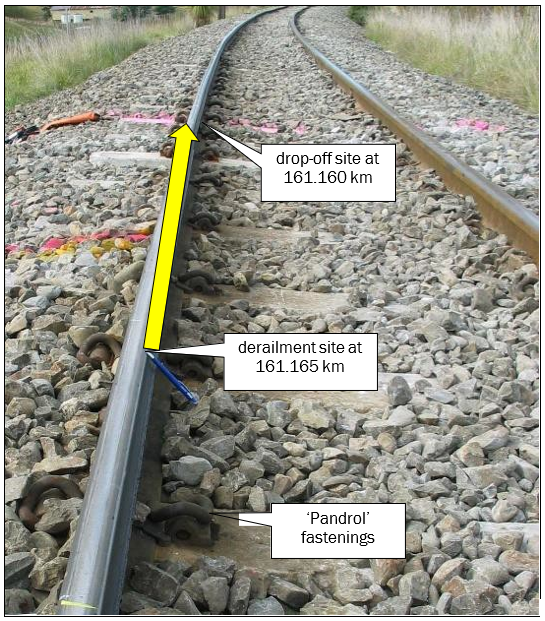
- The derailment site was located within a 264 m right-hand curve in the direction of travel. The curve had a radius of 420 m and was located on a 1 in 75 descending gradient on an embankment comprising a well-drained, medium-strength ground formation.
- The track infrastructure comprised 50-kilograms-per-m, continuously welded rail fastened with ‘Pandrol’ (manufacturer’s name) fastenings to concrete sleepers (see Figure 3). The sleepers, rail and fastenings had been installed in 1983 and were considered to be in a fair condition. The ballast was clean and well spread to form shoulders at the ends of the sleepers and filled the area between the sleepers and rails.
Track defects found after the derailment
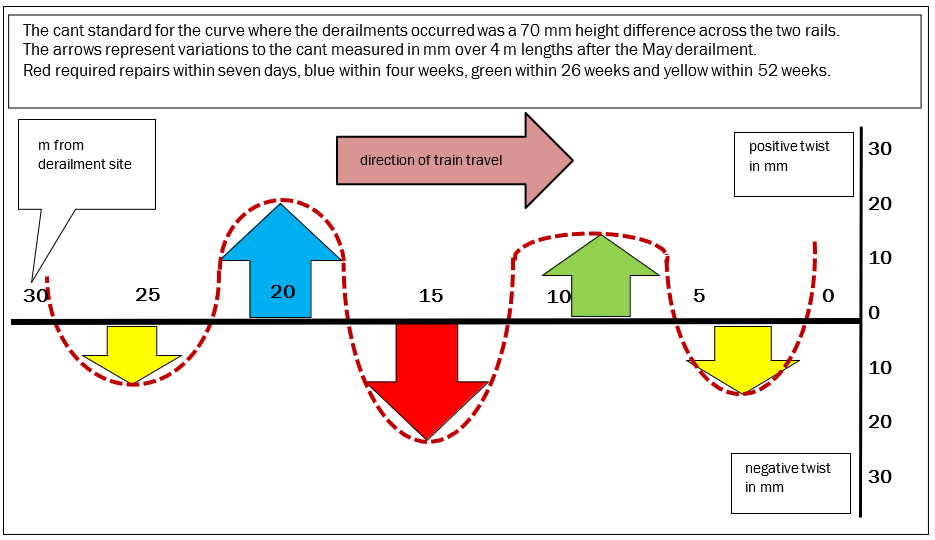
- Straight sections of track are constructed with the rails level. When the track takes on a curve the outer rail is raised above the inside rail and this feature is known as cant (the designed elevation of an outer rail above the height of an inner rail on a curve to allow higher speeds than if the two rails were at the same height. Cant compensates for the centrifugal force arising from a train travelling through a curve). The standard amount of cant depends on the radius of the curve. The standard cant was 70 millimetres (mm) for the curve where the derailment occurred.
-
Any variation from this standard cant over a 4 m length of track is known as a ‘track twist’. A track twist is a defect that can cause wagons on a train to rock or oscillate as they travel over the twist.
- The post-accident measurement of the track geometry revealed five track twist defects that ranged from 11 mm to 22 mm from the standard cant. All of the twist defects were within a 30 m length of track leading up to the derailment site and were sequentially in opposite directions (see Figure 4).
Track defects found after the previous derailment in March 2012
- KiwiRail had found a pattern of twist defects following the derailment six and a half weeks before this accident. They were similar values to those found after this derailment (see Figure 4). However, the track twist represented by the green arrow was more severe at 26 mm and required rectification within two days.
- KiwiRail had concluded that the twist defects were the primary cause of the March derailment. Consequently, there was one track twist that KiwiRail standards required to be fixed within two days and one that was required to be repaired within one week. KiwiRail was unable to provide records of any repairs made to remedy the twist defects before this accident, six and a half weeks later.
Other maintenance work and track failures in the area of the derailment site
- The following paragraphs describe maintenance work and two subsequent track failures that were unrelated to the cause of the two derailments but occurred within the same area.
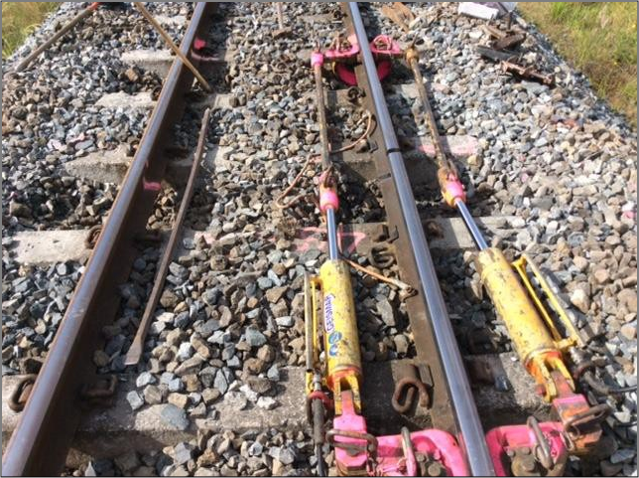
- De-stressing rail is a track maintenance work process of adjusting a length of rail in a section to prevent the rail buckling as the rail expands and contracts under extremes in temperature. On 21 November 2011 (four months before the March derailment), 500 m of rail was de-stressed through the area where both derailments later occurred. Measured lengths of rail were cut out and removed, then the remaining rails were hydraulically pulled together and re-joined, and, welded as part of the de-stressing process (see Figure 5).
- On 6 December 2011, 15 days after the de-stress work, one of the new welds failed. The rail that contained the weld failure was replaced on the same day.
-
One week later, on 13 December 2011, a track buckle failure was found 8 m from the site of the weld failure. A track buckle occurs when hot weather causes rail to expand, causing compression forces. When these forces exceed the resistance provided by the sleepers and ballast, the track can buckle sideways (see Figure 6).
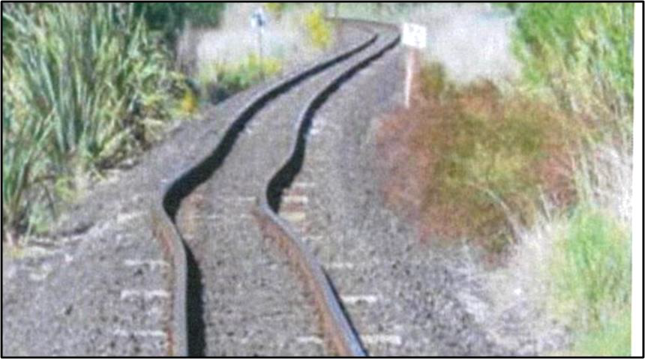
Figure 6. An example of a track buckle - The track buckle site was stabilised and a short length of replacement rail inserted on the same day. On 14 and 15 December 2011 maintenance staff returned to the site to complete the repair work, which included extracting, shifting and inserting a 20 m length of rail through the area and welding track joints.
- Records show that on 19 December 2011, in addition to the de-stressing work required, there was insufficient ballast on each side of the track in the vicinity of the track buckle site.
Analysis Tātaritanga
Introduction
- Mainline derailments have the potential to cause serious harm to people and damage to trains and the rail infrastructure. They do therefore have significant implications for transport safety. Following this derailment, the derailed wagon passed over two-level crossings where there was a greater risk to the public waiting for the train to pass by.
- The following analysis discusses possible factors leading to the derailment and a safety issue relating to the quality of track maintenance and the system for checking that identified track defects had been adequately repaired.
Possible factors contributing to the derailment
- It has not been possible to attribute the derailment definitively to one single factor. The twist defects found in the track following the accident would have been one factor. However, between the derailment occurrences on 8 March and 3 May, a total of 600 freight trains and 40 passenger trains had passed through the area without derailing. It is known that the twist defects were present during that whole period. The derailment cannot therefore be solely attributed to the track defects, otherwise some of those trains should have derailed as well. Other factors must have been involved.
-
The Commission has previously investigated a series of derailments, in rail inquiry 07-102 (rail inquiry 07-102 (incorporating inquiry 07-111), freight train mainline derailments, various locations on the national network). That report discusses the phenomenon of dynamic interaction. Dynamic interaction was the most likely cause of both this derailment and that six and a half weeks prior. The 07-102 report described dynamic interaction as follows:
A train derailment attributed to dynamic interaction occurs when the track geometry, wagon condition, wagon loading and train speed are individually within tolerance limits, or marginally in excess, but not to an extent that each variation on its own is sufficient to be a prime cause of the derailment. However, when in combination these conditions can result in a derailment.
With dynamic interaction derailments, the speed of the train does not necessarily mean the train was travelling too fast. A 1990 publication by an International Government Research Program on Track Train Dynamics on Train Derailment Cause Finding identified the usual speed for ‘bogie hunting’ (bogie hunting is the sideways motion of a bogie travelling at speed, caused by irregularities in the track and/or on the wheel) derailments as being above 75 km per hour.
Hunting increases the lateral forces that lead to wheel climb6 and in extreme cases cause wheel lift, often on straight track. This means that while speed can be a factor in derailments attributed to dynamic interaction, this is not necessarily a reflection of driver technique but more an unfortunate combination of the condition of the track, the state of the wagon and the speed at which the wagon was travelling.
A wagon has a complex suspension system through which it resonates at a natural harmonic frequency when subjected to some external force. If a force is applied that causes the wagon to roll, the springs on one side of the bogie compress. The energy stored in the springs then feeds back into the wagon body to compress the springs on the opposite side of the bogie. This behaviour continues at a constant frequency and amplitude unless an additional force is applied. Should an additional force be applied in phase, such as when passing over track with irregularities, the amplitude of oscillations can increase rapidly and lead to wheel unloading (wheel unloading is the unloading of the weight being carried by a wheel, or wheels, when a wagon rocks from side to side while passing over an area of track with closely spaced opposing rail height variations) and eventually wheel climb. A wagon’s ability to resist such a condition is reduced when the friction wedge (friction wedges provide damping to the vertical and lateral movements between the two bogie side frames and the bolster (see the bogie drawing in the glossary on page vii). The height of friction wedges is measured for wear during mechanical examinations) heights are at or near the condemning limit.
- In this case the wagon that first derailed was found to comply with the KiwiRail maintenance limits. The friction wedge heights were 29 mm compared with the maximum allowable 39mm. The way the wagon was loaded was compliant with KiwiRail’s freight handling code.
- The lathe work (see section 3.2) had reconditioned the wheel treads to near-new condition. The rail-mounted wheel-condition-monitoring systems installed at strategic locations across the rail network had not identified any wheel tread defects during the period between the lathe work and the derailment.
- The heights of the friction wedges on the wagon bogies that had derailed in March averaged 32 mm compared with the allowable 39 mm. There was no evidence that the mechanical condition of either wagon had contributed to the derailment. Both wagons had undergone scheduled 24-monthly mechanical examinations only one and three months respectively before derailing.
- There was nothing untoward in the manner in which the trains were being handled by the two drivers. They had their trains’ speeds under the 40 km/h limit, yet when the trains passed over the series of track twist defects one wheel-set lifted and derailed.
- The track twist defects are highly likely to have caused some degree of oscillation as the wagons passed over them. If this had occurred in phase with the natural harmonic frequency of the wagon for the speed at which it was travelling, this combination could have been sufficient to cause the derailment. However, as none of these factors is measurable it is difficult to say with any certainty the degree to which each contributed to the derailment.
Repair and maintenance
Safety issue – The system for recording and monitoring the effects of track repair and maintenance was not picking up that the repair and maintenance work was not remedying identified track defects.
- Records showed that on 10 occasions between July 2009 and November 2011, KiwiRail’s track-evaluation car had identified and reported the same pattern of track twist defects that contributed to this and the derailment six and a half weeks prior. On each occasion maintenance staff had carried out repairs. However, either the repairs had not remedied the track faults or the root cause of the defects had not been addressed, because they had reappeared with the next pass of the track-evaluation car. KiwiRail had not required track maintenance staff to record the nature of the repair work undertaken, the materials used or the methods applied. No records had been kept of the condition of the track after each repair.
-
The rail de-stressing work and the subsequent track failures that should have been prevented by that work were another example of the system not recording the work done and monitoring its effectiveness.
- There is no evidence linking the rail de-stressing work and the recurring track twist defects, other than that they were in the same section of track, under the control of the same maintenance staff, and under the same rail infrastructure management system.
- Soon after this derailment KiwiRail replaced the ballast and carried out rehabilitation work on the ground formation underlying the embankment.
- Since 2014 KiwiRail has implemented a national, computerised, track infrastructure asset management system known as ‘Maximo’. A review of completed work is a feature of the system and provides KiwiRail track engineers with detailed oversight of repair and maintenance activities.
- A review of KiwiRail’s track database for the area between Rangitawa and Maewa showed no evidence of the defects reappearing following three journeys of the track-evaluation car during 2015.
- KiwiRail now requires a senior track engineer to review the track defect printout after each track-evaluation car journey to identify and analyse the most serious defects. Dependent upon the type, number and severity of the defects identified, the following actions are undertaken:
- an area track inspector re-evaluates the defects identified by the track-evaluation car
- a field asset engineer establishes the necessary defect-rectification work
- a field production engineer assesses the nominated repair methods to ensure that the root causes of the defects are addressed and allocated appropriate resources.
- Following the heat buckle and weld failure, KiwiRail conducted an internal investigation into the track buckle, which identified the following concerns regarding the quality of the track de-stress project completed three weeks previously and also the later repairs completed at the weld failure site:
- recordings of the track position in relation to track survey pegs were not completed following the de-stress project
- too much rail may have been cut out during the de-stress project, causing the rail to creep down the gradient under normal train operations
- the rail used to replace the weld failure was unsuitable
- the ballast each side of the track was in a weak condition
- the longstanding track defects [the track twists] remained.
-
KiwiRail has completed a re-examination programme of the procedures and resources used to manage track de-stressing work. It has created a new position, the ‘de-stress co-ordinator’, who is responsible for scoping all aspects of the work and drawing up a detailed plan for each site identified for de-stressing.
The new procedures now require that:
-
de-stress co-ordinators examine track stability reports in addition to other data streams to highlight known and other track section sites where de-stressing is required
- staff measure rail temperatures to maintain up-to-date information relating to the existing stress levels in the identified track section sites
- an annual de-stressing plan be compiled, prioritised and delivered by the de-stress supervisor to the field asset engineer and agreement reached on the sites to be de-stressed
- the de-stressing work be completed by field staff in accordance with the detailed plan, and the track database updated
- the completed work site be audited by the de-stress co-ordinator for quality assurance.
-
Mainline derailment statistics
- In the reporting year ending 30 June 2005, 55 mainline derailments had occurred on the rail network. Since that date the number of mainline derailments has declined. Seven derailments were recorded during the reporting year ending 30 June 2015.
- Figure 7 has been compiled using data supplied by KiwiRail. It shows the decline in mainline derailments reported by KiwiRail between 1 July 2004 and 30 June 2015, compared with KiwiRail’s capital expenditure on track renewals and its annual gross rail tonnage. The trend lines indicate that the financial investment in track improvements has positively contributed to the reduction in derailments.
- Figure 7 shows that the capital expenditure (capex) on track renewals grew and peaked in the 2009-2012 period when track-related problems were encountered in the Maewa area.
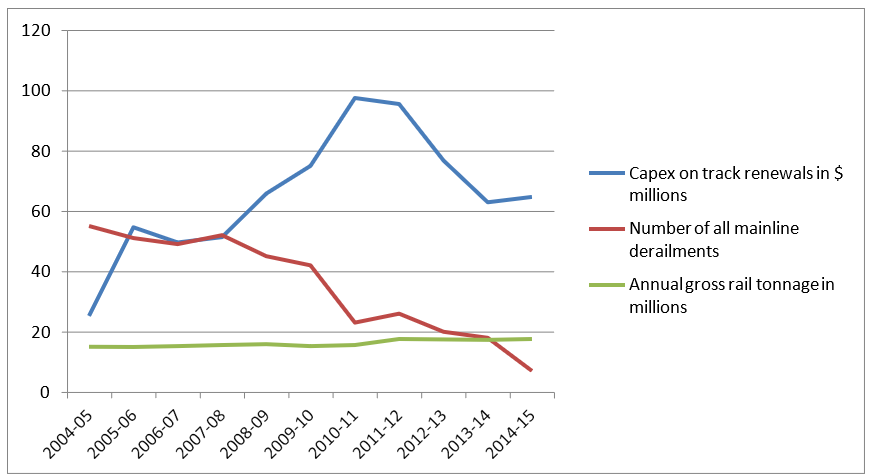
- In view of the derailment statistics shown in Figure 7 and the safety actions taken by KiwiRail, the Commission has not made any recommendations.