
The Commission has released an Interim Report as part of its ongoing investigation into the grounding of a commercial passenger vessel in Akaroa Harbour on 31 January 2026. The Interim Report presents facts that have been established so far. On completion of its inquiry, the Commission’s final report will present analysis, discuss safety issues and (if any) make recommendations for the sector to avoid similar accidents in the future.
Executive summary Tuhinga whakarāpopoto
- The Commission’s investigation is ongoing. This interim report presents the facts and circumstances established up to this point in the Commission’s inquiry. Upon completion of the inquiry, the Commission will issue a final report on the accident. That final report will contain an analysis of the facts of the accident, findings, safety issues and recommendations (if any).
- This was a serious accident, where 41 people were at risk of significant harm, drawing heightened public interest. This interim report has been prepared to provide timely information on the accident to the maritime industry and to the public, for clarity and to avoid similar maritime incidents or accidents in the future.
What happened
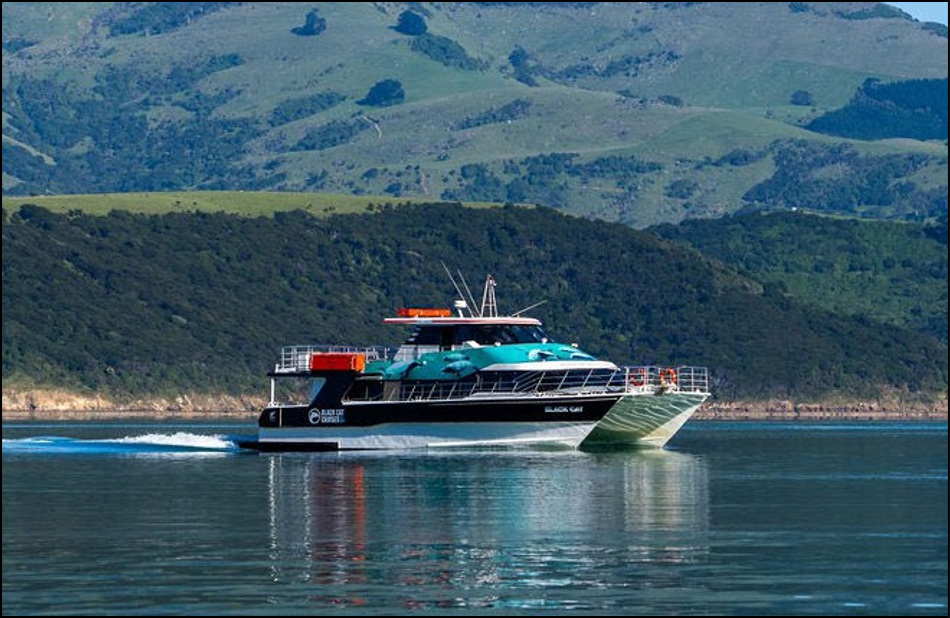
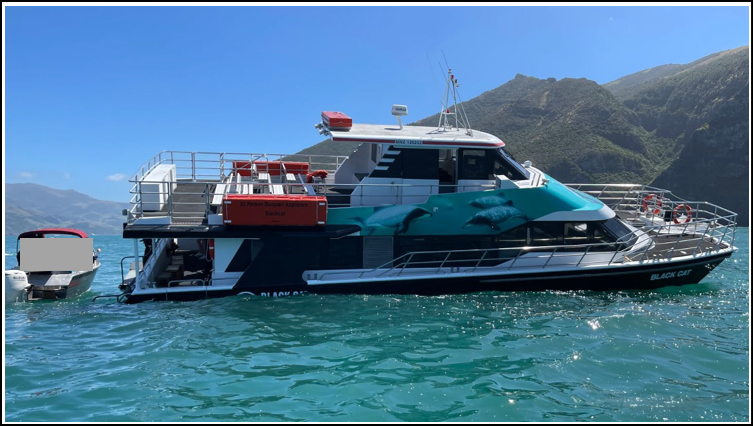
- The Black Cat was a 17-metre (m) catamaran owned by Black Cat Cruises and operated out of Akaroa, New Zealand.
- On the morning of 31 January 2026, the Black Cat was conducting a scenic cruise in the vicinity of Akaroa Harbour with 38 passengers and 3 crew on board.
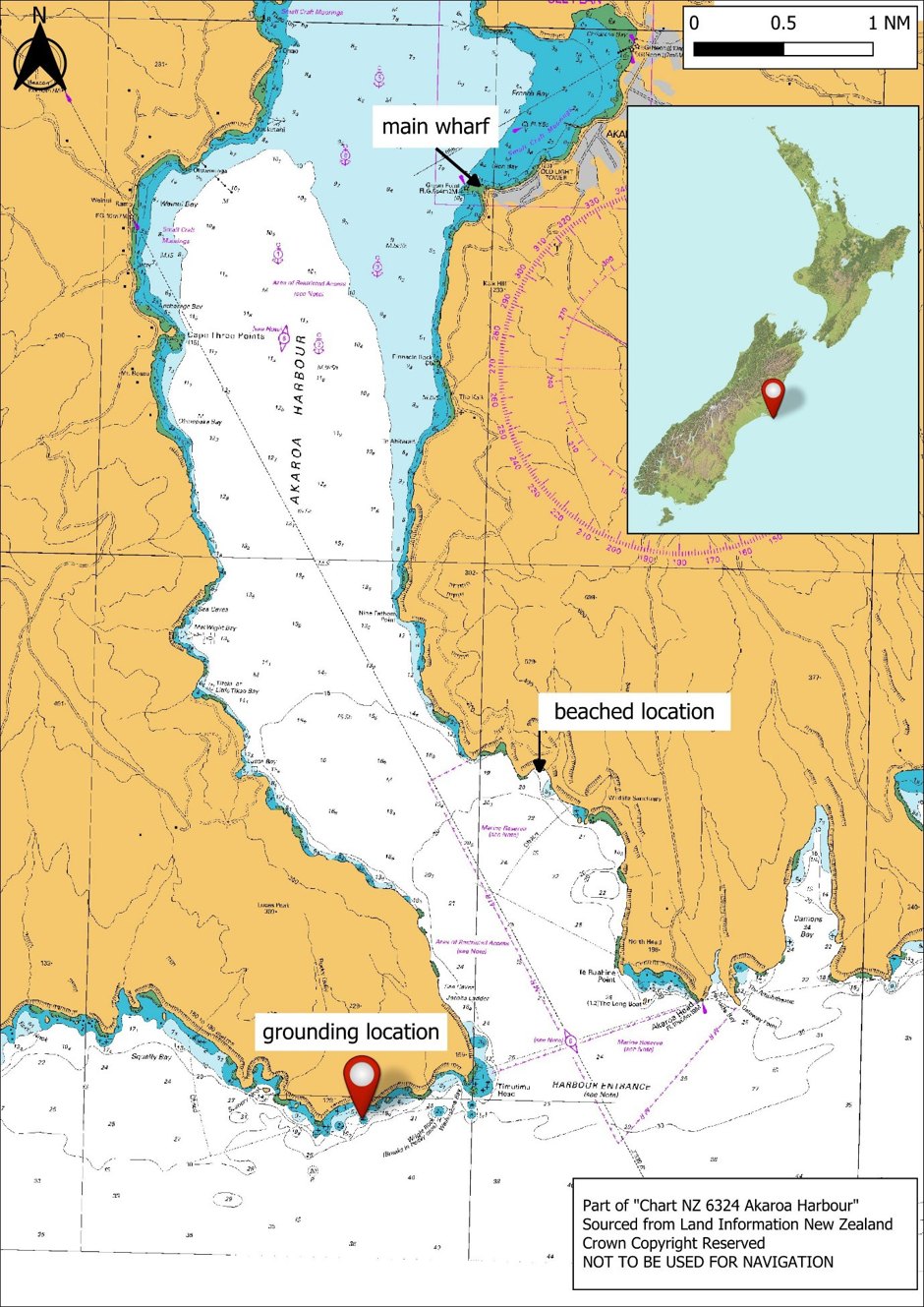
- The weather was calm. While approaching Archway Rock, the vessel struck a submerged object. The vessel’s position at the time of impact aligned with a charted submerged rock of an unknown depth.
- The starboard hull was ruptured and began flooding with seawater. In response, the crew attempted to activate an additional bilge pumping system. The crew were not confident in how to operate the system correctly, so the pump was not engaged.
- The master navigated Black Cat into Akaroa Harbour to facilitate a safe evacuation. While in the harbour, the vessel’s steering and starboard engine had stopped operating and the emergency steering was not responding. By this point the Black Cat had developed a significant starboard list.
- The passengers were safely evacuated onto responding vessels before the Coastguard unsuccessfully attempted to dewater the vessel.
- Trying to save the vessel, the master attempted to manoeuvre Black Cat towards the beach when it ran aground.
- All passengers and crew were safely transferred back to Akaroa without injury.
Factual information Pārongo pono
Narrative
- On the morning of 31 January 2026, the Black Cat was moored in Akaroa Harbour. It was scheduled to conduct a scenic cruise in and around Akaroa Harbour. This was a regular two-hour cruise during which the Black Cat crew embarked passengers at Akaroa main wharf and the vessel visited various locations to view wildlife and scenery. The master determined the route for each trip based on the conditions on the day.
- At about 1007 (times in this report are in New Zealand Daylight Time (Universal Coordinated Time +13 hours) expressed in a 24-hour format) the vessel was moved from the mooring to its berth on the Akaroa main wharf, ready for the day’s operations. The master and two crew (C1 and C2) began boarding the 38 passengers.
- At about 1045, once the passengers had finished boarding, the master manoeuvred the vessel off the berth and departed. The master delivered the safety briefing, which included the layout of the vessel, location of emergency equipment and their expectations in the event of an emergency.
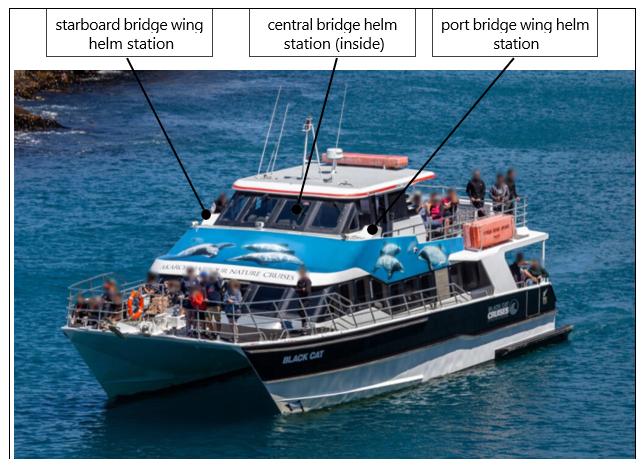
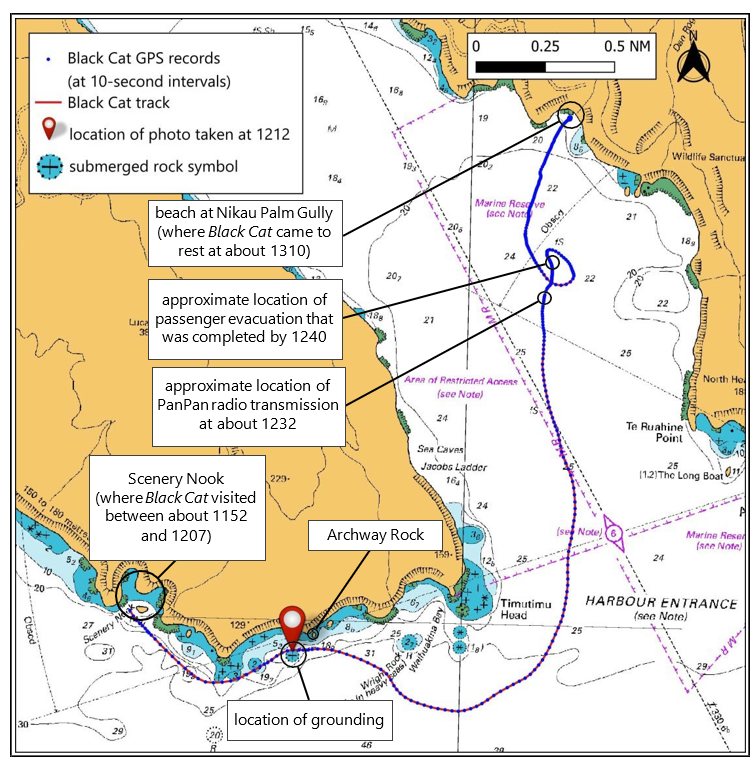
- The master operated the Black Cat from the central bridge helm station (see Figure 3) and navigated south, following the eastern coast of Akaroa Harbour (see Figure 4). At about 1104, the Black Cat arrived at Spotted Shag Rookery and spent about 13 minutes there while the master delivered commentary for the passengers regarding the area and what could be seen.
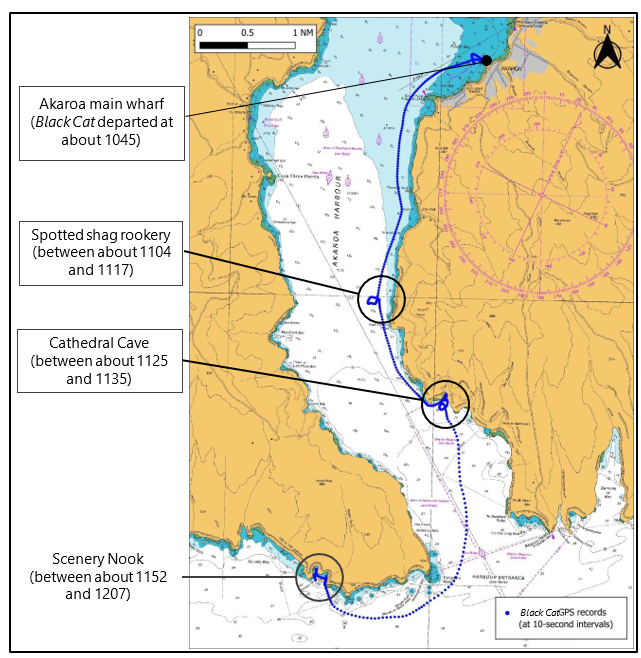
- The Black Cat continued south and at about 1125 arrived at Cathedral Cave, where it spent about 10 minutes, with more commentary from the master.
- The weather was calm and the master decided to navigate outside Akaroa Harbour and visit Scenery Nook, on the south coast (see Figure 4). The Black Cat exited the Akaroa Harbour heads and arrived near the entrance to Scenery Nook at about 1152.
- On approach to Scenery Nook, the master moved to the starboard bridge wing helm station to manoeuvre the vessel close to known rocks.
- While at Scenery Nook, the master decided to visit Archway Rock (see Figure 5), a geological feature, on the way back to Akaroa. At about 1207, the Black Cat left Scenery Nook and the master moved back to the central bridge helm station so they could look at the chart plotter regarding their intended route. The master then moved to the port bridge wing helm station and navigated toward Archway Rock.
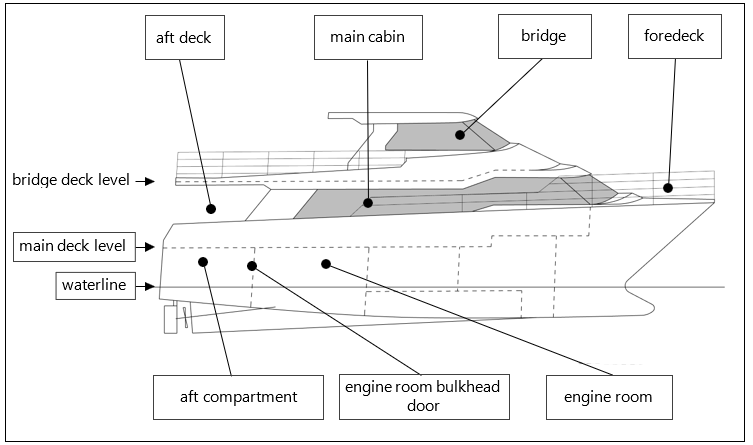
- At about this time, C1 and C2 were talking in Black Cat’s main cabin (see Figure 6). While looking out the window, C1 noticed that the vessel was approaching Archway Rock from an unusual direction. They told C2 they were going to the bridge to discuss their concern with the master. Meanwhile, C2 went to the vessel’s foredeck to meet with passengers and take photos of the view.
- At about 1212, C2 used their mobile phone to take photos (the photos included geo-location data) of Archway Rock. A few seconds later a bump was felt and there was a scraping sound. C2 immediately went to the bridge to join the master and C1 to discuss the event. The geo-location data (the vessel’s position was determined from two independent sources: geo-location data from the photos taken immediately before the grounding and a GPS tracker that was installed onboard the Black Cat) aligned with a submerged rock of an unknown depth on the chart (this rock symbol represents an ‘underwater rock over which the depth is unknown, but which is considered dangerous to surface navigation’ (UK Hydrographic Office, 2026, Admiralty Chart 5011 – ‘Symbols and Abbreviations used on Admiralty Paper Charts’) (see Figure 5).
- The master thought they might have hit the float of a crayfishing pot but couldn’t see anything in the water. About one minute after the scraping sound the bilge alarm activated.
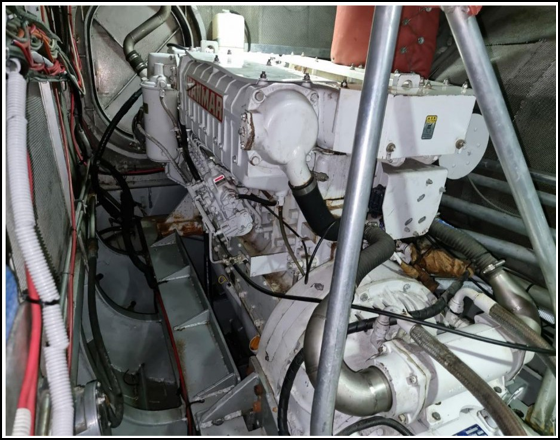
- The master instructed C1 to take the Black Cat’s helm to enable them to check the vessel’s bilges. The master went to the starboard aft deck, opened the hatch and climbed down into the aft compartment (see Figure 6). They opened the starboard engine room’s bulkhead door and saw that water had entered the engine room and the water level was around the top of the engine (see Figure 7). The master immediately closed and secured the bulkhead door and made their way back up to the bridge.
- As the Black Cat passed the harbour entrance, smoke or steam was visibly entering the main cabin from the engine room and passengers became aware that something was wrong.
- Meanwhile, the master arrived on the bridge and notified two company vessels that were nearby by calling them on the very-high-frequency (VHF) radio. The master intended to get the Black Cat near a safe beach to facilitate beaching or evacuation of the vessel. There were limited suitable beaches in the area, and the master chose the beach at Nikau Palm Valley to either anchor or beach the vessel. The master began navigating the vessel towards that location.
- On the bridge the steering had stopped working, along with the CCTV and PA systems. The starboard engine and propulsion system had also stopped operating. The master and C1 could not activate the emergency steering system that was also located in the starboard hull.
- The master instructed the crew to go to the aft compartment (on the port side) and start the engine-driven bilge-pump system. C1 and C2 went to the bilge-pump control station in the aft compartment but were not confident in how to operate the bilge-pump system.
- C1 and C2 left the aft compartment and began reassuring the passengers and getting them into lifejackets. C1 and C2 began mustering the passengers to the bridge deck level on the port side. It took about 10 to 15 minutes for the passengers and crew to finish putting on lifejackets.
- By this time, several other vessels had responded to the earlier radio call and had arrived at the Black Cat’s location ready to assist.
- There was significant radio traffic. Over radio, the master requested other stations to limit traffic so the Black Cat could communicate with responding vessels. At about 1232, the master used VHF radio to broadcast a Pan-Pan (a Pan-Pan urgency signal is a standardised radio-telephony phrase used to indicate a very urgent message concerning safety is to follow, but there is no immediate danger requiring distress assistance) urgency signal, which stated the Black Cat with 38 people on board was taking on water just south of Dan Rogers [bluff].
- By this stage the smoke or steam was filling the Black Cat’s cabin. The vessel was listing heavily to starboard, with some water on deck on the starboard aft deck, and most of the passengers were on the bridge deck on the port side.
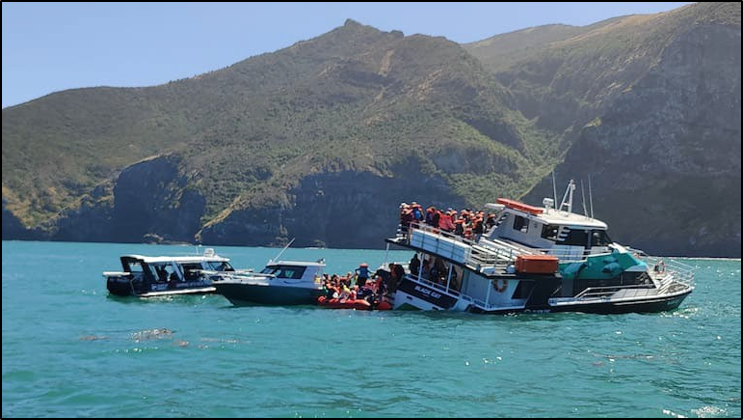
- The master instructed the crew to move the passengers down onto the main deck in preparation to evacuate the vessel. The evacuation began shortly after (see Figure 8).
- Several vessels were standing by to assist. The smaller vessels ferried groups of passengers from the port stern of the Black Cat onto the larger vessels. The evacuation of passengers and C2 was completed without significant issue by 1240.
- The master and C1 remained on board following the evacuation of all passengers. C1 checked there were no passengers still onboard and reported this information to the master. The master then continued to navigate the Black Cat towards the beach at Nikau Palm Gully. With only the port-side propulsion working, the vessel naturally turned to starboard. The master countered this starboard turn by occasional use of astern power.
- A local Coastguard vessel, the Ihenga Rescue, was exercising just outside Akaroa Harbour, with five Coastguard volunteers and two potential recruits on board. When the Coastguard crew heard the Pan-Pan radio transmission they proceeded into Akaroa Harbour, arriving at the Black Cat’s location shortly before the evacuation of passengers finished.
- The Coastguard crew noticed that the Black Cat was settling lower in the water (see Figure 9). The Ihenga Rescue carried a portable petrol-powered water pump, which the Coastguard master decided to use onboard the Black Cat to help clear water from the vessel.
- Once the passenger evacuation was complete, one of the Coastguard volunteers and one of the potential recruits boarded the Black Cat via the port stern door with the pump equipment.
- Once on board they spoke briefly with C1 who assisted them. The Coastguard volunteer and the potential recruit then set up the pump. They could see water sloshing on the starboard side of the aft deck area and proceeded to pump it overboard.
- Intending to beach the Black Cat, the master continued navigating towards the beach as the starboard hull settled lower in the water and the vessel listed more (see Figure 10). Eventually seawater started flowing over the top of the bulwark (a bulwark is a solid vertical extension of the hull above the deck edge that acts as a protective barrier for crew and equipment) into the aft deck area and C1, the Coastguard volunteer and the Coastguard’s potential recruit decided to evacuate from the Black Cat to nearby vessels.
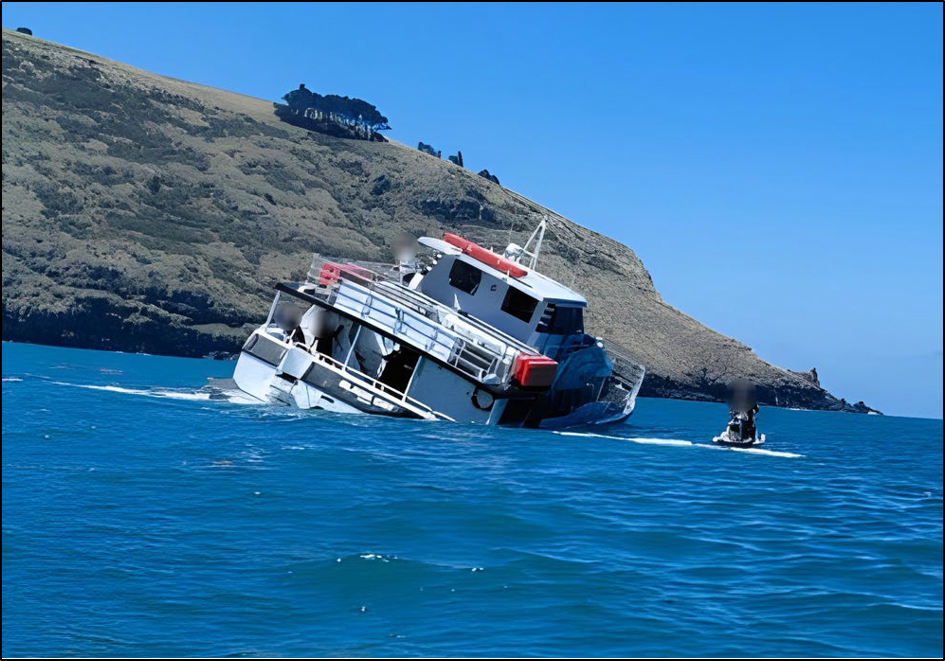
- At about 1247, while the Black Cat was approaching the beach at Nikau Palm Gully, it grounded again. The master shut down the port engine and evacuated the vessel onto a jet ski that was standing by.
- All passengers and crew were safely transferred back to Akaroa with no reported injuries. A Tier 2 (regional) oil-spill response (a regional, council-led oil-spill response for pollution containment and clean-up that does not include search and rescue functions) was declared by Environment Canterbury (Canterbury Regional Council) at 1345. A salvage operation was initiated over the following days by Black Cat Cruises and their protection and indemnity club (a mutual marine insurance association joined by shipowners to cover liabilities and risks that ordinary hull insurance usually does not). The salvage operation failed to refloat and recover the vessel, which broke up in heavy weather conditions. By 19 March 2026, all safe-to-collect vessel fragments were recovered and the Tier 2 response continued as a monitoring and observation presence. Environment Canterbury informed the Commission that the environmental impact of the accident was minimal.
Vessel information
- The Black Cat was a 17 m aluminium alloy catamaran built in 1994 to service the Whitsunday Islands in Queensland, Australia. Black Cat Cruises brought it into service in Lyttelton, New Zealand, and began operating from Akaroa in 2004.
- The Black Cat was powered by two Yanmar 6HY diesel engines, one in each hull. Each engine was connected to a conventional shaft and propeller. Steering was provided by conventional rudders, one on each hull.
- The Black Cat was fitted with four independent bilge-pumping systems:
- a 24 V electric-powered pump
- a 230 V electric-powered pump
- an engine-driven pump
- a manually operated bilge pump.
Personnel information
-
The master was issued an Australian Skipper 3 (Skipper 3 was a former Australian commercial master’s qualification for operating small vessels in limited near-coastal waters) certificate of competency in 1988 when working on the Great Barrier Reef. They worked on several different vessels in various locations until they moved to New Zealand. They were issued a New Zealand Inshore Launch Master certificate of competency in 2013. They joined Black Cat Cruises in February 2025 and began sailing as master of the Black Cat on 1 December 2025.
-
C1 had worked as crew in Doubtful Sound and Lake Manapouri for three years before joining Black Cat Cruises as crew on board Black Cat in 2012.
-
C2 had worked at Black Cat Cruises in the office during the summer season of 2025, and then as crew in November 2025 onboard the Black Cat.