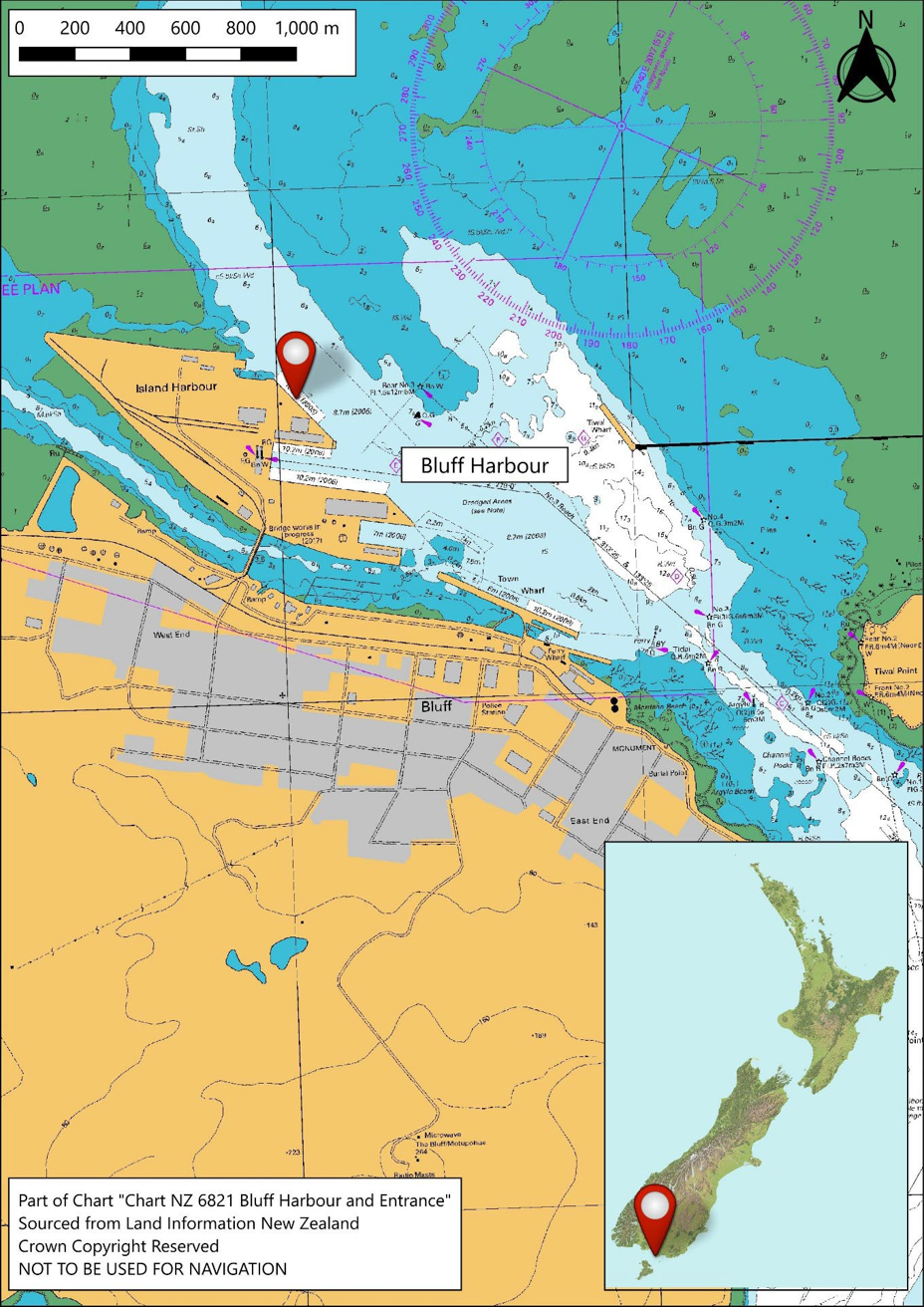
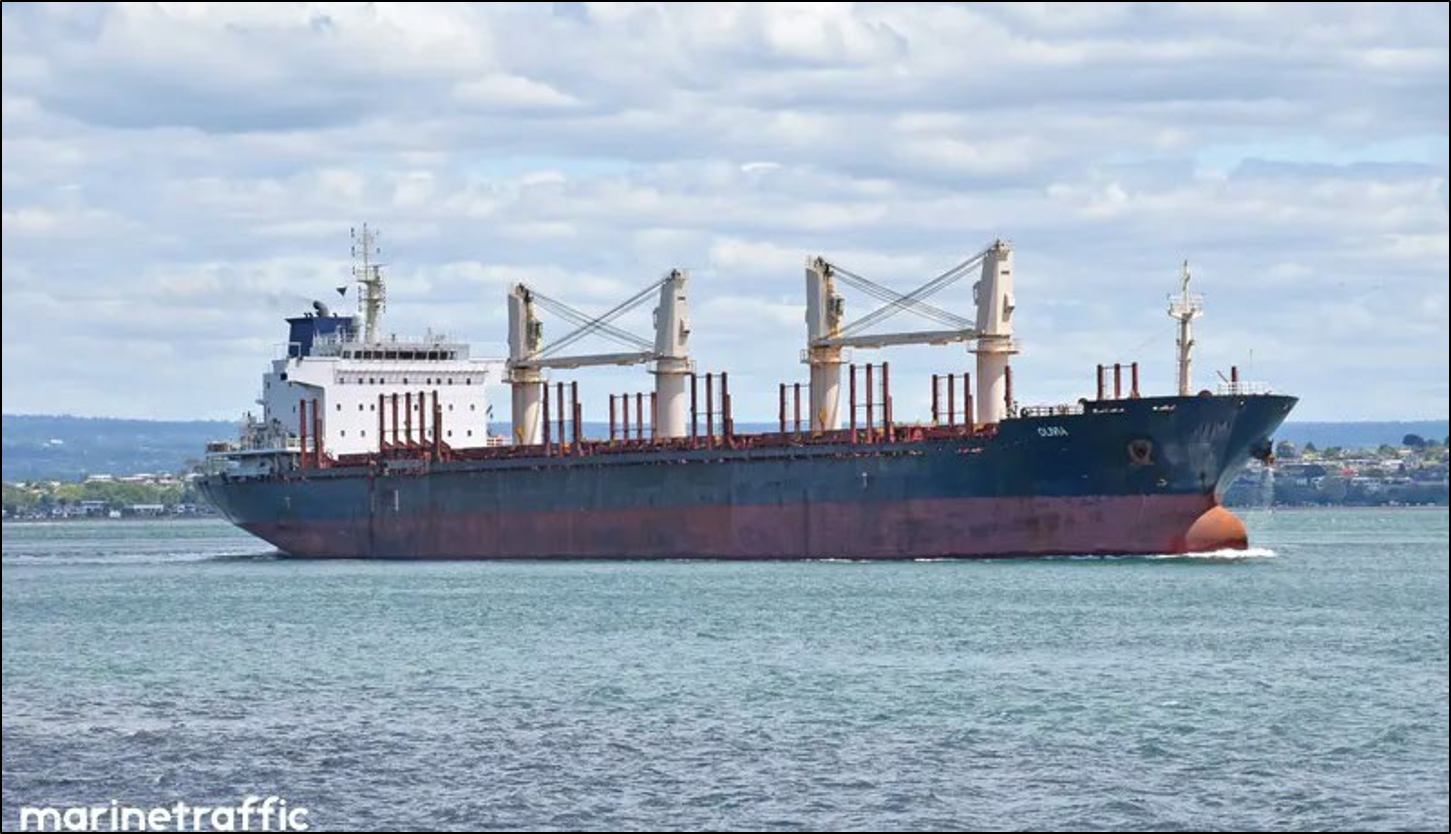
Three crew were injured, two with serious burns, while cleaning the boiler on the bulk carrier Olivia at South Port, Bluff, on 24 May 2025. The report focuses on inadequate implementation of safety procedures and a lack of guidance for managing crew during sustained intensive work. It highlights the need to stop and reassess when working conditions change, verifying safe boiler cooling, and providing suitable resources and supervision. Operator safety actions addressed both safety issues; no new recommendations in this case.
Executive summary Tuhinga whakarāpopoto
What happened
- The Olivia was a bulk carrier with a gross tonnage of 20928. It was registered in Malta and its technical management was undertaken by Fleet Management Limited, Hong Kong (the operator).
- On 23 April 2025, the Olivia berthed at Bluff following main engine and generator issues during the inbound voyage. Maritime New Zealand required the vessel operator to make repairs before the Olivia could leave port.
- In addition to the main engine repairs, a visiting service technician identified that all the vessel’s generators required extensive refurbishment. The operator provided additional personnel and technical support, and the engineering crew was organised into day shift and night shift, to facilitate repairs.
- On 23 May 2025, the vessel’s composite boiler (a composite boiler generates steam and heat for shipboard systems. It combines exhaust-gas heat recovery, used when the vessel is at sea, with an oil-fired boiler, used when the vessel is in port) suffered a burner failure. The engineers made repeated unsuccessful attempts to reignite the burner.
- On 24 May 2025, a team of three engineering crew were air blasting soot from inside the boiler when a blowback explosion (in which unburned fuel or flammable gas accumulates in the boiler furnace and ignites suddenly, causing a rapid release of pressure and flames) occurred. All three crew members were injured.
Why it happened
- It is likely that the boiler initially flamed out and failed to restart because of a combination of the following issues:
- malfunction of the burner’s air-intake flap
- the faulty ignition transformer
- buildup of soot inside the boiler.
- It is likely that the motorman (a skilled worker in the engineering department who assists engineering officers with daily operational, maintenance and repair work) inadvertently disturbed heated soot while withdrawing the air lance, igniting residual fuel inside the boiler and causing the blowback.
- It is very likely that senior members of the engineering team were fatigued as they sought to complete the generator repairs, which adversely affected their decision-making.
- The timing and circumstances of the call between the night shift third engineer and the chief engineer very likely hindered clear communication and shared understanding of the proposed work and required controls.
- During the extended repair period, operational practices did not consistently activate the controls described in the safety management system (SMS), particularly when work changed from routine low-risk duties to emergent higher-risk work.
What we can learn
- Before internal boiler cleaning, the furnace should be isolated and allowed to cool to an objectively verified safe condition. Introducing air into a hot furnace containing unburned fuel or vapour can create or intensify a flammable mixture and lead to a blowback.
- It is important that crews understand and follow safety procedures as they identify a safe system of work.
- Procedures should contain clear task-classification, stop-work, escalation and supervisory triggers so that changed conditions are recognised and reassessed before work continues.
- Where a generic risk assessment does not address the actual conditions of the task, personnel with appropriate technical knowledge and authority should complete a task-specific assessment.
Who may benefit
- Maritime operators, seafarers, maritime training facilities, boiler-reliant industries and firefighting agencies may all benefit from the findings in this report.
Factual information Pārongo pono
Vessel schedule before the accident
Voyage from Bintulu to Bluff
- The Olivia was a bulk carrier registered in Malta. Its technical management (operational and safety responsibilities for a vessel assumed by another organisation on behalf of its owner. This includes overseeing maintenance, engineering, crewing and regulatory compliance) was undertaken by Fleet Management Limited, Hong Kong (the operator).
- The Olivia departed from Bintulu, Malaysia, on 25 March 2025, and was estimated to arrive at Bluff on 15 April 2025.
- The Olivia was delayed by bad weather and technical issues en route. The crew carried out urgent repairs at sea following a generator failure in Bass Strait and main-engine scavenge-space (the scavenge space is an integral part of a two-stroke marine diesel engine. It plays a crucial role in ensuring efficient exhaust-gas expulsion and subsequent intake of fresh air for the next combustion cycle) fires in the Tasman Sea. The vessel arrived at Bluff pilot-boarding grounds at 1530 (times in this report are in New Zealand Standard Time (Universal Coordinated Time +12 hours) expressed in a 24-hour format) on 22 April 2025 and was scheduled to berth at South Port about 2200 that evening. However, an additional main-engine issue delayed berthing until 0930 on 23 April 2025.
At Bluff
- The Olivia was scheduled to spend five days in port to discharge its cargo and load logs for export to China.
- When the Olivia berthed at South Port, the operator’s Auckland-based general manager (the general manager) boarded for a routine visit. They inspected the engine room and identified that two generators urgently needed to be overhauled before the ship’s departure from Bluff. Removal of these two generators from service meant there would be insufficient power to operate the ship’s cargo cranes and cargo operations would be delayed. The operator sourced a portable generator to provide additional power and minimise the delay to cargo operations.
- The general manager arranged for an Auckland-based manufacturer-approved service engineer to attend the vessel, diagnose the generator faults and recommend appropriate repairs. The service engineer inspected generators No 1, No 2 and No 3 and noticed that they all had crankshaft deterioration that exceeded the recommended tolerance. All three of the vessel’s generators required extensive rebuilding and replacement of crankshaft parts.
-
The operator sourced spare parts required to rebuild the generators. Most of these parts were stocked overseas and would take time to be shipped to Bluff. The entire rebuild was expected to take several weeks, extending the Olivia’s stay in port.
-
The vessel’s superintendent (oversees the maintenance, operation and compliance of the vessel, ensuring it operates safety and efficiently) travelled from Hong Kong to Bluff to assist the crew with the repairs. The operator also provided the following support to enable the repairs:
- an additional 3rd engineer, 4th engineer and fitter (engine room worker skilled in machinery fabrication, installation and repair)
- two specialist MAN B&W (MAN B&W was the manufacturer of the generators and main engine) engineers; one from Auckland and the other from Australia
- a four-member specialist repair team from Sydney, Australia.
- On 3 May 2025, South Port moved the Olivia to a vacant berth where the ongoing maintenance work could be conducted with less effect on South Port’s operations.
-
On 5 May 2025, Maritime New Zealand (Maritime NZ) issued the vessel with a Notice of Imposition of Conditions under section 55(1)(c) of the Maritime Transport Act 1994. The Notice of Imposition stated that:
The vessel Olivia shall not depart Bluff harbour until satisfactory repairs have been carried out on the vessel’s main engine and auxiliary engines and the root cause of the damage is identified to the satisfaction of Maritime NZ.
- The condition remained in force until the following requirements could be met:
- the root cause of the main and auxiliary engine damage was identified and corrective action implemented
- the vessel’s classification society, American Bureau of Shipping (ABS), verified that the main and auxiliary engine repairs and subsequent tests and trials had been carried out successfully
- the fuel oil for the onward voyage had been confirmed as compliant with international conventions for sulphur content
- the fuel for the onward voyage had satisfactory results from gas chromatography mass spectrometry testing (testing for contaminants)
- the provision of a disposal plan for any fuel oil considered unsuitable for future use
- the issue of a Notice of Withdrawal of Conditions by the Director of Maritime NZ or a person acting under delegated authority.
Background
The vessel’s engineering team
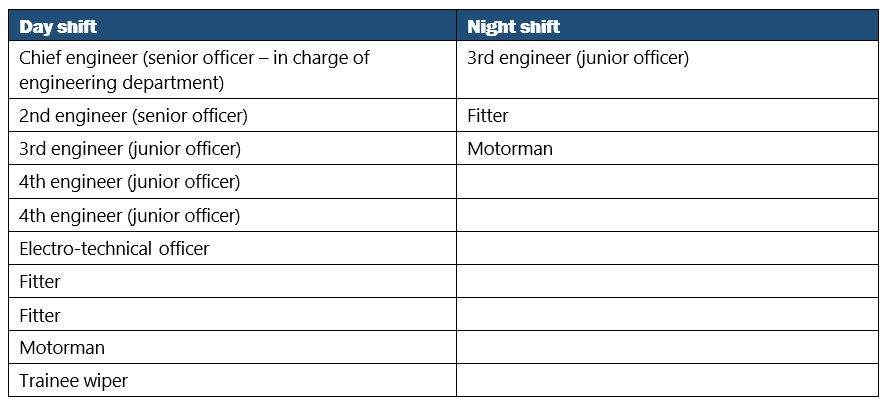
- Engine-room work ran continuously over 24 hours, using two teams operating 12-hour shifts. The day shift worked from 0800 to 2000, and the night shift worked from 2000 to 0800.
- The day shift consisted of the chief engineer, 2nd engineer, a 3rd engineer, two 4th engineers, an electro-technical officer, two fitters, one motorman and a trainee wiper (a wiper is the lowest ranking unlicensed worker in a ship’s engine room). This team worked alongside the specialist MAN B&W team overhauling the generators. They also worked on three units (when referring to a marine diesel engine, a unit refers to an individual engine cylinder and its associated components – the piston, cylinder head, fuel injector and valves) of the main engine.
- The night shift consisted of a 3rd engineer, a fitter and a motorman. This team worked through a job list prepared by the chief engineer, 2nd engineer and the vessel’s superintendent. These jobs included cleaning and preparation work to support the day shift.
Shore management team
- Shore management was represented on board by the Auckland-based general manager and the vessel’s superintendent from Hong Kong.
Composite boiler and its operation
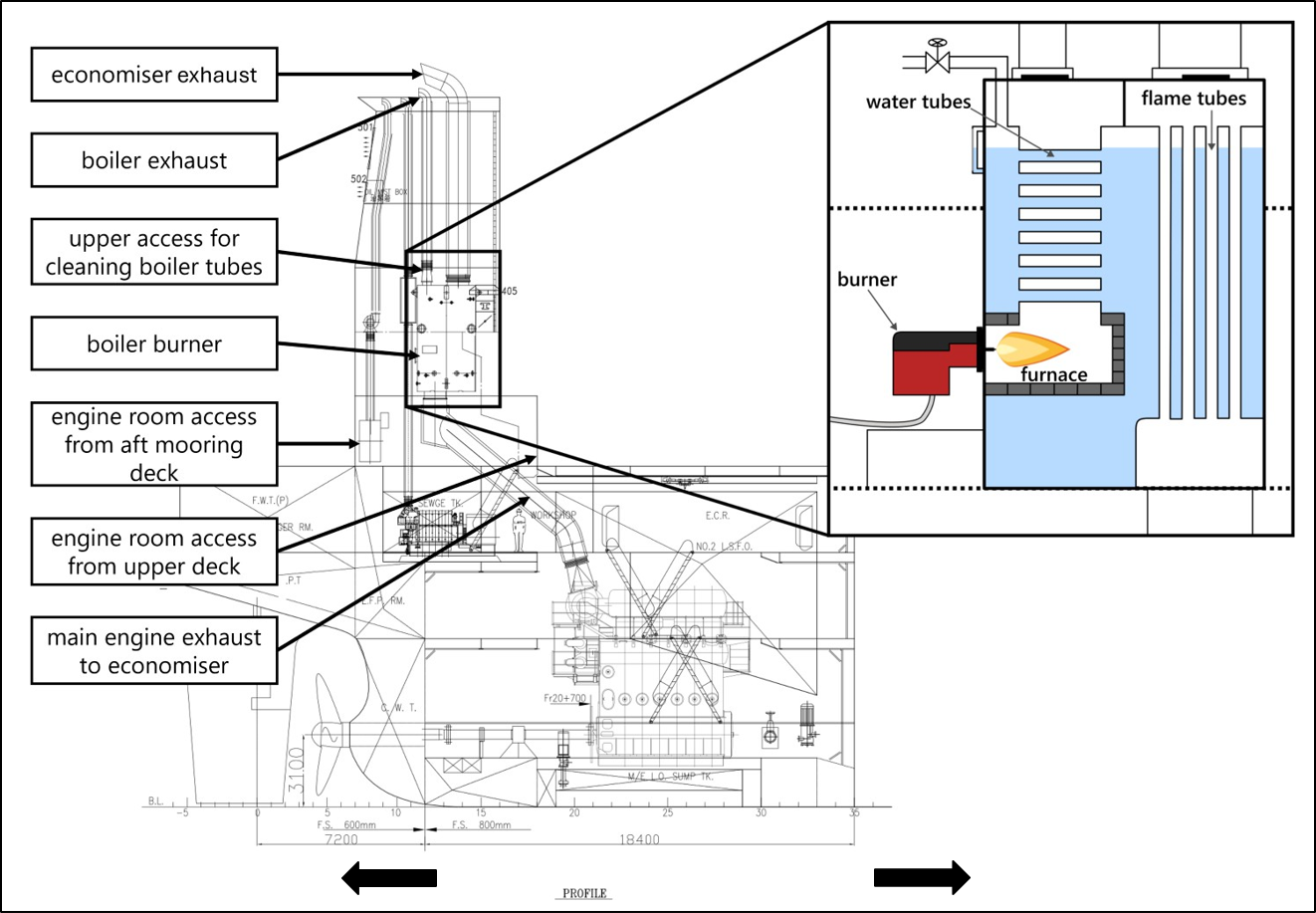
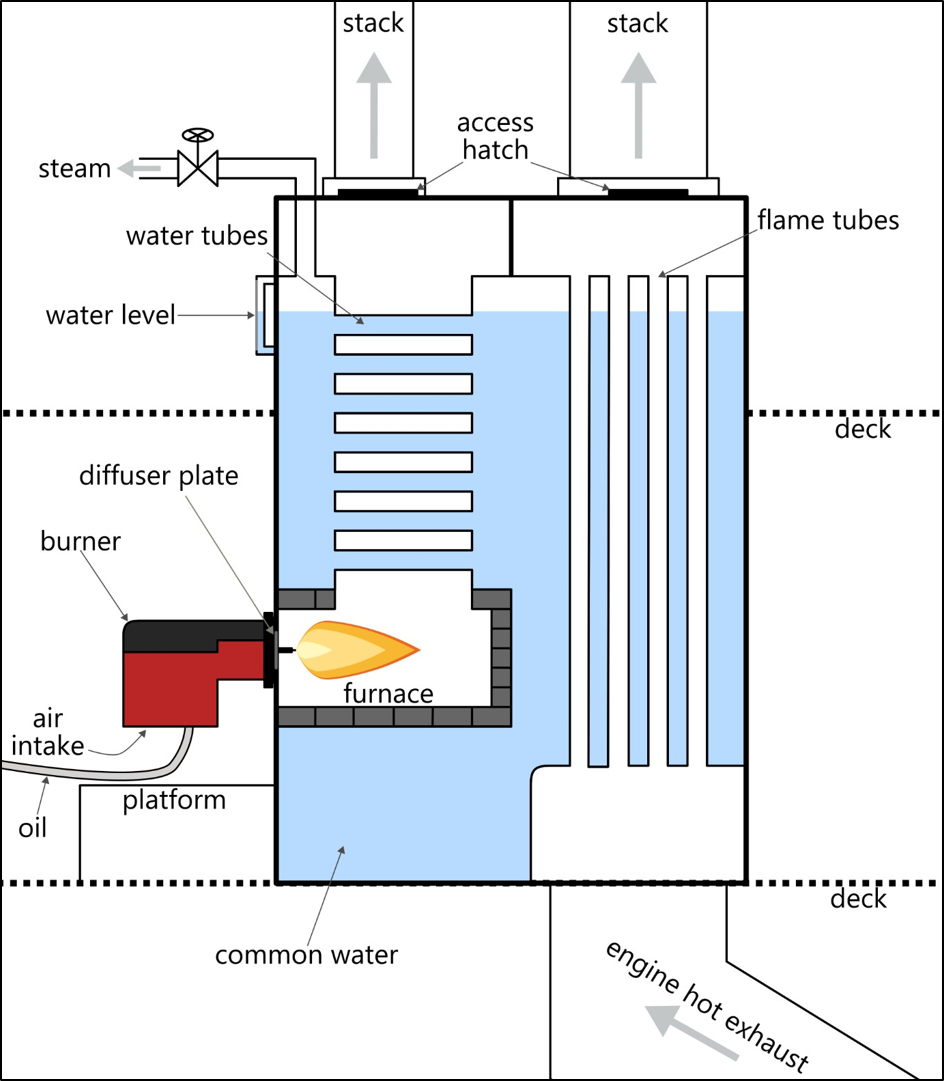
- A composite boiler combines an exhaust-gas economiser (a type of heat exchanger used on ships to recover waste heat from the exhaust gases of the main engine) with an oil-fired boiler in a single unit (see Figure 3). It functions as a compact auxiliary boiler and generates steam and heat for shipboard systems such as fuel-oil heating, domestic-hot-water supply and crew-accommodation heating.
- When the main engine operates during a voyage, it produces hot exhaust gases. The hot exhaust gas from the main engine is directed through the boiler’s economiser section, where steam is recovered to heat the onboard systems. The oil-fired part of the boiler is turned off and allowed to cool while a vessel is at sea. A few days before arriving at a port, it is common for a vessel’s crew to clean the oil-fired part of the boiler by using compressed air to blow accumulated soot out of the system.
- While a vessel is alongside in port and the main engine is not running, the crew operates the oil-fired side of the composite boiler to generate heat and steam for the onboard systems. Typically, the oil-fired part of the boiler is used only for a few days at a time, while a vessel is in port.
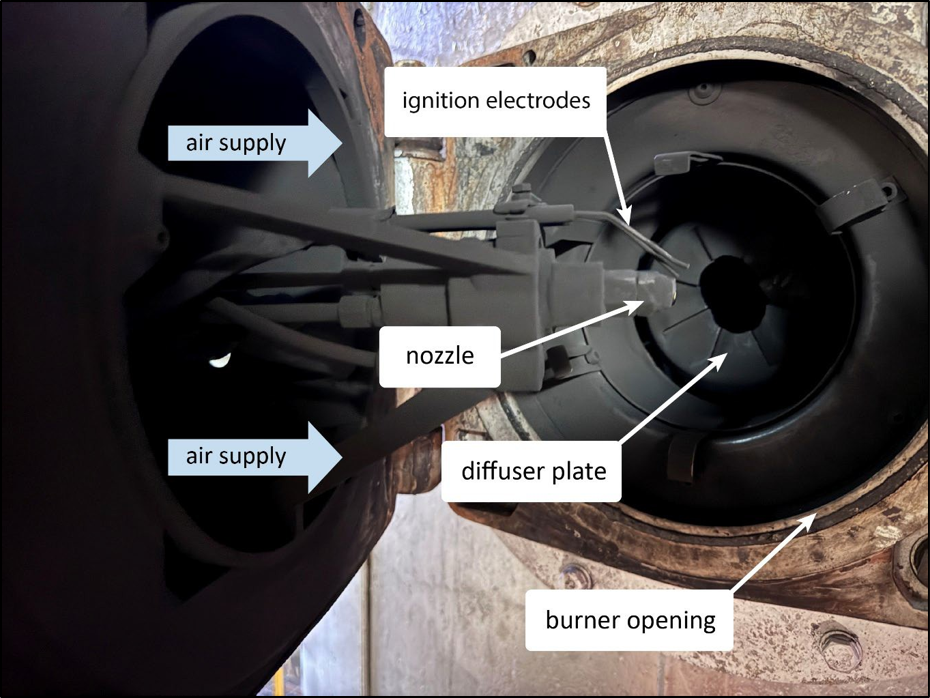
- Optimal running of a boiler relies on the coordinated introduction of the fire elements (air, fuel and heat) to the boiler furnace to create a controlled fire. Air is injected into the burner through an air-intake flap. Ignition is initiated by high-voltage electrodes that produce a spark at the burner. Sustained combustion depends on correct fuel atomisation, airflow and ignition sequencing.
Narrative
Events leading up to the accident – burner failure
-
At the time of the accident the Olivia had been in Bluff for 32 days.
-
On 23 May 2025 at 2000, the night shift started work in the engine room. The night shift 3rd engineer and the fitter were working at the generators and the motorman was cleaning around the generator platform.
-
At about 2229, the boiler’s burner flamed out (the boiler burner flame was extinguished unexpectedly) and the boiler stopped.
- At about 2330, the 2nd engineer, who was on the day shift, went to the engine control room (ECR) to complete some paperwork. They noticed that the boiler steam pressure was low and went to the generator platform to alert the night shift 3rd engineer.
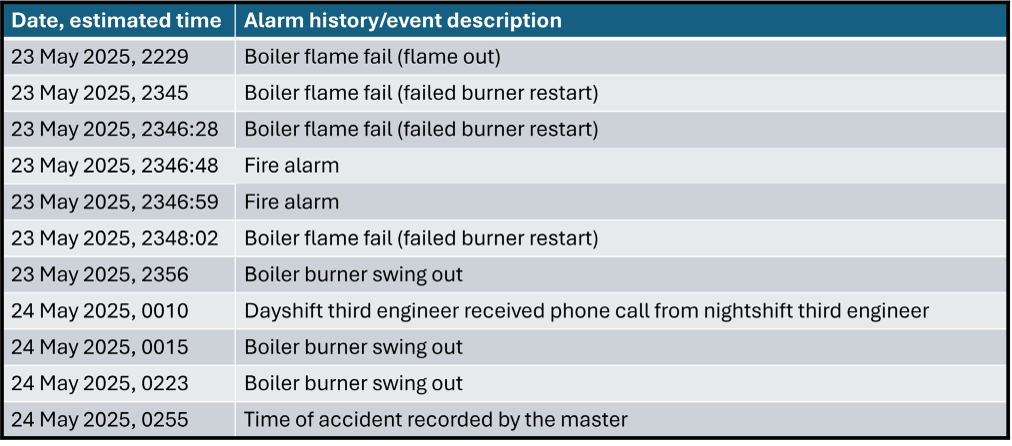
- Shortly afterwards, the 2nd engineer and the night shift 3rd engineer went to the boiler platform and attempted to restart the boiler. The first attempt failed. The second attempt resulted in a boiler blowback. Soot and hot air vented through the air intake to the burner and triggered a fire alarm at 2346 (see Figure 9). In this instance, nobody was harmed.
- The superintendent, who was in the ECR at the time the fire alarm activated, acknowledged and silenced the alarm. A few minutes later the 2nd engineer and the night shift 3rd engineer returned to the ECR. At the same time the bridge watchkeeper called and asked what had caused the fire alarm. The 2nd engineer told the bridge watchkeeper about the failed boiler restarts. The master and chief engineer were informed of the situation and that there was no urgent issue.
- On 24 May 2025 at about 0010, the night shift 3rd engineer called the day shift 3rd engineer to the engine room for assistance with the boiler. Shortly afterwards, the day shift 3rd engineer arrived in the engine room to assist with restarting the boiler.
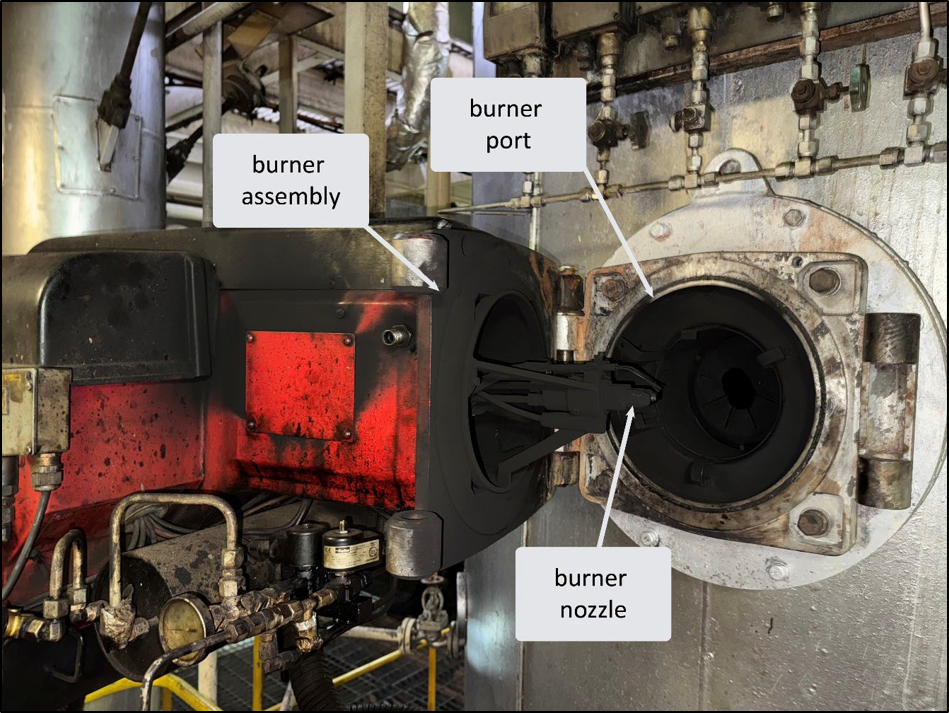
- The 2nd engineer along with the two 3rd engineers returned to the boiler platform. They swung out the boiler’s burner (a device fitted with an ignitor and a fan to produce a steady air pressure required for efficient ignition and good combustion) assembly (see Figure 4) and cleaned the oil burner nozzle (a device that atomises fuel oil into a fine spray by forcing it under pressure through a small opening. The resulting spray is mixed with air and ignited.) and diffuser plate (creates turbulence, mixing the injected air and fuel to provide a blended mix for combustion) (see Figure 5) with rags. After securing the burner, they attempted to restart the boiler, but it failed again.
- The day shift 3rd engineer suggested that the boiler flue17 required cleaning and returned to their cabin.
Boiler cleaning
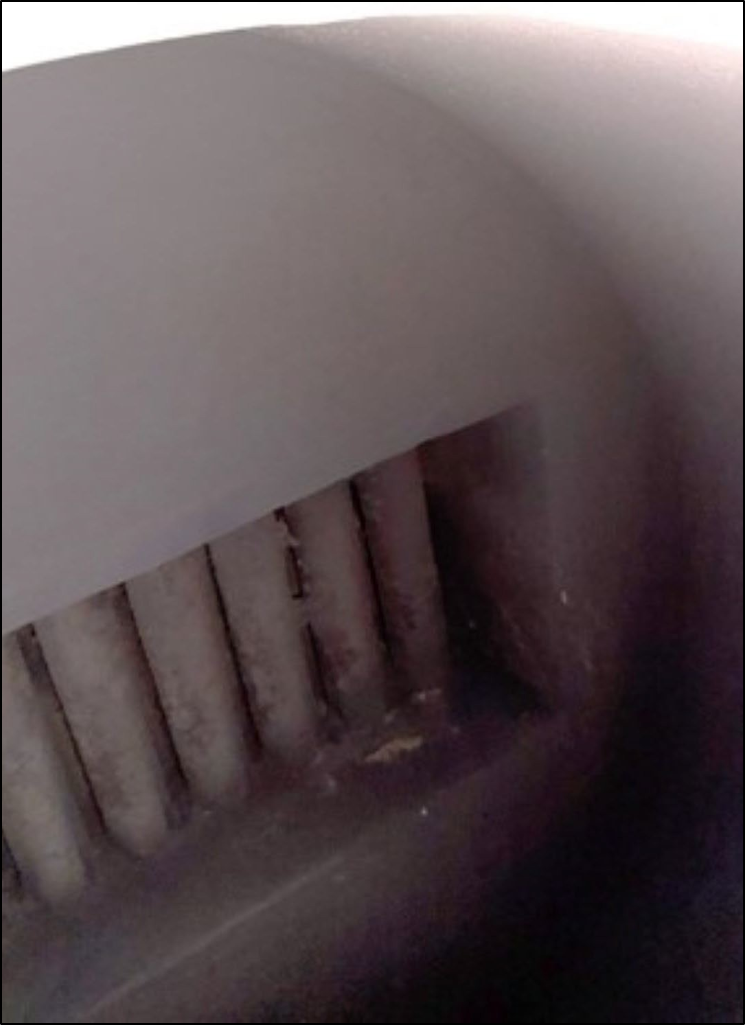
- The 2nd engineer asked the night shift 3rd engineer to get permission from the chief engineer before cleaning the boiler. The night shift 3rd engineer phoned the chief engineer, who was asleep in their cabin, and explained the circumstances of the boiler flame out. They also shared the recommendation made by the day shift 3rd engineer, which was to clean the soot buildup from the flue, around the boiler tubes (see Figure 7 and Figure 8).
- The night shift 3rd engineer recalled that the chief engineer authorised them to clean the soot buildup in the boiler. However, the chief engineer remembered authorising only cleaning the boiler burner nozzle. The 2nd engineer, who had been in the ECR at the time, had only heard the night shift 3rd engineer’s side of the conversation.
- At about 0130, the night shift 3rd engineer, fitter and motorman met in the ECR to discuss the boiler-cleaning task, focusing on the required tools and the cleaning sequence.
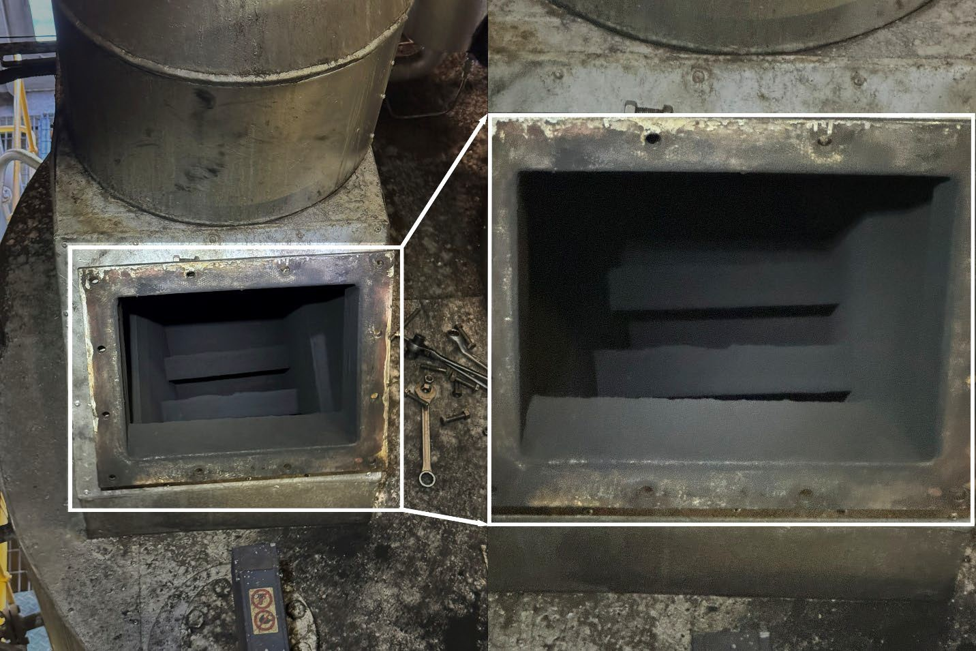
- At about 0200, the fitter unbolted the access hatch cover on top of the boiler (see Figures 6 and 7). The motorman used a ship-made lance (tool that channels high-pressure air through an elongated nozzle) to blow compressed air onto the boiler tubes to dislodge accumulated soot. After doing this for about 20 minutes, they refitted the top cover and proceeded down to the burner platform.
- The night shift 3rd engineer had already swung out the burner assembly when the motorman returned to the burner platform with the air hose and lance. They both looked through the burner opening and observed that the furnace was filled with white smoke, and glowing material was visible at the base.
- The motorman started blowing compressed air into the furnace directed upwards, toward the water tubes in the top of the furnace (see Figure 8). They continued this for about 20 to 25 minutes.
The accident – boiler blowback explosion
- As the motorman withdrew the lance from the burner opening and stepped away from the boiler, there was a sudden explosion from inside the boiler. The force of the blast threw all three of the night shift crew members backwards.
- The night shift 3rd engineer and motorman sustained serious burns to their faces and arms. The fitter was not burned but suffered bruising to their shoulder from falling. Despite their injuries, all three were able to exit the engine room.
- The motorman reported the incident to the on-duty deck crew. The 2nd officer promptly called the master and then the chief engineer to report the accident. The master recorded the accident occurred at approximately 0255 on 24 May 2025.
- The 2nd officer left the bridge to go to the onboard hospital. They met the motorman on their way. After conducting an initial assessment and administering first aid, the 2nd officer escorted the motorman to their cabin to take a cold shower to cool their burns. The night shift 3rd engineer had already gone to their cabin for a cold shower.
- Meanwhile, the master, the superintendent and other crew had assembled to assist the injured crew members. At about 0310, the 2nd officer informed South Port security of the incident and requested an ambulance. At about the same time, the superintendent asked one of the local service technicians to call emergency services.
- At about 0335, Fire and Emergency New Zealand arrived on scene, followed shortly afterwards by two ambulances. The three injured crew members walked down the gangway to the ambulances and were taken to hospital.
- Meanwhile, the Fire and Emergency New Zealand personnel reported to the master that there was no longer any fire.
- The motorman was transferred to Christchurch Hospital so that their burns could be treated before they were repatriated for further treatment at home. The night shift 3rd engineer was treated at Invercargill Hospital for several days before being repatriated. The fitter had no burns but suffered bruising to their shoulder. They were treated locally and rejoined the vessel on the same day.
- Following the accident, the operator engaged a shore-based boiler agent, whose technicians visited the vessel to inspect and repair the burner.
The International Safety Management (ISM) Code
- The International Safety Management (ISM) Code (the International Management Code for the Safe Operation of Ships and for Pollution Prevention) is an international standard for the safe management and operation of ships and for pollution prevention. It sets out safety-management objectives and requires a safety-management system (SMS) to be established by the shipowner or operator, with responsibilities both ashore and on board. The ISM Code was applied to the New Zealand maritime system through Maritime Rules Part 21 – Safe Ship Management Systems, and applied to foreign vessels to the extent set in Maritime Rules Part 21 (Maritime Rule 21.3 – Application of Section 1 (see https://www.maritimenz.govt.nz/media/1cme0szm/part21-maritime-rule-original.pdf))
- The ISM Code requires a Company to establish and maintain an SMS that:
- is implemented on board under the master’s authority
- ensures the maintenance of the ship in safe condition
- ensures compliance with the relevant rules and regulations.
- The Olivia’s technical management was undertaken by the operator. The Olivia had an SMS that was common across a fleet of vessels managed by the operator.
International work–rest hours
- In New Zealand, Maritime Rules Part 31 – Crewing and Watchkeeping sets out requirements relating to the minimum crew numbers, and to crew certificates and qualifications. This part also sets out requirements relating to fitness for duty, prescribed hours of rest and watchkeeping that apply to some ships in accordance with the International Convention on Standards of Training, Certification and Watchkeeping for Seafarers (STCW).
- Maritime Rules Part 31 applies to a range of ships including:
- any New Zealand passenger and non-passenger commercial ships and fishing vessels
- any foreign passenger ship or non-passenger ship of 500 GT or more, that is registered in a state party to STCW or the International Convention for the Safety of Life at Sea (SOLAS), and that is operating commercially within New Zealand waters.
- The Olivia was registered in Malta, which was a party to both STCW and SOLAS. Therefore, Maritime Rules Part 31 applied to the extent set in Maritime Rules Part 31.57 – Foreign ships (Maritime Rule 31.57 – Foreign ships (see https://www.maritimenz.govt.nz/media/wx3iyq13/part31-original-rule.pdf))
- Maritime Rules Part 31 requires masters to establish and enforce rest periods for watchkeeping personnel and those seafarers whose duties involved designated safety, security or marine environmental duties. Crew members were required to ensure their own fitness for duty when keeping watch and undertaking other operational duties. In particular, the owner and master of the ship had to establish procedures that included taking into account the nature of the crew’s duties and the impact that fatigue, stress, alcohol and drugs may have on their ability to carry them out (Maritime Rule 31.29(3)–(4) – Fitness for duty (see https://www.maritimenz.govt.nz/media/wx3iyq13/part31-original-rule.pdf))
-
Hours of rest were required to be in accordance with the provisions of STCW Section A-VIII/1 – Fitness for duty (see https://wwwcdn.imo.org/localresources/en/OurWork/HumanElement/Documents/33.pdf). This specified that:
all personnel assigned as officer in charge of a watch, or part of a watch, or with designated safety, pollution prevention or security duties must be provided with a minimum rest period of:
10 hours in any 24-hour period 77 hours in any 7-day period.
The hours of rest may be divided into no more than two periods, one of which is at least 6 hours long, and the intervals between consecutive periods of rest must not exceed 14 hours.
Personnel information
- The chief engineer joined the Olivia at Bluff on 29 April 2025. They had worked at sea since 2007, progressing through the ranks to become chief engineer in 2020. They began working for the operator as chief engineer in October 2021 and worked on four bulk carriers before joining the Olivia.
- The night shift 3rd engineer joined the Olivia at Bluff on 29 April 2025. They had worked at sea for nine years. They had worked for the operator for two years, undertaking two contracts also on bulk carriers. The contract on board the Olivia was their third contract with the operator, and the first on board the Olivia. The night shift 3rd engineer had previous experience with boiler cleaning on other vessels.
- The 2nd engineer joined the Olivia on 5 February 2025 in Indonesia. They had worked for the operator for about seven years. This was their first contract in the rank of 2nd engineer, and their first on board the Olivia.
- The day shift 3rd engineer joined the Olivia on 10 January 2025. They had worked at sea for 15 years, most of this time working for the operator. This was their fifth contract as a 3rd engineer and their first contract on board the Olivia.
- The night shift motorman joined the Olivia on 11 January 2025. They had worked at sea since 2012 and had worked three contracts as a motorman before they joined the operator as a motorman in 2020. This was their first contract on board the Olivia.
- The night shift fitter joined the Olivia on 1 March 2025. They had started their training as a fitter and welder in 1992 and had worked for the operator as an engine fitter since 2001. This was their first contract on board the Olivia.
Organisational information
- At the time of the accident, the Olivia was owned by a Maltese company, Neco Maritime Limited, and flagged with Malta Ship Registry.
- In August 2016, the owner engaged the operator to provide technical management and implement an SMS.
- Crew management was undertaken by Fleet Management Services Philippines, Inc.
- Following the accident, the vessel was sold in August 2025. It was renamed as the Bao Shine and reflagged to Panama.
Recorded data
- The electronic alarm log was recovered from the ECR. While the data provided a chronological event record, the system date and time had been incorrectly set. Commission investigators therefore estimated event times based on the manually recorded time of the accident and other sources.
Previous occurrences
- The following occurrences have been investigated by the Commission and had similar safety themes. These occurrences were similar to the accident on board the Olivia because there was an onboard failure to follow procedures, risk controls were either not implemented, monitored or understood by the crew and no safety intervention occurred.
- This pattern, in which the SMS provided good guidance but implementation was inconsistent, is a recurring critical safety issue. It highlights the importance of not just having an SMS and risk controls, but ensuring these are actually applied, monitored and reinforced through training and onboard culture.
TAIC inquiry MO-2021-205 Container vessel Moana Chief, serious injury to crew member, Port of Auckland, New Zealand, 10 December 2021
- On 10 December 2021, a crew member aboard the container vessel Moana Chief was seriously injured when their leg became trapped between moving parts of the telescopic accommodation ladder while preparing to depart the Port of Auckland.
- The primary safety issue was that risk controls for retrieving the accommodation ladder were not implemented as per the vessel's SMS, and work procedures were not consistently followed. Because of the safety action taken by the operator following the accident, the Commission issued no recommendations in this report.
TAIC inquiry MO-2020-204 Container vessel, Rio De La Plata, serious injury to crew member during unmooring operations, Timaru Port, 14 November 2020
- On 14 November 2020, the container vessel Rio de la Plata was at Timaru when a crew member suffered a serious injury during mooring operations.
- The Commission identified weaknesses in the vessel’s SMS and the practical implementation of mooring arrangements and equipment checks on board. The Commission recommended that the Maritime and Port Authority of Singapore investigate and, if necessary, review its audit processes, to see if they could be further developed to identify weaknesses in vessels’ SMSs, and in their practical implementation on board vessels under its flag (Recommendation 006/22).
- The Maritime and Port Authority of Singapore acknowledged the recommendation, advised they had conducted a preliminary inquiry and reviewed the company's corrective actions (including removal of cross-over bars under the winches). It stated its intent to promulgate the case within the maritime industry and strengthen checks during audits and inspections.
Analysis Tātaritanga
Introduction
- At the time of the accident, the Olivia had been berthed in Bluff for 32 days, undergoing extensive engineering work. Three crew members were injured when the vessel’s composite boiler (the boiler) they were cleaning suffered a blowback explosion.
- The following section analyses the circumstances surrounding the event to identify those factors that increased the likelihood of the event occurring or increased the severity of its outcome. It also examines any safety issues that could adversely affect future operations.
Why did the boiler malfunction?
- The boiler produced steam to preheat the vessel’s fuel oil and to heat the domestic hot water and accommodation heating systems. It was essential for maintaining fuel quality (heat provided by the boiler lowered the viscosity of the fuel oil, facilitating its pumping and purification processes) and for the comfort of the crew during an extended stay in port. There was only one boiler on board and, with all generators out of service, there was no alternative way to produce steam for the vessel’s systems.
- When the boiler’s burner flame extinguished late at night, the problem was not discovered for about an hour. The 2nd engineer, who was off duty, noticed the boiler’s low steam pressure and informed the night shift 3rd engineer of the problem. Together, they tried to reignite the burner flame but were unsuccessful. One of their attempts resulted in a blowback event during which nobody was harmed.
- The night shift 3rd engineer called the off-duty day shift 3rd engineer to discuss possible causes of the burner failure along with the off-duty 2nd engineer. Based on prior experience, the extended boiler operating period and the symptoms observed, the engineers formed a working diagnosis that soot accumulation was restricting airflow. They determined that the next step would be for the night shift crew to clean the soot from inside the boiler.
- At the time of the accident, the night shift was cleaning the accumulated soot out of the furnace as an attempt at troubleshooting the burner failure. However, the available evidence indicates that the crew proceeded with the cleaning activities without a documented assessment to identify and control the risk from the fire elements present inside the furnace, namely:
- air was present inside the furnace because of the positive pressure (the air pressure inside the engine room was kept slightly higher than the air pressure of spaces outside the engine room) in the engine room and the use of an air lance to dislodge soot deposits
- fuel residue was present inside the furnace owing to multiple failed attempts to restart the burner
- heat was present because sufficient time had not been given for the boiler to cool and bricks lining the bottom of the furnace retained the heat.
- It is likely that the motorman inadvertently disturbed heated soot while withdrawing the air lance, igniting residual fuel inside the boiler and causing the blowback.
- Although cleaning was delayed in an attempt to permit cooling, no objective temperature, manufacturer’s criterion or other verification was used to confirm that the furnace had reached a safe condition. Allowing the boiler to cool down sufficiently before introducing compressed air would have reduced the risk of a blowback explosion occurring.
- A shore-based technician, who attended the vessel after the accident, found that a loose retaining screw caused the burner’s air-intake flap to malfunction. This malfunction would have affected the air supply to the burner. They also replaced a faulty ignition transformer (an electrical device used to generate the high-voltage spark required to ignite fuel in a combustion system such as an oil burner or industrial furnace). Technicians from the same boiler service agent made a follow-up visit to the vessel and also identified anomalies between the manufacturer’s diagrams and the wiring present in the burner unit. The Commission was unable to determine whether these wiring anomalies had any impact on the initial burner failure.
- It is likely that the boiler initially flamed out and failed to restart because of a combination of the following issues:
- malfunction of the burner’s air-intake flap
- the faulty ignition transformer
- buildup of soot inside the boiler.
Hazard identification and risk control for cleaning the boiler
Safety issue 1: An accident occurred because the crew did not follow safe work steps for hazard identification and risk control. The relevant unplanned work and boiler maintenance controls were not used because of the inadequate implementation of the safety management system onboard.
The ISM Code
- The ISM Code identifies general safety management objectives. These objectives are to:
- provide for safe practices in ship operation and a safe working environment
- establish safeguards against all identified risks
- continuously improve the safety-management skills of personnel ashore and on board, including preparing for emergencies related both to safety and environmental protection.
- The ISM Code required maritime operators to document procedures, plans and instructions for key shipboard operations, especially those that concerned the safety of personnel, the safety of the vessel and protection of the environment.
Unplanned work
- The operator’s Quality, Health, Safety and the Environment (QHSE) Manual was part of the SMS and contained instructions and procedures for safe working practices. It included the operator’s expectations for how the crew should handle unplanned work (Fleet Management Limited QHSE Manual Section 9.11.2 – Handling of unplanned jobs).
- The QHSE Manual listed examples of unplanned work that included an unanticipated machinery failure. The boiler flame out was not anticipated, so the crew’s actions to resolve this failure should have been treated as unplanned work in accordance with the SMS. The procedure for unplanned work required a review by the Chief Engineer, or responsible person, and the team leader and crew involved in the job. According to the procedure, this review should have included:
- understanding the complete job scope
- defining and allocating responsibility
- ensuring staff are aware of their responsibilities for executing the job
- ensuring staff know how to execute their job, how to use the equipment required for the job and what interdepartmental coordination is required
- reviewing any additional assistance from the manufacturer or shore-based technicians
- ensuring that everyone involved in the job is aware that if the scope of the job changes, work is to be stopped and reassessed
- ensuring that there is sufficient time to do the job
- checking if any simultaneous operations are taking place on board
- checking if the job has any bearing on external parties, such as harbour authorities and the port facility, and advising as necessary
- identifying the supervisor for the job and ensuring they are experienced and aware which critical parts of the job need to be reviewed before commencing work
- identifying effective isolation measures
- carrying out final checks and tests.
- The SMS required the following mitigations to be implemented for unplanned work:
- a toolbox meeting
- risk assessment, if required
- completion of the unplanned work template
- job hazard analysis (JHA).
Boiler maintenance
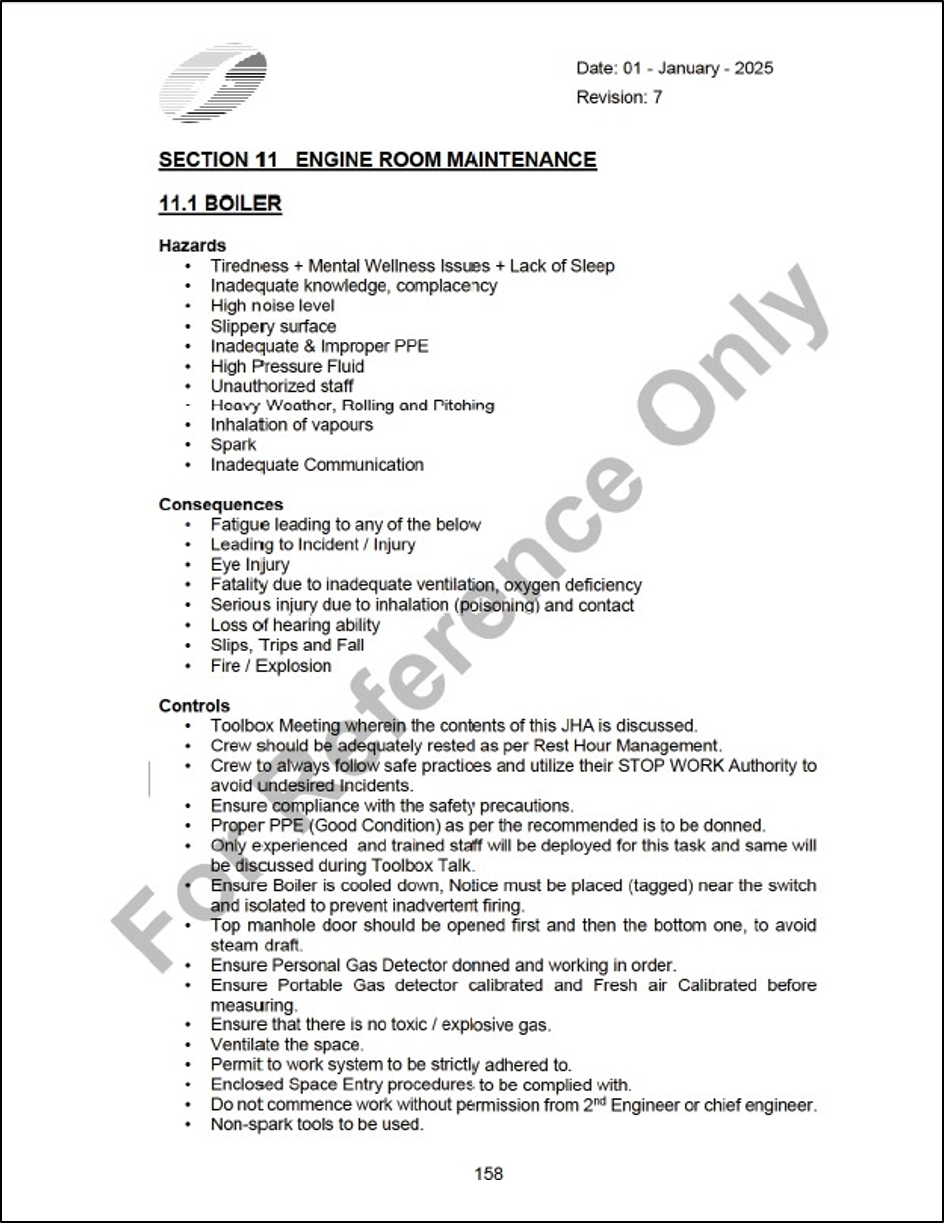
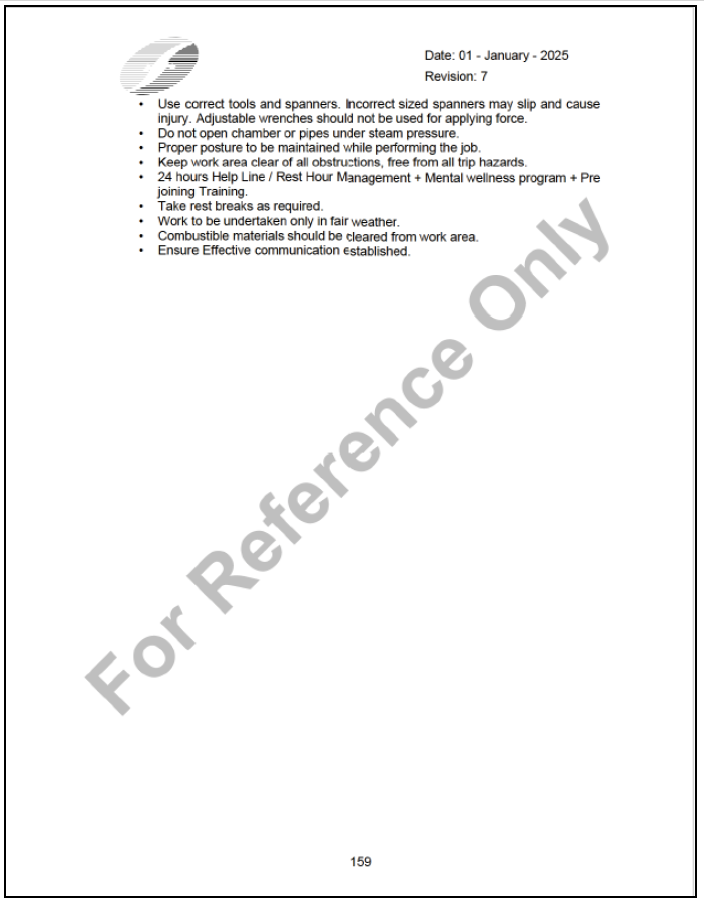
- The operator’s SMS included a JHA for conducting maintenance on the boiler (see Appendix 1). It identified generic hazards and consequences associated with maintenance work on the boiler. These included fatigue, inadequate knowledge, complacency, sparks/fire/explosion, and slips/trips/falls. It identified safety controls that could be applied to boiler-associated work depending upon assessment of hazards present. The safety controls included:
- obtaining permission from the chief engineer or second engineer prior to commencement of work
- adhering strictly to the permit to work system
- holding a toolbox meeting, including discussion of the JHA
- ensuring compliance with safety precautions
- ensuring the boiler had cooled down and was isolated and signage used to prevent inadvertent firing
- ensuring no toxic or explosive gases were present
- ventilating the boiler
- using appropriate personal protective equipment.
- The crew considered that cleaning the boiler was a routine and regular activity. Based on interviews with the engineers and crew, the boiler was usually cleaned a few days before arriving at a port. Although the activity was familiar, the conditions were not. Cleaning the boiler at sea, after it had cooled for several days, differed materially from cleaning it after repeated ignition attempts and an earlier blowback while the furnace remained hot.
- There were no vessel-specific or job-specific procedures or instructions for cleaning the boiler tubes. The motorman was the only person from the night shift who had cleaned the boiler tubes on this ship. They had cleaned the boiler tubes at sea, when the boiler had been shut down and allowed to cool for a few days, eliminating the heat source and risk of blowback.
Onboard practice
- Because of the change of circumstances and insufficient time for the boiler to cool, it was not safe for the crew to use the same method for cleaning the boiler tubes as used on a cold boiler at sea. These factors should have been captured during the job review, risk assessment and JHA steps required by the SMS regardless of whether the job was considered to be unplanned work or routine boiler-maintenance work. Additionally, during interview the superintendent informed Commission investigators that in September 2023, September 2024 and February 2025 they had circulated information to the fleet about preventing boiler blowback incidents. This guidance had been sent out to the fleet, to be shared with all engineers.
- Before the accident, the night shift assembled in the ECR and discussed the cleaning job and what tools and equipment would be required. The crew discussed the tools and cleaning sequence, but the discussion did not function as a formal reassessment of the changed conditions and did not bring the relevant JHA controls into use.
- The engineering officers stated that toolbox meetings were only conducted for planned work and were not considered necessary for unplanned work. This approach is inconsistent with the SMS requirements for unplanned work and signified that some officers were not familiar with relevant parts of the SMS and the responsibilities associated with their rank.
- The JHA contained relevant controls, but it was generic and did not specify objective cooling criteria, a vessel-specific cleaning method, or a clear escalation trigger following repeated failed ignition attempts or a prior blowback. The risk of a boiler blowback accident could have been further reduced if the crew had followed the necessary steps in the unplanned work procedure.
Personal protective equipment
- Personal protective equipment (PPE) is the last line of defence with respect to safety controls when other controls have failed to prevent an accident exposing the worker to an injury. The three crew members working at the boiler had coveralls, safety shoes and gloves, but they did not use any face or eye protection.
- The PPE listed in the JHA included eye protection but not face protection. It is very likely that the severity of the injuries would have been reduced if the crew members had worn appropriate face protection. The decision to not use any face or eye protection was further indication that the crew did not appreciate the risk.
Implementation of the SMS
- The SMS documented the operator’s approach to safety and their goal of “zero accidents and zero injuries”. However, the operator acknowledged that “one can have the best policies, rules, standards and manuals. But they count for little if the personnel do not internalize safety related values”.
- The SMS described positive safety behaviours as:
- putting safety first
- understanding and complying with safety processes
- never walking by when something is not right.
- Meanwhile, negative safety behaviours that could result in injuries were described as:
- rushing into jobs
- adopting an “it’ll do” attitude.
- The SMS further outlined the operator’s development of a safety programme to provide guidelines to seafarers and shore staff, aimed at reinforcing positive behaviour and increasing compliance with procedures.
- The operator’s standing orders, contained in its SMS, required officers and ratings to have a thorough understanding of, and be conversant with, the relevant sections of the SMS.
- The Commission found that during the extended repair period, operational practices did not consistently activate the controls described in the SMS, particularly when work changed from routine low-risk duties to emergent higher-risk work.
Resource management during sustained intensive work periods
Safety issue 2: The operator’s safety management system did not provide guidance for onboard crew management during sustained intensive work periods. This omission led to an under-resourced night shift crew not identifying the risks involved with cleaning the boiler and not implementing sufficient safety controls.
Hours of rest
- The operator described fatigue management in the SMS. This included the expectation that crew met the requirements for hours of rest (see paras 2.47 to 2.51), kept accurate records of their hours of rest, and received compensatory rest time when necessary. Additionally, the SMS stated that the operator fully supported the master to stop work if a crew member was in breach of their hours of rest or appeared fatigued.
- The fatigue management procedure identified four general factors that contributed to fatigue:
- crew-specific factors (the person, their health, their feelings and interactions)
- management factors (organisational, crewing, voyage and scheduling)
- ship-specific factors (ship design, reliability of equipment, comfort of accommodation spaces)
- environmental factors (temperature, humidity, noise levels).
- The SMS stated that the operator would provide sufficient seafarers to ensure compliance with the statutory requirements regarding rest periods. The operator provided additional personnel (see para 2.8) on board while the generators were overhauled.
Day shift crew working while off duty
- The ship’s engineering team had been working 12-hour shifts since 29 April 2025. While this 12-hour shift pattern enabled the crew to meet the statutory requirements for hours of rest, the Commission found evidence that some crew members were working outside their defined shift hours.
- At the time of the boiler flame out, the chief engineer was asleep, having worked the full day shift from 0800 to 2000. They were woken up firstly by the fire alarm, and again when the night shift 3rd engineer called to request permission to clean the boiler. The chief engineer stated they were in a deep sleep when they were called and very tired. The chief engineer thought the night shift 3rd engineer was asking permission to clean the burner nozzle and diffuser plate, not the boiler itself.
- The 2nd engineer was also assigned to the day shift, but was completing paperwork and preparing for the next day when the boiler flamed out at around 2229. The 2nd engineer informed investigators that spending additional hours doing paperwork was typical. Following the boiler flame out, the 2nd engineer assisted the night shift 3rd engineer with troubleshooting the boiler until about 0100 – five hours after the 2nd engineer’s shift had ended.
- The superintendent had worked for 21 hours from 0800 on 22 May 2025 until 0500 on 23 May 2025. They then rested for 4 hours before working until 0100 on 24 May. The superintendent was under pressure to ensure the extensive work was completed in a timely manner.
- The crew recorded their 12-hour shifts on their hours of rest records, but interviews with the chief engineer, 2nd engineer and superintendent demonstrated that these hours were being exceeded. Despite the operator providing additional personnel, they were used to facilitate finishing the engineering work as soon as possible rather than for managing compliance with the hours of rest requirements.
Crew resourcing
- The Commission did not find any indication that working hours were reassessed to ensure effective personnel management as the timeframe for the repair work increased.
- At the time of the accident, senior engineering officers – the chief engineer and the 2nd engineer – had worked all day. Additionally, their rest time was interrupted by the earlier fire alarm as well as paperwork requirements. Although the 2nd engineer had been present when the boiler initially failed, they were not on duty and needed to rest.
- There were no senior engineering officers on duty overnight and this meant that there was nobody authorised to oversee work that carried a higher risk than the cleaning and preparation work planned for the night shift. The SMS requirements for the chief engineer’s involvement with the unplanned work procedure meant that no work that exceeded the defined night shift scope should have been carried out while the chief engineer was not available.
- When the night shift 3rd engineer phoned, the chief engineer had completed a long working day, and their sleep had already been disrupted. The communication between the night shift 3rd engineer and the chief engineer did not accurately convey the true nature of the job. As a result, the chief engineer did not understand the work that the night shift 3rd engineer intended to do, nor did they appreciate that it was high-risk work that required a risk assessment and/or JHA.
- Despite the involvement of the senior engineering officers at the time of the initial boiler failure and fire alarm, nobody identified the risks involved with carrying out unplanned remedial work overnight. It is very likely that senior engineering officers were fatigued as they sought to complete the generator repairs, which caused an adverse effect on their decision-making.
- The timing and circumstances of the call between the night shift 3rd engineer and the chief engineer very likely hindered clear communication and shared understanding of the proposed work and required controls.
Skill and experience to carry out tasks
- When the Olivia arrived in Bluff on 23 April 2025, the port stay was scheduled to be five days. Urgent maintenance and repair work on all the ship’s generators extended the stay in Bluff indefinitely. At the time of the accident, the Olivia had been in Bluff for 32 days.
- The engine-room night shift consisted of three people. Onboard management of personnel prioritised the available resources, skills and experience to the day shift. This was to facilitate the ongoing critical work on the generators.
- The night shift had limited duties, such as general cleaning and preparation for the day shift’s work. As the only officer on the night shift, the 3rd engineer held a supervisory role over the night shift fitter and the night shift motorman. This arrangement was suitable as long as the planned overnight duties were routine and low risk. Cleaning the soot from the inside of the boiler was not planned work and arose because of the burner flame out. The motorman was the only member of the night shift who had experience cleaning the Olivia’s boiler. The night shift 3rd engineer had previous experience with the task on other vessels.
- As acknowledged by the boiler maintenance section of the SMS, there were potential known hazards relating to combustion and explosion. A significant safety control to eliminate or minimise the risk was allowing the boiler to cool completely before working on it. The SMS contained detailed instructions for risk assessments. Although the night shift 3rd engineer consulted the 2nd engineer and the day shift 3rd engineer, nobody identified the work as unplanned work. Nor did they consult the JHA for routine boiler maintenance despite the known risk of fire and explosion associated with boilers.
Heating and hot water
- Had the crew followed the requirements of the SMS, the job would not have been done until the next day or night. However, the night shift crew was motivated to fix the boiler overnight because it provided heating to the crew’s accommodation and the domestic hot water. Additionally, the night shift 3rd engineer was concerned about the heat required for the fuel purification plant that was running. Long working hours on an intensive engineering project made heating and hot water for washing and wellbeing another potential motivator.
- The SMS did not directly address the sustained heavy workloads that might be encountered during layups, dry docks and extended work periods. The onboard management of available personnel was focused on the day shift job of repairing the generators and lifting Maritime NZ’s Notice of Imposition so the vessel could depart. When an additional unanticipated repair was required, the night shift did not have the capacity to plan and supervise any higher-risk work.
Findings Ngā kitenga
- It is likely that the boiler initially flamed out and failed to restart because of a combination of the following issues:
- malfunction of the burner’s air-intake flap
- the faulty ignition transformer
- buildup of soot inside the boiler.
-
It is likely that the motorman inadvertently disturbed heated soot while withdrawing the air lance, igniting residual fuel inside the boiler and causing the blowback.
-
It is very likely that the severity of the injuries would have been reduced if the crew members had worn appropriate face protection.
-
During the extended repair period, operational practices did not consistently activate the controls described in the SMS, particularly when work changed from routine low-risk duties to emergent higher-risk work.
- It is very likely that senior engineering officers were fatigued as they sought to complete the generator repairs, which adversely affected their decision-making.
- The timing and circumstances of the call between the night shift 3rd engineer and the chief engineer very likely hindered clear communication and shared understanding of the proposed work and required controls.
Safety issues and remedial action Ngā take haumaru me ngā mahi whakatika
General
- Safety issues are an output from the Commission’s analysis. They may not always relate to factors directly contributing to the accident or incident. They typically describe a system problem that could adversely affect future transport safety.
- Safety issues may be addressed by safety actions taken by a participant; otherwise, the Commission may issue a recommendation to address the issue.
Safety issue 1: An accident occurred because the crew did not follow safe work steps for hazard identification and risk control. The relevant unplanned work and boiler maintenance controls were not used because of the inadequate implementation of the safety management system onboard.
- In the Commission’s view, the safety action described in paragraph 5.5 has addressed the safety issue. Therefore, the Commission has not made a recommendation.
Safety issue 2: The operator’s safety management system did not provide guidance for onboard crew management during sustained intensive work periods. This omission led to an under-resourced night shift crew not identifying the risks involved with cleaning the boiler and not implementing sufficient safety controls.
- In the Commission’s view, the safety action described in paragraph 5.5 has addressed the safety issue. Therefore, the Commission has not made a recommendation.
Safety action taken by the operator
- Following this accident, the operator conducted its own investigation to identify contributing factors, assess the effectiveness of existing controls and determine what additional measures were required to prevent reoccurrence. The operator reported to the Commission that it had completed the following improvement initiatives:
- issuing a company-wide safety memorandum to highlight the circumstances of the incident, lessons learned, and the importance of adhering to procedures contained in the SMS
- reviewing the SMS, focussing on risk assessment processes, job hazard analysis, management of unplanned work, fatigue awareness, and resource management during prolonged maintenance periods
- reviewing and enhancing the PPE matrix to better address task-specific hazards
- developing a dedicated boiler safety warning poster, to be displayed in the vicinity of the boiler, to reinforce critical safety precautions and raise awareness of blowback and related risks
- incorporating the learnings from this incident into the operator's fleet training programme for joining seafarers.
Recommendations Ngā tūtohutanga
General
- The Commission issues recommendations to address safety issues found in its investigations. Recommendations may be addressed to organisations or people, and can relate to safety issues found within an organisation or within the wider transport system that could contribute to future transport accidents and incidents.
- In the interests of transport safety, it is important that recommendations are implemented without delay to help prevent similar accidents or incidents occurring in the future.
New recommendations
- No new recommendations were issued.
Other safety lessons Ngā akoranga matua
- Before internal boiler cleaning, the furnace should be isolated and allowed to cool to an objectively verified safe condition. Introducing air into a hot furnace containing unburned fuel or vapour can create or intensify a flammable mixture and lead to a blowback.
- It is important that crews understand and follow safety procedures as they identify a safe system of work.
- Procedures should contain clear task-classification, stop-work, escalation and supervisory triggers so that changed conditions are recognised and reassessed before work continues.
- Where a generic risk assessment does not address the actual conditions of the task, a task-specific assessment should be completed by personnel with appropriate technical knowledge and authority.
Data summary Whakarāpopoto raraunga
Details
Conduct of the inquiry Te whakahaere i te pakirehua
- On 25 May 2025, Maritime New Zealand notified the Commission of the occurrence. The Commission subsequently opened an inquiry under section 13(1) of the Transport Accident Investigation Commission Act 1990 and appointed an Investigator-in-Charge.
- The Commission issued a protection order under section 12 of the Transport Accident Investigation Commission Act 1990 to protect the voyage data recorder, the boiler and associated documentation.
- On 25 May 2025, three investigators travelled to Bluff to collect evidence and interview crew members.
- On 4 June 2025, two investigators travelled to Christchurch to interview a crew member.
- On 7 August 2025, two investigators travelled to Auckland to conduct further interviews.
- On 24 June 2026, the Commission approved a draft report for circulation to eight interested parties and two substantially interested states under the IMO casualty investigation code for their comment.
- Three interested parties provided detailed submissions, one interested party had no comment, and six interested parties did not respond despite efforts to contact them. Any changes as a result of the submissions have been included in the final report.
- On 23 September 2026, the Commission approved this final report for publication.
Glossary Kuputaka
- Blowback explosion
- Refers to a situation where unburned fuel or flammable gases accumulate in the boiler furnace and ignite suddenly, causing a rapid release of pressure and flames
- Composite boiler
- Generates steam and heat for shipboard systems; it combines exhaust-gas heat recovery, used when the vessel is at sea, with an oil-fired boiler, used when the vessel is in port
- Exhaust gas economiser
- A type of heat exchanger used on ships to recover waste heat from the exhaust gases of the main engine
- Flame out
- When a boiler’s burner is extinguished unexpectedly
- Flue
- Passage or pipe for smoke or hot air
- Motorman
- A skilled worker in the engineering department who assists engineering officers with daily operational, maintenance and repair work
- Scavenge space
- An integral part of a two-stroke marine diesel engine; it plays a crucial role in ensuring efficient exhaust-gas expulsion and subsequent intake of fresh air for the next combustion cycle
- Wiper
- The lowest ranking unlicensed worker in a ship’s engine room
Appendix 1. Fleet Management Limited SMS Section 11.1 – Boiler