New TAIC report on a failure to ensure safe navigation while the crew were fishing. Fishing vessel Austro Carina stranded because a turn took it toward land and nobody was in the wheelhouse to stop it happening. Maritime NZ and vessel’s operator need to improve watchkeeping standards and practices.
Executive summary Tuhinga whakarāpopoto
What happened
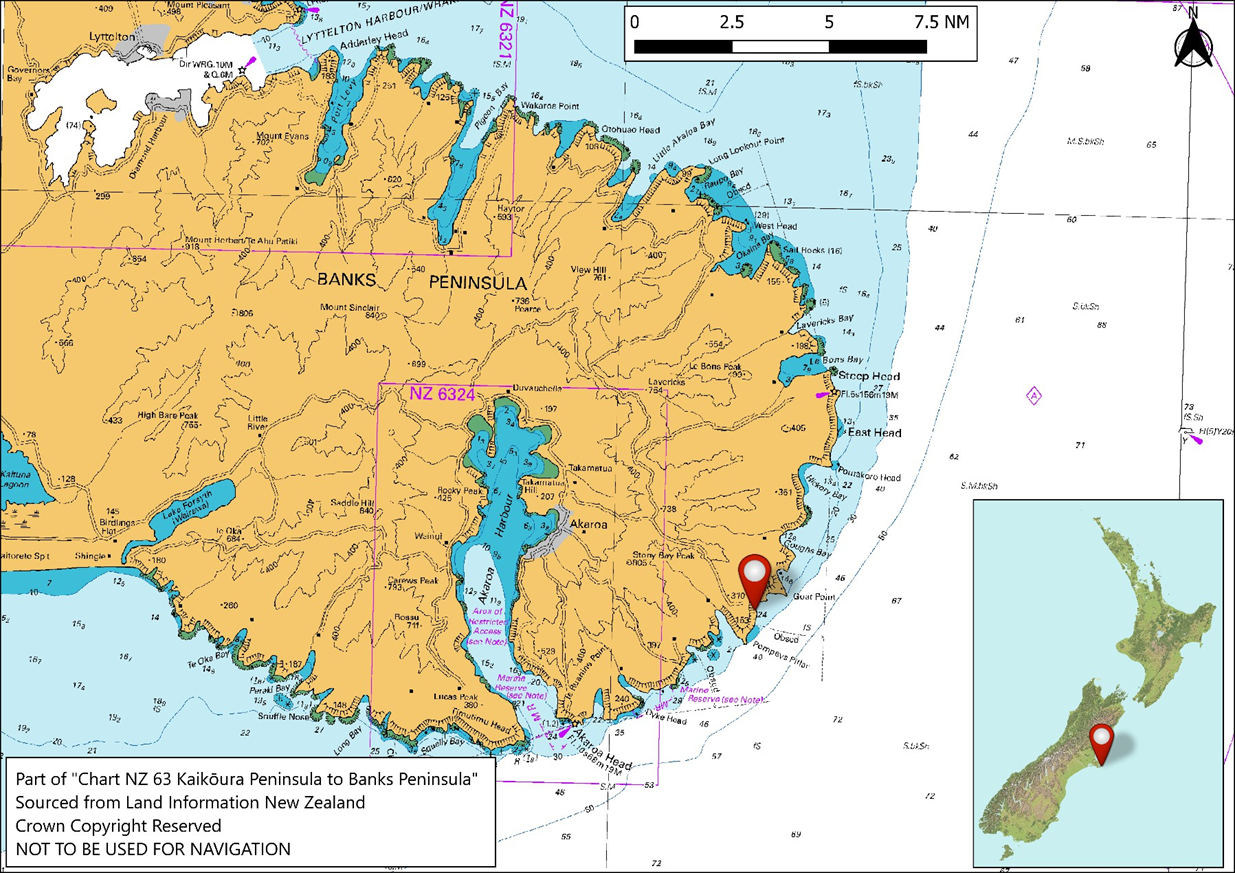
- On 24 September 2023, at about 2137, the Austro Carina stranded while fishing at Red Bay, Banks Peninsula. The vessel suffered extensive damage and was unsalvageable. It was subsequently declared a constructive total loss by the insurer.
- The four crew members abandoned the vessel and were rescued by helicopter and returned to Christchurch.
Why it happened
- Watchkeeping standards and practices on the Austro Carina did not ensure safe navigation while the crew were fishing. The master left the wheelhouse for periods of 5–10 minutes to help the crew with fishing activities. The master believed this to be permitted under the standing orders, and it was apparently normal practice. The master did not activate any of the navigation aids. Had the wheelhouse been continuously manned it is virtually certain that the vessel’s course and speed would have been monitored, and adjustments made to avoid the stranding.
What we can learn
- Strandings can be avoided by implementing good watchkeeping standards, including adhering to the basic principle of keeping a navigational watch on board fishing vessels.
- Effective communication and crew resource management, where all team members are alert to what is happening and are prepared to speak up, are essential for operating fishing vessels safely.
Who may benefit
- All seafarers, fishing vessel owners and operators, fishing vessel insurers and maritime training schools may benefit from the findings of this inquiry.
Factual information Pārongo pono
Narrative
- On Saturday 23 September 2023, the commercial fishing vessel Austro Carina was moored at a wharf in the Port of Lyttelton. The master had organised the crew of two deckhands and a mate for a day fishing trip and had scheduled to meet them at the vessel, at 0200 NZST (New Zealand Standard Time, which is Coordinated Universal Time (UTC) + 12 hours) on Sunday 24 September 2023.
- On 24 September 2023, the two deckhands arrived at port at 0144 NZST and started loading the vessel with provisions for the day trip. The mate arrived a few minutes later.
- At 0200 NZST, New Zealand adjusted clocks forward by one hour for daylight saving.
- The master arrived at the vessel at approximately 0307 NZDT (New Zealand daylight time, which is Coordinated Universal Time (UTC) + 13 hours) and started their predeparture checks while the deckhands and the mate loaded ice into the vessel’s fish holds, which took about 45 minutes.
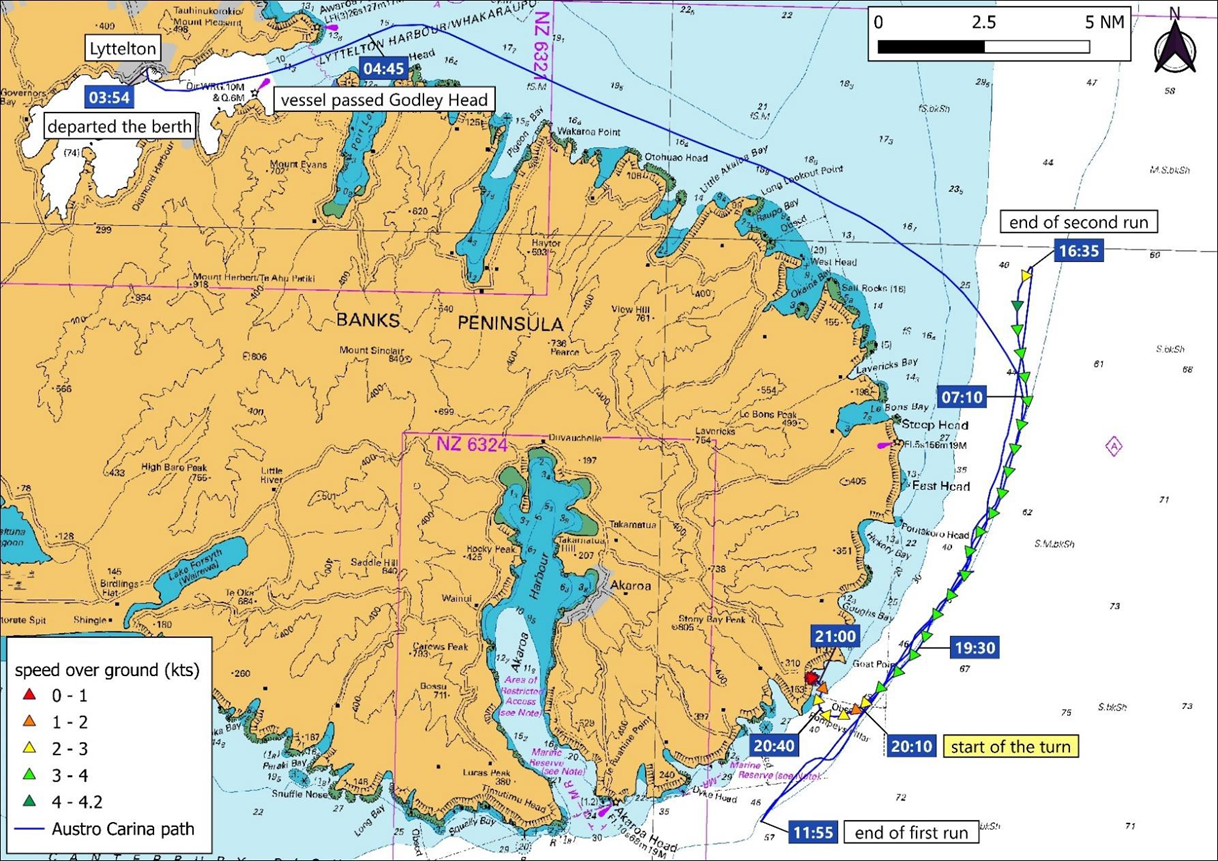
- At approximately 0354 the vessel departed the berth, with the master at the helm.
- At approximately 0445 the vessel passed Godley Head and was clear of the harbour entrance (see Figure 3). The master handed over the navigational watch and control of the vessel to a deckhand. The master switched on the watchkeeping alarm and went to bed.
- The supervision of the navigational watch was shared between the two deckhands until they reached the fishing grounds about 3.5 nautical miles (NM) east of Banks Peninsula.
- At approximately 0710, the Austro Carina arrived at its intended fishing grounds. The deckhand on navigational watch called the master to the wheelhouse. The master took over watchkeeping duties and control of the vessel and turned off the watchkeeping alarm. The deckhand joined the other crew on deck and prepared the net for deployment.
- At about 0715, the crew deployed the net and began fishing along the 50 m isobath. While the net was being towed, the master was in the wheelhouse and maintained the navigational watch and monitored the data received from catch sensors
- Between 0710 and 1635 the Austro Carina completed two trawling runs. Each trawling run involved shooting the net, trawling at a vessel speed of about 3.5 knots (kt), and hauling in the net at a vessel speed of about 1.8 kt.
- The master used the catch sensor data to determine when to haul in the net. After the net was hauled in, the fish trapped in the cod end were emptied onto the deck and sorted by the crew, who then transferred the fish to the freezers. The net was then prepared to shoot again.
- At about 1635, the Austro Carina started the planned third and final run for the day. The vessel was proceeding on a south westerly course at about 3.5 kt. The prevailing weather at that time was a southeasterly wind of approximately 15 kt. There were slight seas with a southeasterly swell (ocean waves not generated by wind in the immediate vicinity) of about 1 metre (m).
- At about 1930, the master called the crew back to the deck to haul in the net. Daylight was starting to fade, so the master turned on the aft-facing deck lights to illuminate the fishing deck and the sea immediately around the vessel. The master remained in the wheelhouse while the crew prepared the deck for hauling in the net.
- At about 2010, the master reduced the vessel’s speed to 2 kt and the crew started retrieving the net.
- On this run the catch sensors had indicated a small quantity of fish in the cod end of the net. However, as the net was hauled in the crew discovered a bigger catch trapped in the middle section of the net. Spiny dogfish had blocked the movement of fish towards the cod end.
- A few minutes later, the master left the wheelhouse to help the crew on deck to remove the spiny dogfish from the net. While on deck, the master also made repairs to the net.
- At about 2020 the crew lowered the net into the water and resumed towing it close to the stern of the vessel to move the fish into the cod end.
- At about 2024, the master returned to the wheelhouse and increased the vessel’s speed to about 3.5 kt to expedite the fish-herding process. Simultaneously, they started a slow turn to starboard to create an arc that was sufficient to make it easier to haul the nets into the rear of the vessel.
- The crew then hauled in the cod end and emptied the fish on to the deck. Because of the size of the catch, they had to tow the net a second time and repeat the process.
- Between about 2024 and 2040, while the net was being hauled in and the fish sorted, the master moved back and forth between the wheelhouse and the deck. They estimate they spent 5–10 minutes at a time on the deck.
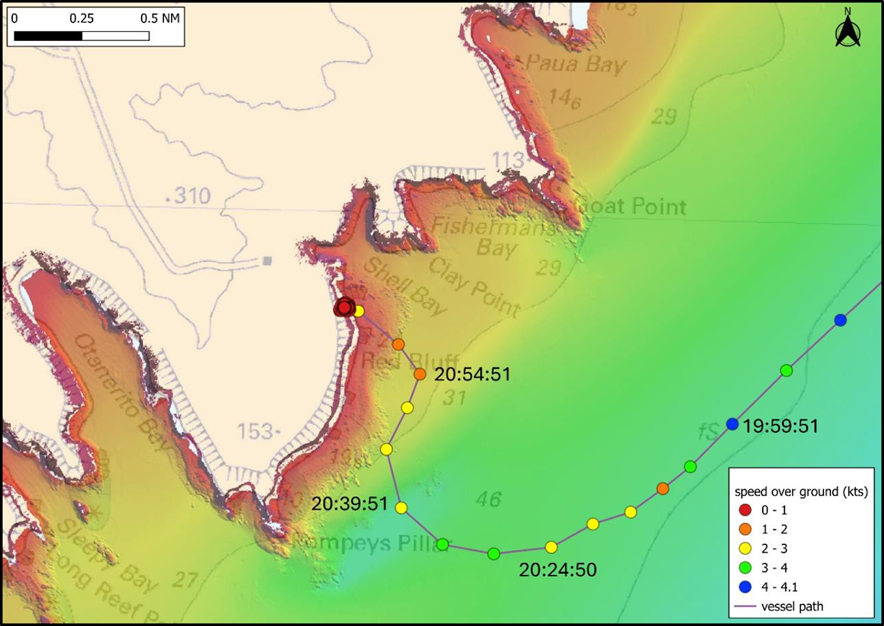
- At about 2040, the Austro Carina was about 0.35 NM from land (see Figure 4).
- At about 2050, the master was on deck when they felt the vessel shudder. During their interview, the master recalled that when they returned to the wheelhouse, they noticed on the engine monitor that the engines were under more load than usual. From the wheelhouse they observed the net laden with fish hanging over the stern of the vessel, and that a synthetic rope (also referred to as synthetic line or fancy line) from the aft deck had washed overboard and looked like it was being pulled underwater. The master returned to the deck, retrieved a knife and cut the synthetic rope, which disappeared under the vessel.
- During their interview, the master stated that after the rope was cut, they felt the vessel make two small shudders followed by a large shudder. The master suspected that the rope might have entangled in the propeller and broken the long shaft. The master checked the freezer room and the engine room but found no damage. During this time the prevailing swell was pushing the vessel towards land.
- At about 2054, the Austro Carina made a sharp uncontrolled turn to port and was about 0.16 NM from land, tracking directly towards shallow waters.
- At about this time, the master went back to the wheelhouse and saw on the electronic chart display that they were off course and close to the shore. The master put the engines to astern, with the fishing net hanging over the stern but there was no response. During interview, the master stated that they felt the vessel shudder again, and they suspected that the net had also been sucked into the propeller, and that the shuddering was probably because of the keel touching the seabed.
- At about the same time, waves started breaking over the aft deck and the master and the crew donned their lifejackets.
- During their interview, the master stated that they returned to the rear deck of the vessel and retrieved the net using the net roller. The net was damaged and had no fish.
- The master made another attempt to go astern at full power, but the vessel continued drifting towards the shore and touching the seabed more frequently. Soon after the main engine shut down.
- The master used the VHF radio to make several Mayday calls but when they did not receive any reply, they activated the vessel’s EPIRB.
- At approximately 2137, Rescue Coordination Centre New Zealand (RCCNZ) received the EPIRB distress message, which included a GPS position of the distress. They immediately started verifying the distress and scope of the rescue.
- At 2149, RCCNZ tasked a Christchurch-based helicopter to deploy to the site.
- By this time, the vessel was only a few metres from the shore. The crew launched a life raft and secured it to the side of the vessel using the painter. One crew member swam ashore with a rope attached to the life raft. Using the life raft, the painter and the rope, the remaining crew and the master made their way safely to shore.
- At about 2231, the helicopter departed from its base towards the distress location.
- At about the same time as the helicopter was approaching the eastern rise of Banks Peninsula, the master of the Austro Carina activated two rocket parachute flares to attract attention. These were spotted by the helicopter crew.
- At 2255 the helicopter pilot advised RCCNZ that they had located the Austro Carina, which had run aground, and that four crew members were visible ashore at Red Bay.
- By 0011 on 25 September 2023, the crew were transferred by helicopter from the shore to farmland above the shoreline. Later, the helicopter returned to Christchurch with the four crew.
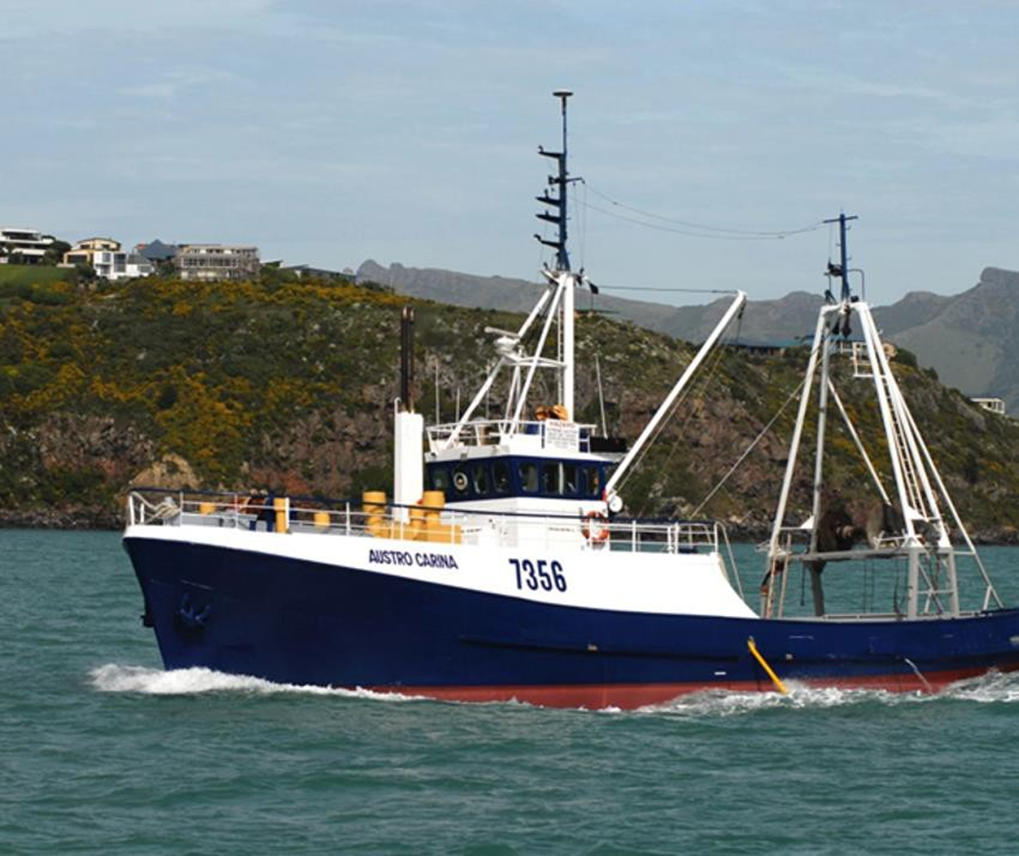
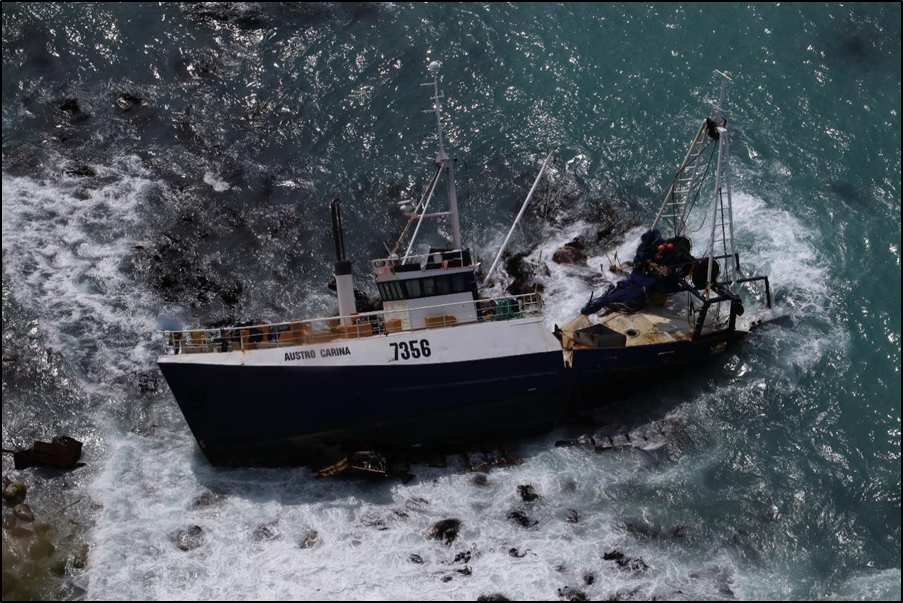
- The stranded Austro Carina (see Figure 5) was assessed as constructive total loss by the insurers.
- The insurers worked closely with Environment Canterbury to clean up the beach and limit any impact on marine life and the environment.
- On 12 October 2023, TAIC investigators examined the vessel’s GPS chart plotter and computers. The chart-plotting equipment could not be powered up or checked by investigators because of water damage.
- The insurers engaged a salvage company to remove the wreck from Red Bay; because of unfavourable weather conditions this task was not started until January 2024 and was completed in February 2024.
- During interview, the master stated that they believed that a rope became entangled around the propeller. The Police dive squad made a video recording from an underwater survey of the vessel and its surroundings before the salvage operations to remove the wreck started. From the video, the Commission was unable to determine if there were any fragments of rope or fishing net entangled around the propeller. After the vessel was salvaged, TAIC investigators inspected the propeller. There was no indication of a rope or net around the propeller, shaft or wedged between the kort nozzle (see Figure 6) and propeller. The Commission was unable to determine whether a rope may have become entangled around the propeller.
Vessel information
- The Austro Carina was built in 1977 as a 24-m steel-hulled fishing trawler. It was lengthened (to accommodate additional fish holds) to 25.6 m by Lyttelton Engineering in 1983. It was operated by Pegasus Fishing Limited (the company).
- The Austro Carina had a forward engine room and was propelled by a 400-horsepower (hp) diesel engine, coupled to a long shaft and a four-blade propeller. The propeller was fitted within a kort nozzle. The engine was connected to a computer, located in the wheelhouse, that displayed a digital reading of the load on the engine.
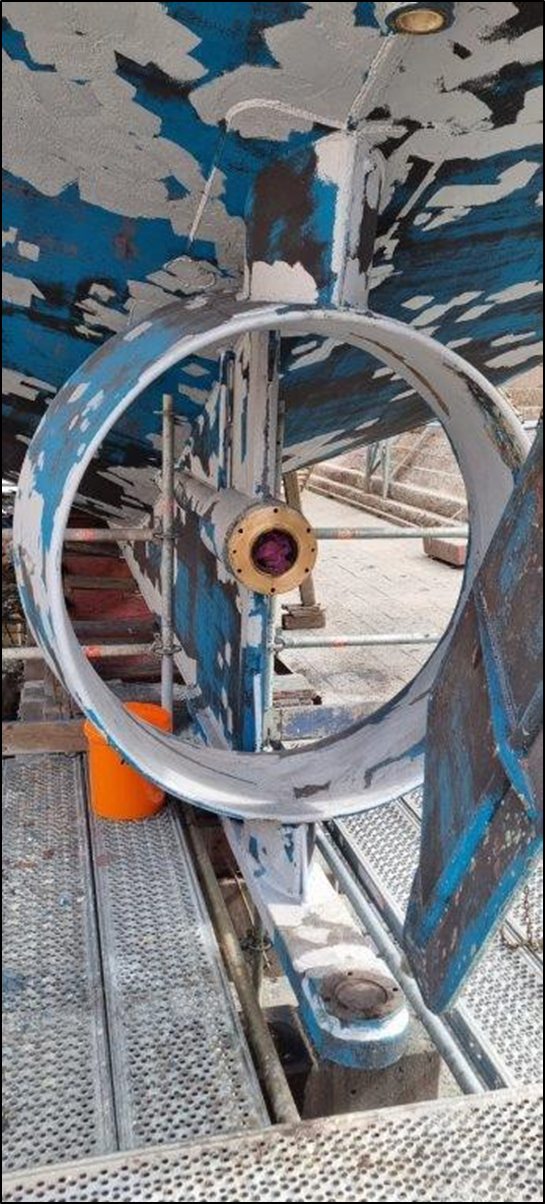
- The vessel's steering system comprised a hydraulic ram and tiller system connected to a steel rudder.
- The vessel’s electronic navigation equipment included a GPS chart plotter, a radar, depth sounder and speed log. The vessel also had back-up paper navigation charts and chart-plotting equipment.
- The Austro Carina was fitted with a Furuno NavNet navigation system. The system integrated navigational equipment such as radar, GPS, echo sounder, heading sensor and chart display.
- The radar had two safety features: a guard zone and a grounding alarm feature. This meant that the operator could designate a guard zone and when any targets, such as ships, islands, landmasses or other navigation hazards, violated the guard zone, an audio alarm sounded. The grounding alarm allowed the operator to define a safe shallow depth, and the system continuously scanned the electronic chart data in front of the vessel to detect charted dangers.
- The company had implemented two previous recommendations made by the Commission regarding watchkeeping alarms (Transport Accident Investigation Commission. (2002). Maritime Inquiry MO-2001-212: Fishing vessel "Hans", sinking, Tory Channel, 19 August 2001, Recommendation 010/02; Transport Accident Investigation Commission. (2004). Maritime Inquiry MO-2004-205: Fishing vessel "Bronny G", grounding, Steep Head, Banks Peninsula, 26 March 2004, Recommendation 041/04) and had fitted the Austro Carina with a watchkeeping alarm system.
- Watchkeeping alarm systems are automated systems designed to monitor the alertness of watchkeepers, while the vessel is underway. A series of indications and alarms, which activate at preset intervals in the wheelhouse, require the watchkeeper to acknowledge and silence the alarm. If an alarm is not acknowledged promptly, the system alerts another watchkeeper or the master, indicating that urgent attention is required in the wheelhouse. The system helps to manage the safety of the ship in the event of the watchkeeper being incapacitated by a medical condition, falling asleep or being distracted by other non-watchkeeping activities such as fishing.
- The watchkeeping alarm on the Austro Carina was set up to automatically activate audio and visual alarms in the wheelhouse every 13 minutes that required the watchkeeper to intervene and reset the alarm. If the alarm was not reset within 1 minute, another louder alarm would sound. The alarm could be heard from the back deck.
- In November 2022, the Austro Carina was surveyed while it was laid up at Lyttelton. The surveyor determined that the vessel complied with the provisions of Maritime New Zealand’s (MNZ’s) Maritime Rules and Marine Protection Rules for a fishing vessel of its size and operating limits, and a Certificate of Survey was issued.
- An MNZ Maritime Officer conducted a Maritime Operator Safety System (MOSS) audit in May 2023 and verified that the vessel and the company complied with their Maritime Transport Operator Plan (MTOP).
Personnel information
- The master of the Austro Carina held a current New Zealand Offshore Watchkeeper (NZOW) Certificate, last assessed in December 2022 and valid for 5 years. They were also the qualified engineer on the vessel. The master had been with the company for about 20 years, primarily as an engineer ashore but also occasionally on the vessels as a mate-engineer or a master. As a mate-engineer their responsibilities included maintaining the engines and equipment and, while fishing, operating deck machinery and overseeing fishing activities on deck.
- Before accepting the role of permanent master, they spent about a year on the Austro Carina as a mate-engineer. At the time of the accident, they had been the permanent master for about three months.
- One of the two deckhands had 15 years’ experience working on fishing vessels and had worked with the company for about 9 years. They had an Advanced Deckhand – Fishing (ADH-F) certificate, issued by MNZ in February 2021.
- The other deckhand had 20 years’ experience working on fishing vessels. They had worked with the company for about 10 years. They had been trained as a watchkeeper overseas but did not have a New Zealand-issued certificate. They had attended a watchkeeping refresher course organised by the company in April 2023. The course was conducted by Westport Deep Sea Fishing School and was modelled around MNZ’s competency framework for ADH-F.
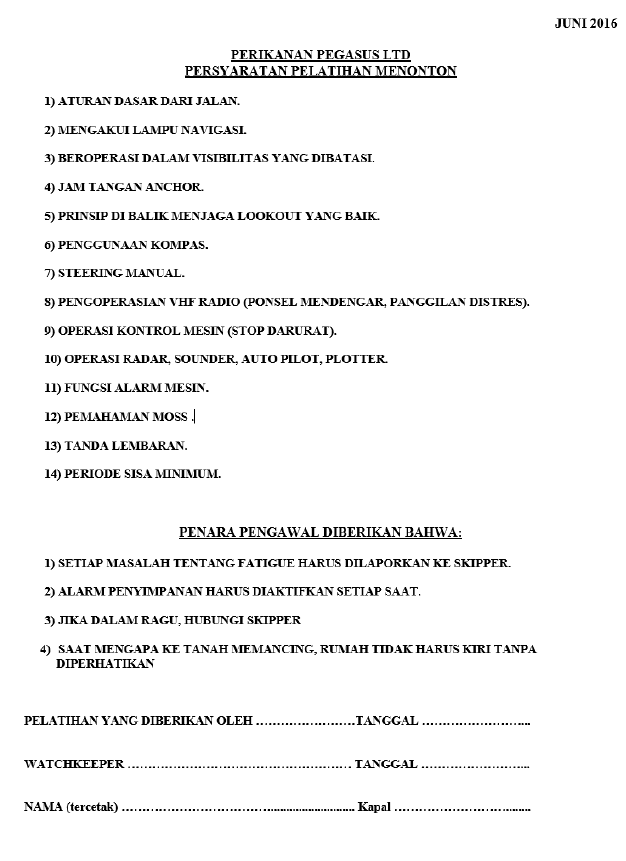
- The primary language of the two deckhands was Indonesian. English, which was the working language of the vessel, was their second language. The company provided relevant documents and the standing orders in both English and Indonesian. Additionally, when there were substantive work meetings, the company ensured that an Indonesian interpreter was available. There was no evidence to indicate that language was a factor leading to this accident.
- The mate was an extra crew member on board, exceeding the minimum safe-manning crewing requirements for the vessel. They had been with the company for 3 months and had about 10 months of fishing experience over 12 years. This was the second fishing vessel they had worked on. In this entry-level role, they had no formal training and did not hold a certificate of competency as none was required.
Previous occurrences
- Since 1998, the Commission has investigated and published 10 reports (MO-1998-209: Fishing trawler "San Rakaia", grounding; MO-1998-214: Fishing trawler "Dong Won 529", grounding; MO-2000-209: Fishing charter vessel "La Nina", grounding and foundering; MO-2001-212: Fishing vessel "Hans", sinking; MO-2004-205: Fishing vessel "Bronny G", grounding; MO-2004-207: Fishing vessel "Poseidon", grounding; MO-2004-209: Fishing vessel "Joanne" and motor tanker "Hellas Constellation", collision; MO-2006-203: Fishing vessel "Venture," grounding; MO-2020-201: Collision between bulk carrier Rose Harmony and fishing vessel Leila Jo; MO-2021-203: Collision between fishing vessel ‘Commission’ and container ship ‘Kota Lembah’) of serious incidents that involved fishing vessels. The safety themes described in these reports were:
- poor watchkeeping standards, including preoccupation with non-watchkeeping duties
- inadequate crew resource management leading to fatigue
- lack of a watchkeeper monitor alarm for single-handed bridge operation
- the operator, skipper and crew not implementing Maritime Rule Part 31: Crewing and Watchkeeping, Subpart C – Fishing Vessels
- The overarching themes of the recommendations from those reports were to:
- implement watchkeeping standards as required by Maritime Rule Part 31, including training to enhance watchkeeping skills, ensuring compliance with the rule
- update the safety management system manual to minimise the risk of accidents and incidents caused by poor watchkeeping and fatigue
- implement procedures to ensure that watchkeeping alarms, independent of all other equipment, are fitted and used in the wheelhouse whenever a navigational watch is undertaken
- train all crew members in crew resource management to improve teamwork, awareness, and response to dangers
- review auditing procedures to ensure they reflect real practices and confirm that documented procedures are being followed.
Analysis Tātaritanga
Introduction
- The following section analyses the circumstances surrounding the event to identify those factors that increased the likelihood of the event occurring or increased the severity of its outcome. It also examines any safety issues that have the potential to adversely affect future operations.
- The Austro Carina with four crew on board, was on a commercial day fishing trip 3.5 NM east of Banks Peninsula, along the 50 m isobath.
- The vessel was compliant with all the relevant maritime requirements for the type of vessel, the location and the operation. During the day no mechanical issues were reported and all navigational and electronic equipment functioned as designed.
- During interview, the master stated that they believed that the entangled rope had caused the vessel to turn to port. The Commission analysed all available evidence, including:
- shallow water effect
- mechanical failure
- rope entanglement
- net entanglement
- sea conditions
but were unable to find a definitive cause of the turn to port by the vessel.
- However, the Commission was able to determine the cause of the stranding, being inadequate watchkeeping procedures on board the vessel in the immediate lead up to the accident. The Austro Carina wheelhouse was unmanned while the vessel executed a slow turn to starboard in fading daylight. The vessel’s radar was not used to its full potential and the watchkeeping alarm had been turned off.
Maintaining a safe navigational watch
Safety issue 1: Chapter IV of the Annex to STCW-F addresses collision, stranding and safe navigation. However, MNZ’s seafarer competency framework and the vessel operator’s safety management system primarily focus on collision avoidance and inadequately address stranding and safe navigation. This increases the risk of watchkeepers on fishing vessels not always maintaining a safe navigational watch when fishing.
- The drivers behind the current lookout and watchkeeping practices within the fishing industry are multifaceted and complex. They include economic constraints (particularly for smaller operators), and interactions with other drivers of harm such as fatigue, historical practices and attitudes to compliance. The following section outlines the factors that the Commission identified as having contributed to this accident.
- New Zealand ratified to the International Convention on Standards of Training,Certification and Watchkeeping for Fishing Vessel Personnel (STCW-F) in 1995.
- The STCW-F outlines the requirements for certification and minimum training and the watchkeeping standards for fishing vessel personnel. The aim was to promote the safety of life at sea and the protection of the marine environment, considering the unique nature of the fishing industry and the working environment.
- The STCW-F was given legal effect in New Zealand through the Maritime Rules, specifically Maritime Rules Part 31, which addresses crewing and watchkeeping.
-
Maritime Rules Part 31.85(1) states that:
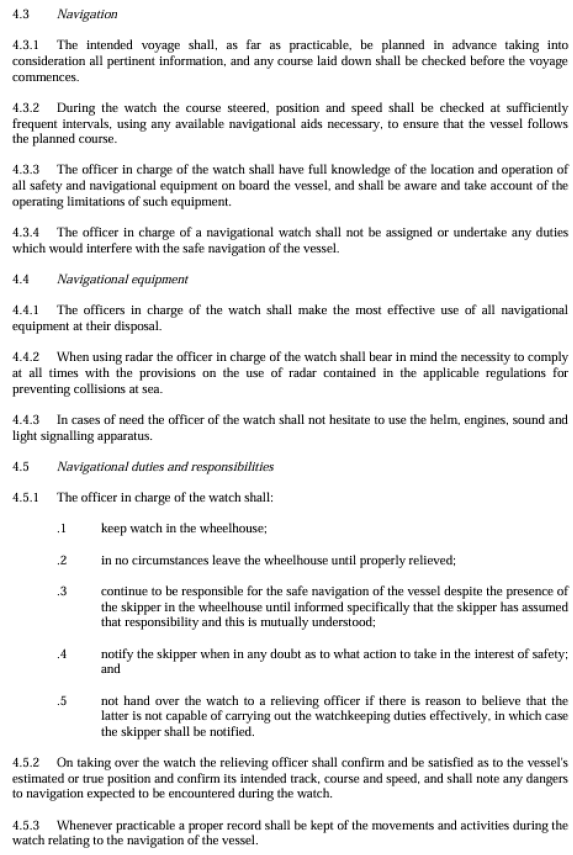
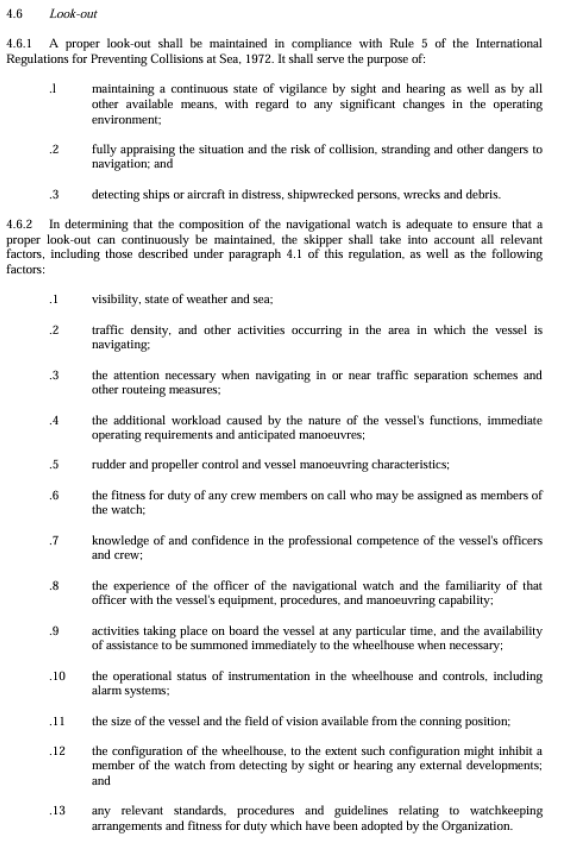
The master of a fishing vessel to which this subpart applies must ensure that any navigational watchkeeping arrangements are adequate to maintain a safe watch taking into account the basic principles set out in Chapter IV of the Annex to STCW-F.
-
Maritime Rules Part 31.85(2) states that:
In performing duties relevant to a navigational watch on a fishing vessel to which this subpart applies, the owner and master of the ship and any person engaged in watchkeeping duties on the ship must take account of the standards for watchkeeping set out in Chapter IV of the Annex to STCW-F.
-
Maritime Rules Part 31.85(5) states that:
Any person who under subrules (1) to (4) is required to take into account principles or standards in STCW-F or the Document for Guidance on Training and Certification of Fishing Personnel may take those principles or standards into account with any necessary modifications that are required because of the type of fishing vessel and operation.
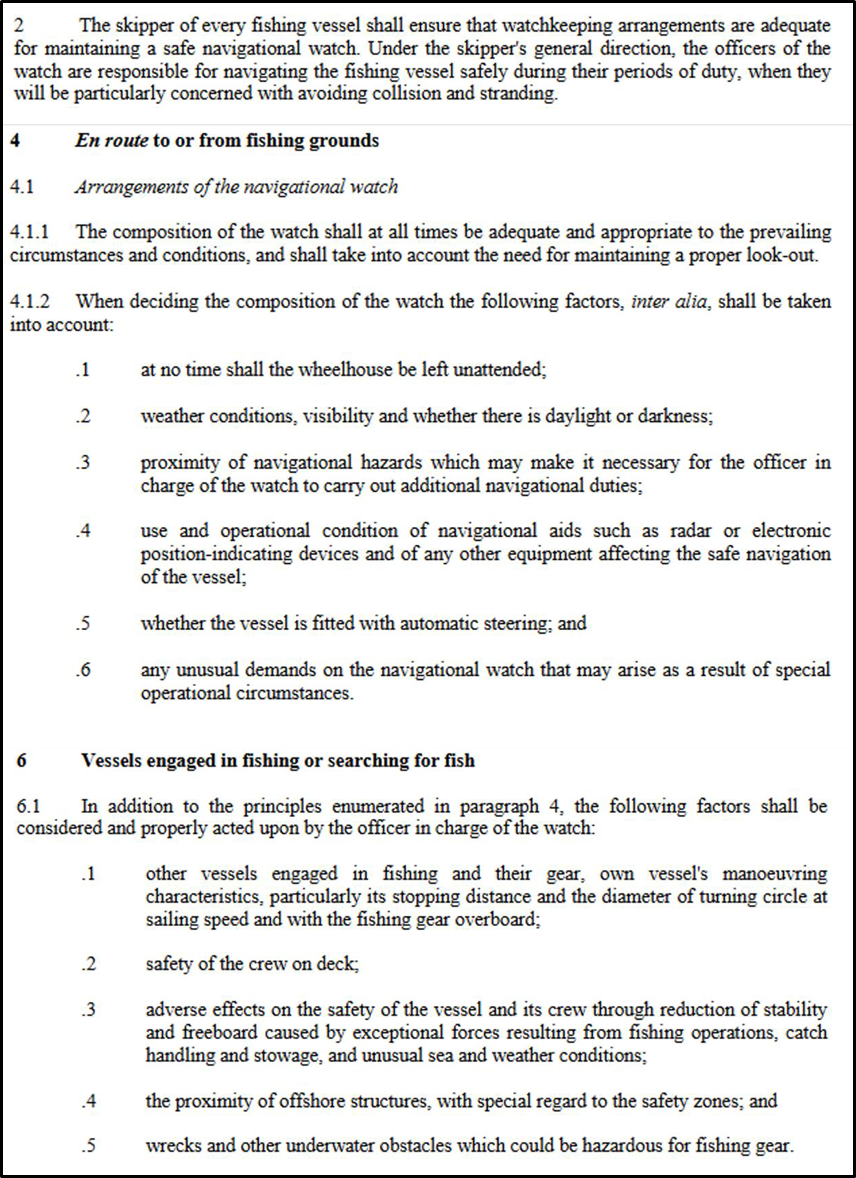
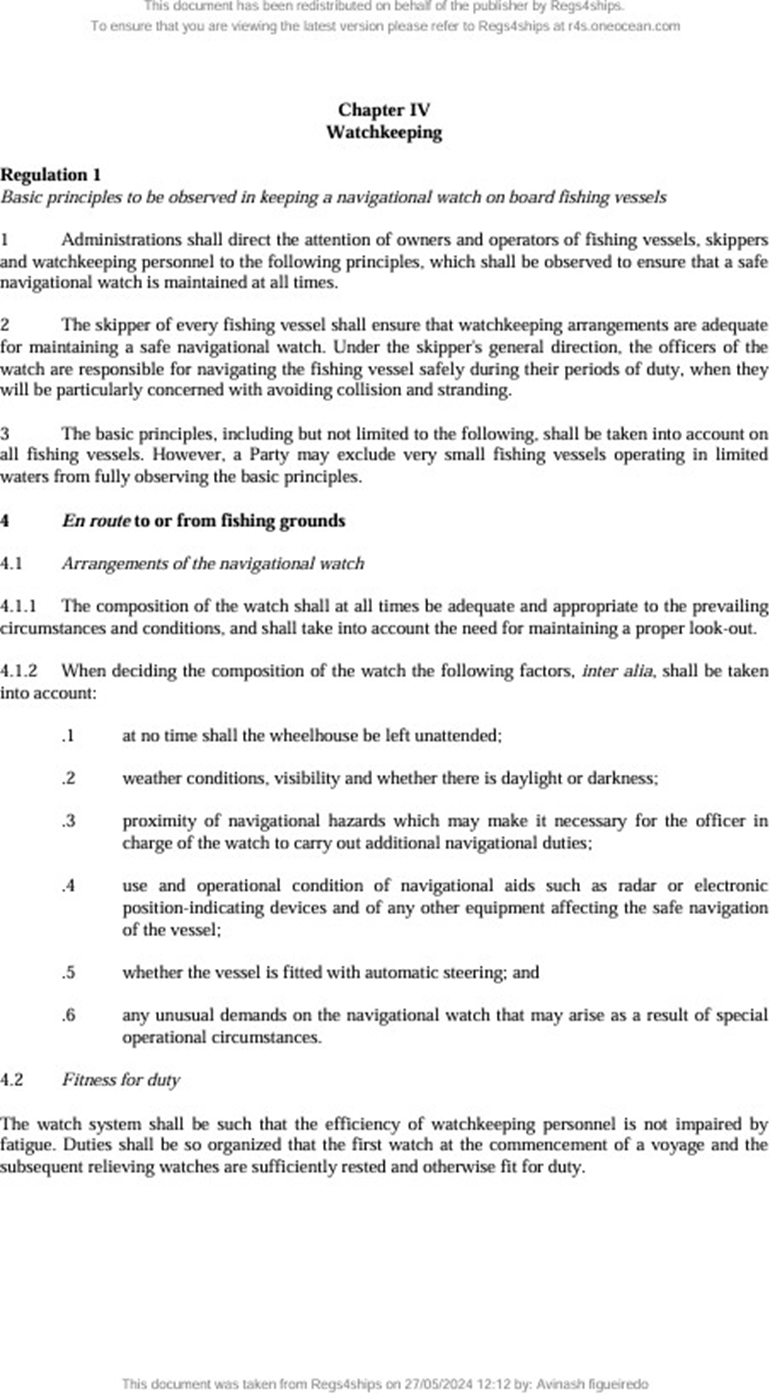
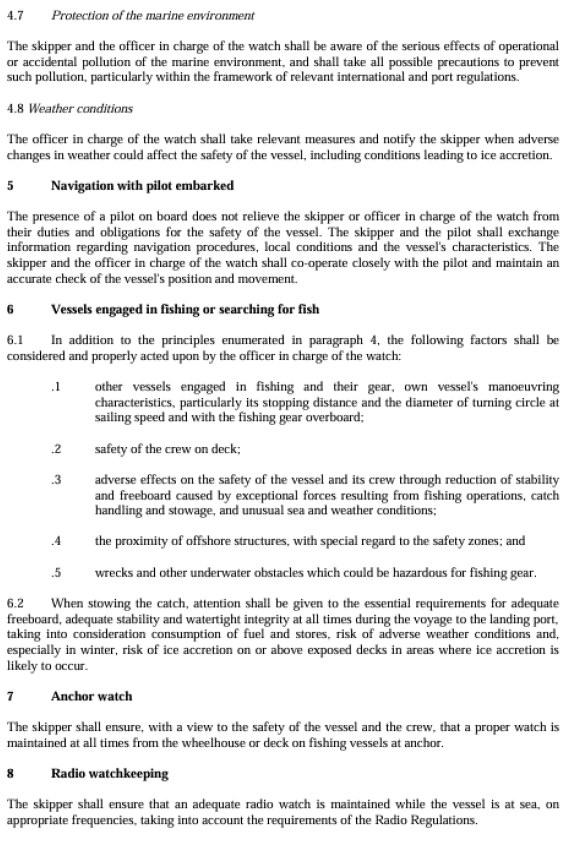
- Chapter IV of the Annex to STCW-F (Chapter IV) sets out the basic principles to be observed in keeping a navigational watch on board fishing vessels (see Figure 7). For the complete Chapter IV see Appendix 1.
Maritime New Zealand watchkeeping guidelines
- Maritime New Zealand published guidance documents giving advice about good watchkeeping practices, how to manage risks to safety, and legal obligations. The following guidance documents covered the duties of owners, operators and workers conducting fishing operations in New Zealand:
- Watchkeeping – Guidelines for fishing vessel owners and operators (April 2023)
- Keeping a watch – Guidance for crew on fishing vessels (April 2023)
- Maritime New Zealand have carried out a significant review in regard to watchkeeping and in April 2024 published revised guidelines Watchkeeping – Guidelines for fishing vessel owners and operators.
- These documents provided guidance to owners, operators and watchkeepers of fishing vessels regarding watchkeeping. The documents were specific about their obligations under the Health and Safety at Work Act 2015 (HSWA) and Maritime Rules Part 22.5 and Part 31, which include the basic principles to be observed in keeping a navigational watch on board fishing vessels as set out in Chapter IV.
Maritime New Zealand competency frameworks for STCW-F-aligned certificates
- Maritime New Zealand’s education and training framework was developed to ensure that seafarers who successfully completed their training in New Zealand have the competencies, skills and experience required to meet New Zealand education standards and maritime rules and are aligned with international conventions.
- Maritime New Zealand has set competencies that must be achieved for each of the certificates. New Zealand’s maritime training schools develop training courses based on these competencies, and the training courses are approved by the New Zealand Qualifications Authority.
- The Austro Carina master’s ring-fenced NZOW certificate (a regulatory framework that permits mariners with legacy certifications to retain their credentials, thereby avoiding the expense of transitioning to a new qualification, these certificates are not STCW aligned) was assessed by Maritime New Zealand to have met the requirements for a Skipper Fishing Vessel – Limited (SFV – Limited) certificate as per Figure 8.
- The holder of a SFV – Limited certificate is expected to be able to perform the functions and duties of master on a fishing vessel of less than 45 m overall length operating in inshore fishing limits and in limited waters.
- The holder of an Advanced Deckhand – Fishing (ADH-F) certificate is expected to be able to perform the functions and duties of deckhand on fishing vessels of any length and in any operating area.
- While Maritime New Zealand’s competency framework for Skipper Fishing Vessel – Unlimited explicitly requires that the applicant demonstrates knowledge of the content of the basic principles to be observed in keeping a navigational watch on board a fishing vessel, as prescribed in Chapter IV, the competency framework applying to SFV – Limited and ADH-F certificates when they were issued did not (see Figure 8).
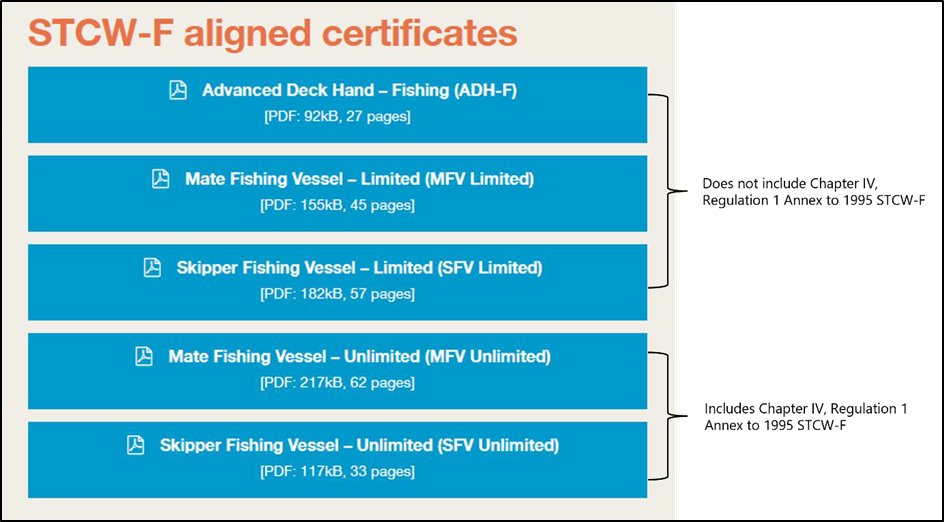
- The likelihood of watchkeeping errors on board fishing vessels could be reduced if the basic principles to be observed in keeping a navigational watch as outlined in Chapter IV were included in the competency framework for all certificates.
- The Commission found that more can be done to inform seafarers of the benefits of good watchkeeping and have made a recommendation to MNZ to review its competency frameworks for STCW-F-aligned certificates to ensure that they include the basic principles as outlined in Chapter IV.
The company’s safety management system
- The MNZ Maritime Operator Safety System (MOSS) was introduced on 1 July 2014 as a new regulatory system for maritime safety. The MOSS system was intended to improve safety and protection of the marine environment associated with domestic commercial vessels in New Zealand.
- Under MOSS, an operator is required (by Maritime Rule 19.41) to develop and prepare a Maritime Transport Operator Plan (MTOP) for each vessel they operate. The MTOP details the specific risks associated with the vessel’s intended operation, and a safety system of procedures and controls to mitigate the risks.
- The MTOP is assessed by MNZ to ensure it contains the required components, such as risk management, training and maintenance. To ensure it is appropriate, MNZ conducts a site visit, during which the operator demonstrates various aspects of the MTOP.
- Under Maritime Rule 19.22, the Director of Maritime New Zealand must grant a
- Maritime Transport Operator Certificate (MTOC) if satisfied that the operator’s MTOP has met all the requirements as specified in Maritime Rule Part 19 and section 41 of the Maritime Transport Act 1994. An MTOC is valid for 10 years.
- It was the operator’s responsibility to ensure that the MTOP was a living document, by assessing risks and addressing them as they arose. Maritime New Zealand conducts periodic MOSS audits to verify how the operator is performing against their MTOP.
- In December 2022, the company engaged an auditor to go to sea on Austro Carina for a week and review the operation of the vessel regarding safe operation, health and safety, and any potential risks. The auditor reported back to the company, which made minor changes as a result of this review but, overall, the auditor did not report there were any significant issues.
- In March 2023, the company contracted an external provider to conduct a MOSS assessment of their policies and procedures and make recommendations based on Maritime Transport Act 1994 and HSWA 2015 requirements. The assessment was aimed to audit the company against their operator plan under the MTOC. The assessment concluded:
- Pegasus Fishing are being proactive by requesting an independent assessment and are taking the safety of their operations seriously. As with all systems they must be monitored and improved on a regular basis, as standards continue to change and remaining current with these changes not only reduces risk but improves compliance and results in a lower risk operation.
- Following the Leila Jo accident (Transport Accident Investigation Commission. (2021). Maritime Inquiry MO-2020-201: Collision between bulk carrier Rose Harmony and fishing vessel Leila Jo, Off Lyttelton, 12 January 2020) the company identified areas for improvement to watchkeeping. They sponsored their deckhands to complete the ADH-F certification course and their masters to complete the Skipper Coastal/Offshore (SCO) certification course. The company also provided funding to develop a one-day introductory and refresher training course relating to watchkeeping, which was open to all crew in the industry. In addition to the training provided, the company installed an intercom so that watchkeepers could remain in the wheelhouse while communicating with other crewmembers.
- The company’s MTOP for the Austro Carina contained guidance regarding safe operating procedures but did not cover all the basic principles to be observed in keeping a navigational watch on board fishing vessels, as described in Chapter IV, specifically while the vessel was engaged in fishing (see Section 6 of Chapter IV).
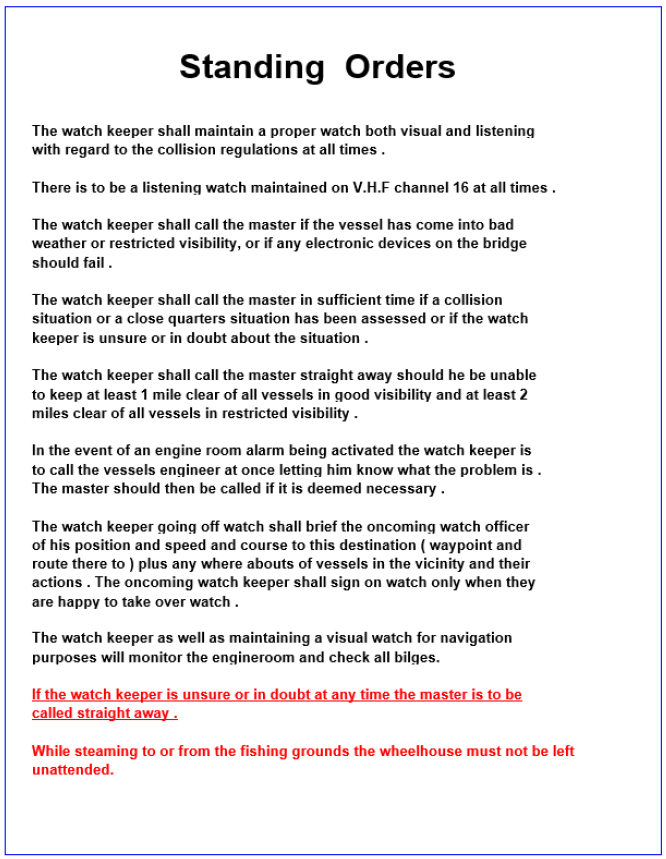
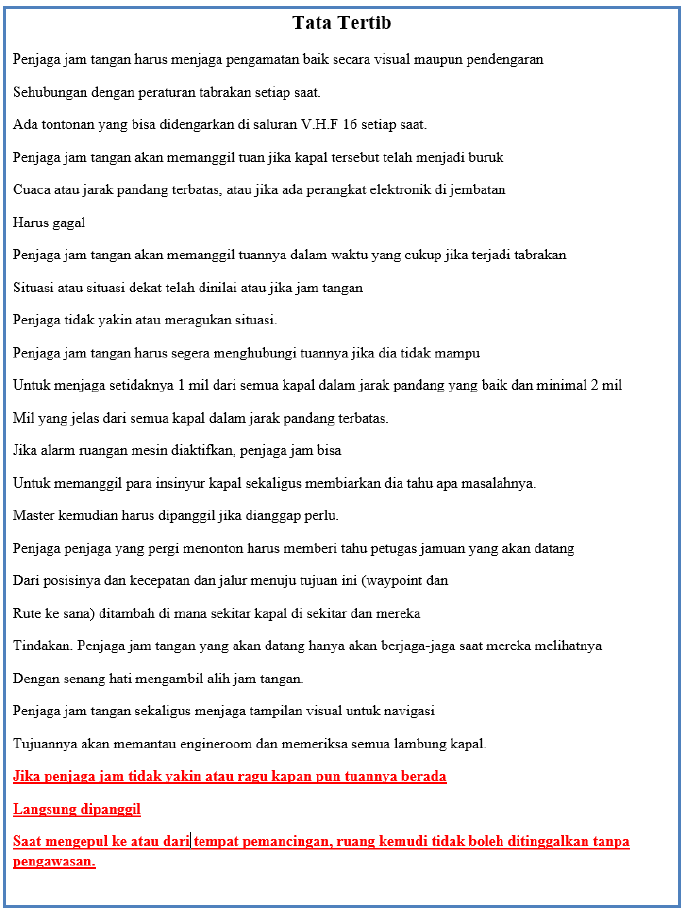
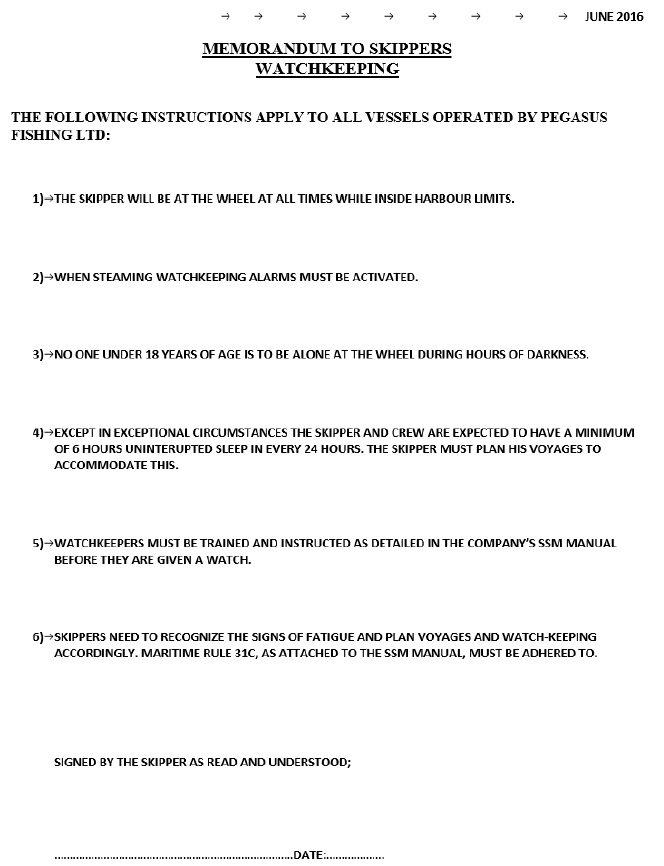
- The MTOP included the company’s standing orders for watchkeeping. The standing orders were printed in two languages, English and Indonesian, and posted in the wheelhouse and formed part of the log book (see Appendix 2). The standing orders required the wheelhouse to be attended while steaming to or from fishing grounds.
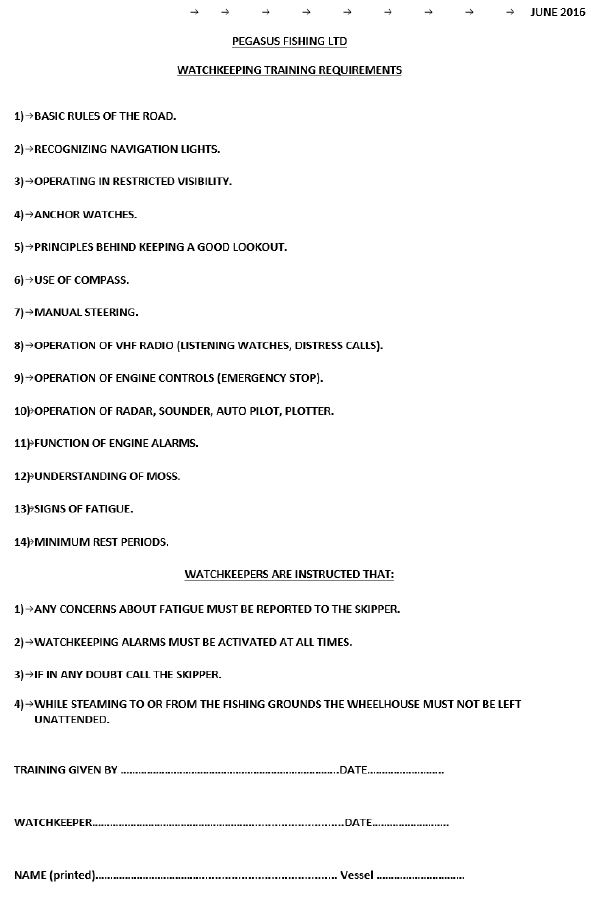
- The included two other documents, the Memorandum To Skippers Watchkeeping form and the Watchkeeping Training Requirements checklist (see Appendix 2).
- The Memorandum To Skippers Watchkeeping form required the wheelhouse to be attended at all times while inside harbour limits and for the watchkeeping alarm to be activated when steaming.
- The Watchkeeping Training Requirements checklist was printed in two languages, English and Indonesian. The checklist was signed off by the master when they were satisfied that a deckhand had demonstrated their ability to keep a navigational watch (see Appendix 2). This checklist required the watchkeeping alarms to be activated at all times.
- The Memorandum To Skippers Watchkeeping form and the Watchkeeping Training Requirements checklist had conflicting information on activation of the watchkeeping alarms.
- The standing orders, Memorandum To Skippers Watchkeeping form and the Watchkeeping Training Requirements checklist, addressed the function of a lookout in relation to the collision avoidance rules, but did not include the basic principles to be observed in keeping a safe navigational watch on fishing vessels. These documents required the wheelhouse to be manned while steaming to and from the fishing grounds but did not include specific requirements or instructions for the wheelhouse to be attended or for the watchkeeping alarms to be turned on while the vessel was engaged in fishing.
- The master had reduced the vessel’s speed to 2 kt and started a slow turn to starboard. The starboard turn took the vessel closer to land. The master then left the wheelhouse unattended and went on deck to assist with the removal of spiny dogfish from the net. This meant that the wheelhouse was left unattended while in close proximity to navigational hazards and no one was performing watchkeeping duties.
- From the interviews with the crew, the Commission found that it was not unusual for the master to step away from watchkeeping duties during fishing activity to help on deck and that was not explicitly prohibited by standing orders. Had the master maintained a continuous navigational watch it is virtually certain that they would have adjusted the vessel’s course and speed to avoid the stranding.
- The company had fitted a watchkeeping alarm and had documented procedures and training requirements. Had the watchkeeping alarm been on, it would have activated after the preset time interval of 13 minutes had elapsed, requiring the master to reset it in the wheelhouse. This would have given the master an opportunity to check the vessel’s position and the progress of the turn and, if required, adjust the course and speed to avoid navigational dangers.
- The vessel was equipped with a radar but the safety features, such as guard zone and grounding alarm, had not been set.
- It is crucial that operators develop a full understanding of the navigational tools available to them and that such tools are used appropriately to reduce risk of collision or grounding. Had safety features been set on the radar, they would have alarmed and alerted the crew that the vessel was approaching shallow waters and was close to land, which may have prompted an adjustment to the vessel’s course and speed thereby avoiding the stranding.
- If the wheelhouse had not been left unattended and without a safe navigational watch and had the navigational tools been used, it is virtually certain that the stranding and eventual total loss of the vessel could have been prevented.
- The Commission has made a recommendation to the company to review its safety management system and watchkeeping procedures to ensure the navigational watchkeeping principles in Chapter IV are observed during all phases of the voyage.
Crew resource management
- Crew resource management (CRM) is the effective use of all available resources to achieve safe and efficient operations. Operational safety and efficiency are improved when management ashore and the team on board the vessel combine resources such as people, equipment and information with non-technical skills such as situational awareness, decision-making, social skills and communication skills.
- The Austro Carina had four crew members on board at the time of the accident. The master was recently promoted to the role and had about three months’ command experience as the primary master. The master was also an experienced engineer and had previously worked on the Austro Carina as a mate-engineer. The two deckhands were experienced fishermen, and both had been trained as watchkeepers. The fourth crew member was a newly appointed mate with limited experience and was on board as a crew member additional to the minimum required safe manning crew of three.
-
The master was newly promoted, and before that promotion the company had taken the following steps to ensure the master was adequately prepared for the role:
(1) assigning the master to a vessel with another skipper
(2) providing the master with opportunities to skipper the vessel under the supervision of the primary skipper
(3) easing the master into the role over time, initially starting off on a relief basis
(4) speaking to the master frequently to check in
(5) crewing the vessel with two highly experienced and qualified deck hands (6) having a vessel with more than the minimum safe manning crew.
- On the final trawl run for the day, the master left the wheelhouse for 5–10 minutes to assist the crew on deck, which was not explicitly prohibited by the standing orders. From the interviews with the crew, the Commission identified that it was not uncommon for the master to step away from the wheelhouse to assist on deck during fishing.
- From the interviews with the crew, the Commission found it was normal practice for the master to set a steady course and reduce speed while hauling nets. On this occasion the master had started a slow turn to starboard, to make it easy to haul the net into the rear of the vessel, before leaving the wheelhouse to assist the crew on deck with the fishing activity. It is about as likely as not that the crew did not have situational awareness of the vessel’s route and therefore did not challenge the master when the master left the wheelhouse to assist on deck.
Appendix 1. Chapter IV of the Annex to STCW-F
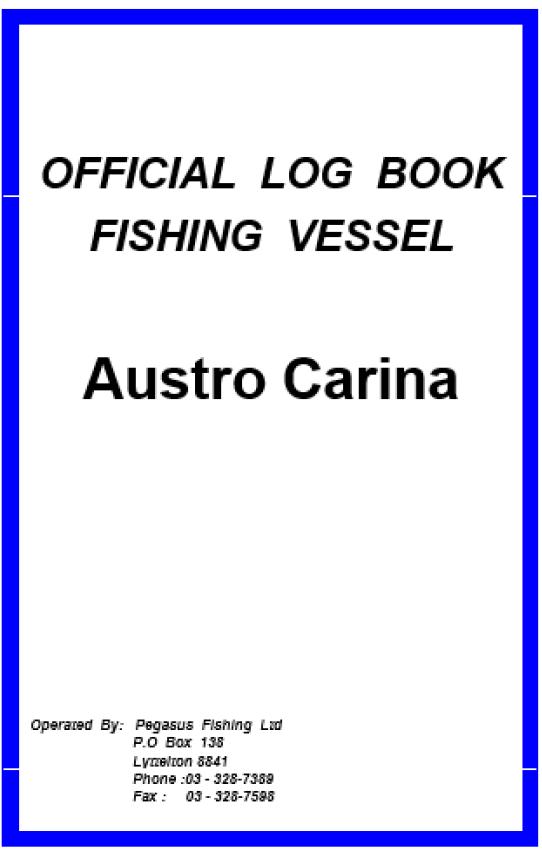
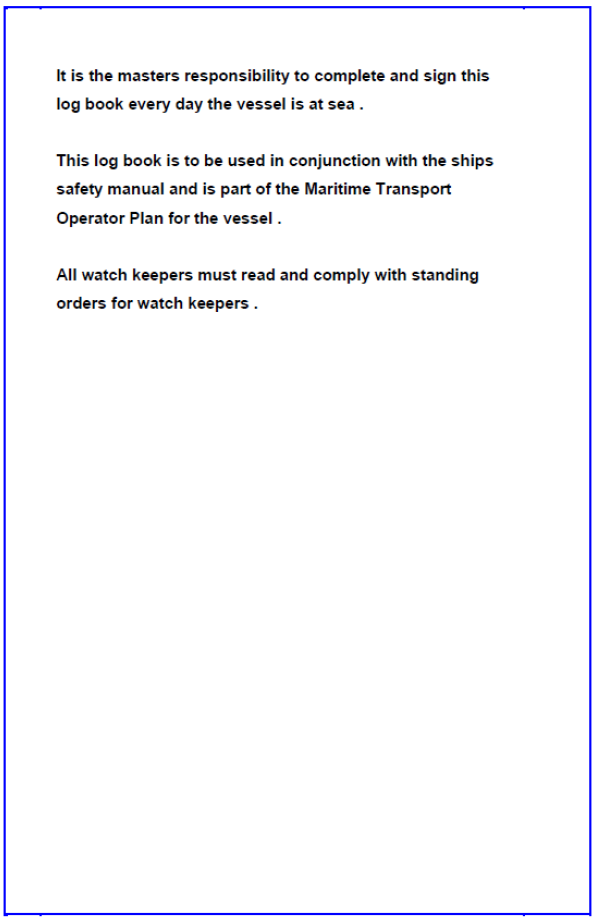
Appendix 2. Extract from Austro Carina’s Official Log Book