
The catamaran Dolphin Seeker was conducting a dolphin-watching tour and ran aground in the Bay of Islands. The Commission found that the skipper was focusing on providing a good tour experience and didn’t notice the vessel moving towards shallow waters. The company’s safety management system did not adequately address the risks associated with the skipper’s role and was subsequently updated to address this safety issue.
Executive summary Tuhinga whakarāpopoto
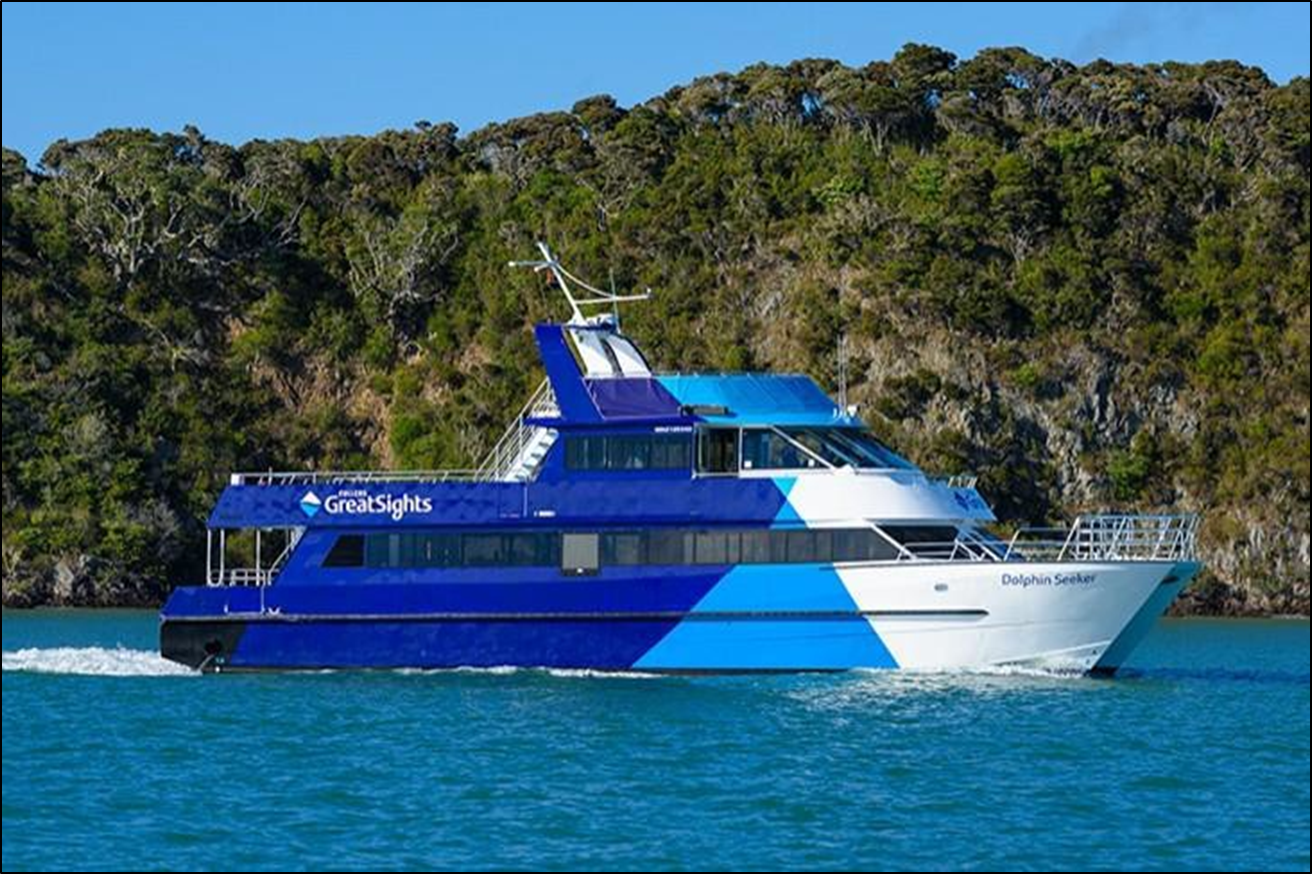
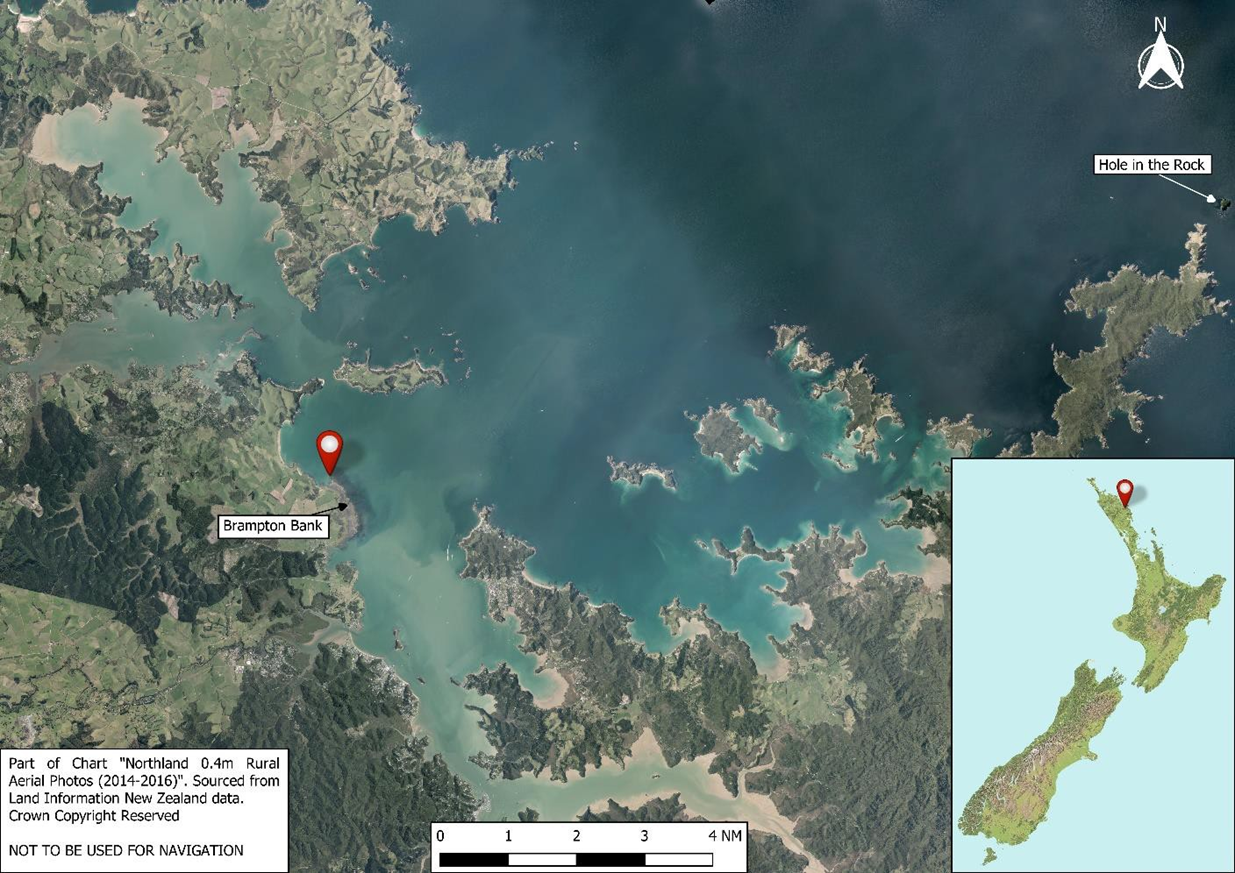
- During the afternoon of 27 October 2018, the restricted-limits passenger catamaran Dolphin Seeker was on its second dolphin-watching tourist trip of the day in the Bay of Islands, with six crew and 47 passengers on board.
- The skipper had located a pod of dolphins near the Brampton Bank area and was manoeuvring the Dolphin Seeker to stay with the pod, at the same time as giving a commentary over the public address system, when the vessel ran aground on rocks at slow speed.
- Nobody was injured, but the vessel sustained significant damage to both propellers and minor damage to its hull. The passengers were transferred to another company vessel. The Dolphin Seeker was re-floated on the rising tide and towed back to its berth.
- The Transport Accident Investigation Commission (Commission) found that the grounding occurred because the skipper did not notice that the vessel had moved into shallow waters while focusing on giving a passenger commentary at the same time as manoeuvring the vessel to maintain proximity to the pod of dolphins.
- The Commission also found that the skipper was effectively working alone in a high-risk situation. There were few or no defences in place to prevent the one-person errors that resulted in the grounding, such as fully utilising the features of the vessel’s electronic navigation equipment.
- The Commission identified a safety issue that the operator’s safety management system did not fully address the risk of vessel groundings and collisions where its skippers were in effect working alone in the wheelhouse.
- The operator took safety actions to address this safety issue. Therefore no new recommendations were required.
- A key lesson arising from this inquiry is that when skippers are operating vessels alone in high-risk situations, there should be adequate measures in place to minimise the risk of one-person errors resulting in maritime accidents and incidents.
Factual information Pārongo pono
Background
- Fullers Bay of Islands Limited trading as Fullers GreatSights is a subsidiary company of InterCity Group (NZ) Limited. Fullers GreatSights operates 10 passenger vessels and a coach service, providing mainly tourist trips in and around the Bay of Islands, New Zealand.
- The Dolphin Seeker was one of the vessels operated by Fullers GreatSights. On the day of the accident the Dolphin Seeker was delivering one of Fullers GreatSights’ tourism products, the ‘Hole in the Rock Dolphin Cruise’. The cruise was offered twice per day, the first departing Paihia at 0900, and the second at 1330.
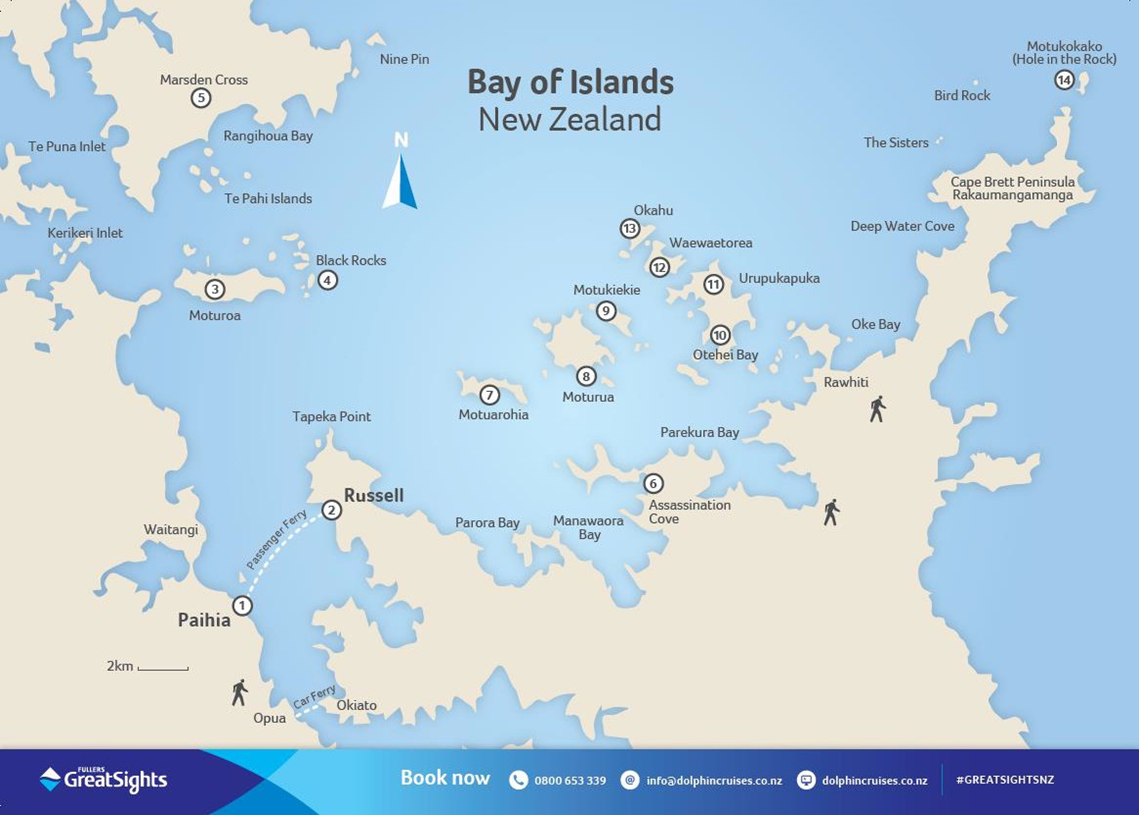
- Passengers embarked at Paihia, then the vessel made the short trip to Russell to pick up other passengers before beginning the cruise through the Bay of Islands towards the Hole in the Rock (a renowned feature of Piercy Island in the outer Bay of Islands; there is a hole through the middle of the island large enough for tourist vessels to pass through). There were several tourist features along the way, where the skipper slowed the vessel and delivered commentary related to the points of interest (see Figure 1).
- During the cruise the crew would keep a look-out for dolphins. If a pod of dolphins were spotted, the skipper could deviate from the planned track to intercept and follow the pod, giving commentary over the public address system.
Narrative
- On the morning of 27 October 2018, the Dolphin Seeker was at its overnight berth in Ōpua (see Figure 2). The skipper and crew went on board and prepared the vessel for the day.
- At about 0805 the Dolphin Seeker departed its berth in Ōpua for Paihia, where it boarded 100 passengers. The vessel then departed Paihia for Russell, where it boarded another 30 passengers. The Dolphin Seeker then departed Russell at about 0920 for the morning ‘Hole in the Rock Dolphin Cruise’. The trip was completed without incident. During the trip the skipper had a radio call from another vessel, informing them that dolphins were in the region of Brampton Bank.
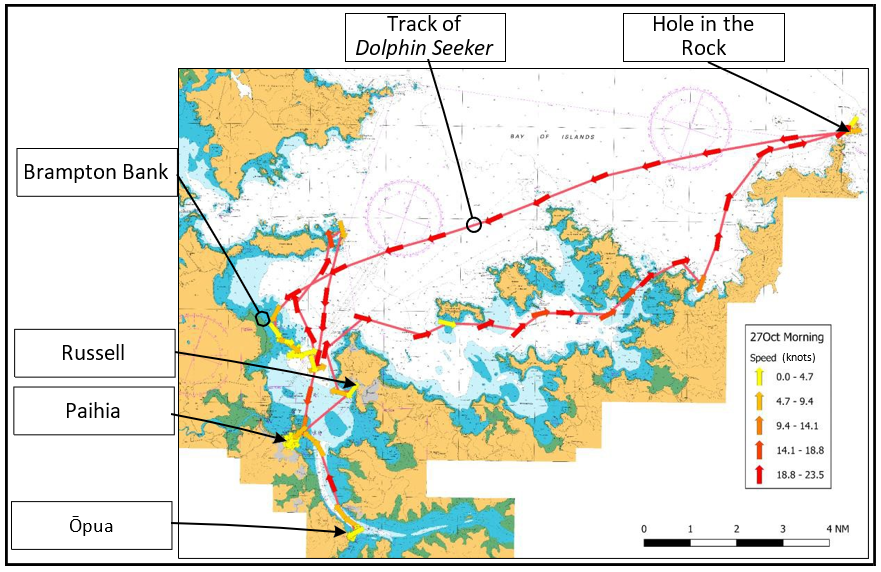
- The skipper navigated the Dolphin Seeker to Brampton Bank, where they slowed the vessel to enable the passengers to watch dolphins at about 1105. After the passengers had spent some time dolphin watching, the Dolphin Seeker returned to Paihia and then Russell to disembark passengers. The Dolphin Seeker was alongside back in Paihia by 1250.
- The reported weather during the afternoon was small waves and a gentle breeze.
- Passengers embarked in Paihia for the afternoon voyage at about 1315. The Dolphin Seeker then went to Russell, where more passengers boarded.
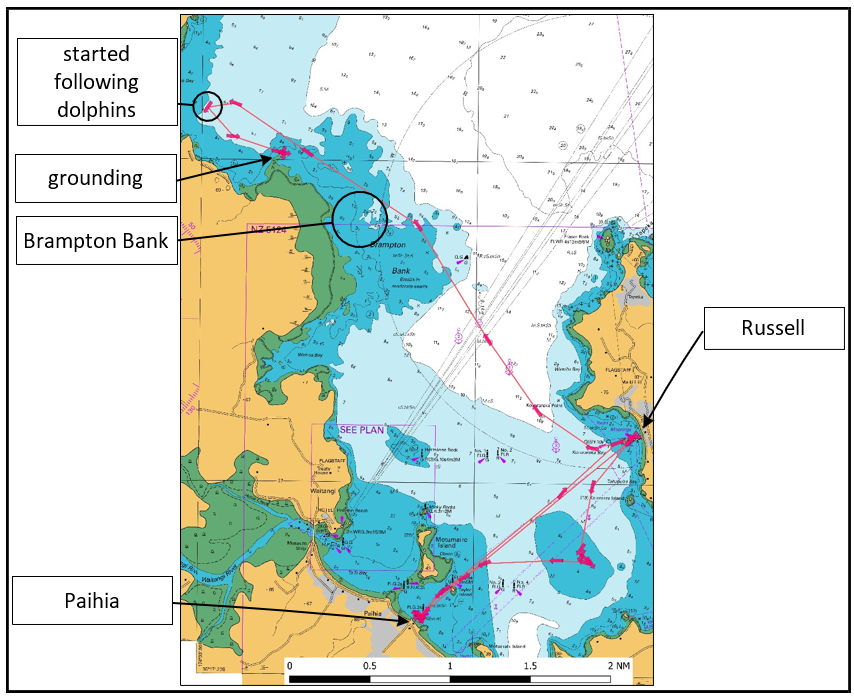
- The Dolphin Seeker departed Russell for its afternoon voyage at about 1346, with 47 passengers on board. The skipper took the vessel directly to the area near Brampton Bank where they had found the dolphins on the morning trip (see Figure 3). A pod of dolphins was located at about 1400.
- The skipper, who was alone in the wheelhouse, slowed the vessel and began following the pod of dolphins at a low speed of up to about 5 knots at times. At the same time the skipper began delivering the tourist commentary about the dolphins over the public address system.
- Having been following the dolphins for about 15 minutes, the Dolphin Seeker entered an area of shallow water and ran aground on rocks at low speed. The skipper was not able to manoeuvre the vessel off the rocks. The crew made an internal inspection of the hulls and found no evidence that the vessel was taking on water.
- The skipper contacted Fullers GreatSights’ management and notified them of the grounding. Because there were other company vessels in the vicinity and the Dolphin Seeker appeared to be resting stably on the rocks, the skipper did not make a radio distress call. They agreed to transfer the passengers to another Fullers GreatSights vessel of a similar size to the Dolphin Seeker, the Te Maki.
- The Te Maki and a smaller company vessel the Tutunui were standing by, ready to assist the Dolphin Seeker, by about 1430. The Tutunui was used to transfer all the passengers to the Te Maki. The transfer operation was complete and the passengers disembarked at the wharf in Paihia by 1540, one hour and 40 minutes after the vessel ran aground. There were no reports of passenger or crew injury.
- The time of the grounding was about two hours before low water. The incoming tide lifted the Dolphin Seeker off the rocks at about 1830, whereupon it was towed back to its berth in Ōpua.
- An underwater inspection revealed that the grounding had caused minor damage to the hulls, but both propellers were significantly damaged.
The Dolphin Seeker
- The Dolphin Seeker was a 23.38-metre catamaran constructed of aluminium. The vessel had been built in 2001.
- The Dolphin Seeker’s operating limit was Restricted Limits (inshore) (Restricted Limits (inshore) means within five nautical miles of the coast in certain areas) in the Northland, Auckland and Great Barrier Island areas.
- The minimum safe crewing certificate issued by Maritime New Zealand allowed the Dolphin Seeker to carry up to 230 passengers. The minimum number of crew members required on board was dependent on how many passengers there were. One of the crew members had to hold an Inshore Launch Master certificate or higher, and one of the crew members had to hold a Marine Engineer Class 6 certificate or higher. The same crew member could hold both certificates. There were six crew members on board during the voyage in which the vessel grounded.
- Paper charts were carried on board. The vessel was equipped with the following electronic navigation and monitoring systems:
- SIMRAD NSS12 evo2 series incorporating a chart plotter with AIS, depth sounder and radar
- MTU (MTU is a manufacturer of commercial internal combustion engines) engine displays
- two very-high-frequency radios
- an EROAD unit
- autopilot.
The safety management system
- Fullers GreatSights was subject to Maritime Rules Part 19, Maritime Transport Operator – Certification and Responsibilities. Under this rule Fullers GreatSights operated under a Maritime Operator Safety System.
- Underpinning the safety system is an operator’s Maritime Transport Operator Plan, which must be audited and approved by Maritime New Zealand.
- Once a plan has been approved, Maritime New Zealand issues the operator with a Maritime Transport Operator Certificate. Each vessel in an operator’s fleet is issued with a certificate of survey by a Maritime New Zealand authorised surveyor.
- The Maritime Transport Operator Plan contained all the various policies, guidelines and requirements of the Dolphin Seeker.
Navigation
- The skipper was solely responsible for the Dolphin Seeker’s navigational watch, that is to say the skipper was routinely alone in the wheelhouse during the voyage. The skipper was also responsible for delivering the tourist commentary as necessary. At the discretion of the skipper, other crew would occasionally deliver the tourist commentary instead of the skipper, usually for the purpose of training the crew.
-
The Dolphin Seeker’s standing orders stated:
LOOK-OUT Every Skipper must at all times maintain a proper look out by sight and hearing as well as by all available means appropriate in the prevailing circumstances and conditions, so as to make full appraisal of the situation and the risk of collision.
-
The Dolphin Seeker’s safe navigation policy stated:
At certain times the need to provide commentary could distract the Skipper from the safe navigation of the vessel. At such times the commentary is to be suspended until conditions are such that it is safe for the commentary to resume.
- The operator prohibited skippers delivering tourist commentary at certain times as the risk to navigation was considered too high. Those times included when its vessels transited the Hole in the Rock.
Electronic navigation aids
- In 2014 Maritime New Zealand had introduced SeaCert, a new certification framework for seafarers. As part of transitioning older qualifications to the new system Maritime New Zealand had run training workshops to refresh and update the knowledge of those holding the older qualifications. The workshops had included training for electronic navigation aids.
- The skipper had attended one of the workshops, following which the company had decided to improve the use of electronic navigation aids on its vessels. Fullers GreatSights had adopted a standardised electronic chart navigation system across its fleet and engaged an external provider to provide additional training for its skippers on its use. The skipper of the Dolphin Seeker had received this additional training.
-
The Dolphin Seeker’s safe navigation policy stated:
Electronic navigational aids such as GPS, Chart Plotter, Radar and AIS [automatic identification system], are to be used to assist with the safe navigation of the vessel; however there is to be no over reliance on these aids in lieu of maintaining an efficient visual lookout and reference to the proper navigational charts for the area.
The skipper
- The skipper had been issued with a Commercial Launch Master certificate in 1998 and a Marine Engineer Class 5 certificate in 2008. Both the Commercial Launch Master and the Marine Engineer Class 5 certificates were higher qualifications than those required by the minimum safe crewing certificate.
- The skipper had started working at Fullers GreatSights in 2000 and had been involved in all areas of sea-going operations.
- Maritime New Zealand had issued the skipper with a Pilotage Exemption Certificate for the Bay of Islands in 2011, which the skipper required to pilot Fullers GreatSights’ largest passenger vessel. A Pilotage Exemption Certificate confirms that the skipper has a thorough navigational knowledge of the local area and has met the requirements for piloting vessels larger than 500 gross tonnes in designated pilotage areas; they are exempt from the requirement to use an independent marine pilot. The Pilotage Exemption Certificate had expired in 2016, and had not been renewed due to the large vessel being retired from the fleet.