On 27 February 2016, the bulk carrier Mount Hikurangi had just completed loading a cargo of logs at the port of Tauranga. The ship's crew were involved in applying chain lashings to the logs that had been loaded above deck when a deck cadet fell from the stack of logs 10 metres onto the wharf below, then into the sea. The deck cadet did not survive this fall. His body was recovered by divers a number of hours later. The deck cadet was not wearing a safety harness attached to a fall arrestor while working close to the edge of the log stack, despite a company requirement to do so.
Executive summary Tuhinga whakarāpopoto
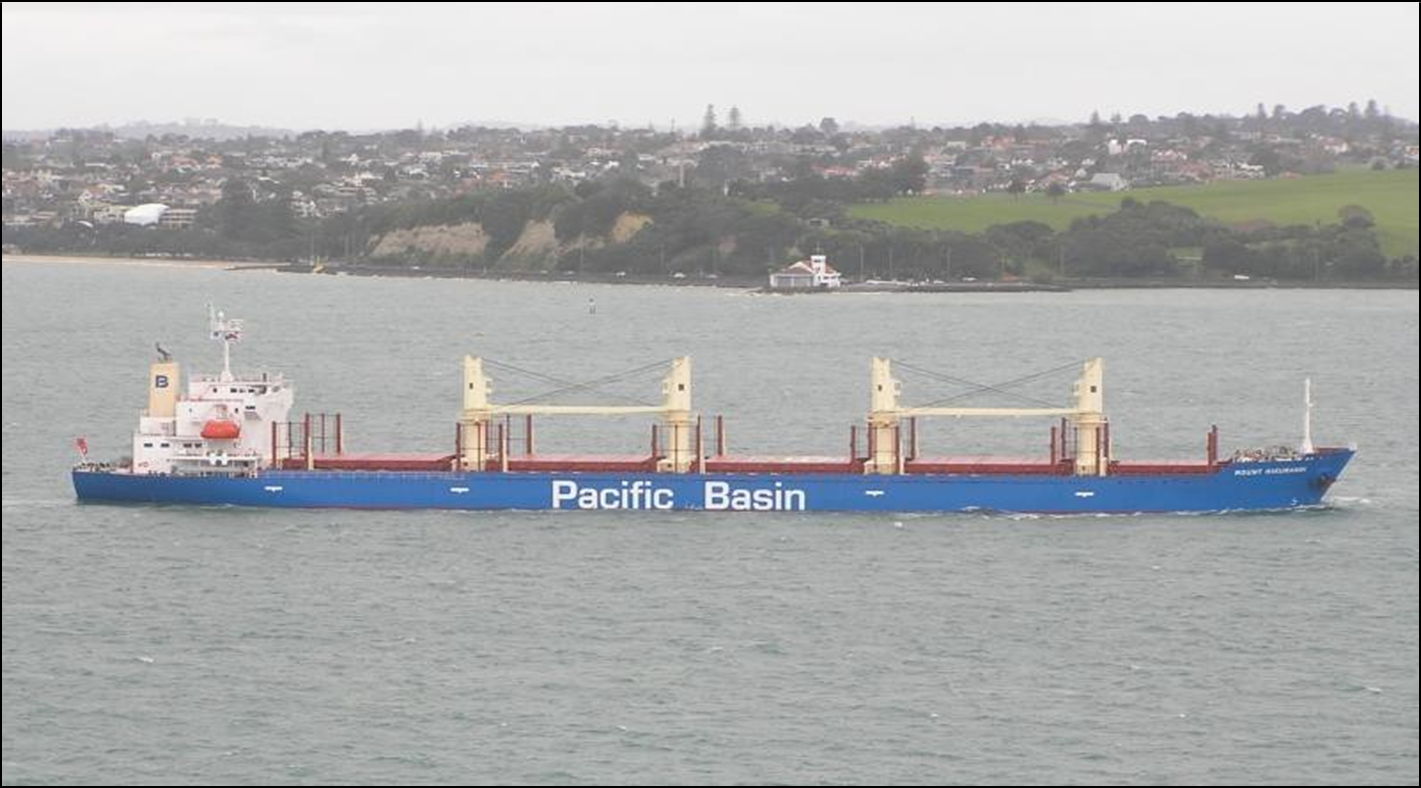
- On 27 February 2016, the bulk carrier Mount Hikurangi had just completed loading a cargo of logs at the port of Tauranga. The ship’s crew were involved in applying chain lashings to the logs that had been loaded above deck when a deck cadet fell from the stack of logs 10 metres onto the wharf below, then into the sea. The deck cadet did not survive this fall. His body was recovered by divers a number of hours later.
- The deck cadet was not wearing a safety harness attached to a fall arrestor while working close to the edge of the log stack, despite a company requirement to do so.
- The Transport Accident Investigation Commission (Commission) found that the crew on Mount Hikurangi routinely did not follow company procedures by working on top of log cargoes without the required safety harnesses.
- The Commission also found that there was little evidence of a strong safety culture on board Mount Hikurangi at the time.
- The safety actions taken by the ship operator and Maritime New Zealand negated the need for the Commission to make any recommendations.
- Key lessons arising from the inquiry include:
- all crew members must wear safety harnesses, preferably connected to fall arrestors, when working at height
- a strong safety culture must be established and promoted from the highest levels of management on board a ship. It must be encouraged, monitored and enforced throughout all levels of the organisation so that best safety practices are followed.
Conduct of the inquiry He tikanga rapunga
- Maritime New Zealand notified the Transport Accident Investigation Commission (Commission) of the accident at about 1700 on 27 February 2016. The Commission opened an inquiry the same day under section 13(1)b of the Transport Accident Investigation Commission Act 1990 and appointed an investigator in charge.
- On 28 February 2016 two investigators travelled to Tauranga and conducted interviews with the vessel’s crew and collected evidence, which included video footage of the accident from the port security camera.
- On 29 February 2016 contact was established with the Hong Kong flag administration and agreement was reached that New Zealand would lead the investigation and conduct the investigation on behalf of Hong Kong.
- On 18 April 2016, with the aid of the Hong Kong flag administration, email correspondence was established between the investigator in charge and the deck cadet’s next of kin, and the purpose and role of the Commission were explained.
- Additional information was requested from Maritime New Zealand, the vessel’s operator, Port of Tauranga and the Coroner.
- On 22 June 2016 the Commission received the final post-mortem report.
- On 27 July 2016 the Commission approved the draft report to be circulated to interested persons for comment.
Factual information Pārongo pono
Background
- At the time of the accident Mount Hikurangi was preparing to carry a cargo of logs on deck.
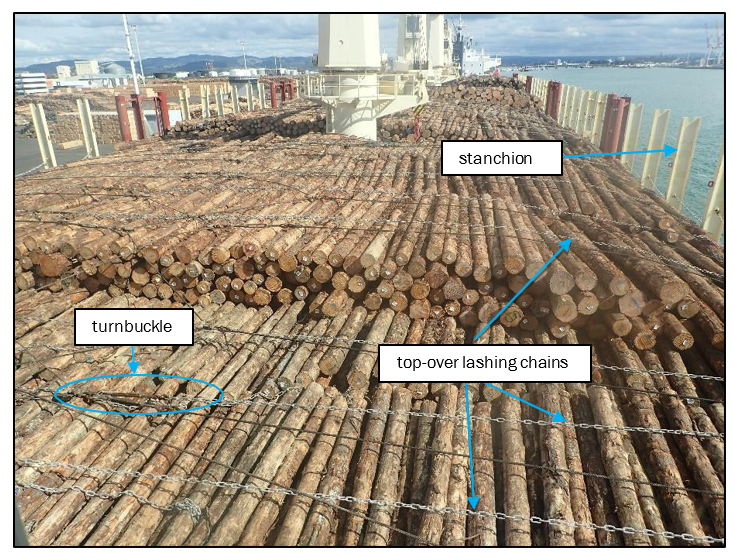
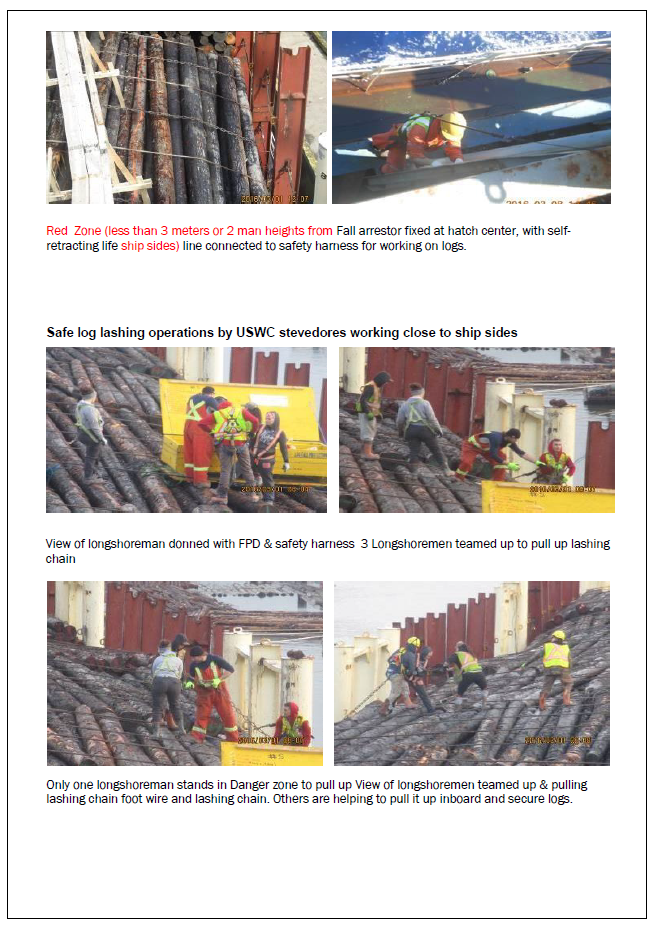
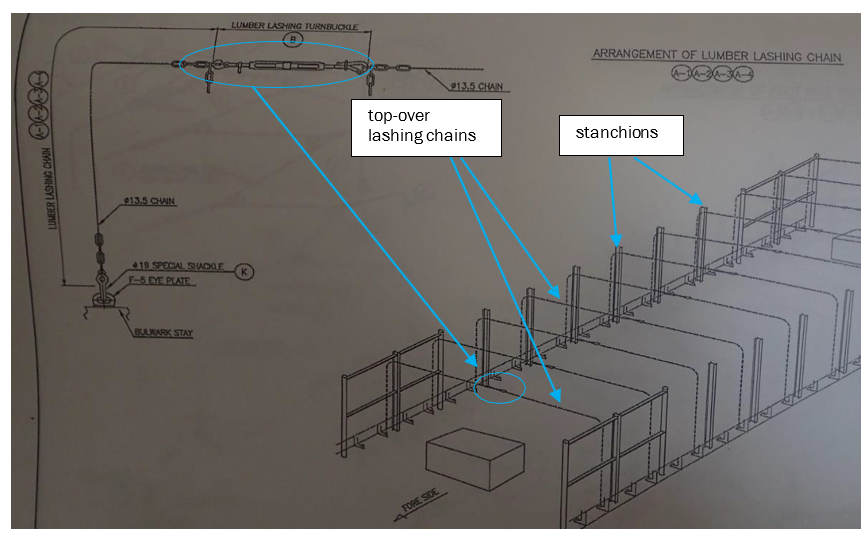
- In preparation for loading, the crew rigged stanchions on both sides of the ship adjacent to all of the hatches, to retain the logs in a block stow. Once the logs were loaded, a series of wire and chain lashings was rigged across the entire stow to secure the logs.
- The procedure for securing log cargo on Mount Hikurangi was laid down in the approved ship’s cargo securing manual.
- Chapter 5 of the operator’s Fleet Regulations also laid down the voyage procedure when carrying a cargo of logs. In respect of lashing deck cargo, paragraph 13 of the procedure made reference to the International Maritime Organization’s Timber Code: Code of Safe Practice for Ships Carrying Timber Deck Cargoes 2011 (Timber Code) and the ship’s cargo securing manual. Specifically, it referred to the requirement for rigging lumber lashing chains, also known as top-over lashing chains.
- Each top-over lashing chain was shackled to a deck eye-plate. The other end of the chain had a rope eye attached through the last link. The rope eye was suspended over the top of each stanchion (see Figure 4) so that the chain was easily accessible whilst lashing the logs. At the time of the accident the crew were rigging the chain lashings (see Figures 1 and 2). They used a ship’s crane to haul each chain inboard over the logs.
- One at a time, the port and starboard lashing chains were lifted across the logs by the ship’s crane. They were connected near the centreline with a turnbuckle, which was used to increase the tension in the chains. The tension increased the vertical friction force between the logs at the outer part of the stow and, together with other types of lashing, helped to achieve a secure stow. The final lashing configuration was the same at all hatches (see Figures 1 and 2).
Narrative
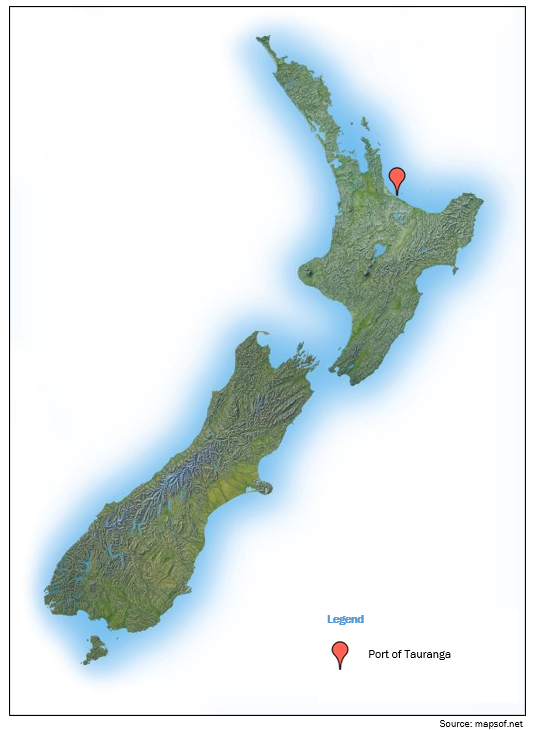
- At 1530 on 24 February 2016, the Hong Kong-registered bulk carrier Mount Hikurangi secured portside alongside number nine berth in the port of Tauranga in a ballast (empty) condition.
- At 2015 the vessel commenced loading a full cargo of logs in the cargo holds and on top of the hatch covers as deck cargo. The loading of logs continued for the next three days.
- At about 0600 on 27 February 2016, a ship’s cargo securing team comprising the boatswain (bosun), three able-bodied seamen (AB) one ordinary seaman and a deck cadet were securing the log cargo above number 5 hatch.
- The weather was fine and dry. There had been some rain the previous evening but the surface of the logs was dry at the time of the accident.
- Before the crew commenced work the chief officer briefed them to secure the cargo in accordance with the instructions contained in the cargo securing manual. At the same time, he checked that they were wearing appropriate personal protective equipment (PPE). The cadet was dressed in an overall, safety helmet, high-visibility vest and safety boots fitted with removable pull-over spikes designed for walking on logs. On completion of the briefing the crew commenced securing the log cargo above number 5 hatch.
- At about 0900 on 27 February 2016, all cargo loading operations had been completed. The crew that had secured the log cargo above number 5 hatch commenced securing the log cargo above number 2 hatch, using number 1 crane to haul the chains across the logs (see Figure 3).
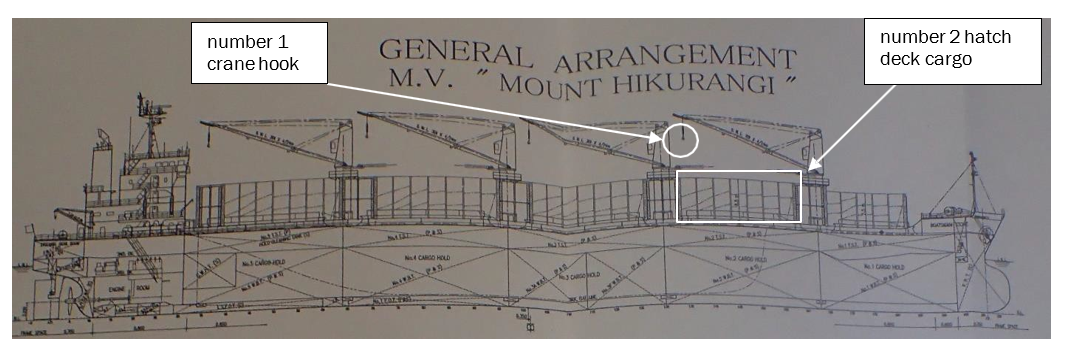
- The crew used a short wire strop and small hook attached to the main crane hook to drag the chains across the logs. The bosun had tasked the deck cadet with hooking each lashing chain on to the small hook (see Figure 4).
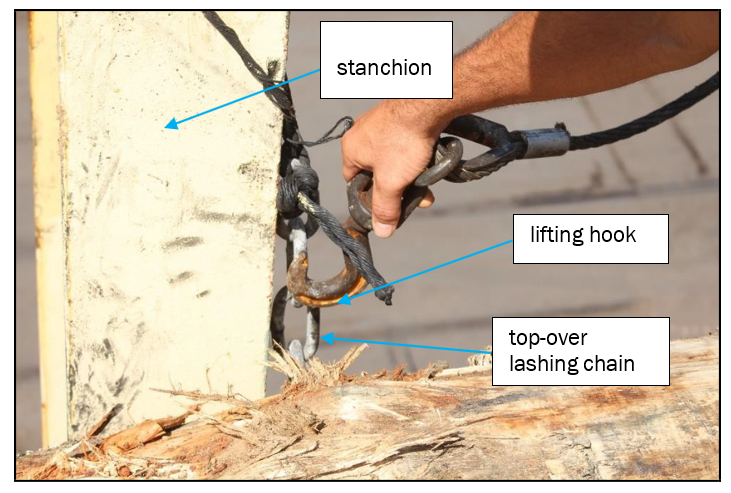
- At about 0911 the deck cadet positioned himself adjacent to the aftermost stanchion on the port side of number 2 hatch in preparation for hooking on the lashing chain. He was standing at the edge of the log cargo about eight metres above the ship’s main deck, which was 10 metres above the quay and 12 metres above the waterline. As the lifting hook was lowered in front of him he bent down to hook on the lashing chain, which had been hung over the top of the stanchion with the rope eye (see Figure 4). Once the cadet had hooked the chain on to the lifting hook he stood up and remained next to the stanchion whilst the crane driver hoisted and slewed the crane to drag the chain across the logs, where it was unhooked by the bosun. The crane hook was then returned to the port side to receive the second lashing chain.
- The cadet grabbed the wire and bent down to hook on the second lashing chain. He stood up momentarily before bending down again. About four seconds later, as the main crane hook was being raised, the cadet fell overboard, striking the quay and falling into the water. The bosun raised the alarm on his portable radio.
- The deck lashing crew ran to the ship’s side and the third officer went down to the quayside with a lifebuoy. The master, who was in his cabin at the time, heard the emergency call on his portable radio and went to the port bridge wing. He called the emergency services and the ship’s commercial agent.
- At about 0930 a police patrol boat arrived and commenced searching for the cadet. HMNZS Manawanui was also berthed in Tauranga at the time of the accident. The crew of Manawanui were alerted by the police and responded by providing divers to search for the cadet.
- At about 1150 the divers entered the water and about 10 minutes later they located the cadet’s body.
Experience of the deck cadet
- The deck cadet had commenced employment with Pacific Basin Shipping (HK) Limited on 17 September 2015. He had joined Mount Hikurangi, his first vessel, on 22 September 2015.
- The cadet had completed the joiner’s familiarisation checklist within 48 hours of joining, as required by the operator’s safety management system. This included familiarisation with the permit to work8 system on board in relation to enclosed space procedures, working aloft and hot work.
- The cadet had been involved in loading and discharging logs on four previous occasions.
- Prior to the accident on 27 February, the cadet had rested for 16.5 hours on 26 February and had had six hours of rest on 27 February prior to commencing work at 0600. Fatigue is not considered to have been a contributing factor to the accident.
Hazard identification and risk assessment
- The operator’s Fleet Regulations addressed risk management using the following process:
- assessing operational tasks at all levels for the possibility to cause injury, damage or loss. The ‘Hazard Identification and Risk Assessment’ document on board provided generic risk assessments for onboard operations
- periodic reviews of the document to ensure that any additional hazards and risks in operations on board were identified and discussed before carrying out the operations
- six-monthly formal reviews by the master
- a brief and informal risk assessment prior to “each and every task”. This was described as a “3W” risk assessment where the following questions were posed:
- What can go wrong?
- What factors can cause it to go wrong?
-
What should be done to prevent it going wrong?
There was no requirement to record that the 3W risk assessment had taken place.
- There was a risk assessment for “working aloft” and “over the side” that did consider falling from height and falling overboard. The control measures included, but were not limited to:
- consideration be given to working under the permit-to-work system (the permit-to-work system is a safety measure whereby seafarers must get written permission from senior officers before they can perform high-risk tasks including, but not limited to, working aloft, welding and entry to enclosed spaces. An operator’s safety management system will identify which activities must be carried out under a permit to work)
- young or inexperienced persons not required to work aloft or over the side unless accompanied by experienced seafarers or under adequate supervision
- all seafarers are required to wear safety harnesses, and safety nets are to be rigged where appropriate.
- A risk assessment and hazard identification had been carried out by the operator for loading logs, but it had not identified falling from height during lashing operations as a hazard.
-
However, the operator’s Fleet Regulations referred to access and the safety of the crew when working on logs. It stated that:
retractable lanyards (fall arrestors), safety harnesses and log spike shoes should form part of the PPE while working on log cargoes. Working on timber deck cargo is a hazardous operation and only the deck crew should be permitted to work on timber deck cargo
-
The Fleet Regulations also required adherence to the International Maritime Organization’s Timber Code. This code included guidance for developing procedures and checklists for the safe loading, carriage and discharge of timber deck cargoes. It stated that:
Personnel working on cargo stowed at heights 2m and above, within 1m of an unguarded edge, should if deemed necessary be protected from falls with fall restraint equipment such as a safety harness or other fall restraining devices approved by the Administration.
-
An entry in the chief officer’s cargo logbook, written on 24 February 2016, included a standing order that:
Anyone on the main deck or logs must be worn (sic) 1. safety helmet 2. safety shoes and spikes 3. Hi-vis vest 4. Safety belt
- The following PPE was available to the crew involved in cargo securing operations:
- boots
- attachable boot spikes (to assist movement when walking on top of logs)
- gloves
- safety helmets
- full-body safety harnesses
-
fall-arrestor devices.
There were 12 safety harnesses and six fall-arrestors on board.
Internal audit
- The operator had carried out an internal audit of Mount Hikurangi about five months before the accident, between 8 and 10 September 2015. In respect of the safety management system the audit identified two non-conformities and seven observations. The senior officers on board Mount Hikurangi at the time of the accident were also on board at the time of the audit.
-
Of the two non-conformities identified by the auditor, non-conformity number 02/2015 required corrective action by:
Regular inspection to be strictly carried out to verify training effectiveness. A special officers meeting held to enhance critical importance of safety practice – not tick box culture.
-
Amongst the recommendations for continual improvement, the auditor recommended that all officers and crew take a positive interest in and adopt a proactive approach to enhancing loss-prevention techniques:
This will help to improve on 3W risk assessment and hazard identification, self-check and taking adequate safety measures to prevent any accident/incidents and personal injury.
The auditor also recommended that the crew be encouraged to carry out risk assessments for both critical and routine jobs.
Analysis Tātaritanga
General
- Lashing logs on the deck of a ship is a hazardous task. There is a significant risk of slips, trips and falls, the consequences of which are greater when the crew are working at height near the edge of a log stack.
- The deck cadet who fell was not an experienced seafarer, but he was not new to the lashing procedure either, having participated in log-lashing operations on four other occasions. He had had adequate opportunity for rest in the previous two days, so fatigue is not considered to have been a factor in his death. Post-mortem testing showed that he was not under the influence of drugs or alcohol.
- The following analysis discusses briefly what happened to cause the deck cadet to fall. The key safety issues discussed include the fact that the deck cadet was not wearing a safety harness and, more importantly, that none of the crew routinely used safety harnesses, despite their being a requirement under the ship’s safety management system. The type of safety culture on board that allowed that situation to exist is also discussed.
The accident
- The deck cadet was working about eight metres above the ship’s main deck, which was 10 metres above the quayside and 12 metres above the water. He was not wearing a safety harness attached to a fall-arrestor device.
- The deck cadet was giving hand signals to the crane driver, indicating the movements he required of the crane as he prepared to attach the lashing chain to the lifting hook. Video footage showed him standing at the edge of the cargo with his left hand holding the stanchion for security. As he bent down to attach the chain to the lifting hook he let go of the stanchion. Using both hands, he appeared to have difficulty attaching the chain to the hook and partially stood before bending down again. Seconds later he lost his balance and fell overboard.
- It cannot be determined with certainty what caused the cadet to lose his balance and fall. The video footage showed that before the cadet had time to step clear and signal the crane driver, the main crane hook was already swinging and moving upwards. It is possible that the wire came under tension and caught on some part of his body or clothing, or equally possible that he just lost his balance and fell.
- Once the deck cadet lost his balance, there was nothing to prevent his falling.
- The deck cadet was seen to strike the side of the ship and then the quay before falling into the water. The post-mortem examination showed that he very likely died from a critical head injury before falling into the water. Therefore it is exceptionally unlikely that the immediate efforts of the crew to find and retrieve him from the water would have saved his life.
Procedures
- In three separate ways the operator’s ship safety management system either directed the crew to or advised that the crew wear safety harnesses and use fall arrestors when they were lashing logs on deck.
- The operator’s Fleet Regulations directed the crew to adhere to the Timber Code, which clearly stated that crew should be protected from falls with fall-restraint equipment such as safety harnesses and other fall-restraining devices (see 3.4.5).
- The operator’s Fleet Regulations further directly stated that “retractable lanyards [fall arrestors], safety harnesses and log spike shoes should form part of the PPE while working on log cargoes. Working on timber deck cargo is a hazardous operation”.
- The chief officer’s cargo logbook contained the written standing order that “Anyone on the main deck or logs must be worn [sic] 1. safety helmet 2. safety shoes and spikes 3. Hi-vis vest 4. Safety belt”.
- Before starting cargo-lashing operations on the morning of the accident, the chief officer gave a briefing to the crew and reaffirmed that they were to secure the cargo in accordance with the cargo securing manual. He even checked that they were wearing the correct PPE.
- Even though the risk assessment document on board did not specifically mention working from height in relation to log-lashing operations, there should have been no doubt among everyone on board, deck officers and deck crew, that safety harnesses and fall arrestors were to be used by crew members tasked with working near the edge of the log stow.
Procedures not followed
- None of the crew was wearing a safety harness on the day of the accident. On the morning of the accident the chief officer held a briefing with the deck crew; this included assigning their jobs and carrying out a PPE check.
- The chief officer’s standing orders stated what PPE was to be worn when working on the logs. The deck officers all signed to confirm that they had read the chief officer’s standing orders. However, the deck officers did not set an example to the crew by wearing safety harnesses themselves, nor did they insist that the deck crew wear safety harnesses.
- Interviews with the crew confirmed that the deck crew never used safety harnesses or fall arrestors when lashing logs on deck. This violation of the company instructions and best industry advice on the matter had become routine.
- The cadet was only five months into his first trip to sea. The company’s expectation was for the cadet to be mentored by another officer and taught the appropriate safe working practices. When the cadet was allowed to work at height close to the ship’s side without using fall-prevention equipment his safety was being jeopardised. This may be explained by the belief amongst the crew, which was consistent throughout all ranks interviewed, that there was little risk associated with falling from the log cargo whilst working close to the ship side. Their perception of the risk was low.
Safety culture
- Not wearing appropriate fall-prevention equipment was normal behaviour on Mount Hikurangi. Nobody questioned or called a halt to the unsafe practice. This acceptance of risk provided an insight into the underlying safety culture on board Mount Hikurangi.
- Safety culture describes the way that safety is “perceived, valued and prioritised” throughout an organisation. The development of an effective safety culture is dependent on “foresight, good organization and the wholehearted support of management and of all seafarers” (International Labour Organization 1996 accident prevention on board ships at sea and in port). (Organization, 1996)
- Having such a safety culture requires total commitment from the operator and crew alike. The operator encouraged a positive safety culture through the safety management system, which required that senior officers motivate and train the crew, lead by example and promote “safe operational working practices with adequate risk assessment”.
- The crew were encouraged to carry out a 3W dynamic risk assessment to identify hazards and appropriate control measures prior to “each and every task”. In this case a 3W assessment was not carried out.
- The internal audit by the operator to assess the implementation of the safety management system on board Mount Hikurangi had been carried out in September 2015. The audit identified strengths, weaknesses and areas for improvement. The auditor recommended that all officers and crew adopt a proactive approach to help improve the standards of risk assessment, hazard identification and safety awareness. The audit findings were indicative of a poorly developed safety culture on board.
- The auditor’s recommendations to improve safety had been signed off as completed by the master, but as this accident demonstrated not much had actually changed.
- The deck cadet was on his first trip. It is very unlikely that he would have challenged his superiors about non-compliance with a procedure when it was seen by them as routine practice. If he had been made to wear a safety harness connected to a fall arrestor, this would have saved his life when he lost his balance while standing on the edge of the log stack.
- An illustration of the safety culture on board was the following day when the investigators observed some of the crew still working atop the log cargo without wearing safety harnesses.
Findings Ngā kitenga
- The deck cadet suffered a head injury when he fell some 10 metres to the quay before falling into the water. The reason for his fall could not be conclusively established.
- The deck cadet was not wearing a safety harness attached to a fall arrestor. If he had been it is virtually certain that he would not have lost his life.
- Company policy and procedures required that all crew working near the edge of a log stack on deck wore safety harnesses attached to fall arrestors. However, the crew routinely did not comply with those company requirements.
- There was little evidence of a good safety culture on board Mount Hikurangi.
Safety issues and remedial action Ngā take haumanu me ngā mahi whakatika
General
-
The Commission classifies safety actions by two types:
(a) safety actions taken by the regulator or an operator to address safety issues identified by the Commission during an inquiry that would otherwise result in the Commission issuing a recommendation
(b) safety actions taken by the regulator or an operator to address other safety issues that would not normally result in the Commission issuing a recommendation.
Safety actions addressing safety issues identified during an inquiry
-
Safety actions taken by the operator of Mount Hikurangi
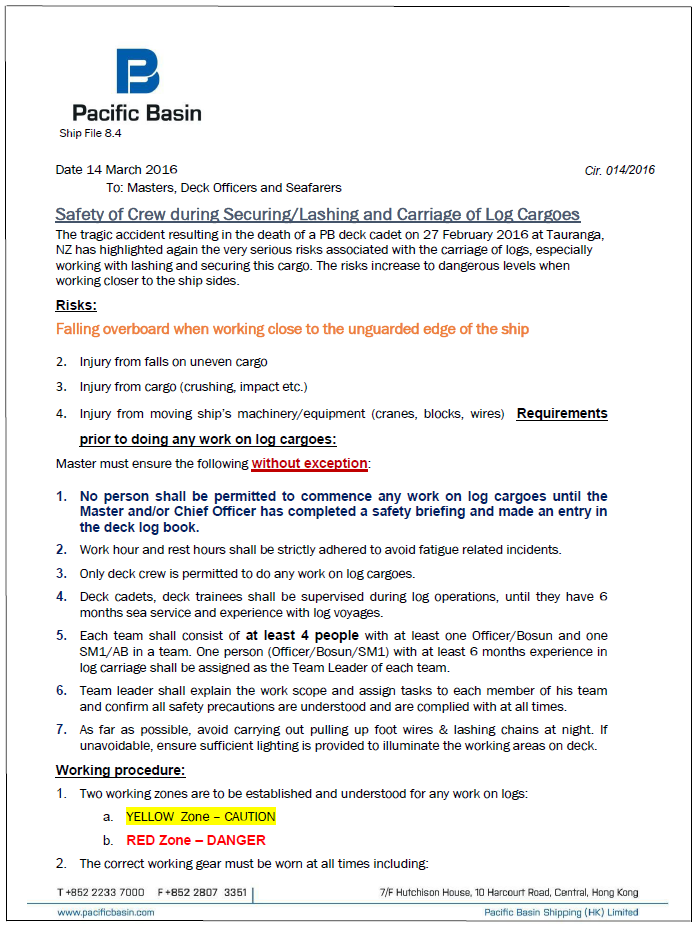
After the accident the operator, Pacific Basin Shipping, issued a risk assessment circular (see the Appendix) to all masters, deck officers and seafarers. It identified the risk of falling overboard when working close to the unguarded edge of the ship and instructed that:
1.No person shall be permitted to commence work on log cargoes until the master and/or chief officer have completed a safety briefing and made an entry in the deck logbook.
2.Work hours and rest hours shall be strictly adhered to, to avoid fatigue-related accidents.
3.Only deck crew are permitted to work on log cargoes.
4.Deck cadets and deck trainees shall be supervised during log operations until they have six months’ sea service and experience with log voyages.
5.Each team shall consist of at least four people, with at least one officer or bosun and one AB in the team. One person with at least six months’ experience in log carriage shall be assigned as the team leader.
6.The team leader shall explain the work scope and assign tasks to each member of their team and confirm that all safety precautions have been understood and are complied with at all times.
7.As far as possible, avoid pulling up lashing chains at night. If unavoidable, ensure sufficient lighting is provided to illuminate the working areas on deck.
8.Two working zones have been identified for any work on logs:
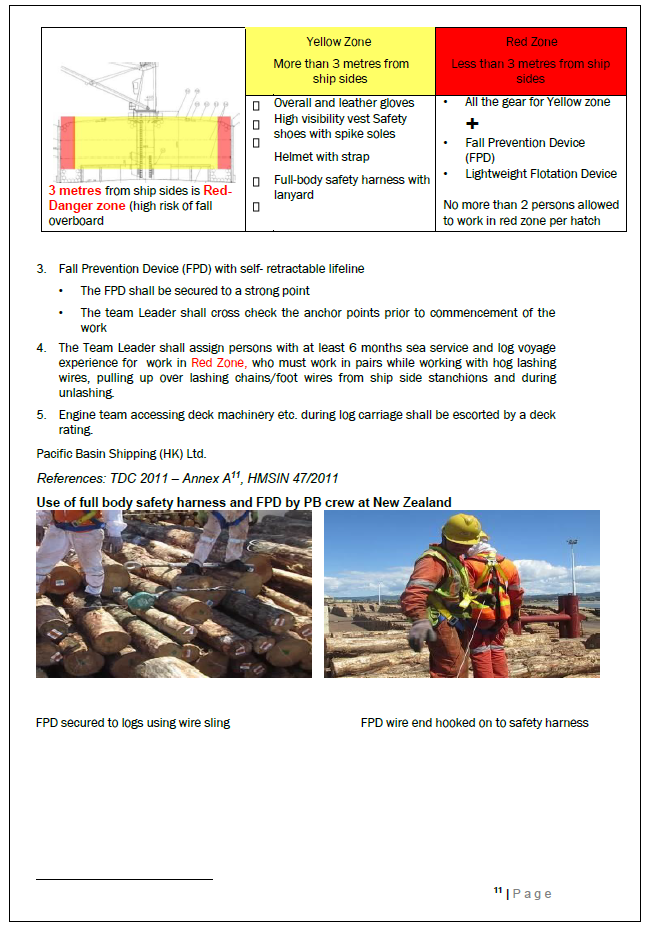
- A yellow caution zone on top of the logs in the area more than three metres from the side of the ship. To work in the yellow zone, the prescribed PPE is overalls, leather gloves, safety shoes with spikes, helmet with chinstrap and a full body harness with lanyard.
- A red danger zone within three metres of the ship side where only two persons per hatch may work at any one time. This zone carries a high risk of falling overboard and the operator requires that anybody working in the red zone wear the full PPE prescribed for the yellow zone plus a fall prevention device and a lightweight flotation device.
-
Safety action taken by Maritime New Zealand
As a result of this accident Maritime New Zealand is currently in the process of writing a safety bulletin to be distributed to the New Zealand maritime industry. The safety bulletin will highlight the inherent dangers involved with working at height and close to unguarded edges.
Recommendations Ngā tūtohutanga
General
- The Commission may issue, or give notice of, recommendations to any person or organisation that it considers the most appropriate to address the identified safety issues, depending on whether these safety issues are applicable to a single operator only or to the wider transport sector. In this case no new recommendations have been issued.
- Safety actions taken have negated the need to make any recommendations.
Key lessons Ngā akoranga matua
- All crew members must wear safety harnesses, preferably connected to fall arrestors, when working at height.
- A strong safety culture must be established and promoted from the highest levels of management on board a ship. It must be encouraged, monitored and enforced throughout all levels of the organisation so that best safety practices are followed.
Glossary Kuputaka
- Able-bodied seafarers (ABs)
- Experienced seafarers competent to perform the usual and customary duties on deck.
- Boatswain
- The foreman of a deck crew
- Deck cadet
- A trainee
- Fall arrester
- Safety equipment used, when working at heights or over the side of a ship, to stop a downward free fall and prevent serious harm or death of the person
- Stanchion
- A vertical support structure used to secure cargo, such as logs, on the upper deck of a vessel
- Turnbuckles
- A screw device used for adjusting the tension or the length of ropes, cables, tie rods and other tensioning systems.
- Deck eye-plate
- A steel fixing welded to the deck to provide a securing eye
- Top-over chain lashing (referred to as a top-over lashing chain)
- A chain secured by a shackle to a deck eye fitting then run vertically up the side of the deck cargo and then across the top. Two top-over chain lashings are rigged, one from the port and one from the starboard side. They are joined in the middle by a turnbuckle that also allows them to be tensioned.
Data summary Whakarāpopoto raraunga
Details
Citations Ngā tohutoru
Anderson, P. (1999). The Mariner's Guide to Marine Insurance. London: The Nautical Institute. Organization, I. L. (1996). Accident Prevention On Board Ships At Sea And In Port. International Labour Organization.
Appendix 1. Pacific Basin’s risk assessment circular