
The Commission’s Interim Report sets out facts established so far. On completion of its inquiry, the Commission’s final report will present analysis, discuss safety issues and (if any) make recommendations for the sector to avoid similar accidents in the future.
Factual information Pārongo pono
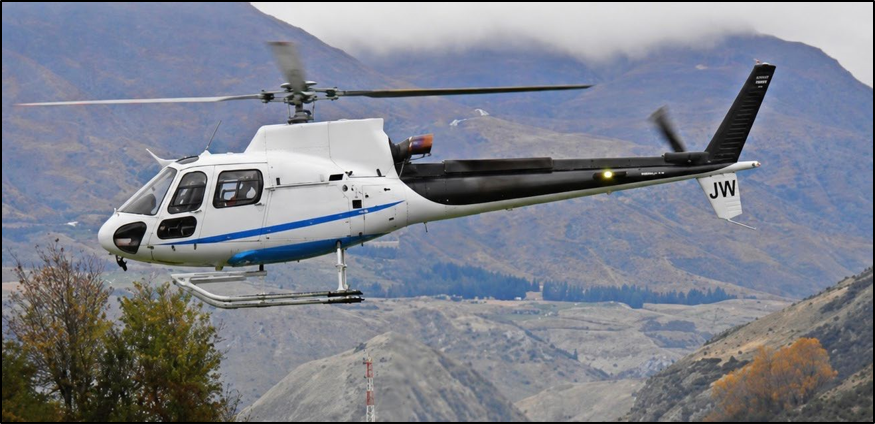
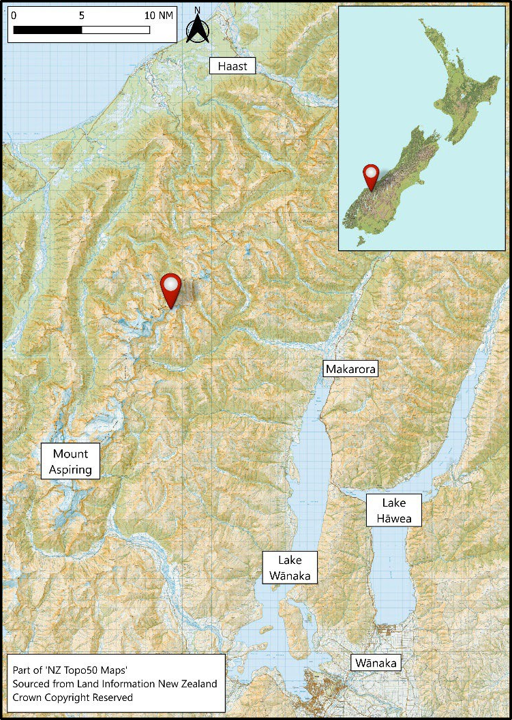
Background information
- On 17 May 2026, a pilot and a hunting party, consisting of a guide, a hunter and two passengers (the two passengers were observing the hunting), were using an Airbus AS350-B3 helicopter, registration ZK-IJW (the accident helicopter), to conduct aerial-assisted trophy hunting (AATH) activity in the Mt Aspiring National Park area. A second helicopter followed the hunting party. On the second helicopter were a guide and four passengers (the four passengers were observing the hunting).
- Aerial-assisted trophy hunting (AATH) is the use of a helicopter to locate a trophy animal. The hunter is then offloaded with a guide to shoot the animal. The animal is later taken to a taxidermist for mounting. On this occasion the objective was for the hunter to shoot a tahr and a chamois.
Narrative
- On 16 May 2026, The Alpine Group Limited, trading as Alpine Helicopters (the operator), pre-positioned two helicopters to be used for the AATH on a private property near Mt Barker. This was because of forecast low cloud or fog at Wanaka Aerodrome the following day.
- At about 0700 on 17 May 2026, two of the operator’s pilots prepared the helicopters for the day’s flying. The weather was frosty, but the forecast was for a fine day with little to no wind and clear skies.
- The two guides, one hunter and six passengers arrived shortly after and were given a safety briefing. The helicopters departed Mt Barker at about 0735, making their way north of Mt Aspiring National Park.
- A tahr was located in the Landsborough area north of the Haast River and shot by the hunter. The tahr was recovered and both helicopters landed and shutdown to facilitate the taking of photographs. The tahr was then placed in the external cargo pod of the accident helicopter.
- The two helicopters then flew to an area 24 kilometres (km) west of Makarora, where the hunting party located a chamois on the north face of Mercury Peak. The guide and hunter were off-loaded from the accident helicopter nearby. The pilot then flew the accident helicopter a safe distance away. The second helicopter also remained clear at this time.
- The hunter shot the chamois, which fell into a gut (a narrow deep ravine or gully). The pilot of the accident helicopter returned and uplifted the guide and hunter, flying them a short distance to a large flat area. The hunter and two passengers were offloaded to await the arrival of the second helicopter.
- The pilot and the guide flew up the mountain face to retrieve the chamois. The accident helicopter was fitted with an EAGLEi 4K Video & Flight Data Recorder (the cockpit camera), which was recovered from the accident site. The recording showed the accident helicopter was hovering by a rocky ledge. The guide was exiting the accident helicopter through the front left door when the accident sequence started. Marks on the rocks and tussock grass at the accident site showed that the main rotor blades had contacted the mountain face.
- The main rotor blades were destroyed and the accident helicopter fell about 30 metres (m) down the mountain side. The helicopter’s final position was at an altitude of about 5,700 feet (ft).
- One of the passengers from the accident helicopter was observing the recovery of the chamois and took a photograph of the accident helicopter moments before the accident (see Figure 3). They then saw the helicopter falling down the mountain face and coming to rest below (see Figure 4). The hunter and two passengers alerted the pilot and guide of the second helicopter after it landed in an area just out of view of the accident a few seconds later.
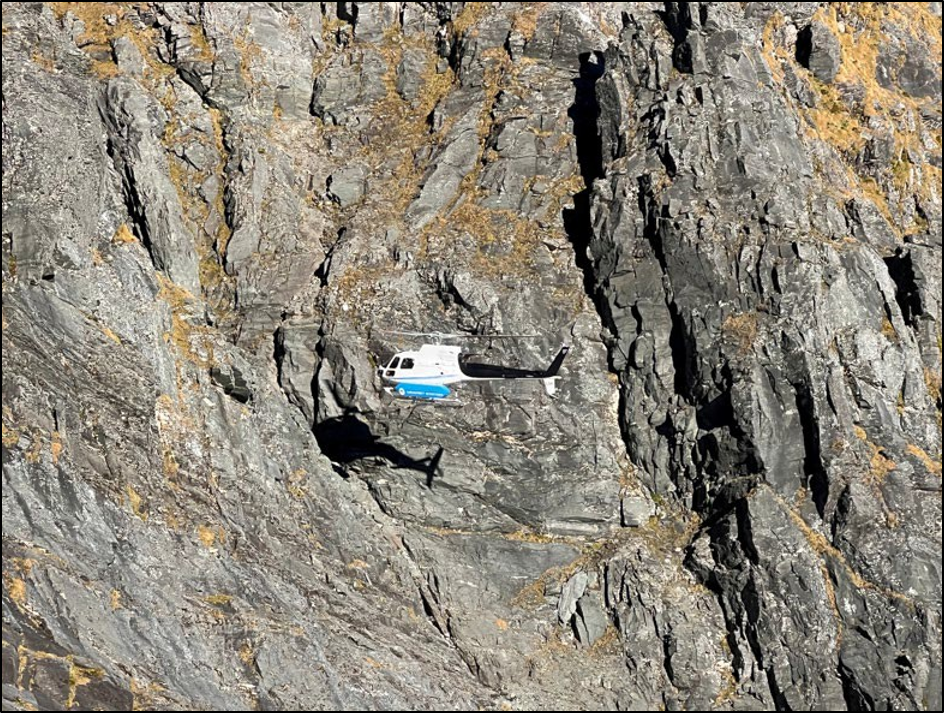
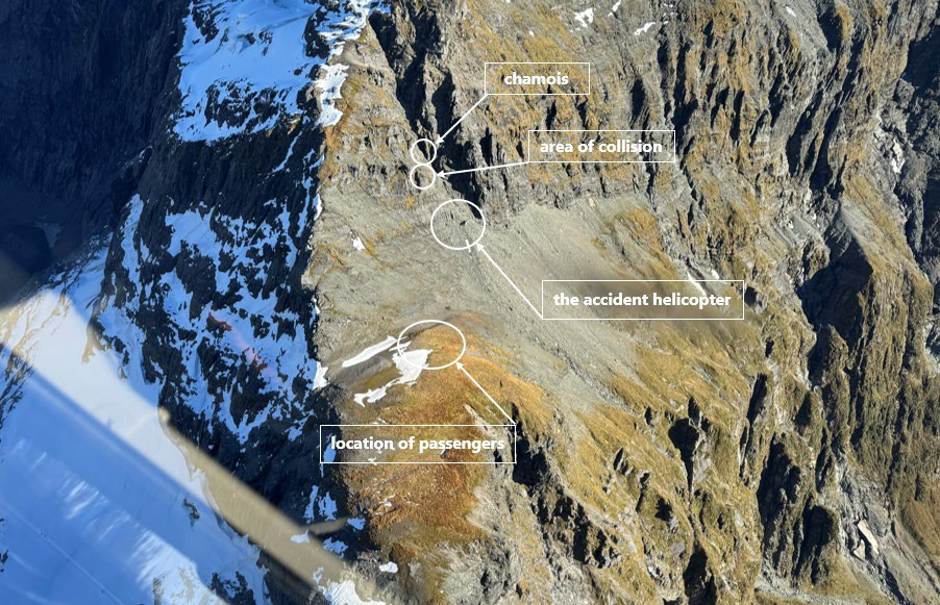
- The cockpit camera and the photograph taken by the witness indicated that the accident occurred at 0935.
- The second helicopter pilot then manoeuvred the second helicopter above the wreckage of the accident helicopter and was able to direct the second guide on the ground to the pilot and guide. The second guide radioed the second helicopter pilot, advising the status of the guide and the pilot and that neither had survived the accident.
- The second helicopter pilot immediately informed the operator of the accident, who activated their emergency response plan and contacted emergency services. At 0947 the Rescue Coordination Centre New Zealand (RCCNZ) was advised of the accident and initiated a response plan.
- The second helicopter pilot took five of the passengers off the mountain and returned them to Wanaka. The second helicopter and the second pilot were then stood down by the operator. The second guide, the hunter and one passenger remained on the mountain.
- Helicopters responding to the direction of RCCNZ collected the second guide, the hunter and the remaining passenger and transported them to an awaiting vehicle at Makarora. Later that day, members of the alpine cliff rescue team and NZ Police recovered the deceased.
- The RCCNZ later advised that an emergency locator transmitter (ELT) signal from the accident helicopter had not been received. Examination of the accident site and helicopter confirmed that the ELT had activated but a broken aerial had prevented a signal from being transmitted.
Aircraft information
- The accident helicopter, registration ZK-IJW, was an Airbus AS350-B3 helicopter, serial number 4735, constructed in 2009. It was powered by a Safran Arriel 2B1 turboshaft engine. The helicopter airframe hours at the time of the accident were 8618.
- ZK-IJW was issued with a non-terminating certificate of airworthiness in the standard category. An annual review of airworthiness had been completed on 7 August 2025.
Pilot information
- The pilot held a current medical certificate Class 1 and Class 2 and a Commercial Pilot Licence – Helicopter (CPL-H). They had approximately 6625 hours (h) total flying experience with 3570 h on type.