
A runway overrun shows why communication under pressure matters. During take-off, one pilot tried to avoid birds while continuing the take-off. The other believed a rejected take-off was underway and responded immediately by reducing power and braking. The report is about communication under pressure, and why standard procedures exist. Its lesson is simple and transferable: when intent is not clearly stated, even experienced crews can act at cross purposes.
Executive summary Tuhinga whakarāpopoto
What happened
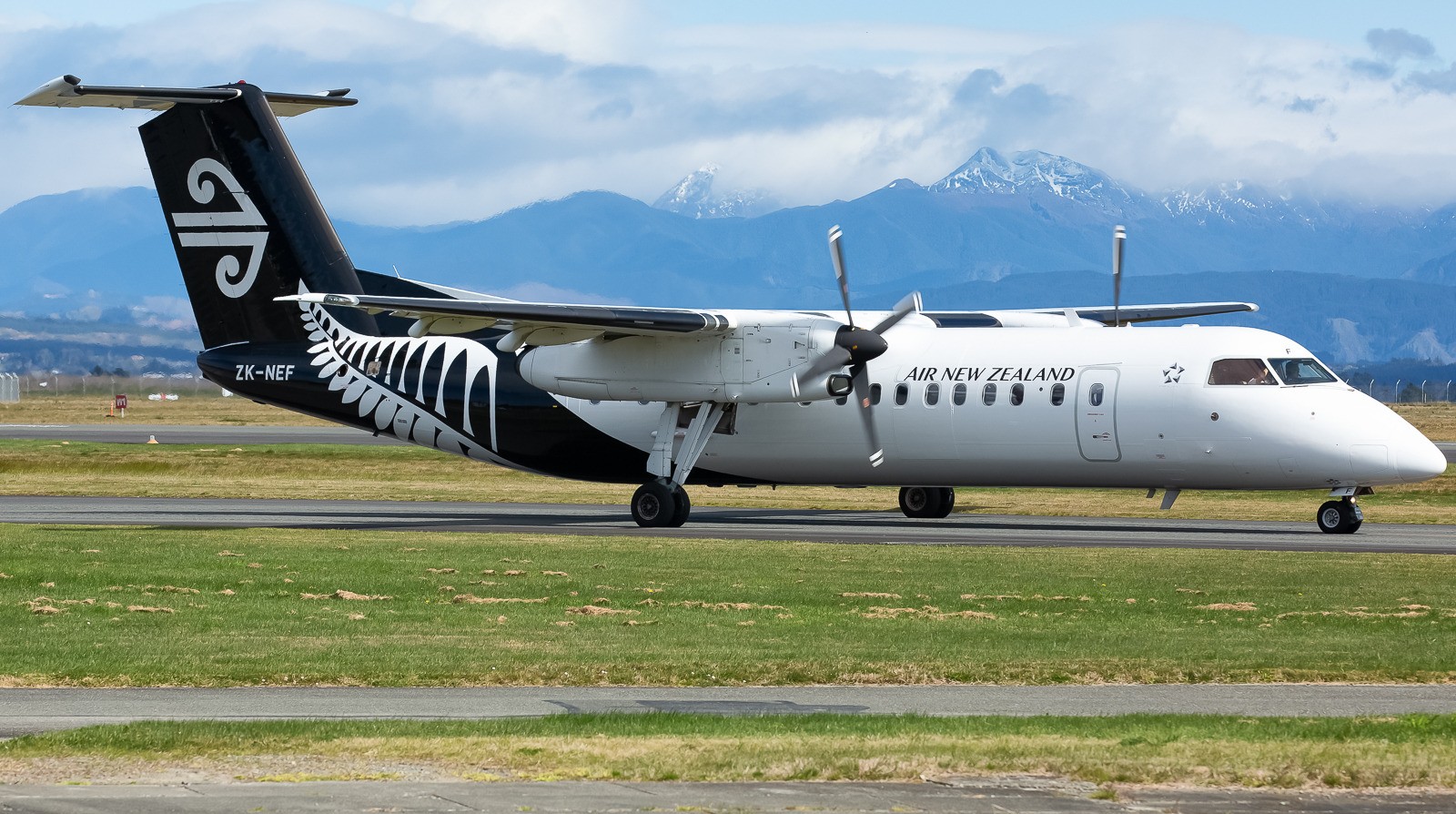
- On 7 February 2024, a De Havilland DHC-8-311 (Q300) aeroplane was taking-off from Timaru on a scheduled flight to Wellington. On board were 36 passengers and three crew.
- After accelerating past the maximum take-off rejection speed the first officer, who was the pilot flying, saw a flock of birds out to the right flying towards the take-off flight path. The first officer was concerned that the birds might strike and damage the aeroplane. The first officer intended to continue with the take-off and, to avoid the birds, moved the control column forward to reduce the rate of rotation and stay below the birds.
- The captain perceived the reduced rate of rotation as a lowering of the nose of the aeroplane and thought the first officer was rejecting the take-off. The captain immediately closed the power levers and started braking action.
- The aeroplane overran the end of the runway by about 5 metres (m). There was no damage to the aeroplane or injuries to the passengers or crew.
Why it happened
- The first officer prioritised avoiding the birds over flying the normal take-off profile. To achieve this the first officer reduced the rate of rotation of the aeroplane while still intending to continue with the take-off. This was not an approved or standardised procedure and was not communicated to the captain.
- The captain, on observing the first officer’s actions believed they were rejecting the take-off. The captain therefore immediately reduced power and started hard braking. Despite these actions, the aeroplane overran the end of the runway.
- There was a breakdown in communication between the two pilots, resulting in neither pilot having a correct understanding of the other’s intentions. The actions taken resulted in the take-off being rejected above the maximum permitted decision speed and the aeroplane overrunning the end of the runway.
What we can learn
- Crew resource management (CRM) is both a preventative and recovery risk control. To be effective it is dependent on clear, concise, consistent, correct and timely communication between crew members.
- The perceived consequences of a bird strike need to be factually based, to help ensure pilots take actions informed by presented risk.
- Standardised procedures enhance safety, by ensuring crew take consistent and reliable actions to minimise errors, mitigate risks and provide clear protocols for all phases of flight. Deviation from a procedure can have unintended consequences.
Who may benefit
- Pilots and operators may all benefit from the findings, safety issue and other safety lessons contained within this report. A breakdown in communication at a critical time can occur in any system in which people interact with technology. The discussion, findings and lesson relating to crew resource management and human factors may benefit other organisations outside aviation.
Factual information Pārongo pono
Narrative
- On Wednesday 7 February 2024 (times are in New Zealand Daylight Time (coordinated universal time (UTC) + 13 hours) and expressed in 24-hour format), a De Havilland DHC-8-311 (Q300) ZK-NEF (the aeroplane) operated by Air New Zealand (the operator) was scheduled to fly a regular air transport flight from Timaru to Wellington. On board were 36 passengers and three crew, comprised of two pilots and a flight attendant.
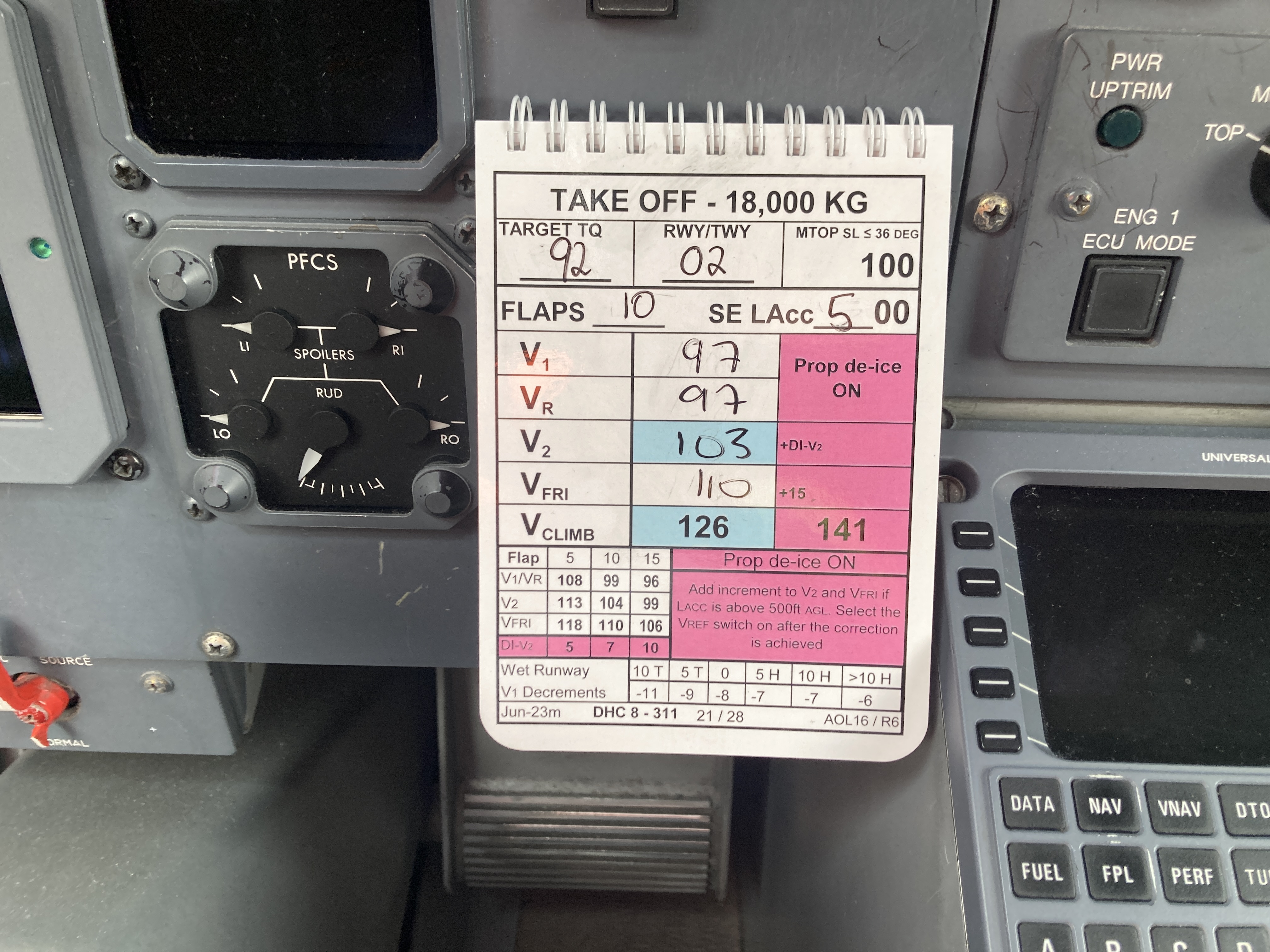
- The crew had overnighted in Timaru after landing there the previous evening. They arrived at the aerodrome at about 0540 to prepare for the flight. The pilots, after preparing the aeroplane, completed their take-off performance calculations and filled in the performance card (see Figure 3). The crew boarded the passengers and obtained air traffic control clearance for the flight to Wellington. The pilots agreed that the first officer (FO) would be the ‘pilot flying’ (the pilot responsible for controlling the aeroplane) for the flight and the captain would perform the duties of ‘pilot monitoring’ (the pilot responsible for monitoring the flight management and aeroplane control actions of the pilot flying and carrying out support duties such as radio communications and checklist reading). The captain was seated in the left seat and the FO in the right seat.
-
The FO, as the designated pilot flying, gave the take-off safety briefing, including the following statement:
Rejected take-off, either pilot may call ‘stop, stop’ and I’ll use the rejected take-off procedure. And any malfunction at or after V1 (V1 is the take-off decision speed (see paragraph 3.12 for more detail)), the take-off will continue. Anything critical, smoke, fire, – we’ll take that into the circuit (meaning return to land at Timaru).
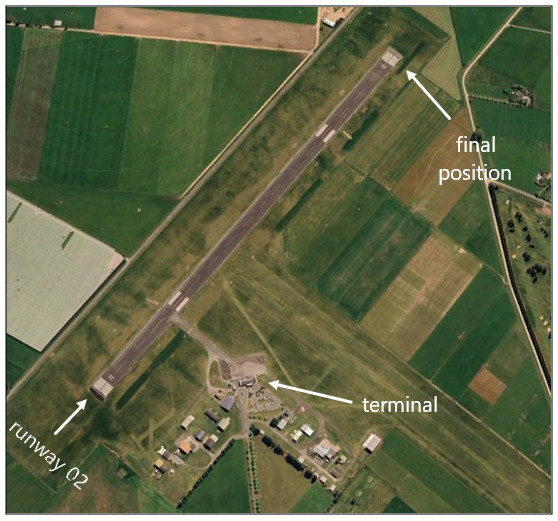
- The captain taxied the aeroplane from the terminal to line up on runway 02 (runways are referenced to the nearest 10° magnetic bearing. Runway 02 is on a bearing of 020°), the main sealed runway (see Figure 4). At 0648:52, the FO, after making the take-off and departure radio call on the local aerodrome frequency, took control of the aeroplane and advanced the power levers to start the take-off. The FO then called ’Set power’. In response, the captain fine-tuned the power setting while the FO focused on remaining aligned with the runway centreline. At 0649:13, the captain called ‘70 knots’ and the FO replied ‘Checked’ (a check that both airspeed indicator readings correlated. 70 kt is equivalent to 130 km/h).
- At 0649:17, as the airspeed indicator reached 97 knots (kt) (180 kilometres per hour (km/h)) the captain called ‘V1, rotate’. At this time the FO started pulling back on the control column with both hands (flying pilots are trained to use both hands on the flight controls to set the take-off attitude) to initiate the rotation towards the target take-off attitude of 9° nose up. At 0649:20, the FO observed a flock of birds to the right flying towards the take-off path and called ‘Oh no’ over the intercom (the intercom was voice activated and did not need a transmit button to be pushed). The captain replied, ’Keep going’.
- The FO, believing the birds might strike the aeroplane, reduced the rate of rotation resulting in a lower pitch attitude to stay below the path of the birds, but still planned to continue with the take-off. The FO did not communicate this action or their intended plan to the captain. At interview, the captain stated that they observed the reduction in the rate of rotation, perceived as the aeroplane nose lowering, and thought the FO was rejecting the take-off.
- At 0649:24, the captain retarded the power levers and started braking action. At the same time, the FO was recorded saying ‘Oh no no’, and the captain uttering an expletive. The aeroplane had accelerated to 114 kt (211 km/h), 17 kt above V1, before it started to decelerate under braking. The aeroplane was brought to a halt at 0649:34 with the nosewheel 4.7 metres (m) beyond the end of the runway but still on the bitumen (see Figure 5).
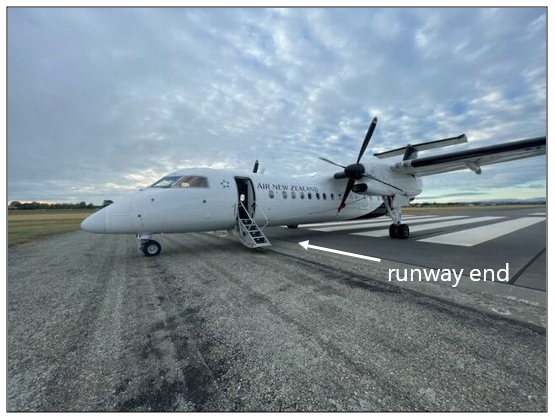
- The FO advised air traffic services that the runway was blocked. The crew then shut down the engines and isolated the flight data and cockpit voice recorders in accordance with the operator’s procedures. The passengers and crew were returned to the terminal by vehicles and the aeroplane secured to await the arrival of technical and investigative personnel.
- There was no injury or damage, but the main landing gear wheels and brakes were replaced as a precaution. The aeroplane was returned to service two days later.
Personnel information
- The captain joined Air Nelson (Air Nelson became fully integrated into Air New Zealand on 19 November 2019) in January 2017, having accrued some 1300 hours flying experience, including 230 hours on a multi-crew turboprop aeroplane. The captain obtained their Airline Transport Pilot Licence (Aeroplane) in October 2019 and captaincy qualification in May 2022. At the time of the occurrence the captain had accrued 4130 hours total flying experience, including 2813 hours on the Q300 aeroplane. The captain held a current Class 1 medical certificate, and reported they were in good health and fit for duty on the day of the occurrence.
- The captain’s training records, including their captaincy upgrade, were reviewed. The final upgrade assessment commented that the captain’s ‘check to line completed to a very proficient standard’, ‘displaying a high level of situational awareness and CRM (crew resource management) skills’. The captain’s last check was completed on 12 August 2023 with an overall result of ‘Proficient’. Additional comments included a ‘high standard of competence displayed with well managed challenging exercises. Runs a relaxed flight deck, ensures necessary tasks are completed and no unnecessary risks taken to complete flight’.
- The FO joined the operator, to fly Q300s, in January 2023. At the time of joining, the FO had a total of 1758 hours flying experience. This was mainly on single-engine aeroplanes with some limited multi-engine training experience but no multi-crew flying. The FO completed their conversion training and was cleared to flying duties in July 2023.
- The FO held a Commercial Pilot Licence (Aeroplane) issued in May 2018. At the time of the occurrence the FO had accrued 2042 hours total flying, including 276 hours on the Q300 aeroplane and a further 22 hours in the simulator. The FO held a current Class 1 medical certificate, and reported they were in good health and fit for duty on the day of the occurrence.
- The Commission reviewed the FO’s training records. During initial conversion training, several references were made regarding the FO’s ‘lack of experience’ and that one additional simulator training session was included. The FO was also given additional training before repeating their final simulator check ride, in which they were assessed as ‘proficient’.
- The FO’s line training (flying with an instructor during a routine commercial flight) records stated that the FO was ‘progressing as expected’ and passed their ‘clearance to line’ check on 5 July 2023. Following this the FO joined the pilot roster, which was interspersed with several simulator rides. Three of these rides were as ‘support pilot’ and a further three were for training and assessment. On 15 November 2023, the FO completed their scheduled 90-minute human factors (HF) course as part of the operator’s HF training programme (see paragraph 2.28).
Aircraft information
- ZK-NEF was a DHC-8-311 aeroplane manufactured by De Havilland Canada. It was a development in the ‘Dash 8’ series of aeroplanes and was known as (in 1992 the company was purchased by Bombardier. The Dash-8 series in production were the -100, -200 and the 1ne-300 series. Bombardier renamed the Dash-8 as Q300 for ’Quiet’. Bombardier ceased production of the Q300 in 2009 and in 2018/2019 Longview Aviation Capital bought the Dash-8 and Q400 type certificates from Bombardier and re-established production under the De Havilland Canada Limited (DHC) brand. From this date all DHC model type certificates, including the Q300, were held by the same company). It was a high-wing, pressurised aeroplane powered by two turboprop engines. It was configured for a two-pilot flight crew, one flight attendant and has a seating capacity of 50 passengers.
- The aeroplane could be flown from either seat. However, directional control while taxiing was via a tiller or hand control located to the left of the captain’s seat. If the first officer was the pilot flying when landing, the captain would take control as the aeroplane slowed below about 50 kt. The same principle applied during a rejected take-off.
- The operator’s Q300 aeroplanes were fitted with both a cockpit voice recorder (CVR) and a flight data recorder (FDR). The two recorders from the aeroplane were removed by Commission investigators and taken to the Australian Transport Safety Bureau (ATSB) in Canberra where they were downloaded. The recordings were confirmed to be of good quality.
Aerodrome and weather information
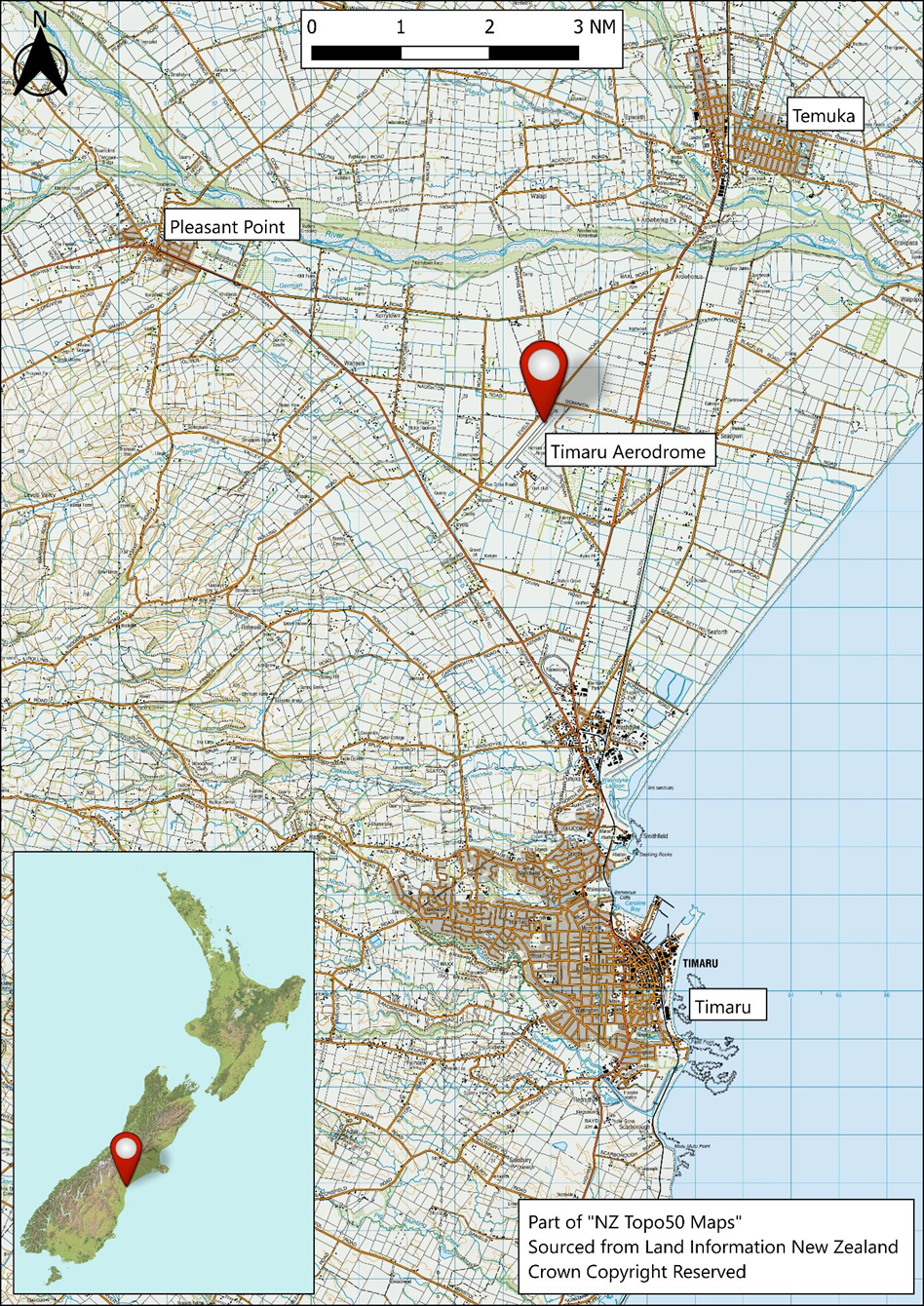
- Timaru is a certificated (an aerodrome is required to be certificated when it is used for regular international flights or regular air transport involving aeroplanes with a seating capacity greater than 30 passengers) unattended (no air traffic control service provided at the airfield) aerodrome situated 6 nautical miles (NM) (10 km) north of Timaru. The aerodrome consisted of one bitumen runway, aligned 02 or 20 (depending on take-off or landing direction), a parallel grass runway and a grass cross runway. The main bitumen runway was 1280 m long and 45 m wide.
- The runways were surrounded by mown grass with farm paddocks out from the boundary. The boundary fence was 160 m from the end of runway 02.
- Birds were a known hazard at the aerodrome, especially in late summer and cropping time. Civil Aviation Rules (CARs) required certificated aerodrome operators to have a ‘wildlife hazard management’ plan (Civil Aviation Rules 139.71, ‘Wildlife hazard management’. https://www.aviation.govt.nz/rules/rule-part/part-139/subpart-b/#P139.71). The bird hazard risk was regularly reviewed using local information and recent bird-strike and near-miss reports provided by the Civil Aviation Authority of New Zealand (CAA) and the operator. The aerodrome operator had assessed the bird hazard as ‘low and steady’ for most of 2023, rising to ‘low and increasing’ at the end of the year and returning to ‘low and steady’ in January 2024.
- The aerodrome operator’s bird-management plan included the use of two fixed gas cannons set to fire at regular intervals and a combination of mobile pyrotechnics and shotguns. For noise abatement the gas cannons operated between 0900 and early evening only.
- On the morning of the incident, about 30 minutes before departure of the aeroplane, the person conducting the runway inspection also observed some birds near the runway. The aerodrome manager reported that some pyrotechnics were used to disperse these birds.
-
The operator’s Q300 route guide, part 2, noted for Timaru:
Plovers frequent on the aerodrome.
Black-backed gulls observed when cropping occurs on surrounding farmland.
- The incident occurred during daylight hours. The crew reported the weather was fine with little or no wind. The runway was dry. This observation was supported by several witnesses and the aerodrome operator’s closed-circuit television (CCTV) recordings taken at the time.
Organisational information
Pilot training
- With the return to unrestricted operations after Covid-19, the operator started an expansion of its operations across its various fleets of aircraft. This involved extensive recruitment and training programmes. The operator’s internal investigation report into this occurrence noted that ‘pilots join the fleet with comparatively less experience than they had historically’. The combined recruitment, experience levels and training programmes placed additional demands on the operator’s training resources, including the requirement for CRM and HF training.
- The operator’s specific CRM and HF training programme for Q300 pilots was conducted in four parts:
- Introduction course (one day) – completed as part of the pilot’s initial aircraft technical course
- Awareness course (two days) – completed within the first year of line flying
- Refresher training (90 minutes) – conducted annually
- Upgrade course (one day) – completed as part of command upgrade training.
- Training covered the typical human factors topics required for airlines operating under CARs Part 121, ‘Air Operations Large Aeroplanes’ and detailed in CAA’s Advisory Circular AC121-4 (Civil Aviation Authority, 2013). These included information processing, situational awareness, leadership and teamwork, decision-making, communication, threat and error management, stress and fatigue, social influences and just culture.
- During simulator and line-training exercises, the operator also assessed the ability of pilots to operationalise their CRM/HF knowledge. Non-technical skills were a core component of flight training and checking. The operator graded pilots on their non-technical skills ability. Poor scores against behavioural markers (application of procedures, communication, flight path management – automation, flight path management – manual, knowledge, leadership and teamwork, problem solving and decision making, situational awareness and workload management) could lead to a pilot failing a check or assessment flight even if they had flown the aeroplane within technical tolerances.
Analysis Tātaritanga
Introduction
- A ‘runway excursion’ is when an aircraft departs the runway in use during either take-off or landing. This occurrence was specifically defined as a ‘runway excursion (overrun)’ as the crew could not stop the aeroplane within the runway area during a rejected take-off and it overran the end of the runway (the other type of excursion is a ‘veer-off’, in which an aircraft departs the side of a runway or taxiway).
- Runway excursions during take-off or landing continue to dominate aviation accident statistics, with crew performance being a major contributor. A study by the ATSB found that runway excursions, including overruns and veer-offs during take-offs and landings, continue to ‘dominate as the primary cause of commercial hull losses (Australian Transport Safety Bureau, 2009, April).
-
A study by a consortium of European regulators, operators, aircraft manufacturers and universities found that runway excursions remained the most common type of reported accidents and the number had remained consistent over the last 20 years (Future Sky Safety, Post J. A, 2015, 14 December). The study used a taxonomy of 31 standard descriptions to describe the causal factors contributing to veer-off occurrences. The leading 16 factors by frequency were listed as:
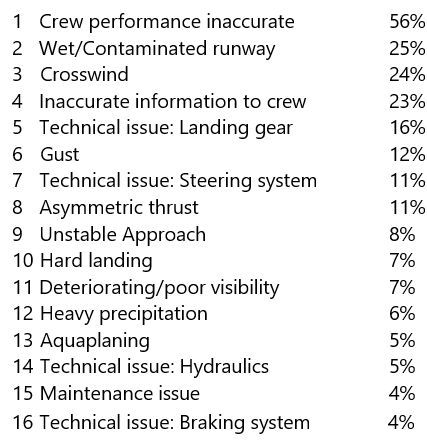
The remaining 15 factors rated 3% or less.
-
The study made the following comments regarding ‘crew performance inaccurate’:
This causal factor is observed in more than 50% of the occurrences for both landing and take-off. This factor was allocated to all occurrences where it was observed that action(s) or lack of action of the crew contributed to the occurrence of the veer-off. This causal factor comprises a wide range of crew handling from (in rare events) crew errors to (in most cases) non-optimal response for the situation… - More recently, the International Civil Aviation Organization’s (ICAO’s) Global Aviation Safety Plan 2023–2025 identified runway excursions as one of the top five high-risk categories of occurrences (International Civil Aviation Organization, 2022).
- The following section analyses the circumstances surrounding the event to identify those factors that increased the likelihood of the event occurring or increased the severity of its outcome. It also examines any safety issues that could adversely affect future operations.
What happened
- During a routine take-off in good weather conditions, the FO became concerned about a flock of birds approaching the take-off path of the aeroplane from the right. The FO called out ‘Oh no’. The captain had also seen the birds and thought they understood what the FO was expressing. In response, the captain, aware the aeroplane had passed V1, replied with ‘Keep going’.
- The FO said at interview that they were aware they had passed V1 and was adamant there was no intention of rejecting the take-off. However, the FO was becoming increasingly worried about the potential serious damage a bird strike could cause. To mitigate this risk, the FO intended to continue with the take-off but remain below the birds by reducing the rate of rotation of the nose of the aeroplane.
- The FO did not communicate this plan to the captain. The captain said they observed the reduction in the rate of rotation and thought the FO was rejecting the take-off. The captain, aware that time was critical, immediately retarded the levers, applied reverse thrust and started heavy braking.
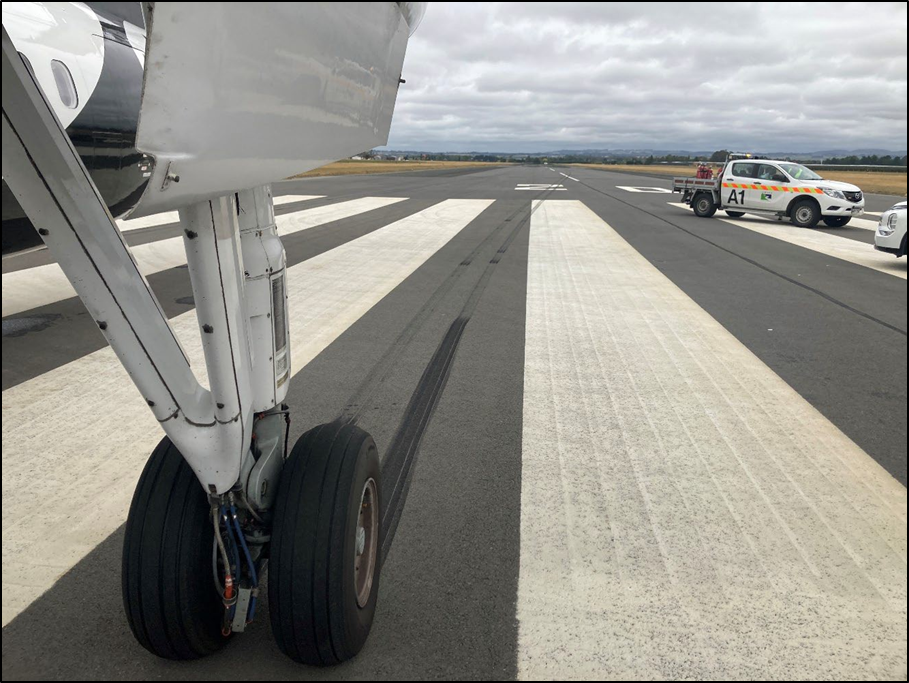
- The anti-skid system functioned as designed with both main wheels starting to lock up several times but then releasing, resulting in some skidding as the aeroplane slowed to a stop. The anti-skid activation was not fully symmetrical and so the aeroplane started to deviate right of the centreline by 2–3 m before the captain was able to correct this movement (see Figure 6).
- The aeroplane travelled 4.7 m past the end of the designated runway area but remained on the sealed bitumen overrun.
V1 take-off decision speed
- Civil Aviation Rules define V1 as the take-off decision speed (CARs Part 1, ‘Definitions and Abbreviations’). It is the maximum speed during take-off at which the pilot must take the first action to reject take-off (like reducing thrust or starting to brake) ensuring the aeroplane can stop within the available runway distance. Above this speed a pilot must continue with the take-off as there will be insufficient runway available to stop safely.
- The V1 speed is calculated for each take-off and is based on runway length, aircraft weight and environmental conditions. For the take-off from Timaru on 7 February 2024, the V1 speed was calculated as 97 kt. This was also the VR or rotate speed, the speed at which the flying pilot would start pitching up (rotating) the nose of an aeroplane to the take-off attitude.
- When interviewed by the Commission, both pilots were able to clearly articulate what V1 was and the procedure for a rejected take-off (see Figure 7). They were also aware of the circumstances in which a rejected take-off could be initiated and the requirement to continue with a take-off after passing V1.
- For the Q300, the target take-off pitch attitude was 9°, displayed on the attitude indicator on the instrument panel. The FDR recorded the pitch attitude reaching a maximum of 6.3° before starting to lower. The pitch attitude then lowered at a faster rate. The FDR also recorded that the aeroplane was still on the runway at this time but the weight on the main landing gear was reducing. The aeroplane was about to become fully airborne.
-
The captain, on observing the rate of rotation reducing believed that in the limited time available they could either allow the FO to continue with the rejected take-off, attempt to take control and continue with the take-off, or immediately retard the power levers and start heavy braking. The captain chose the last action as they knew they could react faster; their right hand was still on the power levers while both the FO’s hands were on the flight controls. Any further delay could have resulted in a significant overrun of the runway (at 114 kt and accelerating, the 160 m from the end of the runway to the fence would have been traversed in about two seconds or less).
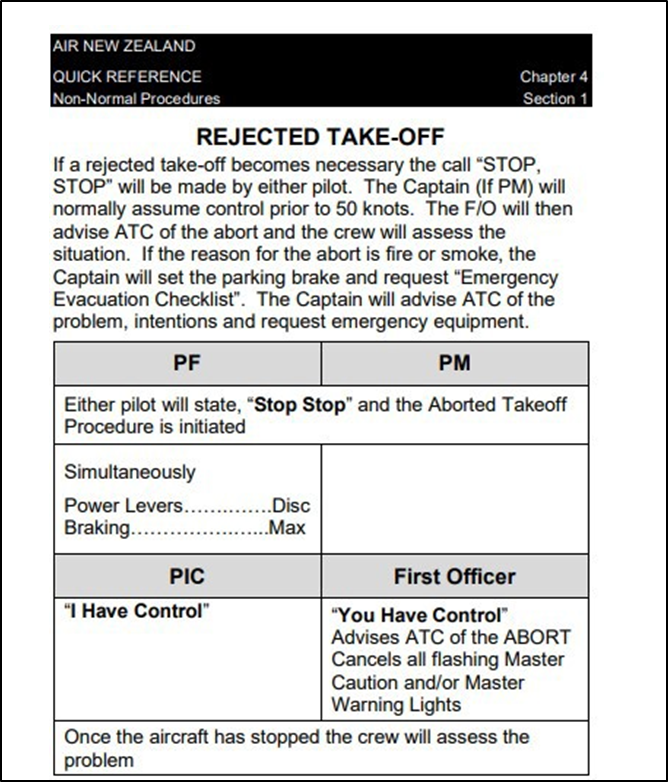
Figure 7: Rejected take-off procedure (Credit: Air New Zealand)
Bird strike hazard
- The FO reported that they were concerned about the consequences of a bird strike, especially if a bird struck the windscreen. This concern was repeated by the operator, who commented that for some Q300 pilots the perception of the threat to flight safety posed by birds is higher than it actually is. This perception suggested that some pilots were overestimating the damage or risk that a bird strike might cause.
- The Commission reviewed data on rejected take-offs for all of the operator’s aircraft types over the five years preceding the 7 February 2024 occurrence. There was a total of 163 rejected take-offs across the entire fleet. Most rejected take-offs were for technical reasons, for example engine performance. The data also showed that in 43 of the 163 rejected take-offs, birds were cited as the reason for rejecting the take-off. All but two involved either the Q300 or the ATR72. Between 30% and 33% of these were determined to be within 20 kt of reaching V1. Two reports, both involving ATR aeroplanes, recorded the speed at which the take-offs were rejected as ‘just prior to V1’. In neither case did a bird strike occur.
- The damage a bird strike could inflict on an aircraft (aeroplane and helicopter) is dependent on several variables, including the speed of the aircraft, the mass and number of birds, the type of aircraft and where a bird strikes on an aircraft. Aircraft speed and the mass of the bird are inter-related; the faster the aircraft or heavier the bird, greater the impact force (for a more detailed description of impact variables and forces see Transport Canada (2004)).
- The location and effect of a bird strike can be influenced by the aircraft type. For example, turbofan- versus turboprop-powered aeroplanes, such as a Boeing or Airbus versus a Q300. The risk of a bird being ingested into an engine resulting in a power loss is greater for a turbofan aircraft because, unlike a turboprop, a bird can directly enter the engine and not have to pass through the propellor arc.
- While an engine is designed to be capable of ingesting a small- or medium-sized bird with minimal consequences, the ingestion of a large bird or multiple birds can result in significant damage (see SKYbrary, n.d.). For example, on 15 January 2009 an Airbus A320 was forced to ditch into the Hudson River, New York, after the aircraft struck a flock of Canada geese, causing both engines to fail. The ditching was successful; of the 155 persons on board, there were 5 serious and 55 minor injuries but no fatalities (National Transportation Safety Board Accident Report NTSB/AAR-10/03).
- While there is a greater potential for a bird strike closer to the ground, aircraft speed is slower when taking off or landing. Therefore, the risk of significant damage is less when compared to cruise flight, including for a bird striking the windscreen. Had a bird strike occurred, it was considered very unlikely that it would have penetrated the flightdeck or been ingested into an engine. The aeroplane’s design and performance characteristics meant that even with the loss of an engine it should still have remained controllable. This would have allowed the crew to return and land at Timaru without further damage or injury.
-
Initial conversion and subsequent continuation training for the operator’s Q300 fleet pilots included practising engine failures at various phases of flight. The failure of an engine on take-off, either for mechanical reasons or a bird strike, formed part of that training.
- The operator’s internal investigation and report into this occurrence stated that crew training did not focus on ‘the threat of birds to the aircraft, only on administrative action following a bird strike or near strike’, including submitting an internal air safety report. The report noted that no specific bird awareness training existed and the Q300 simulator was not capable of simulating birds. This was planned to be addressed in a simulator upgrade programme. Scenario-based bird awareness training provided to ATR72 pilots would be given to Q300 pilots.
- Further, the report stated that: ‘As pilots join the [Q300] fleet with comparatively less experience than they have had historically, this training will become more important, as bird awareness and risk analysis has largely been an assumed skill’.
- The FO, concerned about the risk of a bird strike, reduced the rate at which the nose of the aeroplane was being raised or pitched up. The maximum pitch angle achieved was 6.3°compared to the normal target take-off pitch attitude of 9°. At interview following the occurrence, the FO advised that they had heard of this action before. The operator’s internal report identified one other occasion on which the normal departure flight path had been altered to avoid birds.
- Reducing the rate of rotation to avoid a bird strike was not a procedure taught or endorsed by the operator. It was a non-standard action that the captain confirmed they did not expect.
- The climb performance of an aircraft for any departure is calculated to ensure that all obstacles in the departure flight path are cleared by a specified minimum safety margin. To achieve this, the aircraft must be flown at specific speeds and attitudes. If these are varied, the climb path and obstacle clearance cannot be guaranteed. While the topography around Timaru is relatively benign, the departure flight path from airfields such as Queenstown or Wellington would be more critical.
- To mitigate the risk of a bird strike pilots practised ‘engine out scenarios in the simulator to equip crews with the skills to deal with birds being ingested into the engine’. The operator stated, ‘there was no evidence of a widespread culture of adjusting take-off path for birds and is not something taught by the operator.’
-
On 14 May 2024, the operator issued an internal memorandum Bird Strike Risk & Decision Making to all Q300, ATR72 and A320 pilots and simulator instructors. The memorandum reminded pilots of the threat birds pose around aerodromes, and that any pilot action in response to this threat needs to be carefully considered to avoid increasing risk to safety in other areas. The memorandum gave guidance on relevant considerations including performance considerations, destabilising an approach and runway excursions. The memorandum stated that:
Pilots should:
-
be go minded in the high-speed phase (>70 kts Q300/ATR72, >100kts A320) of the take-off (there are very few instances where the bird strike threat is greater than the risks of a high-speed reject)
-
not delay take-off rotation after VR or manoeuvre in response to birds below acceleration altitude
-
not adjust the approach path below the stable gate in response to birds (unless commencing a go-around).
Crew resource management and human factors
Safety issue: There was a breakdown in communication between the two pilots, resulting in neither pilot having a correct understanding of the other’s intentions. The actions subsequently taken resulted in the take-off being rejected above the maximum permitted decision speed and the aeroplane overrunning the end of the runway.
Communication
- Runway excursions during take-off or landing continue to dominate aviation accident statistics, with crew performance being a major contributor. A crew needs to be functioning effectively to ensure an aircraft is flown as accurately as possible during these two critical phases of a flight.
- The FO, in response to their perception of a threat of bird strike, intended to continue with the take-off but fly a lower take-off profile. The FO did not communicate this to the captain. Consequently, there was an incorrect understanding of the others’ intentions between the two pilots at a critical phase of the flight. The origin of this breakdown in communication started earlier in the take-off sequence.
- Some three seconds after passing V1, both the captain and the FO saw the flock of birds approaching the runway from the right. The FO said, ‘Oh no’ and the captain replied with ‘Keep going’. While the captain may have thought they understood what the FO was saying, a clearer articulation by the FO of their intention would have assisted. For example, ‘Birds approaching, continuing’.
- While the captain acknowledged the FO’s comment, as a captain they could have more clearly and forcefully stated the requirement to continue with the take-off. For example, ‘Roger, continue take-off’. This would have ensured both pilots knew the other was aware of the potential threat and what action was planned.
- Reducing the rate of rotation resulting in a lower pitch attitude to stay below the birds was a non-standard and unpredictable action that, because of the phase of flight, required a time-critical response. Communication of this plan to the captain would have meant the captain had the option to either direct the FO to not reduce the rate of rotation, immediately reset the take-off attitude to allow the FO to continue as planned, or take over control and continue with the take-off.
- As the aeroplane was being slowed, both pilots were still providing control input. Only after coming to a stop did the captain state that they had control. While the two pilots worked in concert to bring the aeroplane to a stop, the captain should have instructed the FO that they had control as soon as they started the rejected take-off, thereby reducing the potential for any further misunderstanding.
Crew resource management and human factors
- There was a breakdown in CRM and communication between the two pilots, resulting in neither pilot having a correct understanding of the other’s intentions. This occurred during one of the most critical phases of the flight and resulted in a runway overrun.
- The operator’s report into this occurrence commented that pilots were joining ‘with comparatively less experience than they have had historically’. As a result, training had become more important.
- The captain had some 2800 hours flying experience on the Q300 spread over nearly seven years. By comparison the FO’s Q300 and multi-crew experience was limited to the 276 flying hours accrued since completing conversion training seven months earlier. This meant that, initially at least, the FO was heavily reliant on their training, in particular CRM and HF training, to help ensure they operated effectively in a crew environment (see paragraphs 2.26 to 2.29).
- In summary, a crew needs to function effectively to ensure an aircraft is flown as accurately as possible during these two critical phases of a flight. Training, especially CRM training, is about optimising human performance and crew interactions, focusing on communication, leadership and situational awareness. Communication between pilots needs to be clear, concise, consistent, correct and timely to ensure the safe operation of an aircraft (see Good Aviation Practice (GAP) booklet Plane Talking (Civil Aviation Authority of New Zealand, 2009)). If used as intended, CRM can then be an effective tool in threat and error prevention, detection and recovery.