On 4 September 2010 the pilot of a Walter Fletcher aeroplane (the aeroplane) with eight parachutists on board lost control during take-off from Fox Glacier aerodrome. The aeroplane, registered ZK-EUF, crashed in a paddock adjacent to the runway, killing all nine occupants. On 9 May 2012 the Transport Accident Investigation Commission (Commission) published Final Report 10-009 (final report) on its inquiry into the causes and circumstances of the accident. The Commission was not formally requested to re-open its inquiry, nor did any party offer any new and significant evidence that the Commission had not already considered in its initial inquiry. However, on 15 April 2014 the Commission decided to “review the evidence relating to its findings as to the causes and circumstances of the accident, including evidential matters that have arisen since the publication of its report into the matter”.
Re-examination of the wreckage
General
- Following the examination of the accident site in September 2010, a substantial part of the wreckage, including the cabin floor and lower fuselage that had been completely destroyed in the fire, was released by the Commission and subsequently buried nearby. The Commission removed the remainder of the wreckage, which included the engine and propeller, the cockpit and all of the tail, from the accident site for further inspection and analysis. These parts were returned to the owner at the completion of the inquiry. The buried wreckage was exhumed on 1 March 2014 for the television documentary, and later returned to the owner. The Commission reclaimed all of the available wreckage on 14 April 2014.
- Four persons, who were not involved with the initial site investigation, examined every item of the reclaimed wreckage on 5 and 6 May 2014, at the Commission’s facility near Wellington. Special attention was given to those items that could affect pitch attitude (as used in this report, pitch attitude is an aeroplane’s climb angle) control and engine power, in particular:
- whether a fracture in the aeroplane control stick existed prior to the accident
- whether the control stick was inadvertently locked for the take-off
- whether the setting of the horizontal stabiliser trim at take-off was a factor contributing to the accident
- whether the power setting at take-off was a factor contributing to the accident
- whether any mechanical failure contributed to the accident.
- The wreckage re-examination was subject to the following limitations:
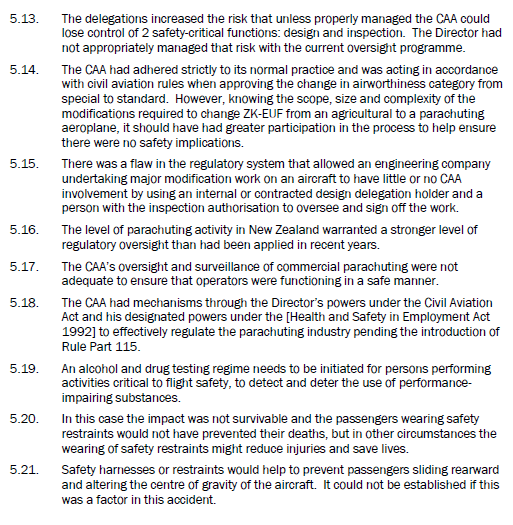
- it was not possible to recreate accurately the layout of the wreckage as it was at the scene of the accident, although photographs of the wreckage in situ were available (see Figure 1)
- most of the aeroplane was affected by the fire, which destroyed some components
- it was very likely that some components were damaged further when the wreckage was moved (three times since the accident) and/or as a result of it being buried for three and a half years
- the aeroplane owner had disconnected some components in order to transport and store the wreckage
- not all of the components were located.
Control stick
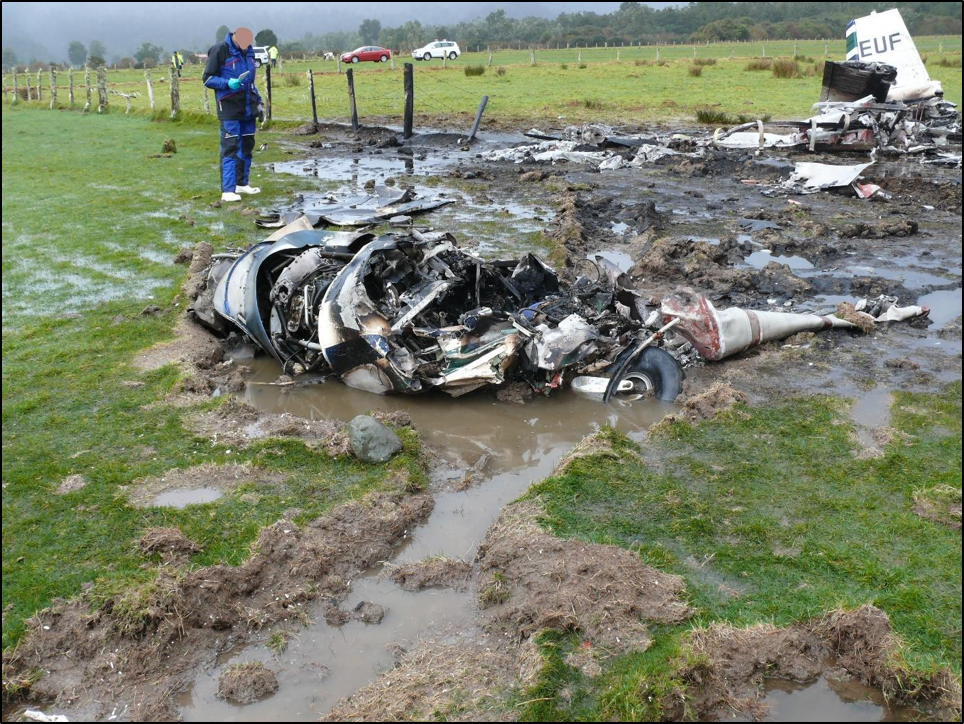
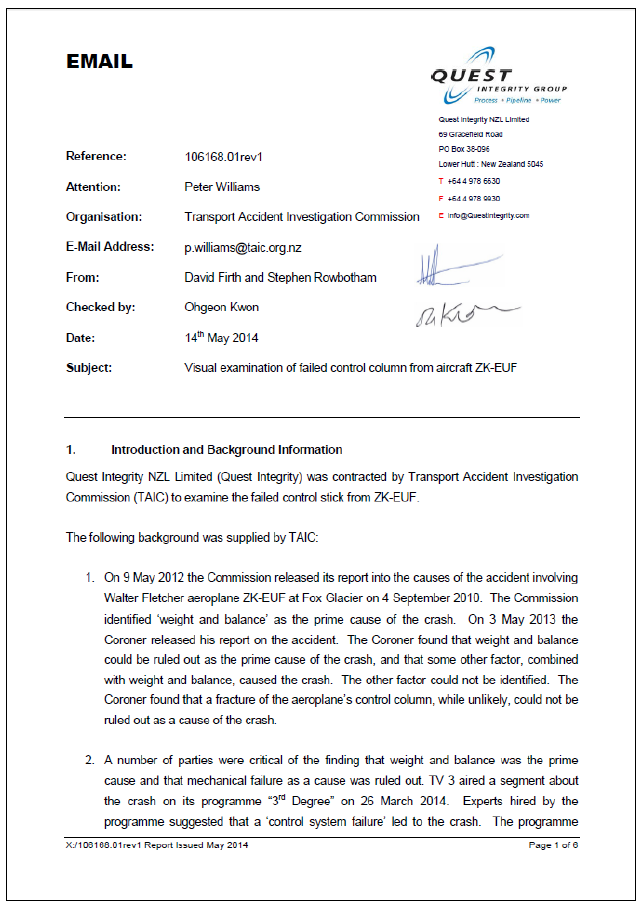
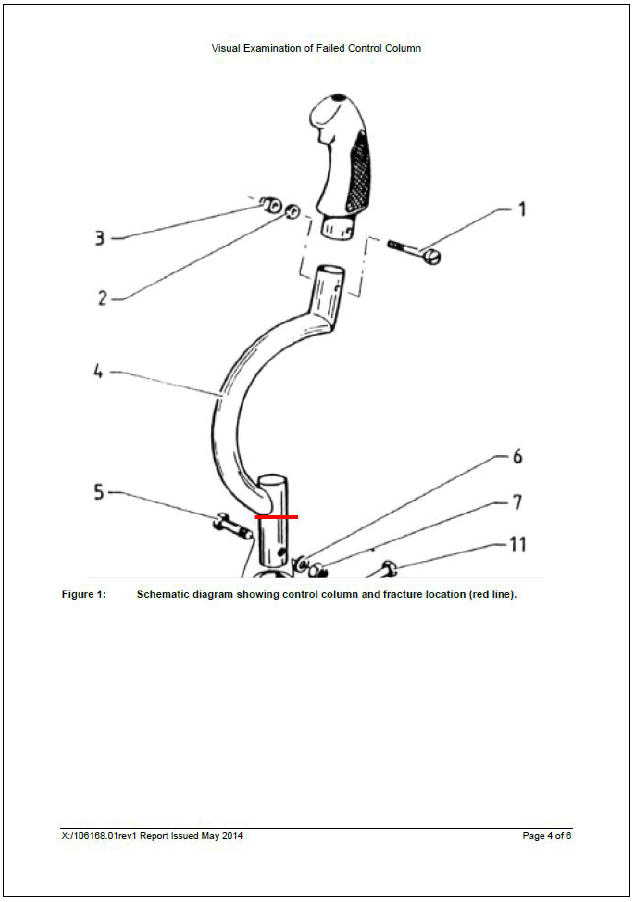
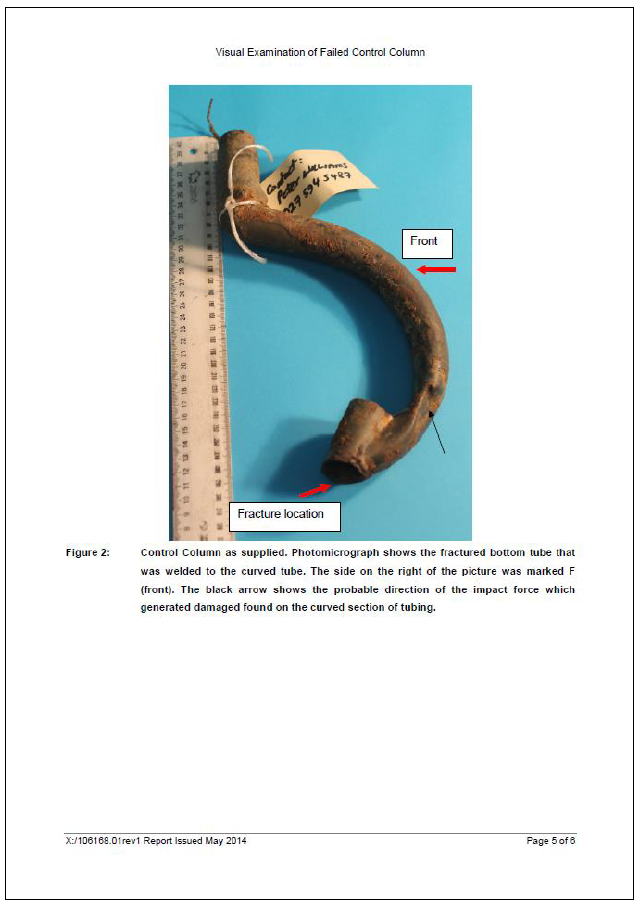
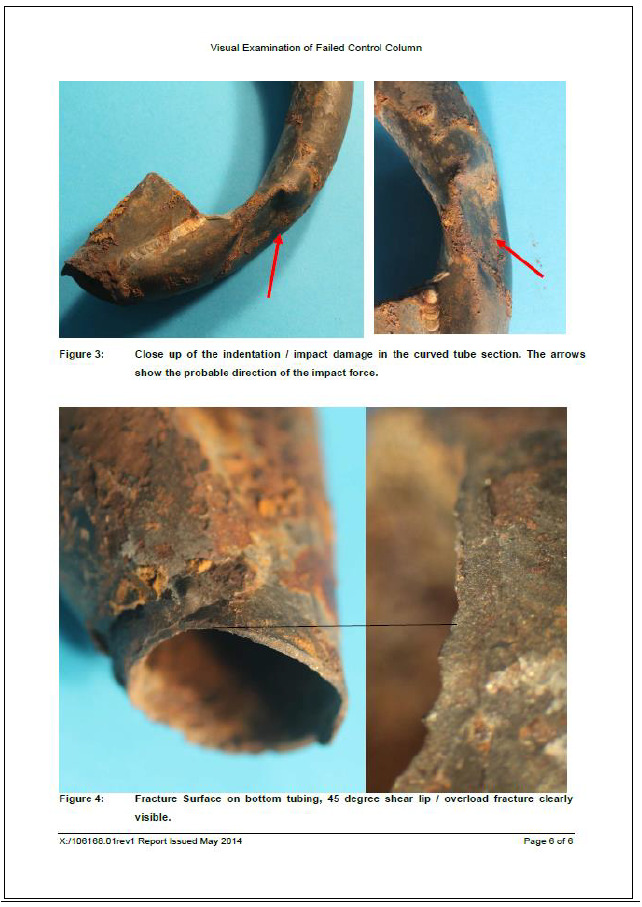
- At the accident site, the investigator in charge determined by visual examination of the fracture surfaces that the control stick had broken in the crash, but that conclusion was omitted from the final report. An independent metallurgist who examined the control stick as part of the review determined that the failure was typical of “tensile overload” (that is, forces that had exceeded the material strength) and was “consistent with damage occurring as a result of the accident”. He found that the fracture “did not occur as a result of fatigue or any other pre-existing defect” (see Appendix 2). The wreckage re-examination showed that the control stick had struck the rudder pedal assembly during the crash (see Figure 2).
- The Coroner’s inquest was told of two other control stick failures. One of them, on a Walter Fletcher, originated near a wiring hole and was caused by improper maintenance. The other involved a different aeroplane type with a different control stick design. These events did not indicate a potential systemic issue with the Walter Fletcher control stick.
Control stick lock
-
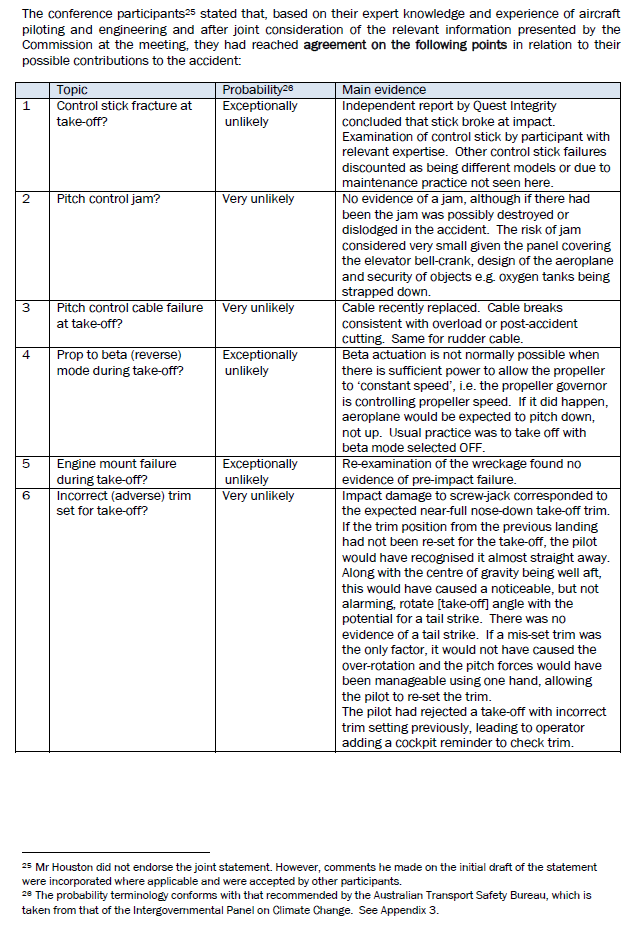
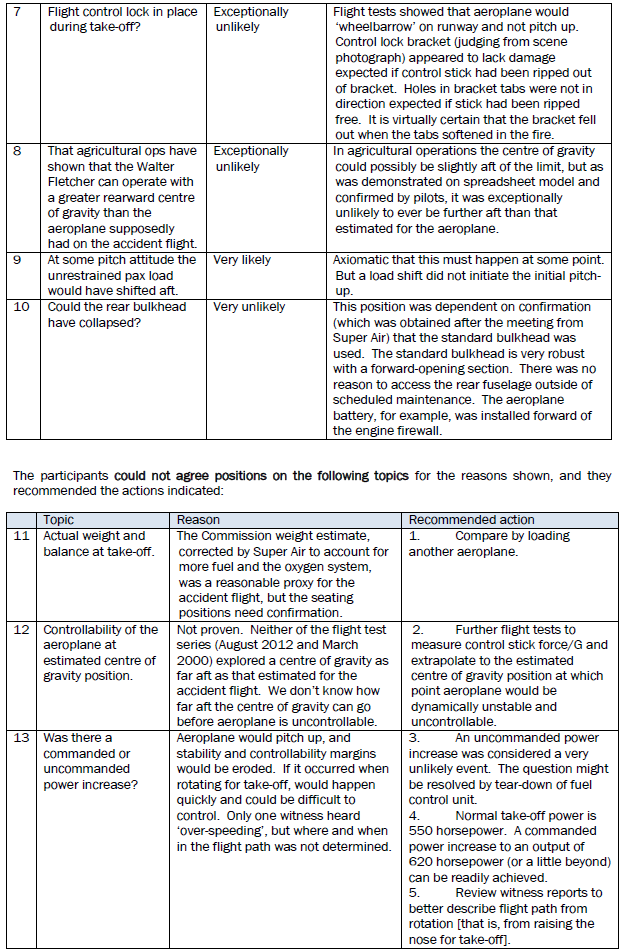
The final report stated that the possibility of the pilot having commenced the take-off with the control stick lock in place was unlikely, but it was not excluded (TAIC, 2012, paragraph 4.2.9). Flight tests conducted by Super Air Limited in August 2012 confirmed that the aeroplane nose could not be raised for take-off when the control stick was locked in the forward position.
- The lock was not recovered during the initial site investigation or during the exhumation of the buried wreckage. However, during the review the lock was identified in a photograph that had been taken on site. The lock was not completely visible in the photograph, but an analysis of the dimensions indicated that the steel lock was not distorted, which one would expect to see if great force had been applied by the pilot to free a locked control stick.
- The brackets that had attached the control stick lock to the horizontal bulkhead in the cockpit were received with the recovered wreckage. The final report referred to holes in the brackets having been “torn open” (TAIC, 2012, paragraph 3.2.6), this having “most likely occurred during the impact” (TAIC, 2012, paragraph 4.2.10). A further examination of the brackets showed that the damage had been caused by the steel control stick lock having pulled (under the effect of gravity) through the aluminium brackets, which had been softened in the fire that followed the crash. That finding showed that the lock was not connected at impact.
The horizontal stabiliser trim setting
- The aeroplane was controlled in pitch by movement of the horizontal stabiliser, although the report used the more usual term, ‘elevator’. Unlike most light and medium-weight aeroplanes, the Fletcher does not have an elevator hinged to a fixed tail plane. Instead, when the pilot moves the control stick forwards and backwards, the complete horizontal stabiliser moves. By adjusting a trim tab attached to the stabiliser, the pilot can reduce the effort required to hold the control stick in that position.
- The horizontal stabiliser trim tab screw-jack was bent at a position that was confirmed, by comparison with a similar aeroplane during the wreckage examination, to correspond with the cockpit trim position indicator having been about halfway between neutral and fully nose down at impact. A substantially nose-down trim was normal for a take-off with four tandem pairs on board.
The engine power setting
- The Coroner’s inquest was told that Walter Fletchers had experienced uncommanded power increases in the past because of fuel control unit malfunctions, the inference being that such a failure could have caused or contributed to the loss of control at take-off.
- An independent New Zealand-based aircraft maintenance engineer with considerable experience of Walter engines told the review that he knew of no case in which the Walter engine fuel control unit had failed and caused an uncommanded application of full power.
- The manufacturer of the engine, GE Czech, advised that it was “unaware of any method for an uncommanded power increase within the fuel control unit of the M601D engine model. The fuel control unit limits [the maximum] operating speed and it is equipped with mechanical failsafe”.
-
GE Czech also wrote that, as the engine and accessories had not been inhibited for nearly four years:
… the engine and controls will likely have environmental damage (rusting, pitting, etc.) from exposure. It would be difficult to distinguish this type of post-accident damage from any pre-existing damage. Also, disassembly of the hardware may cause additional damage which may also be difficult to distinguish from pre-existing damage or may mask or destroy pre-existing damage. For these reasons, any further investigative work will be difficult and may be inconclusive.
- The re-examination of the propeller damage confirmed that the engine had been delivering high power at impact. For this reason, and noting the advice from GE Czech that the fuel control unit could not cause an uncommanded increase in power, a further examination of the engine and its accessories was not undertaken.
Other flight control system failures
- The wreckage re-examination did not disclose any evidence of pre-existing mechanical damage or failure. However, the limitations of the re-examination (refer paragraph 3.1.3) cannot be overlooked.
- Before the wreckage re-examination took place, the review considered the 28 flight control system defects on Fletcher aeroplanes that had been notified to the CAA between 2005 and 2014. None of the defects was relevant to the circumstances of this accident.
- The elevator cables with attached turnbuckles were examined. Not all of the elevator system pulleys were recovered. The elevator mass balance assembly weight of about 19 pounds (8.6 kilograms) was within the maintenance manual limit for the assembly. No evidence was found of pre-impact damage or jamming within the elevator control system.
Other mechanical failures
- The failure of an engine mount was mentioned at the Coroner’s inquest as a possible cause of the loss of control, because a failed mount would likely alter the engine thrust line. One of the aeroplane’s engine mounts had fractured, but that was an overload fracture that was almost certainly a result of the crash. The CAA database included seven notifications of previous Fletcher engine mount defects. These were considered prior to the wreckage re-examination and none was found to be relevant to the circumstances of this accident.
Flap setting
- Neither the investigation notes held on file nor the final report referred to the flap setting of the aeroplane during the take-off or at impact. The flap setting was not reported by any witness and could not be determined at the wreckage re-examination.
Controllability of the aeroplane with a rearward centre of gravity
- The review accepted that the actual weight of the aeroplane at take-off, although over the maximum permissible weight for the ‘normal’ certification category, was not a critical factor in the accident, as the Fletcher aeroplane was known to perform well at the much heavier weights permitted in the agricultural role. In the agricultural role, the centre of gravity generally remained within the permitted range. The key issue for controllability was the location of the centre of gravity.
- Many participants in the parachuting industry disagreed with the Commission’s finding that the rearward centre of gravity “would have caused serious handling issues for the pilot and was the most significant factor contributing to the accident” (TAIC, 2012, finding 5.7). Their rejection of the finding was partly based on the fact that the aeroplane (like other Walter Fletchers used for parachuting) had flown with similar loads on more than 70 occasions without any reported control issues during take-off.
- The Coroner’s inquest heard of flight tests conducted in August 2012, after the Commission’s final report was published. The purpose of these tests, conducted by Super Air, was to evaluate the pitch control characteristics of the Walter Fletcher, and to determine whether (paraphrased from Super Air report A401-02R, August 2012, p.1):
- the pitch control forces [primarily the use of the stabiliser] could override the pitch trim control
- an excessively steep climb with take-off power was predictable and manageable
- the pitch could be controlled from a nose-high attitude, and how effectively the aeroplane responded to control stick inputs at lower airspeeds and with a rearward centre of gravity [up to 4.11 inches (.104 metre) rearward of the rear limit]
- the aeroplane could become airborne with the pitch control forward (simulated control column lock position) and when loaded so that the weight and centre of gravity [approximated those of the accident flight]. This test was repeated with the trim in the most adverse (nose-up) position.
- Super Air’s report on the August 2012 flight tests concluded, in part (Ibid, pp.2-4):
- at this [weight and balance] the aircraft did not appear to show a flight characteristic that was unpredictable, or that the aircraft was uncontrollable when operating with adverse pitch trim at lower flight speeds (90 knots or less) with the flap settings of 0, 20 and 40 degrees. The control stick forces (the stick force is the force that a pilot applies to the control stick to move the elevator or ailerons to alter the aeroplane attitude) were not beyond the capability of a normal person to control with their right arm
- if raising the nose for take-off was delayed, by maintaining the control stick in a fully forward position, the aircraft [main landing gear would try to fly off first] but the propeller wash and increasing airspeed increased the effectiveness of the tail plane capability to keep the nose pitched down and in contact with the runway. The pitch control forces in this attitude were manageable
- the delayed take-off was repeated with the pitch trim set to [maximum] aft (nose-up) and gave similar results with similar control stick forces. Attitude on take-off appeared to be around 20 degrees nose-up
- the flight handling characteristic of the aircraft in an excessive climb attitude stall with maximum continuous power and take-off power appears to show the aircraft is fully controllable
- the excessive nose-up attitude with low airspeed just prior to the stall was further explored to see what form of pitch control was effective to lower the nose and prevent a stall. Take-off power improved the effectiveness of any forward pitch control input and the use of 20 degrees flap also improved the effectiveness. Control was not difficult [nor] were the control forces on the control stick unmanageable
- three take-offs were completed with the pitch trim set to take-off position with a rearward centre of gravity; with flap set at 20 degrees (take-off position) and the control stick held forward on the stop until the airspeed indicated 62 [knots] (2 runs) and 70 [knots] (one run), before being eased back and the aircraft allowed to take off. For all runs the nose wheel maintained contact with the runway, but it was possible to feel the main wheels lightening as the aircraft attempted to become airborne. The aircraft was controllable at all times. Repeating the take-offs with a fully [nose-up] pitch trim (this would be the worst case when the centre of gravity was located well to the rear) resulted in a similar response from the aircraft and similar control forces on the control stick.
- The Coroner’s inquest heard of other flight tests conducted in a Walter Fletcher in 2000 as part of the programme to certificate the type in the normal category for parachute operations. These tests showed that, with the centre of gravity position within the flight manual limits, the Walter Fletcher would not enter a true, sustained spin condition. However, the tests did produce instances of incipient spin, which was possibly the condition observed by witnesses before the aeroplane dived into the ground.
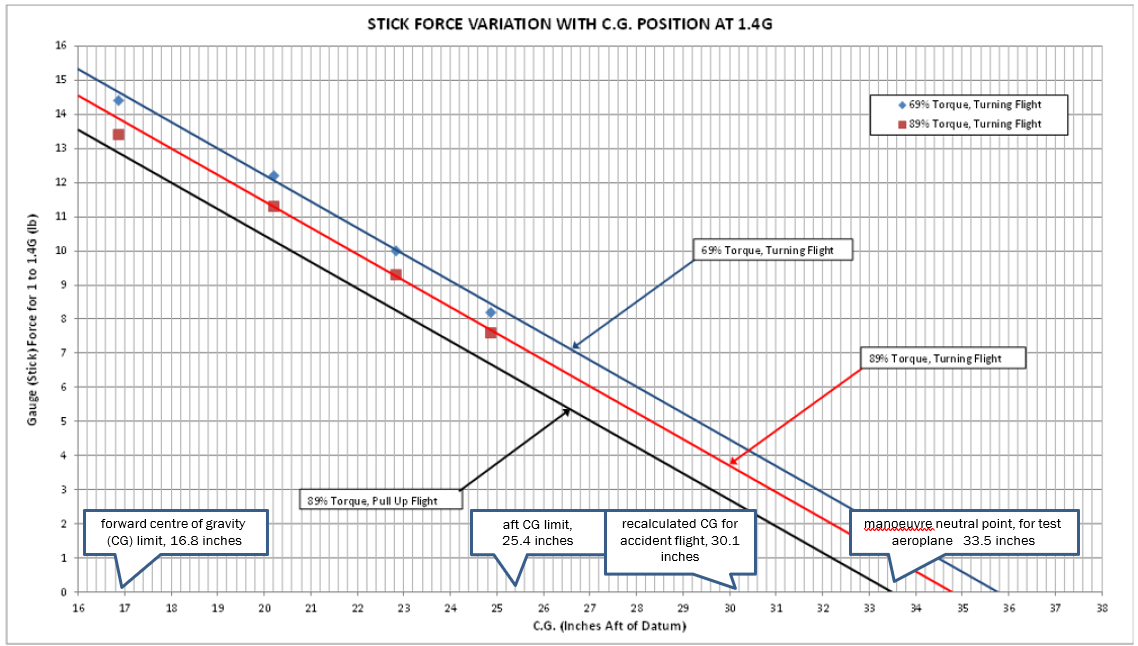
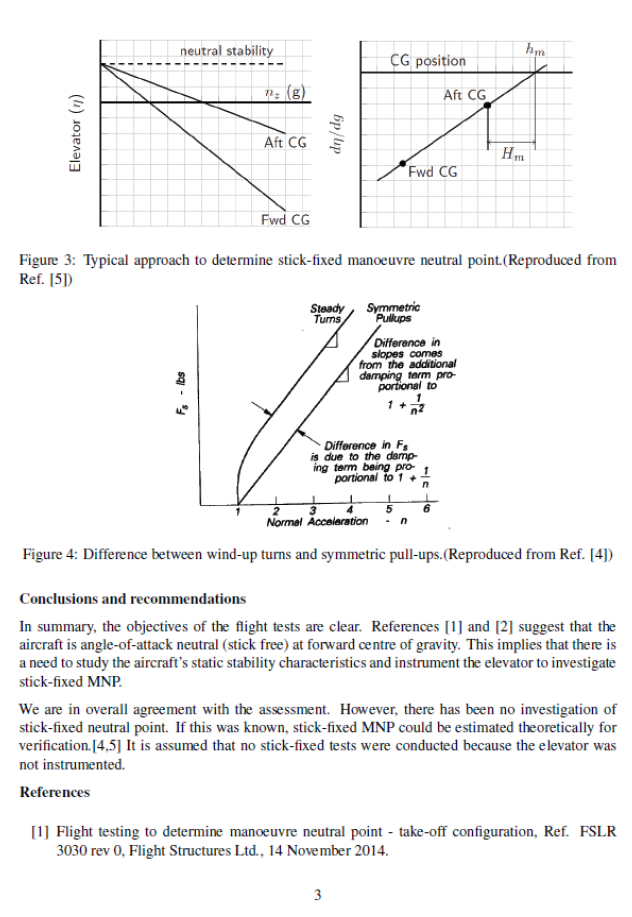
- A question often asked after the accident was, “Where would the centre of gravity have to be for the aeroplane to be uncontrollable in pitch?”. As the centre of gravity moved further rearward, the control ‘stick force’ needed to move the stabiliser reduced. Reduced stick forces can lead to a pilot over-controlling in pitch, because the aeroplane is more responsive.
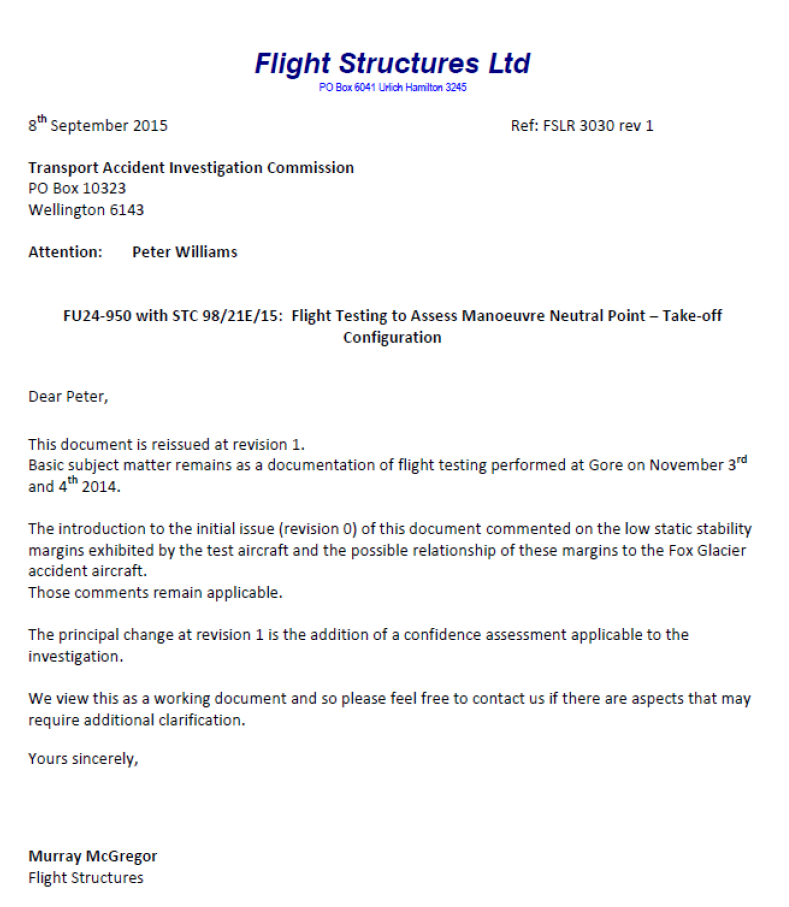
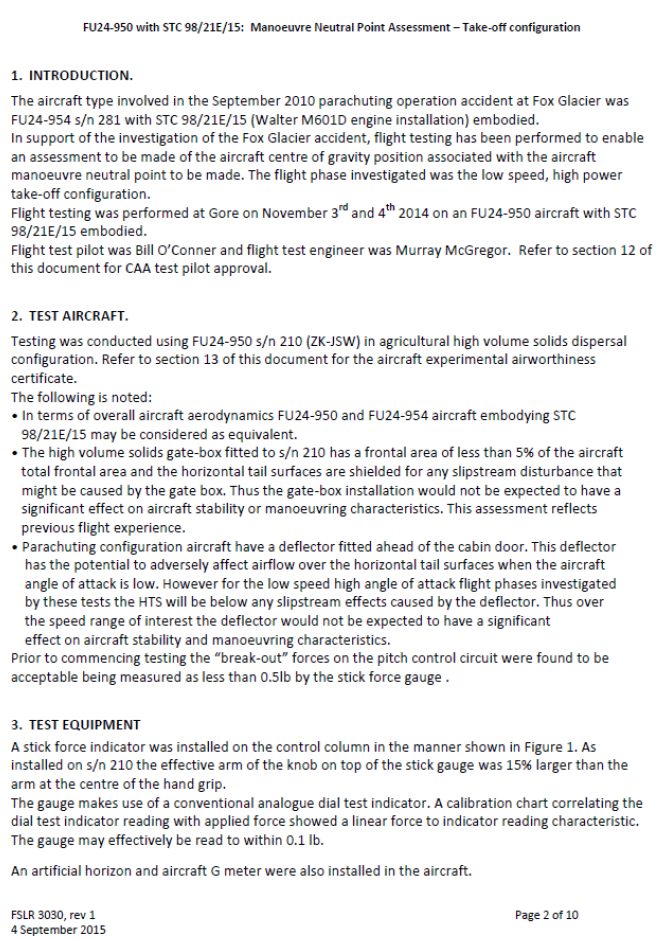
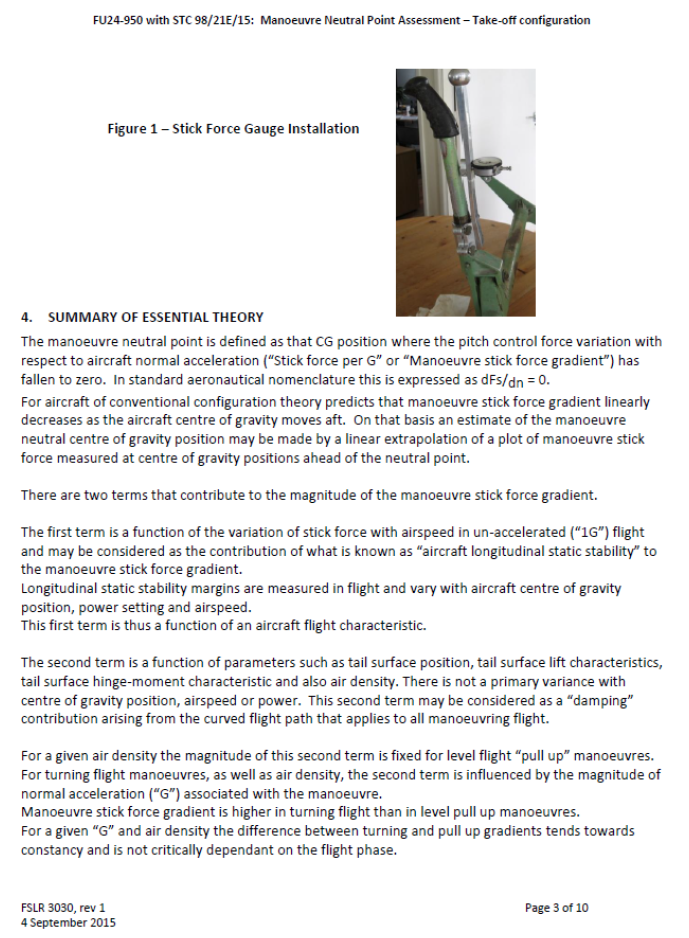
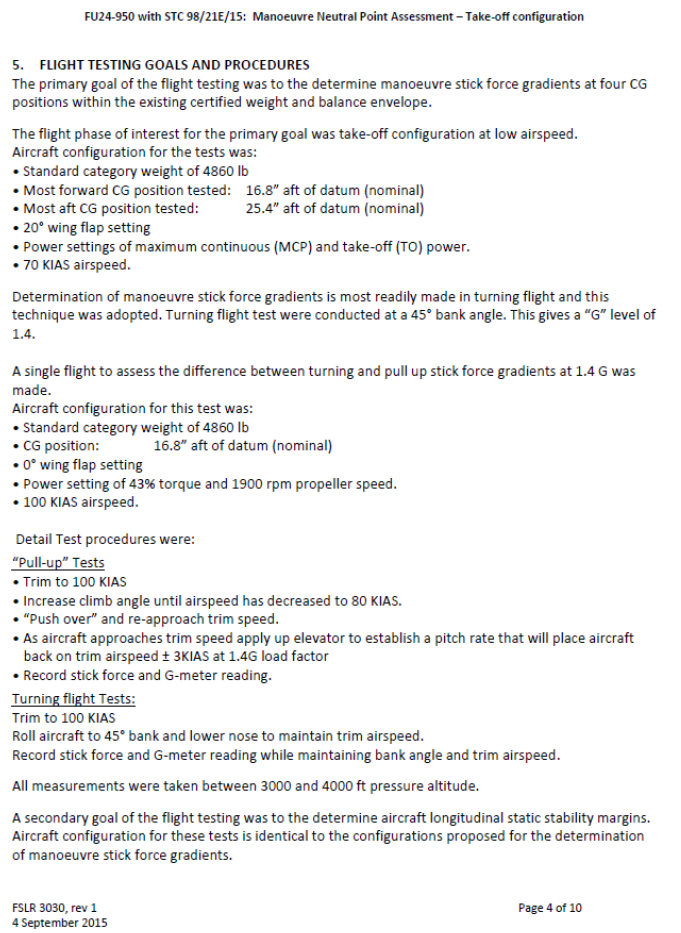
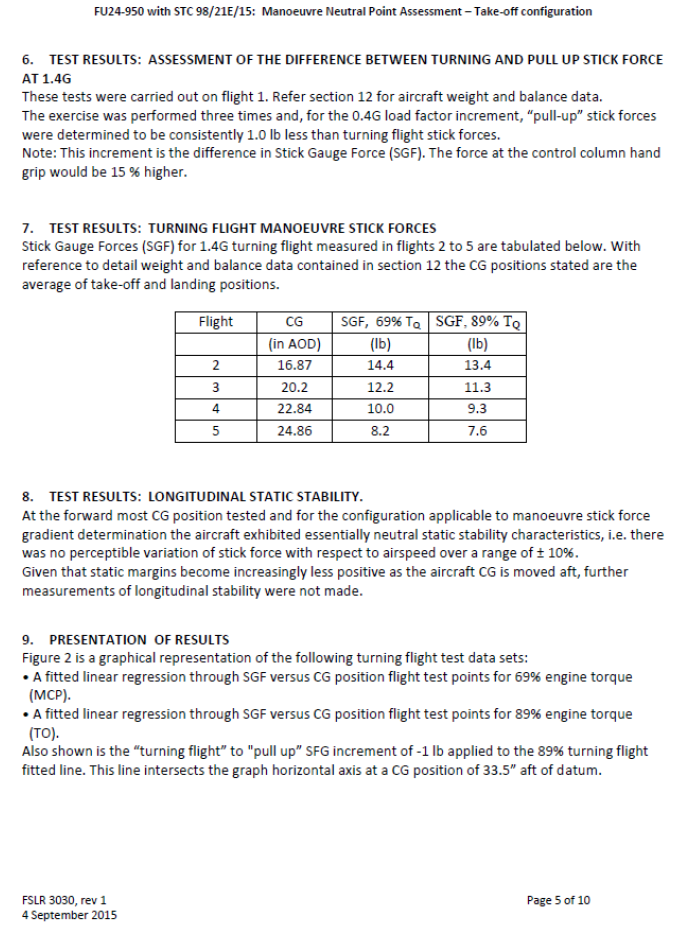
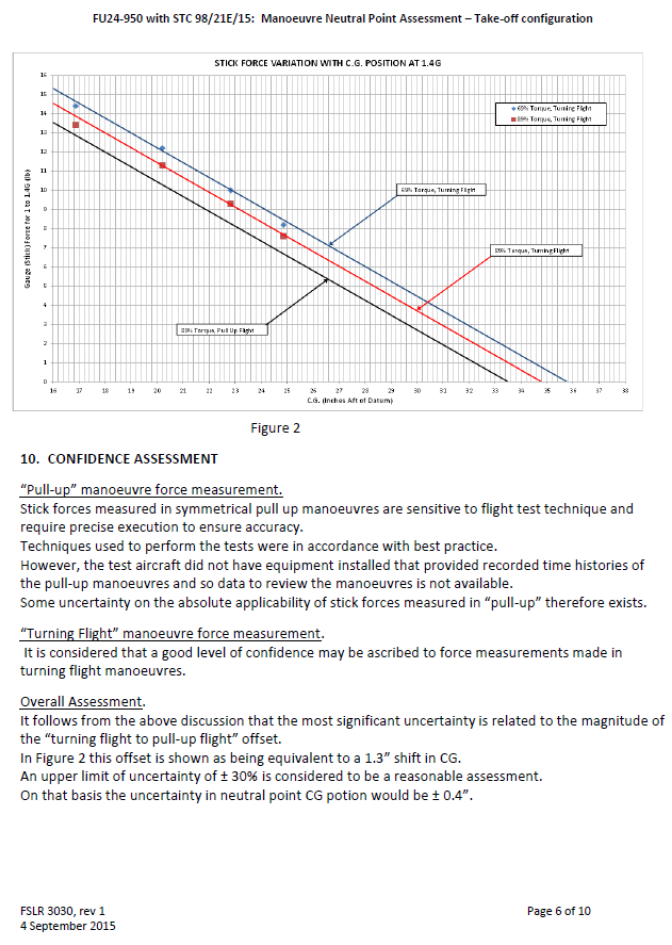
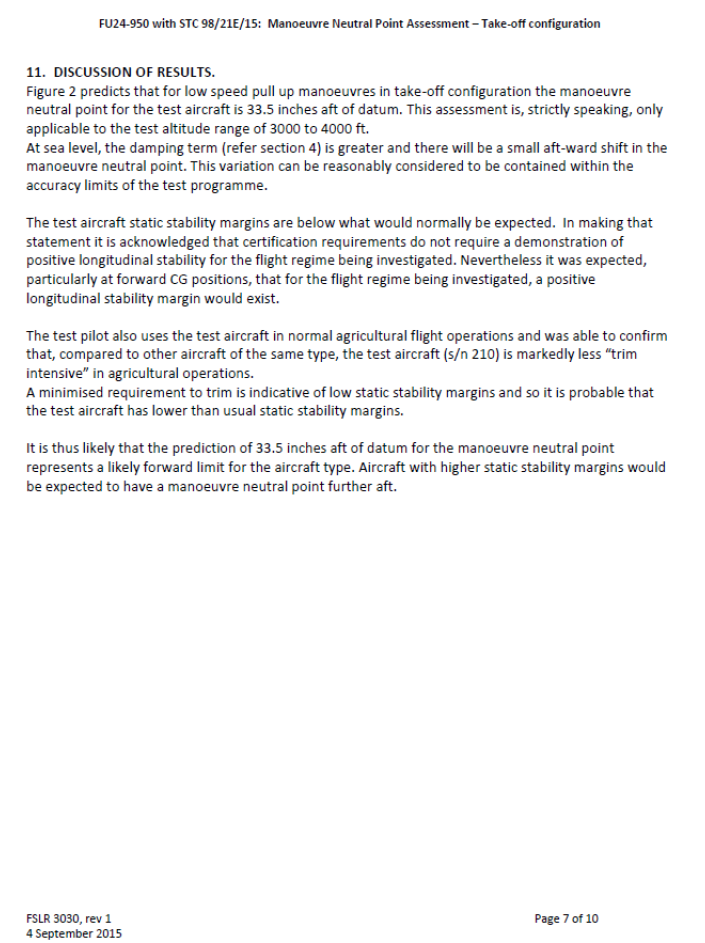
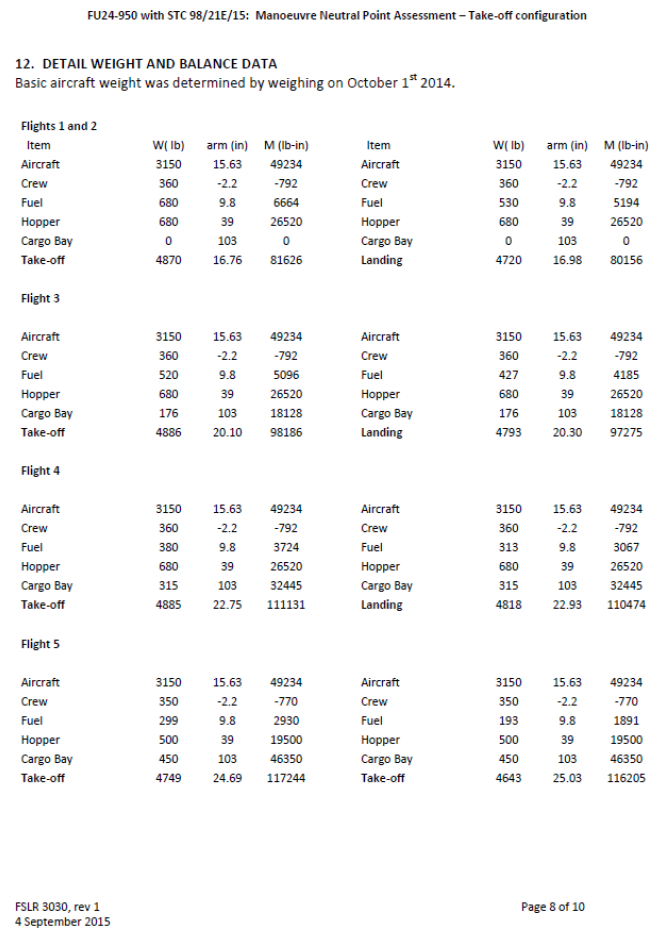
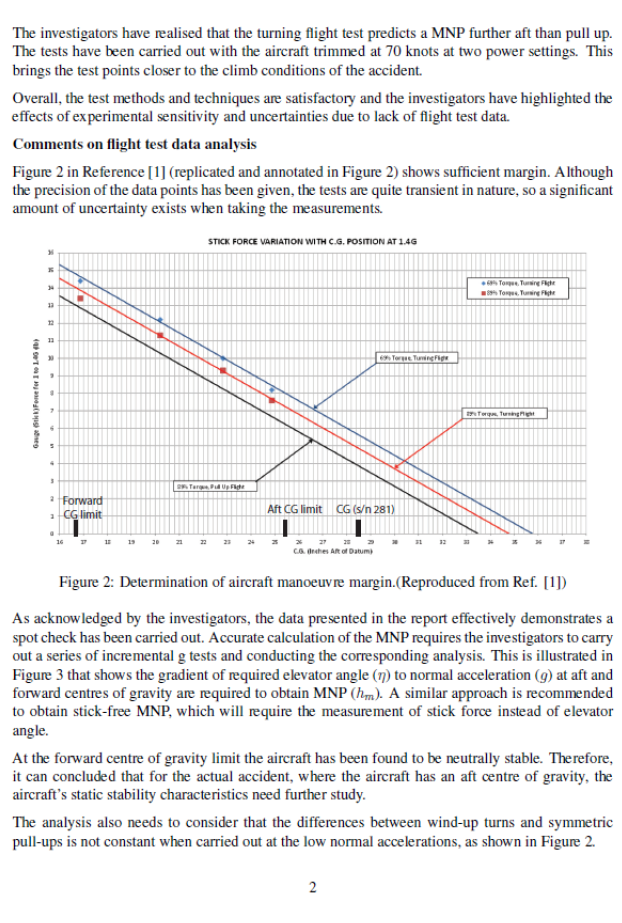
- The answer to the question was to be found by assessing the likely position of the manoeuvre neutral point; that is, the centre of gravity position where the control stick force per G was zero. An indication of this point was found during the flight tests conducted at Gore on a Walter Fletcher configured for agricultural operations. The aeronautical engineer who conducted the tests assessed that the configuration differences between the agricultural and parachuting versions of the aeroplane would not be significant in terms of aerodynamic characteristics of interest (the configuration differences included, for example, a projecting hopper gate on the agricultural version, and a cabin door air defector and external steps on the parachuting version. Refer to Appendix 5).
- The test results conformed to conventional aerodynamic theory (see Figure 3, which reproduces Figure 2 of Appendix 5). Measurements of the control stick force were taken at two power settings, one of which was the nominal take-off power for the Walter Fletcher. The plotted results produced straight-line graphs showing that the stick force per G (measured on the vertical axis) decreased as the centre of gravity moved rearward. At the points where the extensions of the plotted graphs cut the horizontal axis, the stick force per G was zero. The corresponding centre of gravity positions (on the horizontal axis) were the manoeuvre neutral points for the respective engine power settings.
- For the test aeroplane using take-off power, the results indicated that there was a margin of approximately 3.5 inches (0.089 metre) between the manoeuvre neutral point and the centre of gravity position that had been estimated for the accident flight. Consequently there would likely be acceptable control stick forces for that centre of gravity position. The aeronautical engineer noted that, in his experience with the design and flight testing of Fletchers, the manoeuvre neutral point found for the test aeroplane represented a likely forward limit for the aeroplane type; that is, the manoeuvre neutral point for a typical Walter Fletcher would be further to the rear, which would give a greater margin of controllability.
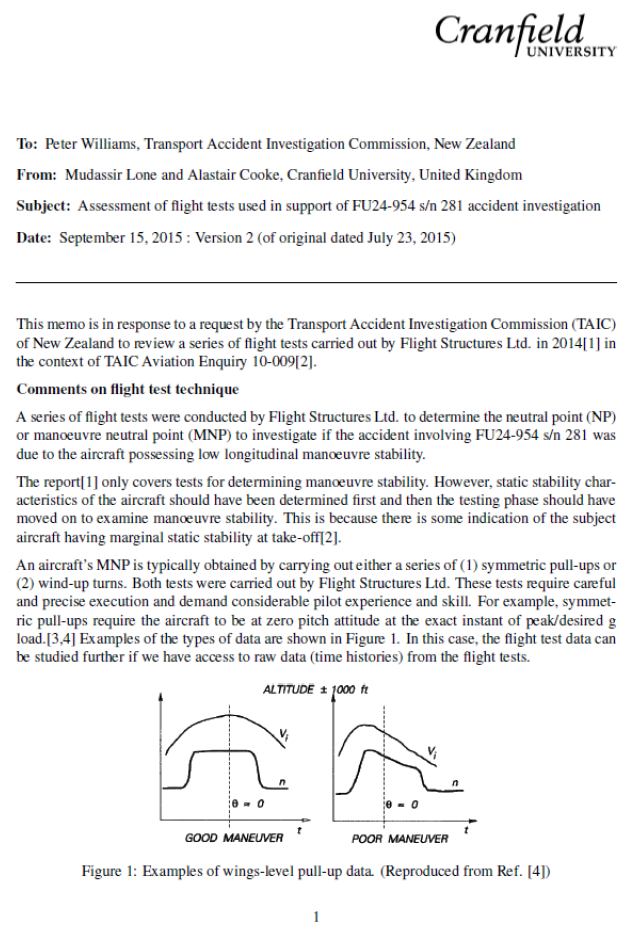
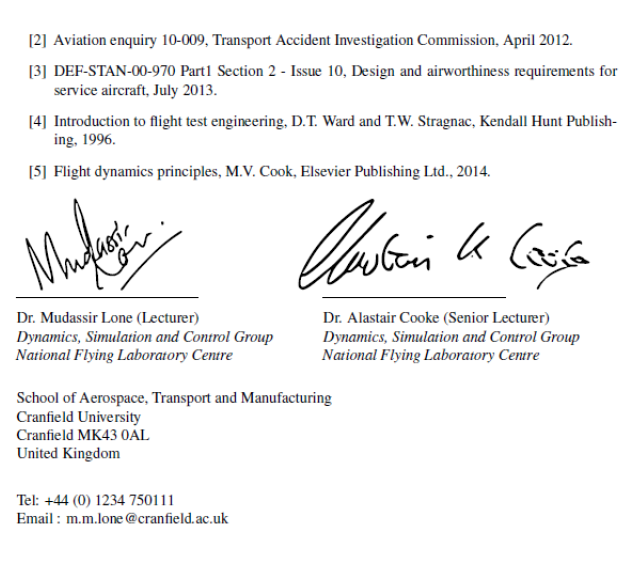
- The National Flying Laboratory Centre of the School of Aerospace, Transport and Manufacturing, Cranfield University, United Kingdom, was asked to appraise the method and results of the Gore flight test. Its report (see Appendix 6) commented on the test having been in the nature of a ‘spot check’ and thereby having had some limitations.
-
In summary, the Cranfield review concluded:
Overall, the test methods and techniques are satisfactory and the investigators have highlighted the effects of experimental sensitivity and uncertainties due to lack of flight test data.
The objectives of the flight tests are clear [and] we are in overall agreement with the assessment.
-
- The manoeuvre neutral point moves forward at higher engine power settings, which will reduce the stick force per G. The engine manufacturer advised that the engine fuel control unit could not produce an uncommanded increase in power above normal take-off power. However, the engine control system on the Walter Fletcher did not prevent pilots exceeding the nominal power limit, because they had to have the ability to adjust the maximum power according to the environmental conditions on the day. Therefore the possibility could not be excluded that at the point of take-off the pilot inadvertently or deliberately exceeded the nominal take-off power, which would have reduced the stick force and might have been a cause of the steep climb.
Findings Ngā kitenga
- The addendum should be read in conjunction with the final report published on 9 May 2012, which still stands, along with the identified safety issues and its safety recommendations. The original findings (with the same paragraph numbering as used in the final report) are in Appendix 7.
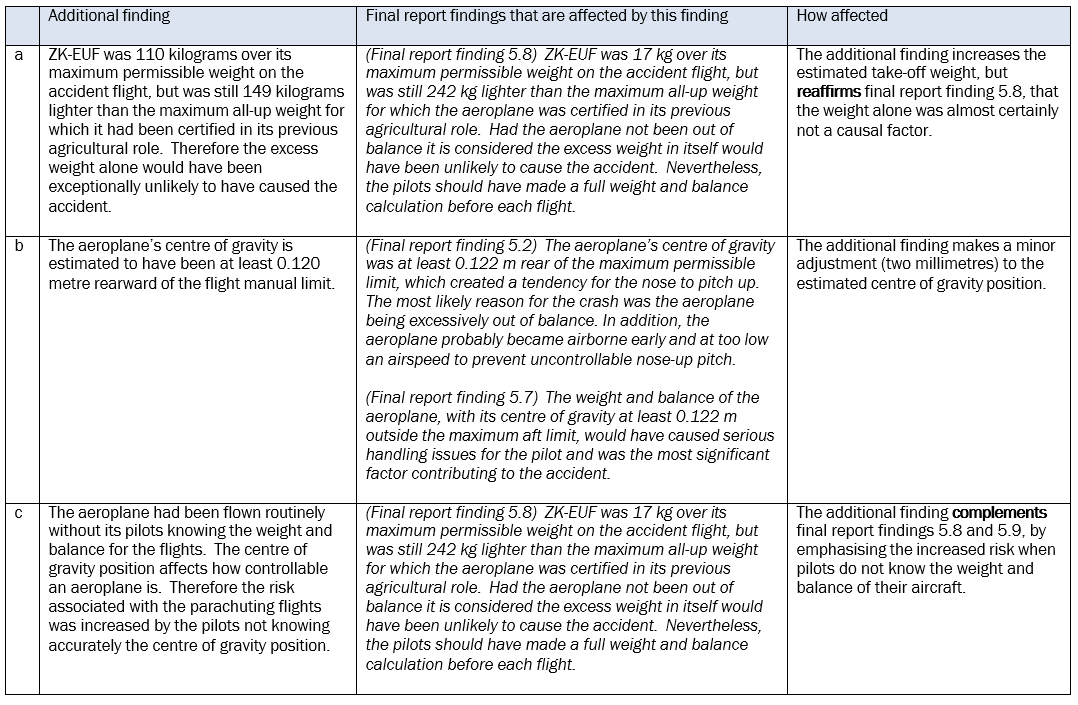
- As a result of the review the Commission made the following additional findings, which in some cases supersede or refine one or more of the original findings:
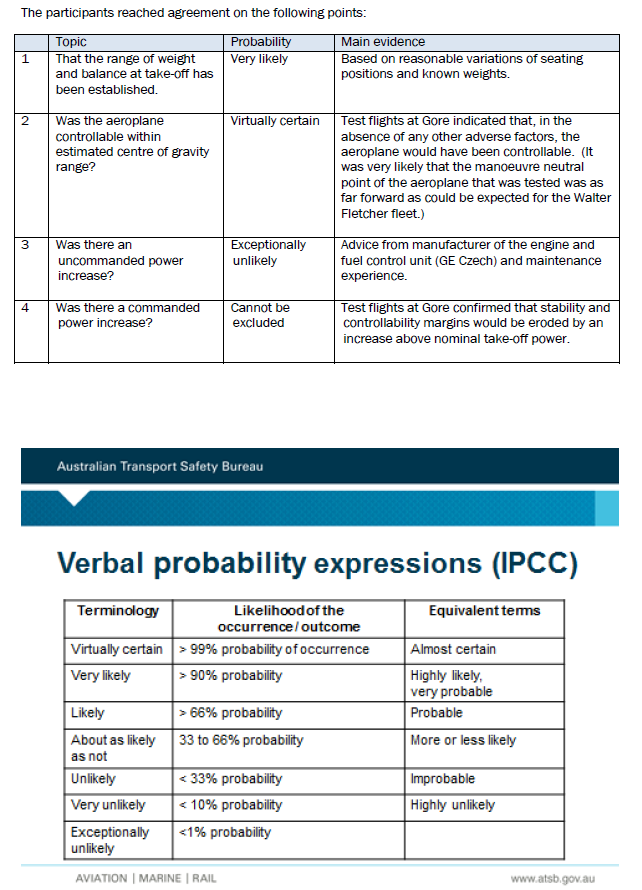
- ZK-EUF was 110 kilograms over its maximum permissible weight on the accident flight, but was still 149 kilograms lighter than the maximum all-up weight for which it had been certified in its previous agricultural role. Therefore the excess weight alone would have been exceptionally unlikely to have caused the accident.
- The aeroplane’s centre of gravity is estimated to have been at least 0.120 metre rearward of the flight manual limit.
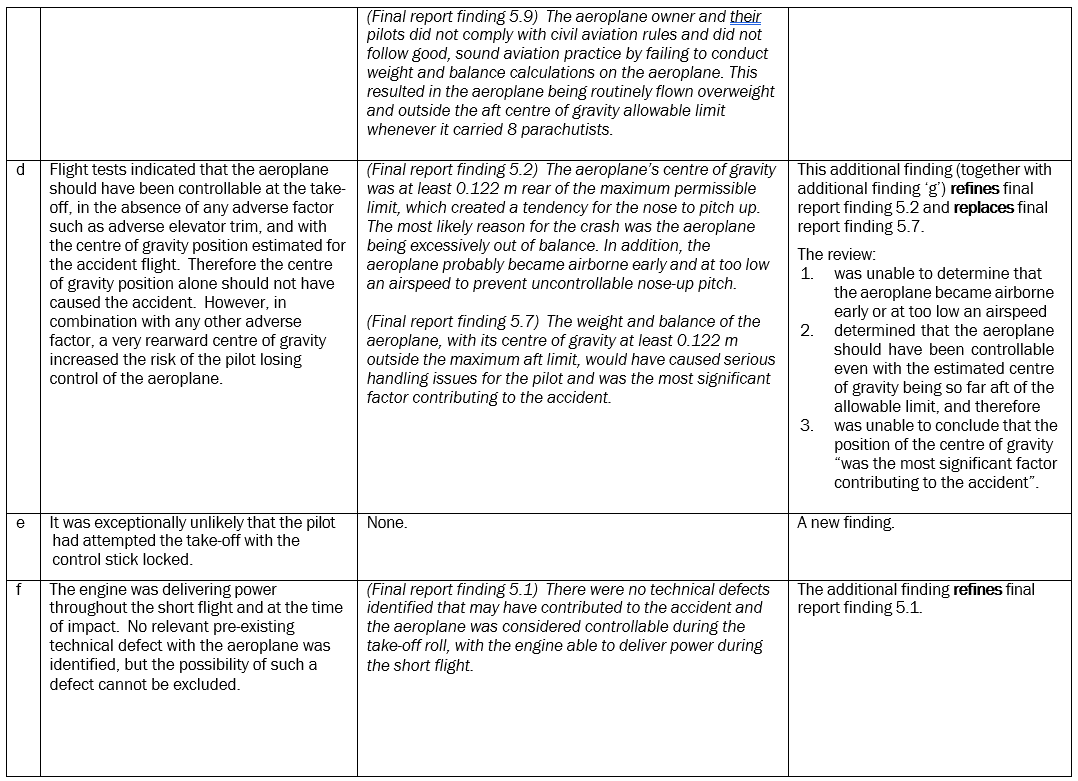
- The aeroplane had been flown routinely without its pilots knowing the weight and balance for the flights. The centre of gravity position affects how controllable an aeroplane is. Therefore the risk associated with the parachuting flights was increased by the pilots not knowing accurately the centre of gravity position.
- Flight tests indicated that the aeroplane should have been controllable at the take-off, in the absence of any adverse factor such as adverse elevator trim, and with the centre of gravity position estimated for the accident flight. Therefore, the centre of gravity position alone should not have caused the accident. However, in combination with any other adverse factor, a very rearward centre of gravity increased the risk of the pilot losing control of the aeroplane.
- It was exceptionally unlikely that the pilot had attempted the take-off with the control stick locked.
- The engine was delivering power throughout the short flight and at the time of impact. No relevant pre-existing technical defect with the aeroplane was identified, but the possibility of such a defect cannot be excluded.
- The Commission considered various adverse factors that might have been present singly or in combination, but could not determine the cause of the excessive pitch up at take-off that preceded the steep climb and the subsequent stall.
- The following table shows how the additional findings affect some of the findings in the final report.

Safety issues and remedial action Ngā take haumanu me ngā mahi whakatika
- This section lists the pertinent safety actions taken since the accident.
Safety actions in response to a recommendation issued by the Commission
-
On 13 September 2010 the Commission made the following urgent safety recommendation:
The Commission recommends that the Director of Civil Aviation as a matter of urgency alerts all pilots and operators using the Fletcher FU24-954 aircraft for parachuting operations that when loaded with 6 or more passengers it is possible for the aircraft CG [centre of gravity] to be aft of the allowable limit, and that this could result in control difficulties, and that parachutists should be seated in the forward cabin area, preferably restrained to prevent them inadvertently moving rearward. (037/10)
-
On 20 September 2010 the General Manager of the General Aviation Group of the CAA replied in part:
As we have already advised the Commission, the CAA issued Emergency Airworthiness Directive (AD) DCA/FU24/179 on 11 September 2010, to address the safety issues that you identify in your letter. The AD was sent immediately to all operators of Fletcher series aircraft conducting parachute operations. We accept that this is based on information gained early in the investigation and the issue of the AD should be considered to be immediate interim action pending completion of your investigation.
AD DCA/FU24/179 Parachuting Operations – Limitation and C of C Determination, which requires;
1. Amendment of the Aircraft Flight Manual (AFM) to restrict maximum occupancy of the cabin aft of F.S 118.84 to six persons. This may be accomplished by inserting a copy of the AD into the AFM adjacent to the applicable supplement for parachuting operations.
2. No parachuting operation is to be conducted with any number of occupants, unless for each individual flight:
a. A weight and balance calculation is performed to establish that the aircraft Centre of Gravity will remain within AFM limits for the duration of the flight, and
b. The calculation uses actual weights for all occupants and their equipment, and
c. The calculation accounts for the positions of all occupants. The occupants’ positions shall be taken as the most aft positions that result from the rearmost members of the group sitting against the aft cabin wall and subsequent occupants located immediately forward of them, unless a means of restraint is provided to prevent the occupants moving rearwards from their normal position, and
d. A record of the Centre of Gravity determination is kept for each parachuting operation.
The effective date of the AD is 11 September 2010 and compliance with 1 and 2 above is required before further parachute-drop operations and before every parachute-drop operation, respectively.
-
On 25 October 2012 the CAA replaced AD DCA/FU24/179 with the following:
DCA/FU24/182 Standard Category Aircraft – Parachuting Operations
Applicability: All turbine powered FU24 series aircraft with a Standard Category Airworthiness Certificate and used for parachuting operations.
Note 1: DCA/FU24/182 supersedes the requirements in DCA/FU24/179.
Requirement: To prevent operation outside of the C of G envelope which can result in loss of aircraft control, accomplish the following:
For every parachuting flight accomplish the following:
a. A weight and balance calculation is performed to establish that the aircraft C of G will remain within AFM limits for the duration of the flight, and
b. The calculation uses actual weights for all occupants and their equipment, and
c. A record of the C of G determination is kept for each parachuting operation.
Add fuselage station markings in the cabin of the aircraft to aid in determining weight and balance positions in accordance with acceptable technical data. Insert a Flight Manual Supplement specifically approved for parachuting operations for the aircraft, which must contain detailed information for determining the weight and balance of the aircraft. The operator must ensure that aircraft crew are aware of the AFM Supplement.
Note 2: CAA approved AFM supplement AIR 2672-FMS-P1 for the FU24 series aircraft with STC 98/21E/15 embodied and CAA approved AFM supplement AIR 2817-FMS-P1 for FU24 series aircraft with STC 3/21E/1 embodied are an acceptable means to comply with requirement 2 of this AD.
Note 3: Copies of the CAA approved AFM supplements can be obtained from flight.manuals@caa.govt.nz
Note 4: Requirement 1 of this AD may be accomplished by adding the weight and balance calculation requirement for every parachuting flight to the tech log. (NZ Occurrence 10/3403 refers)
Compliance: 1. From 11 September 2012 (the effective date of DCA/FU24/179). 2. By 25 November 2012.
Effective Date: 25 October 2012.
-
On 13 September 2010 the Commission also made the following urgent safety recommendation:
The Commission recommends that the Director of Civil Aviation as a matter of urgency reviews the approvals granted for the FU24-954 aircraft with a view to amending the Flight Manual to allow more accurate determinations of aircraft centre of gravity. This review should also extend to other conversions of Fletcher and Cresco aircraft. (038/10)
-
On 20 September 2010 the General Manager of the General Aviation Group of the CAA replied in part:
The CAA intends to issue a further Emergency Airworthiness Directive (DCA/FU24/180 Parachuting – Flight Manual Supplement Approval) to be applicable to all FU24 series aircraft modified to conduct parachute operations. It will address the issue that it may be possible in some parachute configurations to exceed the aircraft’s aft Centre of Gravity limit. In doing so, CAA will review all AFM parachute operation supplements, including those approved by delegation holders or foreign authorities to ensure that they provide adequate determination of the Centre of Gravity position.
In addition to the ADs, CAA has commenced a broader safety review of parachuting operations, to establish if there are other safety issues arising. The review includes existing parachuting flight manual supplements, pilot training and type ratings for FU24 series aircraft, the provision of operational information to pilots, clarification of aircraft loading limitations and a review of the necessity of seating and/or restraint systems for parachutists. (See paragraph 10.12.)
-
On 22 March 2012 the Commission made the following recommendations to the Director of Civil Aviation:
The modification of ZK-EUF by the engineering company was not in keeping with required engineering practices and the supporting documentation was both incomplete and inaccurate. The Commission recommends the Director takes the necessary action that ensures that high engineering standards are maintained by this and other aircraft maintenance organisations. (005/12)
The operator’s fuel management policy, control of the flight manual and failure to ensure the aeroplane was being operated within its centre of gravity limits may be an indication of wider non-compliance issues. The Commission recommends that the Director takes the necessary action that ensures all parachuting operators are conforming to Civil Aviation Rules and operating safely. (006/12)
In approving the change in airworthiness category, the CAA did not review all the required documentation and so missed the opportunity to ensure the aeroplane was fit for the purpose. The Commission recommends that the Director takes the necessary action that ensures there is a thorough and coordinated oversight when accepting aircraft modifications and approving changes in category, especially for specialised operations like parachuting. (007/12)
The wearing of appropriate seat restraints can reduce injury and save lives. The Commission recommends that the Director monitor the outcome of the joint FAA/USPA [Federal Aviation Administration/United States Parachute Association] study and determine if any findings are applicable for the New Zealand parachuting industry. (008/12)
The owner’s introduction into service of ZK-EUF was not in accordance with Civil Aviation rules and there was no assistance or oversight provided by the CAA to ensure it was safely completed. The Commission recommends that the Director ensure there is a coordinated and proactive approach by relevant departments within the CAA to ensure safety efforts are best directed to promote the coordinated safe management of flying activities. (009/12)
Parachute-drop pilots can fly for many years without external validation of their parachuting related skills. The Commission recommends that the Director initiate a regular checking requirement to help ensure drop pilots remain skilled and current, similar to other commercial operators. (010/12)
-
On 13 April 2012 the General Manager of the Safety Information Group of the CAA replied:
(005/12) Accepted. Newly introduced risk based surveillance processes will improve the effectiveness of the CAA’s audits, through better targeting and focus on ‘risk issues’.
(006/12) Accepted. Following the accident, the CAA carried out a series of spot checks on commercial parachuting operations, paying particular attention to flight manual data and the application of weight and balance limitations. In addition to this activity, the implementation of Civil Aviation Rule Part 115 (Adventure Aviation) will require tandem parachute operators to be certificated, and enable closer oversight of such operations.
(007/12) See Comment. This recommendation addresses 2 separate issues.
First, with respect the review of documentation required for a change from ‘restricted’ to ‘standard’ category, the Director will consider whether physical aeroplane inspections are warranted when an aircraft changes category. However, the resources and other implications of such inspections will need to be identified and evaluated before the Director accepts the recommendation in full. Second, with respect to aircraft modifications, the CAA has amended the conditions of all design delegation holders, which has the effect of the CAA being able to exercise closer oversight of any major design changes. These changes took effect on 24 August 2010.
(008/12) Accepted. The Director will monitor the outcome of the joint FAA/USPA study, and consider their applicability/relevance to the New Zealand aviation environment.
(009/12) See comment. The CAA is currently undergoing a major change programme to ensure that it is able to target its resources more effectively, and conduct its activities more consistently. To this end, the thrust of the recommendation is accepted. The CAA also notes that the introduction of Civil
Aviation Rule Part 115 will enable the CAA to exercise closer oversight of organisations conducting commercial parachute operations, which in part address elements of the recommendation.
(010/12) See comment. The Director will consider the recommendation in light of the changes that are being brought about by the introduction of Civil Aviation Rule Part 115.
-
On 22 March 2012 the Commission made the following recommendation to the Secretary for Transport:
The use of performance impairing substances is known to have a detrimental effect on the ability of people to safely operate in critical transport environments. The Commission recommends that the Secretary for Transport promotes the introduction of a drug and alcohol detection and deterrence regime for persons employed in safety critical transport roles. (011/12)
-
On 3 May 2012 the General Manager Aviation and Maritime, Ministry of Transport, replied in part:
I accept the specific recommendation 011/12 directed to the Secretary for Transport
I also urge the Commission to note the existing health and safety in employment regulatory regime, where drugs and alcohol are specifically mentioned in the definition of “hazard”. This regime already places obligations on both employers and employees
Since the Fox Glacier accident the Minister of Transport has approved a new Rule Part 115 that entered into force in November 2011. The Rule requires adventure aviation operations to be certified by 1 May 2012. Adventure aviation organisations, including commercial parachuting, now face the risk that their safety certification can be suspended and removed for safety violations. This gives such operators a stronger incentive to ensure they address alcohol and drug taking safety risks in their organisations
Over the next two years the Government will be considering rule amendments that would require aviation organisations to introduce safety management systems [SMSs]. This would require certificated operators to assess and mitigate all safety risks relevant to their operation. This risk of intoxication of personnel by drugs and alcohol would clearly be a safety risk that we would expect both operators and the Civil Aviation Authority (when certifying and auditing aviation organisations) to be actively addressing under an SMS regime. Decisions will also be made in the near future to ensure that the Civil Aviation Authority is resourced to transition to the ICAO [International Civil Aviation Organization]-endorsed SMS approach which has widespread industry support
Whilst recognising that where the illegal use of drugs is involved, changing individual behaviour will be challenging, the Ministry will encourage the Civil Aviation Authority to step up its effort to alert the aviation community through education of the risks that drugs pose to the safety operation of aviation undertakings. This will require an ongoing effort
As you are aware, the Ministry has developed a Transport Regulatory Policy Statement that specific rule changes may not always be the best interventions to achieve desired safety outcomes. Non-regulatory interventions can often be more appropriate. In this regard we appreciate the Commission’s recommendation to promote a drug and alcohol detection and deterrence regime, rather than to implement a regime.
The Ministry of Transport has in the past sponsored an inter-agency Substance Impairment Group. This looked at whether or not compulsory random drug and alcohol testing, and specific breath alcohol limits, should be required by regulation in the aviation, marine and rail transport modes. In part because of a lack of data, we were not convinced at that time that the costs would outweigh the benefits. We will, however, monitor international experience in this regard and, in particular, the recent relevant changes in the Australian aviation regime.
- On 10 March 2015 the Ministry of Transport released a discussion paper on options to reduce the risks of alcohol- and drug-related impairment in the aviation, maritime and rail transport sectors. The consultation followed the Commission’s final report on its investigation of a hot-air balloon crash near Carterton in 2012. In its report the Commission recommended regulatory changes to strengthen the management of alcohol and drugs in the aviation, maritime and rail sectors. Submissions on the document closed with the Ministry on 8 May 2015.
- On 18 June 2015 the Commission asked the Director of Civil Aviation for an update on the status of the “broader safety review of parachuting operations”, which the CAA had said in a letter of 20 September 2010 had commenced (see paragraph 10.6).
- On 24 July 2015 the CAA replied that no specific document had mapped out the areas the CAA had considered, but specialist staff had been tasked in 2010 with reviewing the issues stated in the Commission’s final report concerning adventure and agricultural aviation. The CAA noted that “the advent of Rule Part 115 addressed the majority of the issues”.
- The CAA’s response also stated that it had worked with the parachuting industry regarding the issue of safety restraints. Although some in the industry were convinced that a requirement to wear restraints would provide a hazard equal to or greater than not wearing them, some operators had voluntarily introduced restraints. The CAA was continuing with an operational review and risk assessment of the requirement.
Safety actions that were not in response to a recommendation of the Commission
- On 11 October 2011 the Minister of Transport signed the new Civil Aviation Rule Part 115 Adventure Aviation (Certification and Operations). Part 115 (initial issue) entered into force on 10 November 2011. Transitional arrangements in Part 115 required commercial tandem parachute and parachute-drop aircraft operators conducting operations immediately before 10 November 2011 to comply with Part 115 by 1 May 2012. CAA resources were increased as a result.
-
On 26 July 2012 the CAA issued the following airworthiness directive for Fletcher aeroplanes:
DCA/FU24/181 Horizontal Stabiliser Electric Trim System – Installation
Applicability: All turbine powered FU24 series aircraft with a Standard Category Airworthiness Certificate.
Requirement: Because of the wide trim range required during aircraft operation, an approved electric trim system must be installed. Accomplish the following:
1. Install an approved electrically operated pitch trim system.
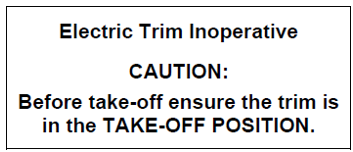
2. If the electric trim system becomes inoperative, the aircraft may continue to be operated for a maximum of 3 days while it is repaired. The manual trim system must be serviceable and extra care must be taken to ensure correct trim is set before take-off. Install a warning placard on the instrument panel while the electric trim is inoperative in clear view of the pilot with the following text:
(NZ occurrence 10/3403 refers).
Compliance: 1. By 26 August 2012 unless already accomplished. 2. From 26 August 2012.
Effective Date: 26 July 2012.
-
On 29 May 2014 the CAA issued the following airworthiness directive for Fletcher aeroplanes
DCA/FU24/183 Control Column – Inspection
Applicability: All FU24 and FU24A series aircraft fitted with control column P/N 08-45031/32.
Note: This AD requires an inspection of the control column for mechanical damage, deformation and cracks per Pacific Aerospace Limited (PAL) Mandatory Service Bulletin (MSB) No. PACSB/FU/095 issue 2 dated 28 May 2014 (Pacific Aerospace Limited Mandatory Service Bulletin No. PACSB/FU/095 was first issued on 10 July 2012).
Requirement: To prevent failure of the control column due to possible mechanical damage or deformation which could result in cracks, inspect the control column per Pacific Aerospace Limited (PAL) Mandatory Service Bulletin (MSB) No. PACSB/FU/095 issue 2 dated 28 May 2014.
If no mechanical damage or deformation is found, no further action is required. If any cracks are found, replace the control column per PACSB/FU/095 before further flight.
If any mechanical damage or deformation is found, accomplish the NDT [non-destructive testing] inspection of the control column per PACSB/FU/095. If any cracks are found, replace the control column per PACSB/FU/095 before further flight. If no cracks are found accomplish a NDT inspection at intervals not to exceed 50 hours TIS [time in service] until replacement. Replace the control column at the next maintenance inspection or within the next 150 hours TIS, whichever is the later.
(Occurrence No 12/1784 refers) Compliance: Within the next 50 hours TIS.
Effective Date: 29 May 2014
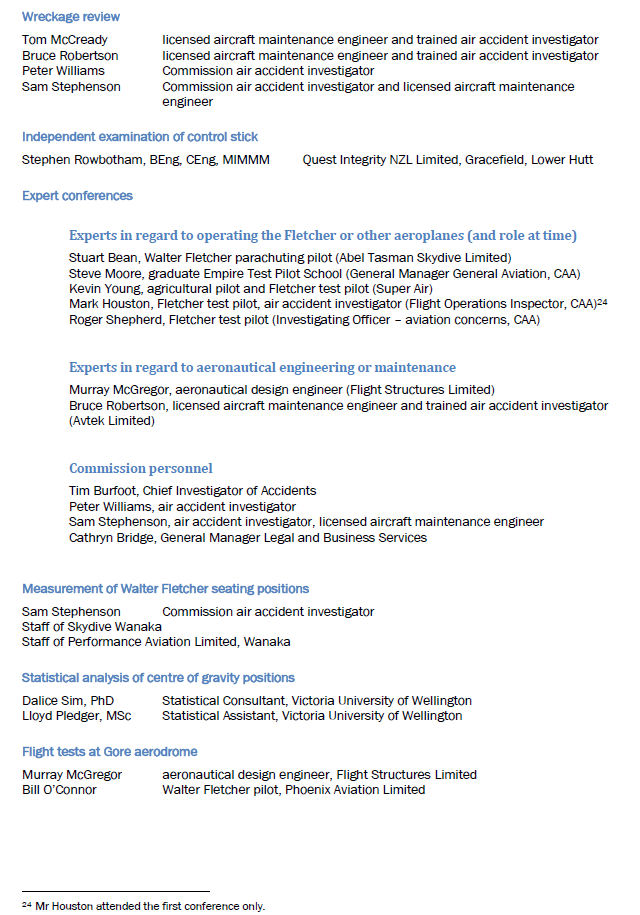
Appendix 1: Participants in the review
Appendix 2: Independent report on control stick fracture
Appendix 3: First expert conference, 16 June 2014
Appendix 4: Second expert conference, 28 January 2015
Appendix 5: Flight testing to assess manoeuvre neutral point
Appendix 6: Cranfield University peer review of Flight Structures report
Appendix 7: Original findings from final repo