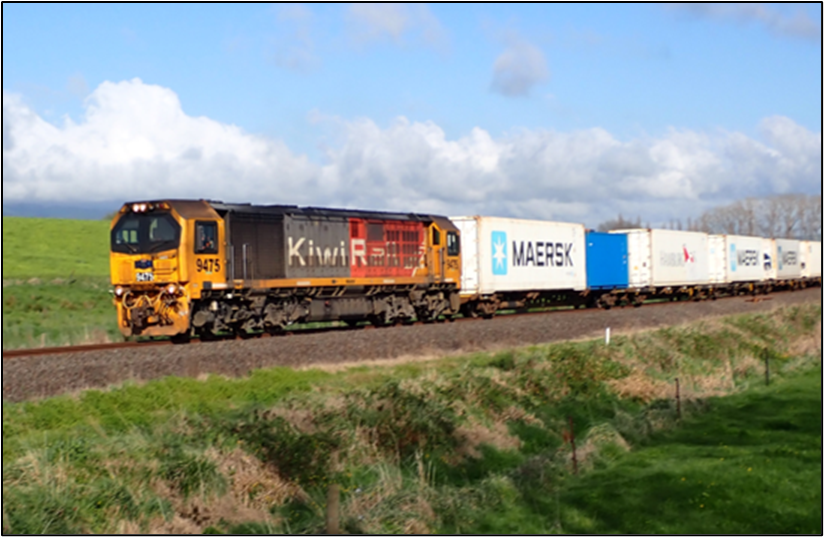
A freight train passed two stop signals, entered section of track without authority, narrowly avoiding a collision with a hi-rail truck that had permission to be there. Train driver expected a clear track and misread signals and radio calls while using mobile phone. The train had no engineering safeguards to stop it. TAIC found over-reliance on rail people being perfect, and a rising nationwide rate of signals passed at danger, calls for stronger engineering controls and oversight.
Executive summary Tuhinga whakarāpopoto
What happened
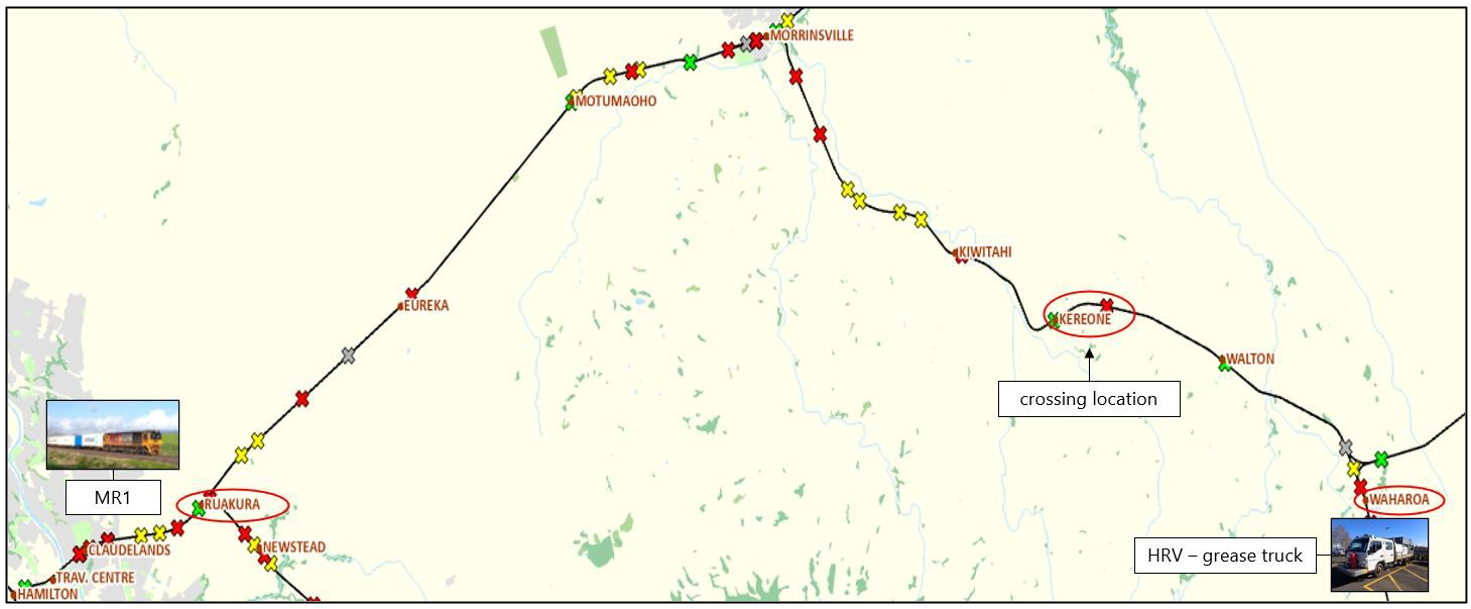
- On 2 August 2024 at 1108 (New Zealand Standard Time), a scheduled freight train departed Ruakura rail siding (stores freight and is accessible by track to load or unload freight on to a train’s wagons) north of Hamilton, travelling towards Tauranga on the East Coast Main Trunk.
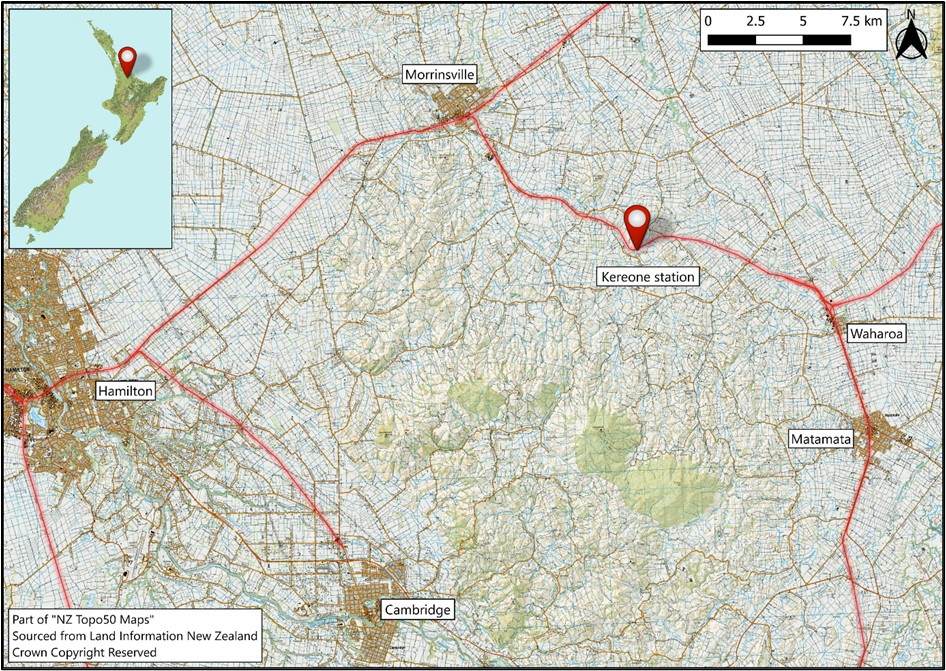
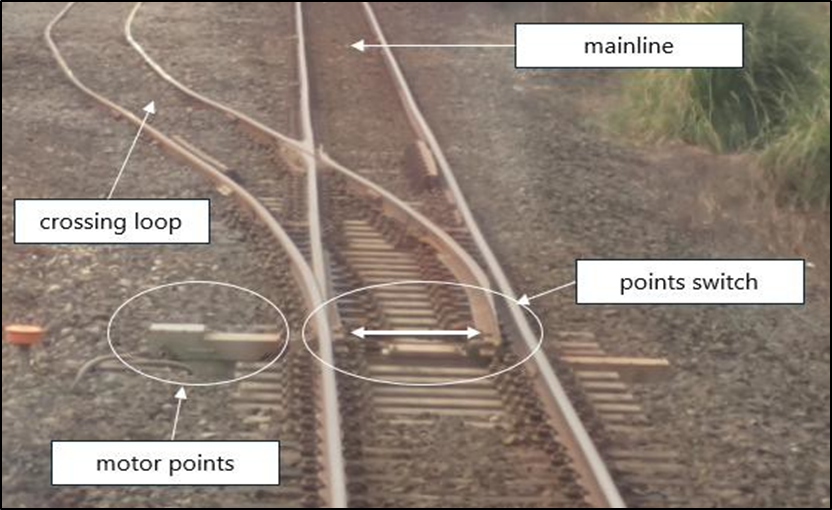
- At 1122, a hi-rail vehicle operator obtained track protection authority from train control and on-tracked (operating the hi-rail vehicle from the road onto a section of railway track to operate), travelling from Waharoa to Kereone station (Kereone station comprises a crossing loop. This is a short section of double track on a primarily single-track railway that allows trains travelling in opposite directions to pass each other. It typically consists of two parallel tracks connected at both ends by switches (also called points), enabling one train to pull into the loop while the other continues on the main track) towards the approaching freight train on the East Coast Main Trunk.
- At about 1140, the hi-rail vehicle arrived at Kereone station and entered the crossing loop (a section of track next to, and joined to, the main line that allows rail traffic to be diverted off the main line on to the loop, enabling rail traffic to pass through) as arranged with train control. The hi-rail vehicle operator contacted train control and started to cancel the track protection authority.
- Before the cancellation process was completed, the approaching freight train passed the entry signal into Kereone station at stop.
- The freight train proceeded down the station’s main line and passed a second signal also at stop – entering the next section of single track without authorisation from train control (passing a signal at all red (stop) without authorisation is referred to as a signal passed at danger (abbreviated as SPAD)).
- Train control used their radio to contact the locomotive engineer of the freight train and requested they stop the train.
- There was no injury to personnel or damage to infrastructure or rail vehicles as a result of the incident.
Why it happened
- The locomotive engineer incorrectly interpreted track signals to be at ‘proceed’ instead of ‘caution to stop’ and ‘stop’ prior to arriving at Kereone station.
- The locomotive engineer was using their personal mobile phone and did not hear critical track protection arrangements for the hi-rail vehicle over the open radio channel.
- The locomotive engineer had reviewed available train and rail vehicle traffic information sources and had formed an expectation that they would not encounter any rail traffic on their return journey.
What we can learn
- Engineering controls that protect rail users from human error are available, but they have yet to be fully implemented or adopted by KiwiRail (KiwiRail Holdings Limited (KiwiRail) is a New Zealand state-owned enterprise. It operates trains and rail vehicles, controls rail movements on the national rail network and maintains the railway infrastructure as the rail access provider). This incident could have been prevented if these controls were in place.
- Using a mobile device while carrying out safety-critical tasks creates a distraction and compromises a person’s vigilance and attention, increasing the likelihood of errors.
Who may benefit
- Rail personnel, rail operators and all users of safety-critical equipment may benefit from the findings in this report.
Factual information Pārongo pono
Background
- The Metro Ruakura train MR1 (also known as Metro Ruakura One) was a freight train operating between Hamilton and Tauranga. It transferred freight containers between Ruakura Inland Port container terminal (southeast of Hamilton) to the Port of Tauranga along the East Coast Main Trunk line (ECMT).
- On the day of the incident, the freight train was hauling 39 wagons and being operated by a recently certified Tauranga-based locomotive engineer (the LE).
- Weather conditions on the day of the incident were fine with sunny periods, ranging from 5 to 15 degrees Celsius, with light to moderate winds.
- Train control was staffed by a trainee train controller (the TTC), supervised by a senior train controller (the STC) who was qualified to oversee staff in training.
Narrative
- At 0530 on 2 August 2024, the LE arrived at Tauranga depot and completed the required book-on process (prestart paperwork includes updating rule changes and reviewing the trains documentation) and paperwork for their shift. They boarded the outbound freight train service and departed Tauranga, travelling west along the ECMT to Hamilton.
- At 0803 they arrived at Hamilton and stabled (when the train has the locomotive’s handbrake and train’s braking system applied and is safe to leave unattended) the train for the following Te Rapa, Hamilton-based LE.
- At 0847, the LE boarded freight train MR1 (the train) and checked its paperwork before departing for Ruakura Inland Port (the inland port).
- At 0911, the LE stopped the train at the signal that controls entry into the section of track that leads to the inland port. Because the signalling system was not yet fully commissioned, the LE obtained a safe working authority (SWA) (a form used to authorise rail traffic movements not otherwise permitted under the normal system of safe working) to pass the signal at all red (stop).
- At about 0935, the train entered and came to a stop within the inland port container terminal. The container loads were removed and additional containers attached to the train’s wagons.
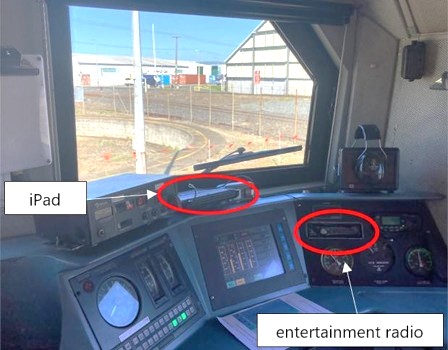
- While stationary, the LE set up their work-issued iPad to listen to music. They then sent a text message on their personal mobile phone to make family arrangements for later that day as they were running about two hours ahead of schedule.
- The LE checked the daily information bulletin for the ECMT and the global positioning system (GPS) iPad application for rail vehicle locations. Based on that information, no trains or other rail traffic was scheduled to cross on the LE’s return journey to Tauranga.
- At about 1100, reloading of the train was complete. The LE called train control via the in-cab radio and requested authority to depart the inland port.
- The LE obtained an SWA from the TTC and departed the inland port. At 1108 the train re-entered the main line.
- The LE opened the locomotive’s window as it was a warm and sunny day, and listened to music on the work iPad which was directly connected to the locomotive’s in-cab entertainment radio system (an AM/FM radio and CD player unit fitted into the locomotive’s cab console with two speakers positioned above the front right-hand window) (see Figure 3).
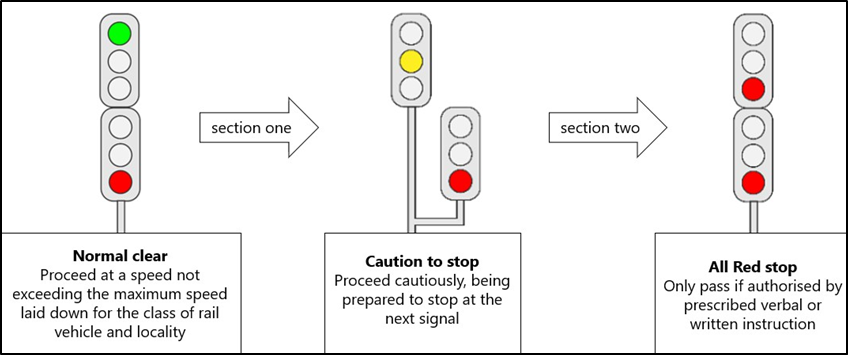
- At 1117, on clearing the limits specified in the SWA, the LE called the TTC via the in-cab radio, cancelling the authority. They continued running at maximum speed of 80 kilometres per hour (km/h) with green over red (proceed) signals (a signal informing the LE there are two clear sections of track between the advancing signals ahead of the train and that the track is not occupied; they can maintain maximum speed for the section of track) towards Morrinsville on the ECMT.
- At 1120, a hi-rail vehicle (HRV) operator of a ‘grease truck’ (a hi-rail vehicle that applies grease to the inner rails of the track to reduce wear and noise from rail vehicles) called train control to request a track occupancy authority to travel towards Hamilton (A track occupancy authority must be obtained to allow unscheduled rail vehicles (which are not heavy enough to activate the track circuits that operate track signals) to operate on the track).
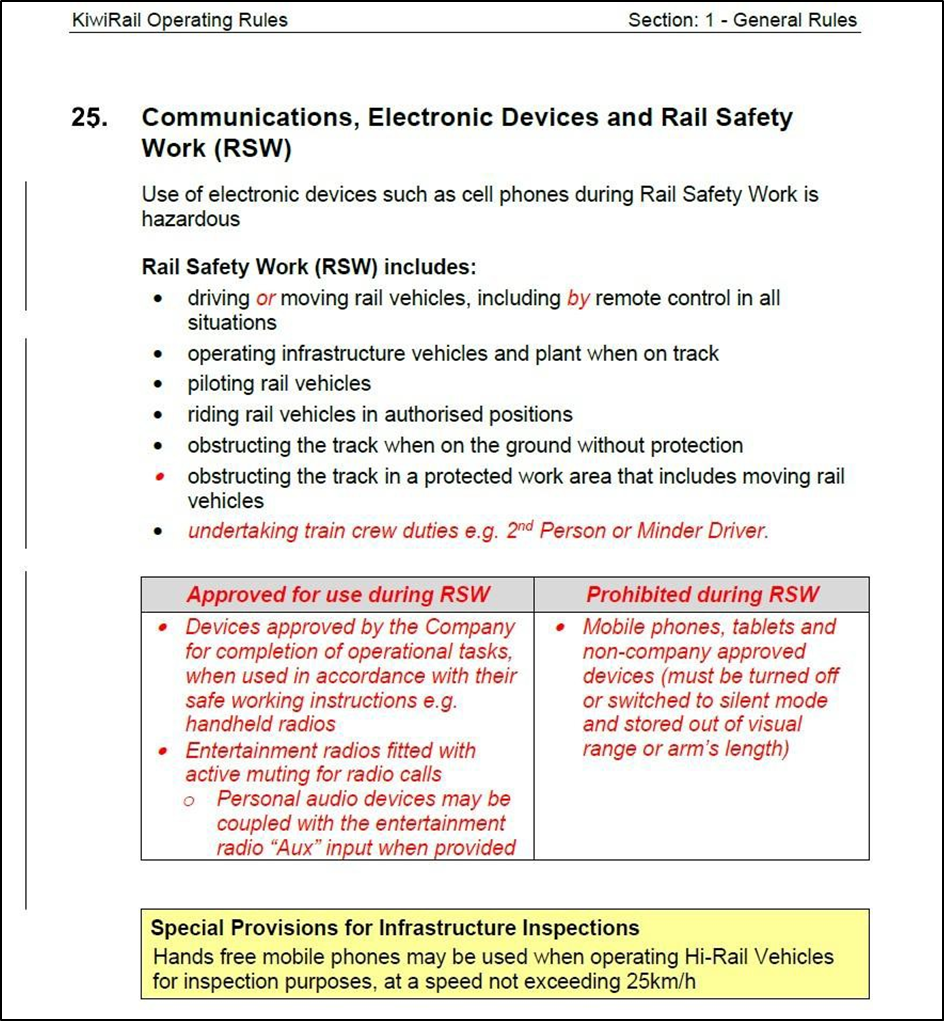
- At 1121, while driving the train, the LE used their personal mobile phone to write and send a text message. The use of mobile phones while driving a locomotive contravenes KiwiRail’s Rail Operating Rules and Procedures, General Rule 25 (see Appendix 1).
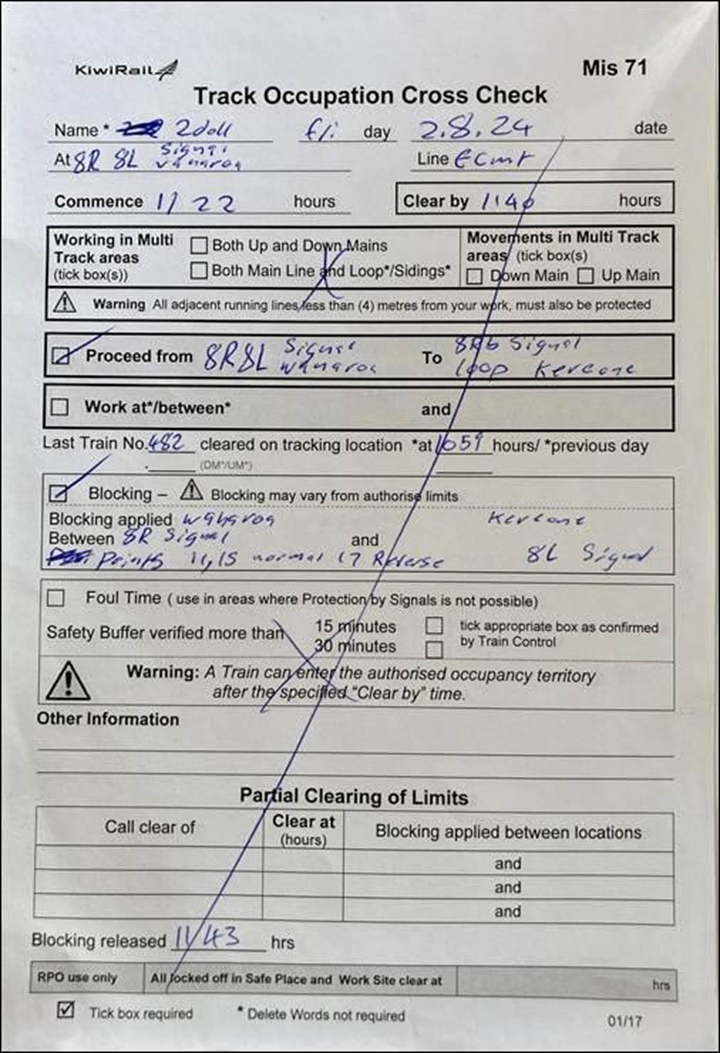
- At 1122, a conversation between the HRV operator and the TTC took place over the open VHF radio channel 2. This enabled the HRV operator to complete a track occupation form (written train control authority to occupy a section of track for a specified time) (known as a Mis 71 form, see Appendix 2) with the TTC to travel west from Waharoa to Kereone station, towards the approaching train (Figure 3 4).
- At 1124 the LE received a text message on their personal mobile phone.
- At 1125, the TTC confirmed with the HRV operator that the Mis 71 form for track protection was complete and repeated it back correctly. This gave the HRV operator permission to on-track and travel to Kereone station to enter the crossing loop.
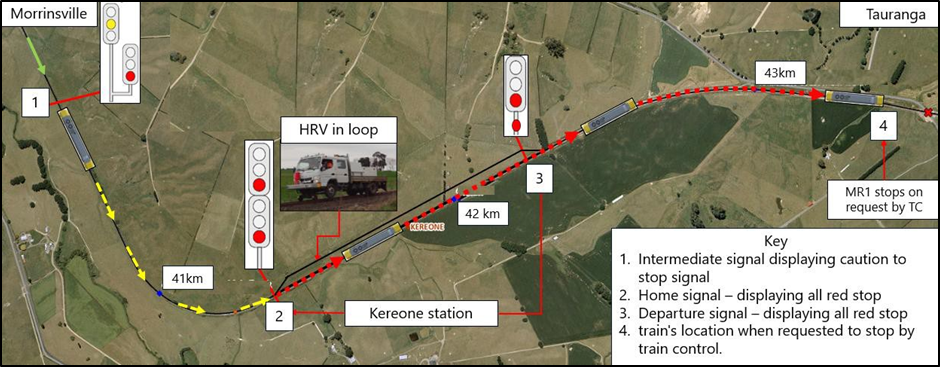
- At about 1140, after travelling west from Waharoa, the HRV arrived at Kereone station and entered the crossing loop. It travelled the length of the crossing loop track and stopped approximately 50 metres (m) short of the signal that led back onto the main line (see Figure 5).
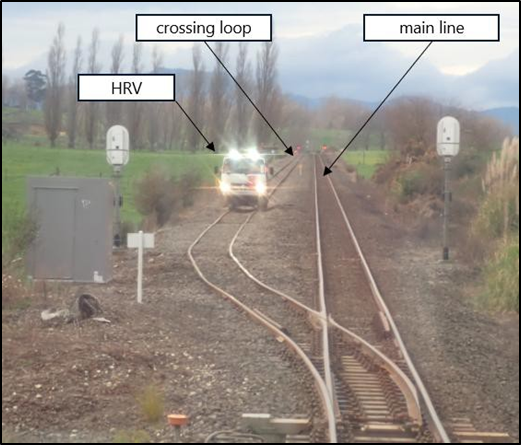
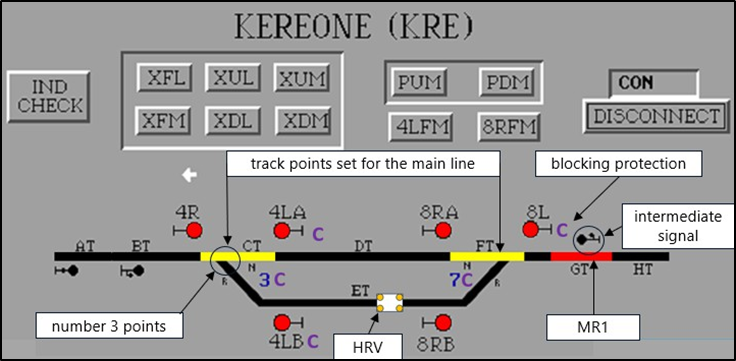
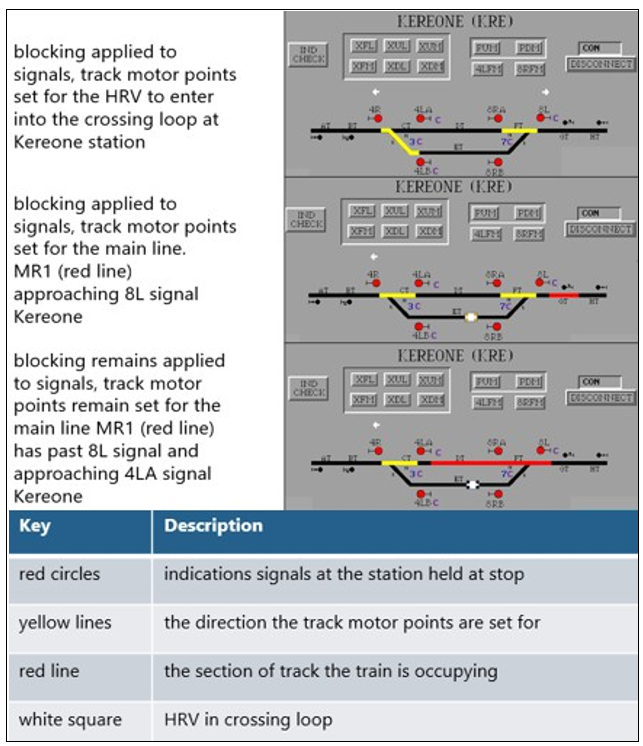
- At 1141:24, the HRV operator called the TTC informing them that the HRV was clear of the main line and stationary in the Kereone crossing loop. The TTC acknowledged the HRV operator and began the cancellation process to rearrange track points and electronic blocking (a form of protection for rail vehicles that enables the train controller to use the train control system to hold signals at stop, preventing entry of rail traffic into the blocked area. Points can also be blocked to prevent movement towards a protected area) (blocking) for the passage of the approaching train.
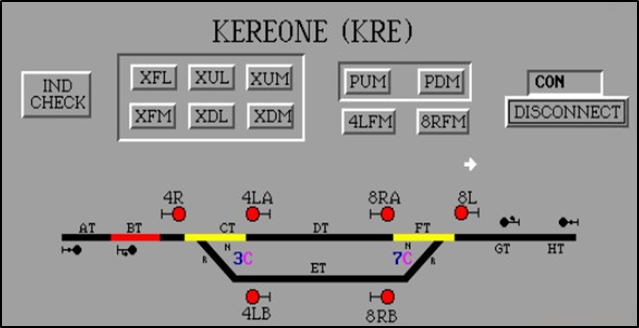
- At 1142:03, the TTC removed the blocking from the number 3 points (which were set for the crossing loop to allow entry of the HRV) (see Figure 6), then moved the number 3 points from reverse position (for the loop) to the normal position (for the main line) in preparation for the approaching train.
- At 1142:09, with the points positioned for the main line, the TTC reapplied blocking protection, while the Kereone station 8L home signal (the entry signal) and the 4LA departure signal (the exit signal) remained at all red (stop) (see Figure 6).
- At 1142:11, as the train approached the intermediate signal, the LE sounded the train’s horn acknowledging a person they were passing.
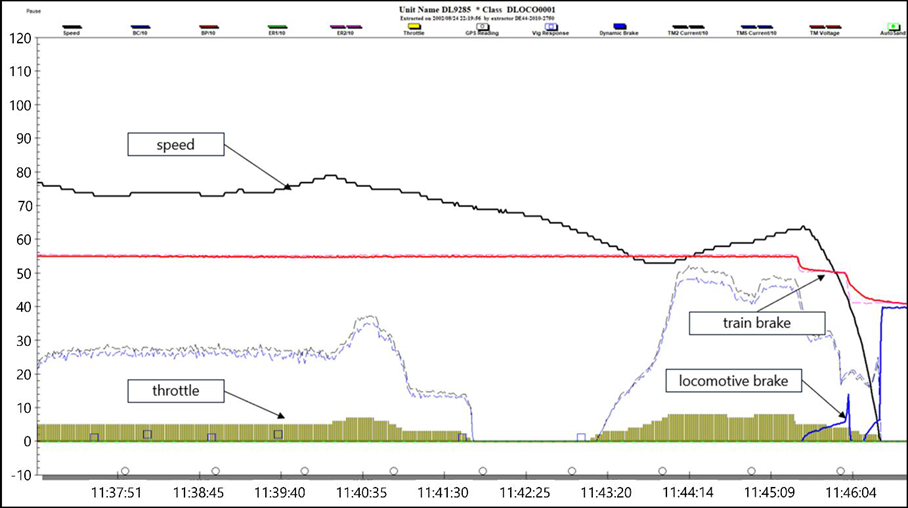
- The LE decreased the train’s speed by reducing the throttle setting to idle in preparation for a 60 km/h left-hand curve ahead.
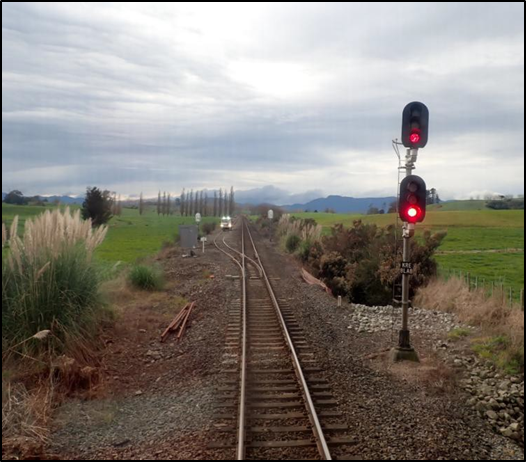
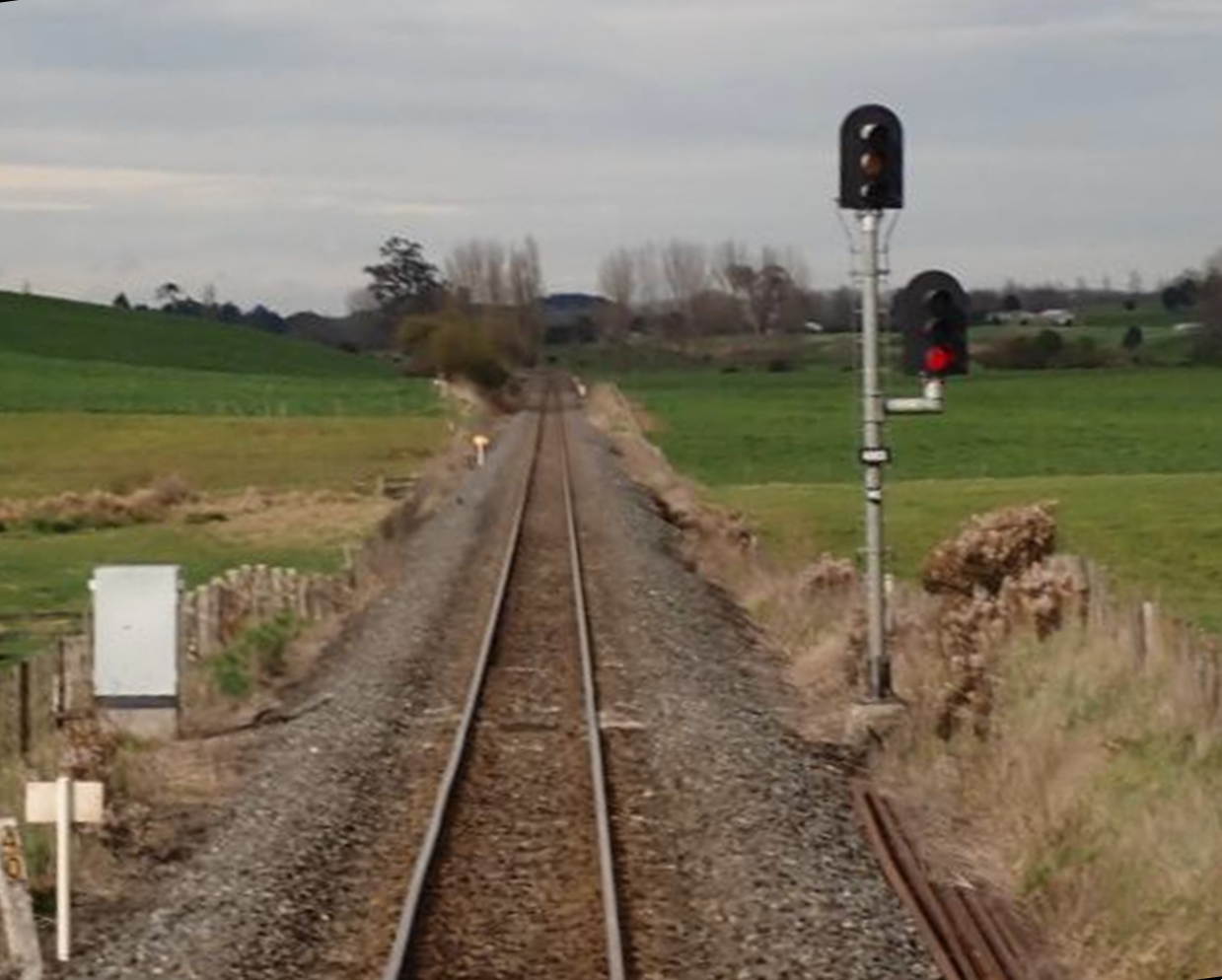
- At 1142:34, the train passed the intermediate signal that was displaying a yellow top with a red bottom aspect (the aspect of a signal is the colour light) (as per the recorded signal logs). This signalled ‘caution to stop’ (see Figure 7), informing the LE to proceed with caution and be prepared to stop at the next signal, which was the entry point into Kereone station.
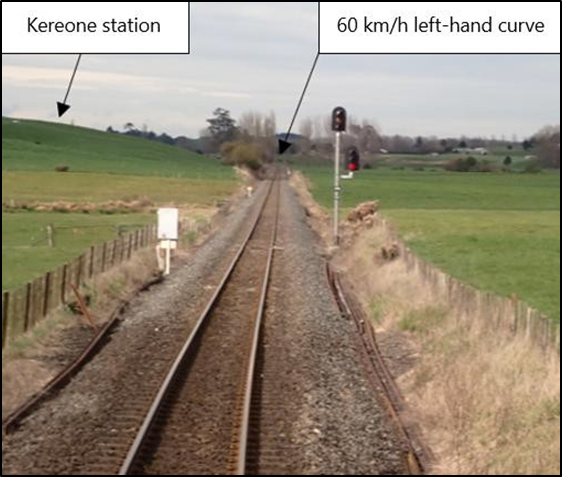
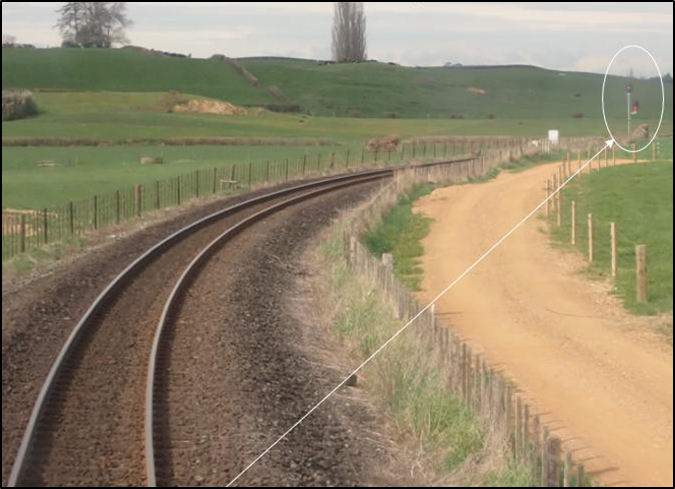
- The intermediate signal was approximately 1.3 kilometres (km) from the entrance to Kereone station and approximately 0.6 km before a 90-degree left-hand curve on an upward track gradient. The signals to enter and exit Kereone station were not visible to the LE when they passed the intermediate signal.
- The LE was aware of the track gradient and left-hand curve with a 60 km/h speed restriction. They increased the locomotive’s throttle setting to six (of the eight available) to maintain the train’s speed on the approach to the station.
- At about the same time, the TTC was issuing the HRV operator a new track occupancy authority to occupy the Kereone crossing loop. This had to be completed to ensure the HRV was protected before the TTC was able to change the entry signal (signal 8L) and the exit signal (signal 4LA) at Kereone station from all red (stop) to a proceed signal for the approaching train.
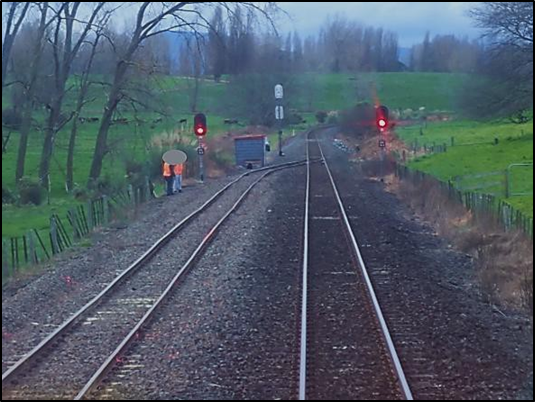
- At 1143:57, as the TTC and HRV operator were finalising the new track occupancy authority, the train passed the entry signal (signal 8L) at stop, travelling at a speed of 51 km/h, and entered the main line at Kereone (see Figure 8).
- The signalling system at Kereone station is not equipped with any engineering systems to stop a train or rail vehicle from passing a signal at stop.
- Upon sighting the HRV in the crossing loop, the LE sounded the locomotive’s horn, stood up out of the seat, and waved to the HRV operator in the crossing loop as they passed on the main line.
- At 1143:57, the TTC and the STC observed the train on the train control system mimic screen (a visual display of the train control system enabling the train controller to control the movement of points and the operation of signals – the train control system’s graphical user interface) pass the entry signal (signal 8L) at stop. Passing a signal at all red (stop) without authorisation is contrary to KiwiRail’s Rail Operating Rules and Procedures and is referred to as a signal passed at danger (SPAD). The train proceeded down the main line towards the exit signal (signal 4LA) (see Figure 9).
- Realising a potential SPAD had occurred, the STC took over from the TTC. The STC used the train control radio system’s base call (a function of the radio system that triggers an audible alert when urgent communication is required) feature to send an audible alert directly to the train’s locomotive cab. At the same time, the train passed the exit signal (signal 4LA) at stop without authorisation, resulting in a second SPAD.
- The base call alerted the LE who responded by calling train control on the radio. The STC asked the LE what they had observed when sighting the two signal aspects at Kereone station. The LE responded that the signals were ‘normal clear’. As this did not match the train control system mimic screen, the STC instructed the LE to stop the train to enable further investigation of the signalling functions and track circuitry system.
- At 1146:23 the train stopped 2.057 km past the first red signal (signal 8L) (see Figure 10). A rail incident coordinator (Personnel certified to attend an incident or accident within the rail corridor, liaise with rail and emergency services to support the site recovery, and initiate the first parts of the investigation for the rail provider) (RIC) and a signal technician (personnel qualified to test, maintain and repair signalling equipment) travelled to the site to investigate.
After the incident
- Once stopped, the LE reconfirmed that they had seen ‘normal clear’ (green top unit, red bottom unit aspects) on the intermediate signal, the entry signal and the exit signal at Kereone station.
- The RIC and signal technician arrived at Kereone to conduct testing of the signalling functions and track circuitry system.
- Initial testing by KiwiRail found that the signals leading up to Kereone and at the station were all working correctly. This reflected what the TTC and STC had observed on the train control system mimic screen and the recorded signal log information.
- A signal sighting assessment completed by KiwiRail found that the signals before Kereone and at the station all met the required standard for sightline distance and time-over-distance measurements. There was no vegetation or rail infrastructure impeding the view lines to any of the three signals.
- The data obtained by the Transport Accident Investigation Commission (the Commission) from the train, the HRV, the track circuitry and the signal log all indicated that a potential collision between the train and the HRV was avoided by approximately three minutes and 35 seconds.
Personnel information
- The LE was employed by KiwiRail in August 2022. They completed theory and on-job training, achieving certification on 9 May 2024. KiwiRail completed a safety observation (a practical on-job observation completed every eight months by a certified rail assessor to assess if a rail worker is competent to retain their current licence to operate) assessment on 2 July 2024, and the LE was competent at the time of the incident.
- KiwiRail’s post-incident drug and alcohol testing of the LE produced a negative (clear) result.
Vehicle information
- The train was 741 m long, weighed 1274 tonnes (powered by a DL9285 diesel electric locomotive), hauling 39 wagons.
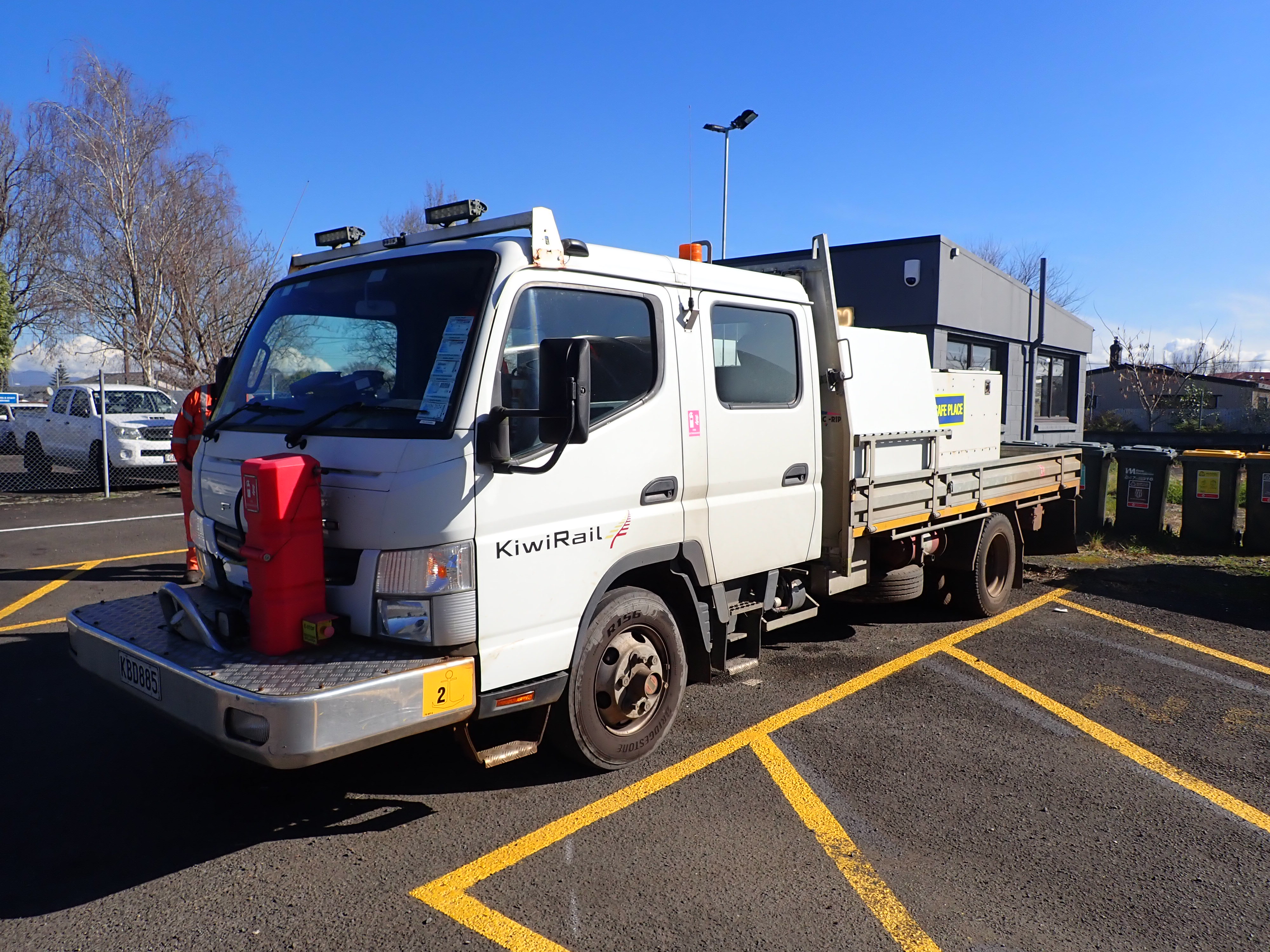
- The HRV grease truck was a Mitsubishi Fuso Canter 2016 configured to travel on road and railway track (see Figure 11). When in rail mode, the truck applies grease to the inner side of the rail head to minimise wheel-to-rail friction, noise and wear on rail vehicles’ components.
Organisational information
KiwiRail Holdings Limited (KiwiRail)
- KiwiRail is a New Zealand state-owned enterprise. It operates trains and rail vehicles, controls rail movements on the national rail network and maintains the railway infrastructure as the rail access provider.
Recorded data
Tranzlog data
- The train’s locomotive was fitted with a Tranzlog data recording system (this system records and stores operational data from the locomotive). The data pertaining to this incident was obtained by the Commission and used in this report (see Figure 12).
GPS data from the HRV grease truck
-
The HRV was fitted with a GPS recording system, and the data was obtained by the Commission and used in this report.
Train control signal logs
-
The train control signal logs (the recorded actions of the train controller moving and locking the track’s motor points at the station (yellow line indication set for the main line) and any active blocking commands. It also records the movement of the train in each section of track (red line)) and data from the train control system mimic screen were obtained by the Commission and used in this report (see Figure 13).
.
Testing
- KiwiRail conducted post-incident signal testing on the day of the incident at Kereone station, checking the signal aspects and track circuitry between Morrinsville and Kereone (including the station). The Commission obtained the results of this testing, and these are discussed in this report.
- The Commission also conducted testing, including:
- confirming train control route settings and signal logs
- re-enacting the HRV entering the loop at Kereone station, with blocking applied
- using a locomotive to activate track circuitry between Morrinsville and Kereone
- assessing the effect of movement of motorised track points at the east end of Kereone station
- testing the train control display monitor panel relating to signal aspects, interlocking motorised points and track circuits at Kereone station.
- The results of this testing are discussed later in the report.
Previous occurrences
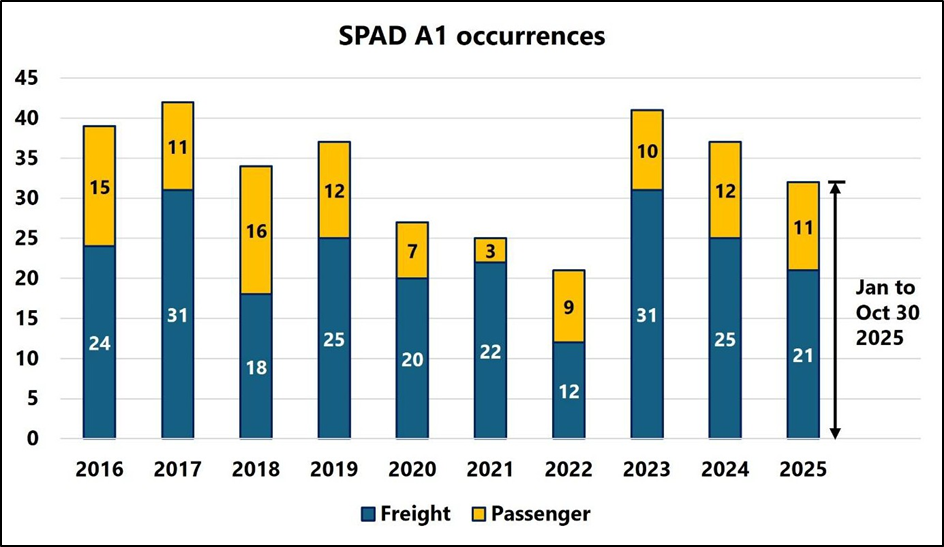
The Commission obtained KiwiRail’s SPAD occurrence data for the period 2016 to 2025. The data captured freight and passenger operations, including metro passenger operations in Auckland and Wellington (see Figure 14).
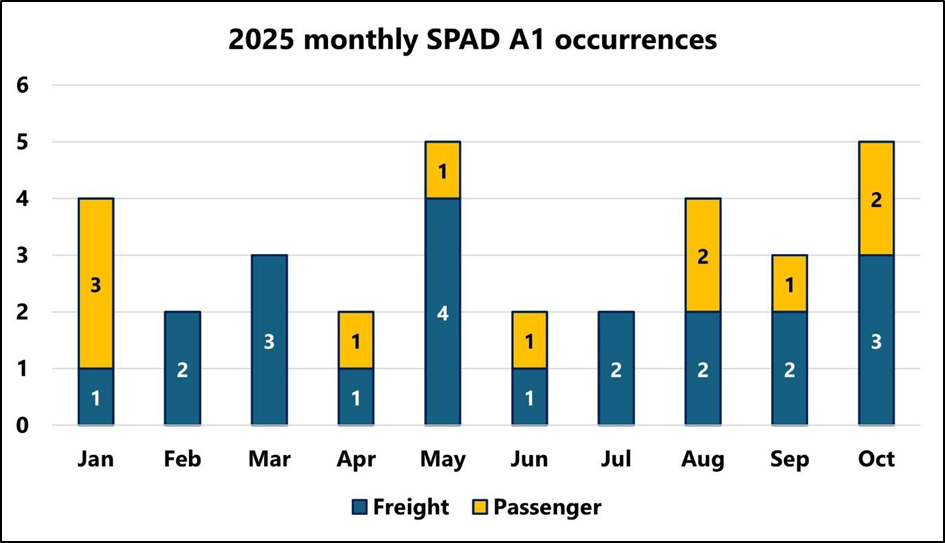
- Figure 15 shows the number of SPADs occurring monthly between 1 January 2025 and 31 October 2025.
RO-2024-101 SPAD Cora Lynn
- On 27 February 2024, a fully loaded freight train was on the main line, travelling from Ngakawau (north of Westport) to Christchurch. At about 0820 the train reached the crossing loop at Cora Lynn near Arthur’s Pass.
- The train passed a red stop signal and continued for another 800 m before stopping at the east end of the crossing loop.
- Another freight train travelling westwards had just berthed in the crossing loop.
- There was no collision, and no injuries were reported as a result of the SPAD.
RO-2023-104 SPAD Penrose
- On 17 June 2023, the regional passenger train service, Te Huia, was travelling from Hamilton to Auckland on a scheduled service.
- At Penrose Station on the North Auckland Line, the train passed a stop signal and entered the Onehunga branch line junction, damaging the junction points.
- The signalling system detected that Te Huia had entered the junction, and the signals on the Onehunga branch line reverted to a stop sequence. This alerted the commuter train driver as they were departing that the route was now occupied, preventing a potential collision.
RO-2019-107 SPAD Wellington Station
- On Wednesday 6 November 2019, the train driver of the 1317 off-peak Melling service failed to stop at a red-stop signal in the Wellington Railway Station area and continued towards an oncoming returning Waikanae service.
- Both train drivers realised what was happening and stopped their trains 31.8 m apart.
- There was no collision, and no one was injured in the incident.
RO-1999-122 SPAD Waipahi fatal head-on train collision between two freight services
- On 20 October 1999 at around 0702, Train 938, a northbound express freight train, collided with Train 919, a southbound intercity express freight train, which was stationary on the main line within station limits at Waipahi (see Figure 16).
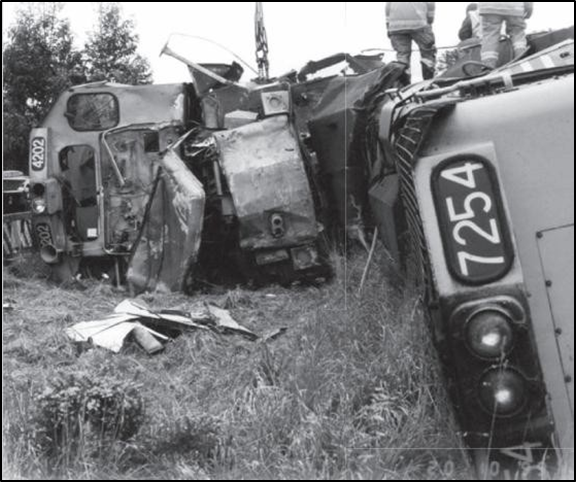
- The collision resulted in significant damage to both trains and the death of the locomotive engineer of Train 919.
International SPAD inquiry
United Kingdom – Southall and Ladbroke Grove Rail Inquiry
- Other international jurisdictions have recognised the various risks associated with SPAD occurrences, particularly the collateral and social impacts.
- The Cullen Report (a United Kingdom inquiry resulting from a collision between two trains at Ladbroke Grove Junction on 5 October 1999 that caused considerable loss of life and injuries. It is referred to as either “the Uff/Cullen report”, or simply “the Cullen report”) for example, refers to the findings of the public inquiry, chaired by the Rt Hon Lord Cullen, into the Ladbroke Grove rail crash which occurred on 5 October 1999. This accident involved a collision between a Thames commuter service and a First Great Western express, resulting in 31 fatalities and 417 injuries.
-
The Cullen Report highlighted multiple prior SPADs in the Paddington area, which were not adequately addressed by Railtrack. The inquiry highlighted there was confusion due to too many organisations handling overlapping safety responsibilities, and a need for train protection systems. The inquiry found:
The safety systems and procedures considered in this report will reduce, but not eliminate, the risk of a catastrophic accident occurring during the next decade or more through a signal passed at danger (SPAD). But most of that risk will be removed when the railway system is fitted with the European Train Control System (ETCS), which is first to be installed on the West Coast Main Line
Fitment to the remainder of the network will inevitably be gradual, involving, as it does, great cost and resources
For the present, existing train protection systems, including the Train Protection and Warning System (TPWS), must continue to be supplemented by other measures to reduce or mitigate the effect of SPADs. For the future, our greatest concern is that nothing should impede the fitment of ETCS and the achievement of the best possible level of train protection. The rail industry has a poor record in meeting its objectives. We believe that the measures we have recommended, coupled with adequate funding and resources, should enable this important objective to be met.
Until ETCS is generally available on UK lines the risk of a catastrophic accident following a SPAD remains. This will continue to be the case after fitment of TPWS in respect of a significant proportion of trains.
Analysis Tātaritanga
Introduction
- On 2 August 2024, a freight train passed the entry signal into Kereone station at all red (stop). It entered the main line unauthorised, narrowly avoiding a collision with an HVR grease truck that had entered into the crossing loop, three minutes 35 seconds earlier. Then, without train control’s authority, the train passed a second signal at stop, exiting the station and entering a block section (a single section of line between two adjoining stations. Movements in either both directions or one direction only are possible)
- Section 3 analyses the circumstances surrounding the event to identify those factors that increased the likelihood of the event occurring or increased the severity of its outcome. The inquiry looked into the following potential safety issues:
- the signalling system: it’s fundamental importance, how it works and how it relates to crossing loops
- exceeding limits of authority and monitoring safety performance indicators
- human factors: confirmation bias (the tendency to favour information that confirms existing beliefs), and attention and distraction within a cognitively demanding environment
- the extent of engineering safety controls.
The signalling system
- The signalling system (a coloured light display that informs rail vehicles of the condition of the track ahead. It is overseen by a train controller who directs the routes of the track movements) is fundamental to the safe operation of the railway, ensuring that all rail traffic occupying the track is spaced safely apart and conflicting movements (is where rail vehicle movements are against each other (head on) or are fouling the adjoining track in the way of another movement) are avoided. Railway signals are like road traffic lights; they tell an LE if it is safe to proceed along the track, and to control the train speed accordingly. Like road traffic lights, an LE shouldn’t pass a red signal.
- The ECMT is a single-line track with crossing stations (a running line, secondary to the main line, with entry and exit points connected to the main line, provided primarily for the crossing or passing of trains) along the route enabling rail traffic to cross. The Centralised Traffic Control (CTC) system is used by train control (via their access to trackside signals) to manage the movement of rail traffic entering and exiting crossing stations.
-
The system relies on illuminated coloured light indications, known as signal aspects. Positioned on trackside signal equipment, they provide the LE with visual information to enable them to control the train’s speed as it moves along the track (see Figure 17).
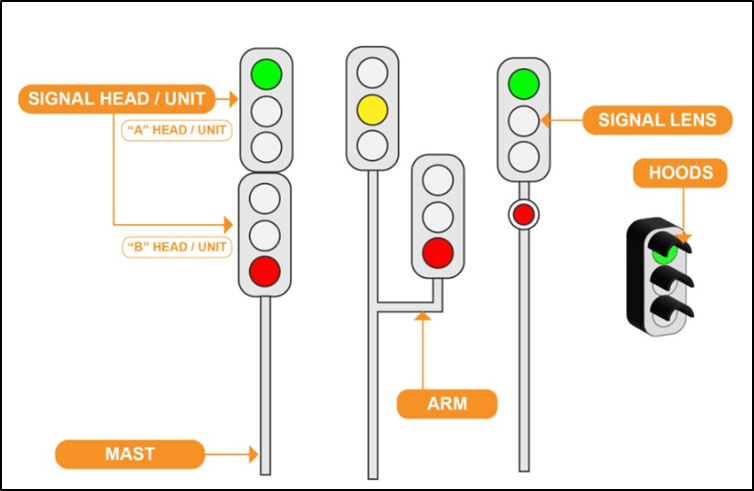
Figure 17: Trackside signal equipment (Credit: KiwiRail) - The coloured lights can be illuminated in several combinations. These combinations enable the LE to understand the track condition ahead, whether it is occupied, what speed is required by the train, whether they are approaching a stop, or if they need to stop.
- To stop a train movement at a CTC crossing station, the signals progressively display the signal aspects as shown in Figure 18: normal clear; caution to stop; all red stop. These combinations result in two clear sections of track between the signals. This gives enough track space ahead for the train to stop and comply with the minimum signal sightline distance of 12 seconds at the maximum line speed of the area. It also allows the LE enough time to plan train handling actions accordingly.
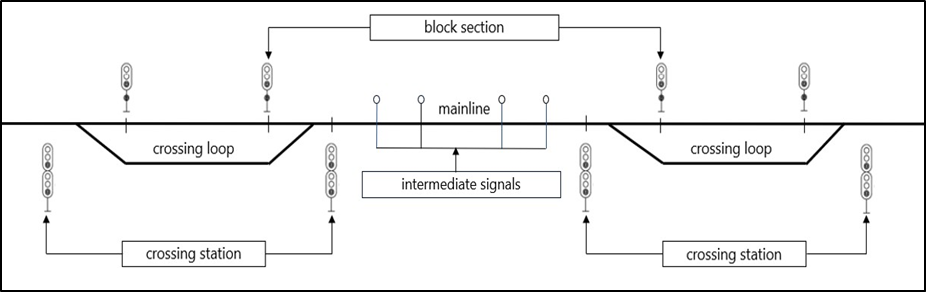
- The track as a whole is segmented into block sections, with each block comprising a section of single track between a crossing station. The track within a block is further divided into smaller sections through the placement of intermediate signals between each station (see Figure 19). This gives increased control of a train’s movements.
- The train controller has oversight of the train’s position between each signal within the block section. Track circuitry or axle reading equipment relays information in real time back to the train control system mimic screen as the train passes trackside signals.
- Train control manages rail vehicle movements into a block section of track, and the entry and exit of rail vehicles at crossing stations. They use the signals and motorised track points (see Figure 20) to position the rail vehicles accordingly.
Post-incident signalling system testing
- After the incident, a KiwiRail signal maintainer went to the site and conducted testing to determine whether the signalling system was working correctly at the time of the incident. Part of the testing was to check whether the signals leading up to and at Kereone station replicated what was shown on the train control system mimic screen.
- The Network Control Manager (NCM) oversaw the initial testing of the incident site immediately following the incident, before giving clearance to release the site back into normal operation. The NCM collected signal log information for the train’s movements (see Figure 21).
-
The Commission’s testing found that the TTC computer command inputs and the trackside signals displayed the correct signal aspects to stop the train at Kereone station’s entry signal.
-
The Commission also found that there was no evidence of a power supply outage at Kereone station before, during or immediately after the incident.
- Testing onboard the locomotive found no prior or post-incident faults with the onboard equipment, nor any mechanical issues.
- Static testing of the locomotive’s VHF radio system found that the onboard radio was working correctly and was able to send and receive voice transmissions between the locomotive and train control.
- Having reviewed all available evidence, the Commission found that it is virtually certain that the signalling system for Kereone station was operating correctly when the train passed through. It is also virtually certain that both signals at Kereone station were set at stop (red) when passed.
Why do SPADs occur?
Confirmation bias
- The signalling system on New Zealand’s rail network should enable train movements to be precisely controlled. However, the system’s effectiveness relies on human performance, which is fallible. For example, research shows that people tend to notice, focus on and give greater credence to evidence that fits with their existing beliefs and expectations (Nickerson, 1998). Moreover, people are generally unaware they are influenced by their expectations in this way. This is known as confirmation bias.
- LEs are not immune to this bias. A study using eye-tracking technology has shown they pay less attention to the next potential signal when the previous signal was green. Evidence from verbal reports in the same study indicates some LEs may alter their concentration levels when they expect to be running on green signals (Luke, 2006).
- The LE involved in this incident was not informed by the TTC that an HRV was due to conduct grease work on the track, and it was not a requirement for the TTC to do so. When interviewed, the LE did not recall hearing any discussion about the HRV movements over the radio. The LE had also checked the daily information bulletin and used a GPS application on their work-issued iPad to look for movements of other trains and rail vehicles on the track. They did not see any other trains they could potentially encounter on the return journey to Tauranga.
- Based on the information that the LE had at the start of their trip, it is likely that they expected the signals on the return trip to Tauranga to be at a normal clear (green top over red bottom).
- It is also likely that because they expected normal clear signals, the LE was subject to confirmation bias, predisposing them not to notice that the signals were yellow over red or all red (stop).
Visibility of the intermediate signal
- The impact of confirmation bias may have been enhanced on the LE’s approach to the intermediate signal. This is because while the intermediate signal met KiwiRail’s signal sighting standards and could be seen clearly from approximately 600 m away, the track leading to the signal was on a right-hand bend. As a result, the signal became harder to read as the train got closer to it due to the curvature of the track (see Figure 22).
- In particular, the upper unit of the signal (yellow) became harder to read than the lower unit (red). Therefore, it is about as likely as not that the LE mistakenly perceived a normal clear signal as they approached the intermediate signal (see Figure 23).
Attention and distraction
- Operating a train safely requires an LE to sustain a high level of visual, cognitive, physical, and auditory attention (attention describes a mental function that allows us to consciously process sensory stimuli and prioritise information) It is a complex environment. For example, LEs must be aware of their surroundings, look out for and identify signal combinations, receive and listen to radio communications, and be prepared to respond to changing situations. In addition, their attention to relevant tasks must be sustained over a long period of time, even when there are periods where there may seemingly be little to pay attention to.
- Research shows that attention is a limited resource that can readily be distracted and switched between different foci – intentionally or otherwise (Scalf, 2013). Therefore, effort is required to prevent task-irrelevant thoughts and actions. Not surprisingly, performance in tasks requiring sustained attention tend to decline over time (Thomson, 2015)
- At the time of the SPADs, the LE had been driving for about 45 minutes since their most recent period of rest. They had been working for approximately six hours, of which at least three and a half hours had been spent operating a train. This was within the limits set by KiwiRail’s fatigue assessment tool. The Commission found no evidence that the LE was fatigued.
- The LE was subject to several distractions in the lead-up to the incident. At 1121, the LE wrote and sent a text message, then received a response to the text message at 1124 (see Figure 24, Tasks 1 and 2).
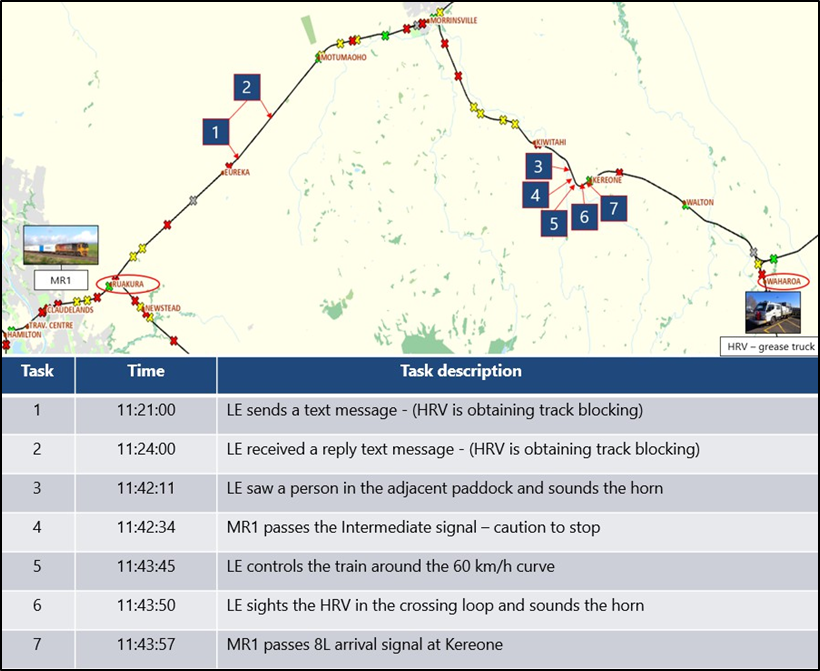
- As attention is a limited resource, it is very likely the LE did not hear the conversation between the TTC and HRV operator as they were distracted by their mobile device. This removed an opportunity for the LE to receive advanced notice of the upcoming crossing with the HRV at Kereone station, and to expect signals directing them to prepare to stop the train.
- On approaching the intermediate signal, the LE observed a person adjacent to the track and acknowledged them by sounding the horn.
- As they passed the intermediate signal and approached the stop signal at Kereone, there was open radio channel communication between the HRV operator and the TTC completing the required track authority for the HRV to occupy the Kereone crossing loop.
- At that time, the LE’s focus was likely on responding to the person and maintaining and controlling the correct line speed for the 60 km/h left-hand bend and uphill gradient ahead.
- It is likely that when approaching the intermediate signal, the LE’s attention was directed between acknowledging the person trackside, sounding the horn, and maintaining and controlling the correct train speed.
Controls to prevent exceeding limits of authority
Safety issue 1: Administrative controls alone are insufficient to prevent rail traffic from exceeding limits of authority. Without engineering controls in place, and when administrative controls fail, the risk of human error remains unmitigated.
- Rail transportation is a complex system (a complex system is one where multiple individual, but inter-related, components interact. Within complex systems, safety is considered to be an emergent property of the system as a whole (ie, its multiple components), not the result of individual components acting in isolation) that requires robust risk controls to guard against outcomes associated with the limitations of human performance. This means that administrative controls (paper-based rules or codes to follow to mitigate the hazard risk) which are inherently vulnerable to human error or non-compliance, should not solely be relied upon to keep the system safe.
- In this incident, the existing administrative control (a reliance on the LE recognising and then reacting appropriately to signal aspects) proved inadequate to prevent the SPAD because the control failed to compensate for variabilities in human performance.
- Complex systems require multiple reliable defences, such as engineering controls (in general, engineering risk controls work by isolating hazards by way of the physical design of a system) to maintain acceptable levels of safety. The absence of these controls can predispose a system to errors, as occurred in this incident.
- KiwiRail’s current risk controls to prevent SPADs are largely administrative controls. Limited areas of the rail network have engineering controls and largely rely on human performance. These include:
- training – theory and practical on-job training
- route knowledge – signal and station locations and track gradients
- rules, codes and standards
- certification and safety observation assessments (eight monthly)
- revalidation programme (two yearly)
- fatigue rostering guidelines of the Fatigue Audit InterDyne (FAID) (fatigue‑modelling framework, where FAID is an Hours‑of‑Work–based biomathematical model used to estimate relative fatigue exposure)
- locomotive vigilant alert devices and a signal alert system
- non-technical skills – KiwiRail’s online course
- risk-triggered commentary and stabilised approach to signals and end of limits – short course
- signalling system and track movement authorisations.
- Engineering controls support the reduction of incidents and accidents, but they are not in place across all areas of New Zealand’s rail network infrastructure and locomotive fleet (see Figure 25: Locations of engineering safety systems).
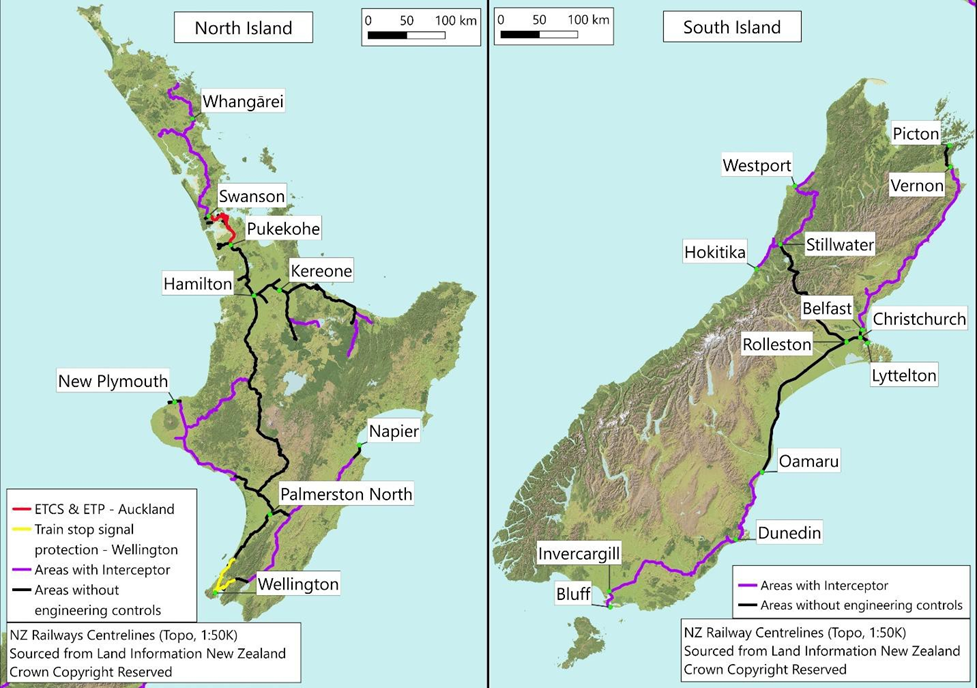
- There is a range of engineering safety systems that could be implemented to prevent unintended rail vehicle movements and vehicles exceeding the limits of authority, including:
- European Train Control System (ETCS) – Level 1 is in Auckland
- Train Stop Protection (TSP) – in Wellington
- Electronic Train Protection (ETP) – in Auckland on the Te Huia passenger locomotives fleet only
- the worksite protection system, E-Protect
- a geofenced track warrant limit of authority system, Interceptor – in parts of the North and South Islands.
- Currently there are no engineering controls installed on KiwiRail’s HRVs or mobile track maintenance vehicles (MTMV) (rail-bound maintenance vehicles/machines, for example (but not limited to) tampers, regulators, track stabilisers, ballast cleaners, low loaders, track evaluation cars, track undercutters, self-propelled cranes. Generally, they operate track circuits, so must comply with signals. May be operated singly or as a group) to prevent these vehicles exceeding the limits of authority.
- Auckland One Rail (AOR) operates Auckland’s commuter train services. The Commission reviewed AOR data for the last five years of SPAD occurrences, where trains and infrastructure are fitted with ETCS. Their SPAD ratio for 2024 was 0.77 SPADs per million kilometres travelled (see Figure 26).
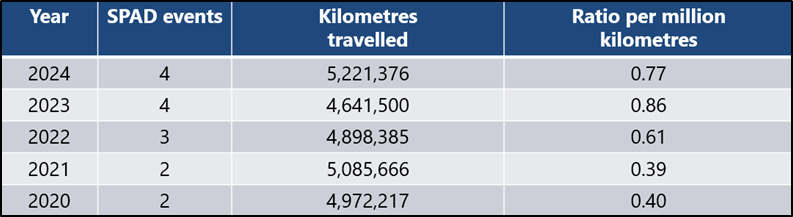
- This demonstrates the effect that an engineering safety system can have on the frequency of SPADs by preventing a train from entering an area where a conflicting movement could occur.
- Had an engineering control been in place, it is likely the train would not have passed the entry signal at danger. It is virtually certain that had ETCS been fitted and operational, the train would not have exceeded the overrun area (buffer zone) where a collision could occur.
- Further, it is virtually certain that the second SPAD into an unauthorised section of track at the far end of the station would have been prevented.
Monitoring and responding to safety performance indicators
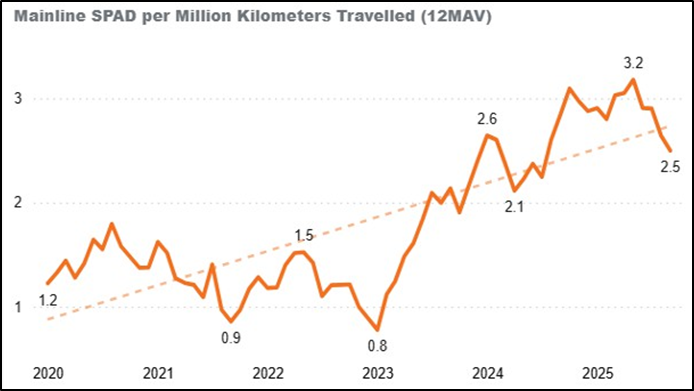
Safety issue 2: The rate of SPAD incidents across KiwiRail’s rail network has risen to 3.2 SPADs per million kilometres, compared to the benchmark set by KiwiRail of 1.0 SPAD per million kilometres. This rate indicates a decline in safety performance. The Ministry of Transport, New Zealand Transport Agency and KiwiRail all have roles to play in responding to the high rate of SPADs.
- SPADs are not a new phenomenon in the New Zealand rail industry, or around the world. They can be precursors to serious rail vehicle collisions, derailments and level crossing accidents and incidents.
- The frequency of SPADs being reported by KiwiRail to the regulator, referred to as the SPAD ratio, has increased over the past two years across New Zealand’s rail network. The SPAD ratio is calculated from the number of SPADs per million km travelled, and is a key safety metric in the rail industry.
- The national rail data trends of all operators showed SPAD occurrences have increased in both freight and passenger services.
- In the last two years, KiwiRail has had four serious SPAD incidents involving passenger trains either at risk of a head-on collision, a side-on collision with merging rail traffic, or a collision with a motor vehicle at a protected level crossing.
- Further analysis of the SPAD data found that KiwiRail did not include all SPADs involving HRVs or MTMVs that occurred on the rail network (instead reporting these as safe working irregularities). This is contrary to how safety performance measurements are determined internationally and what the Rail Industry Safety Standards Board (RISSB) recommend in their guidelines (see Figure 27).
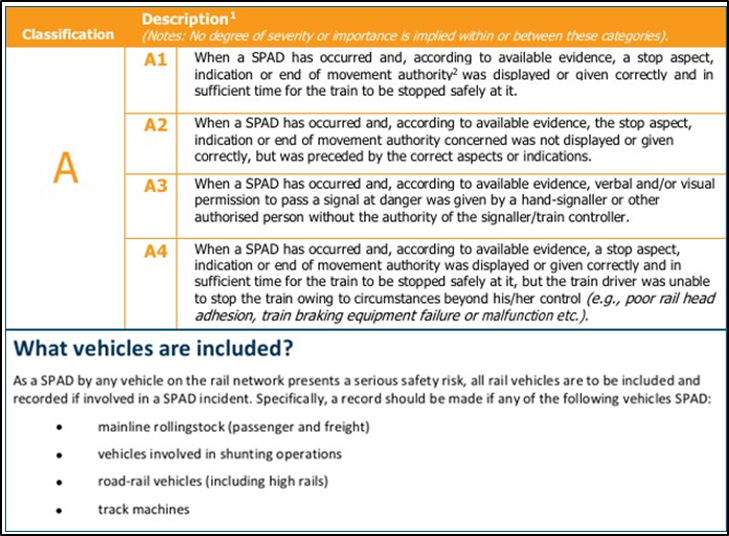
- The Commission obtained KiwiRail’s mainline train SPAD data, which showed that in 2025 the SPAD ratio had increased to 3.2 SPADs per million kilometres, despite engineering controls being added to some of their locomotive fleet (see Figure 28). The SPAD ratio KiwiRail has set as a benchmark is 1.0 SPAD per million kilometres, which is consistent with international practice.
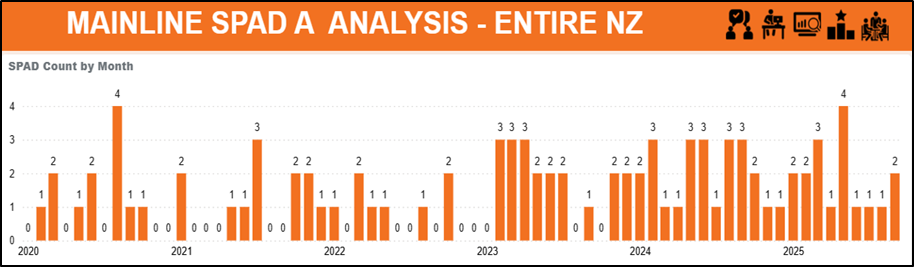
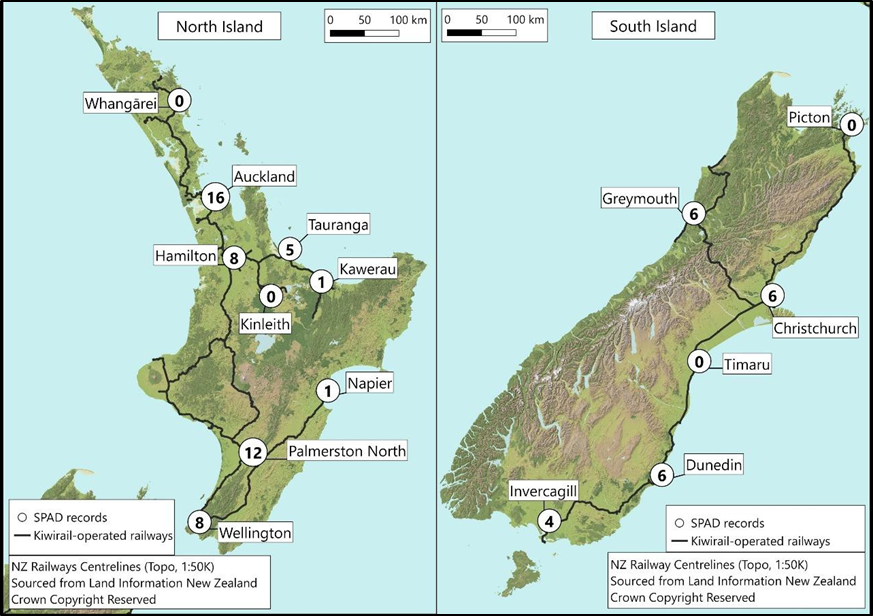
- This investigation reviewed five years (the SPAD data reviewed full calendar years from 2020 to 2024) of KiwiRail’s national SPAD data to identify where incidents were occurring across its operations. The analysis showed that SPADs were not confined to a single location but occurred throughout the rail network, across both the North and South Islands (see Figure 30).
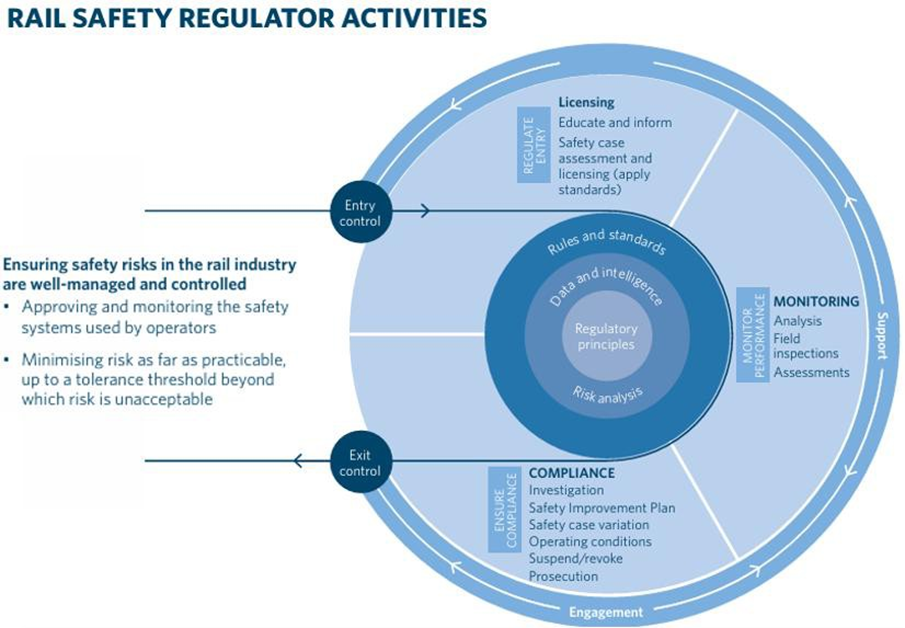
- In New Zealand, SPAD data is primarily monitored and managed by the New Zealand Transport Agency Waka Kotahi (NZTA), the rail safety regulator under the Railways Act 2005.
- NZTA is responsible for (the four points are from New Zealand Transport Agency's Regulatory Capability and Performance Report, 26 June 2019):
- Licensing: Managing the entry and compliance of rail participants who are required to hold a rail licence.
- Monitoring: Using intelligence to identify and target critical safety risks, assessing performance, and investigating accidents to identify non-compliance and unsafe practices such as SPAD incidents.
- Compliance: Intervening with compliance tools to improve performance or control significant risks, and prosecuting breaches of the Railways Act 2005.
- Engagement and education: Working with rail and road stakeholders to achieve a safer rail system and educating rail participants on their regulatory duties (see Figure 31).
- Each year, rail licence holders, including KiwiRail, must submit a Safety Performance Report to NZTA. These reports help NZTA assess the overall safety performance of the rail sector and inform policy and planning.
- The reports include the following:
- workforce details
- rail activity levels
- safety incidents, including SPADs.
- The Ministry of Transport (the Ministry) monitors NZTA’s regulatory performance to ensure it is fulfilling its safety oversight role effectively. This includes reviewing NZTA’s capability to respond to safety risks, such as SPADs, incidents and accidents (see Figure 32).
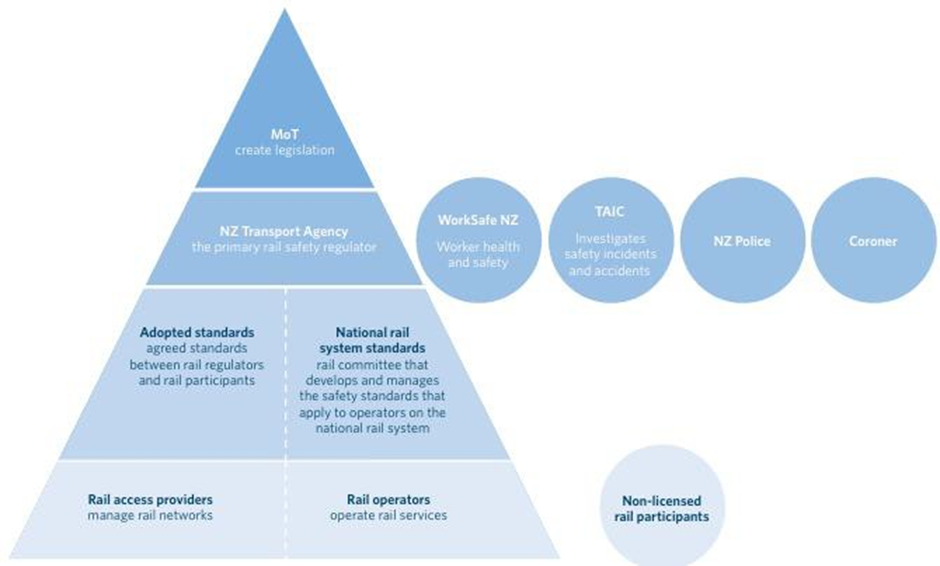
- The rail participants and licence holders are responsible for safely managing their operations. As the regulator, NZTA is responsible for continuous monitoring of rail participants’ performance against their safety objectives. It achieves this through the monitoring of key performance indicators, accident and incident occurrence data, and a safety assessment programme.
- When asked how it monitored KiwiRail’s SPAD performance against their safety objectives, NZTA responded that it had been engaging with KiwiRail and metro operators in relation to SPAD reduction work, including:
- facilitating the introduction of new immediate safety controls for the Auckland Metro rail network (AMRN)
- increasing the frequency of KiwiRail’s safety observations of LEs operating in the AMRN (every two months instead of every eight months)
- mandatory use by LEs of an in-cab signal alert tool, which provides a visual reminder to LEs that they are approaching a stop signal
- amending KiwiRail’s LE roster to reduce the number of Hamilton/Te Rapa-based LEs operating in the AMRN, to respond to issues around route knowledge and familiarity
- engaging with KiwiRail in regard to their ETCS project for North Island freight locomotives
- holding a watching brief on KiwiRail’s ETCS level 2 detailed business case for Wellington Metro
- closely monitoring the effectiveness of KiwiRail’s SPAD reduction programme and querying any noted increase in SPAD occurrences
- planning involvement in a KiwiRail-led SPAD deep dive, with Auckland One Rail, TransDev Wellington and NZTA, which will include a review of the driver competency/compliance framework across all operators.
- Many of these safety improvements are focused on the Auckland Metro area. However, this occurrence, and the KiwiRail data, indicate that SPAD incidents occur across the entire rail network.
- There are no engineering controls in place to prevent a SPAD on the ECMT. In this incident, the only available controls were administrative, relying on the LE recognising and then reacting appropriately to signals.
- It is likely that a national-level focus on SPAD occurrences would identify areas of the network that are more vulnerable to human error, particularly non-metro areas that lack trackside engineering controls. The absence of trackside engineering controls outside metro areas increases the likelihood of SPADs occurring.
- Subpart 5 of the Railways Act 2005 gives the Minister the power to make ordinary rules for the purpose of, amongst other things, safety and licensing, including, the authorisation of rail participants and rail personnel, technical requirements and standards for, or in relation to, all or any rail vehicles, railway premises, or railway infrastructure (Section 49(1)(a) of the Railways Act 2005) Ordinary rules may also set out standards, specifications, or codes of practice for the safety performance, design, construction, inspection, alteration, maintenance, or use of railway infrastructure or railway premises (Section 52(1)(b) of the Railways Act 2005) Since the Railways Act 2005 has been in force, no ordinary rules have been promulgated. However, this remains an option available to the Minister of Transport for future rail safety improvements.
Appendix 1. KiwiRail Operating Rules for use of mobile devices
Appendix 2. Mis 71 Track Occupation form