
TAIC has published its Final Report on the immobilisation and tagging of an Auckland metropolitan passenger train in September 2017. TAIC recommended that the train operator improve training for train crews, including liaising with emergency services. A fast and efficient emergency response depends on first responders receiving clear, concise and timely information.
Executive summary Tuhinga whakarāpopoto
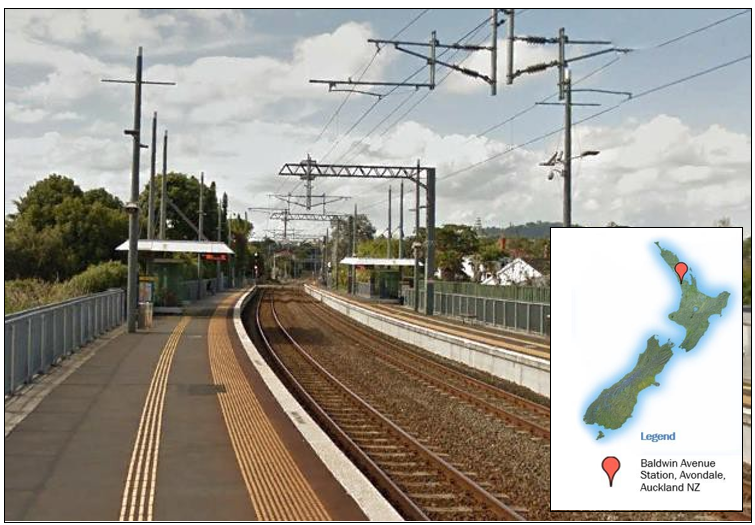
- At about 1638 on Sunday 17 September 2017, an Auckland metropolitan passenger train was travelling eastbound from Swanson to Britomart Transport Centre with a train driver, a train manager and about 40 passengers on board.
- As the train approached Baldwin Avenue Station, a group of people on the station platform wearing masks disabled the train by pulling the emergency door release levers on the outside of the train. The group then spray-painted one side of the train before escaping along the rail corridor.
- The train doors remained closed throughout the event and the passengers were kept on board. Nobody was injured and damage was confined to spray-painting one side of the train.
- The Transport Accident Investigation Commission (Commission) found that the design and installation of the emergency door release levers on the Auckland metropolitan trains met the recommended industry standards, and found that the design achieved an appropriate balance between deterring unauthorised use and allowing the doors to be opened from outside the passenger cars.
- The Commission also found that the emergency response to the incident was appropriate for the circumstances based on the information that was reported. The response to the incident would likely have been more efficient if the train crew involved had spoken directly with the Police communications centre.
- The Commission identified one safety issue: Transdev Auckland Limited had no policies or procedures in place to guide its train crew in responding to unusual situations.
- The Commission recommended that Transdev Auckland Limited improve the quality of training for train crews, including training on liaising with emergency services, so that they are better prepared to respond to unusual situations.
- A key lesson arising from the inquiry is that in any emergency situation, it is important that clear, concise and timely information be given to first responders so that a fast and efficient response can be planned and executed.
Factual information Pārongo pono
Narrative
- On Sunday 17 September 2017, a passenger train was travelling eastbound from Swanson to Britomart Transport Centre. The train was crewed by a train driver (the driver) and a train manager, both employees of Transdev.
- The train approached Baldwin Avenue Station at about 1638 for a scheduled stop. There were about 40 passengers on board.
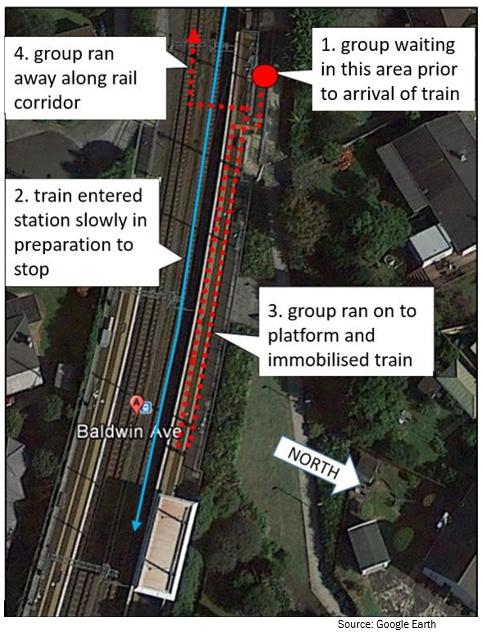
- The driver was slowing the train in preparation to stop at the station and noticed a group of about 12 people gathered on a pathway leading to the platform. The group attracted the driver’s attention because they were wearing masks covering their faces.
- The driver would normally have activated a door release from the driving cab once the train stopped at the platform, which would then have allowed the train manager to open the doors. Being unsure of the group’s intentions, the driver decided to not activate the door release when the train stopped.
- However, before the train stopped one of the masked group jogged alongside the moving train, opened the cover to the emergency door release (a device located on the outside of a train’s passenger car, primarily for the use of emergency services to enable the doors to be operated manually in the event that they cannot be opened by normal means. Sometimes referred to as an emergency egress device) panel on the third passenger car and pulled the lever (see Figure 2). Two other members of the group pulled the identical levers on the other two passenger cars as the train came to a stop at the platform.
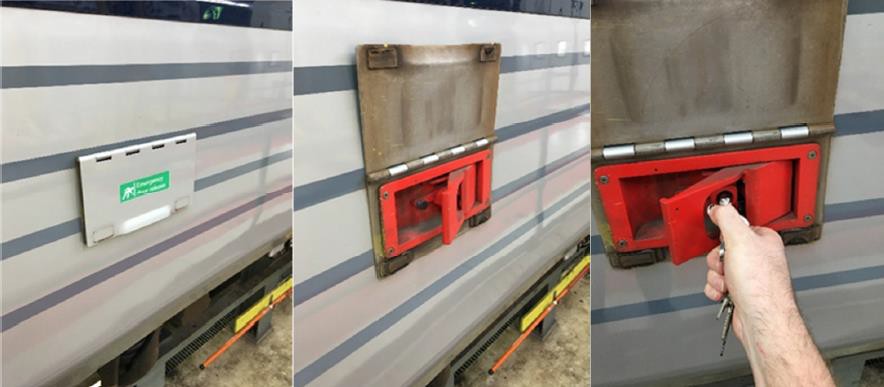
- Activating the emergency door release levers caused the train door locking mechanisms to release, which meant that the doors could then be opened by hand with minimal effort.
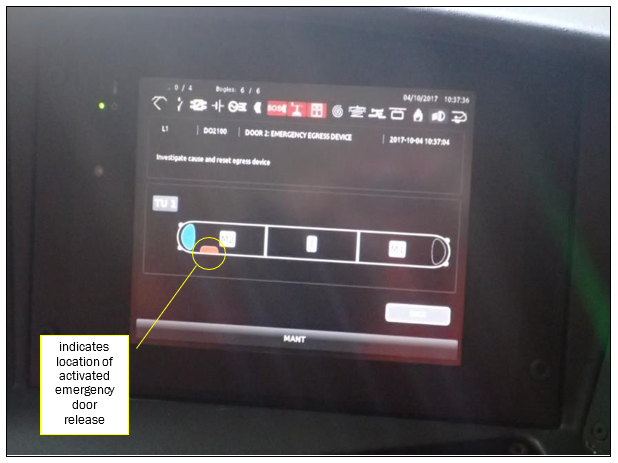
- Pulling a lever also initiated an alarm in the driving cab, which alerted the driver that a lever had been activated (see Figure 3).
- The group began spray-painting the entire platform side of the train while one member of the group videoed the activity.
- The train manager instructed the passengers to stay on the train to avoid any potential confrontation.
- The driver contacted train control by radio to report what was happening and informed the controller that the train would be delayed. At the same time the train manager contacted the Transdev Operations Centre and reported the situation, which in turn contacted the Police communications centre.
- The Police communications centre received several 111 calls from passengers on board the train. Police units were dispatched to the area around Baldwin Avenue Station.
- The group of masked people continued spray-painting the side of the train for about seven minutes. They then escaped along the rail corridor towards Mount Albert (see Figure 4).
- At 1648, having been stopped for a total of 10 minutes, the train crew considered it was safe for the doors to be opened for those passengers wishing to disembark. The train crew then carried out an inspection of the train.
- Due to the extent of the spray-paint covering the windows and doors, the train crew deemed it unsafe to continue any further as a revenue service. All remaining passengers were then disembarked on to the platform to await the arrival of the next train, which was due to arrive in 19 minutes.
- The train was placed out of service. The emergency door release levers were reset by the train crew and the train was then taken to the Wiri maintenance depot for cleaning.
Key personnel
- The train driver had first trained as a driver with Transdev Auckland in 2013. The driver had previously driven trains for a different company. The driver’s certification was current.
- The train manager had been first certified for duties with Transdev Auckland in 2008. The train manager’s responsibilities included the security of the train and the safety of the passengers, for which conflict awareness training had been provided in 2014.
Analysis Tātaritanga
Introduction
- Suburban rail networks throughout the world have long been the target of spray-paint attacks. There is an active subculture that encourages and applauds this activity, and the participants engage in it to obtain notoriety within that subculture. More recently the attacks have been recorded and uploaded to social media, thereby reaching a potentially vast audience.
- The act itself is not a safety issue that concerns the Commission. However, the deliberate act of immobilising a passenger train in order to carry out an attack highlighted potential safety and security vulnerabilities within the rail passenger operation.
- It was in the context of these vulnerabilities that the Commission opened this inquiry.
- The following analysis discusses the circumstances surrounding the unauthorised immobilisation of the passenger train. The analysis then discusses a safety issue, that Transdev had no policies or procedures in place to guide its train crew in responding to unusual situations.
What happened
- It was virtually certain that activating the emergency door release levers was a deliberate act to immobilise the train to allow the group enough time to carry out their intent of spray-painting the side of the train. The incident was recorded on closed-circuit television and revealed members of the group running directly to the emergency door release panels and activating the levers while the train was still slowing down at the platform.
-
Several calls were made to the Police by passengers on the train while the group was carrying out the attack. The train crew did not call the Police. Instead, the driver notified train control and the train manager notified the Transdev Operations Centre.
-
Both the train manager and the driver stayed on board the train while the group was present and did not confront them in any way.
- The Police communications centre dispatched several Police units to the area to set up a cordon surrounding Baldwin Avenue Station. In accordance with Police procedure, officers were not sent directly to the platform to confront the large group until more information had been gathered from people at the scene.
- The group continued to spray-paint the train and completely covered the side of the passenger cars facing the platform in about seven minutes. This took until 1645, whereupon the group escaped along the rail corridor, avoiding the Police cordon.
Emergency door release
- The emergency door releases had been fitted at the time of the train’s manufacture in Spain and designed to comply with European Union standards. The devices were located on the exterior of the train and their purpose was to enable rescuers to access the train in the event of an emergency.
- The purpose of an emergency door release is not to stop a train. It is intended for use only while a train is at a standstill. It does not have any effect on the train braking system. It is a device that releases the locking mechanisms on the connected set of train doors. The doors may then be opened manually in the event that they cannot be operated internally by the train crew.
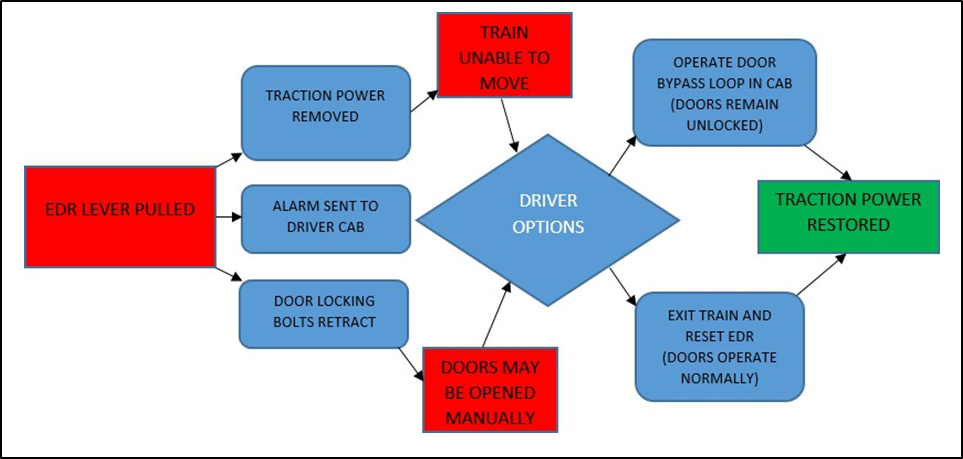
- Once an emergency door release is activated it is recognised by the train’s computer system, which sends an alarm to the driver and simultaneously removes traction power to the wheels to prevent the train moving off from a standstill with the doors potentially open. The brakes are not automatically activated (see Figure 5).
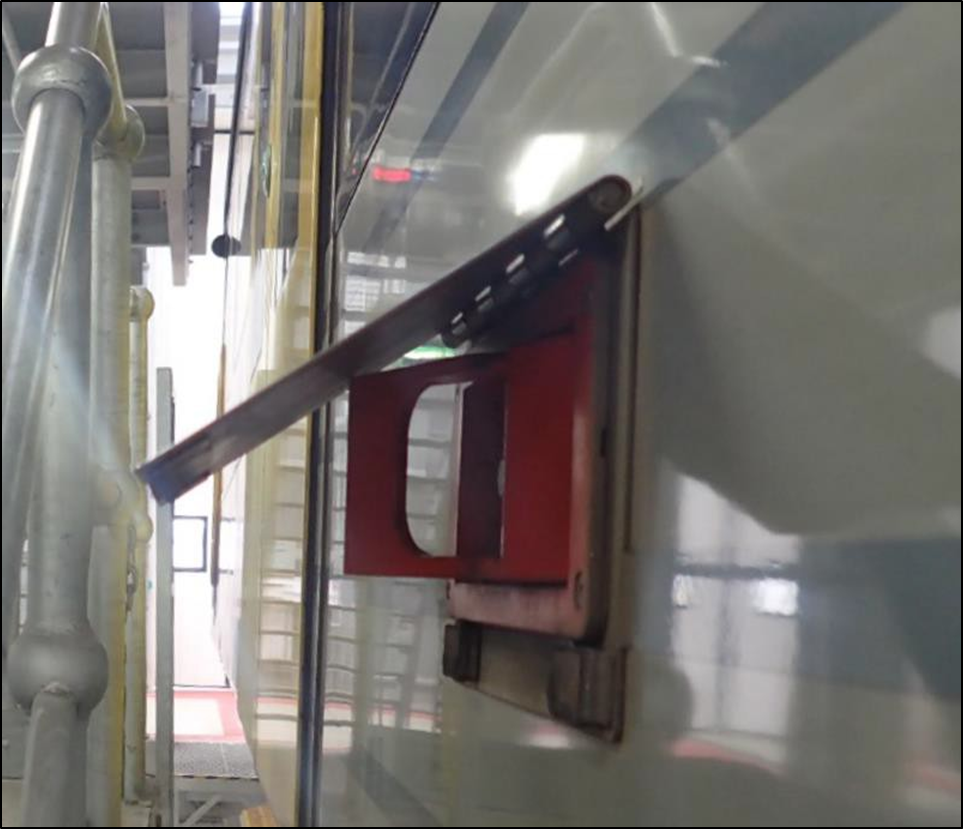
- An emergency door release is not intended for use while a train is moving. However, the driver is able to override the system if necessary and move the train if circumstances dictate. Moving a train with an emergency door release activated creates two hazards: people could fall from the train through doors that can be opened manually (or that could be open already); and the metal access cover will protrude from the side of the passenger car, presenting a hazard to people or objects outside the train (see Figure 6).
- Both Europe (where the trains were designed and built) and the United States have similar philosophies for protecting the emergency door release from accidental activation or deliberate misuse.
-
Railway Group Standard GM/RT 2473 Para B10.1 (Rail Safety and Standards Board (United Kingdom)) stated in part:
Each device… shall be protected to deter abuse and accidental operation.
-
The United States’ Code of Federal Regulations Title 49 (Transportation) (Federal Railroad Administration's Office of Railroad Safety) stated in part:
The rail operator may protect these emergency door opening devices by placing a cover or screen over the devices. These covers must be capable of being removed without the use of any tool or implement.
- The location of an emergency door release on the side of a train is to provide ease of access to authorised personnel. Different types of rolling stock locate emergency door releases in less accessible positions, such as underneath the bodies of passenger cars, to deter unauthorised use.
- A safety report titled Train Door Emergency Egress and Access and Emergency Evacuation Procedures was published in New South Wales, Australia (Independent Transport Safety & Reliability Regulator, 2004). The recommendations of that report are reproduced in part below:
- In light of reviewed accident reports and the standards in place in other developed countries, it is the recommendation of the project team that passengers should have the means to escape a train of their own accord if the situation is serious enough to warrant it. This will entail the installation of emergency door opening devices. The risks associated with vandalism and passengers escaping into an unsafe environment are recognised and should be taken into account when implementing this recommendation.
- It is recommended that external emergency door release mechanisms should be accessible without the use of a key and clearly identified. The abbreviation “EDR” is not recognised by all members of the emergency services and it would be virtually impossible to train all personnel. The issue of emergency responders being delayed in accessing the train is a recurring theme throughout several of the accident reports.
- To prevent unauthorised access to the train when it is stabled, the train should be locked so that it is secure and the emergency door release mechanism rendered inoperative. The locking system should be designed in such a way that it is impossible to move the train while the release mechanism remains inoperative, i.e. it should not depend on crew remembering to reactivate the release mechanism.
-
In recommending that the facility should exist for passengers to open doors, the possibility of vandalism and inappropriate use of the door-opening device must be recognised. There are very real dangers associated with passengers opening doors when the train is moving, as well as that of escaping onto nearby tracks where there is the hazard posed by oncoming trains. As a result, the following parameters should be incorporated into the installation of door opening devices:
a) The doors should be locked when the train is moving. The doors should lock automatically when the train is about to commence to move. This will guard against people opening doors and falling out when the train is moving.
b) [not relevant to this report]
c) The emergency door opening device located in the carriages must be designed and positioned such that it cannot be operated accidentally.
d) The emergency door opening device should be guarded in such a way that it will discourage as far as possible acts of vandalism. There must be some type of cover or barrier over the device and it would be possible for the device to be alarmed so if it is tampered with, the crew would be alerted.
e) There should be a suitable penalty imposed for those persons found guilty of tampering with safety equipment and/or emergency door opening devices. This is a crime of a different nature from that associated with acts of vandalism such as graffiti, rather this is a crime that endangers public safety.
f) Train crew emergency procedures and training will need to be reviewed to encompass any new equipment and procedures that result from a change to door policy.
- The design of the emergency door releases on the Auckland trains meets the intent of these recommendations. Notwithstanding this, the owner is currently assessing whether further measures could be taken to further deter unauthorised activation of the emergency door releases.
- It is not easy to strike the right design balance between deterring unauthorised use of the emergency door release system and allowing entry and egress in an emergency. However, in the circumstances of this incident it is unlikely that any design deterrent would have prevented the group carrying out a planned immobilisation of the train.
Response to the incident
Safety issue – Transdev had no policies or procedures in place to guide its train crew in responding to unusual situations.
-
The crew on board the immobilised train were faced with an unusual dilemma. Their prime responsibility was for the safety of the passengers, but they were also faced with a group of people intent on damaging the train, which could have potentially put the passengers at risk.
- The driver was aware from training that the emergency door release alarm could be bypassed and the train moved to a safe place. The driver did not consider taking this course of action for two reasons:
- the driver thought that it would first require permission from the train maintenance provider
- the driver was aware that train control had placed the signal ahead at stop (this was done to avoid the road level-crossing alarms ahead of the train activating early. If the alarms had activated with the train stopped for an extended period at the platform, road traffic would have built up and created the potential for road users to become frustrated and attempt to drive through the activated level crossing). This was done to avoid the level-crossing alarms at the nearby road activating early.
- Both the driver and the train manager stated that they had not been trained to ring 111. Their understanding was that their responsibility was to inform the respective control centres. The consequences of this action are discussed in the following section.
-
The train manager did not make an announcement to passengers over the train’s public address system because it was considered that there was not enough time and that the passengers could already see what was happening.
-
Transdev operates under KiwiRail’s Rail Operating Rules and Procedures, which stated in part:
5. Unusual Circumstances
- Not provided for
When circumstances occur when [sic] are not provided for in rules, regulations or instructions, Rail Personnel must be guided by their own judgement, bearing in mind the importance of safety in the discharge of their duty.
- At the time of this incident Transdev was writing procedures for staff to follow in the event of various physical threats. However, these procedures had yet to be included in any formal training package for train crews.
- In the circumstances of this incident the train crew took a safe option of not acknowledging the group on the platform and keeping the passengers on board the train. This avoided the potential for physical confrontation.
- However, it was likely that this course of action was taken simply because the train crew was not trained in alternative options. In different circumstances the crew might need to take alternative action. Guidance on the options that might suit various scenarios would be useful to train crews.
- The Commission has made a recommendation to Transdev Auckland to improve the quality of training for train crews, including training on liaising with emergency services, so that they are better equipped to respond to unusual situations.
Incident reporting
- New Zealand Police has policies and procedures for dealing with high-level safety and security events involving the metropolitan train system. The Police response to this event was consistent with the event as it was reported.
- The gathering of information by the Police was potentially hampered by a lack of knowledge of the geographical location of the train. The passengers sitting in the train who called the Police did not know any nearby streets to use as a reference and the Police communications centre call-takers on this occasion were unfamiliar with the locations of stations on the metropolitan rail network.
-
The computer-assisted dispatch system used by the Police communications centre had the ability to overlay train stations on the general working map to assist staff to locate a train if required.
- Since this incident Police communications centres have gained the ability to pinpoint caller locations using the geographical locating technology available in conjunction with most mobile telephones.
- As neither the driver nor the train manager contacted the Police communications centre directly, the call takers were receiving some of the information from parties who were not at the scene, and that information was in some cases being relayed third hand.
- A Police call taker obtained the train manager’s phone number and rang them directly. At that time the train manager was actively engaged in managing the passengers and was unable to provide the level of information the call taker required.
- On being advised of the incident by the train driver, the train controller offered to ring the Police. An extended conversation then took place between the train driver, the train controller and the Police communications centre call taker. The train controller was relaying questions from the Police by radio to the train driver, then relaying the driver’s answers by telephone to the Police.
- Had the train crew contacted emergency services directly, it is likely that the necessary information would have been passed on with more accuracy and in a timelier fashion.
- This incident shows the importance of clear and concise information being forwarded to emergency services by those best placed to report the actual circumstances. An incorrect description of an event could have safety consequences in cases where the intended outcome of the event is more serious. For example, a direct report from the driver in this case explaining that the train had been disabled by a group of masked individuals would likely have given the first responders a better appreciation of the seriousness of the event.