
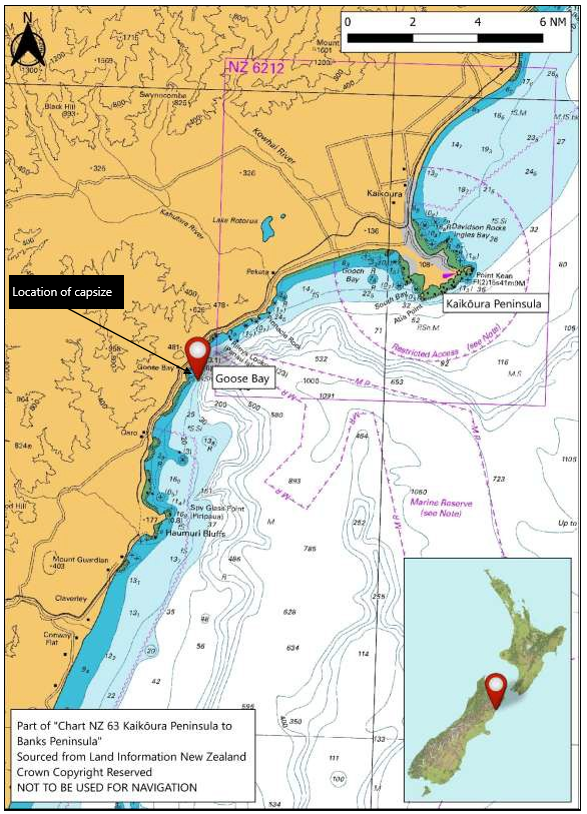
The i-Catcher, an 8-metre aluminium charter vessel operated by Fish Kaikoura, departed South Bay on 10 September 2022 with 11 people onboard for a photography charter. At about 1005, while returning from Goose Bay, the vessel experienced a sudden impact beneath the hull and rapidly capsized. Six occupants managed to escape onto the upturned hull and raise the alarm, prompting a major search and rescue response. Despite the rescue efforts, only six people survived; the remaining five passengers were later found deceased in a petrol-contaminated air pocket beneath the vessel.
Executive summary Tuhinga whakarāpopoto
What happened
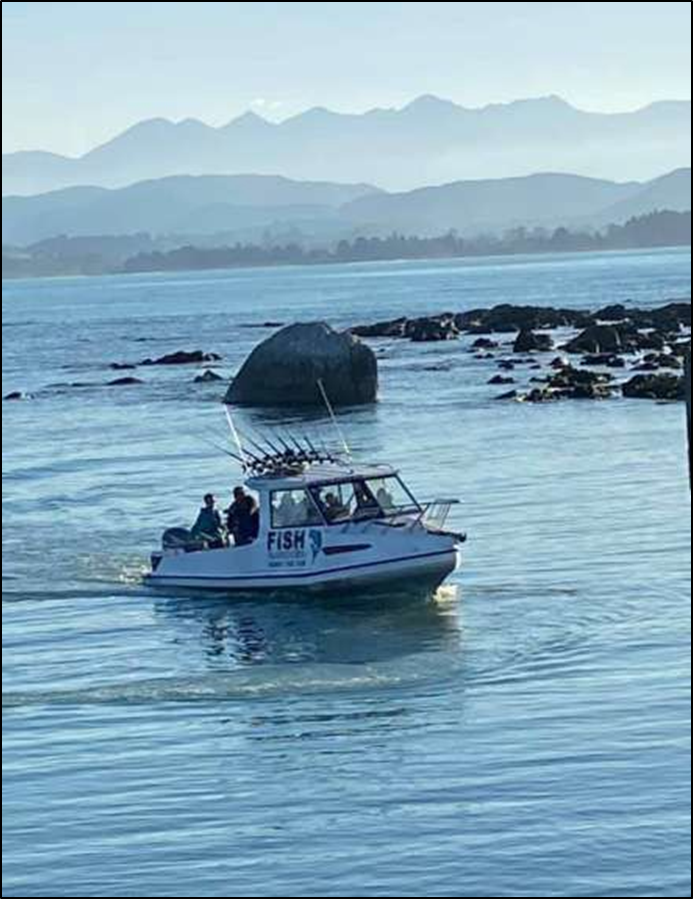
- The i-Catcher was an 8-metre (m) aluminium pontoon boat operated by Fish Kaikoura 2011 Limited (Fish Kaikoura) out of South Bay in Kaikōura, New Zealand. The vessel was primarily engaged for charter fishing, with occasional sightseeing tours around the coastal waters of Kaikōura.
- At approximately 0800 on Saturday 10 September 2022, the i-Catcher departed South Bay, Kaikōura with 11 people onboard, comprising 10 passengers and the skipper.
- The passengers were members of the Nature Photography Society of New Zealand and had chartered the vessel for a three-hour passage to photograph pelagic birds.
- At approximately 1005, the i-Catcher was off the coast of Goose Bay heading towards Rileys Lookout on its return to South Bay, when the vessel’s occupants felt a sudden impact from underneath the hull and the i-Catcher rapidly capsized to starboard.
- Five passengers and the skipper managed to climb on top of the upturned hull, while the other five passengers remained in an air pocket underneath the vessel.
- The skipper placed an emergency 111 call using a passenger’s mobile device, alerting New Zealand Police (Police) to the accident, and initiating a search and rescue operation.
- Six of the eleven people survived the accident. The survivors were retrieved from on top of the upturned hull by responding vessels. The Police National Dive Squad later recovered the bodies of the remaining five passengers from underneath the upturned hull.
- The deceased were found wearing inflated lifejackets within an air pocket that was heavily contaminated with petrol.
Why it happened
- It is virtually certain the i-Catcher struck a whale that had surfaced underneath the hull, causing the rapid capsize to starboard.
- All five deceased passengers were found within the air pocket under the upturned hull wearing inflated lifejackets, hindering their ability to escape. Four of the lifejackets were manually activated, while one was automatically activated.
- It is virtually certain that defects in the vessel’s fuel system allowed fuel to leak into the air pocket of the upturned vessel reducing the survivability of the accident.
What we can learn
- Because of the suddenness of the capsize, the vessel occupants were unable to retrieve the Emergency Position Indicating Radio Beacon (EPIRB) to alert authorities to their emergency. The EPIRB remained secured in its bracket underneath the upturned hull. There is a significant safety benefit for vessels equipped with EPIRBs that are manually released and activated to carry a reliable secondary form of communication suitable for the location and conditions such as a Personal Locator Beacon. This practice greatly improves the likelihood of alerting authorities to an emergency should a sudden event occur.
- It is important for vessel owners and operators to be familiar with the state of fuel systems onboard their vessels through regular inspections for deficiencies, ensuring the safety of the vessel and its occupants.
- Lifejackets are a critical lifesaving appliance. On the day of the accident, the vessel occupants were well equipped, wearing inflatable lifejackets suitable for the vessel’s operation. The circumstances of this accident highlight the importance for people to understand how to safely deflate and remove an inflatable lifejacket while in the water should they need to do so in an emergency.
- Pre-departure safety briefings should include doffing3 procedures as part of lifejacket operational instruction so that vessel occupants are well informed should a sudden emergency occur.
- Inflatable lifejackets rely on the successful operation of an inflation mechanism to make them buoyant. It is important that inflatable lifejackets are regularly inspected and maintained to ensure they work as designed when needed.
- There were challenges in coordinating the search and rescue operation resulting in delays and elevating risk to those responding. The Commission considers it unlikely that the delays contributed to the overall outcome of this accident, given the toxic environment within the air pocket of the upturned hull. Nevertheless, valuable lessons can be learned from this response to better prepare for a search and rescue response for similar accidents in the future.
Who may benefit
- All mariners, maritime regulatory agencies, industry stakeholders, recreational boaters, lifejacket manufacturers and their consumers, and agencies and operators involved in search and rescue operations.
Factual information Pārongo pono
Narrative
- On 10 September 2022, the Photography Society of New Zealand had chartered the i-Catcher to conduct a three-hour passage to photograph pelagic birds. Between 0730 and 0745, ten members of the Photography Society boarded the vessel in South Bay.
- The skipper provided inflatable lifejackets to nine of the ten passengers to wear while underway. One passenger had brought their own inflatable lifejacket to wear while onboard.
- The skipper assisted the passengers with fitting their lifejackets and conducted a safety briefing instructing passengers on how to inflate their lifejackets in the event of an emergency.
- At approximately 0800, i-Catcher departed South Bay and headed southeast along the southern coast of the Kaikōura Peninsula stopping at Atia Point to photograph wildlife (see Figure 3). Around 0827, the vessel continued south toward Kaikōura Canyon.
- After reaching Kaikōura Canyon at approximately 0842, the skipper reduced speed and baited the water to attract birds while the passengers took photographs. At about 0924 the vessel proceeded west towards Oaro.
- By 0937 the i-Catcher was north of Spyglass Point. The skipper had altered course to the north and soon after noticed two humpback whales. The skipper stopped the vessel and turned the boat around so that passengers on either side of the boat could photograph the whales in the distance (because of the size of the aft deck, passengers were generally restricted to five people per side).
- The two whales continued in an easterly direction out to sea, and the skipper continued in a northerly direction along the coast towards Rileys Lookout at a speed of approximately 10 knots (kt) or less.
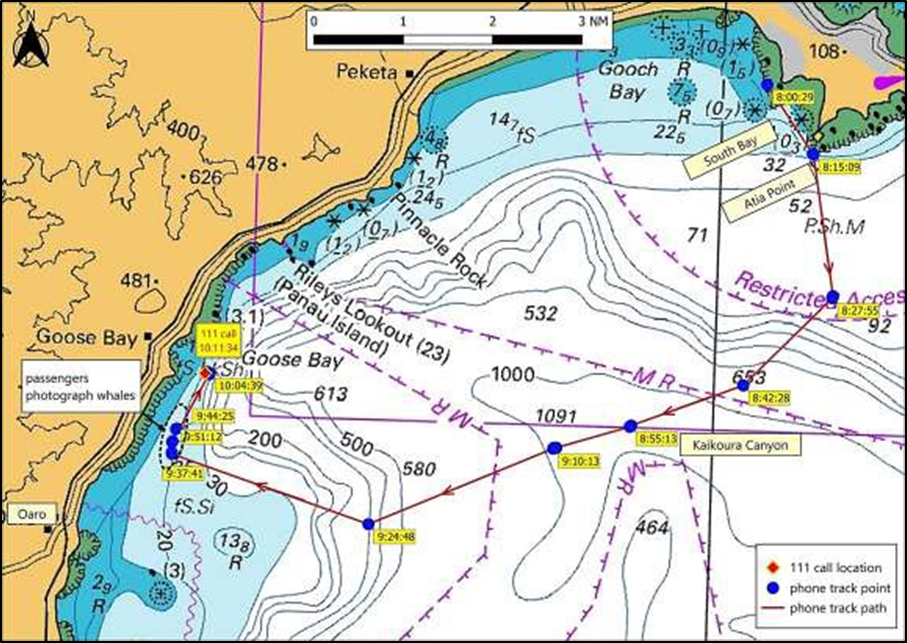
- At approximately 1005, the i-Catcher was off the coast of Goose Bay in a water depth of about 30 m and clear of any charted obstructions (see Figure 3). A passenger located near the port quarter of the vessel was looking over the port side towards the Goose Bay shoreline. They noticed the water colour beneath the boat quickly changing from turquoise, darkening to black. They were certain that they had sighted a whale, and it appeared to have come from below and slightly behind the i-Catcher.
- The survivors described feeling and hearing a significant thump from underneath the port pontoon, the port side rapidly lifted, and the vessel capsized.
- During the sequence of the capsize, two passengers who had been standing on the port side of the aft deck were ejected from the vessel. The skipper, who was seated at the helm, had landed on their head on the overhead of the cabin, injuring their neck. One passenger broke their shoulder blade, while others received moderate to minor injuries.
- Eight passengers and the skipper were initially underneath the upturned hull. Two passengers swam out straightaway from underneath the vessel without inflating their lifejackets; the skipper took two attempts to swim out (see Figure 4).
- At this time five people, including the skipper, were on the surface of the water, clear of the vessel. The six remaining passengers had surfaced underneath the upturned hull, in an air pocket that extended the entire length of the vessel.
- While in the air pocket a passenger (referred to as the ‘observing passenger’ in Figure 4) who was positioned close to the stern looking forward, observed three other passengers within the air pocket. Two passengers were located on either side of the vessel, facing away from the observing passenger while the third passenger was located amidships, looking directly at the observing passenger. None of these passengers had their lifejackets inflated at that time.
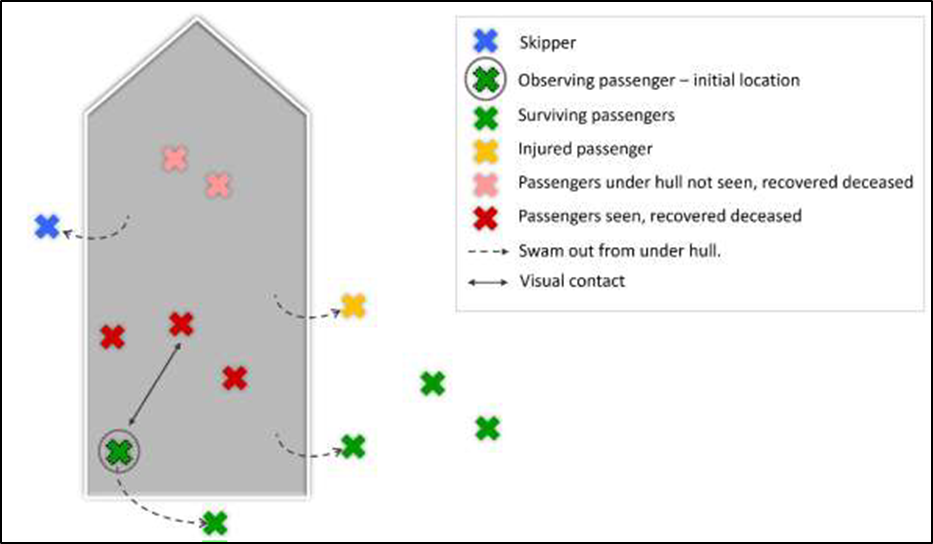
- The observing passenger attempted to verbally instruct and signal to the passenger facing them, to swim out, but the passenger did not respond. Sensing that “the air did not feel good” (description given by passenger during interview with TAIC investigators) the observing passenger swam out from under the vessel, joining the other five people on the surface.
- At about the same time, one of the passengers who had been ejected from the vessel inflated their lifejacket and helped the other ejected passenger, who was clinging to a lifebuoy, swim approximately 20 m back to the upturned hull.
- The skipper climbed onto the slippery upturned hull, injuring their knee and assisted the five passengers up onto the hull and out of the water. One passenger attempted to call emergency services using their mobile phone but did not have enough signal for the call to be connected. The skipper then successfully called 111 using another passenger’s mobile phone.
Search and rescue
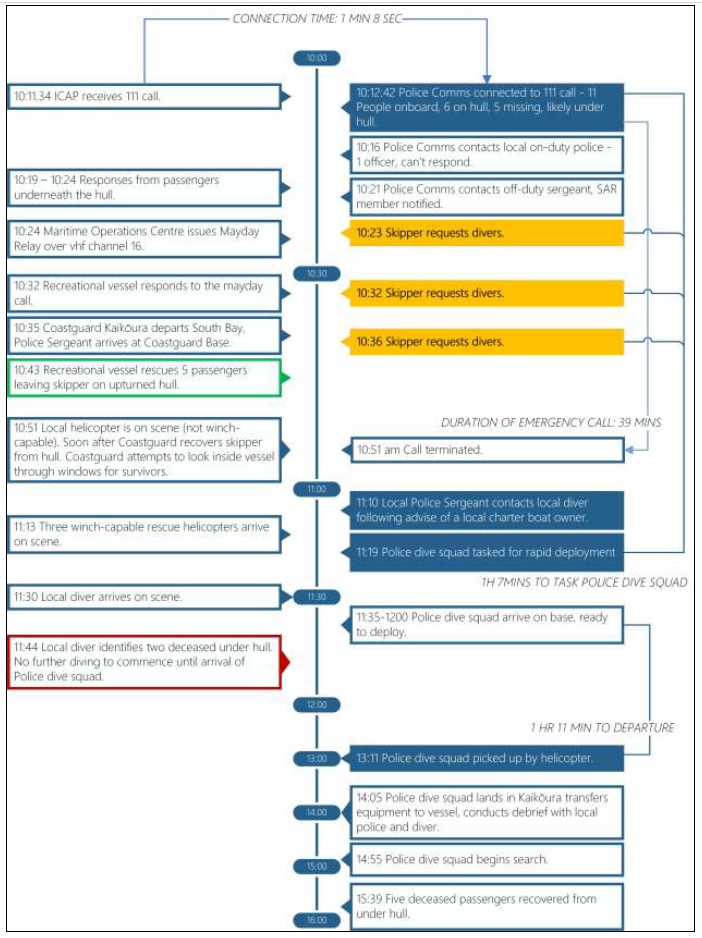
- At 1011, the skipper’s 111 call was received by an operator from the Initial Call Answering Point (ICAP). In accordance with standard operating procedures, the ICAP operator asked the skipper what emergency service was required: fire; ambulance; or Police. The skipper replied, “you tell me, we’re capsized and were off the coast of Goose Bay Kaikōura.” The ICAP operator then attempted to transfer the call to the Police.
- While waiting for the call to transfer, the skipper repeated their emergency to the ICAP operator. The ICAP operator reiterated to the skipper to stay on the line while they wait to be connected to Police.
- At 1012, the skipper was transferred to a Police communicator. The skipper informed the Police communicator that the vessel had capsized after being hit by a whale and that there was a total of 11 people onboard. Six were atop the upturned hull, while five people were unaccounted for, likely underneath the boat. The skipper advised that they were about 1 km off the coast of Goose Bay.
- Information provided by the skipper was recorded by the Police communicator and accessed by the Police Southern Emergency Communication Centre (emergency comms centre) to enable them to dispatch responding assets.
- By 1016 the emergency comms centre had notified a local Police Constable in Kaikōura of the event. The local Police Constable was engaged in another Police matter and was not available to respond to the i-Catcher event. There were no other Police officers on duty in Kaikōura at the time.
- As there were no other Police officers on duty, the emergency comms centre attempted to contact the local Police Sergeant at approximately 1019, without success as they were off duty. The emergency comms centre then sent a request to Rescue Coordination Centre New Zealand (RCCNZ) to broadcast a mayday relay over very high frequency (VHF) radio channel 16.
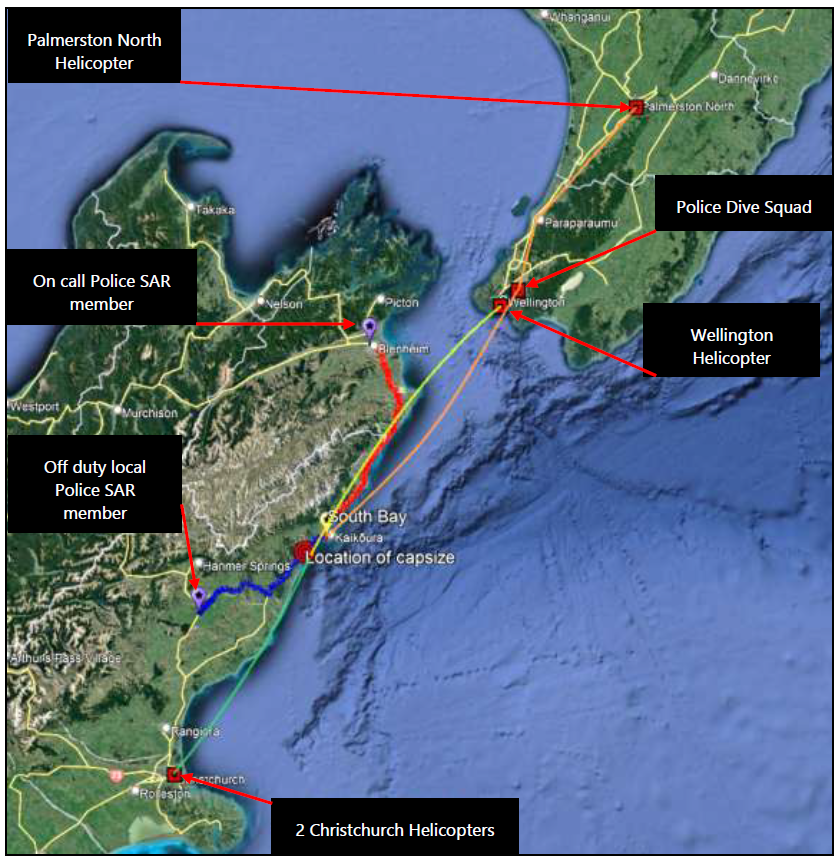
- By 1021, the emergency comms centre had successfully contacted the off-duty local Police Sergeant and the on-call Police search and rescue (SAR) member based in Blenheim. The emergency comms centre had also tasked two winch-capable helicopters to respond, one from Christchurch and one from Wellington.
- The local Police Sergeant returned to their home to get the necessary equipment before heading to the Coastguard Tautiaki Moana (Coastguard) base in South Bay. The on-call Police SAR member began preparations for a search and rescue operation (SAROP) by confirming appropriate assets had been deployed and contacting relevant parties.
- During this time the emergency comms centre was unable to contact Coastguard
- Meanwhile the skipper had knocked on the hull attempting to communicate with any passengers that might be underneath. In response, knocking from underneath the upturned hull was heard by the skipper and passengers atop the hull. The skipper then yelled that help was on the way, while remaining on the line with the Police communicator. By 1022 the knocking from underneath the hull had stopped, and the skipper then told the Police communicator to send divers urgently.
- Kaikōura. The emergency comms centre had paged the unit on three occasions while attempting to contact the local Coastguard skippers via their mobile phones.
- At 1024, Maritime New Zealand’s (MNZ’s) Maritime Operations Centre (RCCNZ requested MOC to issue mayday relays issued a mayday relay on VHF radio channel 16). The mayday relay was answered by a nearby recreational vessel, who advised that they would head to Goose Bay to assist. By this time, the emergency comms centre had tasked a third winch-capable helicopter to respond, based in Christchurch.
- Attempting to contact the local Coastguard, the emergency comms centre contacted a Police Constable who was a member of Coastguard Kaikōura. The Police Constable also served as the local Police SAR member for Kaikōura and was on leave approximately 1.5 hours away. The Police Constable sent an alert to Coastguard members using Facebook messenger and then began to drive back to Kaikōura to assist.
- Between 1030 and 1035, a Coastguard member dialled 111 and contacted the emergency comms centre, acknowledging receipt of the notification and confirmed that they were responding.
- Paramedics were directed to establish a triage area to receive patients on the shore at Goose Bay.
- Meanwhile the skipper made two additional requests for the Police communicator to send divers urgently.
- At approximately 1035, the local Police Sergeant arrived at the Coastguard base in South Bay at the same time as the Coastguard vessel was departing for the accident scene.
- Soon after 1040, the recreational vessel arrived at the accident scene and began retrieving the five passengers from atop the upturned hull. The skipper of i-Catcher elected to stay behind to look out for the remaining passengers.
- At 1044 the skipper of the recreational vessel called maritime radio (Maritime Operations Centre monitors VHF channel 16 for distress, safety and calling 24 hours per day) and advised that five people were still trapped under the hull. They also confirmed that they would head back to South Bay to offload passengers for medical assistance.
- By 1047, the skipper of i-Catcher had considered diving underneath the vessel to try and assist the passengers and advised the Police communicator of their intention and asked if divers were coming. The Police communicator responded that the Coastguard was on its way, and mistakenly provided the skipper with incorrect information, informing them that the Coastguard vessel was equipped with dive gear and that the two winch-capable helicopters would be able to lift the boat (Coastguard does not have diving capability and air ambulances are not capable of hoisting a vessel out of the water).
- At 1048 the recreational vessel departed the accident scene and headed towards South Bay. Noticing the paramedics on the Goose Bay shoreline, the skipper of i-Catcher advised the 111 communicator that they would need to go to South Bay to offload survivors as the established triage area was inaccessible by boat because of the rocky shoreline.
- At about 1050, a local private helicopter flew over the i-Catcher and conducted a visual assessment as directed by the local Police Sergeant. The helicopter crew photographed the scene while the skipper signalled to them that people were underneath the hull. This information was communicated back to the local Police Sergeant confirming the nature of the emergency. The helicopter was not equipped with a winch, limiting its ability to assist with a water rescue. At about this time the skipper ended the 111 call.
- Shortly after, Coastguard arrived on scene and recovered the skipper from the vessel. The skipper informed Coastguard that people were trapped underneath the upturned hull. One of the Coastguard crewmembers, an experienced free diver, got into the water to attempt to look through the windows of the vessel for signs of life but was unable to see anyone inside. The skipper was later brought ashore by another commercial vessel that responded.
- At approximately 1056, it was identified by the local Police Sergeant that paramedics had not arrived at South Bay to treat incoming passengers as they were still positioned at Goose Bay. The emergency comms centre then tasked Fire and Emergency New Zealand (Fire and Emergency NZ) to deploy to South Bay to fulfil this duty. When the passengers arrived at South Bay they were met by Fire and Emergency NZ and taken to hospital for assessment.
- At about 1110, a charter boat skipper contacted the local Police Sergeant and suggested they source divers. The Police Sergeant contacted a local recreational diver to request assistance. The Police Sergeant explained that two divers would need to conduct a search of the vessel from outside the perimeter of the hull. The diver agreed to assist and requested to be picked up by helicopter from their house. The Police Sergeant then arranged for the local helicopter to depart the accident scene to retrieve the diver.
- At 1113, the Blenheim-based on-call Police SAR member confirmed with RCCNZ that the search would be classified as Category 1, (The classification of SAROPs in New Zealand is discussed from paragraph 2.78 onwards) and therefore an extended SAROP would be coordinated by Police. By 1119, the emergency comms centre contacted the Police National Dive Squad (Police dive squad) for assistance.
- From 1113 to 1120 three winch-capable helicopters had arrived on scene, two from Christchurch and one from Wellington. The helicopter crews were unaware that passengers were under the hull. Two helicopters searched the surrounding area for potential survivors, while the third was grounded on standby.
- At approximately 1130, the local helicopter returned to the scene with the recreational diver. The diver remained clear of the vessel swimming around the perimeter beneath the water’s surface. The diver identified two deceased passengers underneath the upturned hull, but was unable to see any others, leaving three passengers missing. With this information, Police advised that no further diving on the vessel would take place until the Police dive squad arrived.
- By 1135, the Police dive squad began assembling at their base in Seaview (Wellington) preparing for an urgent deployment. A helicopter based in Palmerston North was tasked with transporting the Police dive squad to Kaikōura, as the Wellington-based helicopter had already been deployed to the scene. By 1200, the Police dive squad was ready to deploy and made enquiries regarding the estimated time of arrival (ETA) of the helicopter.
- Meanwhile in Kaikōura, helicopters and vessels of opportunity16 continued to search the area for the three missing passengers. By about 1206, the Blenheim-based on-call Police SAR member asked the emergency comms centre to request drift mapping from RCCNZ to assist with the coordination of helicopters and vessels for an extended search. At approximately 1225, the local Kaikōura Police SAR member arrived at the Coastguard base in South Bay to assist the Police Sergeant.
- At 1311, the Palmerston North-based Helicopter retrieved the Police dive squad from their base in Seaview (Wellington) and arrived in Kaikōura at approximately 1405. Immediately upon arrival, the Police dive squad held a briefing with the local recreational diver before proceeding out to the scene by boat.
- Soon after, two additional Police from Blenheim (an on-call Police SAR member and the Police Acting Response Manager) arrived at the Coastguard base in South Bay, where they were updated by the local Police Sergeant.
- By 1539, the Police dive squad had located and recovered all five of the deceased passengers from under the upturned hull. All deceased passengers were found wearing inflated Type 401 lifejackets. The deceased were transferred onboard a vessel of opportunity and returned to South Bay.
- See Figure 5 for a summary of the key event timeline for the search and rescue response and Figure 6 for the origin of the search and rescue resources that deployed.
Salvage
- Shortly after all deceased passengers had been recovered, Coastguard Kaikōura, with the assistance of the Police dive squad, successfully righted the vessel by parbuckling. Coastguard proceeded to tow i-Catcher to South Bay, where the vessel was loaded onto its trailer and hauled out of the water.
- Local rūnanga members attended the vessel carrying the deceased, and conducted a karakia21, blessing those who had died, and those who were involved in the rescue and recovery effort. The i-Catcher was then towed to a secure facility where it was held for post-accident examination.
Meteorological information
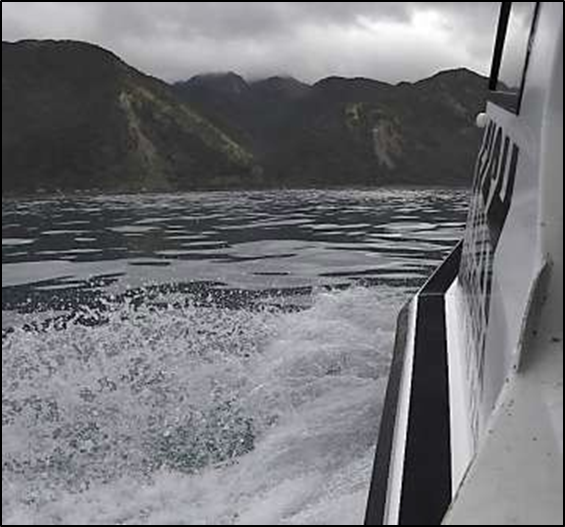
- The weather conditions on the day were calm with overcast skies and occasional drizzle. Hourly recorded weather observations for the Kaikōura area measured wind speeds as light and variable between the hours of 0800 and 1000, increasing to 5–10 kt from the northeast as the day progressed.
- Sea state models provided by the Meteorological Service of New Zealand Limited, Te Ratonga Tirorangi (Metservice) indicated that at 1000 on the day, the average wave height was approximately 0.8 m with a period of 13.3 seconds (s) from the south. The air temperature was 9.4°C and the sea temperature was 10°C (see Figure 7).
Vessel information
- The i-Catcher was a Kiwi Kraft 820 HT 8-metre aluminium pontoon boat, built in 2003 by Kiwi Engineering & Marine Limited as a recreational vessel. The vessel was approved as CPC compliant at the time of manufacture.
- In 2009, the vessel’s original owner began leasing i-Catcher to Fish Kaikoura Limited, who applied to have the vessel brought into survey for commercial use as a charter fishing boat. In 2011, Fish Kaikoura Limited was sold to its current owner and rebranded as Fish Kaikoura 2011 Limited (Fish Kaikoura). After several months of operation, Fish Kaikoura purchased the i-Catcher from its original owner.
- The i-Catcher was surveyed by an MNZ Recognised Surveyor to carry up to ten passengers and two crew. The vessel was surveyed to operate within the restricted inshore limits of Kaikōura and for daylight operations conducting charter fishing and sightseeing trips. The vessel was powered by twin 115 horsepower (hp) Yamaha outboard engines.
Hull examination
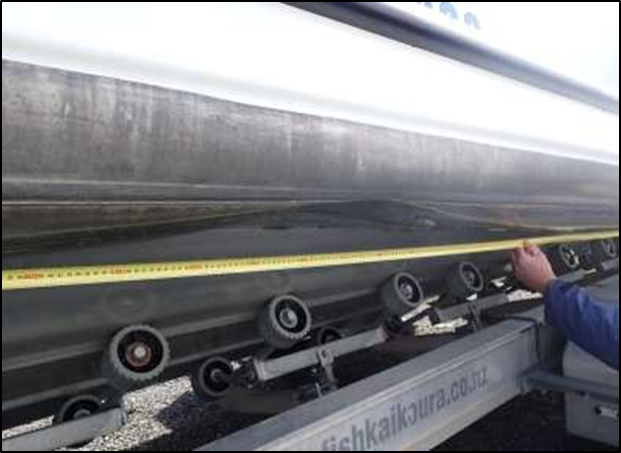
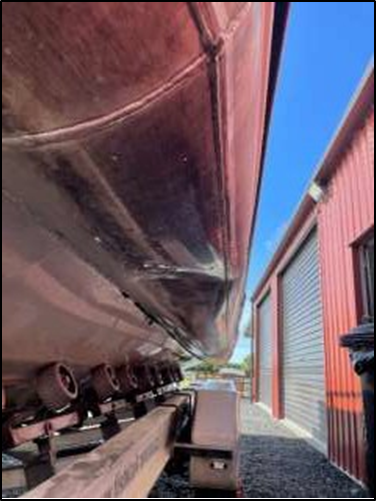
- During its initial examination of the vessel, the Commission identified a significant smooth indentation underneath the port pontoon, measuring approximately 2.47 m in length. The depth of the indentation was greatest in the forward portion measuring 8 cm deep, tapering in depth further aft (see Figure 8).
Vessel fuel system
- Fish Kaikoura informed the Commission that no modifications had been made to the i-Catcher’s fuel system since they purchased the vessel.
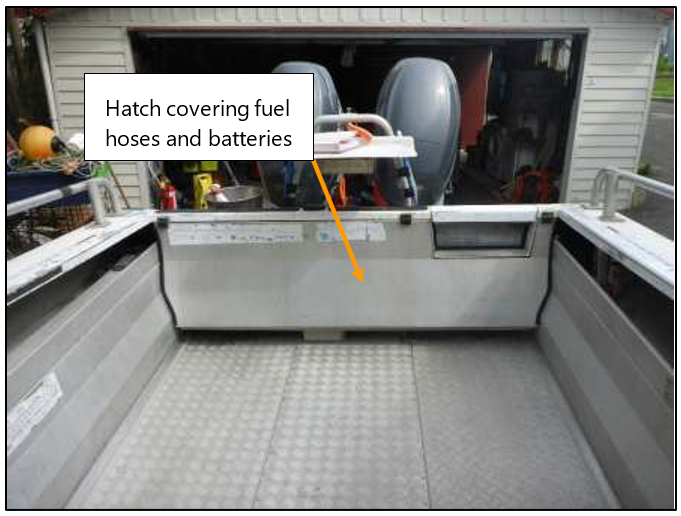
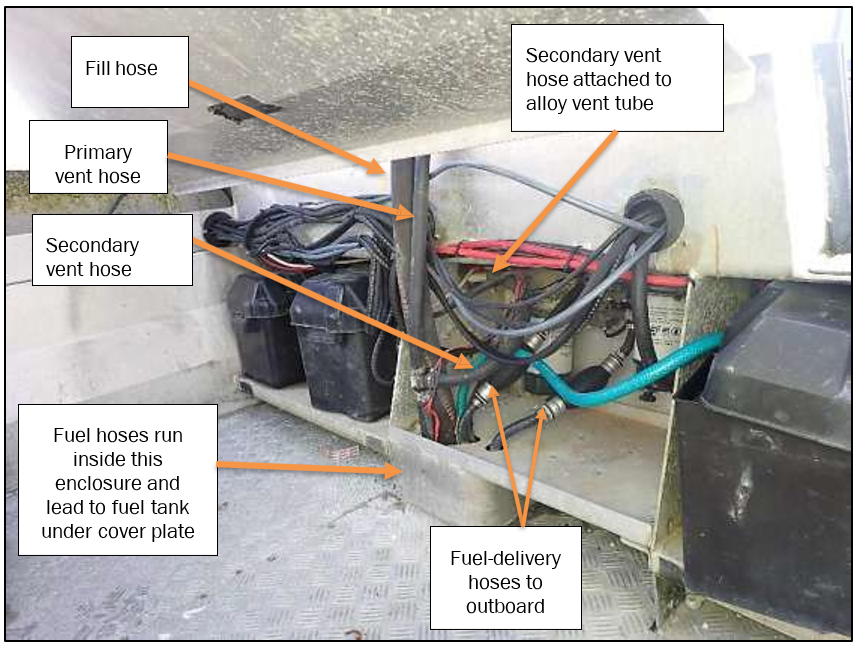
- The fuel system on i-Catcher was made up of the following main components (all main components of the fuel system were examined and tested by Commission investigators for potential leaks) in the stern of the vessel (see Figure 9 and Figure 10):
- 190 litre fixed centreline fuel tank located under the deck plate (fuel tank)
- main fuel fill hose for refuelling the vessel (fill hose), which connected the fuel fill cap and fuel tank
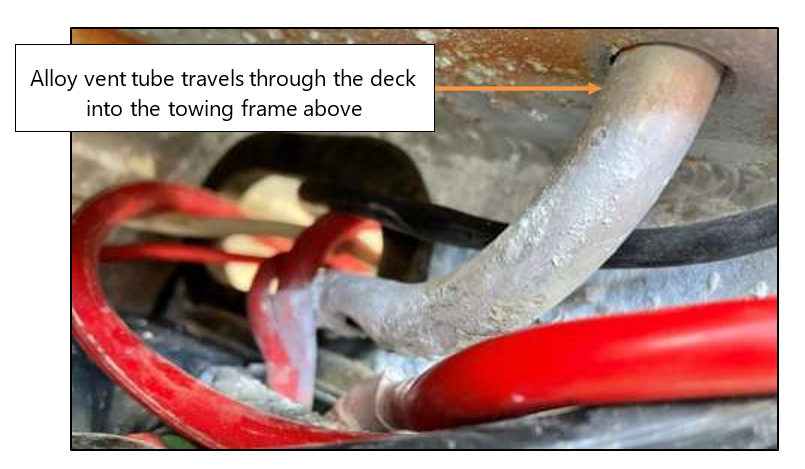
- the fuel-tank venting arrangement comprising three components: a primary vent hose; a secondary vent hose that branched off the primary vent hose; and an alloy vent tube attached to the secondary vent hose, which passed up through the deck of the vessel
- two fuel-delivery hoses, each leading to a fuel filter and one of the two outboard engines (fuel-delivery hose).
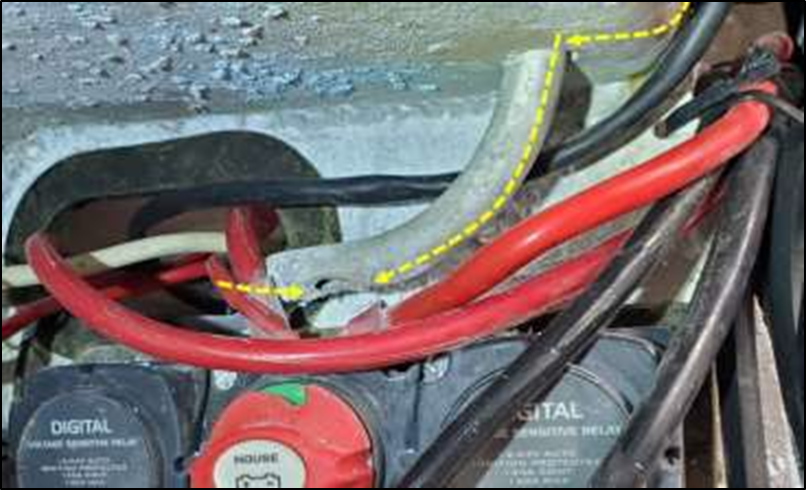
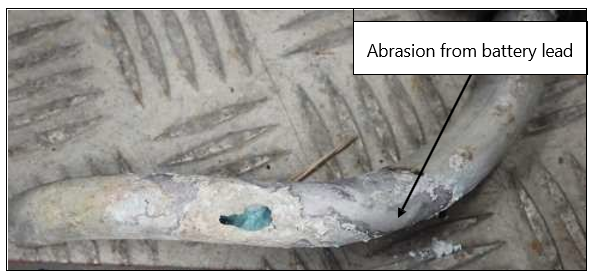
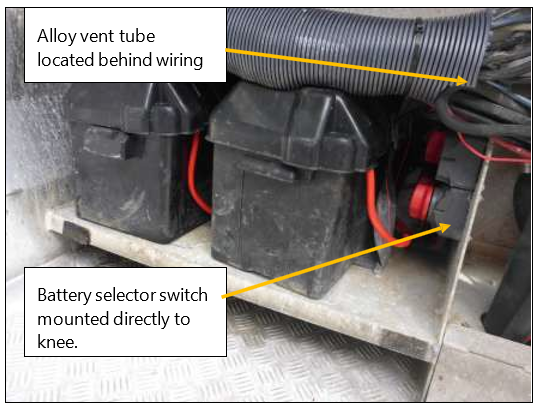
- Initial inspection of the fuel system revealed a hole measuring approximately 12 mm x 6 mm in the alloy vent tube used as a secondary fuel vent (see Figure 11). The alloy vent tube was situated above the battery cluster switch located within the interior of the stern of the vessel (see Figure 12).
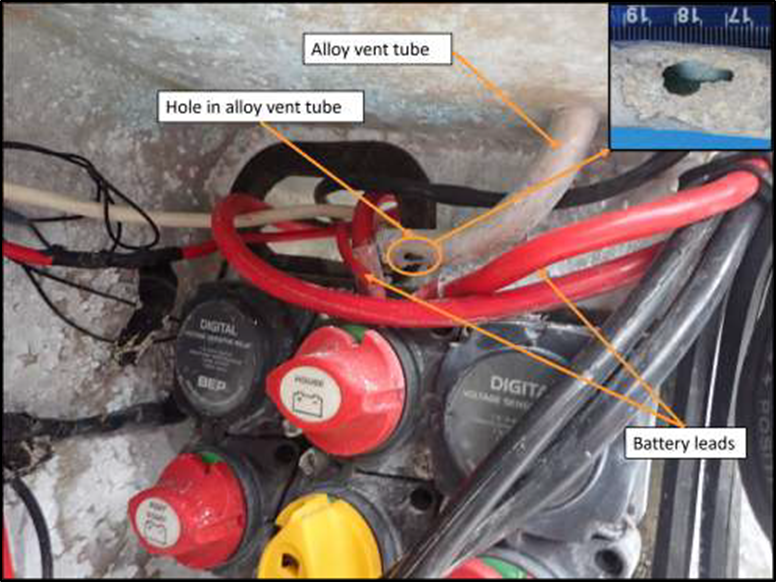
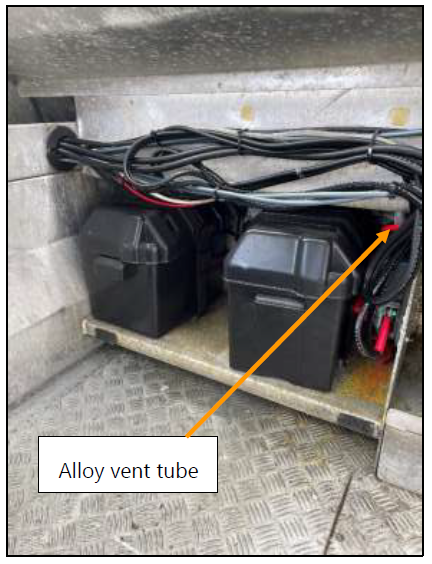
- Identification of the hole in the alloy vent tube required a thorough examination of the venting arrangement. The alloy tube was partially restricted from view by a battery box and surrounding wiring (see Figure 13). The hole was a potential path for fuel to escape when filling the fuel tank or if the vessel overturned. It was also close to the battery leads and contact points, which presented a significant fire or explosion hazard.
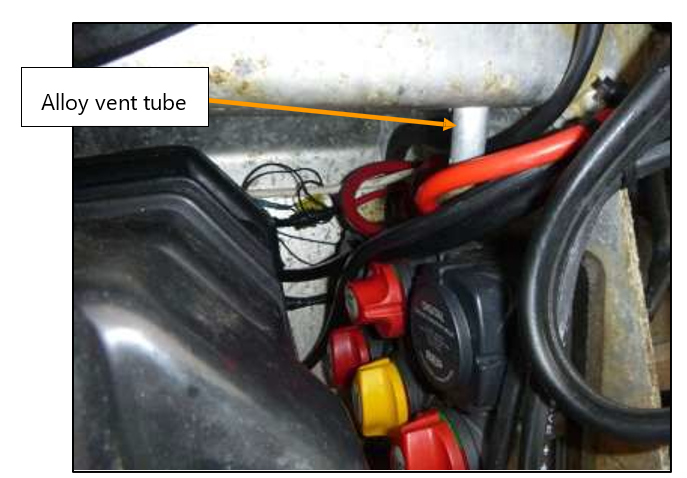
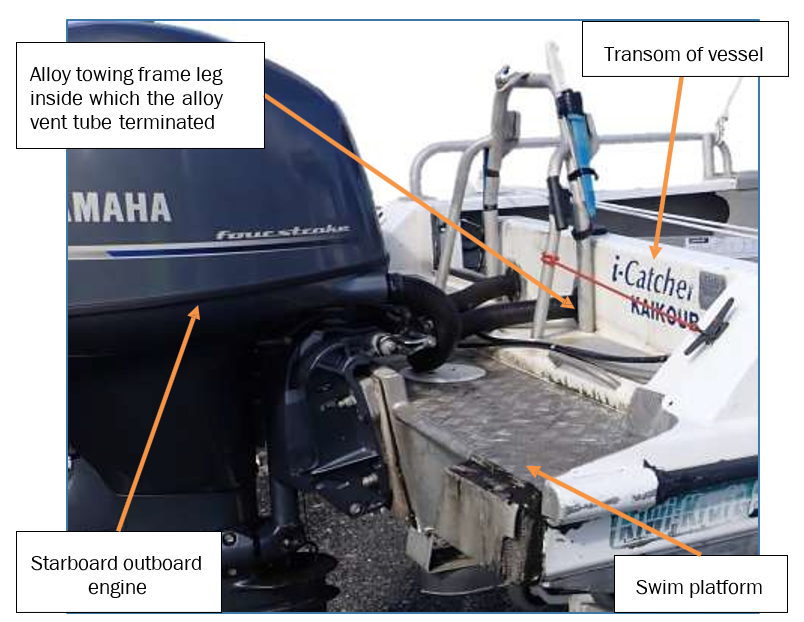
- The alloy vent tube terminated inside an alloy towing frame on the transom just forward of the swim platform (see Figure 14 and Figure 15). A pressure test of the alloy frame revealed that it was closed off from the atmosphere, preventing fuel vapours from venting to open air and rendering it ineffective as a fuel-tank vent.
- The vessel’s fuel-delivery hoses ran from the fuel tank through two holes in a cover plate (see Figure 16)
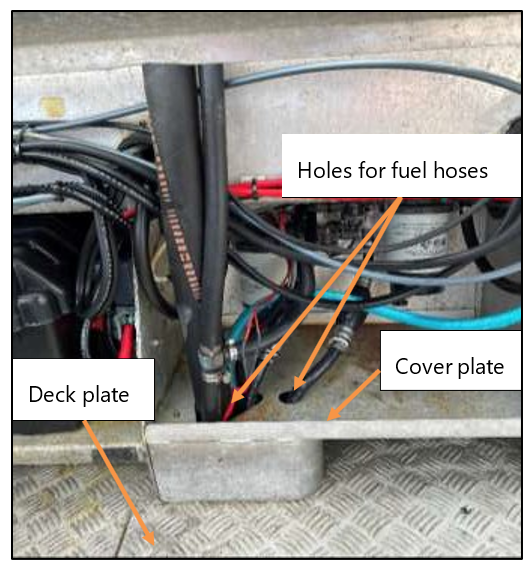
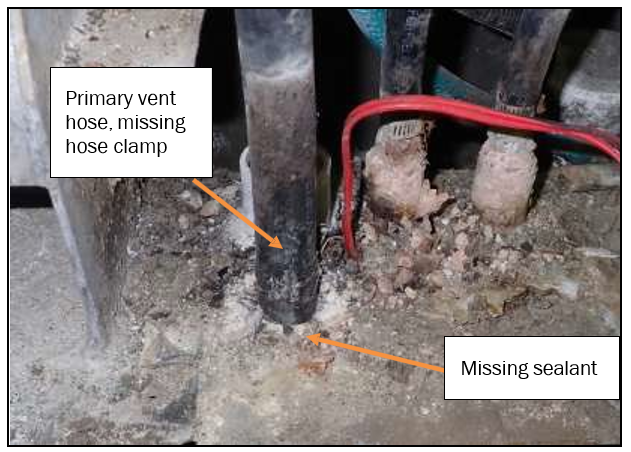
- To enable inspection of the fuel tank and its connections, investigators removed the cover plate and the deck plate and partially disassembled the fuel system. Upon disassembly, investigators found the primary vent hose was not secured with a hose clamp, a critical component to ensure a secure connection to the fuel tank (see Figure 17).
- A sealant had been applied around the plating where the fuel and vent hoses connected to the fuel tank. It was observed that a portion of the sealant had broken away, leaving a section of the primary vent hose connection exposed. The fuel tank and its fuel hoses were pressure-tested by Commission investigators, which revealed a leak from the base of the primary vent hose.
Tests and research
Deoxyribonucleic acid (DNA) analysis
- Scientists from the University of Auckland’s Molecular Ecology and Biological Anthropology labs were engaged by the Commission to conduct an analysis of environmental DNA samples collected by Police from i-Catcher’s hull to assist with determining whether the vessel struck a whale.
- The DNA analysis identified three main sources (the other two main DNA sources were pig and cattle, which are often found in DNA analysis as they are common animals, and their DNA is easily transmitted through air and water) of environmental DNA, including humpback whale, with 100% certainty.
Metallurgical testing
- The Commission engaged Quest Integrity NZL Limited to conduct a visual assessment and further testing of the i-Catcher’s fuel system to assist with determining the cause of the hole found in the alloy vent tube and identify other potential leaks in the fuel system.
Previous Commission investigations
- MO-2022-201: On 20 March 2022, the charter fishing vessel Enchanter capsized off North Cape, New Zealand with eight passengers and two crew onboard. An extensive SAROP took place over two days resulting in five passengers being rescued, and five recovered deceased. The Commission made recommendations to the Ministry of Transport to address limitations in New Zealand’s search and rescue capability. The Commission also recommended MNZ ensure adequate systems are in place for effective technical guidance for marine surveyors and monitoring of marine surveyor performance.
- MO-2016-206: On 26 November 2016, the charter fishing vessel Francie was struck by a large breaking wave while crossing the Kaipara Harbour bar and sank. Eight of the eleven people onboard died; only three people were wearing lifejackets at the time of the capsize. The Commission made a recommendation to MNZ to review lifejacket requirements to ensure lifejackets are of an appropriate type for the operation and to implement requirements for crotch straps to be fitted to lifejackets on commercial vessels operating in exposed waters.
- MO-2012-201: On 14 March 2012, the fishing vessel Easy Rider was transiting the Foveaux Strait when it was engulfed by a large wave, capsized, and later sank. Onboard were three crew and six passengers; only one crewmember survived. The Commission made recommendations to MNZ to develop a centralised database for the storage and maintenance of important vessel documents, and to educate the public that not all lifejackets sold meet the requirements of the Maritime Rules and the importance of having an appropriately sized lifejacket for an individual’s size.
Domestic survey system
- Commercial vessels were required to comply with MNZ’s Maritime Rules. Compliance with the rules was assessed through periodic surveys conducted on vessels by qualified Recognised Surveyors.
- Originally vessel surveys were conducted and managed by Ministry of Transport surveyors. This later changed with the implementation of Safe Ship Management (SSM) in 1998. Under the SSM system, SSM companies (third parties) supervised the safety of vessels under the requirements of Maritime Rules Part 21. SSM companies were responsible for ensuring vessels were compliant with the rules by conducting surveys, as well as ensuring operators were maintaining safe operational plans.
- The Commission considered the SSM system in its investigation into the capsize of the fishing vessel Easy Rider in 2012. It was found that important historical vessel documentation, such as stability information, were lost because of inadequate record-keeping practices in the SSM system.
- In 2014, MNZ introduced the Maritime Operator Safety System (MOSS) as a new regulatory system to replace SSM. By 2019, MOSS was fully implemented by most domestic operators.
- Before a vessel enters commercial service, a design approval and initial survey were required. A Certificate of Survey was then issued by a Recognised Surveyor, which was valid for a period five years.
- The vessel was then subject to periodic surveys by Recognised Surveyor’s in accordance with the survey performance requirements (specific requirements for conducting a survey set out by MNZ Maritime Rule Part 44). This included an intermediate survey (between two and three years) and a renewal survey (between four and five years) for renewal of the operator’s Certificate of Survey.
- Upon completion of a survey, the Recognised Surveyor submitted a survey report to the vessel owner and to MNZ by uploading the document into Navigator. The survey report was a formal record demonstrating the state of the vessel at the time of survey. The survey report listed any deficiencies and the corrective actions taken by the vessel owner to address them.
- In addition, a MNZ Maritime Officer (MO) conducted an operational audit to assess whether an operator’s Maritime Transport Operator Plan (MTOP) was compliant with the Maritime Rules. If satisfied the MTOP was compliant, the Director of MNZ granted a Maritime Transport Operator Certificate (MTOC), which was valid for ten years.
New Zealand search and rescue system
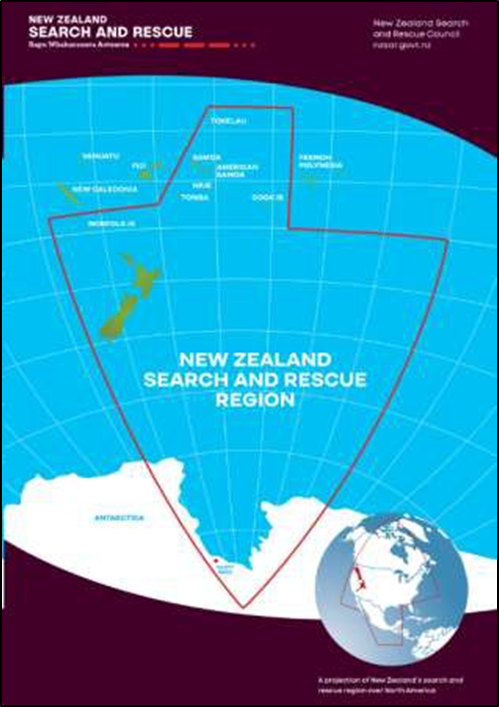
- New Zealand was responsible for one of the largest search and rescue (SAR) regions) in the world (fulfilling its obligations under the International Convention on Maritime Search and Rescue), covering over 30 million square kilometres (see Figure 18).
- The coordination of SAROPs for the region was divided into two categories, Category I and Category II. Category I SAROPs were coordinated at a local level by Police, covering searches within New Zealand on land, inland waterways and maritime operations up to 12 nautical miles (nm) offshore. Category II SAROPs were coordinated at a national level by the Rescue Coordination Centre New Zealand (RCCNZ). These operations typically involve missing aircraft, aircraft in distress and offshore maritime operations within New Zealand’s SAR region.
- Police and RCCNZ (the SAR coordinators) could task different types of resources and assets provided by various agencies and private operators. These include helicopters, fixed-wing aircraft, vessels, land vehicles and people. Most SAR personnel are volunteers (according to the NZSAR Annual Report 2023, the sector consisted of 11,091 personnel, of which 89% were volunteers).
Category I SAROPs
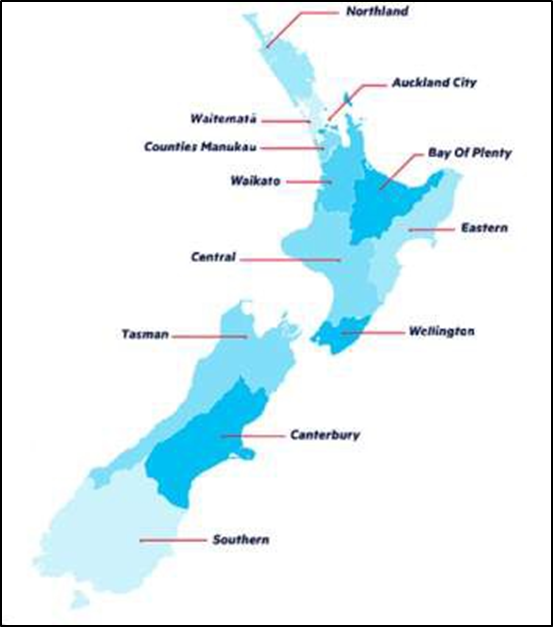
- The Police was divided into 12 Districts around the country (see Figure 19), each District comprising multiple areas with suburban and subsidiary stations managed by District Headquarters.
- Category I SAROPs were managed by the local Police Districts, which maintained the required capability to coordinate and support SAROPs
-
Police National Headquarters provided direction and guidance on the strategic and operational principals for Category I SAROPs and the relationships with SAR partner agencies.
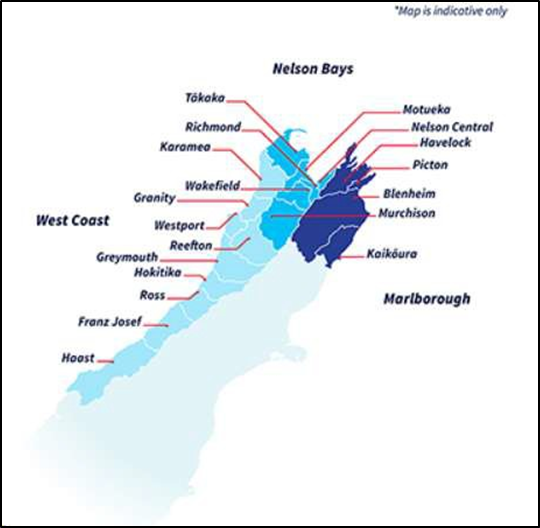
- Kaikōura lies in the southeastern corner of the Marlborough Police region, which was one of the three regions within the Tasman District (see Figure 20); the other regions within Tasman District being Nelson Bays and the West Coast. Kaikōura had a Police station and was supported by Police in Blenheim when needed (Police in Blenheim provided additional resources and capability).
- Each Police region had a SAR Squad with specially trained Police officers (SAR members). SAR members were on a rotational on-call roster to provide 24/7 assistance with the coordination of SAROPs within their region. The SAR member role was typically a secondary role that Police officers took on in addition to their primary policing role. Marlborough SAR members on the on-call roster were based in Blenheim and responded to SAROPs throughout the region.
- In addition, in remote Police stations within the Marlborough region a local Police SAR member was assigned; they were not on the on-call roster but assisted with SAROPs in their assigned location when available.
Emergency 111 calls
- New Zealand’s emergency 111 calling system was a two-stage public service answering point (PSAP) system, in which emergency calls were initially triaged by an ICAP (Initial Call Answering Point) operated by Spark New Zealand. ICAP operators answered all 111 calls asking the caller which emergency service they required: fire; ambulance; or Police. The ICAP operator then transferred the call to the requested emergency service (see Figure 21).
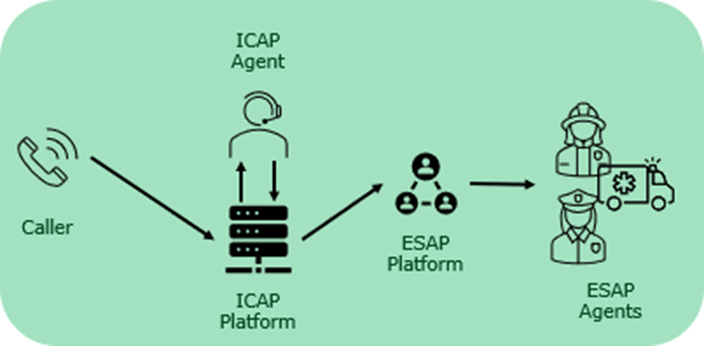
- Each emergency service operated its own emergency service answering point (ESAP) via emergency comms centres. Police had emergency comms centres in Auckland, Wellington and Christchurch.
- Police emergency comms centres received emergency 111 calls transferred from the ICAP. The transferred 111 calls were received by the next available Police communicator (communicator). The communicator referred to the Master Standard Operating Procedures (MSOP) to collect information from the caller to understand the circumstances of the emergency.
- Police Dispatchers took the information gathered by communicators and dispatched the appropriate resources and assets to the emergency under the guidance of the MSOP.
- In a Category I SAROP, the emergency comms centre would manage the initial response by dispatching Police personnel including SAR members and SAR assets. The emergency comms centre would maintain incident control and coordinate assets until it was satisfied that an appropriate Police presence was on site and in a position to effectively take command of the response.
SAR Assets
Helicopters
- SAR coordinators could task a variety of helicopters for SAROPs, from the New Zealand Defence Force, Police, air ambulances and other civilian operators.
- Hato Hone St John Air Desk (Air Desk) was responsible for dispatching and monitoring the availability of air ambulances around the country for urgent medical operations. SAR Coordinators could task air ambulances for the purposes of a SAROP by making a request through the Air Desk. The Air Desk would advise the SAR coordinator of the nearest available assets and notify the chosen air ambulance operator of the event.
- The helicopters tasked by the emergency comms centre to respond to the i-Catcher accident were air ambulance helicopters operated by Garden City Helicopters (Christchurch) and Life Flight (Wellington). The helicopter tasked by the local Police Sergeant was a local commercial helicopter.
Vessels
- Coastguard was a volunteer-based charity comprised of 63 units serving communities around the country. Coastguard operated 59 vessels of varying size and type, with the average size being 9.5 m in length.
- Police were equipped with two purpose-built response vessels to support a variety of Police work, including SAROPs and Police dive squad support. The vessels were crewed by Police trained in maritime operations located in Auckland and Wellington.
- The RCCNZ maintained a nationwide database of all SAR assets and their capabilities, which was used to assist with tasking assets for SAROPs throughout the country.
Police National Dive Squad
- The Police dive squad was a group of highly trained Police divers based in Wellington. At the time of the accident, the Police dive squad comprised 5 full-time Police officers and an additional 16 Police officers who served the Police dive squad in a secondary role to their normal policing duties.
- The Police dive squad were specifically trained to provide the following services:
- search and recovery of missing persons in the water
- evidential searches underwater
- underwater photography and video
- in-water safety support for water-borne policing operations.
- The Police dive squad also trained with the RNZAF No. 3 Squadron as rescue swimmers to support the squadron’s wet-winching capability for maritime SAROPs.
- Police dive squad maintained 24/7 readiness by having members on call at any given time.
Analysis Tātaritanga
Introduction
- The i-Catcher’s hull was well constructed and in a good state of repair. There was no evidence of any mechanical failure that could have contributed to the capsize.
- The weather conditions on the day were calm, with overcast skies and occasional drizzle.
- It is virtually certain the i-Catcher suffered a sudden capsize as a result of coming into contact with a whale that had surfaced under the port side of the vessel. The accident was survived by the skipper and five of the ten passengers.
- The following section analyses the circumstances surrounding the event to identify those factors that increased the likelihood of the event occurring or increased the severity of its outcome. It also examines any safety issues that have the potential to adversely affect future operations.
- Other non-contributory safety issues that have the potential to adversely affect future operations are also discussed.
Cause of capsize
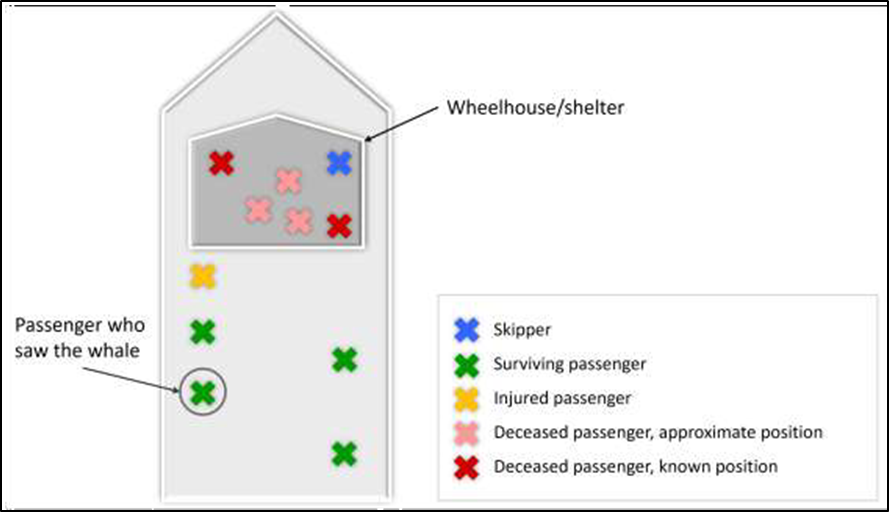
- Immediately before the accident, the passengers were evenly distributed throughout the vessel, having minimal impact on vessel stability (see Figure 22). The skipper was seated at the helm on the starboard side of the wheelhouse.
- Passengers were generally limited to five people each side because of the size of the vessel. When wildlife was sighted nearby, the skipper would turn the vessel 180° allowing for both port and starboard side passengers to view and photograph the wildlife.
- All five surviving passengers were located on the aft deck on the port and starboard sides. Survivors recalled that all the deceased passengers were located under the shelter of the wheelhouse before the capsize.
- The indentation underneath the vessel’s port pontoon was smooth and of significant size (see Figure 23), indicating that it was caused by a soft but dense material rather than a hard object. Contact with hard objects usually result in significant abrasions, definitive markings, transfer of material and possible holing in the hull.
- While humpback whale DNA was found on the vessel, it is possible that this resulted from the vessel being near a humpback whale rather than coming into direct contact with one. However, given the passenger's account of seeing a whale under the boat, the nature of the dent under the port pontoon, the DNA results and the absence of any other factor that might have caused the boat to capsize, the Commission considers that it is virtually certain the vessel capsized as a result of coming into contact with a whale that had surfaced under the port side of the vessel.
- The skipper maintained a lookout while operating the vessel. However, they were unable to see the whale approaching from below and did not have an opportunity to take avoiding action. During interviews with Commission investigators, the skipper demonstrated sound knowledge of guidance published by the Department of Conservation (DOC) that informs boaters on how to safely operate around whales (see Appendix 1). All available evidence indicated that the skipper was operating appropriately, in accordance with the DOC guidance.
Fuel system deficiencies
- The type of aluminium used for the alloy vent tube was a marine-grade aluminium that develops a natural passive layer when exposed to the atmosphere. This passive layer protects the underlying material from the environment and corrosion.
-
The presence of corrosion would indicate that the passive layer was damaged or removed. Metallurgical testing carried out by Quest Integrity, on behalf of the Commission, identified that:
the most likely cause of the hole was an accelerated external corrosion that occurred locally in-service, before the capsize. The accelerated corrosion was likely because of crevice corrosion conditions caused by contact of the electrical cables with the pipe and/or accumulation of debris.
- The corroded hole was located at a low point in the system, which would allow water and dirt to run and collect (see Figure 24). When the alloy tube was removed from the system it was evident that there was further abrasion and corrosion where the battery leads had been in contact with the alloy tube (see Figure 25). With time it can be expected that these areas would also develop into holes
- The i-Catcher’s battery selector switch was replaced in 2019. The original battery selector switch was mounted directly to the knee of the transom (see Figure 26). When the new battery selector switch was installed, an insulator pad was added to absorb vibrations between the knee and the switch. This would have changed where the battery leads contacted the alloy tube.
- At the time the battery selector switch was replaced, the alloy vent tube may have been subject to abrasion and the hole may not yet have formed. With the aluminium’s natural passive layer damaged or removed by the battery leads, it would just be a matter of time before a hole developed.
- It is likely that before the battery selector switch was replaced, the battery leads had been in contact with the alloy vent tube contributing to the corrosion that later developed into a hole.
- The Commission found that the hole in the alloy vent tube was very likely a result of crevice corrosion over time, because of one or a combination of the following factors:
- mechanical abrasion from electrical cables
- the collection of dirt/salt in the immediate area
- saltwater evaporation from the localised area.
- The skipper typically filled the fuel tank to about 90% but occasionally would completely fill the tank if back-to-back trips were booked. The skipper recalled occasionally noticing a few small droplets of fuel appearing on the battery selector switch when accidentally overfilling the tank. The skipper estimated that this issue was first noticed about 1 year before the accident.
- The skipper told Commission investigators, that they were concerned about petrol being in close vicinity to the battery cluster switch and raised the issue with their mechanic. However, the source of the issue was not identified before the accident. Taking into consideration the initial slow degradation period of crevice corrosion, it is possible that when this issue was raised the alloy vent tube may have only corroded enough for a pinhole to develop, which could easily be missed. This along with the difficulty in accessing the vent tube may have been limiting factors during an inspection.
- The vessel’s self-venting fuel cap was located on top of the transom along the centreline. Considering its design, it is possible for fuel to escape a self-vented cap when inverted.
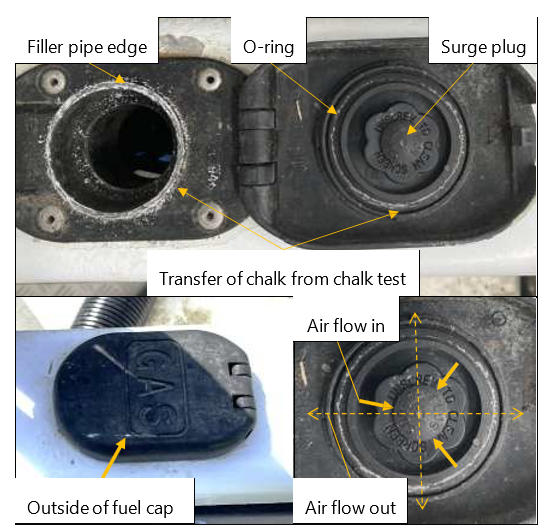
- For the cap to seal, it requires that the surge plug is depressed, and the O-ring completes a seal with the edge of the filler pipe (see Figure 27). When inverted, head pressure from the fuel will apply a downward force on the surge plug and fuel cap, which may break the seal.
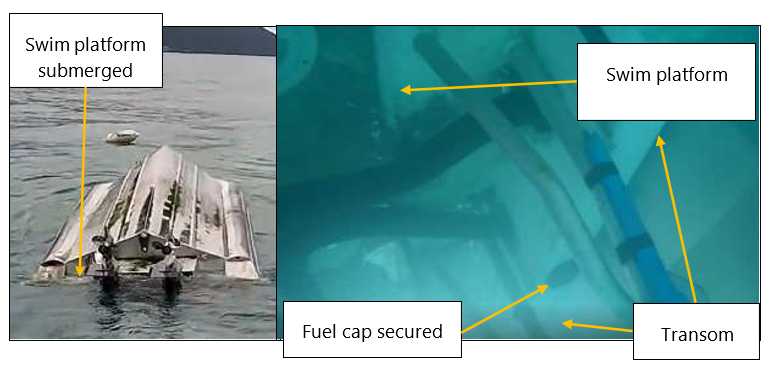
- When an inverted cap is submerged in sea water, the sea water applies an upward force to the surface area on the outside of the cap, countering the force applied by the fuel. The i-Catcher’s fuel cap was mounted on the transom, which remained submerged with the vessel capsized in relatively calm conditions. Inspection of the vessel by the Police dive squad immediately following the accident found that the fuel cap was secured (see Figure 28).
- Commission investigators tested the seal of the fuel cap’s O-ring by conducting a chalk test. The chalk test revealed that when the cap was closed, the O-ring contacted the entire edge of the filler pipe (see Figure 27).
- If the fuel cap had leaked, a significant petrol sheen would have been visible outside the hull by the outboard motors and swim platform. Survivors who were sitting on the upturned hull for nearly forty minutes while awaiting rescue, reported seeing very little fuel in the water. Therefore, it is unlikely that the fuel cap contributed to the fuel leak.
Survivability
- The survivability of the accident was significantly reduced because of a combination of the following factors:
- exposure/inhalation of petrol fumes
- confinement in a toxic space
- time immersed in the 10°C water.
- It is virtually certain that flaws found in the vessel’s fuel system allowed fuel to leak into the air pocket of the upturned vessel reducing the survivability of the accident.
- Evidence reviewed by the Commission’s medical consultant identified that all deceased passengers showed symptoms of petrol exposure, consistent with inhalation and absorption of petrol fumes.
- The presence of petrol in a confined space significantly reduces survivability, as petrol attacks the cardiac and central nervous systems. At low concentration levels people can experience the smell and irritation of the eyes and upper respiratory tract. Higher exposure levels above 8000 mg/m3/h can rapidly lead to confusion, loss of consciousness and sudden death (Reese, E. and Kimbrough, R. D. (1993). Acute Toxicity of Gasoline and Some Additives. Environmental Health Perspectives Supplements 101 (Suppl. 6), pp115–131).
- In the absence of petrol, a 3.67 m3 air pocket may provide enough breathable air to sustain life for five average adults for approximately three to five hours depending on the respiratory rate of the occupants. Considering the water temperature of 10°C, the survival time would likely be reduced to approximately three hours before succumbing to hypothermia (The volume of the air pocket is approximate and there are variables relating to the individual occupants that bring an element of uncertainty to any survival calculation).
- On the day of the accident, it is known that the knocking from underneath the hull stopped approximately 17 minutes after the capsize. The volume of the air pocket was approximately 3.67 m3, extending the entire length of the hull. As little as 0.14 litres of petrol in a controlled confined space of 3.67 m3 for 17 minutes can result in exposure levels of 8000 mg/m3/h and its associated symptoms (calculations are based on a controlled environment, which would differ from a dynamic environment. They should be considered as approximate as there are many variables to consider and/or are otherwise unknown).
- The effects from exposure to petrol in a confined space are significant. Therefore, it is important for all vessel owners to regularly ensure their fuel systems are sound.
Survey System
Safety issue 1: Maritime New Zealand’s survey system does not adequately assure the integrity and safety of fuel systems. There are no requirements to inspect fuel systems in their entirety, nor regularly. This increases the potential for undetected deficiencies to exist in fuel systems, which can lead to catastrophic consequences.
- The i-Catcher entered commercial service in 2009 and was registered as a passenger vessel restricted to carry a maximum of 12 people onboard, operating within specified restricted limits. Under this classification the vessel was required to comply with MNZ’s Maritime Rules, including Part 40A Design, Construction and Equipment – Non-SOLAS Passenger Ships. Compliance with Part 40A was assessed through surveys (Maritime Rules Part 44 Surveyor Responsibilities and Survey, Certification, and Maintenance for Ships in Maritime Transport Operations (see Appendix 2)) conducted periodically by MNZ Recognised Surveyors.
-
At the time of the accident, Maritime Rule 40A.32(4) provided that:
(4) The machinery, fuel tank or tanks, and associated piping systems and fittings must be—
- of a design and construction adequate for the service for which they are intended; and
- so installed and protected as to reduce to a minimum the danger to persons from moving parts, hot surfaces and other hazards during normal movement about the ship.
- Although Maritime Rule 40A provided some information regarding adequate standards for fuel-system components, what constituted ‘adequate’ was largely left to the discretion of the surveyor. This allowed surveyors flexibility when surveying various vessel designs but was open to an inconsistent application of the Maritime Rules with respect to quality assurance of safety critical components such as fuel systems.
- With the implementation of MOSS, MNZ issued surveyor performance requirements for Recognised Surveyors to adhere to. While these requirements provided additional guidance on the items to be surveyed, they did not include inspecting fuel systems. The Maritime Rules also did not prescribe that the entire fuel system be inspected.
- The fuel system is safety critical because a failure in that system can have serious consequences such as fire, explosion, inhalation of toxic fumes and environmental harm. For this reason, it is important that fuel systems are regularly monitored and periodically tested to ensure they are safe and fit for purpose.
- Surveyors create and/or update survey plans after every survey to ensure critical systems are inspected at scheduled intervals. These survey plans are then submitted to MNZ with the survey report.
- Fish Kaikoura engaged three different SSM companies throughout i-Catcher’s commercial history.
- Each surveyor issued a survey plan identifying a specific year to remove the vessel’s fuel tank for inspection and pressure testing (see Table 1). However, the recommended year of inspection from previous survey plans was not carried through to the next survey.

- In 2016, Fish Kaikoura changed its Safe Ship Management company to Able Ships Limited (Able Ships) and a renewal survey was conducted. This survey report recorded that the deck plating was last lifted in 2014 by a mechanic to replace wiring for the fuel tank sender unit, exposing the fuel tank. During its investigation, the Commission was able to determine that the deck plating was lifted in 2011, not 2014.
- A mechanic lifting the deck plating to service the fuel tank sender unit would have exposed the top surface of the fuel tank. However, the Commission does not consider this would equate to an inspection of the fuel system as conducted by a Recognised Surveyor.
- The surveyor from Able Ships created a survey plan recommending that the fuel tank should be removed, inspected and tested during its next renewal survey in 2021. This period was based on the understanding that the deck plate was lifted in 2014.
- In December 2021, a surveyor from Able Ships conducted a renewal survey but did not remove or inspect the fuel tank. Neither did they provide a recommended date for future removal and inspection of the fuel tank. At the time of the accident the fuel tank had not been removed or inspected in 13 years.
- All i-Catcher’s survey reports provided minimal description of the vessel’s fuel system and did not include details of any inspection of the fuel system below the deck plate (see Figure 29). Similarly, the survey reports did not identify that the secondary fuel tank vent was ineffective.
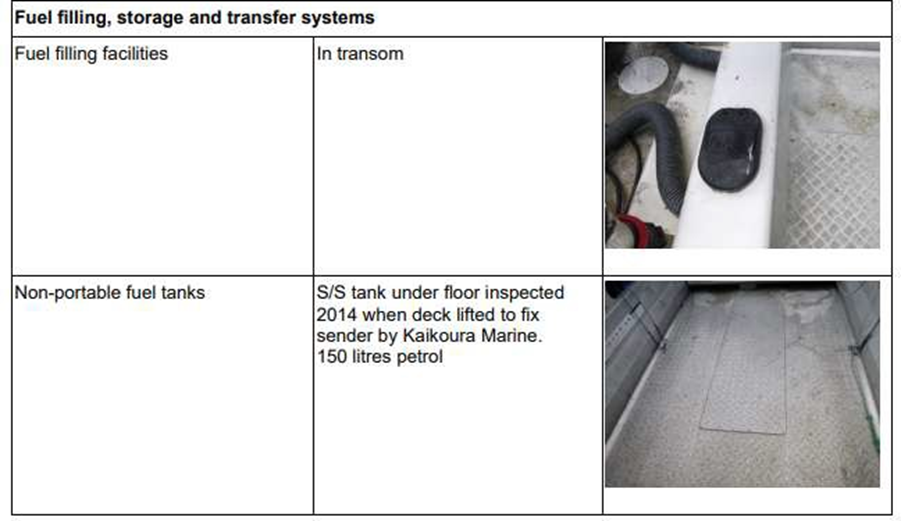
- Fuel systems on smaller vessels can be difficult to access and, like the i-Catcher, may require disassembly or destructive measures to gain access. Without specific regulatory requirements to survey the entire fuel system, Recognised Surveyors rely upon their judgement in determining the extent of inspection. This decision may be based on an overall visual appraisal of the vessel that may not accurately reflect the condition of hidden components. At the time of the accident there was little guidance for Recognised Surveyors as to how often, and to what extent, a fuel system should be inspected and/or tested.
MNZ oversight and monitoring
Safety Issue 2: The level of regulatory oversight and monitoring of the survey system is not sufficient to give Maritime New Zealand confidence that the survey system is ensuring the safety of the vessel and its occupants.
- During the Commission’s investigation, issues were identified in the i-Catcher’s design approval, initial survey and subsequent periodic surveys.
- The i-Catcher’s initial survey was conducted by Survey Nelson Limited (Survey Nelson) in February 2009. Initial surveys are intended to be a thorough survey to ensure a vessel is fit for purpose in accordance with the Maritime Rules and that it meets the requirements set out in the design approval letter. The Survey Nelson survey documents were templates with handwritten notes, which were either difficult to read or completely illegible.
- The design approval required the vessel to meet an extensive list of requirements. There were ten requirements specifically relating to the fuel system and the i-Catcher’s complied with only two of these. When this is the case, the Recognised Surveyor must provide documented reasoning as to why the vessel does not need to meet the requirement. No such reasoning to explain why the vessel did not comply with the other eight requirements was included in the vessel’s files.
- Given the number of design approval requirements that were not met by the i-Catcher’s fuel system and the absence of supporting documentation as to why the requirements were not met, it is very unlikely that the fuel system was thoroughly examined during the initial survey.
- Over the i-Catcher’s 13 years in commercial service, periodic surveys were conducted to ensure that the vessel remained fit for purpose and met the requirements of the Maritime Rules.
- The Commission’s review of the two most recent survey reports (in 2019 and 2021) identified that significant portions of both reports contained information repeated verbatim from the 2016 survey report.
- The Commission’s review of the 2019 and 2021 survey reports relating to the fuel system and lifejackets identified that the information in both reports was not accurate and did not represent the state of the vessel’s fuel system or lifejackets.
- For example, the 2019 and 2021 reports repeated incorrect information from the 2016 survey report as to when the deck plating was last lifted to inspect the fuel tank. They also repeated information that did not accurately reflect the age or in-service date of the vessel’s inflatable lifejackets.
- The overall responsibility for ensuring that a vessel is fit for purpose lies with the vessel’s operator. The operator is most familiar with the vessel and its operation. While it may be reasonable for operators to have some reliance on the technical expertise of Recognised Surveyors, operators should proactively engage with Recognised Surveyors to ensure that their vessel’s survey plans are followed and review survey reports to ensure they accurately reflect the state of the vessel.
- As the regulator, MNZ was responsible for monitoring the performance of Recognised Surveyors to ensure the standard of the domestic fleet is upheld, and the safety of a vessel and its occupants are maintained. Monitoring currently occurs through:
- renewal of surveyor recognition
- MOSS audits by Maritime Officers (MOs)
- reactive investigation.
- MNZ required survey reports to be uploaded into Navigator within ten days of conducting a survey. MNZ informed the Commission that once uploaded, resource limitations restricted proactive review of survey reports for quality assurance. MNZ relied on the expertise and experience of the Recognised Surveyors to provide accurate reports.
- Given the large number and variety of vessels that an individual Recognised Surveyor may assess over the course of a year, a degree of variance both within and across survey reports should reasonably be expected.
- To become a Recognised Surveyor, the applicant must pass a written examination and gather enough experience under the supervision of a Recognised Surveyor. A Certificate of Surveyor Recognition is valid for five years, after which they must reapply (rule 44.24 of the Maritime Rules).
- An application for renewal included:
- an updated CV
- list of relevant vessels surveyed in the last 12 months
- five survey reports conducted in the last 12 months
- an approved survey plan.
- MNZ then reviewed the documentation provided, along with any further documentation requested and, if it was considered satisfactory, the surveyor’s recognition was renewed. The review checks for quality and consistency within the documentation provided but did not include an inspection to confirm that the contents of the report accurately recorded the condition of the vessel.
- Further, there was no requirement for Recognised Surveyors to maintain and develop their knowledge of the rules and best practices.
- MNZ MOs could review survey reports when conducting MOSS audits. Surveys and MOSS audits had different purposes. A MOSS audit was a high-level operational audit that helped ensure appropriate procedures and policies were in place for a specific operator that may have operated several vessels. Surveys are a technical inspection of a vessel conducted by Recognised Surveyors to ensure the vessel is fit for purpose and meets the requirements set out in the Maritime Rules.
- The frequency of MOSS audits was determined by the operator’s risk rating. In 2018, Fish Kaikoura was identified as being a low-risk operation and therefore the next scheduled in-person audit was not required for 43 months.
- As the frequency of MOSS audits are reduced, MOs have fewer opportunities to review survey reports for specific vessels. Oversight is further reduced when auditing a multi-vessel operation, as MOs may review reports from one vessel as a sample rather than from the entire fleet. While MOs were trained to conduct MOSS audits, they may not all have the appropriate expertise required to identify certain technical issues in a survey report.
- MNZ could investigate based on information received from industry about a Recognised Surveyor who is considered to be underperforming. Depending on the outcome of the investigation, this could result in revocation of a surveyor’s recognition and/or prosecution.
-
The Commission identified the safety issue of surveyor oversight in its investigation in 2022 into the capsize of the charter fishing vessel Enchanter resulting in the death of five passengers (Transport Accident Investigation Commission. (2023). Maritime inquiry MO-2022-201 Charter fishing vessel Enchanter, Capsize, North Cape, New Zealand, 20 March 2022) Previous surveys had not identified the use of non-compliant and deficient lifesaving appliances, limiting the ability for search and rescue assets to detect people in the water and the overall survivability of that accident. In response, the Commission issued the following recommendation to the Director of MNZ:
018/23: Ensure that Maritime New Zealand has an adequate system for monitoring the performance of marine Surveyors.
- On 11 September 2024, MNZ informed the Commission that it was currently considering the implementation that recommendation.
- The Commission considers that while the process for surveyors entering the system is robust, oversight and monitoring of Recognised Surveyors once in the system is limited and could be improved.
- The Commission has made a recommendation to the Director of MNZ to implement proactive practices allowing for greater oversight and monitoring of Recognised Surveyors.
Lifejackets
Lifejacket servicing
Safety Issue 3: There is an increased risk of inflatable lifejackets not working properly if serviced incorrectly. The Maritime Rules do not impose any restrictions on who can re-pack and re-arm inflatable lifejackets that are in commercial use. There was also no requirement for Recognised Surveyors to record the servicing history of lifejackets, increasing the risk of lifejackets that were not fit for purpose remaining in service.
- Inflatable lifejackets rely on the successful operation of an inflation mechanism to make them buoyant. It is important that inflatable lifejackets used by commercial operators are regularly inspected and maintained by an approved servicing centre in accordance with the manufacturer’s instructions to better ensure they are fit for their intended purpose and that they inflate properly.
-
According to Maritime Rule 42A.38 Servicing of inflatable lifejackets:
The owner and master of a ship must ensure that any inflatable lifejacket is serviced at the periods recommended by the manufacturer but not less than once in every 2 years. The servicing must be carried out at an approved servicing station.
- The 2019 and 2021 survey reports recorded that there were 12 inflatable lifejackets onboard, six were documented as new in 2015 and the other six were documented as new in 2016. The lifejackets expected service dates were not recorded in either survey reports, nor any corrective action to service them and nor was there a requirement to record that information.
- Commission investigators inspected the inflatable lifejackets worn by all passengers and identified that six had not met the servicing requirement set out in the Maritime Rules.
- Four of the lifejackets worn on the day were purchased in 2018, and two were purchased in January 2020. Of these, three had been serviced by the skipper in 2021 and 2022.
- Occasionally on previous trips, passengers would accidentally inflate the lifejacket. As a result, the skipper would take the opportunity to inspect the inflated bladder before repacking it and replacing the CO2 cylinder and arming kit.
- During a previous charter, a lifejacket was inflated by a passenger. The skipper repacked the lifejacket and replaced the discharged cylinder with a corroded cylinder after assessing that the cylinder seal was still intact, and the cylinder remained pressurised.
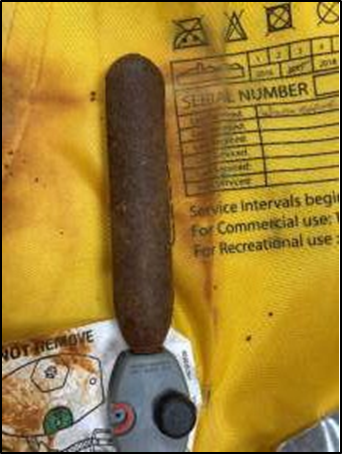
- The CO2 cylinder had corroded to a point where the cylinder wall had significant pitting (see Figure 30). This level of corrosion posed a significant risk to the wearer as the canister was at risk of failing while pressurised, which could have led to the lifejacket not inflating, or the canister exploding.
- To repack a lifejacket properly requires that the bladder is folded in accordance with the manufacturer’s instructions to allow the lifejacket to inflate properly. If a bladder is repacked using a non-approved method to that recommended by the manufacturer, it may result in an unusual inflation. The Commission was unable to determine the method of packing used for any of the lifejackets worn by the i-Catcher passengers.
- An injured passenger on the i-Catcher attempted to inflate their lifejacket to assist with keeping afloat as one of their arms was ineffective. Only one side of the bladder initially inflated, further complicating their swimming ability for a moment until the second portion suddenly inflated. The Commission tested another lifejacket that was not inflated during the accident and found a similar inflation sequence where the bladder inflated to a point where it appeared pinched and, after a significant build-up of air pressure, a subsequent sudden violent burst of inflation occurred (see Figure 31 and Figure 32).
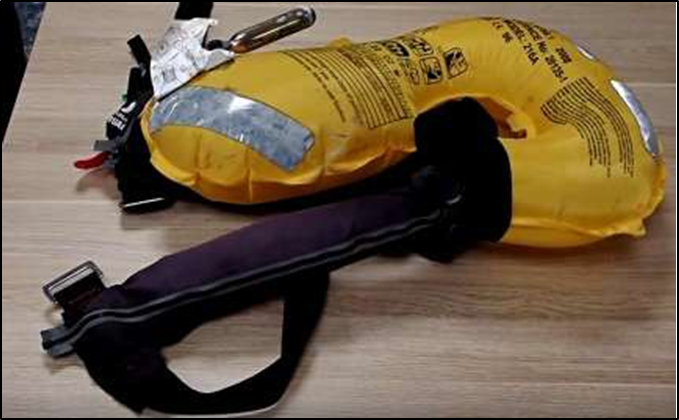
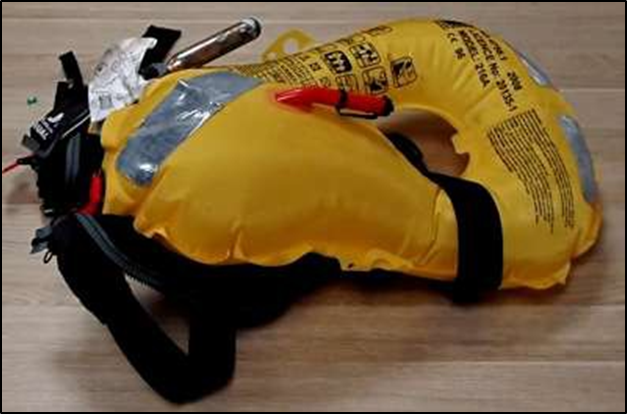
- While Maritime Rule 42A.38 requires inflatable lifejackets to be serviced by an approved servicing station at periodic intervals, it should be expected that inflatable lifejackets may be activated and inflated in-between scheduled servicing and will require re-arming and re-packing for continued use. The rule does not require that the servicing of inflatable lifejackets in commercial use must always be completed at an approved servicing station by trained technicians.
- Without this requirement, someone who is not trained or formally certified in servicing inflatable lifejackets can repack and re-arm them as needed, rendering the approved service prescribed in Maritime Rule 42A.38 null and void. Further, it complicates surveyors’ ability to determine the suitability of the lifejacket when inspected.
- Imposing a requirement for all servicing to be done by an approved servicing station may provide greater assurance that inflatable lifejackets are appropriately maintained. However, it may not be a practical solution due to other factors such as cost, logistics and capacity.
- The Commission has made recommendations to the Director of MNZ to address this safety issue.
Lifejacket operational instructions
Safety Issue 4: The operational instructions provided by inflatable lifejacket manufacturers do not identify the risk of inflation while obstructed overhead nor include doffing procedures, which are critical to the safe use of lifejackets.
- Lifejackets are critical lifesaving appliances and have contributed to countless lives being saved around the world.
- The outcome of this accident does not diminish the importance of wearing lifejackets; rather it reflects the need for people to understand how to use and wear them safely and properly. (See Appendix 2 for a description of lifejacket types.)
- On the day of the accident, all five deceased passengers recovered from under the upturned hull were wearing inflated Type 401 lifejackets, which were designed to keep the wearer’s head above the water. One passenger wore an automatic- (auto-) inflating lifejacket, which they had brought along, and the other four passengers wore manually activated inflatable lifejackets provided by the skipper.
- A survivor saw three other passengers underneath the hull, without their lifejackets inflated.
- A manual inflatable lifejacket can be inflated by either the wearer or someone else pulling on the pull tab to activate the inflation mechanism (see Figure 33). The Commission could not determine at what point the manual inflatable lifejackets had been inflated.
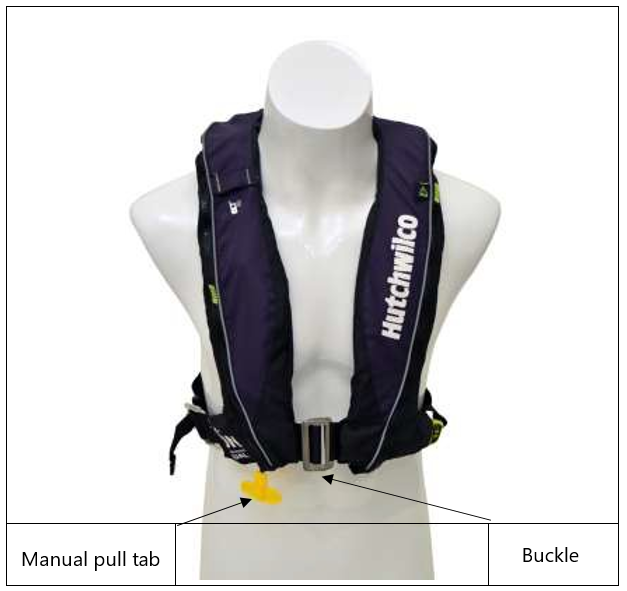
- The lifejackets used were designed for offshore use and provided buoyancy once inflated to at least 150 newton (N), which is twice as buoyant as a traditional foam lifejacket. Without removing the lifejacket, the buoyancy provided would have made it difficult for the passengers to submerge themselves deep enough to exit the upturned hull.
- This issue is not exclusive to inflatable lifejackets. However, because of their more complex operation and increased buoyancy, inflatable lifejackets can be more difficult to remove when the wearer is in the water if they are unfamiliar with how to do so.
- Two surviving passengers inflated their lifejackets to aid them in swimming back to the boat. While swimming, one passenger’s lifejacket rode up, obstructing their face and making it difficult for them to breath. Later, onboard the rescue vessel both passengers attempted to remove the lifejacket but were unable to. Eventually a knife was used to puncture the lifejackets to deflate them.
- Inflatable lifejackets were designed and tested by manufacturers to remain in place on a person’s torso when inflated. To achieve this, the wearer must ensure that the lifejacket is snugly fitted as per the manufacturer’s instructions.
- The use of crotch straps can also help prevent lifejackets from riding up the wearer’s torso. However, they too need to be fitted appropriately to serve their intended purpose.
- To fit an inflatable lifejacket correctly, the securing straps are buckled and tightened to fit snug around the torso. If a crotch strap is fitted, it is intended to be passed through the legs, buckled, and tightened to prevent the lifejacket from riding up over a person’s head.
- During the inflation process, the securing straps of the lifejacket will naturally tighten around the body as the bladder inflates. If fitted correctly, this process will help prevent the lifejacket from riding up while in the water.
- With the securing straps now tight it can be difficult for the occupant to unbuckle and remove the lifejacket once it is inflated. The level of difficulty significantly increases in cold water (if the wearer loses dexterity in their fingers) and if the inflated bladder is blocking the wearer’s peripheral vision.
- To improve visibility and ease tension in the straps, the bladder can be partially deflated by pressing down on the release valve in the oral inflation tube, which is ordinarily used for manually adding air to the bladder (see Figure 34). Attached to the top of the oral inflation tube is a cap that, when inverted, can be used to press down on the release valve located at the top of the tube. As the bladder deflates the straps will loosen around the body making it easier to unbuckle.
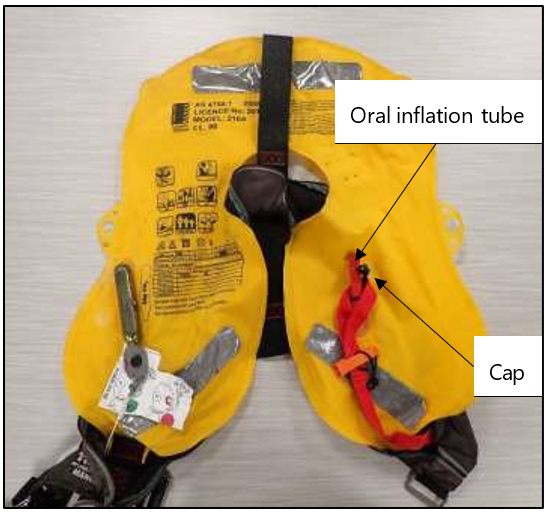
- Vessel operators and individual wearers must ensure that lifejackets are fitted in accordance with the manufacturer’s instructions to prevent them from riding up and obstructing the wearer’s face. All people wearing lifejackets should also have a complete understanding of its full operation, including how to remove it in water if need be. This information is best shared during predeparture safety briefings to ensure all vessel occupants are well informed.
- On the day of the accident, the skipper of i-Catcher conducted a safety briefing before departure. Wearing a lifejacket was required by the skipper, who provided lifejackets to all passengers who needed one.
- The skipper proceeded to help the passengers don their lifejackets and informed them of the general operation to inflate the lifejacket, instructing them to pull the cord to inflate it. The level of instruction provided by the skipper would be considered common practice within the industry.
- Maritime Rules Part 42A covered the performance standards and requirements for the maintenance, servicing, testing and inspection of life-saving appliances used in commercial maritime operations in New Zealand.
- Maritime Rule 42A.19 required non-SOLAS lifejackets (in relation to a life-saving appliance, means an appliance that is not required by Maritime Rules to meet the requirements for that type of appliance contained in the International Convention for the Safety of Life at Sea (SOLAS 1974)) meet the requirements of the New Zealand Standard NZ 5823:1989 Specification for buoyancy aids and marine harnesses and lines. This standard was primarily based on the Australian standard (Australian Standard 4758 Lifejackets, Part 1: General Requirements) and other international standards, including those of the International Organization for Standardization (ISO) and requirements of the International Maritime Organization (IMO) that applied to SOLAS-approved lifejackets. (International Convention for the Safety of Life at Sea (SOLAS) sets minimum safety standards in the construction, equipment and operation of merchant ships) SOLAS-approved lifejackets must be capable of automatic inflation.
- None of these standards required the operating instructions on lifejackets to include doffing procedures or to identify the risk to the wearer of a lifejacket while obstructed overhead.
- The Commission has made recommendations to the Director of MNZ and Chief Executive of Standards New Zealand to address this safety issue.
EPIRBs on passenger vessels
Safety issue 5: In a sudden event, a Category II EPIRB may not be accessible to be manually activated, increasing the likelihood of a delayed emergency response.
- There are two types of EPIRBs: Category 1 (Cat I) EPIRBs that float free and self-activate; and Category II (Cat II) EPIRBs that needs to be removed from their bracket and manually activated.
- Cat I EPIRBs are automatically released from their brackets by a hydrostatic release mechanism, which activates when it is submerged between 1.5 m and 4 m.
- One of the key reasons operators of smaller vessels prefer to use Cat II EPIRBs is the 1.5–4 m triggering depth of the hydrostatic release for a Cat I EPIRB. On smaller vessels, such a depth is often greater than the height at which an EPIRB can be mounted because of the limited size of the vessel. This can result in a Cat I EPIRB not being released in a capsize event.
- The i-Catcher was equipped with a Cat II EPIRB, mounted in the forward hold. Because of the suddenness of the capsize, the skipper was unable to access the EPIRB to remove it from its bracket and manually activate it. Two passengers on the i-Catcher had mobile phones, one of which was able to be used to alert authorities. Had the phone been inoperable because of water damage or insufficient signal, the time for authorities to be alerted and respond would have been longer.
- Mobile phone coverage varies in quality along the New Zealand coastline and generally decreases further offshore. Mobile phones are also susceptible to being damaged and becoming inoperable from exposure to water. These factors decrease the reliability of mobile phones as a secondary form of communication in the maritime environment.
- While the risk of a mobile phone becoming inoperable because of exposure to water can be mitigated with the use of a dry bag, the reliability of the mobile network at sea will remain a limitation.
- In addition to an EPRIB, another device capable of transmitting a distress signal in an emergency is a Personal Locator Beacon (PLB). A PLB can be attached to a crew member’s lifejacket and can be used in conjunction with EPIRBs. This practice would provide redundancy in the event of a sudden emergency when the EPIRB is not activated or is inaccessible.
- The safety benefits of carrying a PLB in addition to an EPIRB were identified as a key lesson in the Commission’s inquiry into the capsize of the charter fishing vessel, Enchanter, off North Cape in 2022 (Transport Accident Investigation Commission. (2023). Maritime Inquiry MO-2022-201, Charter fishing vessel Enchanter, Capsize, North Cape, New Zealand, 20 March 2022). The vessel’s crew came across the EPIRB floating in the water following a sudden capsize and manually activated it. A PLB could have enabled a distress signal to be sent had the EPRIB not been found. Passengers also attempted to call 111 but did not have sufficient signal for their calls to be connected.
-
The United States’ National Transportation Safety Board (NTSB) has also raised this safety issue and in December 2023 issued a Safety Alert (National Transportation Safety Board. (2023, December). Personal Locator Devices: Improve Your Chance of Rescue. Safety Alert 089) stating:
Vessel owners and operators can enhance the safety of their crews by providing each crewmember with personal locator devices, such as PLBs or SENDs, to supplement EPIRBs.
- The Commission has made a recommendation to the Director of MNZ to address this safety issue.
Search and Rescue
- SAR operations are dynamic in nature, with new lessons that can be applied to benefit future operations arising out of every SAR operation.
- The response to the i-Catcher accident was a strong demonstration of authorities and the local community working together to respond to an emergency. The Commission acknowledges the significant effort of those involved in rescuing the six survivors and locating and recovering the deceased.
- The following analysis examines why systemic limitations contributed to inefficiencies in the response, despite those efforts. The Commission considers it unlikely that the delays contributed to the overall outcome of this accident, given the toxic environment within the air pocket of the upturned hull. Nevertheless, valuable lessons can be learned from this response to better prepare for a search and rescue response for similar accidents in the future.
- The i-Catcher SAR operation was considered by many involved as significant, considering the number of deployed assets, yet it consisted of a single 8-m vessel close to shore with 11 occupants. At any time in New Zealand, there are likely to be much larger vessels with more people onboard. The Commission has considered the accident and the identified systemic issues on that premise.
Emergency 111 system
Safety issue 6: The emergency 111 system used to access the three emergency services (fire, ambulance or Police) introduces delays to the emergency response.
- The i-Catcher was equipped with three methods of communication capable of transmitting a distress message in a maritime emergency, providing redundancy. These were a VHF radio, an EPIRB and the skipper’s mobile phone.
- Because of the sudden capsize, none of the three communication methods were available. This left the skipper and passengers reliant on a passenger’s mobile phone that, despite being wet, continued to work and had sufficient signal to make a 111 call.
- New Zealand’s emergency 111 system was a two-stage public service answering point where emergency calls were received by the ICAP (operated by Spark New Zealand) and then transferred to a single emergency service: fire, ambulance or Police.
- The caller was asked to state the service they required, before being put on hold while the call was transferred to the selected emergency service. If the caller didn’t know which service to choose, the ICAP communicator would elect a service based on the information provided or, if unsure, would default to Police. The ICAP communicators were not trained to provide emergency advice to the caller.
- The connection time from the ICAP to emergency services varied depending on call volume and staff availability. Police aimed to answer 90 per cent of calls within ten seconds of being transferred from the ICAP. Immediately before the i-Catcher call, the emergency comms centres were experiencing high call volume with low staff numbers, where some callers experienced a nine-minute connection time.
- The time between the skipper placing the 111 call and connecting to the Police communicator was 1 minute 8 seconds.
- The design of the two-stage system created unnecessary delay and increased the risk of a call being dropped before the caller had explained their emergency to Police. When this occurs the ICAP communicator can provide Police with a verbal summary of what they remember was said on the call. If required, the Police communication centre can request the ICAP supervisor to review the call and provide a verbal transcription of the recording. However, the ICAP cannot provide Police with a copy of the recording without a warrant or production order being issued, limiting the Police’s ability to determine the nature of the emergency when the call disconnects with limited information.
- For the public it is not always clear who the most appropriate emergency service is, and often multiple agencies are required to attend. This confusion could result in callers selecting the wrong emergency service, delaying the response. Further, it is not common knowledge that if the emergency requires a SAR response, then the Police should be notified.
- In the case of the i-Catcher, the skipper did not know which emergency service to ask for, relying on the ICAP communicator to connect them to the appropriate agency.
- The Ministry of Business, Innovation and Employment provides policy advice to government as it relates to the ICAP aspects of the emergency call services in New Zealand.
- Next Generation Critical Communications Poutama Whai Tikanga Pāpāho (NGCC) is stakeholders, to remove unnecessary delay and improve New Zealand’s emergency response efficiency.
- To address this safety issue, the Commission has recommended that the Ministry of Business, Innovation and Employment and Next Generation Critical Communications collaboratively conduct a review of the emergency 111 system with sector the government’s leading advisor on critical communications for public safety in New Zealand. NGCC is a cross-agency entity involving Police, Fire and Emergency NZ, Hato Hone St John and Wellington Free Ambulance.
Emergency services coordination
Safety issue 7: The communication and resource deployment (CARD) platforms of the three emergency services are not integrated, which delays and restricts the flow of information necessary to coordinate a multi-agency response.
- Police and Fire and Emergency NZ shared a common communication and resource deployment (CARD) platform with specific customisations for each agency. This allowed the two agencies to have oversight of each other’s communications and resource deployments during a multi-agency response.
- New Zealand’s ambulance services (ambulance) operated on a separate CARD platform from that of Police and Fire and Emergency NZ. While the two platforms could exchange basic information, they were not fully compatible. This limited the flow of information between services during multi-agency responses, contributing to delays and a lack of coordination.
- During the i-Catcher response, the Police emergency comms centre tried to provide the coordinates of the accident to ambulance for tasking. The emergency comms centre entered the coordinates into the system to send to ambulance and received an error message. The ambulance CARD platform did not accept locations offshore as it is outside the scope of an ambulance’s operation.
- As a work around, the Police emergency comms centre verbally informed ambulance of the scenario. A scenario description was manually entered by ambulance into their system, including that people were in the water (as opposed to being trapped under the hull as recorded in the Police system). This information was then provided to the helicopters, who focused their search on the area surrounding the vessel, looking for people in the water.
- To connect to the ambulance CARD platform, Police searched for the nearest land-based address to the accident and entered it into the system.
- Later, when Coastguard contacted the Police emergency comms centre seeking the coordinates of the accident site, the location in the system had to first be changed back to the original coordinates before being provided to Coastguard. As a result, Coastguard was informed that the accident occurred in Goose Bay, but the coordinates provided were for a different location.
- The Commission has recommended that NGCC lead the establishment of a common communication platform for emergency services, to support the sharing of inter-agency communications during a response.
Coastguard notification
Safety issue 8: The method of contacting Coastguard is inconsistent around New Zealand and not always reliable, increasing the likelihood of delays and confusion around their deployment in a maritime response.
- Coastguard Kaikōura received notifications of maritime responses through a pager system. In the i-Catcher response, the initial page sent by Police to Coastguard was received but, because of a toll bar (a restriction that prevents outgoing chargeable calls being made from a telephone landline) Coastguard was unable to call to acknowledge receipt. Without acknowledgement of receipt, the Police emergency comms centre continued to page Coastguard Kaikōura multiple times and call Coastguard skippers directly on their mobile phones, all without success.
- Eventually a skipper from Coastguard Kaikōura phoned 111 and was put through to Police to acknowledge receipt of the page. While this did not significantly delay Coastguard’s deployment, it created significant additional workload for the Police emergency comms centre, detracting from the progression of the SAR operation.
- Since this accident, Coastguard Kaikōura is transitioning to the new Active Alert app-based alert system. Active Alert allows a SAR coordinator to call the Coastguard communications centre, who then alert the nearest unit using the app.
- Coastguard intends to implement Active Alert nationwide but until this is achieved, Police and RCCNZ will continue to maintain a database of the individual paging numbers for each Coastguard unit around New Zealand.
- Inconsistencies in the method for notifying Coastguard unnecessarily complicated the notification process and increased the potential for delay. The nationwide implementation of Active Alert would provide Coastguard with national oversight and consistency.
Police dive squad
Safety issue 9: The SOPs for water rescue events did not include early engagement of the Police national dive squad for expert advice or assistance, delaying the sourcing and deployment of appropriate local and national divers.
-
During the skipper’s 111 call, the initial information provided included the fact that five passengers were trapped under the hull. The headline recorded in the Police event chronology log at 1014 was:
Boat hit by whale-overturned-people trapped
- The communicator handling the call was based in Wellington, while the Southern Emergency Communications Centre leading the response was based in Christchurch.
- The skipper’s repeated requests for divers were not recorded in the event chronology provided to the emergency comms centre leading the response.
- At around 1100 the Officer-in-Charge (OIC) of Police dive squad was first made aware of the incident by the Police Maritime Unit, who had been contacted by the Wellington District Command Centre inquiring about the availability of Police vessel Lady Elizabeth IV.
- The assistance of the Police dive squad was not formally sought until 1119, when the emergency comms centre contacted the Police dive squad OIC, over an hour after the 111 call began. The emergency comms centre advised the Police dive squad OIC that local Police were in the process of sourcing a local diver and that tapping was heard from under the hull. The two parties then made arrangements for an urgent deployment of Police dive squad by helicopter.
- The Police dive squad was based in Wellington, which could present logistical challenges when transporting the squad to other parts of New Zealand in a timely manner. The Wellington-based helicopter had already been deployed to Kaikōura in response to the accident by the time the Police dive squad was notified, and the nearest available helicopter was based in Palmerston North, adding a further delay of an hour and eleven minutes.
- The Police Standard Operating Procedure (SOP) for water rescue events did not include consideration for notifying the Police dive squad if appropriate. The Police dive squad was primarily tasked with body and evidence recovery. However, they were also skilled in water rescue, working with the RNZAF No. 3 Squadron as rescue swimmers. The knowledge and training received by the Police dive squad would be a valuable resource in any water rescue event.
- The recreational diver was contacted by the local Police Sergeant at approximately 1110. Early engagement of the Police dive squad would provide greater opportunity for early advice in sourcing local divers, implementing risk-mitigation strategies for the safety of responding civilian divers and consideration for rapid deployment of the Police dive squad for urgent scenarios.
- The Commission acknowledges that earlier deployment of the Police dive squad would not have changed the outcome of this accident. Despite this, opportunities were missed to involve the Police dive squad at the outset of the SAROP, to provide early advice and support in relation to sourcing local divers and consider an earlier deployment.
SAR coordination
Safety issue 10: The Police has limited dedicated resources to effectively coordinate the deployment of multiple air and maritime assets during a Cat I SAROP, increasing the risk of an uncoordinated response.
- The two SAR coordinating authorities, Police and RCCNZ, had specific skills that aligned with their assigned SAR category.
- Police led Cat I SAROPs, and when there was a fatal accident, the Police’s role was broadened to include documenting the scene, body recovery, collecting evidence and notifying next of kin on behalf of the coroner. The Police’s role in a Cat I SAROP was in addition to their regular Police work.
- RCCNZ led Cat II SAROPs, which was their sole purpose. They were funded and equipped to coordinate complex search and rescue operations involving multiple assets within New Zealand’s extensive search and rescue region.
- While Police may have had strong local knowledge and leadership, their ability to coordinate multiple assets during a SAROP could be limited. During the i-Catcher response, the Police emergency comms centre was unable to communicate directly with Coastguard or the helicopters. Communications from the Police SAR member was also limited while they drove down to Kaikōura from Blenheim. As a result, helicopter crew were initially unclear on which SAR coordinator was leading the response. Police were unable to provide helicopter crew with essential communications such as early instruction on where to search or inform them that people were under the hull.
- The Police relied on RCCNZ to issue mayday relays and develop drift modelling. Upon receiving the drift modelling, the Police SAR member had to text the coordinates for the proposed search area to the helicopter pilot’s mobile phone as they had no other system available to them to share the information. However, the helicopter was already airborne and the pilot could not immediately access their phone to manually enter the coordinates into their onboard navigation system.
- An alternative method for transferring coordinates to air ambulances was through the National Air Desk (operated by Hato Hone St John, the National Air Desk is responsible for dispatching and coordinating air ambulance resources in New Zealand). The National Air desk had the ability to send coordinates as a message to the aircraft’s iPad, which had navigation software. The crew could then transfer the coordinates from the message to the navigation software for use.
- In a Cat II SAROP, RCCNZ would direct and monitor all assets, maintaining communication with them to ensure appropriate search patterns were conducted and updates were provided and shared with all responders. Using the maritime operations centre (MOC), they could broadcast distress messages and redirect vessels of opportunity to assist in a search.
- Limitations in the Police’s ability to effectively coordinate multiple assets in the maritime environment could reduce the effectiveness of a SAROP and increase risk to those involved.
- The Commission has made a recommendation to address this safety issue.
Police emergency response plan
Safety issue 11: The Kaikōura region was not resourced to respond to a large maritime accident. There was no maritime rescue plan for the region, leaving an area with a significant level of maritime activity vulnerable in an emergency.
- Each Police District was responsible for maintaining search and rescue capability within their district and to implement and maintain mass rescue plans.
- Mass rescue plans are generic in nature but include area-specific information. This allows for flexibility when dealing with dynamic search and rescue operations. They serve as an important guiding tool during large-scale SAROPs and were put in practice in SAR exercises. This ensured that all participants that may be involved become familiar with their roles and responsibilities. These plans were also available to RCCNZ as the coordinator for Cat II SAROPs, so that they knew how Police would respond.
- While RCCNZ was provided with copies of all Police mass rescue plans for reference, they did not input into the development of the plans. Given their SAR expertise, their input would have provided additional robustness to mass rescue plans.
- Kaikōura falls under the Tasman District in the Marlborough Police region, which had a mass rescue plan for the Marlborough Sounds area. Marlborough Sounds had the most water-based SAROPs in the region and the greatest risk of a mass rescue with the Picton–Wellington ferries.
- Kaikōura was a hub for maritime adventure tourism, with several passenger vessel operators, including two whale watching vessels each capable of carrying over 100 passengers.
- Kaikōura’s remote location, limited local resources and level of maritime activity made responding to a major maritime event a significant challenge.
- Kaikōura Police resources were limited and required collective support from community assets. This support required planning and preparation to identify the capability and availability of resources within the community.
- Extensive SAR exercises had not been conducted in the Kaikōura area and there was no mass rescue plan in place, leaving an area of significant maritime activity at risk of an uncoordinated response in a maritime emergency.
- The Commission is concerned that if an area like Kaikōura, which has significant maritime activity, did not have a rescue plan, there could be other areas around New Zealand that may also be at risk of being unprepared for a maritime response.
- The Commission has made recommendations to address this issue.
Appendix 1. DOC guidelines for operating boats around marine mammals
The Department of Conservation (DOC) provides guidance for boaters operating around marine mammals, to help keep both marine mammals and people safe. The guidelines recommend that boaters avoid operating in front of whales to avoid impeding their natural direction of forward motion.
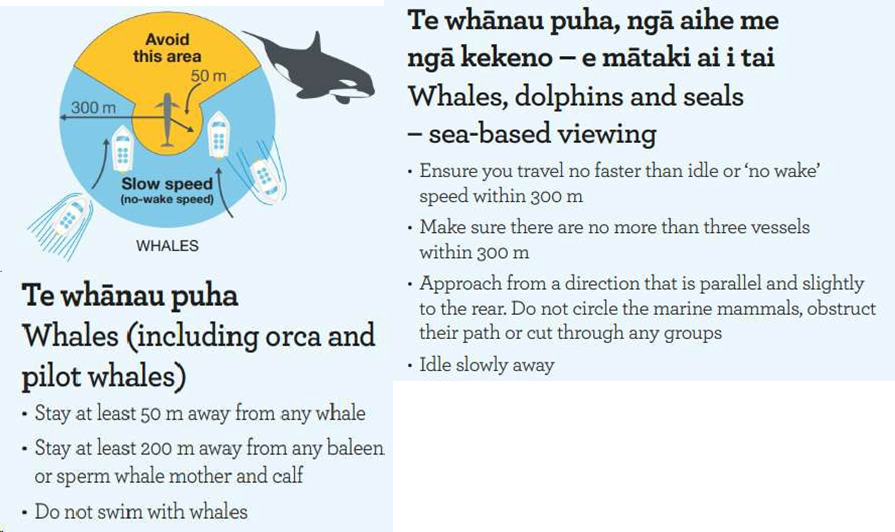
Appendix 2. Description of lifejacket types
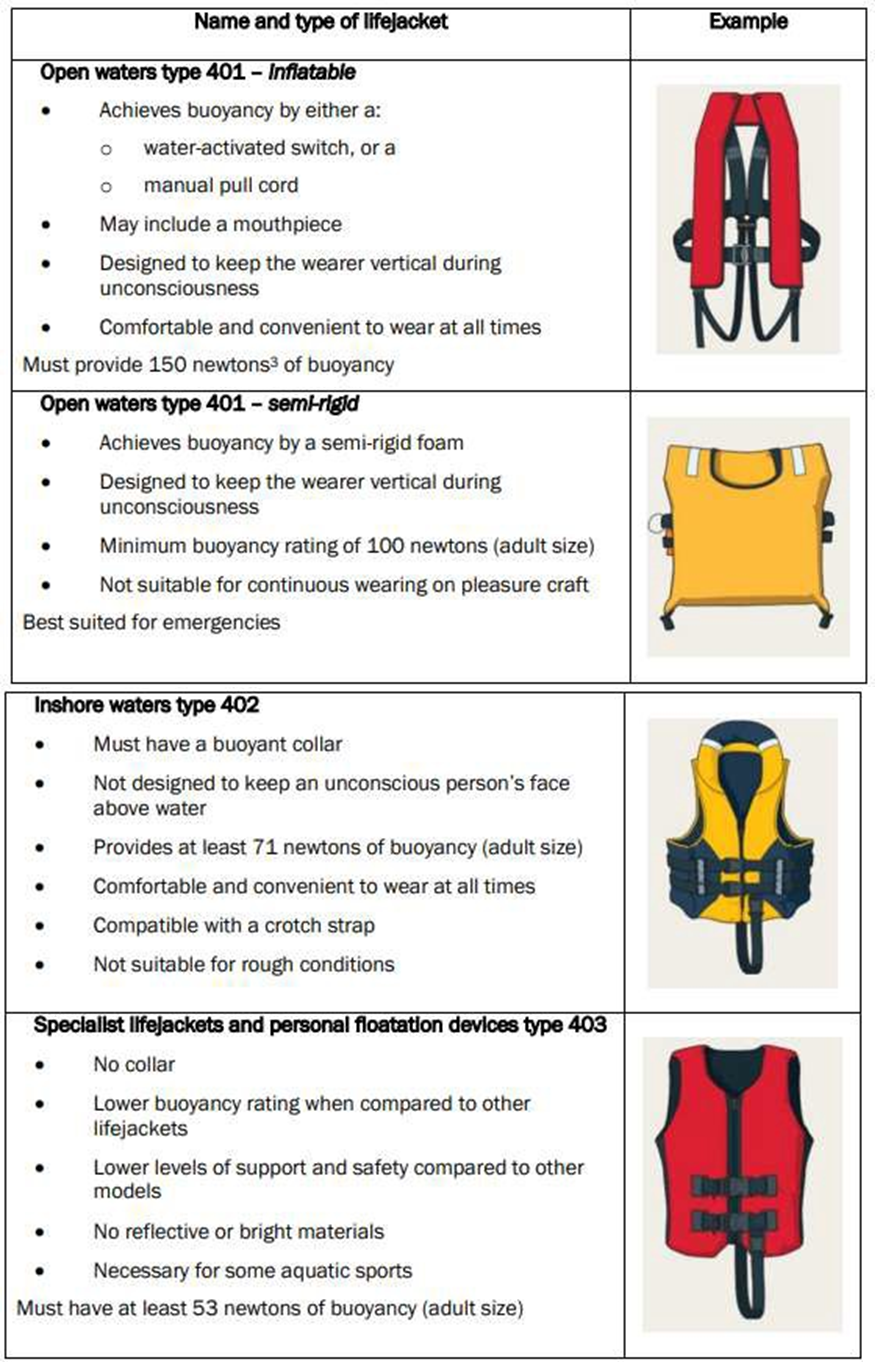
*3 Newton (N) is a unit of force, in this case used to describe the magnitude of buoyancy provided by a lifejacket.