The evacuation procedure took significantly longer than the certification benchmark and details valuable lessons and opportunities to improve crew evacuation training, preparedness, safety briefings, and the importance of passengers paying attention and doing as instructed. The fatigued turbine blade was likely present during the engine’s overhaul done the day prior to the incident. This highlights the importance of thorough overhaul quality assurance processes that ensure the airworthiness of aircraft before they are returned to service.
Executive summary Tuhinga whakarāpopoto
What happened
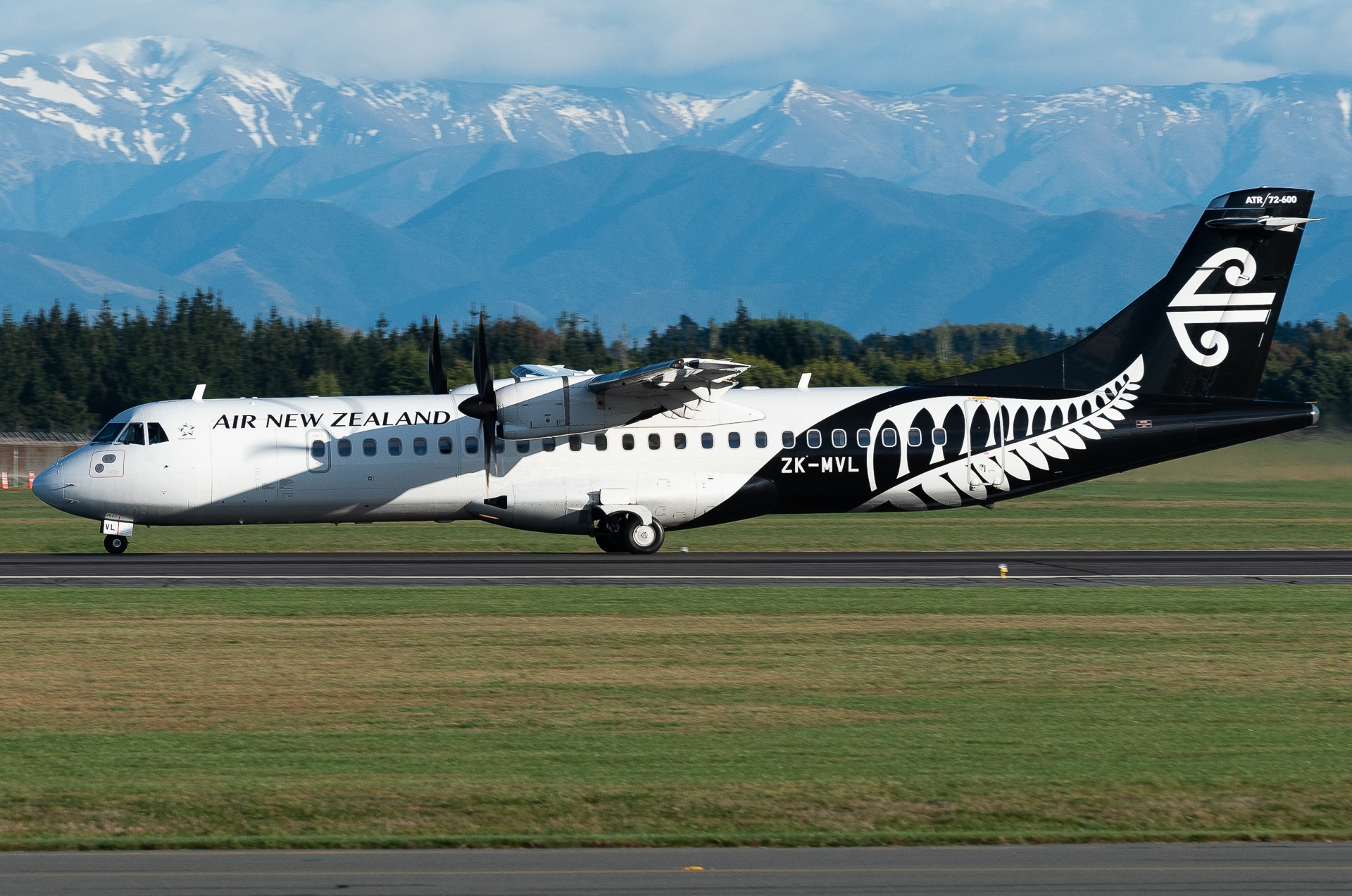
- On 1 September 2024, ATR72-600 ZK-MVL was flying from Christchurch to Wellington with four crew and 70 passengers on board. On approach to land at Wellington the left engine caught fire. The crew landed the aeroplane safely, stopping on the runway, and then discharged fire suppressant into the engine area.
- While it is virtually certain that the fire was extinguished, the fire warning remained illuminated and so the captain ordered an evacuation. The passengers were evacuated with some minor injuries, and damage was limited to the left engine.
Why it happened
- An engine low-pressure turbine blade failed. This caused a vibration and failure of internal air seals, which allowed oil to flow directly into the engine.
- The blade failure was a result of fatigue cracking. The Commission was unable to definitively determine when the fatigue cracking originated.
- The engine failure occurred within four flying hours of the engine having been overhauled.
- The fatigue cracking was likely present during the engine overhaul but was not identified as part of the overhaul quality assurance process. The Commission was also unable to determine why it was not identified during the engine overhaul process.
What we can learn
- In addition to ensuring the continued airworthiness of the engine, the inquiry identified additional safety issues relating to the evacuation of the aeroplane. The evacuation took significantly longer than the certification benchmark. There was a combination of reasons for this, including:
- not all passengers were prepared for an evacuation
- passengers could not identify a clear threat to their safety and so did not expedite their escape
- not all available exits were used
- passengers who used the forward two exits found them challenging
- many of the passengers did not follow crew instructions and took their carry-on baggage with them.
- Several passengers also endangered themselves after evacuating the aeroplane by walking near the previously burning engine.
Who may benefit
- The travelling public, engine manufacturers, regulators, aircraft and aerodrome operators, pilots and cabin crew may all benefit from the findings, safety issues and recommendations made in this report.
Factual information Pārongo pono
Narrative
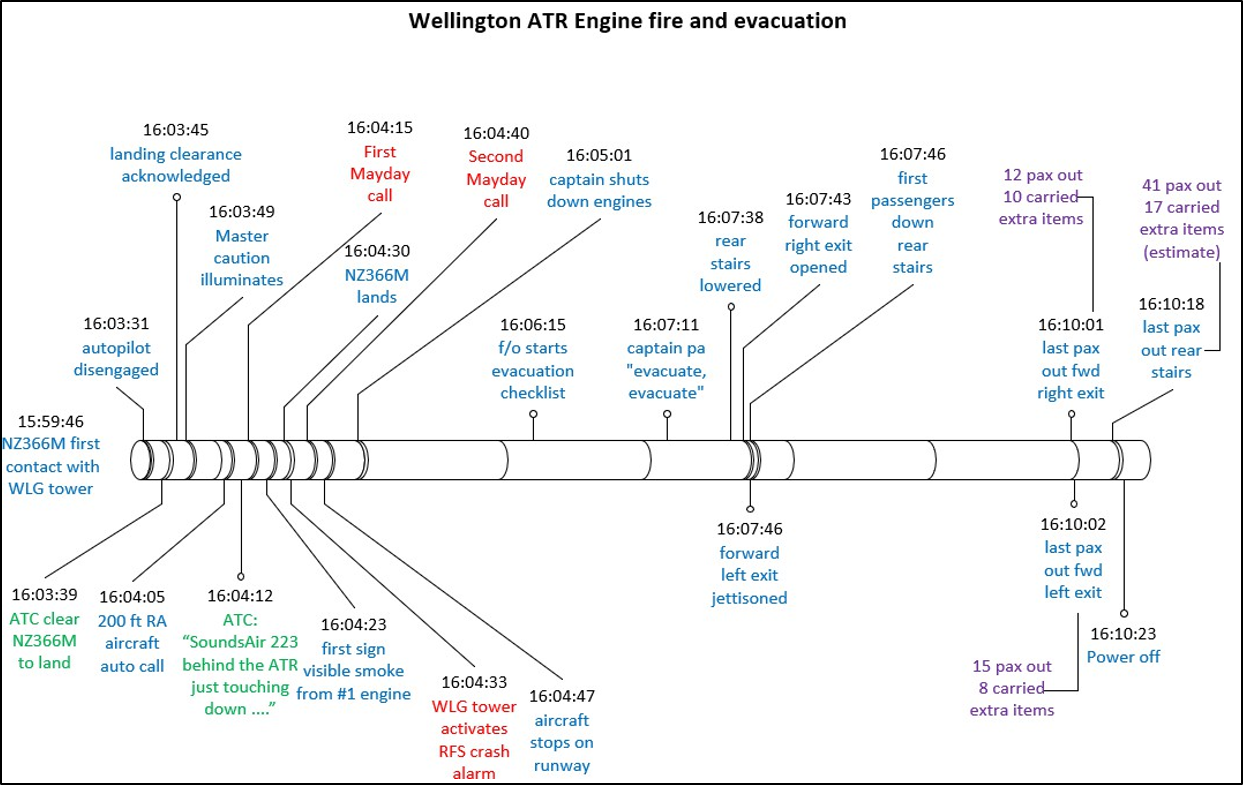
- On Sunday 1 September 2024, ATR72-600 ZK-MVL (the ATR) operated by Air New Zealand (the operator) departed Christchurch at 1516 with four crew and 70 passengers on board, including one infant, and one passenger occupying the jump seat (an auxiliary seat for approved persons, usually airline staff and safety or flight-check personnel) on the flight deck. The captain was the pilot flying and the first officer was the pilot monitoring (the pilot flying is the person operating the flying controls, while the pilot monitoring is the person responsible for monitoring the course of the flight and radio communications with air traffic control, flight attendants and passengers) (see Appendix 1 for a timeline of events).
- The flight was uneventful, and the captain started descent for the approach into Wellington. At 1558 the approach air traffic controller instructed the crew to change frequency to Wellington Tower (the tower). The tower controller responded to the initial contact call from the ATR and informed the crew that they were the second aeroplane on approach.
- The preceding aeroplane landed, and at 1603 the ATR was cleared to land on Wellington runway 34 (runways are referenced to the nearest 10 degrees magnetic bearing. Runway 34 is therefore aligned on 340°). The first officer acknowledged the landing clearance. Five seconds later at 1603:49, with the ATR at about 380 feet (ft) (above mean sea level), the oil pressure on the left engine reduced causing an auditory alarm to sound and a caution light to display on the ATR’s monitoring system. The first officer announced the caution and was acknowledged by the captain, who responded that they would continue the approach. The caution cleared but returned a further three times over about a 15-second (s) period.
- As the ATR passed 100 ft, a fire warning alarm rang on the flight deck and the fire warning light illuminated. The captain stated, ‘Engine fire’ and instructed the first officer to make a Mayday call (mayday is an emergency procedure word used internationally as a distress signal in voice-procedure radio communications). The first officer made the call stating, ‘Mayday, Mayday, Mayday New Zealand 366 Mike engine fire’ (New Zealand 366 Mike was the callsign for the flight). The tower controller did not hear the Mayday call because they were making a call on the same radio frequency, giving another aeroplane a conditional clearance to line up on the runway after the ATR had landed.
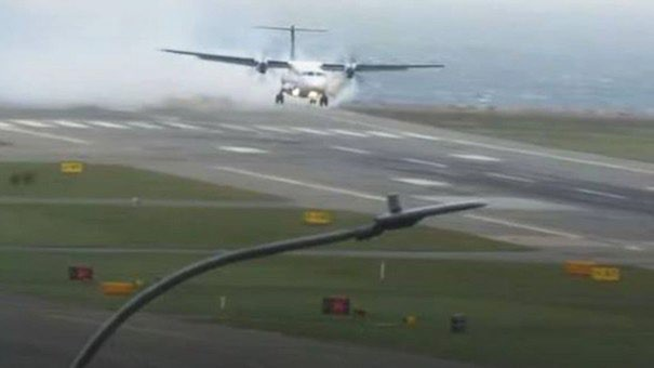
- In issuing the line-up clearance, the tower controller was watching the ATR through binoculars as it approached the runway threshold. The tower controller observed smoke coming from one of the ATR’s engines and activated the emergency alarm in the tower (see Figure 3). This in turn sounded an alarm in the airport rescue fire service (RFS) building, and the tower controller made an announcement informing RFS staff of the emergency and location. The RFS vehicles were immediately dispatched in the direction of the landing ATR.
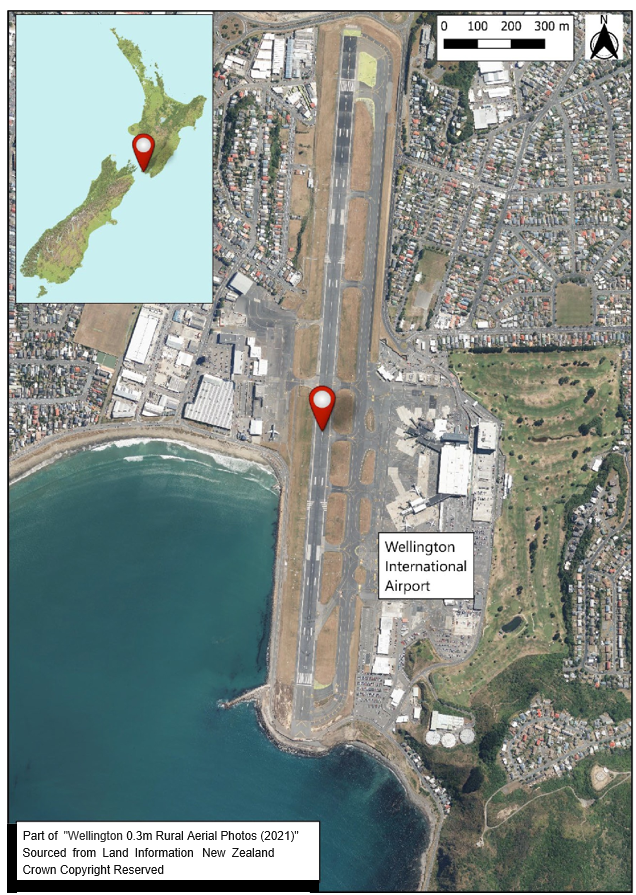
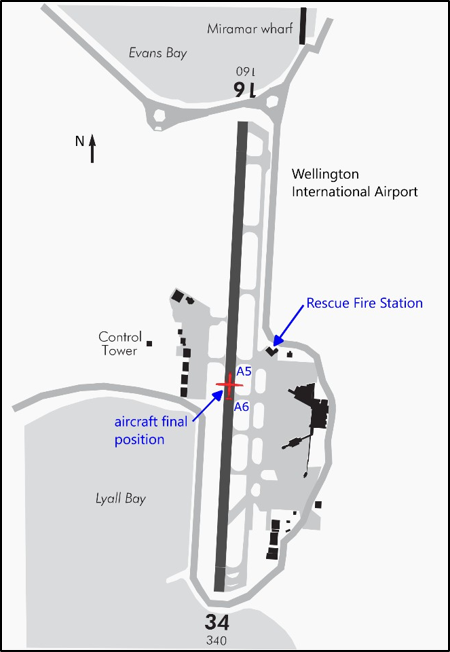
- At 1604:30, the ATR touched down and was brought to a stop about halfway down the runway, near taxiway A6 (see Figure 4). As the ATR was slowing, the first officer made a second Mayday call on the tower frequency. The tower controller acknowledged the Mayday and advised that RFS vehicles were on their way. The tower controller then instructed the next aeroplane on approach to overshoot and remain in the circuit, and for all aircraft on the ground to hold position.
-
After the ATR was brought to a stop, the flight attendant stationed at the rear of the aeroplane (FA1) contacted the flight crew via the intercom to report that there was a fire on the wing. The flight attendants and several passengers reported that there was also smoke or a haze in the cabin, and some passengers were starting to stand up. The flight attendant stationed at the front of the cabin (FA2) made an announcement using the ATR’s public address (PA) system instructing passengers to sit down, which they did.
- The flight crew, in response to the engine fire alert, carried out the required memory checklist actions (specified checklist actions that pilots need to be able perform from memory and not rely on accessing a physical checklist) for an engine fire (see Figure 5). Both engines were shut down, and the left engine fire handle was pulled (this isolates the left engine, including shutting off the fuel supply and other services). The first fire-agent bottle (fire-agent bottles are installed within the engine cowling or fuselage of an aeroplane and contain extinguishing compounds that can be discharged into the engine surrounds) was then discharged into the left engine nacelle (the streamlined casing on the outside of the engine housing). While waiting for the required 30 s to pass, the captain made an alert call (the alert call is “attention, attention, cabin crew at stations” and initiates the alert phase for the cabin crew in response to a non-normal or emergency situation on the ground in which an evacuation may be required (Air New Zealand ATR Cabin Safety Manual, p 4.4.1)) to the cabin crew over the PA. The fire warning light remained illuminated, so after 30 s the second fire-agent bottle was discharged into the left engine nacelle. During this time the captain removed their headset to facilitate communication with the first officer, but did not select the speaker on the flight deck. The first officer subsequently did the same.
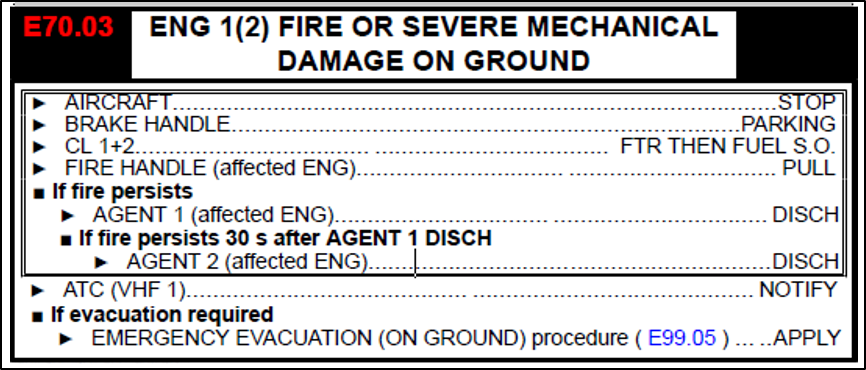
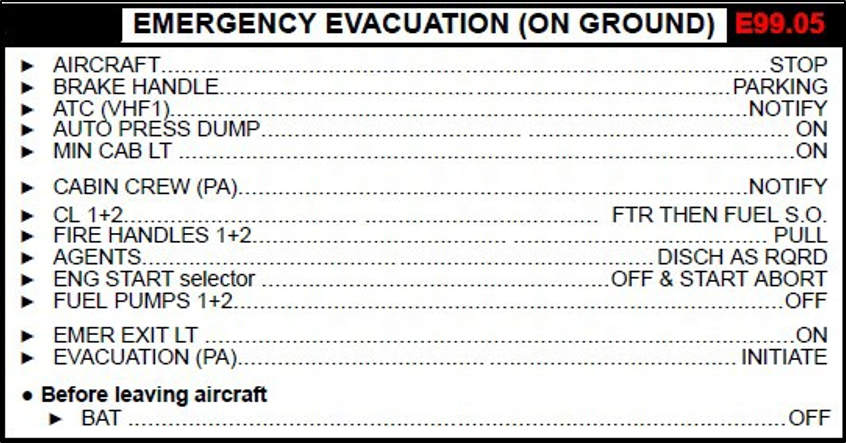
- The fire warning light for the left engine remained illuminated, so the captain instructed the first officer to carry out the emergency evacuation checklist (see Figure 6). The first officer read the checklist using the required challenge and response style (challenge and response is where pilot monitoring reads the item to be checked from the check list and pilot flying confirms the proper status/configuration of the item). For challenge ‘ATC (VHF1)’ item, the first officer responded ‘Notify’.
- At 1606:30, the RFS on-site controller called the tower and advised that there was ‘a very small amount of smoke still coming from the port [left] engine’. The tower controller acknowledged the call and in turn called the ATR asking if they had anything to add. There was no response from the flight crew, who still had their headsets removed and were completing the evacuation checklist. The second-to-last item on the checklist was the evacuation PA. At 1607:11, the captain announced ‘Evacuate, evacuate’ over the PA.
- RFS personnel saw passengers exiting the ATR onto the runway, and the fire appeared to be out. They moved towards the ATR to assist passengers coming out the two forward emergency exits and the rear-left entry/exit door.
- At 1610, the flight crew completed the final item of the evacuation checklist, which was to switch the aeroplane battery off. At this time the cockpit voice recorder (CVR) stopped recording. The flight crew and the passenger who had occupied the flight deck jump seat left the flight deck and moved to the rear of the cabin. The flight crew, after confirming the cabin was clear, vacated the aeroplane and joined the flight attendants who were with the largest group of passengers, downwind of the ATR.
The evacuation
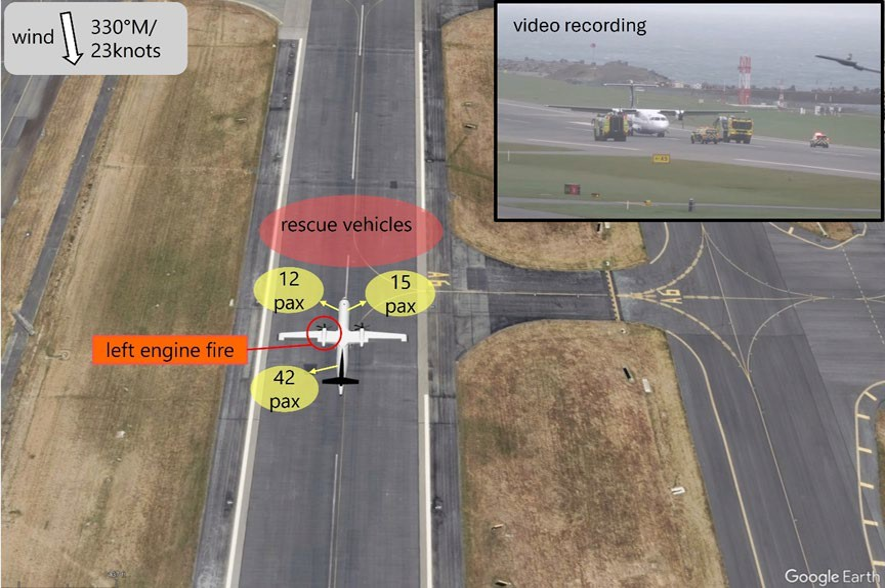
- In addition to the two forward emergency exits, the rear-left normal entry/exit was used to evacuate the ATR. Most passengers exited through this door and gathered about 20 to 30 metres (m) away. They were joined by the passengers who exited through the forward-left emergency exit. Passengers who exited through the forward-right emergency exit gathered about 10 to 15 m out and forward of this exit (see Figure 7).
- About five minutes after the last passenger evacuated, airport, airline and RFS vehicles began to ferry passengers to the terminal. This process took about 20 minutes.
- The operator towed the ATR clear of the runway to a secure location on the aerodrome. The aerodrome operator then inspected the runway before it was reopened at 1647.
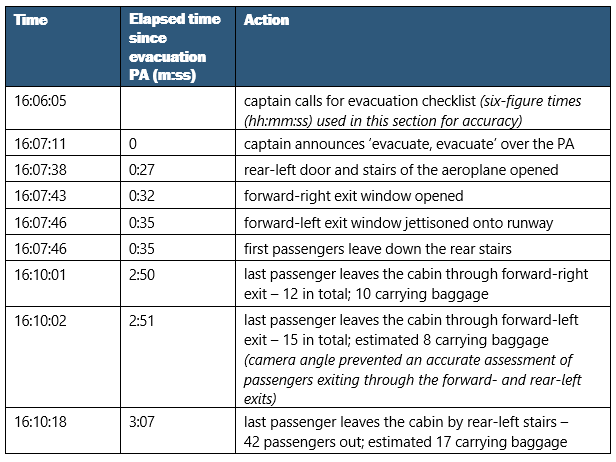
- Table 1 shows the sequence of events after the evacuation command was issued by the captain over the PA.
Personnel information
- The captain held an Airline Transport Pilot Licence (aeroplane) and a current class 1 medical certificate. The captain joined the operator in March 2017 and upgraded to captain in February 2023. At the time of the incident the captain had accrued 5280 hours (h) total flying time, of which 3779 h were on the ATR-type aeroplane.
- The first officer held a Commercial Pilot Licence (aeroplane) and a current class 1 medical certificate. The first officer joined the operator in May 2023. At the time of the incident the first officer had accrued a total of 2663 h, of which 776 h were on ATR-type aeroplanes.
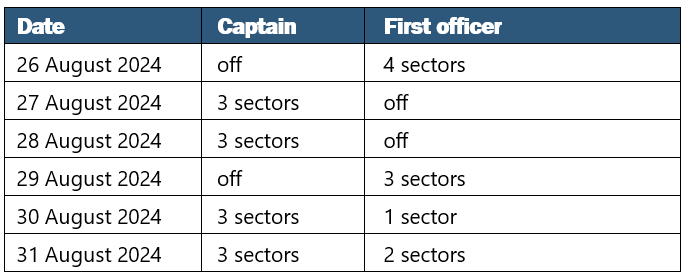
- Both flight crew were based in Christchurch. They had reported to Christchurch airport at 0830 on the day of the incident and completed two sectors flying to Rotorua and return before the incident flight. The incident flight to Wellington was their third sector. All three sectors were in the same aeroplane. Both flight crew reported they had good quality sleep the night before the incident and felt alert.
- Table 2 shows the flight crew’s individual work patterns immediately preceding the incident.
- There were two qualified flight attendants on board. FA1 was stationed at the rear of the cabin, next to the entry door, for take-off and landing. This position was normally designated as the Senior Flight Attendant position. FA2 was stationed at the front of the aeroplane cabin, facing the passengers during take-off and landing. A qualified flight attendant could fulfil either position.
- FA1 had been called from standby, and the incident flight was their first sector. FA2 had also been called from standby, but earlier in the day, and had already completed the first two sectors to Rotorua and back with the flight crew.
Aircraft information
- ZK-MVL was an ATR72-212A-600 aeroplane, serial number 1328. It was manufactured in early 2016 and accepted by the operator and registered in New Zealand on 17 May 2016. Its first revenue service (commercial use carrying passengers) was on 30 May 2016.
- The ATR72 was a twin-engined high-wing aeroplane, approved for operation by two pilots and two cabin crew (flight attendants), which first entered service in 1989. The - 600 series entered service in 2010. The operator’s ATRs were configured for 68 passenger seats (in 2015 the European Aviation Safety Authority approved a high-density seating arrangement, increasing the maximum capacity to 78 persons). On the occurrence flight, one young child was seated on a parent’s lap (the child was secured by a safety belt connected to the parent’s seat belt, in accordance with Civil Aviation Rule 91.207(d)) and an adult was seated in the jump seat on the flight deck behind the pilots.
- The ATR had four cabin exits for use in an emergency, including the normal entry/exit door at the rear-left of the cabin. This door hinged downward to provide built-in stairs and handrails. Opposite this was a service door hinged on the side. At the front of the cabin were two smaller exits for use in an emergency only. To access these exits, the panels needed to be removed.
Engine information
- The ATR was powered by two Pratt & Whitney Canada (P&WC) PW127M turbo-prop engines. The original left engine had been removed as part of scheduled maintenance the day before the incident. The replacement engine, serial number ED1493, was installed on the ATR at that time. An engine ground run was satisfactorily completed and the ATR was returned to service.
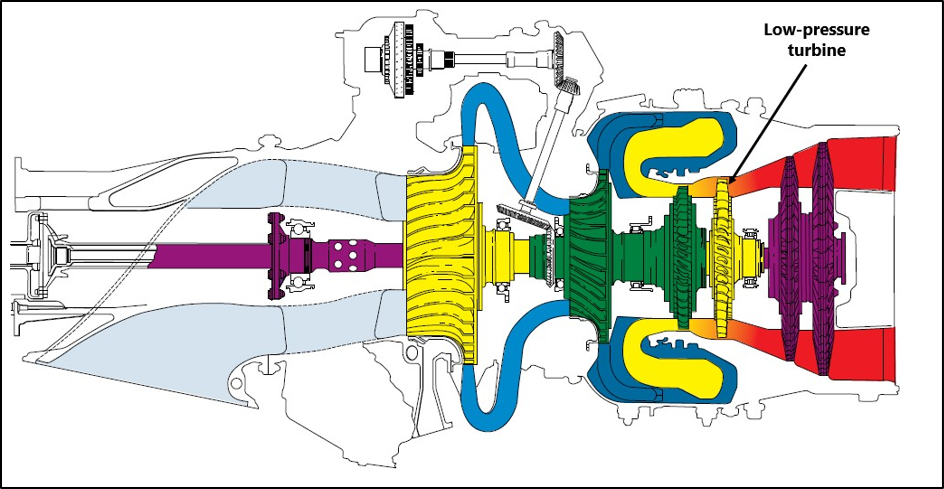
- The replacement engine had been removed from another of the operator’s ATR72 aeroplanes earlier in the year and sent to the engine manufacturer’s facilities in Singapore for a scheduled overhaul. The overhaul involved a teardown (the complete disassembly of an engine) of the engine and the examination or replacement of its individual components. This included replacing the low-pressure turbine (LPT) disc that was becoming time-expired and testing (the testing was non-destructive and included the use of fluorescent penetrant to detect any cracking) the 47 LPT blades. It was then reassembled (see Figure 8).
- The replacement engine had been returned to the operator at the end of August 2024. At the time of the occurrence, the replacement engine had completed 11,258 h and 10,961 cycles (a cycle is one start. An engine start as part of post-maintenance work is not normally included) in service since new. This included the four hours and three cycles flown by the crew on the day of the incident. The crew reported no issues with the ATR until the activation of the low engine oil pressure warning on approach to Wellington.
Meteorological information
- Meteorological information, obtained by the Commission from interviews, the aerodrome operator’s closed-circuit television (CCTV) recordings and video recordings, all confirm that the weather conditions at the time of the occurrence were suitable with no cloud and unrestricted visibility. The tower reported the wind as 330 degrees at 23 knots (wind readouts are reported by the tower in degrees magnetic and the velocity in knots (kt). The runway orientation at Wellington is 340°, meaning that the reported wind was almost all headwind; 23 kt equates to 43 kilometres per hour (km/h)).
Aerodrome and communications information
- Runway 34 at Wellington Aerodrome was 1921 m long and 45 m wide, with 1815 m available for landing. The ATR stopped between taxiways A5 and A6 (see Figure 4).
- Radio communications between the tower controller and the ATR flight crew were on the tower radio frequency. Because of the low volume of traffic at the time of the incident, the controller had combined the Wellington Tower, delivery and ground frequencies. This meant a transmission on one of these frequencies could be heard on all three frequencies. The recordings of the three were provided to Commission investigators.
- The control tower and some RFS vehicles were also equipped to support communications on a discreet frequency called ‘Fire’. This allowed the tower controller, RFS staff and pilots to communicate on a quiet frequency. The same frequency was also available at Auckland and Christchurch international aerodromes.
- At the time of the incident, Wellington International Airport Limited, the aerodrome operator, had a bus permanently positioned at the aerodrome for normal aircraft-to-terminal transfers. However, the bus could not be used as the contracted driver was approximately 30 minutes away. Following the incident, the aerodrome operator has contracted a bus operator to have a bus available within a 5 to 10-minute period in the event of an emergency.
Recorded data
- The ATR was fitted with a CVR and a flight data recorder (FDR). The CVR and FDR were removed from the ATR under Commission supervision and delivered to the Australian Transport Safety Bureau’s (ATSB) recorder facility in Canberra, Australia, for downloading and verification. The download was conducted in the presence of a Commission investigator. The downloaded data was confirmed as being of good quality.
- The CVR and FDR recordings, along with the air traffic control (ATC), CCTV and video recordings, together provided an accurate record of the communications and sequence of events.
Tests and research
- The left engine, serial number ED1493, was initially examined by Commission investigators while still installed on the wing. This included a borescope (an optical instrument to assist visual examination of hard-to-reach cavities) examination to look inside the engine. The engine was then removed from the ATR and shipped to P&WC’s manufacturing headquarters in Quebec, Canada.
- Between 22 October and 24 October 2024, a Transportation Safety Board of Canada (TSB) senior technical analyst, acting on behalf of the Commission’s TSB Accredited Representative, oversaw the teardown examination by P&WC. A representative from the operator was also present.
- The examination found the No. 6 and No. 7 engine centreline bearing housings were misaligned. There was also ‘evidence of circumferential rubbing’ and blade tip damage in this area, consistent with the core of the engine being misaligned and moving as it rotated.
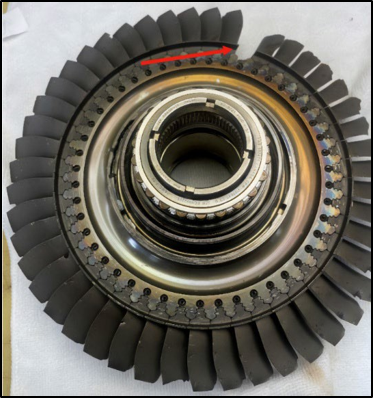
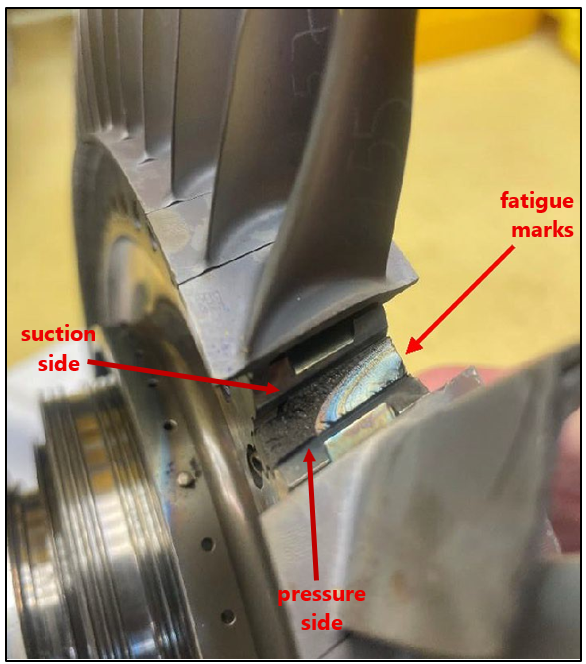
- When the power turbine assembly was removed, an LPT blade fragment was visible behind the first-stage power turbine assembly. Removal of the low-pressure disc revealed that an LPT blade had fractured and separated near the root. The blade was identified as serial number HWTE3998. Initial assessment of the fracture surfaces suggested the blade had failed because of fatigue. There was also damage on the upstream face of the LPT disc (see Figures 9 and 10). The LPT disc is fitted with 47 LPT blades. An examination of a sample of the remaining 46 blades by ‘fluorescent penetrant inspection’ (non-destructive testing using a dye to penetrate and show surface defects, such as cracks, when viewed under fluorescent light) identified no similar evidence of fatigue cracking.
-
Following the engine teardown examination, P&WC concluded that:
The reported engine distress [fire] was cause by the liberation of a low pressure turbine blade. The unbalance caused by the blade liberation have induced an unbalance causing deterioration of some air seals who likely contributed to the reported smoke in cabin. [sic]
- The LPT disc and blade set were secured by TSB and taken to their offices in Ottawa for further fractography and metallurgical examination.
-
On 21 December 2024, the TSB (on behalf of the Commission) examined the LPT disc and blade set and on 26 February 2025 provided the Commission with an examination report. That report stated:
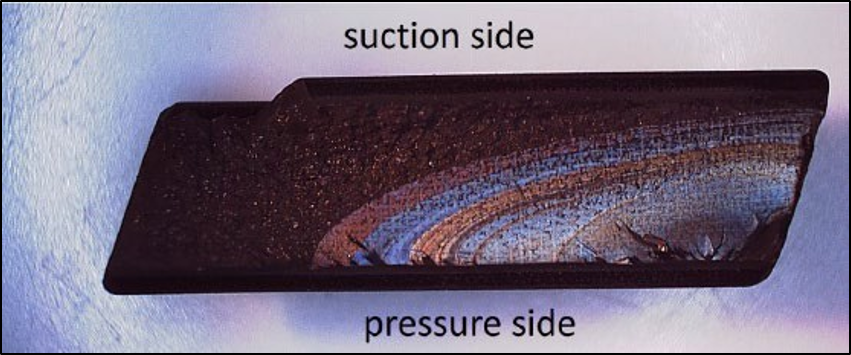
The macroscope acquired image [of the failed LPT blade] shows a fracture surface indicative of fatigue with a well-defined fatigue origin and at least five distinct progression zones. Usually, such zones reflect changes in service conditions; for example, the marks left between zones may respond to prolonged downtime, engine start-ups or engine overhauls/inspections. In this case, it is not known what caused each of the progression zones on the fracture surface [see Figure 11].
-
The LPT blade was also examined under a scanning electron microscope (SEM). The TSB report further stated:
The origin location [of the fatigue crack] had a faceted appearance typical of stage 1 [initial] fatigue. No surface defects were noted that could have initiated the fatigue crack.The progression zones were also visible under SEM examination.
The progression zones closest to and adjacent the origin have a notably different topography as compared to progression zones closest to the crack front.
Features typical of overstress are visible beyond the fatigue areas of the fracture surface.
-
The TSB report made the following conclusions:
1. The liberated LP[T] blade failed as a result of fatigue cracking developed in the blade root.
2. The fatigue crack has likely been present since the blade entered service and was likely present at the time of the engine overhaul.
3. The damage to the upstream edge of the blade root occurred after the fatigue crack had propagated and the blade had failed in overstress.
4. Wear marks on the suction side of the blade platform hinder the ability to read part numbers of in-service blades.
5. The wear mark on the failed blade was not associated with fatigue crack initiation and propagation.
6. The serial numbers of two blades were reversed. It could not be determined if they were reversed during overhaul or during the P&WC investigation (very likely the result of installing the two blades in reverse order but having no effect on their function or wear).
-
On 18 March 2025, after receipt of the TSB’s report, P&WC requested to conduct further analysis on the components to better understand the sequence of events leading up to the LPT blade separation. P&WC commented that:
The absence of oxidation on the blade fracture surface arise questions, would a crack being present and developing for a certain period of time, a certain level of oxidation would be expected, this tent [sic] to suggest the crack was not exposed to operating environment for a prolonged period of time. Should the crack [be] present at the time of the FPI during last shop visit it would suggest and missed at the time of the inspection. To further validate, we would like to perform EDS [energy-dispersive spectroscopy] analysis of the suspected point of origin for evidence of phosphorous content, used in FPI [fluorescent penetrant inspection] fluid content. [sic]
-
The LPT disc and blade set were passed to P&WC. On 16 September 2025 P&WC advised that initial re-examination identified one additional LPT blade that displayed:
a crack around the same height when compared to the liberated blade, the crack was force[d] open revealing a similar metallurgic feature when compared to the liberated blade.
- The second LPT blade, identified as serial number HWTE7693, was located six positions away from the liberated or failed LPT blade, serial number HWTE3998. Upon re-examination of the remaining 45 LPT blades, P&WC found no evidence of crack initiation.
-
On 19 December 2025, P&WC provided the Commission with a copy of its final report on the examination of the engine and LPT disc and blade set. The report’s summary and conclusion are as follows:
SUMMARY OF FINDINGS AND DISCUSSION
One low-pressure (LP) turbine blade was found fractured from a crack that had initiated on the pressure side top serration area. One additional LP turbine blade, which had not liberated, had a crack on the suction side top serration area. Both blades’ crack surfaces exhibited progression marks from a single origin, associated to high cycle fatigue (HCF), with river lines originating from a micro shrinkage. The respective micro-shrinkage porosity sizes are below X-ray detectability limit and are not considered to be the primary cause of the blades cracking and liberation, however, the presence of the micro-shrinkage porosities in the fracture initiation regions likely acted as localized stress concentrators. The Microstructural composition of the blades confirmed that no anomaly was observed and that the base material was consistent with the drawing requirements.
The low number of macroscopically visible propagation marks of both blades cracking surfaces suggests that the fatigue propagated over a low number of “engine” cycles. The light oxidation on both fracture surfaces indicates a low time exposure to the operating environment. In addition, the blades examination did not reveal evidence of fluorescent penetrant inspection (FPI) fluid residue on either the crack surfaces. These findings confirmed that the cracking of both blades occurred after the FPI inspection accomplished during the last engine major refurbishment performed 4HRS [hours] prior the synopsis event.
In the absence of any material anomaly and considering that 2 nonadjacent blades presented similar cracking features suggest that the blades were exposed to a similar unidentified cyclic loading stress.
CONCLUSION
The reported low oil pressure and reported smoke were cause by the fracture of the No. 6&7 bearing housing oil transfer tube and secondary air system components damage, both resulting from the fracture of one (1) LP turbine blade.
The fracture surface of the liberated LP turbine blade and the forced open crack surface of the second LP turbine blade exhibited similar HCF fatigue propagation. The exact cause of initiation on the fractured LP turbine blade and the crack on the non liberated LP turbine blade could not be determined.
Analysis Tātaritanga
Introduction
- The flight was uneventful until approaching Wellington, when the pilots were alerted to a low oil pressure caution for the left engine. This was quickly followed by a fire warning for the same engine. The ATR continued and landed safely.
- After landing, the pilots completed the required actions for the fire warning, including discharging both bottles of fire agent into the left engine nacelle. The fire warning remained and so the captain ordered an evacuation. The fire was extinguished, with damage confined to the left engine. There were some minor injuries during the evacuation, predominantly strains encountered when jumping from the forward two emergency exits. However, all passengers were able to self-evacuate and walk to the assembly area from where they were eventually ferried to the terminal.
- The actions of the flight and cabin crew ensured the safe landing and evacuation of all passengers. The following sections analyse the circumstances surrounding the event to identify those factors that increased the likelihood of the event occurring or increased the severity of its outcome. It also examines any safety issues that have the potential to adversely affect future operations.
Engine failure and examination
Safety issue 1: A low-pressure turbine blade failed because of fatigue. The engine manufacturer’s quality assurance procedures during the recent engine overhaul did not identify the issue, increasing the risk of other similarly faulty turbine blades re-entering service.
- The engine fire warning was initiated by a failure of an LPT blade, which resulted in a vibration in the engine that caused deterioration to some air seals, allowing oil to leak directly into the engine. The resulting low oil pressure in the left engine caused the caution light to illuminate. The combustion of the oil that had seeped onto the engine produced a large volume of smoke, and the temperature within the engine nacelle increased to the point that the fire detection warning was activated.
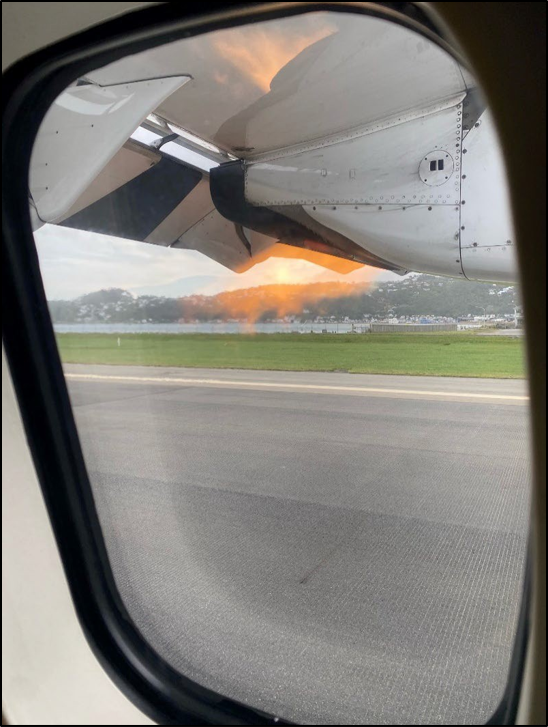
- The burning oil also resulted in flames and a large volume of smoke coming from the engine exhaust. This is what the tower controller saw when issuing the ‘conditional line-up clearance’ to an aeroplane preparing for take-off. Several passengers seated on the left side of the ATR also saw the flames and smoke coming from the engine (see Figure 12) and alerted the flight attendants. Smoke or haze was observed in the cabin at the same time. This slowly dissipated.
- The engine fire was detected by a sensing wire looped around the inside of the engine nacelle. An increase in nacelle temperature reduces resistance in the wire, eventually activating an engine fire warning light and alarm on the flight deck. The observations by the attending RFS personnel indicated that it is virtually certain that the fire was extinguished shortly after the second fire-agent bottle was discharged. However, because of residual heat in the engine nacelle, the engine fire warning light remained illuminated for several minutes afterwards.
- Initial examination of the engine and its components by both the TSB and P&WC identified that an LPT blade had failed as the result of fatigue.
- Detailed examination of the failed LPT blade by the TSB determined that there were two notably different types of fatigue topography over the fracture surface. The first type closest to the well-defined point of origin had a rubbed and flatter appearance. Outside of this area the surface was rougher with at least five distinct bands. This difference, along with the absence of any surface defect, lead the TSB to conclude that the fatigue cracking developed in the root of the blade and the crack was likely present when the blade entered service. Therefore, the crack was likely already present when the engine was overhauled (the TSB uses the same probability expressions as the Commission. ‘Likely’ infers a probability of >66%).
- The engine overhaul had included the removal of the LPT disc and blades. The blades were reportedly examined and fitted to a new disc before being reinstalled.
- Examination of the remaining 46 LPT blades from the same low-pressure disc by P&WC identified one further blade with a crack at around the same height, but on the opposite side to the failed blade (see Figures 13 and 14). This blade was located six positions away from the failed blade. When forced open, the crack revealed a similar metallurgic feature to the failed LPT blade.
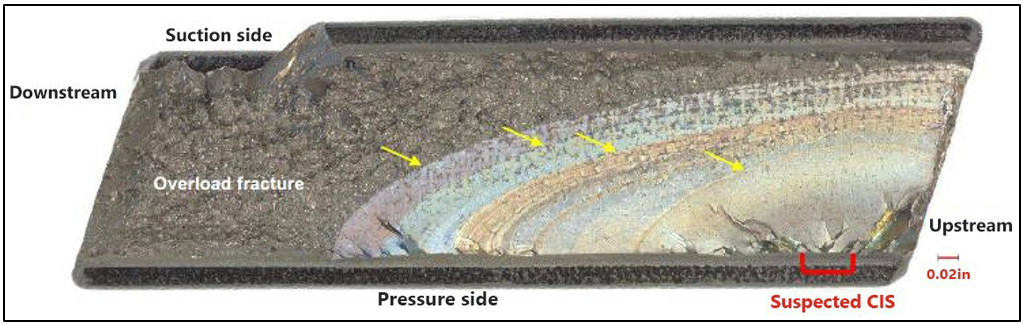
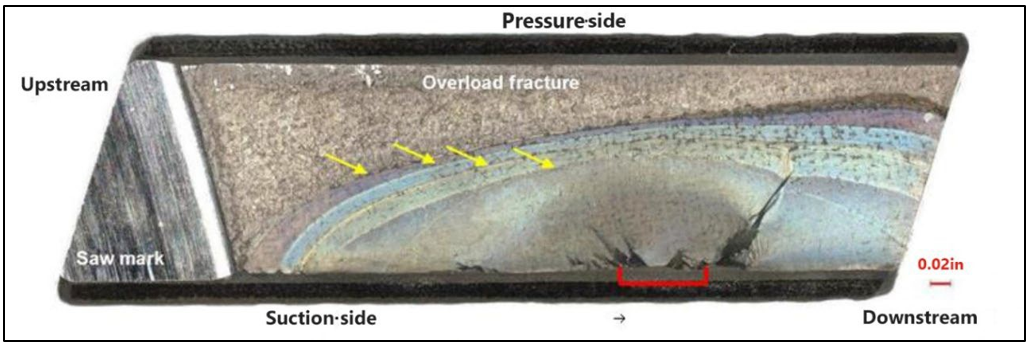
- Following further examination, P&WC concluded that both blades showed fatigue propagating from a single origin or cleavage initiation site. Micro-shrinkage (microscopic-level casting defect) was identified in this area, which acted as a stress concentrator. The blades’ construction material was determined to meet the manufacturer’s specifications.
- P&WC determined that the fatigue was initially high cycle (in this scenario, low cycle refers to each cycle of the engine, while high cycle refers to changes in engine operation, for example changes in power) but the fatigue crack spread rapidly to the point of failure over a low number of engine cycles. P&WC considered there to be eight such bands (often referred to as ‘beach marks’) within the area of fatigue. P&WC concluded that the degree of oxidation on the surface of the cracks and the absence of evidence of the fluorescent penetrant used during the recent overhaul inferred that the cracking occurred in the four flying hours and five cycles (includes the engine runs completed as part of the overhaul and installing on the aeroplane). Further, the two non-adjacent blades – the failed blade and the second cracked blade – had been ‘exposed to a similar unidentified cyclic loading stress’, the exact cause of which could not be determined.
- The P&WC PW100 series of engine has been in service since 1984. By 2024, over 9000 PW100 engines had been produced. The Commission was unable to identify any similar LPT blade failures involving this engine type.
- At an ATR safety conference held on 30 November 2023, P&WC reported that the PW100 series engine had accumulated a total of 53 million flying hours and 57 million cycles. The ‘highest time’ engine had accrued a total of 52,883 flying hours.
- At the time of this occurrence, the operator had a fleet of 30 ATR aircraft with a further 3 on order. A review of the operator’s engine data showed that at 10,961 cycles and 11,258 hours in service, the failed engine and LPT blade were low-time when compared to the pool of over 60 engines. At least 18 of the engines had accrued over 20,000 hours.
- The P&WC report did not state if the post-overhaul cracking related to both the ‘high cycle’ and ‘low number of “engine” cycles’, or just the latter. While the failure of one LPT blade could be considered an isolated occurrence, there was similar fatigue in a second blade.
Conclusion
- The engine completed a total of four hours flying and five cycles between overhaul and the LPT blade failing. The five cycles included one by the manufacturer on completion of the overhaul, one by the operator after engine installation and three by the crew of the ATR. Review of the engine data and interviews of the crew confirm that there was no evidence of any exceedances or abnormalities during the four hours of flying.
- The Commission found no evidence of a design, maintenance or operating issue that may have contributed to the LPT blade failing on approach to landing at Wellington. After reviewing the available evidence, including both the TSB and P&WC examination reports and supporting documents (including responses to questions of clarification and information) the Commission found that the LPT blade failed because of fatigue.
- The Commission also found that a second LPT blade on the engine had evidence of fatigue similar in nature to the failed blade. That fatigue was on the opposite face of the blade to the failed blade. These two blades had significantly different serial numbers, indicating they were not manufactured in the same batch.
- Although unable to determine when the fatigue cracking originated, the Commission found it likely that the fatigue was present in both LPT blades when the engine was recently overhauled. This finding was based on:
- the amount and different types of fatigue (high and low cycle)
- the origin of the fatigue
- the absence of any surface defects
- a lack of evidence of any design, maintenance or operating abnormalities.
- The presence of fatigue in the two LPT blades should have been identified as part of the engine overhaul procedure. This safety issue needs to be addressed to ensure there are no repeat failures. Therefore, a recommendation has been made to P&WC, and given notice to the Canadian regulator, to ensure their quality assurance procedure for engine overhaul is capable of identifying any fatigued LPT blades to ensure they do not enter service.
Crew procedures
Radio calls
- The first officer commented during their interview that they had to make a second Mayday call to elicit a response from the tower controller. The lack of a response to the first Mayday call raised a concern that emergency services may not have been immediately activated.
- The tower controller did not hear the first Mayday call because, about two seconds before the Mayday call, they had initiated a call to the aeroplane waiting to take off. With the tower controller and first officer transmitting at the same time, neither heard the other’s radio call. Over-transmitting is not unusual, especially in airspaces where there are a lot of aircraft operating on the same frequency.
- In most cases, one radio call will finish before the other and that caller will quickly realise their transmission may not have been heard. In other cases, a third party may simply advise, ‘two at once’ or ‘you were stepped-on’. This alerts a caller that they may need to repeat their transmission.
- If a caller does not hear a reply to their transmission or is not alerted to it being ‘stepped-on’, then it would be normal for them to repeat their original call after an appropriate period. This is what the first officer did on this occasion. In the meantime, the tower controller had already observed the smoke coming from the left engine and activated the RFS.
- The captain, after landing and bringing the ATR to a halt, announced ‘engine fire’ to the first officer and started the engine fire emergency checklist. This was a memorised checklist and the captain did not verbalise initial actions. The captain, after discharging the first fire-agent bottle, directed the flight attendants to their stations (the flight attendants to position themselves by the forward and rear emergency exits in preparation for a possible evacuation). The captain removed their headphones during this time.
- After the first fire-agent bottle was discharged, an automatic timer informed the crew when 30 seconds had elapsed. The crew confirmed there was still an engine fire warning light and so discharged the second fire-agent bottle in accordance with the memory checklist.
- The engine fire warning light remained illuminated after the discharge of the second bottle, so the captain called for the evacuation checklist. The first officer as the pilot monitoring located the correct page in the ATR-600 Quick Reference Handbook and called out the various checklist items. The third item in the checklist stated, ‘ATC…… NOTIFY’. This was read out but no radio call was made to the tower regarding the evacuation.
Checklists
- While completing the evacuation checklist the first officer removed their headphones to facilitate conversation with the captain. After the RFS vehicles were positioned around the aeroplane, the RFS crew chief made a radio call on the tower frequency reporting that there was still a very small amount of smoke coming from the left engine. This was followed by the tower controller asking the crew if they had anything further to add. Neither pilot heard these calls as they had both removed their headphones by this time and not selected speaker on the flight deck. The evacuation started soon after.
- The operator’s flight manual for the ATR directed that checklists must be completed in the following order (flight Operations Manual – ATR, 1.20.3. Abnormal refers to conditions that are neither normal nor life threatening (emergency). Memory items refer to those conditions where immediate action may be required):
- memory items
- emergency
- normal
- abnormal
- Any abnormal or emergency checklist action must be verified as correct by both pilots before the checklist is started. Regardless of whether an aeroplane is in flight or on the ground, abnormal and emergency checklists are read by the pilot monitoring. When any abnormal or emergency checklist is being actioned, the crew member completing the checklist should verbalise each checklist item and action. In this incident, the first officer was the pilot monitoring during the flight and after landing.
- While it was appropriate that the captain completed the engine fire checklist from memory as required by the emergency checklist, they should have verbalised their actions. This helps the flight crew ensure that all the required actions are completed and is an opportunity for the other pilot to intervene should any corrections be required. Other accident and incident investigations have identified that the incorrect engine had been shut down by mistake (examples: British Midland Airways Flight 092, Boeing 737-400, England on 8 January 1989. TransAsia Flight 235, ATR72-600, Taiwan on 4 February 2015. Jeju Air Flight 2216, Boeing 737-800, South Korea on 29 December 2024).
- At interview, the first officer advised that they had assumed that because a Mayday call had already been made to the tower for the engine fire, and that call had been acknowledged, they didn’t think to make a second call for the evacuation. Commission investigators spoke with the operator’s ATR72 instructors and standards personnel who agreed that, if time and circumstances permit, both radio calls should be made: the first Mayday call to alert ATC and others to indications of engine fire; the second call to advise what action is being taken and the assistance that might be needed.
- The captain, on initiating the evacuation, announced over the PA system, ‘Evacuate, evacuate’. However, the operator’s procedures stated that the command to be given was ‘Attention, attention. Evacuate, evacuate.’ This helps ensure that both flight attendants and passengers are listening and hear the evacuation command.
Passenger management
- By the time the ATR had landed, both flight attendants were aware that there was an emergency associated with the left engine. On receiving the command to evacuate, the cabin crew followed their training and looked out through the windows on the left side to see if there was any further smoke or other obstruction. Seeing none, they tested the exits for any heat that might indicate the presence of fire. Next, they opened the exits on the left side and checked outside. Confirming there were no fire or hazards, they then instructed the passengers to evacuate and move clear of the aeroplane.
-
Four RFS vehicles attended the scene; two of these were primarily fire-fighting vehicles and two were support vehicles. The lack of an evacuation radio call by the flight crew meant that when the evacuation started the RFS crews needed to shift from fire-fighting mode to passenger-control mode without notification. The crew in the two support vehicles exited their vehicles and moved to the aeroplane exits. The crews of the fire-fighting vehicles stayed in their vehicles in case fire erupted.
The 15 passengers who evacuated using the forward-right exit stayed in a group near this exit. Several of the passengers who had evacuated using the forward-left exit moved to join the passengers evacuating using the rear-left stairs. This path took them near the left engine and the propellor. This is discussed further under Safety issue 3.
Evacuation
Safety issue 2: The evacuation took 2 minutes and 51 seconds. Evacuations that take longer than the certification benchmark of 90 seconds can increase the risk to life.
- As part of the certification process, aeroplane manufacturers are required to demonstrate that an aeroplane, in maximum passenger load configuration, can be completely evacuated within 90 s using only half of the total number of emergency exits. Tests performed by regulatory agencies in the United States and Europe have shown that in a post-crash fire, conditions are conducive to flashover (the near-simultaneous ignition of all combustible materials within a confined space) after 90 s. The likelihood of survival reduces significantly after this time. Use of only half of the exits simulates the potential for failed evacuation devices and blocked exits, perhaps because of fire or structural damage (the tests also include reduced-visibility or night-time evacuations).
- In this incident, the aeroplane was full and evacuation took about 171 s. This was from the time the captain announced the evacuation call over the PA to when the last cabin passenger was observed leaving the aeroplane through the forward-right exit. It did not include the flight deck passenger or the flight attendants and pilots who checked the cabin was clear before evacuating via the normal entry/exit door at the rear of the ATR.
- The timing of the evacuation was confirmed using a combination of sources: CCTV recordings provided by the airport company, a private webcam recording (Wellington Flights Live), Airways tower recordings and the aeroplane cockpit voice recording. The position of the aeroplane precluded a clear camera view of the normal entry/exit door.
- The Commission acknowledges that there are many factors that can cause evacuation in a real-world scenario to exceed the 90 s certification benchmark. Several of these were present in this incident and are discussed below.
Evacuation considerations
- All four exits were available for the evacuation. The two flight attendants opened the exits nearest them. FA1 opened the rear-left entry/exit door and FA2 opened the forward-left exit hatch. A passenger seated in 1C opened the forward-right hatch under the instruction of FA2. The rear-right service door was not used. When interviewed, FA1 was unable to explain why they did not open this door.
- The three exits used operated as designed. After checking the escape path was safe, FA1 positioned themself in front of the service door to keep the aisle clear and better direct passengers. After doing the same, FA2 positioned themself in front of the door to the cockpit so they could better manage both forward exits.
- The video recordings show that 12 passengers exited the aeroplane though the forward-left exit and 15 through the forward-right exit. The Commission determined that it was virtually certain that the remaining 42 passengers from the cabin exited using the normal entry/exit airstair door at the rear-left of the aeroplane (see Figure 7).
- The video recordings also show that 19 of the 27 passengers who left through the two forward exits took their carry-on baggage with them. From the available information, including the video recordings, the Commission estimated that about half of the passengers who left through the rear-left door took carry-on baggage with them. The available camera angles prevented a more accurate assessment.
- In the event of an emergency evacuation, the flight crew would also normally evacuate an aircraft. In this incident the flight crew reported several reasons why they did not immediately follow the passengers off the aeroplane, including checking that there were no passengers still on board and there was no fire. They returned a short time later to prepare the aeroplane for handover to maintenance staff and moving off the runway.
- Evacuation studies and accident investigation reports show that in many cases evacuation times have exceeded the 90 s target by a significant margin (see Citations for a list of the various studies and reports referred to) The studies also identify some common factors that contribute to the slow evacuation times. These factors include:
- blockages at exits
- unusual attitude of the aeroplane (sometimes inverted)
- unfamiliarity with the operation of the exits
- a lack of urgency by some passengers (no obvious threat)
- a desire to take personal items including carry-on baggage
- safety briefings
-
the influence of cabin crew
Themes relevant to this occurrence are discussed below.
Passenger awareness and preparedness
- The evacuation call was made using the aeroplane’s PA system. It was reported by several passengers that at least one fellow passenger did not hear the evacuation call because they were wearing headphones. While it took several seconds for this person to react to the evacuation call, this did not materially affect the overall evacuation time. Nevertheless, it is concerning that personal entertainment devices, especially headphones or ear buds, can impede good communication. Cabin crew need to be aware of this threat to help ensure passengers receive and understand safety-critical information in a timely manner.
- The passenger seated near the forward-right emergency exit stated that they found the exit hatch heavier than expected, and its removal and disposal was not a simple task. Other passengers said they were surprised by the small size of the exits, the difficulty in using them, including having to step up onto the bottom lip of the door and then jump nearly 1.83 m (6 ft) to the ground (six feet is the maximum height allowed before a slide or other device is required to be installed). One passenger thought that there would be a slide available.
- The two forward exits on the ATR72 aeroplane are classified as Type III exits (see Figure 15). This style is often referred to as ‘self-help’ exits as they are not usually expected to be accessed by crew. The Type III exits are more common on single-aisle aeroplanes and often located over the wings.
- The European Union Aviation Safety Agency and the United States Federal Aviation Administration stipulate that a Type III exit can be no smaller than 0.51 m x 0.91 m (20 inches x 36 inches) and be no higher than 0.51 m above the cabin floor. The weight of hatches can vary significantly between aeroplanes; for example, 14.7 kilograms (kg) on an Airbus A320 to 27 kg on a Boeing 767-200. Stairs or slides are not required for exits lower than 1.83 m (6 ft) above ground, requiring evacuees to jump down.
-
The ATR72 Type III exits met the minimum requirement measurements, and the hatches weighed 12 kg. The height of sill above the cabin floor and the ground required passengers to step up before jumping the 1.83 m, or 6 ft, to the ground.
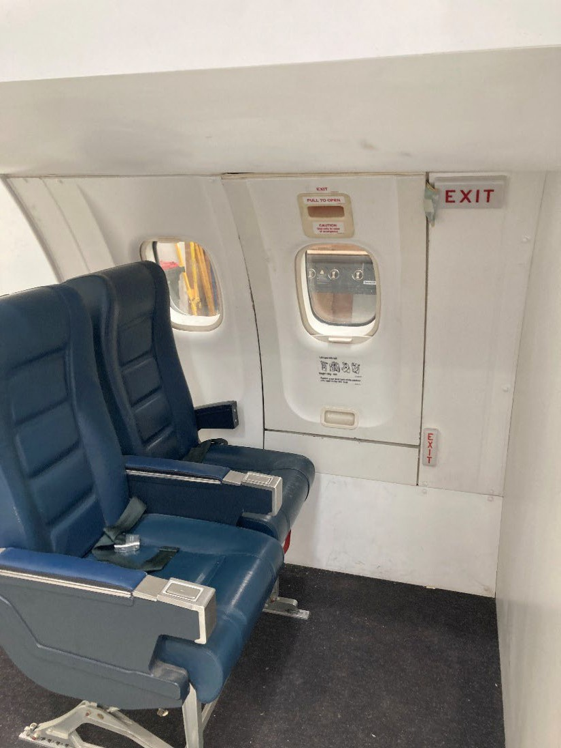
Figure 15: Type III exit installed in cabin trainer - Civil Aviation Rules (CARs) require the opening of the emergency exits to be simple and obvious and not require exceptional effort. The operation of the hatch is required to be displayed on or next to the hatch, which it was. The information was also presented on the passenger briefing cards.
- The videos of the evacuation show several passengers hesitating at the forward exits and requiring time to either pass or throw out their carry-on baggage and position themselves for the jump down. The passengers interviewed said the size of the exits, access challenges and the height above the ground all combined to slow the rate of egress through the two forward exits. While several passengers who had evacuated stayed next to the exits to assist, the queue inside soon slowed. This delay gave other passengers time and opportunity to access their carry-on baggage.
Carry-on baggage
- CARs 91.213, ‘Carry-on baggage’ states that all passenger baggage aboard the aeroplane is to be stowed in a baggage locker or under a seat such that it does not ‘hinder evacuation of the aeroplane in the event of an emergency’. In this incident, there were no reports of loose baggage hindering passengers leaving their seats.
-
The safety briefing given before take-off included the standardised statement that in the event of an evacuation, passengers were to leave all baggage behind. During the evacuation both flight attendants also instructed passengers to leave their baggage.
Despite this, over half the passengers took their baggage with them. The Commission identified a number of possible reasons for this, including:
- not recalling the before-take-off safety briefing instruction to leave baggage behind
- not hearing the crew’s instructions
- a desire to take personal items including carry-on baggage; when the flow of passengers exiting slowed, there was time to retrieve their baggage
- copycat behaviour upon seeing a passenger retrieve their baggage
- no longer observing flames or smoke, there was no obvious threat or urgency
- deliberately ignoring the commands by the flight attendants and that of other passengers to leave behind baggage.
-
Passengers retrieving their baggage slowed the flow of passengers along the centre aisle. This delay was further compounded at the two forward emergency exits where some passengers had difficulty fitting through the exit with their baggage or waited for someone outside to catch their bag as they threw it out.
- Passengers taking carry-on baggage with them during an emergency evacuation of an aeroplane is not uncommon. A review of accident reports by authorities in France, United Kingdom, United States of America and Canada refer to passengers taking their baggage with them. This action was substantiated by passengers also taking time to record their evacuation on a smart phone, again slowing down the evacuation. A paper by the Royal Aeronautical Society noted that ‘this trend is increasing and is potentially exacerbated by a greater volume of baggage allowed by operators to be carried’. In this incident there were no reports of videoing slowing the evacuation.
Crew training
- During the inquiry, Commission investigators spoke to senior ATR flight attendants, including instructors. The investigators viewed the cabin mock-up used to help train ATR72 flight attendants on evacuations. The mock-up consisted of a short section of the forward-left cabin that contained the forward-left emergency exit and the two adjacent seats (see Figure 15). Instructors and students were also able to access an ATR72 aeroplane for training, subject to timing and aeroplane availability. The limited training facilities meant that instructors were unable to realistically simulate an evacuation of a cabin involving both flight attendant positions and all four exits simultaneously.
- In the event of an emergency, both flight and cabin crew need to follow their training and procedures as much as practicable to ensure actions and instructions provide the best outcome. This includes the use of checklists and the management of passengers. Realistic training facilities, such as flight and cabin simulators, have proven beneficial in preparing aircrew for the full range of aircraft emergencies.
- The Bureau d'Enquêtes et d'Analyses (France) (BEA) as the representative for the state of aircraft manufacturer, Avions de Transport Régional (ATR), advised the Commission that the manufacturer had produced an evacuation education video for the ATR72 aeroplanes. This video was publicly available at the time of the incident (https://safety.atr-aircraft.com/2021/03/16/emergency-evacuation/ - accessed August 2026).
- The Commission has made a recommendation to the operator, and given notice to the regulator, that it reviews the lessons identified in this final report to make improvements in crew training to help ensure that any emergency evacuation is completed in an appropriate and timely manner.
Safety issue 3: After exiting the forward-left exit, several passengers walked near the left engine that had been on fire. During an evacuation, passengers must be given clear instructions on what to do once outside the aeroplane to reduce the risk of injury from hazards on the ground such as propellers, fire and wreckage.
- At least five passengers who exited the ATR using the forward-left exit then walked directly to the rear of the aircraft and so passed near the left engine that minutes earlier had been on fire.
- People wandering uncontrolled around an accident site can pose a hazard to themselves and others. Passengers need to be given clear instructions on where to assemble after evacuating an aeroplane. This includes before and during an evacuation.
The role of Rescue Fire Service
- Approximately 5 s after the first passenger evacuated, the RFS crew chief started to reposition their vehicle to the rear of the ATR to assist in passenger management. Approximately 30 s later, several of the attending RFS personnel had left their vehicles and reached the two forward exits. RFS personnel were then able to exert some control over the movement of the passengers and help ensure their safe evacuation.
- CARs 139.57, ‘Aerodrome emergency plan’ requires an aerodrome operator to establish and maintain an emergency plan to minimise injury and property damage in the event of an occurrence. The category of RFS, and therefore the resources required, is determined by the largest aeroplane type to regularly use the aerodrome. If time and resources permit, an aerodrome operator may provide additional RFS or other staff to help manage passengers as they evacuate.
- CARs 139.57 also requires an RFS to be able to start discharging foam within three minutes of being notified. For this incident, the RFS was notified of the emergency at about the time the ATR crossed the start of the runway to land. The distance to travel to the ATR was short, resulting in the RFS being in attendance soon after the ATR had come to a stop on the runway. However, airline operators should not rely on RFS personnel being immediately available to manage passengers as they exit an aircraft. There may be little or no notification of an emergency, or the aircraft may be located a long distance away from the RFS building. Further, all attending RFS personnel may be required to fully focus on fighting a fire to give the passengers and crew the best opportunity to escape.
- If the pilots kept their headsets on, they may have heard the communication between RFS and the tower, including the RFS controller saying that there was a very small amount of smoke coming from the engine and the tower controller asking the ATR if they had anything to add. Further, had an evacuation call been made over the radio, the RFS may have been more prepared to move from fire-fighting mode to passenger management mode earlier.
Safety briefings
- In a major accident, or one involving serious injury, crew may not be able to direct or assist passengers during an evacuation. Passengers may therefore need to be self-reliant when evacuating and once clear of an aircraft to ensure their continued safety. The various studies show that in an emergency passengers cannot always be expected to react rationally. However, passengers who pay attention to briefings are better prepared to act appropriately in an emergency.
- CARs 91.211, ‘Passenger briefing’ requires passengers to be given a pre-departure safety briefing. The briefing must be given by a crew member, a person nominated by the operator or by a recorded presentation. The briefing must include, among other things, ‘the location and means for opening the passenger entry doors and emergency exits’. It must also include a statement that CARs require passengers to comply with lighted passenger signs and crew member instructions. The safety briefing may be supplemented with conveniently located printed cards.
- A National Transport Safety Board (US) (NTSB) evacuation study identified the difficulty of obtaining and then holding passengers’ attention for safety briefings. A passenger survey listed a number of reasons for this, including:
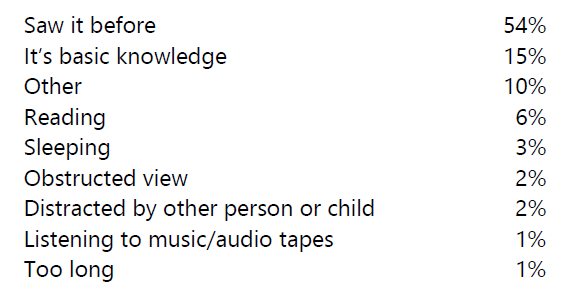
- Passenger safety briefings should ensure that essential safety information is received and understood before departure. A pre-departure passenger briefing may be the only opportunity to provide essential safety information in the event of a sudden emergency. It is the responsibility of an aeroplane captain or delegated crew member to ensure this is done. It is the responsibility of the operator to properly train and equip crew members for this task and ensure it is achieved to a high standard.
- The regulator also has a responsibility for overseeing this safety-critical activity, either through auditing of actual briefings or approval of safety videos if they are used instead.
- For this incident, those passengers interviewed were either positive or neutral about the content and delivery of the safety briefing given by the flight attendants before departing Christchurch. After landing, the pilots, cabin crew and RFS personnel were all busy managing their own spheres of influence. Improved communication would have helped ensure passengers were directed along a safe route to a safe assembly area and/or were met by RFS personnel as soon as they disembarked.
- Since the incident, the operator has amended the passenger safety briefing card for its ATR72 aeroplanes by adding a caution regarding the engine and propellor blades. The diagram now clearly describes the direction in which passengers should leave the aeroplane. It also includes a symbol to remind passengers not to take baggage (see Figure 16).
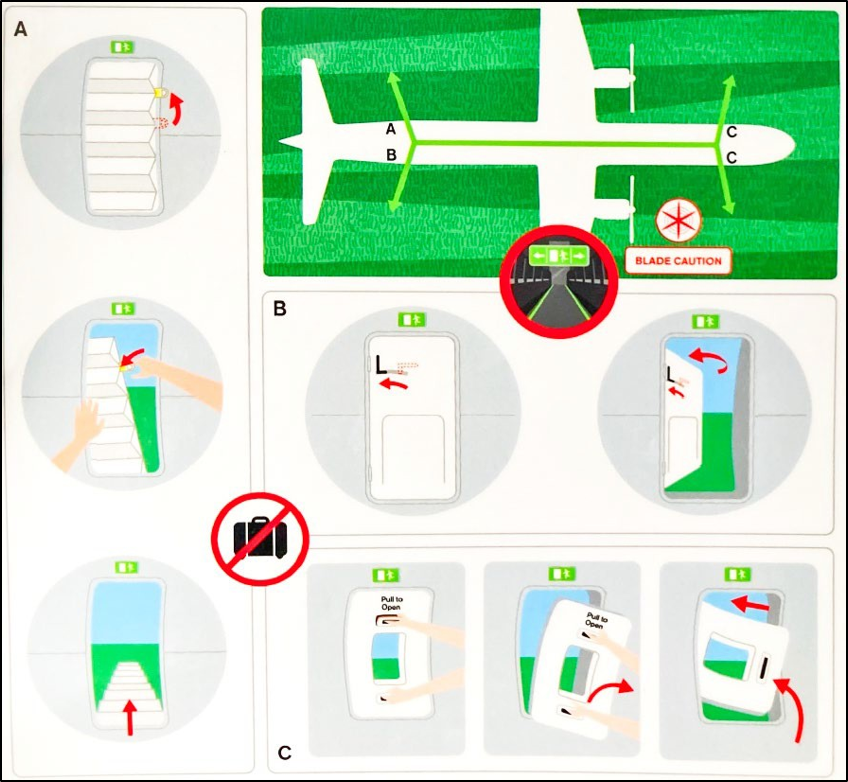
- A recommendation was made to the operator in Section 6 that they review the lessons identified in this final report to ensure pre-departure safety briefings given to passengers are effective in ensuring passengers are as fully prepared as possible to deal with an emergency.
Appendix 1. Timeline of events