At Queenstown Airport two helicopters came into potential conflict due to contrasting mental models, confusion over who is doing what, congested airspace.
Executive summary Tuhinga whakarāpopoto
What happened
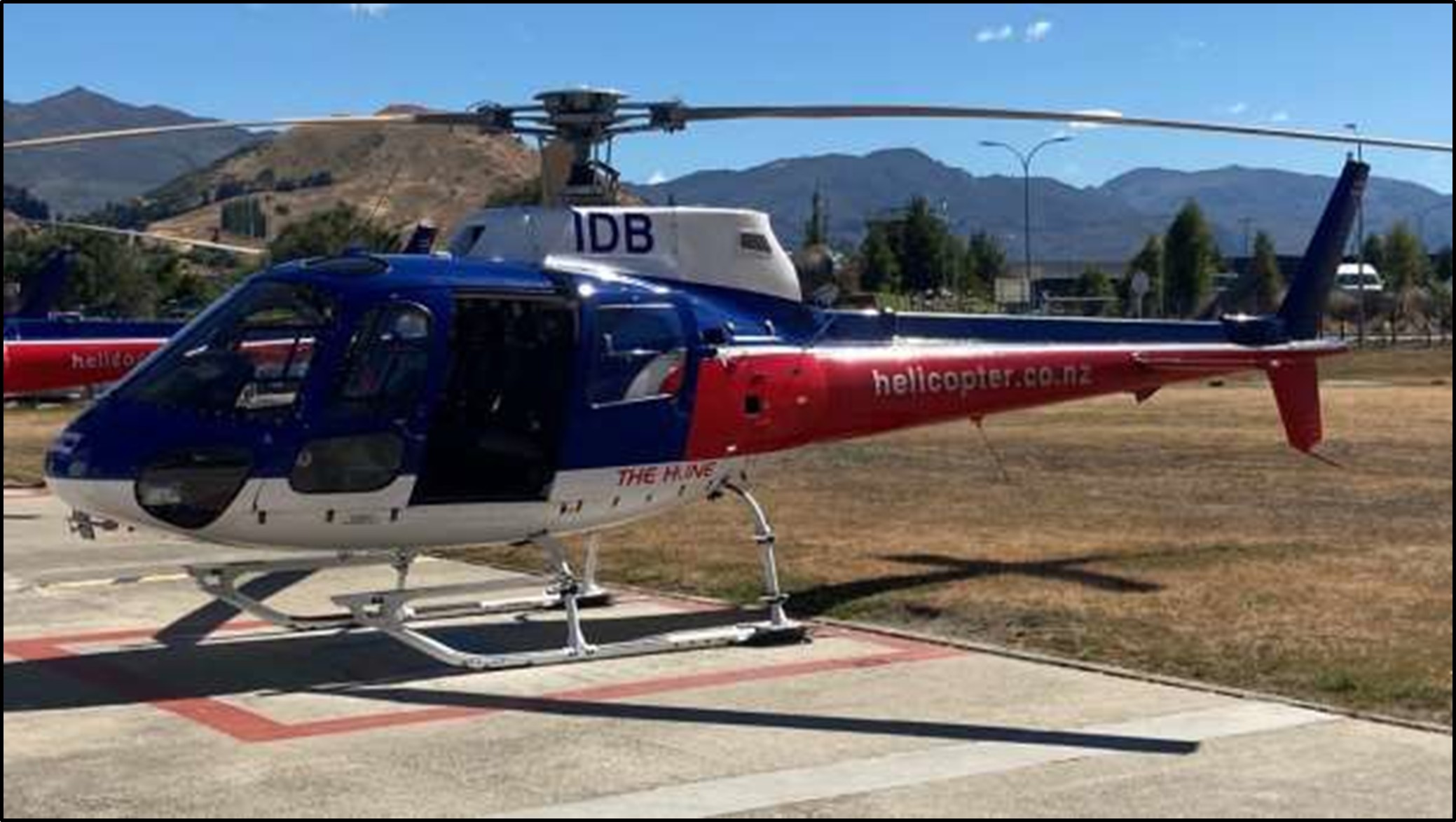
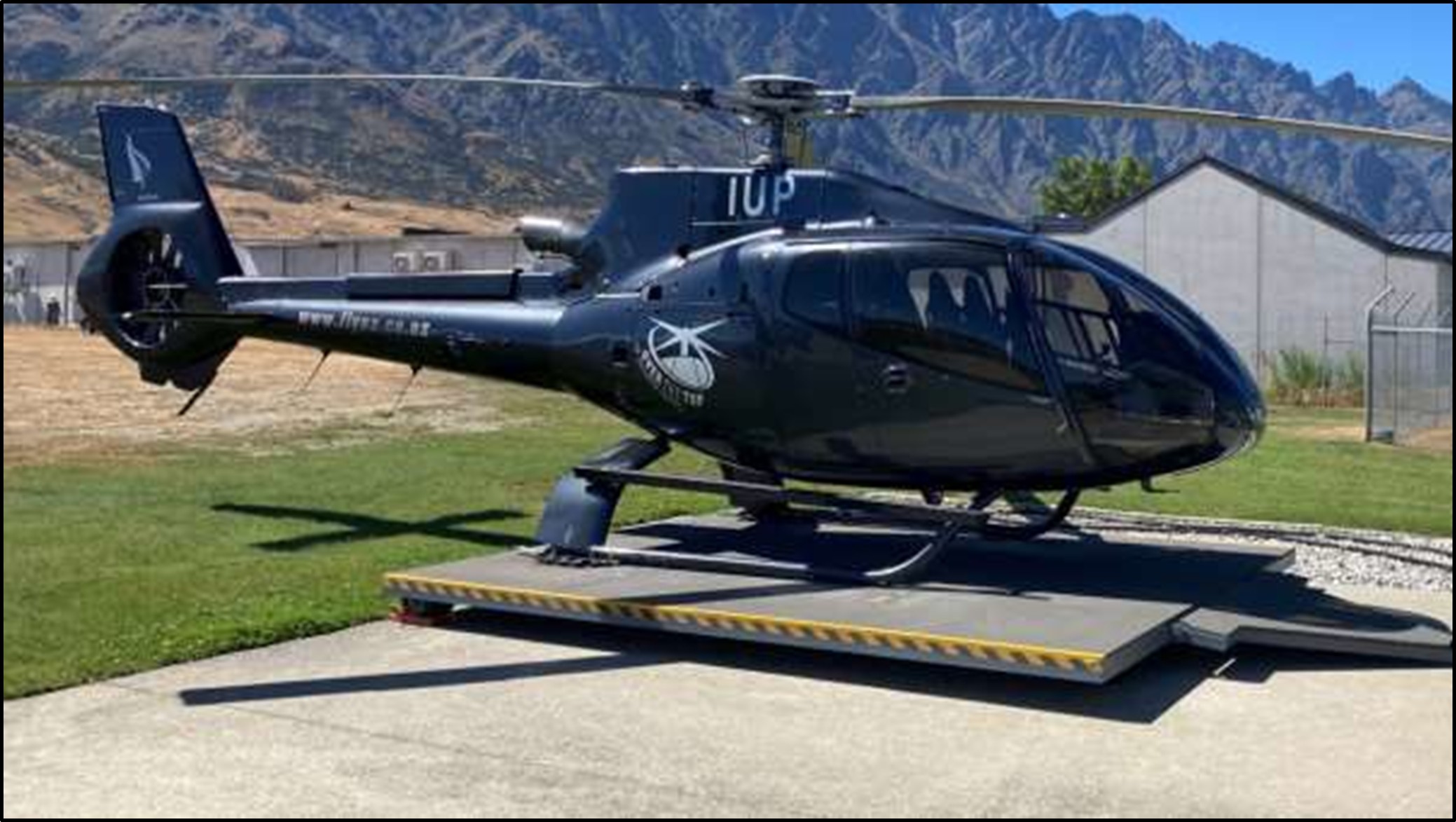
- In the early afternoon of Tuesday 27 December 2022 an Airbus Helicopters EC130B4, ZK-IUP, was cleared to depart from the southern apron, the general aviation (GA) movement area of Queenstown aerodrome. A second helicopter, an Airbus Helicopters AS350B2, ZK-IDB, was cleared to depart number two after ZK-IUP. It was a fine and calm day.
- While ZK-IDB was departing it passed above and to the left of ZK-IUP and took the lead out of the southern apron. Both flights continued uneventfully.
Why it happened
- The pilot of ZK-IDB did not positively identify the location of ZK-IUP because of the initial orientation of their helicopter, and the location of a hangar between the two helipads.
- The pilot of ZK-IDB assumed that ZK-IUP had already departed, given the time since each helicopter had received their clearance to take off.
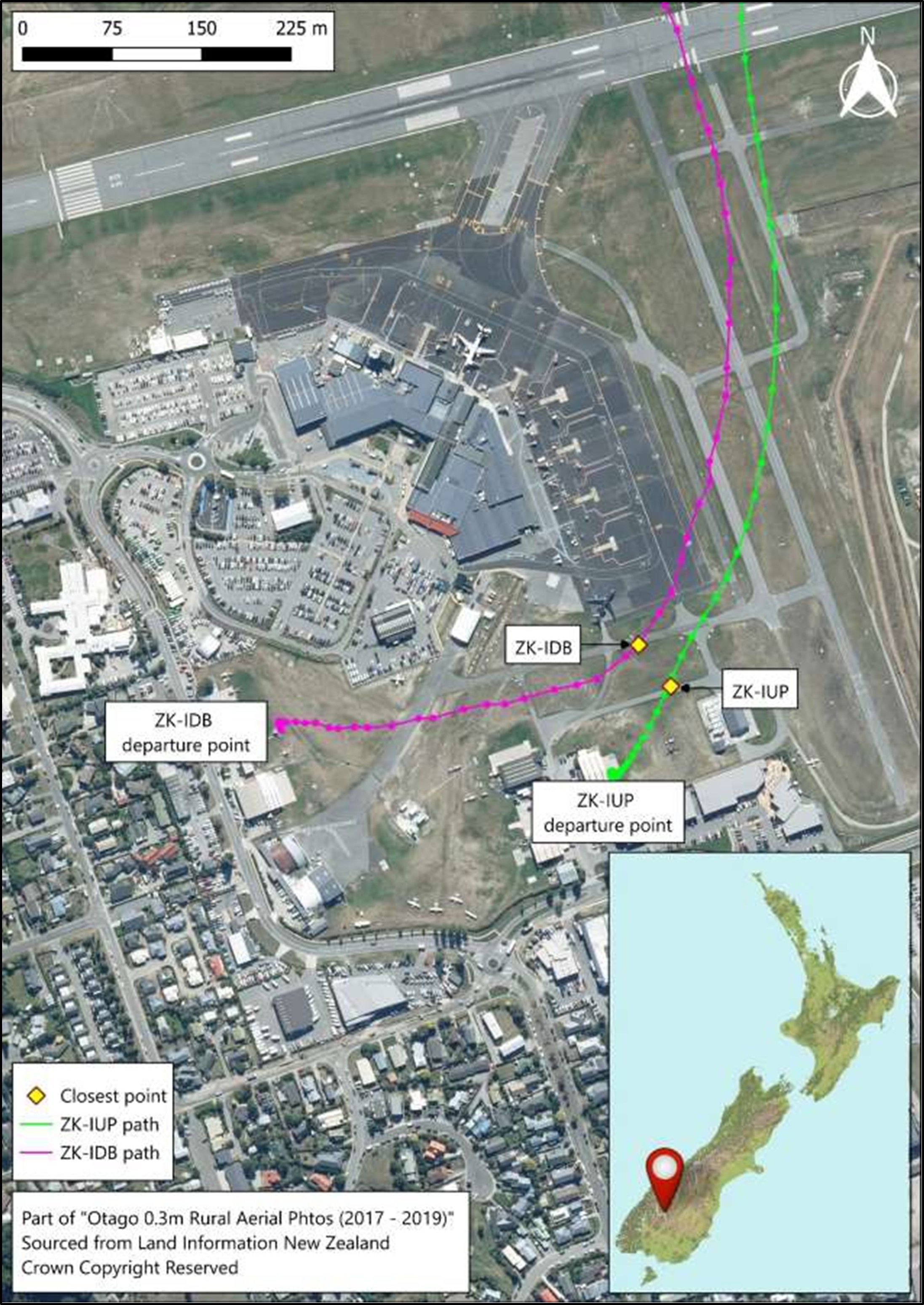
- A reported evasive manoeuvre was found to be a standard turn on departure by ZK-IDB. At their closest point, the helicopters were found to be 44 metres (m) apart.
- The Queenstown Aerodrome southern apron layout, requiring all helicopter movements to arrive and depart via the intersection of taxiways Bravo and Yankee, creates a bottleneck for helicopter operations.
- The congestion and visibility issues of helicopters operating at Queenstown Aerodrome have been identified by the Queenstown Milford User Group and Queenstown Airport Corporation. Actions are being taken to resolve the issues.
- The Commission found one systemic safety issue and, as a result of safety action already taken, has made no recommendation.
What we can learn
- Complex and restrictive operating environments can impact a pilot’s ability to build an accurate mental model.
- Onboard helicopter recording systems provide valuable assistance to safety investigations.
- Aerodrome layout and aircraft movements need to be assessed regularly for safety of operations, especially when daily aircraft movement rates increase.
Who may benefit
-
Aerodrome operators and planners, air traffic control personnel, helicopter company operators and pilots may all benefit from this report.
Factual information Pārongo pono
Narrative
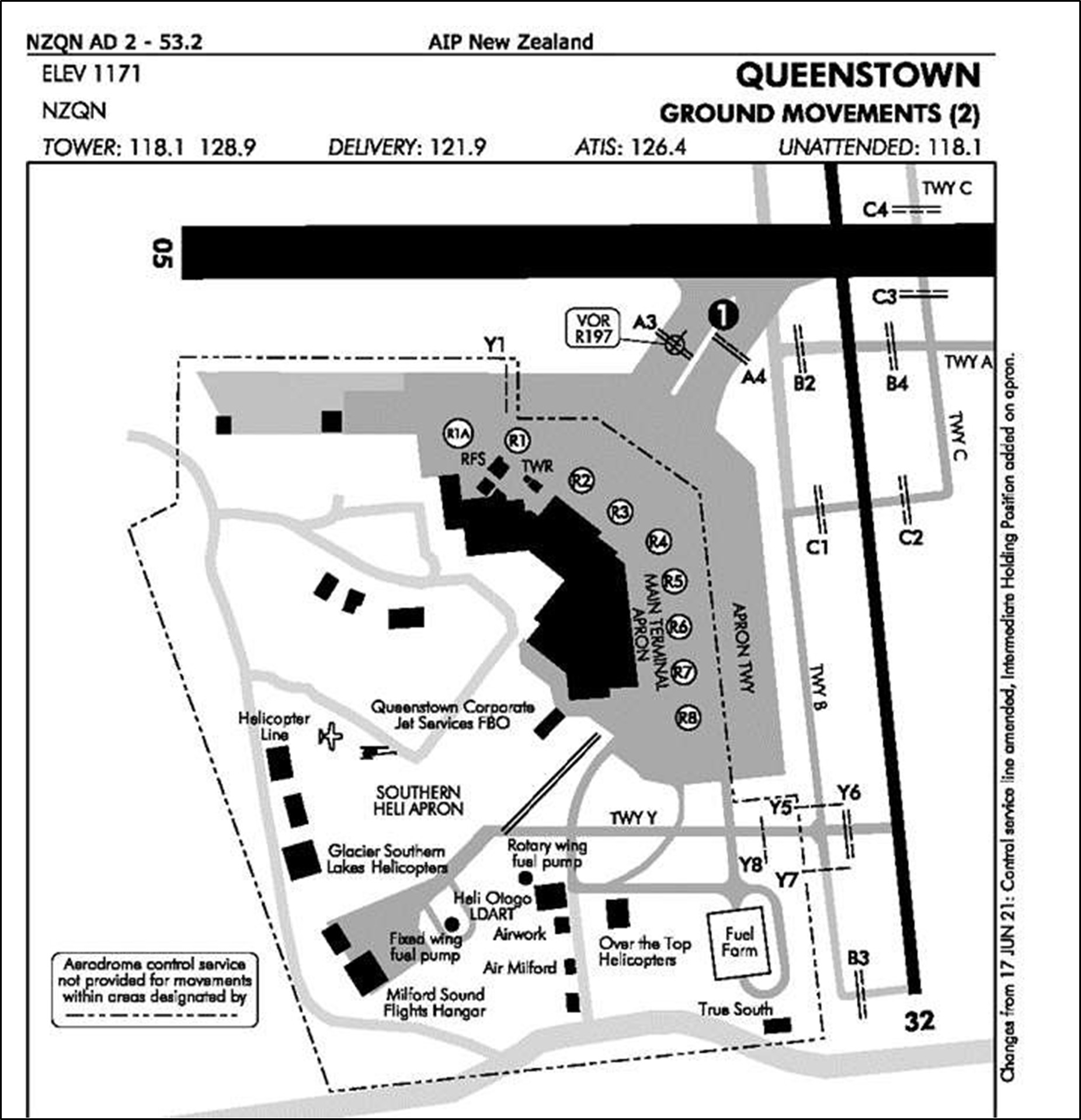
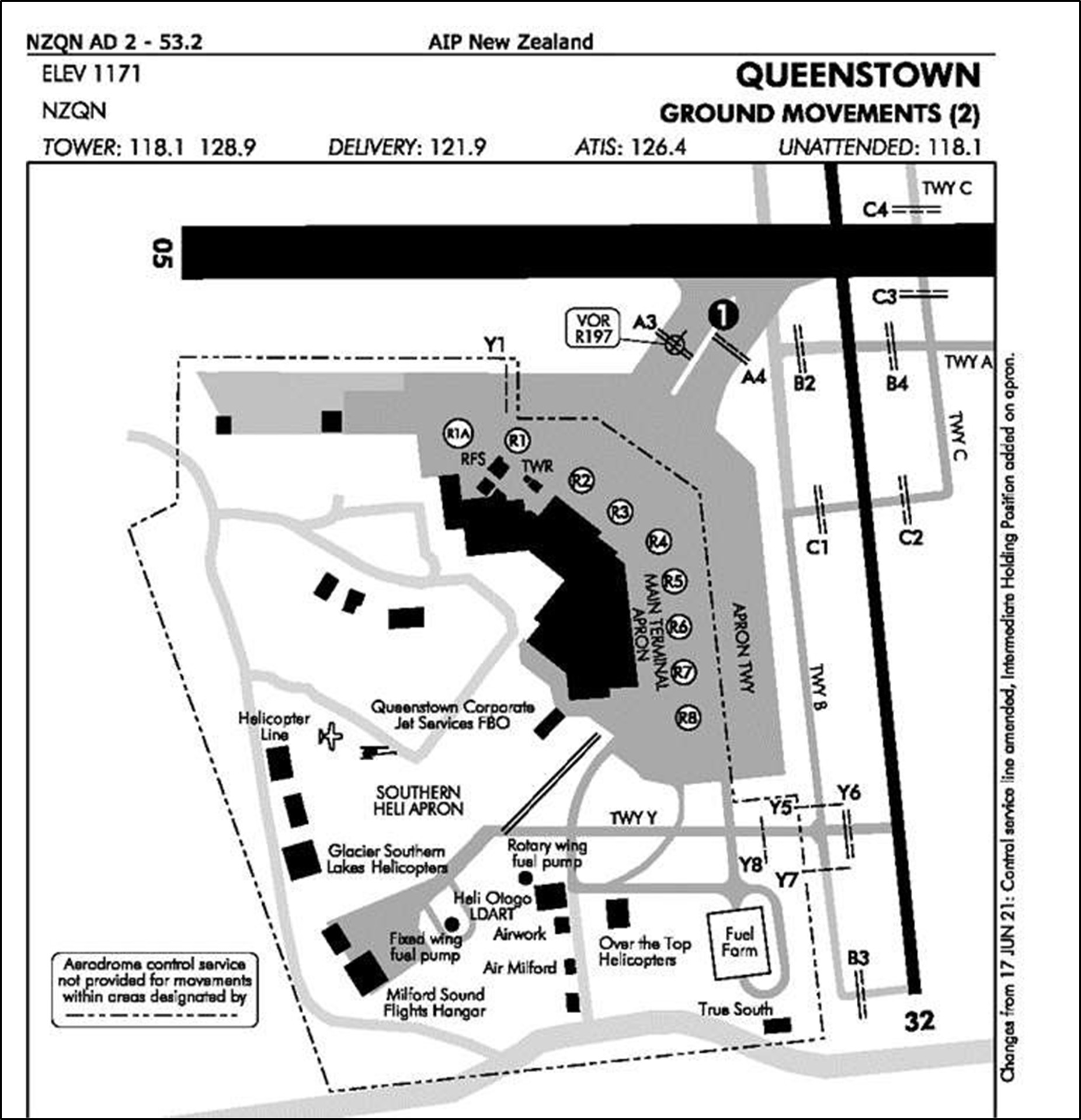
- At 1316 (Times in this report are in New Zealand Daylight Time (Universal Coordinated Time +13 hours) expressed in the 24-hour format) on Tuesday 27 December 2022, the pilot of ZK-IUP (IUP), an Airbus Helicopters EC130B4 operated by Over the Top Helicopters, contacted Queenstown Delivery (Delivery - a dedicated air traffic service ground station used for the issuing of aircraft clearances to reduce communications on the control (tower) frequency) in preparation for departure from their helipad on the southern apron (see Figure 4). Intending to depart to the north of the aerodrome with only the pilot on board, they were notified by Delivery of a significant delay because of inbound traffic.
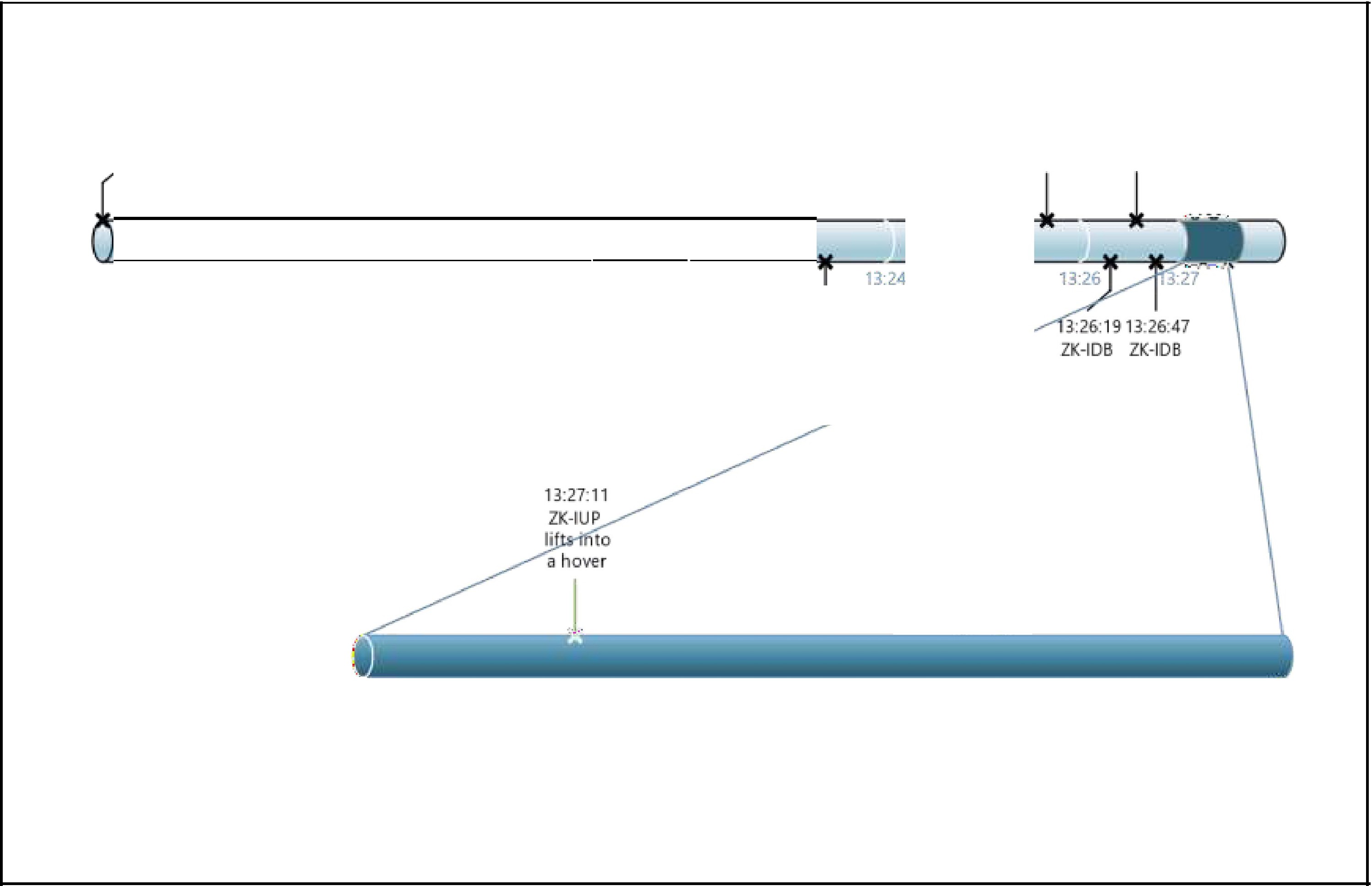
- At 1323 the pilot of ZK-IDB (IDB), an Airbus Helicopters AS350B2 operated by The Helicopter Line with the pilot and five passengers on board, contacted Delivery in preparation for departure, also to the north of the aerodrome.
- At 1325:40 IUP contacted Queenstown Tower (Tower) as instructed by Delivery.
- At 1326:19 IDB contacted Tower as instructed by Delivery, advising that they were ‘ready in turn’ and waiting on an inbound helicopter.
- At approximately 1327 both helicopters proceeded to take off and depart the southern apron.
- The pilot of IDB made a radio call on the Tower frequency, stating they had IUP in sight and had now taken the number one position. The pilot of IUP acknowledged the radio call and followed IDB out of the southern apron area.
- At 1327:31 the helicopters were at their closest point after IDB passed above and to the left of IUP. The flights then continued uneventfully. See Figure 5 for the full timeline.
- Six days later, on 2 January 2023, an occurrence report was submitted to the Civil Aviation Authority (CAA). The Commission was notified by CAA on 12 January 2023.
Personnel information
- Both pilots were locally based. For a summary of their flight experience see section 8 Data summary. The Commission did not identify any medical or personal health issues with the pilots during the investigation.
Meteorological information
-
The weather was fine and calm with good visibility.
Aerodrome information
- Queenstown Aerodrome is a certificated aerodrome located four nautical miles (nm) east of Queenstown. The aerodrome is located within the Queenstown Control Zone, which is designated as Class C airspace.
- Air traffic services at Queenstown are separated into a tower frequency and a delivery frequency. The tower frequency is used for control of aircraft in the immediate vicinity of the aerodrome as well as ground movements. The delivery frequency is used to
facilitate aircraft clearance requirements to reduce congestion on the tower
frequency. - Aerodrome control services were not provided for the southern apron area at Queenstown Aerodrome (see Figure 4 and Figure 6). Aeronautical Information Publication New Zealand for Queenstown specifically stated that air taxiing was restricted to 100 feet (ft) above ground level (AGL) or below and not exceeding 60 knots (kt) indicated airspeed (IAS) (Aeronautical Information Publication (AIP) NZQN AD 2 – 35.5 Queenstown Helicopter VFR arrival/departure procedures (1)). This differs from the definition of taxiing in Civil Aviation Rules (CARs) Part 17 and air taxiing in AIP Gen 2.2.
Recorded data
- IUP was fitted with Automatic Dependent Surveillance – Broadcast (ADS-B) in and out, which provided a traffic advisory via audio prompt and via a screen in the cockpit. It was also fitted with an Eye In The Sky onboard video recorder system.
- IDB was fitted with ADS-B out only.
- Airways Corporation of New Zealand Limited (Airways) provided the Commission with recorded surveillance data from the ADS-B system and audio recordings from Queenstown air traffic control (ATC).
- The Commission obtained CCTV video footage from Queenstown Airport Corporation (QAC).
- The Commission obtained video footage and flight data from IUP’s Eye In The Sky onboard video recorder.
Organisational information
CAA rules for aerodromes
- The requirements for aerodromes are contained in Civil Aviation Rules (CARs) Part 139 Aerodromes – Certification, Operation and Use.
- CARs Part 139 is further expanded in several CAA Advisory Circulars (ACs),10 with AC139-8 Aerodrome Design – Heliports containing the requirements for helicopters.
Queenstown Airport Corporation (QAC)
- QAC was incorporated in 1988 and was responsible for the management of Queenstown Aerodrome on behalf of its shareholders. QAC was governed by a Board of Directors.
- At the time of the incident the corporation had two shareholders: Queenstown Lakes District Council (75.01%) and Auckland International Airport Limited (24.99%).
Queenstown Milford User Group (QMUG)
- The QMUG was formed in 1990 to promote safety for those aircraft operators operating within the Queenstown Flight Information Region according to the QMUG operations handbook (Queenstown Milford User Group, 2016).
- QMUG members primarily consisted of:
- Queenstown Airport Corporation
- Civil Aviation Authority of New Zealand
- Airways Corporation of NZ (Queenstown)
- Local aircraft operators
- Local sport aviation operators
- Ministry of Transport
- Department of Conservation.
Analysis Tātaritanga
Introduction
- When this incident was notified, it was reported that IDB had taken evasive action to avoid IUP. An aircraft taking evasive action raises safety concerns for the Commission.
- The following section analyses the circumstances surrounding the event to identify those factors that increased the likelihood of the event occurring or increased the severity of its outcome. One safety issue that had the potential to adversely affect future operations was identified.
Reported close-proximity event
- A previous incident in December 2021 between an arriving helicopter and an aeroplane departing from runway 32 resulted in changes to helicopter arrival and departure procedures at Queenstown Aerodrome. The new procedures grouped helicopters together for departure or arrival to ensure they were adequately separated from other traffic. The changes came into effect in December 2022 and often resulted in delays for helicopters waiting to depart.
- For IUP, the time from first calling Delivery until they received a clearance to take off was approximately 10 minutes (see Figure 5) while they waited for inbound aircraft to land.
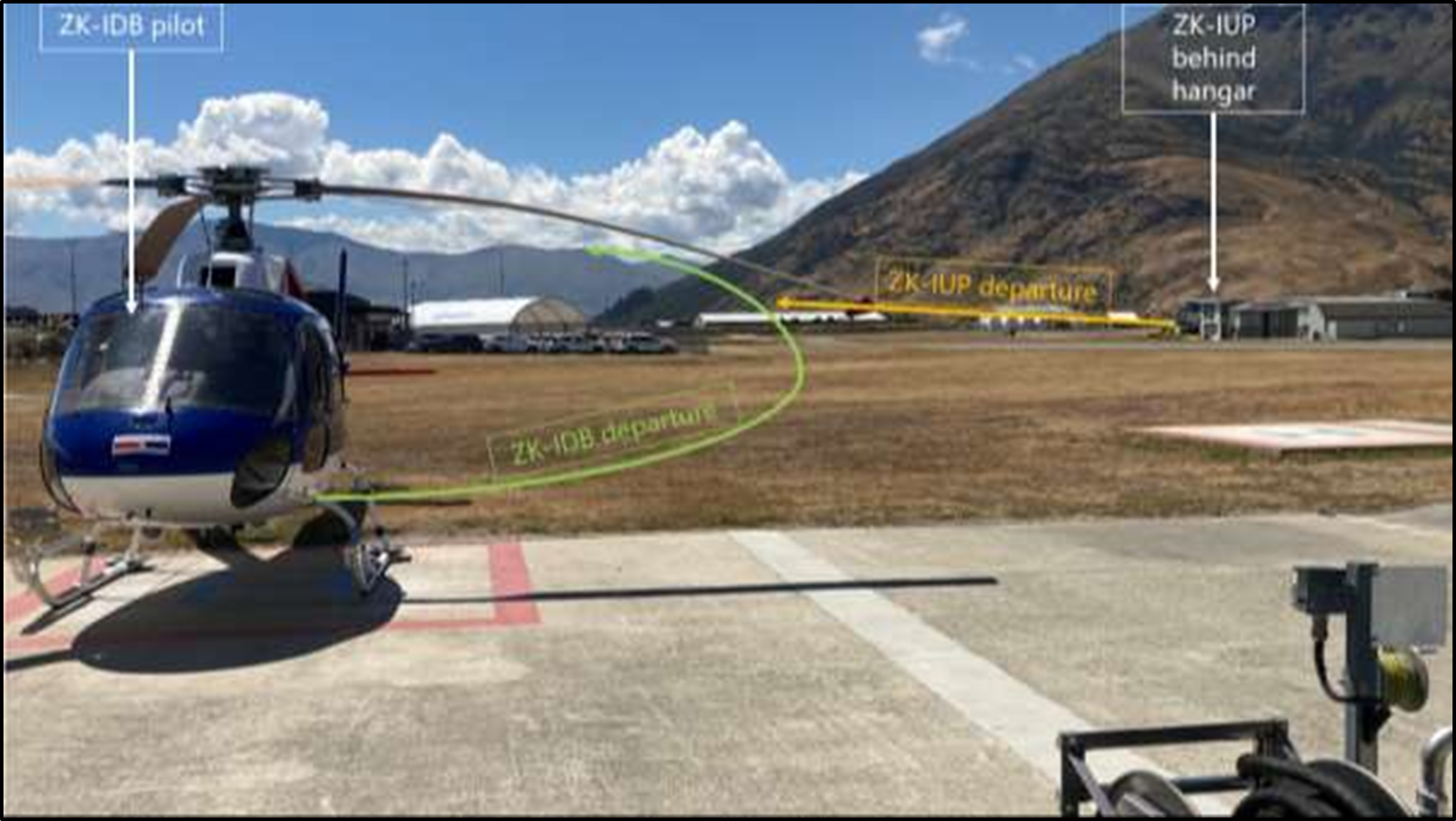
- Before take-off, the pilot of IDB could not see IUP because of the orientation of IDB and the location of a hangar between their respective helipads (see Figure 7). The pilot of IDB recalled that they had assumed that IUP had already departed, and that they had expected to see IUP passing the white half-round hangar (visible behind ZK-IDB in Figure 7) by the time IDB had lifted off the helipad and turned around.
- The pilot of IDB recalled looking along IUP’s expected flight path, but they did not see IUP until they were in view of IUP’s helipad. The pilot of IDB noted that IUP was on a low take-off profile and made a radio call on the Tower frequency, taking the number one position. The pilot of IUP acknowledged the radio call and followed IDB out of the southern apron area.
- ADS-B tracking data and CCTV recordings show that, at their nearest point, the helicopters were separated laterally by about 44 m and were over parallel taxiways at their closest point (see Figure 3).
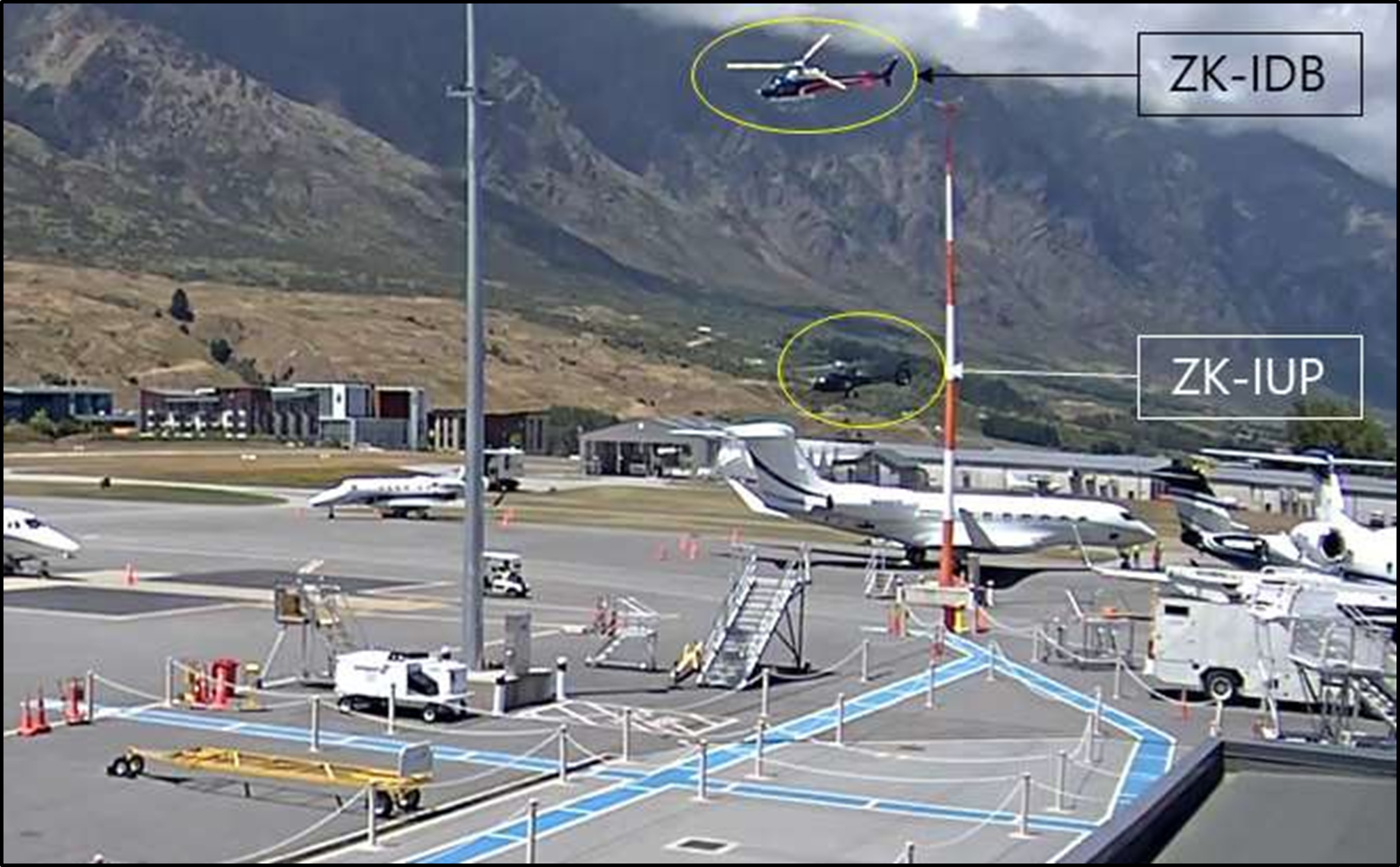
- Because of altitude rounding by the ADS-B system, the exact vertical separation cannot be confirmed. However, CCTV footage shows vertical separation between the two helicopters in the southern apron area (see Figure 8 and Figure 9) with no excessive or obvious avoiding manoeuvre by the pilot of IDB.
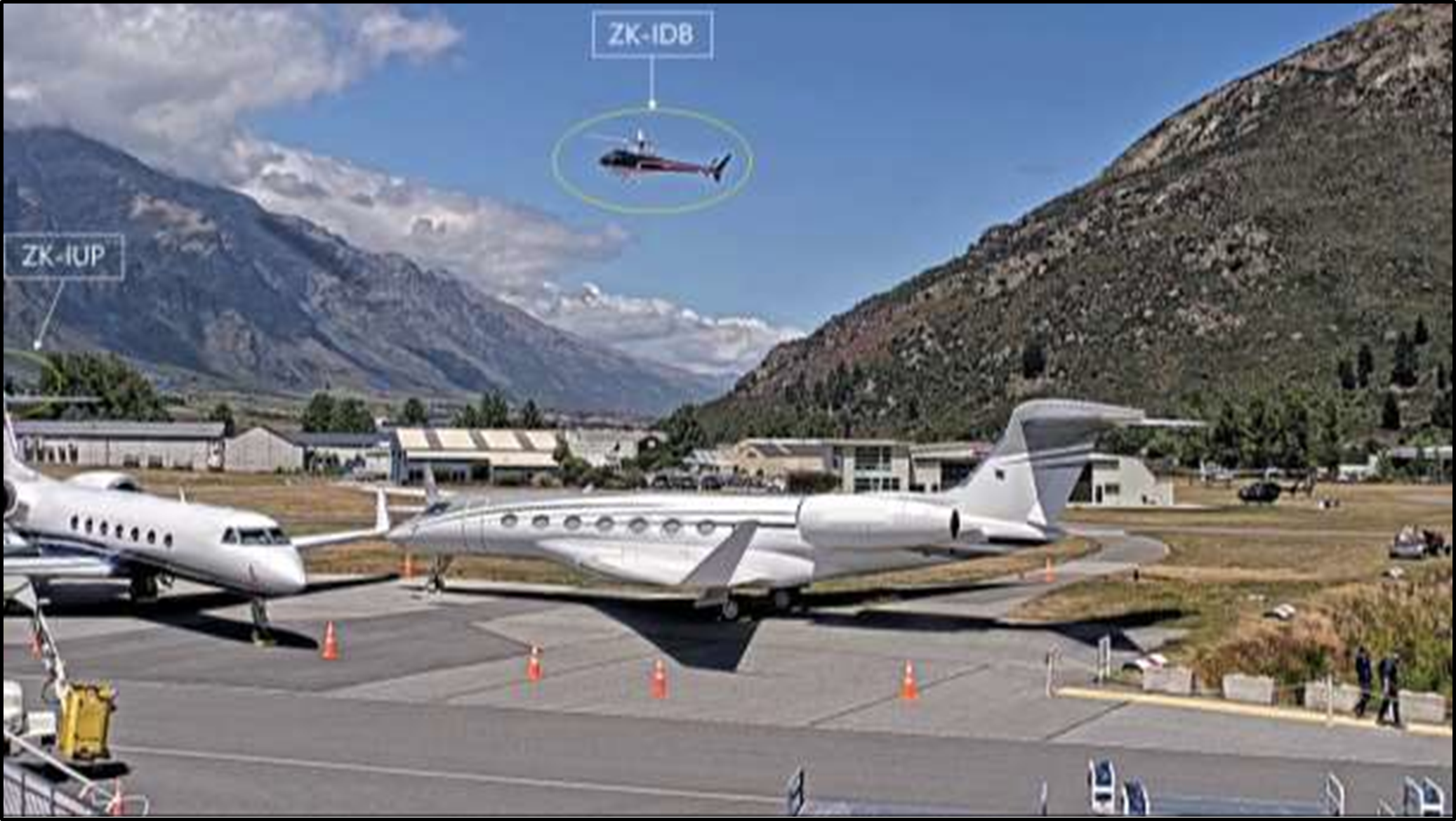
- The pilot of IDB recalled that they did not take evasive action, and instead were already in a turn as a normal part of their departure flight path. From the perspective of IUP’s pilot, who saw IDB momentarily when they looked in their direction, it appeared IDB was conducting an evasive manoeuvre.
- The Commission found that neither pilot took evasive action, nor was it required.
- The Commission considers that while the defence of ‘see and avoid’ has its limitations, as detailed in the Commission’s report AO-2019-006, it remains a critical element for ensuring safety. It is the primary method for separation of aircraft in the visual flight environment, particularly in uncontrolled airspace and during low-level flight.
Queenstown Milford User Group
- As a result of this reported close-proximity event, the QMUG met on 3 January 2023 and discussed this incident and any related concerns, including any follow-up actions required by the members. Following the 2 January 2023 mid-air collision between two helicopters in Queensland, Australia (Australian Transport Safety Bureau investigation) there was heightened sensitivity around this event and a desire for QMUG members to be proactive around aircraft close proximity
events.
Other investigations and follow-up action
- As a result of the reported close-proximity event, both Airways and CAA undertook their own internal investigations.
- Airways identified that the layout of the southern apron had created a bottleneck at the intersection of taxiways Bravo and Yankee and that some hangars were obstructing the line of sight of departing helicopters. These helicopters could be flying at heights and speeds more associated with flight than normal air taxiing. This is discussed further in the Safety Issue in paragraph 3.31.
- Before this occurrence, Airways controllers used sequencing numbers to assist with multiple helicopter departures (for example: “cleared number 2 behind the EC130”). After the occurrence, Airways implemented a procedural change to require pilots to report sighting the previous aircraft as part of any clearance when following another aircraft (for example: “cleared to follow EC130 IUP, report sighting”). This requires the pilot of the trailing helicopter to visually identify the preceding helicopter before complying with their clearance.
-
CAA raised similar concerns that helicopters could be operating at flight speeds near other aircraft over the southern apron without being subject to a full ATC service. CAA reported that:
The CAA Aeronautical Services Unit will liaise with Airways NZ to ensure that helicopters operating at up to 60 kt and 100 ft AGL in the airport environs, including above the apron, will be provided with a full ATC service.
Historical close-proximity events at Queenstown Aerodrome
- A review of incident data from Queenstown between 2017 and 2023 shows several close-proximity events involving runway 14/32 and the Bravo taxiway arrival and departure procedures. These events had prompted a change in procedures in December 2022. As a result of these procedural changes, there was a reported increase in delays because of the requirement to group arriving and departing helicopters.
- The data did not appear to show any patterns concerning close-proximity events over the southern apron.
Aerodrome layout and design
- The Commission undertook further analysis of the layout of Queenstown Aerodrome, with a focus on changes to the southern apron over time. It considered the assessment of risks to the safety of aviation versus commercial considerations.
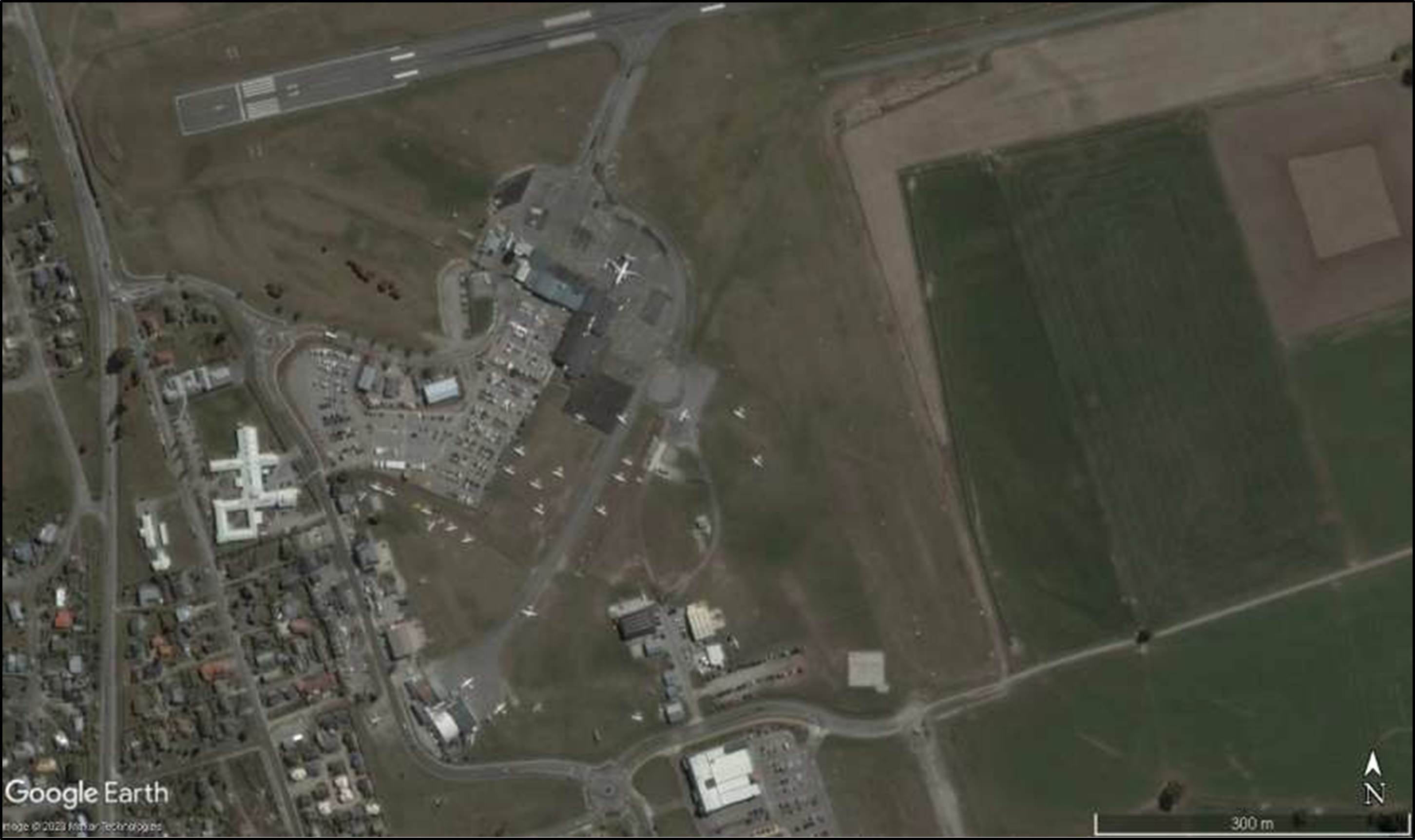
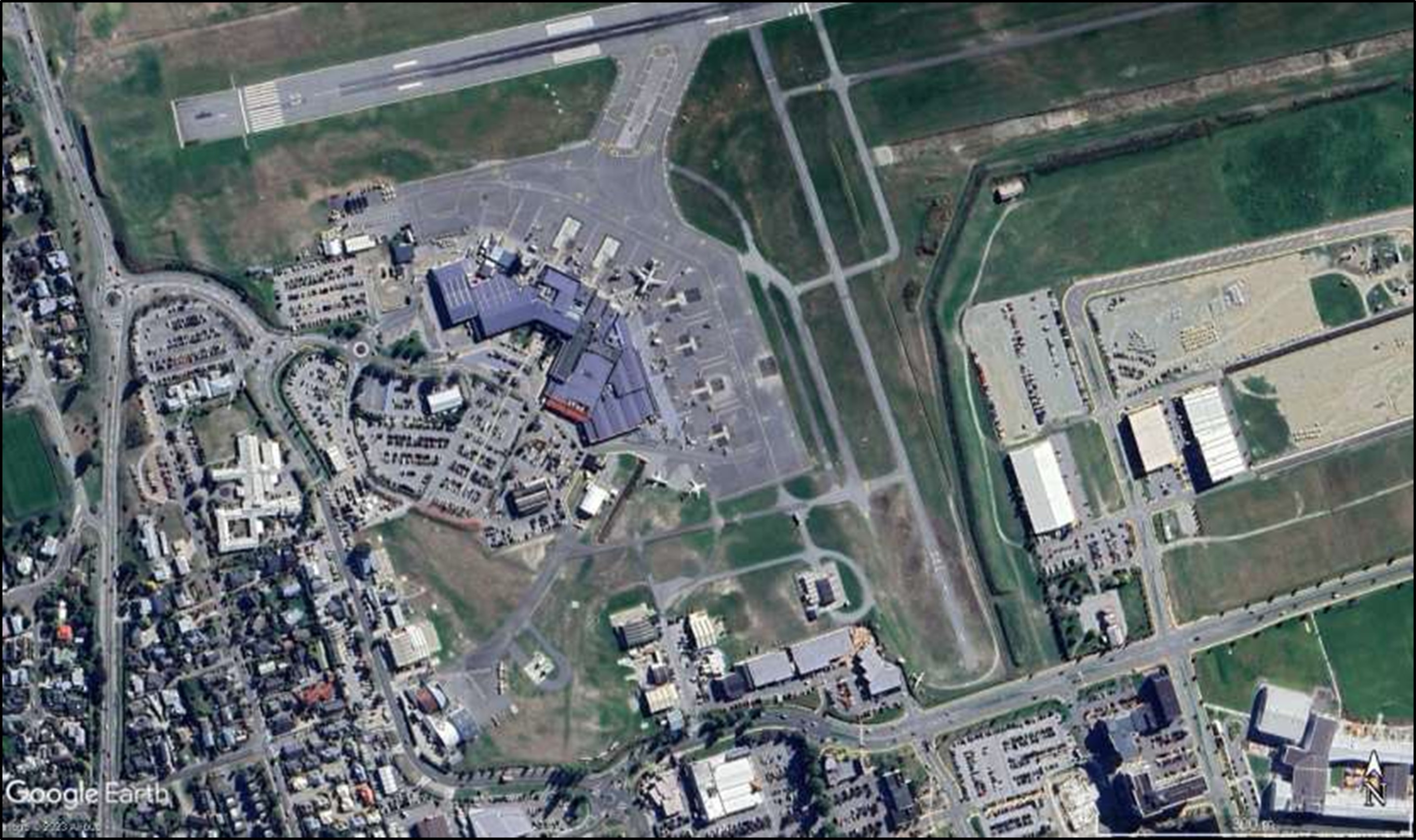
- Review of historical imagery of Queenstown aerodrome shows ongoing development with significant changes to the southern apron and expansion of the main apron. These changes have progressively reduced the space available for helicopters and light aeroplanes to operate. See Appendix 1 for a comparison of the apron areas in October 2004 and June 2022.
Aircraft movements
- In 2018 there were reported to be 42,924 GA movements at Queenstown aerodrome, dropping to 35,222 in 2022 (the COVID-19 pandemic has affected aircraft movement numbers since early 2020). About two-thirds of those movements were helicopters. These movements are projected to increase again to about 43,000 by 2032 (Queenstown Airport Corporation, 2023).
- Although the number of movements per day will naturally fluctuate, the average in 2018 was about 117, reducing to an average of about 96 in 2022. The consensus of current users of Queenstown Aerodrome spoken to by investigators was that the layout of the southern apron at Queenstown Aerodrome at the beginning of 2023 was not ideal for the mix of GA aircraft and the number of helicopter movements.
Aeronautical studies
- An aeronautical study was defined in CAA’s AC 139-15 Aeronautical Studies for Aerodrome Operators as “a tool used to review aerodrome and airspace processes and procedures to ensure that safety criteria in place are appropriate”.
- CARs Part 139.131 Aeronautical Study stated that:
- A holder of an aerodrome operator certificate must monitor operations and
conduct an aeronautical study for any significant change or significant
changes that may affect the safety of aerodrome operations. - For the purpose of paragraph (a), a significant change includes:
- a significant increase in aerodrome aircraft traffic volumes; or
- a significant change in type of aircraft operations; or
- a significant change in the aerodrome physical characteristics; or
- an increase in accidents or incidents at or in the vicinity of the
aerodrome; or - when annual aircraft movements at the aerodrome are forecast to
exceed, for 3 consecutive years,—- 40,000 or more combined VFR and IFR movements; or
- 7,500 or more IFR movements; or
- 60,000 or more combined VFR and IFR movements of which
9,000 or more are IFR movements; or - 15,000 or more IFR movements; or
- 100,000 or more combined VFR and IFR movements.
- The holder of an aerodrome operator certificate must, immediately after
completing an aeronautical study—- review the operation of the aerodrome and, if necessary, make any changes
that are required in the interests of aviation safety, to the operator’s
exposition, in accordance with the procedure for amending the exposition;
and - provide the results of the aeronautical study to the Director.
- review the operation of the aerodrome and, if necessary, make any changes
- If practicable, the holder of an aerodrome operator certificate must conduct the aeronautical study prior to the significant change.
- If it is not practicable for the holder of an aerodrome operator certificate to conduct an aeronautical study prior to the significant change, then the certificate holder must conduct the aeronautical study as soon as
practicable after the change.
- A holder of an aerodrome operator certificate must monitor operations and
- Aeronautical studies have existed for many years on a voluntary basis. They have only been required by CAA since 2015 and the requirement has not been applied retrospectively.
- CAA supplied the Commission with copies of the aeronautical studies undertaken for Queenstown Aerodrome since 1997. The most recent study provided to the Commission was dated June 2019.
- In a 1997 study done for Queenstown Airport Corporation, it was recommended that moving helicopter operations to the area north of the main runway (05/23), and east of the cross runway (14/32) would have several benefits given the projected increases in aircraft movements at the time.
- There have been several different proposals for the relocation of the GA area at Queenstown Aerodrome since 1997. While some helicopter operators have relocated to the northeast of the aerodrome, the rest remain in the current location in the southwest of the aerodrome.
Future plans
- In May 2023 QAC announced a major expansion plan with the release of their draft Queenstown Airport Master Plan (Queenstown Airport Corporation, 2023). This included moving helicopter operations to a new northern aviation precinct and the fixed-wing and corporate-jet operators to a precinct south of the main terminal.
- The Master Plan (the Final Master Plan was published in December 2023) aims to address the challenges of the current layout of Queenstown Aerodrome, including separation of aeroplane and helicopter operations. CAA advised the Commission that aerodrome changes of this nature would require QAC to undertake an aeronautical study and submit it to CAA as part of the approval process under CARs Part 139.
Management of aircraft transitioning into controlled airspace
Safety Issue: The layout of the southern apron, including how aircraft transitioning into controlled airspace are managed, has resulted in situations where uncontrolled aircraft can be flying in close proximity to other aircraft. This increases the likelihood of conflict between aircraft and may lead to an increased risk of collision.
- Helicopters were operating at speeds and heights more associated with flight when compared to taxiing, in close proximity to other passenger transport and private aircraft over the southern apron. This was influenced by the size and layout of the southern apron and how aircraft entered and exited the area. The range in operating speeds over the southern apron, and the absence of a height limit for the area, also had the potential for different expectations and practices between pilots and controllers.
- The potential for differing practices also stemmed from the way air taxi was defined in the Queenstown AIP (see paragraph 2.13). Airways deemed this to be a grey area in terms of responsibilities. The southern apron was an uncontrolled area, regardless of the height and speeds that aircraft were flying within that area. The term used to describe the flight profile of the aircraft (i.e., air taxi or airborne) does not change whether the southern apron was subject to an aerodrome control service.
- While this was not considered a factor in this incident, as both aircraft were subject to a clearance; it is another factor that has the potential to affect safety of operations.
- It was detailed in local ATC procedures that controllers would be expected to include the southern apron in their scan, despite it being an uncontrolled area.
- Airways reported that they would liaise with local stakeholders to ensure the respective responsibilities of pilots and controllers are understood when helicopters are operating over the southern apron.
- At the time of the incident there was no mechanism in place for the positive identification of preceding aircraft. See paragraph 5.3 for action taken to address this.
- All locally involved organisations recognised the limitations of the layout of the southern apron at the time of the occurrence, and that the long-term solution requires relocation of the southern apron GA area.
Summary
- After reviewing the evidence and analysing the circumstances of the reported incident, and reviewing operations at Queenstown Aerodrome in general, the Commission found one systemic safety issue, regarding the management of the southern apron.
- All locally involved organisations involved have been proactive in identifying latent barriers to safety and have taken steps to improve conditions, even when those improvements can involve a financial cost.
Appendix 1. Queenstown aerodrome changes 2004–2022
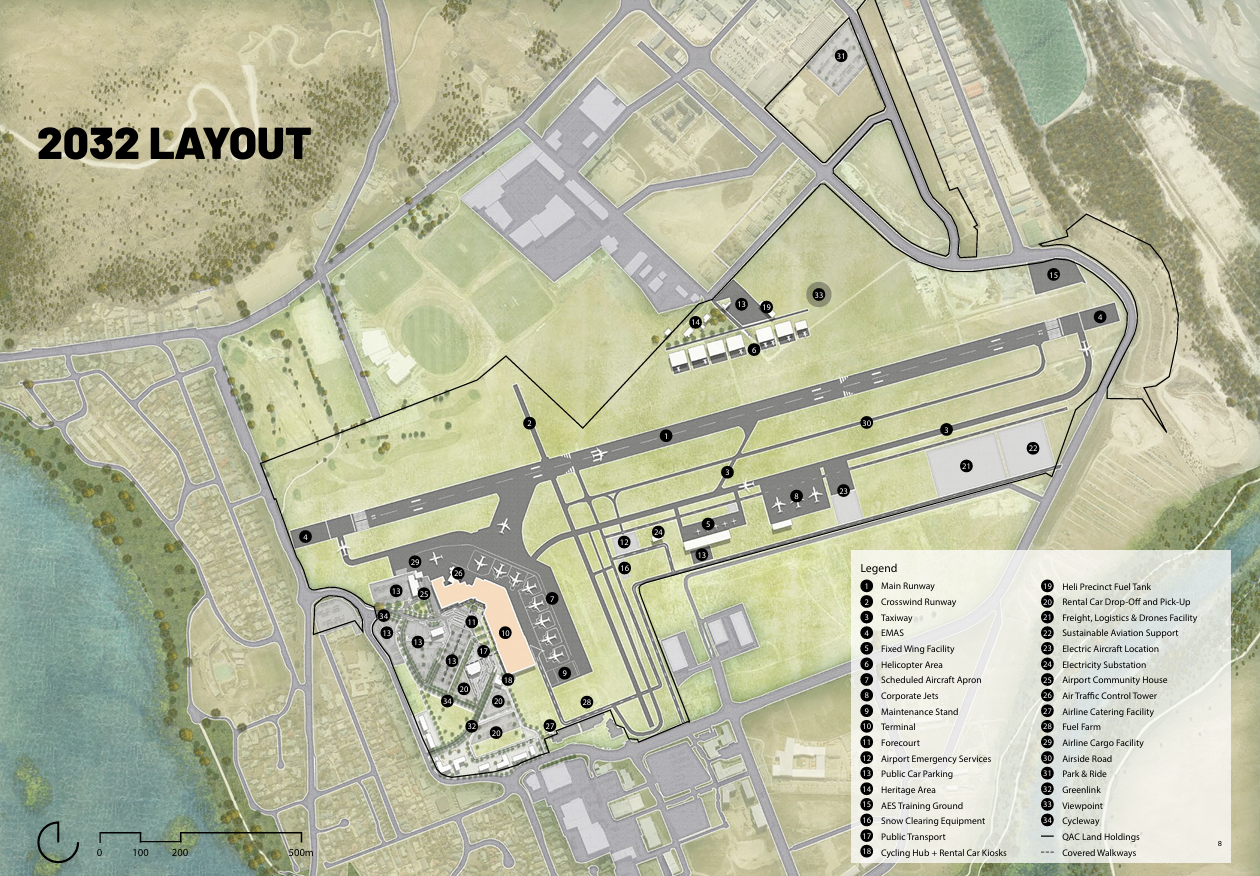
Appendix 2. Queenstown aerodrome proposed layout from the Master Plan