
A Robinson R44 helicopter crashed into dense bush in Glenbervie Forest near Whāngārei. The two occupants – the pilot and a forestry contractor – died in the crash, and the helicopter was consumed by fire. Crash and fire damage destroyed evidence, so the cause or causes could not be determined. The Commission has previously recommended that recorders be fitted to certain classes of helicopter to aid accident investigation.
Executive summary (Interim report) Tuhinga whakarāpopoto
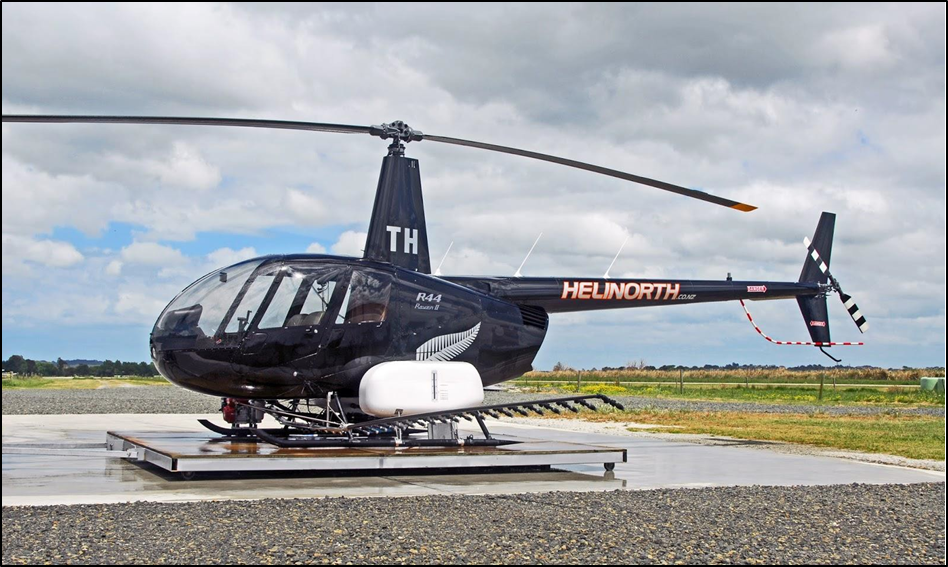
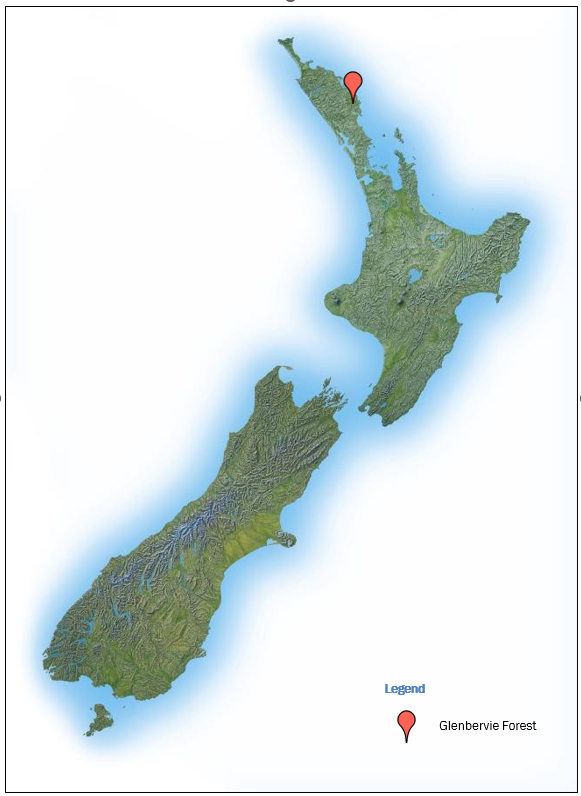
On Monday 31 October 2016, ZK-HTH, a Robinson R44 helicopter, was being used to conduct aerial spraying of forestry blocks in Glenbervie Forest, north of Whāngārei. The pilot and a forestry contractor were using the helicopter to conduct a pre-spraying survey to ensure that the boundaries of the target blocks were correctly identified, and to check for any hazards and obstacles.
The helicopter was flying away from the blocks being surveyed and had just crossed a ridge when it crashed into dense bush and caught fire. The helicopter was destroyed and the two occupants were fatally injured. The Transport Accident Investigation Commission made the following findings:
- The damage to the helicopter sustained in the accident sequence and subsequent fire, and the lack of any other incontrovertible evidence, meant that the cause or causes of the accident could not be determined.
- A bolt that attaches the pitch link to the pitch horn on one of the main rotors was found to be missing. It is virtually certain that the missing bolt came out of position during the impact sequence, meaning it did not contribute to the accident.
- It was not possible to determine why the cyclic extension for the left seat was installed and if it was being used at the time of the accident or at any time during the flight.
The Transport Accident Investigation Commission has previously made a recommendation that on-board recorders be fitted to certain classes of helicopter to aid accident investigation. If such a recorder had been fitted and recovered, it would very likely have helped to identify the cause or causes of this accident. No new recommendation was made.
Factual information Pārongo pono
- On Monday 31 October 2016, a Robinson R44 helicopter, registered ZK-HTH, (the helicopter) was being used to spray recently-planted seedling blocks in two exotic forests in Northland. Prior to commencing each spraying job, the pilot flew a short survey flight with a forestry contractor to ensure that the boundaries of the target blocks were correctly identified and to check for any hazards and obstacles.
- At about 1000 that day, the pilot completed spraying eight sites in the Mokau Forest on the east coast, north of Whangarei. He then refuelled the helicopter and flew to a loading area in the Glenbervie Forest, shut down the helicopter, and waited for his ground crewman and the contractor to drive to the loading area. They commenced flying again after taking a lunchbreak.
- The accident happened while the pilot and contractor were undertaking the survey flight prior to spraying the Glenbervie blocks. At 1309 the Rescue Coordination Centre New Zealand (RCC) received an alert that the emergency locator transmitter fitted to the helicopter had activated briefly at 1258. The RCC contacted the operator, who then phoned the ground crew. The ground crewman was already concerned that the helicopter had not returned from what he expected to be a 10-minute flight. The ground crewman and forestry staff then began a ground search for the helicopter.
- The helicopter had caught fire when it crashed. Smoke from the fire led the ground-based searchers to the accident site, which was in a native forest block, one and a half kilometres to the north of the loading area. A search and rescue helicopter from Whangarei, which had been engaged by RCC to locate the helicopter, arrived at the scene shortly afterwards. Both occupants were found deceased in the wreckage.
Site and wreckage examination
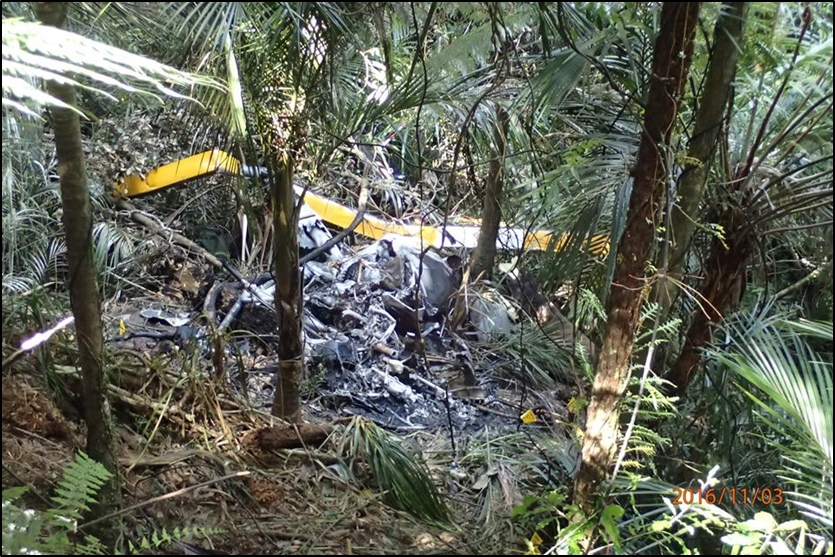
- The wreckage was located in a compact area with most of the helicopter contained around the point of impact with the ground (see Figure 1). Parts of the landing skids and the carbon-fibre spray booms had broken off as the helicopter fell through the trees in a northerly direction. The damage to the helicopter indicated that it had struck the ground with a high rate of descent and a low forward speed.
- An intense fire had destroyed most of the fuselage forward of the tail boom, including the main rotor transmission housing and most of the fairing around the main rotor drive-shaft. The fire had melted the aluminium components in the fuselage and destroyed the fibreglass cabin structure. The fire had not spread beyond the main wreckage.
- The tail, including the horizontal and vertical stabilisers and the complete tail rotor assembly, had detached as a unit from the tail boom. Heavy crushing was found on the leading edge of the horizontal stabiliser, which was consistent with the stabiliser having hit a tree.
- The main rotor blades were attached to the hub and were not damaged by the fire. Outboard sections of both blades had separated and were found close to a tree, which was identified as the first tree the helicopter had struck as it entered the forest. Two pitch links were normally connected between the upper swashplate and the pitch horn on the main rotor blades (refer Figure 2).
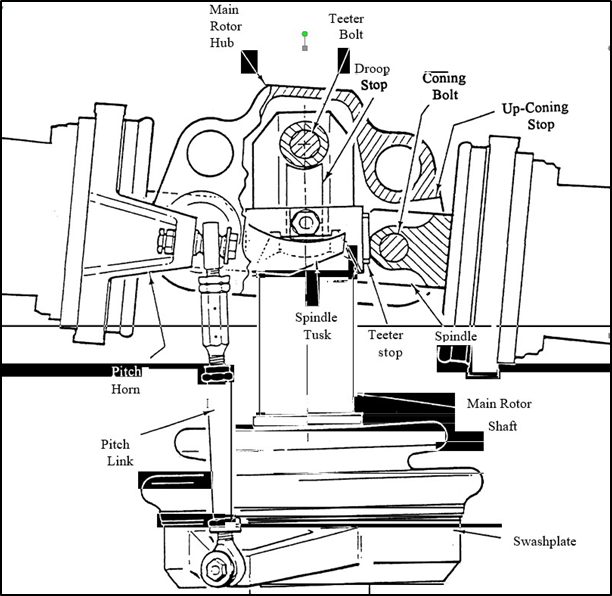
- Both pitch links were found attached to the upper swashplate. However, both had disconnected from their respective main rotor blades. One had broken at the upper rod-end thread, and the other was missing its upper attachment bolt that connected it to the pitch horn on the blade.
Mast bumping
- The Commission is concerned about the number of accidents in New Zealand in which Robinson helicopters have experienced ‘mast bumping’. On 27 October 2016 the Commission added this type of occurrence to its ‘watchlist’ of pressing transport safety concerns (refer to www.taic.org.nz).
- Mast bumping is when the inboard end of a main rotor blade (the spindle) contacts the main rotor driveshaft (or mast). If severe enough, it can result in the main rotor blades striking the helicopter’s cabin and skids, or sometimes the tail boom instead. When this occurs the main rotor driveshaft normally bends and fails, and the helicopter breaks up in flight and leaves a wreckage trail over a large area.
- The leading edges and surfaces of the main rotor blades showed no signs of having struck the helicopter’s cabin or skids.
- There was no sign of the tail boom having been struck by a main rotor blade.
- The main rotor driveshaft was not bent and had not failed through torsional overload (when a main rotor blade strikes a solid, immovable object, a sudden stoppage will occur, and the main rotor driveshaft can fail due to torsional overload if the engine is still producing normal operating power and is driving the main rotor system).
- The confined nature of the wreckage field and the type of damage found on the main rotor blades and the tail boom, suggested that it was very unlikely that the helicopter had broken up in-flight or that the accident had been caused by mast bumping.
Further lines of inquiry
- Current lines of inquiry include, but are not limited to, the following:
- the procedures for the conduct of forestry aerial spraying operations
- the condition of the engine before the accident
- the pre-impact integrity of the main rotor control system
- weather conditions at the time of the accident
- the maintenance history of the helicopter and its engine