
Executive summary Tuhinga whakarāpopoto
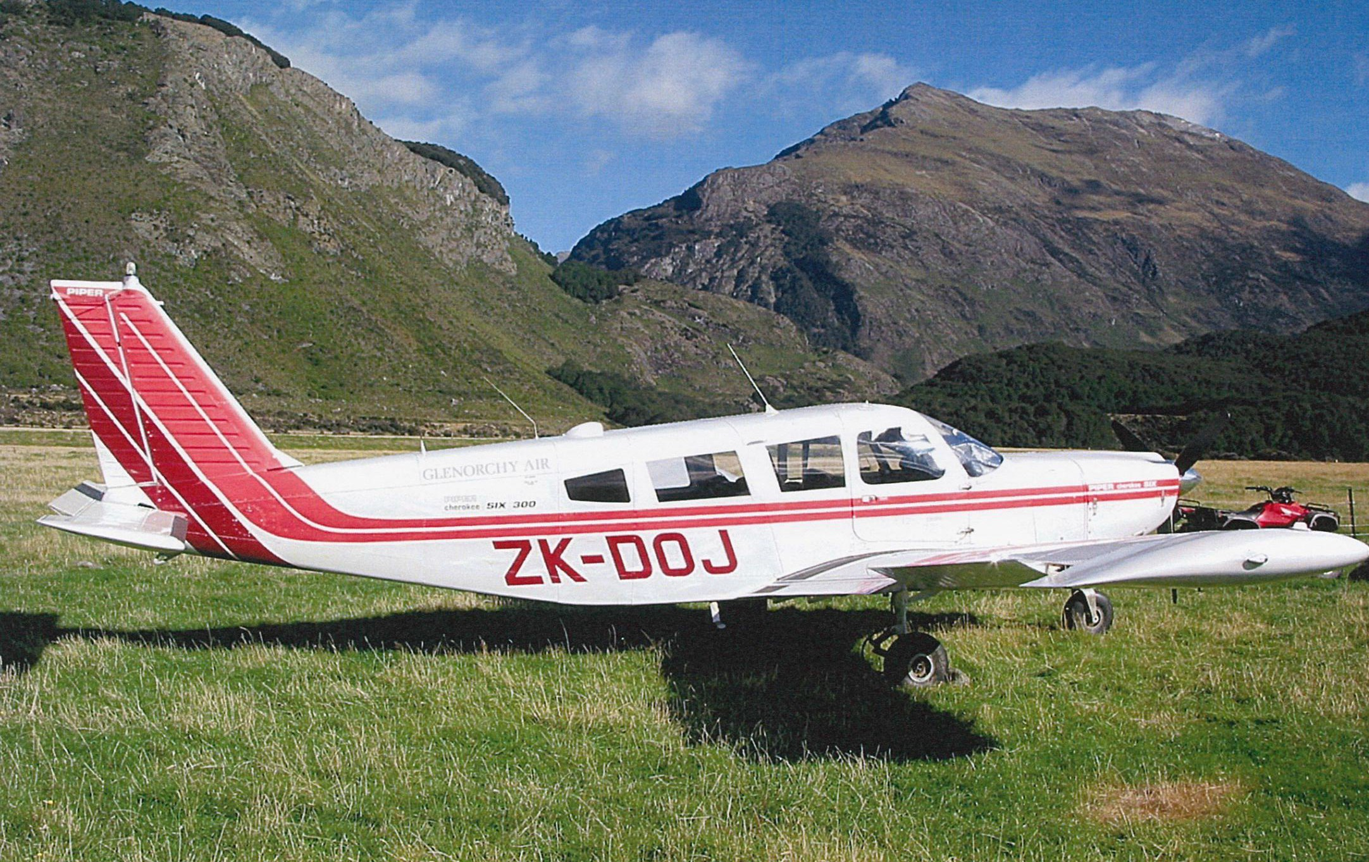
- On 5 August 2014 an aeroplane on a sightseeing flight charter around the lower South Island crashed near the Poolburn Reservoir, killing the pilot and seriously injuring the two passengers.
- The aeroplane aerodynamically stalled while being manoeuvred at low level in the vicinity of an airstrip located on remote farmland. The stall occurred at a height that was insufficient to enable recovery before the aircraft struck the ground.
-
The pilot was carrying out a stock-clearing manoeuvre to move cattle that were on the airstrip, and was in the process of turning the aeroplane around at low level to perform a second pass over the airstrip to scare the livestock away before landing, when the accident occurred.
- The following factors were found to have contributed to the accident:
- a northwesterly wind directly across the airstrip made low-level flying difficult, and required more space than normal for the pilot to turn the aeroplane around
- the pilot’s decision to turn downwind at low level, and towards higher ground without climbing, reduced terrain clearance and safety margins
- the pilot’s decision to continue the turn despite low terrain ahead, and to increase the angle of bank at a low airspeed, led to the aerodynamic stall.
- The Transport Accident Investigation Commission made the following findings:
- pilot incapacitation was very unlikely to have been a contributing factor
- a mechanical or engine failure was very unlikely to have been a contributing factor
- the aeroplane stalled in a turn performed at low level during a stock-clearing manoeuvre
- the operator believed that stock clearing was permitted, but had no written guidelines and had not given its pilots flight training in the manoeuvre
- there was a lack of clarity on whether stock clearing was a permitted activity under the Civil Aviation Rules.
- The Commission made the following recommendation to the Director of Civil Aviation:
- he provide a clear statement to relevant sectors of the aviation industry on whether stock clearing is a permitted activity. If the Director decides it is a permitted activity under a particular Civil Aviation Rule part, he should provide clear guidance on the conduct of the activity.
- The key lessons identified from the inquiry into this occurrence are:
- flying at close proximity to the ground requires a high degree of accuracy as there is little margin for error. It is important that pilots are fully aware of the stall characteristics of their aircraft, in particular how they are affected by manoeuvres such as steep turns. Pilots should also be aware of the effects of wind on the amount of ground covered during a turn
- operators must issue clear guidelines and procedures for their pilots to follow, and ensure that they are being complied with. Pilots should be required to regularly demonstrate proficiency in carrying out the types of manoeuvres and operations they perform for the operator.
Factual information Pārongo pono
Narrative
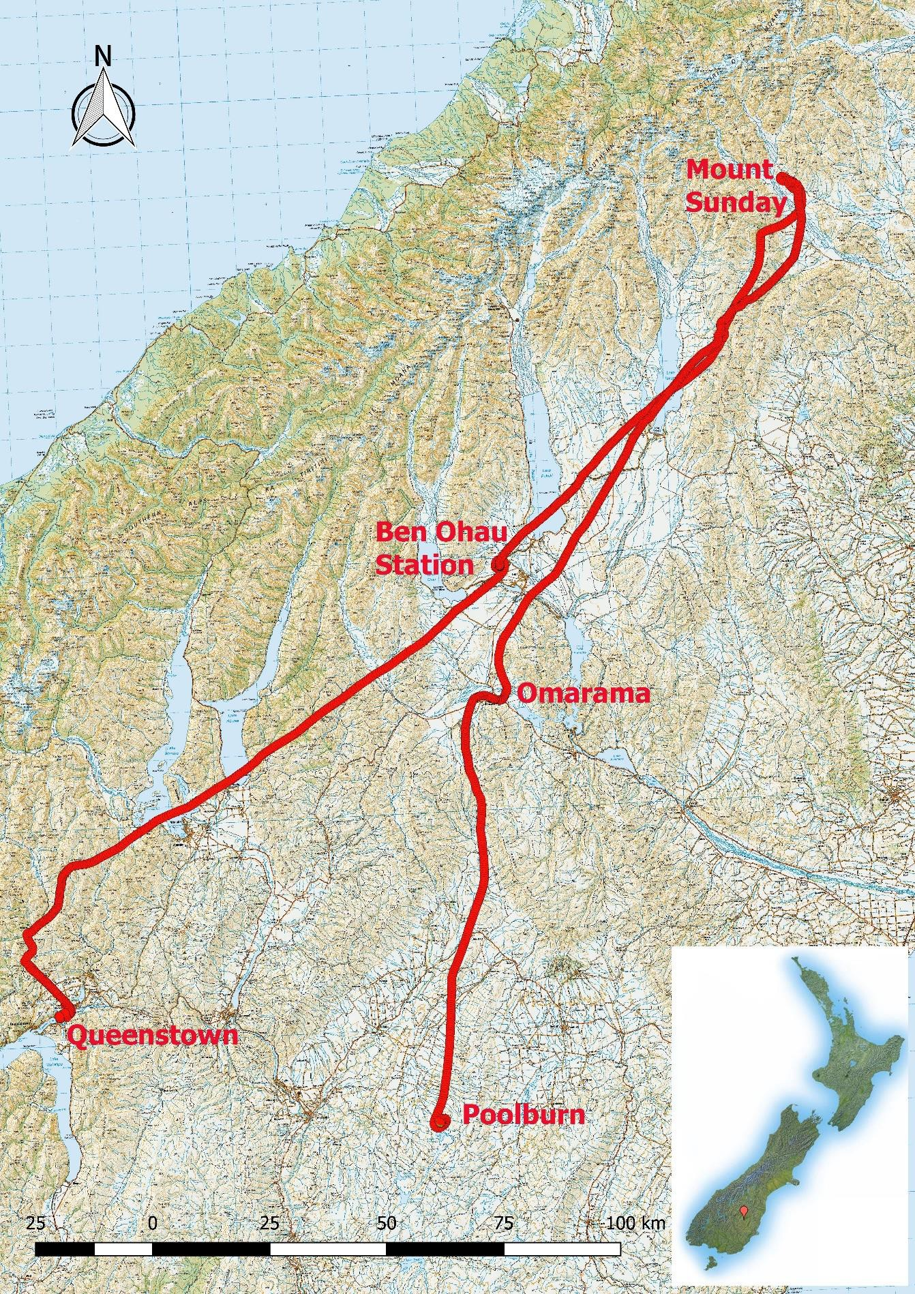
- Glenorchy Air (the operator) was based at Queenstown Airport and carried out scenic and charter flights around the lower South Island and to Milford Sound. An American couple had booked a ‘Three Rings’ (the ‘Three Rings’ tour was a scenic flight to ‘The Lord of the Rings’ filming locations at Ben Ohau station, Mount Sunday and the Poolburn Reservoir) scenic flight with the operator, while on holiday.
- At about 0800 on 5 August 2014, the pilot arrived at Queenstown Airport to prepare for the flight. His preparations included checking the weather conditions; telephoning the landowner at one of the remote aerodromes he planned to use; lodging a company flight plan; completing a load sheet (a load sheet shows the weight and distribution of the items that make up the loaded weight of an aircraft); and conducting a pre-flight inspection of the allocated aeroplane, a Cessna 172.
- The two passengers arrived at Queenstown Airport just before 0900. They met the pilot, who gave them a safety briefing and discussed the tour’s itinerary with them before they boarded the Cessna. However, a technical problem with the Cessna’s radio meant the pilot had to take a larger aeroplane, a Piper PA32-300 registered ZK-DOJ (the aeroplane).
- The pilot amended the flight plan to show the different aeroplane, but he did not complete a new load sheet. He fuelled the aeroplane to about 250 litres, which provided an endurance of over four hours. This quantity of fuel was more than the standard fuel load required for the planned flight time of two hours 42 minutes (the company used standard flight plans for its regular tours. For the ‘Three Rings’ tour the standard flight time was 162 minutes and the minimum fuel load 213 litres when using the PA32). The pilot briefed the passengers about the different features of the aeroplane compared with the Cessna. The male passenger sat in the front right-hand seat because he was unfamiliar with small aircraft and had a tendency to suffer motion sickness. His wife sat in the left seat in the centre row, directly behind the pilot.
- They departed Queenstown at 1116, nearly two hours later than originally planned. The passengers recalled some turbulence on the flight, and said that the pilot was very considerate of their comfort and kept them informed throughout the flight.
- At 1155 they arrived overhead Ben Ohau Station, circled once around the airstrip and landed. After landing the pilot contacted the operator via cell phone and gave an update on their progress. They spent about 20 minutes at this film location before departing for Mount Sunday, about 25 minutes’ flight time to the northeast. At 1247 they arrived overhead Mount Sunday and circled around the hill. Photos taken by the passengers showed the turns, which they described as being made “tightly” at approximately 45 degrees angle of bank (the angle of bank is the angle at which an aircraft’s wings are inclined about its longitudinal axis, with respect to the horizontal).
- The tour then proceeded to Omarama aerodrome where they stopped for lunch at about 1330. The passengers said the pilot ate lunch with them inside the airport building, then went to check the aeroplane and update the operator again. They departed Omarama at 1424 for Poolburn, about 25 minutes’ flight time to the south. Poolburn was the final stop of the tour before returning to Queenstown.
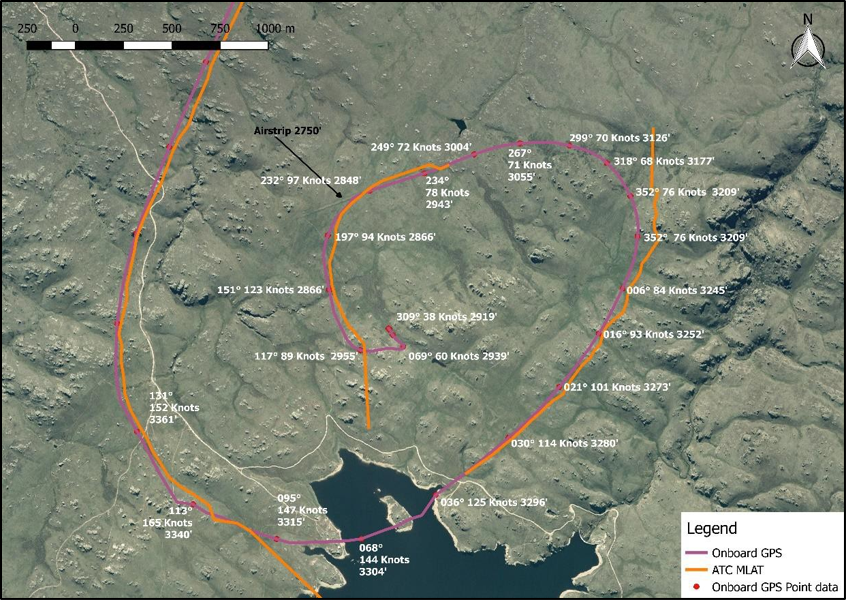
- GPS (global positioning system) flight path data recovered from an on-board iPad (the aircraft carried an iPad so that passengers could follow the tour on a live map and access information about ‘The Lord of the Rings’ movies. Pilots could also refer to it for accurate estimated arrival times) showed that the aeroplane approached the Poolburn airstrip from the north at approximately 1,000 feet above ground level (AGL), then circled the airstrip before descending and approaching the runway from a northeasterly direction. According to the passengers there were cows on the airstrip and the pilot flew the aeroplane on a low pass along the runway to scare them away. The pilot flew along the runway between 100 feet and 150 feet AGL, at a groundspeed (the groundspeed is the speed of an object over the ground, and is affected by wind. For example, if an aircraft flies at an indicated airspeed of 100 knots into a headwind of 20 knots the groundspeed will be 80 knots; if it is a 20-knot tailwind the groundspeed will be 120 knots. A knot is a speed of one nautical mile per hour, equal to 1.85 kilometres per hour) of approximately 95 knots (see Figure 1). After passing over the airstrip the aeroplane remained at approximately 150 feet AGL then turned left. The groundspeed increased to 123 knots before the rate of turn (the rate of turn is the rate at which an aircraft heading changes, expressed in degrees per second) increased and the groundspeed decreased to below 60 knots, at which time the aircraft struck the ground.
- The pilot was killed, and the two passengers were seriously injured. The aeroplane was substantially damaged.
-
When interviewed, the male passenger described essentially the same flight path as described above. He said that when they flew over the airfield the pilot “apologised that we were going to have to bank fairly tightly to make passes over the field to chase them [the cows] off”. He recalled seeing the cattle and remembered the final turn, stating;
“we banked tightly, very sharply, almost wing tip vertical and the ground came up suddenly off one side and me saying something like ‘look out’ and he [the pilot] saying ‘what?’ or being surprised”.
His next recollection was after the accident, “being huddled over the wing, on the ground”. The other passenger could not recall the accident flight or the accident itself.
- At 1453 Rescue Coordination Centre New Zealand (RCC) received an alert from the aeroplane’s emergency locator transmitter (ELT) (an emergency locator transmitter or ELT automatically transmits a signal when activated by accident forces. The signal is received by satellites that can pinpoint the transmitter location). RCC contacted the operator, who confirmed the aeroplane and its location from SPOT Tracker™ (SPOT Tracker is a tracking device that sends GPS position reports to a receiver at set time interval) data. Shortly after this RCC was notified by emergency services of an emergency 111 call from the female passenger.
- The first rescue helicopter arrived on scene at 1548, shortly after a local helicopter pilot had arrived with a police officer from Alexandra. A second rescue helicopter arrived shortly afterwards and both passengers were airlifted to Dunedin hospital for medical treatment.
Site information
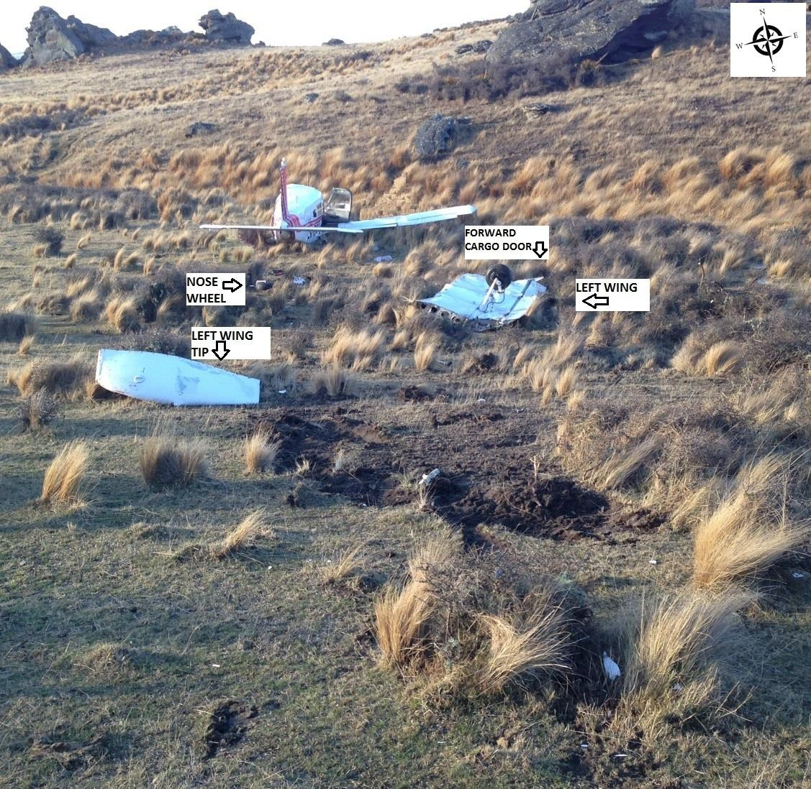
- The accident site was approximately 750 m south of the Poolburn airstrip and 700 m north of the Poolburn Reservoir. The terrain from the airstrip towards the reservoir rose approximately 150 feet above the airstrip and was covered with rocky outcrops. Towards the northwest of the airstrip the terrain gently sloped downwards and was covered in tussock and grass.
- The aeroplane struck the terrain in a left-wing-low and nose-down attitude, on a northerly heading. At this point the left-wing-tip fuel tank, the left wing and left landing gear detached and the aeroplane bounced once. During this sequence the nose landing gear detached. The aeroplane fuselage came to rest upright with the right landing gear detached (see Figure 2).
- Fuel from the ruptured left-wing-tip tank was around the accident site, and there was fuel present in the main fuel tanks inside the wings. A sample was taken from the right main fuel tank.
Personnel information
- The pilot held a commercial pilot licence (aeroplane) that had been issued in April 2008. He had obtained a PA32 series type rating in 2009, and at the time of the accident had accrued approximately 160 flight hours on the type. He had logged 2,181 flight hours in total on aeroplanes.
- The pilot held a valid CAA Class 1 medical certificate (a Class 1 medical certificate is required for pilots who conduct commercial flights). In 2008 the pilot had been assessed by the CAA as having an elevated risk of cardiovascular disease.
- The pilot had recently returned from a three-month break from flying and had resumed flying duties two days before the accident flight. On his first day back he had flown three solo circuits at Queenstown Airport in a Cessna 172 to regain currency (the minimum legal currency requirement for all pilots was three take-offs and landings on type within a 90-day period, in order to carry passengers) on that type, then a flight to Milford Sound with passengers using a GA8 aeroplane on which he was still current. On the day before the accident flight he had flown three solo circuits in the aeroplane to regain currency in the PA32 aircraft type, then operated one return flight to Milford Sound in a GA8 and another in the aeroplane involved in this accident. He had worked one half-day and one eight-hour duty day in the two-day period before the accident.
- The operator’s staff at Queenstown Airport said the pilot appeared to be well rested and in good spirits on the day of the accident.
Aircraft information
- The Piper PA32 is a six-seat, low-wing aeroplane that first flew in 1965. Glenorchy Air had operated the aeroplane since 1996.
- At the time of the accident the aeroplane had accrued 8,099 hours. The 300-horsepower Lycoming engine had accrued 6,055 hours and 1,621 hours since its last overhaul. The propeller had accrued 1,991 hours and 682 hours since overhaul. There was no outstanding maintenance or defects, and the aeroplane had been issued with a valid airworthiness certificate.
- Company pilots reported that the aeroplane had no unusual mechanical or handling characteristics, other than noting that the fuel management system was more complex than other aircraft in the fleet.
-
The weight and centre of gravity (the centre of gravity is the single point in an aircraft through which its total weight (and the force of gravity) can be considered to act) of the aeroplane at the time of the accident were calculated using the:
- actual basic weight of the aeroplane
- actual weight of the pilot
- actual weights of personal items carried
- estimated passenger weights
- estimated weights of other miscellaneous aeroplane items
- calculated fuel load on board (102 litres).
The weight at the time of the accident was calculated to be approximately 1,215 kilograms. The maximum allowable weight was 1,545 kilograms. The centre of gravity was calculated to be approximately 203 centimetres aft of the datum (a datum is a fixed point or reference from which measurements are made), within the allowable range of 193-244 centimetres aft of the datum.
Fuel system
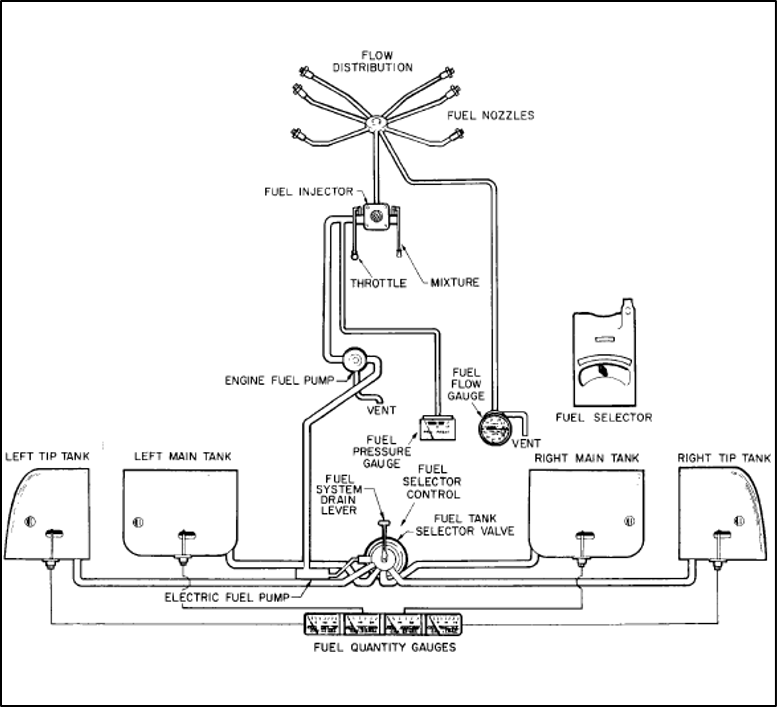
- The fuel system consisted of two aluminium tanks contained in the inboard leading edge section of the wings, plus two fibreglass tanks, one located in each wing tip (see Figure 3). The main tanks had a maximum capacity of 95 litres each and the tip tanks had a maximum capacity of 64 litres each. Fuel was taken from each tank to a combination fuel selector valve and strainer located under the floor below the middle seats.
- The fuel selector control was located below the centre of the instrument panel. It had a position for each of the fuel tanks and one OFF position. From the selector valve, fuel was drawn through the electric fuel pump then an engine-driven pump and on to the fuel injector and the fuel nozzles. Four electric fuel quantity gauges and a fuel pressure gauge were mounted on the right side of the instrument panel. A pilot could turn the electric fuel pump ‘ON’ or ‘OFF’ by using a switch located below the pilot’s side window.
- The operator’s Pilot Operational Supplement outlined procedures for fuel management for the PA32-300. The supplement noted “most forced landings in PA32’s have been caused by fuel starvation by inadvertently running a tank dry or not changing tanks properly” (refer to Australian Transport Safety Bureau, Aviation Safety Investigation Report 198900823 Piper PA32-300 25 August 1989, and Air Accidents Investigation Branch, Report Piper PA-32-300, G-BAXJ, 25 March 2007, for examples of fuel system management occurrences). The operator’s procedures took into account the additional information in the aircraft Owner’s Manual, and included:
- pre-flight checks and fuel contamination checks
- fuelling procedures
- recording of fuel quantities on the load sheet and back of the hand
- in-flight fuel management, including fuel tank selection and electric fuel pump use.
Stall warning system
- The PA32-300 stall warning indicator is a red warning light positioned on the upper left side of the instrument panel, designed to alert pilots to an approaching aerodynamic stall (aerodynamic stall is the breakdown of airflow over an aerofoil (wing) that results in the loss of aerodynamic lift). The stall warning indicator is activated by a lift detector vane installed on the front of the left wing.
- It activates at speeds between 5 and 10 miles per hour (mph) (the PA 32-300 Owner’s manual referenced all speeds in miles per hour (a mile being an imperial speed measurement that equates to 1.6 kilometres per hour or 0.87 knots). In New Zealand the knot is the commonly used speed measurement, in accordance with International Civil Aviation Organization standards) (4-9 knots) above the stall speed. The stall warning system is checked during the pre-flight inspection by turning the master switch ‘ON,’ lifting the detector vane and checking if the stall warning light illuminates (on later-model PA32-300 aeroplanes a horn was added to the stall warning system to give pilots an additional aural warning).
Wreckage examination
- All major components of the aircraft were recovered and transported to the Commission’s wreckage examination and storage facility. The engine was removed and sent to an engine overhaul facility for inspection and component testing. Fuel samples taken from the right main fuel tank and the main fuel filter were clean and clear and were the correct type of fuel.
Flight controls
- The aeroplane was fitted with one control column (the control column is used by the pilot in conjunction with other controls to change direction and altitude), on the left side of the cockpit. The control column was found in the full aft position, bent downwards and to the left. Control continuity was confirmed to the elevator (the elevator is a moveable surface on the tail of the aircraft, and is used to pitch the aircraft. It changes the aircraft’s nose in relation to the horizon – termed the aircraft’s ‘pitch attitude’) and the right aileron (the ailerons are moveable surfaces on the outboard trailing edge of each wing, and are used to bank the aircraft) and from the rudder pedals to the rudder (the rudder is a moveable surface on the tail fin of the aircraft, and is used to move the aircraft’s nose left or right). No evidence was found of a pre-existing failure of the flight controls.
Engine, propeller and cockpit engine controls
- The engine was examined under the supervision of the investigator in charge and the engine manufacturer’s local representative. The examination found that the ignition, fuel (see Appendix 1) and oil system components, accessory drives and gears were all serviceable, and that the crankshaft was free to turn. No evidence was found of a pre-existing failure of the engine or its components.
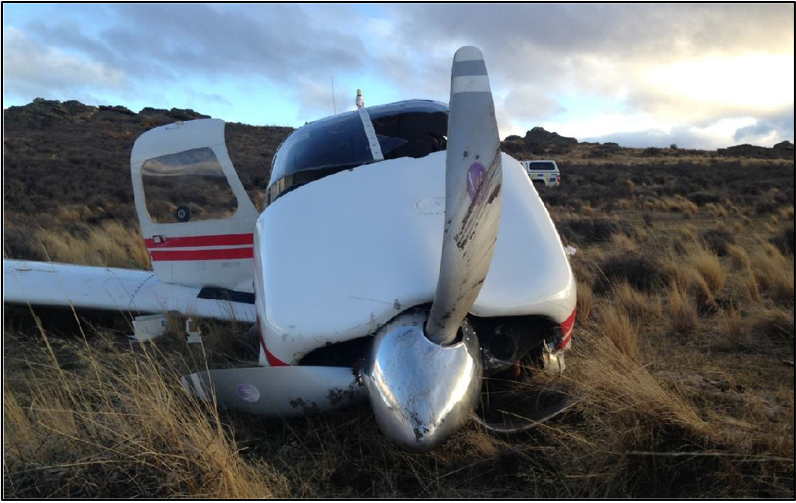
- All three propeller blades were found attached to the propeller hub and bent backwards towards the engine cowl (see Figure 4). There was little damage to the blade tips, edges or surfaces. The pattern of bending and lack of significant scoring marks in the ground or on the blades suggested that the propeller had been turning at low power at impact. The propeller was removed and sent to a propeller examination and overhaul specialist. No evidence was found during the examination of a pre-existing failure of the propeller.
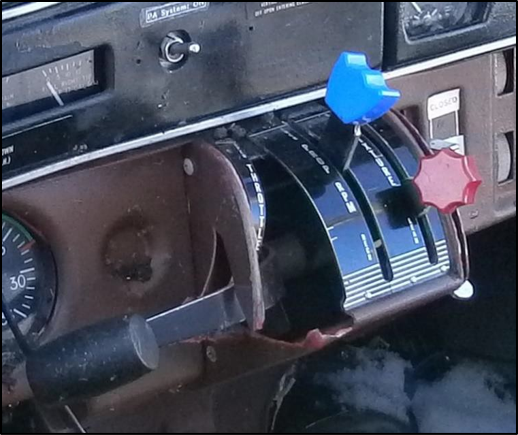
- An examination of the cockpit engine controls found the mixture control (the mixture control is used to adjust the fuel flow to the engine to ensure the correct fuel-to-air ratio for the operating conditions) in a partially leaned position, and the propeller was set to the maximum RPM (revolutions per minute) position. The throttle was full aft (idle) and bent to the left (see Figure 5). The fuel selector (the fuel selector is used by the pilot to select which fuel tank supplies the engine. Refer to paragraph 3.4.5 for a further description of the PA 32-300 fuel system) valve was set to the RIGHT MAIN fuel tank, the electric fuel pump was selected ON, and the ignition was selected to BOTH.
Instruments and stall warning light
- The altimeter subscale was set to 1,011 hectopascals, which approximated the area atmospheric pressure at the time of the accident. The aeroplane’s radios were still powered when the first responders attended the site. The aeroplane was not fitted with an artificial horizon (artificial horizon is a flight instrument designed to indicate aircraft bank and pitch attitude with respect to the horizon. It is an essential instrument for flight in cloud (instrument meteorological conditions) but not required for flights operated in visual meteorological conditions).
- The aeroplane’s stall warning light was intact and the stall warning vane (refer to paragraph 3.4.8 for a detailed description of the stall warning system) on the left wing was undamaged. As the left wing had separated from the aeroplane it could not be tested on site. However, the stall warning vane and light were inspected later and found to be functional.
Meteorological information
- Strong westerly to northwesterly winds of 30-40 knots were forecast for the area at the time of the accident. According to the area weather forecast for the Southland region, the wind strength would increase throughout the day ahead of an approaching front, and occasional moderate turbulence could be expected in the area.
- Aerodrome weather forecasts (refer Appendix 2) for Alexandra and Dunedin, the two closest aerodromes to the accident site, forecast the wind at 2,000 feet to increase to 40 knots later in the afternoon, with scattered cloud.
- The pilot of the first rescue helicopter said it took 30 minutes to fly from Dunedin to Poolburn due to a 30-40 knot headwind. He said that at the accident site it was a clear day, with a northwesterly wind of 10-15 knots and “smooth”.
- The local helicopter pilot who was first to the accident site also reported a clear, sunny day with a north to northwest wind estimated to have been 20-25 knots.
Aerodrome information
- Poolburn airstrip was a non-certificated (CAR Part 139 specifies the requirements for certification of aerodromes) aerodrome and was not promulgated in the Aeronautical Information Publication of New Zealand (the Aeronautical Information Publication of New Zealand contains aeronautical information of a lasting character essential to air navigation, including that pertaining to aerodromes), nor was it required to be. The operator had an airstrip register as required by Civil Aviation Rules (CAR) Part 135.77. The register included the following details for Poolburn airstrip:
- 2,750 feet above sea level
- runway orientated approximately northeast to southwest
- 2% downhill gradient on the north runway
- 900 m take-off distance available on a surface of hard, short grass
- prevailing wind is a cross-wind from the west.
Organisational and management information
- Glenorchy Air was established in 1992 and was certificated by the CAA to carry out air operations under CAR Part 135, Air Operations – Helicopters and Small Aeroplanes. The company provided scenic flights from Queenstown and Glenorchy around the Southern Lakes, Fiordland, the southwest coast and Otago. The company offered three ‘The Lord of the Rings’ movie location tours, the ‘Three Rings’ tour being the longest.
- At the time of the accident the operator’s fleet comprised a four-seat Cessna 172, two eight-seat GA8 Airvans and the PA32.
-
Of the company’s two owners, one was the Chief Executive Officer and the other held the following senior positions:
- Chief Pilot and Operations Manager
- Training Manager
- Maintenance Controller.
An external organisation was responsible for quality assurance and occurrence investigations.
-
The most recent CAA safety audit had been conducted on 20 May 2014 and issued no findings. The CAA’s risk assessment of the operator placed it in the low to medium risk assessment band for this type of operation.
Analysis Tātaritanga
Introduction
- The Commission determined that an aerodynamic stall (stall) occurred during a turn at low level. There was insufficient height above ground to allow the pilot to recover the aircraft, and the left wing tip struck terrain shortly after it stalled.
- Three scenarios were considered as possible reasons for the aeroplane having stalled:
- pilot incapacitation
- mechanical or engine failure
- the pilot’s mishandling of the aeroplane during a low-level manoeuvre. These scenarios are discussed below.
- Aircraft equipment and the operator’s procedures, as well as regulations and guidelines around stock-clearing manoeuvres, are also discussed.
Pilot incapacitation
- The passengers, who had been with the pilot for more than five hours, recalled that he had been in good spirits and not showing any visible signs of ill health. The front passenger recalled that the pilot was responsive in the moments leading up to the stall. The GPS flight path data showed that the aircraft was flown at a relatively constant height and that the rate of turn was maintained until it increased shortly before the crash. This, along with the bent throttle control lever, suggested that the pilot had been in control of the aeroplane.
- The pilot had been assessed by the CAA as having an elevated risk of cardiovascular disease due to higher-than-normal levels of cholesterol and a history of smoking. As a result he had been subjected to regular cardiovascular stress testing. In spite of the perceived elevated risk, the stress testing had not indicated any functional abnormality. In addition, the post-mortem examination found no pre-existing condition that might have incapacitated the pilot.
- The operator suggested that the pilot may have been affected by a neurological condition called Transient Global Amnesia (TGA), that could have resulted in a loss of control. According to the CAA’s medical manual (CAA Medical Examiners’- Medical Manual Part 3 - Clinical Aviation Medicine), TGA is a ‘transient loss of memory’ involving complete or partial amnesia. During a TGA episode there is ‘no alteration to conciousness’ and there is ‘preservation of immediate memory, personal identity, and cognition’. There is also a ‘preservation of motor skills’ and ‘complex tasks are preserved, such as the ability to drive’, which suggests that a loss of control would be very unlikely due to TGA.
- The Commission’s aviation medical consultant (Dr Rob Griffiths MB, ChB(Hons), FAFPHM, FAFOM, MMP, DIH, DipAvMed, FFOM(RCP), FACASM, FACOEM) was asked to assess the likelihood of an episode of TGA having been a contributory factor. After reviewing the post-mortem examination report and the pilots medical history, he determined it was ‘extremely unlikely’ that the pilot had experienced TGA.
- A toxicological examination of the pilot found no performance-impairing substances and the carbon monoxide level in his blood was in the normal range for a smoker. It was therefore very unlikely that the pilot had been physically incapacitated before the stall.

Mechanical or engine failure
Flight controls and fuel supply
- No evidence of a pre-existing mechanical failure was found, and flight control continuity was confirmed between the cockpit controls and the flight control surfaces. The aircraft’s fuel system integrity was confirmed, and the electric boost pump and fuel tank selector valve functioned correctly. Fuel was present in the lines from the selected tank (the right main) to the selector valve and to the engine. A significant amount of fuel was also drained from both main fuel tanks at the accident site.
- The aeroplane departed Queenstown with approximately 250 litres of fuel on board, then flew to Ben Ohau and to Omarama, a total flight time of about two hours. As the normal fuel consumption was about 60 litres an hour, approximately 120 litres of fuel would have been used by the time it landed at Omarama. The pilot did not refuel at Omarama although fuel was available there. Therefore there would have been an estimated 130 litres on departure, which was sufficient for the 60 minutes of flight time to return to Queenstown via Poolburn.
- The operator’s fuel management procedures for the aeroplane required pilots to write down the fuel levels in the fuel tanks prior to each departure. Fuel quantity gauges in older aeroplanes are often unreliable, so pilots measured the fuel tank levels manually, using a wooden dipstick to establish the amount of fuel in each tank. Pilots would then write down the fuel quantities on their hands as they ‘dipped’ the tanks.
- The pilot had the following numbers written on his left hand: 15-3-4-45. The wooden dipstick cannot measure quantities as low as three or four litres. Therefore it is likely that the numbers in full were actually ‘15-3[0]-4[0]-45’. This would have meant there was 15 litres in the left tip tank, 30 litres in the left main tank, 40 litres in the right main tank, and 45 litres in the right tip tank prior to departing Omarama. This gave a total of 130 litres on board, which is the same as was calculated based on the fuel load departing Queenstown, the average fuel consumption rate, and the total flight time.
- The fuel system allowed only one tank to be selected at a time. The operator’s fuel management procedures required pilots to take off and land with the fullest main tank selected, and to balance the fuel distribution every half hour by changing tanks as required. The pilot had a notebook in which he recorded the times when he switched tanks and reminders of when to change tanks. There was a note on the day of the flight that said “change right main @ 1455”, which suggested he intended to select the right main tank at that time.
- If the pilot had followed the normal procedure, he would have taken off from Omarama with the right main tank selected. After take-off he would have selected the right tip tank for half an hour to correct the fuel imbalance, then selected the fullest main tank prior to landing. The aircraft departed Omarama at 1425, so the fuel distribution would have been nearly balanced by 1455. However, the pilot would have started descending as they approached the Poolburn airstrip about five minutes prior to this, at 1450. He would have turned the fuel boost pump on and changed to the fullest main tank before he commenced his descent, as this was the standard operating procedure for the aircraft.
- At the time of the accident the electric boost pump was on and the right main fuel tank was selected. This was consistent with the pilot having followed the fuel management procedure and should have meant there was at least 30 litres of fuel in the right main tank, which was supplying the engine. Therefore the pilot’s management of the fuel system was considered to have been in accordance with the operator’s procedures and was not a contributing factor.
Engine and cockpit controls
- The engine, fuel control unit (see Appendix 1) and ignition system were inspected at a specialist engine overhaul facility (see paragraph 3.4.12). No pre-existing defects were found that would have caused a loss in power. The propeller was inspected at a specialist propeller overhaul facility (see paragraph 3.4.13). No pre-existing defects were found, and it was determined that the propeller had been under low power when it struck the ground.
- The engine throttle lever was found in the idle position and bent sideways to the left. The pilot had an injury to his right hand that indicated it was very likely that he had been holding the throttle when the aeroplane hit the ground. The throttle could not be moved out of this position after the accident, which suggested that the throttle was at idle prior to ground impact. The pre-impact idle position supported the conclusion from the propeller examination that the propeller was at low power when it hit the ground. One explanation for a low power setting is that the pilot closed the throttle when he realised that a crash was imminent.
- The mixture lever that controlled the fuel-to-air ratio within the induction system was found in a partially leaned position after the accident. In order to maintain the same fuel-to-air ratio, the amount of fuel supplied to an engine needs to be reduced as an aircraft climbs, due to the reduction of air pressure as altitude increases. As a rule of thumb, operating at altitudes above 3,000 feet requires the mixture to be leaned by moving the lever rearward. The lever is returned to the full forward or rich position as part of the before-landing checklist during the final approach to land. The aeroplane had been flown to Poolburn at an altitude of about 7,000 feet, so this would have required the fuel mixture to be leaned.
- The aircraft was not fully configured for landing and was not on the final approach to land, so the pilot may not have completed the before-landing checklist and may not have returned the mixture lever to full forward position. The lever could also have been moved by one of the occupants as they exited the aircraft after the accident.
- Both passengers had been briefed by the pilot on the normal changes in engine sound to be expected during the flight. Neither passenger could recall any abnormal or unexpected engine sounds at any stage. Had there been an engine failure following the stock-clearing pass, there were two alternate airstrips to the southwest of Poolburn airstrip that could have been used. The operator said the pilot was likely to have known of them. However, the GPS flight track showed that after the low pass the aeroplane continued to turn, and increased in altitude and speed. This suggested that the engine was producing normal power during the turn.

The low-level manoeuvre
- Both passengers recalled the pilot telling them that during the flight he might have to move stock from one or more of the airstrips to enable them to land. He said that this would involve flying at low level over the airstrip to scare the stock off the landing area, and that it might require several passes at low level with tight turns.
- Two of the airstrips, Ben Ohau and Poolburn, were on farms and accessible to stock. Neither passenger could recall stock being on the Ben Ohau airstrip, and the GPS flight path data showed that the aeroplane circled around the airstrip once before landing. This suggested that the pilot assessed the airstrip and looked for any animals on the landing area, but found none. The pilot had also called the farm owner at Ben Ohau to check the condition of the airstrip before departing Queenstown.
- According to the owner of the Poolburn airstrip, no-one telephoned to ask about the condition of the airstrip, including whether stock would be present, on 5 August 2014. The front passenger recalled seeing cattle on the Poolburn airstrip and that the pilot attempted to clear the animals off the landing area by flying over them at low level. He recalled the pilot saying that cows were stubborn. The passenger said, “We were banking tightly while circling to chase the cows away” and that “it was making me uncomfortable”, so he stopped looking outside the window. He remembered looking outside again just before the accident and seeing the ground coming towards them, that he warned the pilot, and that the pilot “seemed surprised about that”.
Flight path data
- The GPS flight path data (see Figures 1 and 6), recovered from the on-board iPad, showed the aeroplane flying in a wide arc around the airstrip before descending and flying directly above the airstrip at a height estimated at between 100 and 150 feet AGL. About halfway along the airstrip the aeroplane was turned to the left through approximately 180 degrees. Its groundspeed initially increased during the turn, then decreased rapidly just before impact.
- The rate of turn (the rate at which an aircraft heading changes, expressed in degrees per second) was initially moderate, then a southerly direction was maintained for about 400 m before the aeroplane turned left in a tighter turn. The turn radius of the initial turn away from the airstrip approximated that of a turn made with 30 degrees angle of bank in still wind (see Figure 6, dashed red line). The smaller turn radius during the last part of the turn would have required 45 to 60 degrees angle of bank.
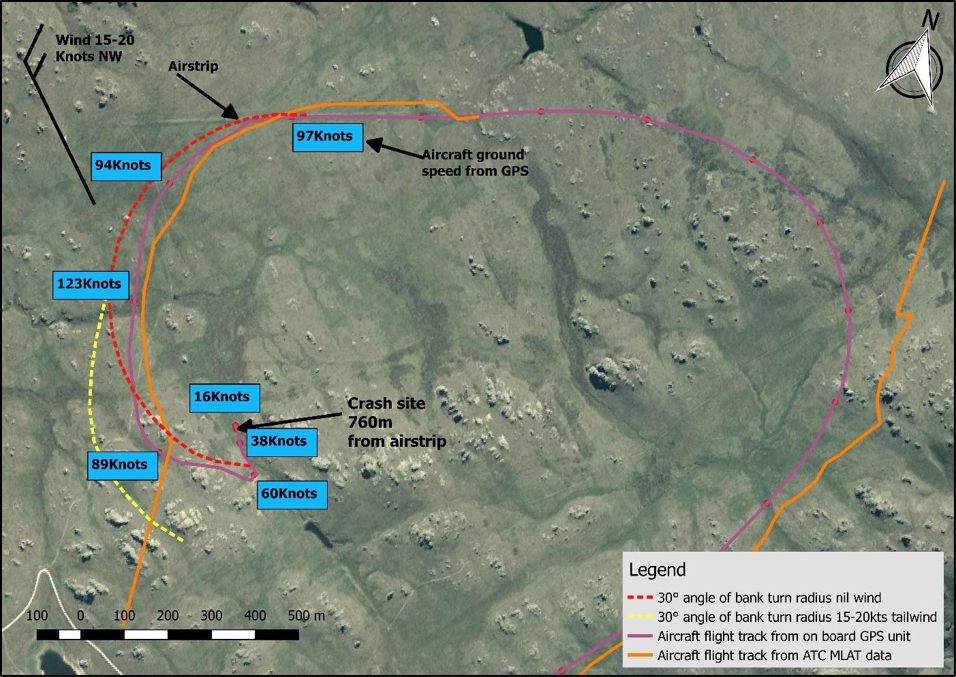
- Figure 6 shows the flight track (in magenta) of the aeroplane as displayed on the on-board iPad by an application called AirNav ProTM. Due to buffering of the GPS data, and in order to show a ‘live’ view of the flight, the application had to predict the next position of the aeroplane. This feature has resulted in an impossible track being depicted between the points at 89 knots and 16 knots. This part of the data is invalid, and was most likely caused by the software predicting the position shown at the 60 knots point then ‘filling in’ the track to the final data point at 16 knots. In fact the aeroplane stalled at about the 89 knots point and followed a line between the 89 knots point and the crash site.
- The dashed red line in Figure 6 represents the calculated radius (380 m) of a turn carried out in still air (no wind) with an entry airspeed of 90 knots and 30 degrees angle of bank. The dashed yellow line at the bottom of the figure represents the expected flight track of a turn carried out in the wind conditions present at the time (15-20 knots from the northwest) and with 30 degrees angle of bank. The rate of turn is the same for both, but with a tailwind more ground is covered during the turn. This put the aircraft closer to the higher terrain to the south of the airstrip, and the pilot would have had to increase the rate of turn or climb to avoid it.
- The aeroplane’s altitude increased slightly during the initial part of the turn, from 2,866 feet (GPS altitude - the height above sea level, referenced to the WGS84 geodetic datum. GPS altitudes can have an error of up to +/- 75 feet, however it is typically accurate to within 20 feet) to 2,912 feet. During the final part of the turn it increased to 2,955 feet before rapidly decreasing to 2,760 feet, the altitude of the accident site. The terrain surrounding the airstrip consisted of rocky outcrops and shallow gullies, with lower terrain to the northwest and a rocky ridge about 170 feet higher, 800 m to the southeast of the airstrip. The aeroplane’s height above ground increased to about 200 feet during the initial part of the turn, but prior to the final part of the turn it decreased to about 100 feet due to the rising terrain ahead.
- When the front passenger recalled seeing ground coming at them, he may have been referring to the higher ground on his side (to the right of the aeroplane) that they were approaching before or during the final part of the turn. The pilot may not have seen the terrain from his position on the left-hand side of the aeroplane (which was in a left turn), or he may have been looking back over his left shoulder to see if the cows had moved off the airstrip. Either way, according to the passenger in the right-hand seat the pilot had seemed surprised by how close the aeroplane was coming to the high terrain, and likely attempted to increase the rate of turn by increasing the angle of bank.
The stall
- The stall speed of a PA32-300 in level flight, in the same configuration and at the same weight as the aeroplane at the time of the accident, is about 55 knots. When an aeroplane is banked in a turn there is an increase in the load (weight or G) factor, and the vertical component of lift is reduced (see Appendix 3). A stall will occur at a higher airspeed in a turn than when in level flight. In a 30-degree angle of bank turn the stall speed is 1.1 times the stall speed in level flight (61 knots), at 45 degrees it is 1.2 (66 knots), and at 60 degrees it is 1.4 (77 knots). The groundspeed recorded by the GPS unit as the aeroplane was partway through the final turn was 89 knots and reducing as the rate of turn increased. There was a tailwind of 5-10 knots at that point, so the airspeed was probably closer to 80 knots and approaching the stall speed for a 60-degree angle of bank turn (77 knots).
- The front passenger recalled the aeroplane “banking sharply” to “almost vertical”. This was likely to have been either an increase in the angle of bank by the pilot to increase the rate of turn, or the left wing dropping when the aeroplane stalled. When an aeroplane stalls in a turn, the inside wing stalls before the outside wing because it is travelling slower through the air. As a result the inside wing drops further and the aeroplane rolls further into the turn. The aeroplane struck the ground in a left wing and nose low attitude with a high vertical and low horizontal speed. The ground impact evidence supported the conclusion that the aeroplane stalled while in a left turn at low level. The stall occurred when the aeroplane was less than 150 feet above the ground, much less than the minimum 300-400 feet or more required to recover the aircraft from a stall.
Other factors
- Having an artificial horizon installed in an aeroplane can assist a pilot in judging their angle of bank during a turn, especially when at low level over undulating terrain. However, there was no requirement for one to be fitted for this type of operation, and the pilot was experienced with flying in mountainous terrain. The aeroplane was fitted with a turn and slip indicator that gave a basic indication of the rate of turn.
- The lack of an aural stall warning may have been a factor that prevented the pilot recognising an impending stall and taking action to avoid it. The stall warning light was operable, but if the pilot had been looking out the side window in the direction of the turn he may not have noticed the light illuminate. A warning horn could have immediately drawn his attention to the impending stall. Later-model PA32-300 aeroplanes were fitted with a stall warning horn as well as the light.
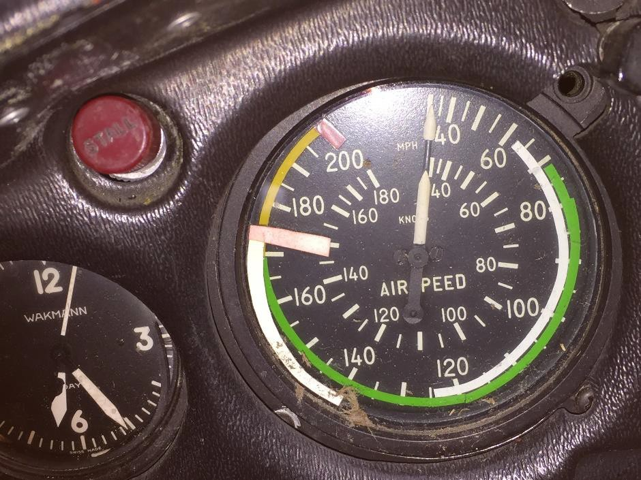
- The outer scale of the airspeed indicator (see Figure 8) was calibrated in mph, while the smaller inner scale was in knots. One knot is equal to about 1.15 mph. The airspeed indicators in the other aeroplanes the pilot regularly flew were calibrated in knots only. According to the pilot’s training records, he had used knots when learning the airspeed limitations for the PA32-300 type rating. The pilot could have read the airspeed off the outer scale (mph) thinking it was in knots, and thought they were flying faster than they actually were. An airspeed of 90 mph on the outer scale would equate to about 77 knots (the stall speed at 60 degrees angle of bank).
- The aeroplane had a high groundspeed (groundspeed is the speed that the aircraft flies over the ground and is affected by wind. For example, if an aircraft flies at an indicated airspeed of 100 knots into a headwind of 20 knots the groundspeed will be 80 knots, if it is a 20 knot tailwind the groundspeed will be 120 knots) during the majority of the turn due to the tailwind. This could have been interpreted as a high airspeed by the pilot if he was looking outside the cockpit and saw the ground rushing past. This illusion is exaggerated at low heights above ground, and if a pilot reduces power to decrease the high groundspeed, the airspeed decreases. The speed margin above the stall speed is also decreased because the aeroplane is turning (see Appendix 3).
-
Although it could not be determined whether these factors contributed directly to the accident, they would have made it harder for the pilot to recognise the dangerous situation that was developing.

The operator’s stock clearing procedures
-
When flying into a farm or remote airstrip, it may sometimes be necessary to clear stock from the strip before a landing can be made. Usually the pilot will fly along the airstrip at low level to scare the stock to one side. After flying along the airstrip, the standard practice is to climb straight ahead to at least 500 feet AGL before turning and re-circuiting for the landing.
- In this case the pilot flew along the airstrip at low level, but instead of climbing straight ahead to 500 feet he maintained his height as he entered the left turn. The front passenger recalled being told by the pilot that they would have to circle back to scare the cattle again.
- The operator did not have any written procedures for or guidelines on how to carry out stock clearing. However, the Chief Pilot said that he had told his pilots that a low pass to scare stock should be done to one side of the airstrip, followed by a straight climb to 500 feet above the airstrip before turning. He said that if stock did not move after one low-level pass, pilots should not make further attempts.
- Other pilots of the operator had different views on how stock clearing should be carried out. None of the pilots had been given flight instruction on the manoeuvre, nor had they been assessed for their competency in carrying it out. They offered a range of minimum heights for the manoeuvre, from 50 feet to 150 feet AGL. They also had different views on whether it was necessary to climb straight ahead to 500 feet after the pass before turning.
- In this case the pilot had indicated that he would perform a second pass, and his low-level turn was consistent with that intention. According to his logbook he had performed multiple passes to clear stock at Poolburn and at other airstrips before. This, and the different views of the operator’s pilots, showed that the Chief Pilot’s verbal instructions about stock clearing were either unclear or being ignored.
- Most of the operator’s pilots said that the circuit (the circuit is a rectangular path followed by aircraft when taking off or landing, while maintaining visual contact with the airfield) direction at Poolburn was always to the left, which would take an aircraft towards the higher terrain when approaching from the north. In this case, with a strong crosswind from right to left, it would have been safer to turn right into the wind, because the terrain sloped down from the airstrip and it would have resulted in a lower groundspeed. It was not possible to determine whether the pilot had carried out stock clearing in similar wind conditions, or if he had flown in a different circuit direction, during previous flights into Poolburn.
- Alternatively, the pilot could have climbed straight ahead to 500 feet AGL before turning. Had there been an engine failure during the low-level turn to the left, there would have been few options for a safe landing because of the rocky terrain and high groundspeed of the aeroplane.

Civil Aviation Rules
- CAR did not define or refer to stock clearing, nor was it covered anywhere in the advisory circulars or guidelines published by the CAA. The commercial pilot licence training syllabus did not include stock-clearing techniques. The agricultural rating syllabus (the agricultural rating training syllabus was reviewed, as it was considered by the investigation to be the most likely place to find any guidelines about stock-clearing procedures) likewise did not include a requirement for stock-clearing training.
- CAR Part 91.127 states that no person may operate an aircraft at an aerodrome unless the runway is clear of all persons, animals, vehicles, or other obstructions during landing or take-off. It does not specifically prohibit a pilot from carrying out a low approach and overshoot to clear animals off the runway.
- In accordance with CAR Parts 91 and 135, the minimum height for visual flight rules (VFR) air transport flights is 500 feet above the surface, or 500 feet above any obstacle within a 150 m radius of the aircraft. Aircraft must also not be operated at a height less than required to safely execute an emergency landing in the event of an engine failure. These requirements do not apply to the pilot in command of an aircraft conducting a take-off or landing, a balked landing or discontinued approach, or taxiing. There is no definition in CAR Part 1 for balked landing or discontinued approach.
- A low approach and overshoot involves an aircraft carrying out a normal approach to land, but it stops descending at low level before climbing straight ahead to 500 feet or more to circuit for landing or to depart the area. On occasions there may be good reason to fly at low level along a runway or airstrip for a short distance before climbing away. This manoeuvre is typically carried out to inspect an unprepared landing area for any hazards, prior to landing.
- An article published in the CAA safety magazine Vector in March 2012, following a low flying incident, discussed low approach and overshoot manoeuvres. The pilot involved in the incident was quoted as saying, “A low pass down the runway was accepted common practice as part of a go-around [low approach and overshoot]” and that “the rules didn’t prohibit the manoeuvre”. The published response from the CAA at the time was “just because the rules are silent on the matter doesn’t make it an acceptable practice”.
- The pilot of the accident aeroplane carried out a modified low approach and overshoot, and instead of climbing out straight ahead after flying along the airstrip he turned at low level in order to make another low-level pass over the airstrip. In the absence of any specific guidelines from the operator or within the civil aviation system regarding stock clearing, the pilot carried out what he may have thought was an acceptable manoeuvre for stock clearing. Entries in the pilot’s logbook, and the briefing he gave to the passengers about making “close passes” and “tight turns to get back around”, suggested this may have been his usual technique for clearing livestock that had not moved after the first pass.
- The CAA was asked by the Commission to clarify the requirements for operators who carry out stock clearing during commercial or air transport operations. The CAA responded by saying that stock clearance is not authorised under CAR Part 135. The reason the CAA gave was that CAR Part 91, which applies to all pilots under all CAR, states that pilots must ensure a runway is clear of animals during landing.
- CAR Part 91 states that a pilot is allowed to fly below 500 feet AGL for the purposes of taking off or landing, and for carrying out a balked landing or discontinued approach. As stock clearing could be interpreted as being a form of balked landing or discontinued approach, and in the absence of any clear guidance from the CAA, the stock-clearing procedure could be interpreted as being allowed.
- This operator and others had been carrying out stock-clearing manoeuvres for many years, possibly in the belief that it was not prohibited under CAR. The CAA’s view that stock clearing is not permitted on an air transport flight may not be shared by all aviation industry participants. Therefore the Commission is recommending that the Director of Civil Aviation provide appropriate guidance to the aviation industry on stock clearing.

Appendix 1. Fuel control unit inspection
At the time of the accident CAA Airworthiness Directive (an airworthiness directive is a mandatory instruction to ensure the continued airworthiness of an aircraft or component) DCA/MA/17 was applicable to Robinson R44 II helicopters fitted with Lycoming IO-540 series engines and Precision Airmotive RSA-10AD1 fuel control units (FCUs). Teflon thrust washers inside these FCUs had shown signs of delamination, which had the potential to restrict fuel flow and cause a reduction in power. The aeroplane’s FCU (part number RSA-10ED-1) used the same type of washer. Therefore the possibility of a delaminated washer being a causal factor was examined in detail.
The FCU was taken apart and inspected at an approved engine overhaul facility under the supervision of the investigator in charge. The FCU, fuel nozzles, fuel filter and pump were tested and found to be serviceable and free of blockages. However, a small amount of delamination was detected on washer part number 367757 (see Figure below).
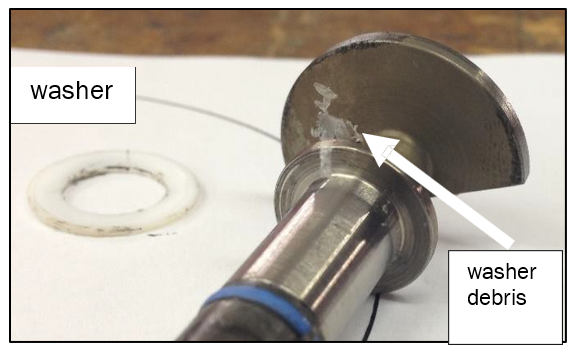
The Commission notified the Director of Civil Aviation that similar delamination had been found on the washer from the aeroplane’s FCU. Following this and further reports from other aeroplane operators, the CAA issued Airworthiness Directive DCA/MA/19 that was applicable to all aircraft fitted with RSA-10ED1 model FCUs and other Precision Airmotive FCUs that contained the Teflon washer.
Despite the breakdown of the washer material, the fuel nozzles and lines were clear of any debris and there was no sign of any blockages.
Appendix 3. Aerodynamic stalls and steep turns
Introduction
The following information has been copied in part from the Civil Aviation Authority Flight Instructor Guide Briefings for Basic Stalling, Advanced Stalling and Steep Turns. This presentation of this information will be familiar to many New Zealand pilots. Full briefings are available from https://www.caa.govt.nz/FIG/index.html.
Aerodynamic Stall
An aerodynamic stall is not like a stall in a car – the engine does not stop. Aerodynamic stalling is the breakdown of smooth airflow over the wing into a turbulent flow, resulting in a decrease in lift. The lift will no longer fully support the aeroplane’s weight, and the aeroplane sinks. The cause of this breakdown of smooth airflow is the result of the wing being at too high an angle of attack to the airflow. For the average aerofoil used on general aviation aeroplanes, this limit is reached at an angle of attack of about 15 degrees.
Lift is primarily controlled through angle of attack and airspeed, and lift must equal the aeroplane’s weight to maintain level flight. As the airspeed decreases, the angle of attack must be increased to maintain lift equal to weight.
L = angle of attack x airspeed
As the angle of attack increases, the airflow finds it more and more difficult to follow the contoured upper surface of the wing (aerofoil) smoothly, and the point at which the airflow breaks away from the wing (the separation point) moves forward from the trailing edge. At the same time, the point through which lift acts, the centre of pressure (C of P), also moves forward; this movement is unstable because it reduces the moment of the lift/weight couple. See Figure 1.

Eventually, the stalling (or critical) angle of attack is reached, and the inability of the air to flow smoothly over the top surface of the wing results in a decrease in lift and a large increase in drag. The result is that the aeroplane sinks. At the same time, the C of P moves rapidly rearward. The rearward movement of the centre of pressure increases the moment provided by the lift/weight couple, causing the nose to pitch down in a stable movement.
The aeroplane's manufacturer provides stalling speeds for one or more aircraft configurations as a guide to the pilot. Although the critical angle remains constant, the stall speed will vary for other configurations and with several factors.
Lift primarily varies with angle of attack and airspeed. Since the critical angle cannot be altered, anything that increases the requirement for lift will require an increase in airspeed to produce that lift. Therefore, when the critical angle is reached the airspeed will be higher. Conversely, anything that decreases the requirement for lift will decrease the airspeed observed at the stall.
Weight
An increase in weight will require an increase in lift, resulting in an increase in the stalling speed. Loading
Loading, or load factor, is the name given to the force/acceleration that the aeroplane must support, for example, in pulling out of a dive. When you ride a roller coaster, at the bottom of the dip you feel heavier, as you're pushed into your seat by the force/acceleration of changing direction. You haven't actually gained weight, but it feels that way. For an aeroplane this is often referred to as apparent weight, or G, and this increase in apparent weight increases the requirement for lift, and thus it increases the stall speed.
↑ apparent W → ↑ L → ↑ VS Power
If the aeroplane had enough power, it could climb vertically (like a rocket) and there would be no requirement for lift at all. So when thrust is inclined upwards, it decreases the requirement for lift and reduces the stalling speed. In addition, the slipstream generated by having power on increases the speed of the airflow and modifies the angle of attack (generally decreasing it) over the inboard sections of the wing. The increased airspeed increases the lift and reduces the aeroplane's stall speed.
Flap
Flap increases lift and therefore the stalling speed is reduced. However, flap also changes the shape of the wing, and this results in a lower nose attitude at the stall.
Although flap increases lift, it also increases drag – generally, about the first 15 degrees of flap increases lift with little adverse affect on the L/D ratio. The application of any further flap rapidly increases drag, adversely affecting the L/D ratio.
Steep Turns
A steep turn is defined as a turn of more than 30 degrees angle of bank. It is common practice for flight instructors to teach students to conduct steep turns at 45 degrees angle of bank.
In order to turn the aeroplane, an acceleration towards the centre of the turn must be provided. This is done by banking the aeroplane with aileron. It is the horizontal component of lift (centripetal force) that provides this acceleration towards the centre of the turn. With the lift vector inclined, the vertical component of lift no longer supports the aeroplane’s weight. To maintain a constant altitude or height, the total lift vector must be increased so that the vertical component now equals the weight. Of the options available for increasing lift, changing the angle of attack is the most practical. Any increase in lift will produce a corresponding increase in drag, and therefore, a reduction in airspeed. In the medium level turn, the lift and drag increases are very slight and the decrease in airspeed is minor. The appropriate amount of backpressure on the control column achieves this.
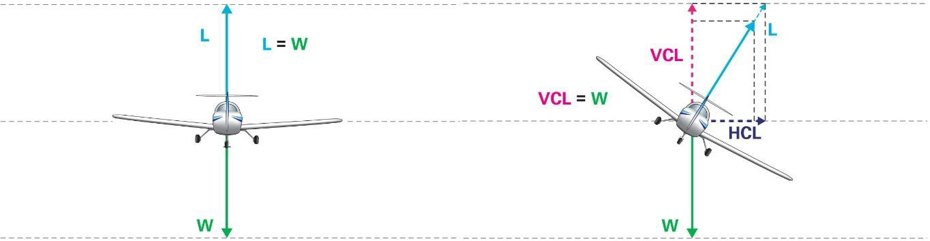
For a steep turn a greater turning (centripetal) force is required and so the aeroplane banks to a steeper angle than for a medium turn. Therefore, increased lift is required in order to provide sufficient vertical component to equal weight and provide the horizontal component. The acceleration pushing the pilot into the seat is known as load factor (commonly referred to as G). This is equal and opposite to lift, and the wings must support it.
At 45 degrees the load factor is +1.4 G and at 60 degrees angle of bank the load factor is +2 G, and the occupants will feel twice as heavy. The load factor is often referred to as apparent weight – because it is an acceleration (force) that the wings must support, similar to weight.
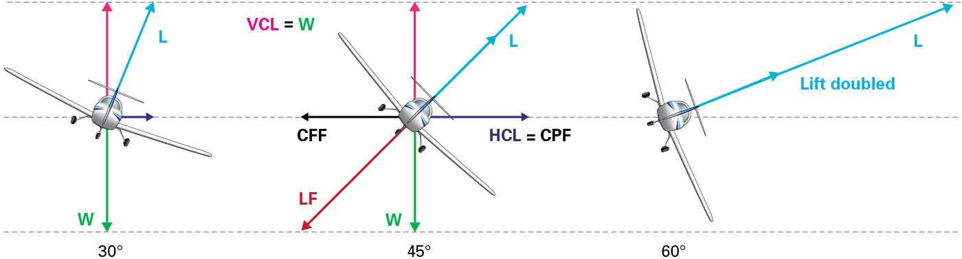
The stall speed in a manoeuvre increases as the square root of the load factor (LF). Assuming a stall speed of 55 knots in level flight, at 60 degrees angle of bank the stall speed will increase by the square root of the load factor +2 (√2), which is approximately 1.4. This means that, at 60 degrees angle of bank, the stall speed is increased by 40% to 77 knots.
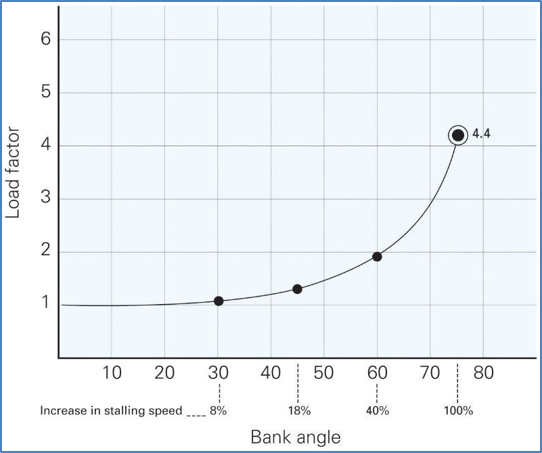
At the same time, because lift is increased by increasing the angle of attack, adversely affecting the L/D ratio, the drag also increases, resulting in decreased airspeed.
It is an undesirable situation to have the stall speed increasing and airspeed decreasing. Therefore, the power is increased to combat the increased drag to maintain a margin over the stall speed. This can be referred to as a power sandwich.
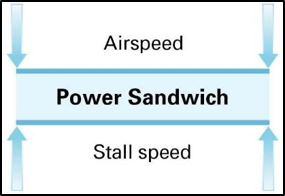
As the increase in drag, load factor and stall speed is not linear, the effect of increasing drag must be compensated by an increase in power in turns at angles of bank greater than 30 degrees. At 45 degrees angle of bank this increase will be about 100–200 RPM.
Source: CAA Flight Instructor Guide