
Worse-than-expected sea conditions caused capsize of a perceived very safe ‘pontoon’ design water taxi. Skipper rescued all six passengers trapped inside, all survived. Lessons for passenger boat sector: know vessel stability as well as buoyancy; prioritise safety over commercial expectations; manage risks; ensure the right safety equipment is available; actively lead safety on-board.
Executive summary Tuhinga whakarāpopoto
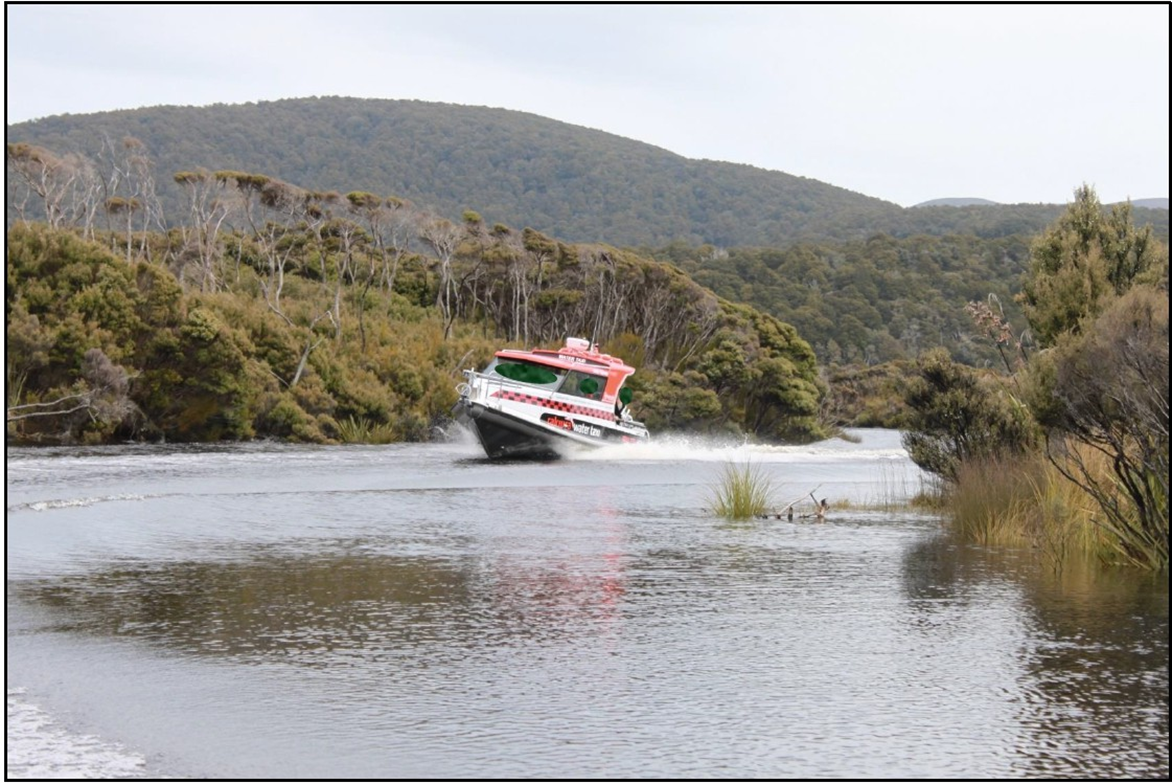
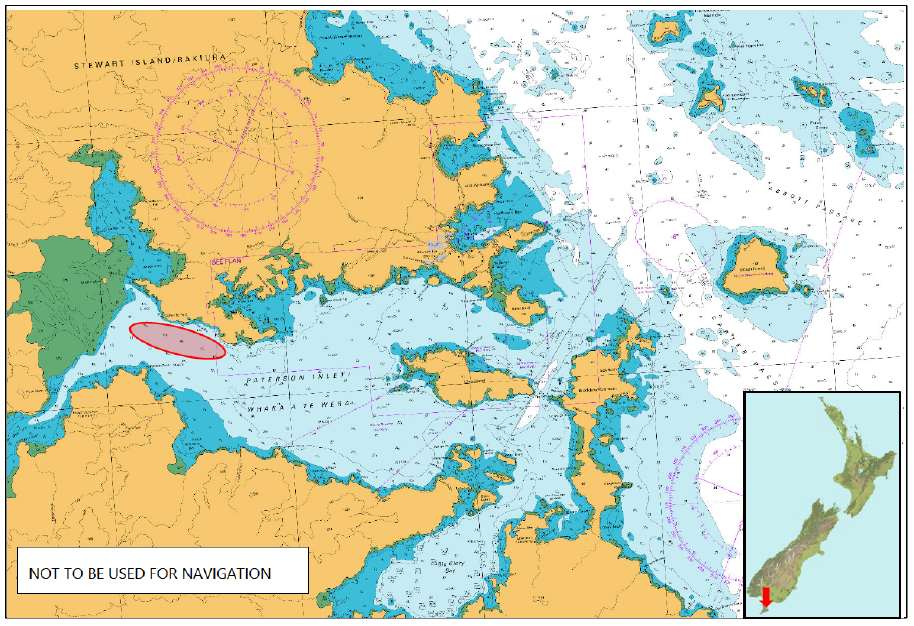
What happened
- On 12 September 2019, the Henerata was being operated as a water taxi service from Freshwater Hut to Golden Bay via Paterson Inlet on Stewart Island/Rakiura.
- At approximately 1300, the Henerata departed from the Freshwater Hut landing and travelled down the Freshwater River. There were six passengers and the skipper on board. At about 1310 the vessel entered Paterson Inlet and the weather conditions deteriorated. About 10 minutes later the Henerata became swamped and capsized. The skipper made a Mayday radio broadcast prior to the capsize. The skipper and the passengers held on to the upturned vessel for about an hour before rescue vessels arrived.
- The passengers and the skipper suffered hypothermia and water ingestion to varying degrees. Passengers who required hospital treatment were transferred to Southland Hospital by helicopter. There were no fatalities.
Why it happened
- The Transport Accident Investigation Commission (Commission) found that the sea conditions were worse than the skipper expected when the Henerata entered steep and unpredictable seas. The Commission also found that the Henerata broached as a result of the steep and unpredictable seas, was overwhelmed, and capsized.
What we can learn
- Due to the absence of any communication facilities in the Freshwater River area, passenger pick-up services from Freshwater Hut were rarely cancelled. It was about as likely as not that this resulted in a self-perceived pressure to operate the water taxi service. The operator has since amended its booking information provided to passengers to notify them that cancellations are possible and that they should be prepared to stay overnight should cancellations occur.
- The operator’s Maritime Transport Operator Plan had no defined weather criteria to assist the skipper’s decision to sail, nor did it assess the risk of capsize. The Commission has made a recommendation to the operator to address these issues. The operator has made several changes to its operations to improve safety should a capsize occur.
- A lack of stability information likely prevented the operator being able to assess fully the risk of capsize. The Commission has made a recommendation that Maritime New Zealand ensure that future Maritime Rules require appropriate stability and buoyancy testing for all domestic commercial passenger vessels.
Who may benefit
- Maritime operators, regulators, surveyors and boating associations may all benefit from the findings in this report.
Factual information Pārongo pono
Narrative
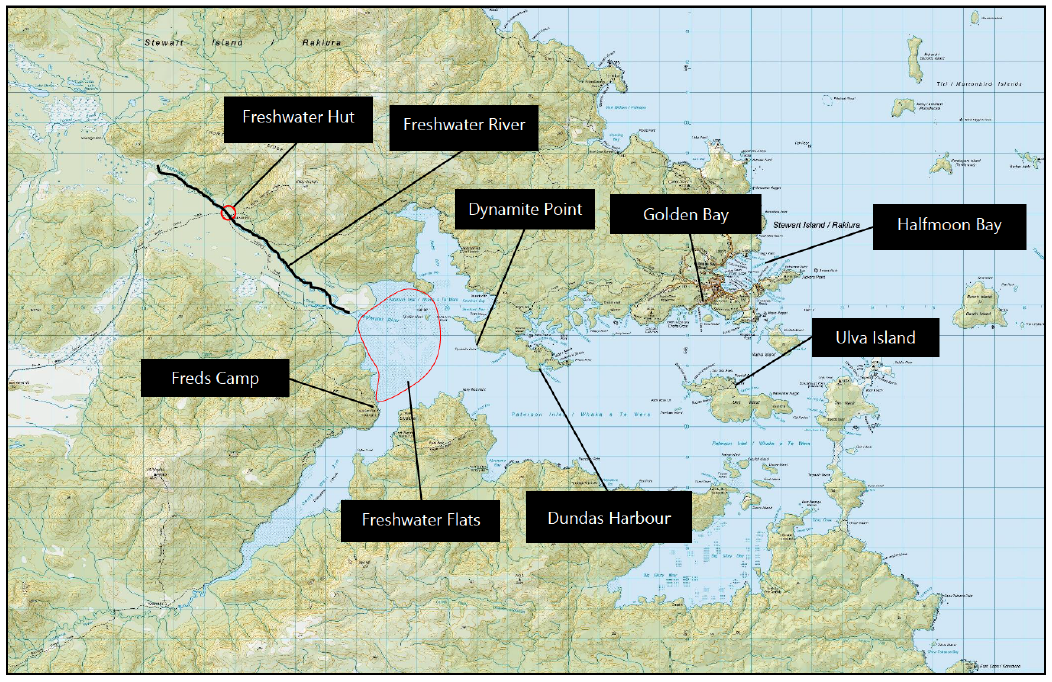
- On 12 September 2019, the Henerata, operated by Rakiura Charters Limited (the operator) was providing water taxi services in Paterson Inlet, Stewart Island/Rakiura. The services for the day included a morning service to and from Ulva Island, and an afternoon water taxi service, picking up six passengers from the Freshwater Hut landing and dropping them off at Golden Bay (see Figure 3).
- The operator was based in Oban, and at about 0730 that day the skipper checked the weather forecast for the day. It predicted strong north-westerly winds, which were forecast to increase in the late afternoon.
- A passenger ferry, the Foveaux Express, which sailed between Oban and Bluff, had its scheduled morning service cancelled due to the prevailing weather. In addition, its afternoon service was brought forward to depart at 1100 to avoid the increasing winds.
- Prior to the ferry’s departure, the skipper of the Henerata went to the wharf at Halfmoon Bay to discuss with the ferry’s skipper the weather and the reasons for the ferry reschedule.
- The skipper checked the weather forecast again at about 1100 and noted that the north-westerly winds were due to increase from 1600 onwards.
- The skipper cancelled the Henerata’s morning service to and from Ulva Island, knowing that the weather conditions would make embarking and disembarking the passengers dangerous.
- At about 1130 the skipper boarded the Henerata at Golden Bay, completed the start-up procedures, and departed for the Freshwater River at the western end of Paterson Inlet (see Figure 3).
- During the passage to the Freshwater River the skipper kept close to the sheltered northern shoreline of Paterson Inlet. Once the Henerata had passed Dundas Harbour, the skipper took a direct track across the Freshwater Flats to the mouth of the river.
- The Henerata arrived at the Freshwater Hut landing slightly ahead of schedule. The skipper embarked the passengers, gave them a safety briefing and departed from the landing. The skipper made a radio broadcast on very high frequency (VHF) channel 65 (Stewart Island Marine Radio ZLRZ) to report that the Henerata was proceeding down the Freshwater River.
- At about 1310 the Henerata exited the river and the skipper steered a direct line across the Freshwater Flats toward Dynamite Point. The skipper noticed that the wind speed had increased and, as the vessel moved into deeper water, the sea state changed to very steep and confused waves.
- The skipper manoeuvred the Henerata through the waves. Upon seeing a larger set of waves, the skipper steered straight and used the throttle to match the vessel's speed to the wave speed and ride on the back of a wave. The wave lifted the stern of the Henerata and drove the bow down into the wave trough. The Henerata broached to port and rolled onto its starboard side.
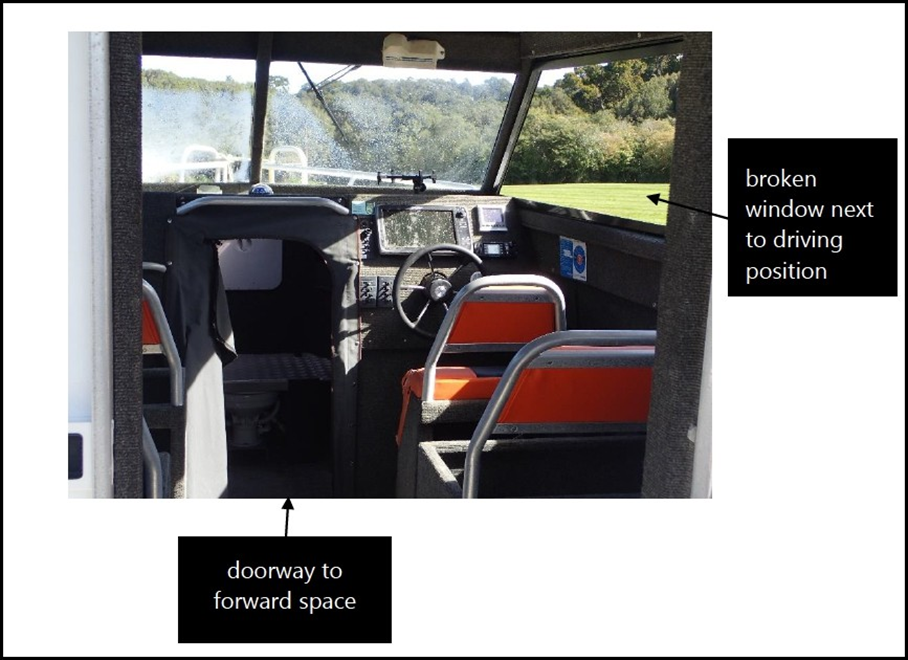
- The skipper saw that there was water in the cabin and that the amount of water was increasing. At 1320 the skipper made a Mayday call on the VHF radio and then went aft and opened the cabin door. Water flooded into the cabin and the Henerata capsized. The incoming water washed the skipper through a broken window next to the driving position (see Figure 4).
- When the skipper surfaced, none of the passengers was visible. The skipper then dived underneath the upturned vessel, opened the hatch to the forward space and swam inside. Five of the passengers were trapped under the hull in an air pocket contaminated with petrol fumes (see Figure 5).
- The skipper assisted the passengers through the forward hatch and out of the upturned hull. When the skipper surfaced, three of the passengers were holding on to the side of the vessel. However, one passenger had drifted away and was being assisted back by another passenger. The sixth passenger was found clinging to the outboard motor at the stern.
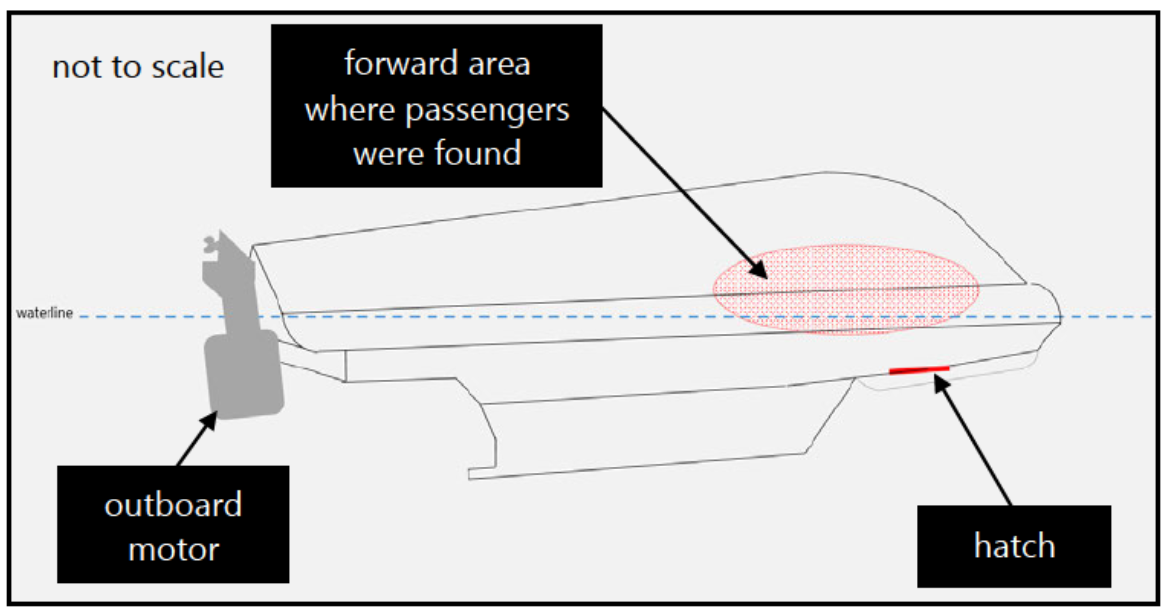
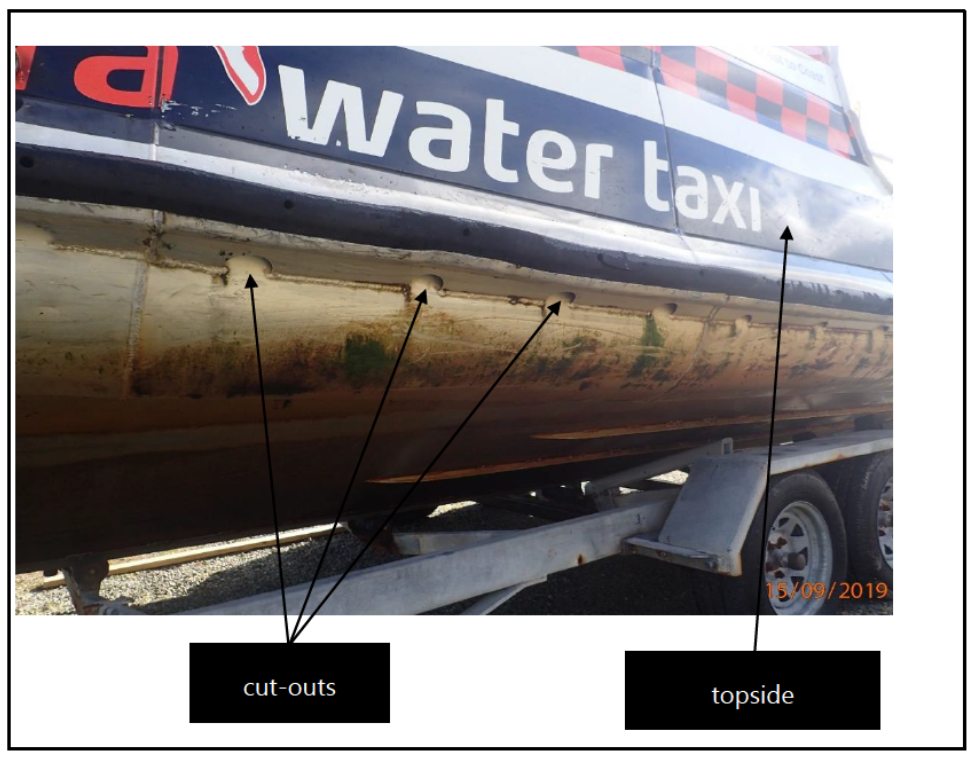
- The skipper and the passengers were on the windward side of the upturned vessel where the wave action and exposure to the wind were greatest. Following the skipper's instructions, the passengers moved around to the leeward side of the upturned vessel and held on to the cut-outs (see Figure 6) where the topside was welded onto the pontoons.
- Meanwhile, the radio operator at Stewart Island Marine Radio had heard the skipper's Mayday message on VHF channel 65. The radio operator tried to call the Henerata back on VHF radio but received no response. The radio operator also tried to call the skipper's mobile phone but there was no answer.
- The radio operator then attempted to contact Rakiura Charters' office and the Police, but was unable to do so due to a cell network outage. At about 1328 the radio operator successfully contacted the Department of Conservation (DoC) office. The DoC operations manager informed the radio operator that DoC would prepare the vessel Hananui to depart immediately for Paterson Inlet to search for the Henerata.
- Other operators had also become aware of the situation, and at about 1332 the skipper of the Ulva Island water taxi Kaian phoned the radio operator and advised that the Kaian was leaving Golden Bay to join the search for the Henerata. Ten minutes later the radio operator was advised that the Aurora Australis was also joining the search in Paterson Inlet.
- From 1343 the search and rescue operation was led by the Police.
- As the Henerata drifted near to Dundas Harbour, the skipper swam into the vessel again and grabbed lifejackets and flares. They were unable to reach the emergency position indicating radio beacon (EPIRB).
- The skipper climbed onto the upturned hull and observed the Kaian approaching.
- At about 1419 the skipper of the Kaian confirmed to the radio operator at Stewart Island Marine Radio that the Henerata had been located and that there were seven people in the water. The Aurora Australis and the Hananui followed shortly after the Kaian. Between the three vessels, the Henerata's passengers and the skipper were recovered from the water and taken to Golden Bay.
- The local ambulance and fire services were awaiting their arrival. The skipper and passengers on board the Henerata were assessed by the island's nurse; two had lost consciousness and the rest had hypothermia. Two helicopters were deployed from Dunedin and arrived at Stewart lsland/Rakiura around 1615 and 1625 respectively. They subsequently transferred four of the patients to Southland Hospital.
- The vessel Aurora arrived on site shortly after everybody from the Henerata had been rescued. The crew of the Aurora righted the Henerata and towed it back to Golden Bay.
Personnel information
- The skipper of the Henerata had earned a commercial launch master qualification in 1998. The skipper had been operating similar vessels since 2002, including seven seasons operating from beaches where the effects of wave action on a vessel were an important aspect of the vessel's handling.
- After working as a skipper overseas and as a supervisor and manager for a large tour operator elsewhere in New Zealand, the skipper had bought the water taxi company in 2012. The building of the Henerata had been commissioned in 2014.
Vessel information
- The Henerata was an aluminium alloy, hard-top, collared vessel (in New Zealand terminology, a rigid-hulled collared vessel that has alloy buoyancy chambers around the periphery of the hull) based on an Osprey Boats design. The design had been approved in 2005 and the vessel had been built by Alloyd Engineering in Nelson. The vessel was similar to a rigid-hulled inflatable boat and was commonly referred to as a pontoon boat in New Zealand.
- The build had been carried out under survey (constructed subject to an initial survey, conducted by a certified surveyor, from the time of the commencement of building the vessel until the completion of the building of that vessel) and the Henerata had been deemed to meet all the relevant requirements of Maritime Rules Part 40A: Design, Construction and Equipment – Passenger Ships which are not SOLAS Ships (Maritime New Zealand Consolidation, 1 November 2016. SOLAS is the International Convention for the Safety of Life at Sea). On the completion of the build, the Henerata had been issued with a Certificate of Survey dated 16 December 2014.
- On 28 September 2018, a renewal survey had been conducted and a new Certificate of Survey issued, valid for five years.
- The Henerata was certified to carry a maximum of 20 people on board, operating within restricted inshore limits. The skipper was the only crew member required to be on board.
- The Henerata was propelled by a Honda 250-horsepower outboard motor.
Vessel stability
-
Collared vessels such as New Zealand pontoon boats and rigid-hulled inflatable boats are inherently buoyant. The hull consists of a number of air-filled chambers around its periphery, in addition to underdeck airtight voids.
-
The building and stability requirements for the Henerata were contained in Maritime Rules Part 40A. When the Henerata was built in 2014, Part 40A was silent on stability and swamp test requirements for vessels between six and 15 metres in length.
- In 2018 Maritime New Zealand had issued a position statement (PS [Position Statement]-07-18 Swamp calculations or swamp tests for open or partially-decked boats. Maritime New Zealand, July 2018) that contained guidance for surveyors on assessing the stability and buoyancy of applicable vessels. The position statement recommended swamp testing and/or swamp calculations for vessels on which Part 40A was silent.
- The swamp test and swamp calculations were intended to ensure that there was enough buoyancy, in the form of airtight chambers or additional floatation material, to support the weight of a vessel, its engine and associated equipment, and the maximum number of persons on board when the vessel was inundated with water.
Meteorological and ephemeral information
- The forecast weather conditions for Stewart Island between 1300 and 1630 on 12 September 2019 are summarised below:
-
a severe weather watch (when referred to in a severe weather watch or warning, a 'severe gale' is a mean wind speed greater than or equal to 90 kilometres per hour (48 knots), or frequent gusts exceeding 110 kilometres per hour (60 knots). A knot is a measurement of speed in nautical miles per hour, equivalent to 1.852 kilometres per hour) was in force that stated:
West to north-westerly winds may approach severe gale in exposed places at times
-
the Foveaux coastal forecast indicated:
northwest winds of 50 knots for the coastal waters east of Stewart Island
The forecast was updated at 1248 and the forecast wind speed was reduced to 45 knots
-
the Southland regional forecast, which included Stewart Island, forecast:
north-westerlies with gusts to 59 knots and showers.
- The Foveaux coastal marine forecast (this forecast covers the sea area from Nugget Point (South Island) to South West Cape (Stewart Island)) initially contained a strong wind warning. It was later revised with a decreased wind speed (see Figure 7).
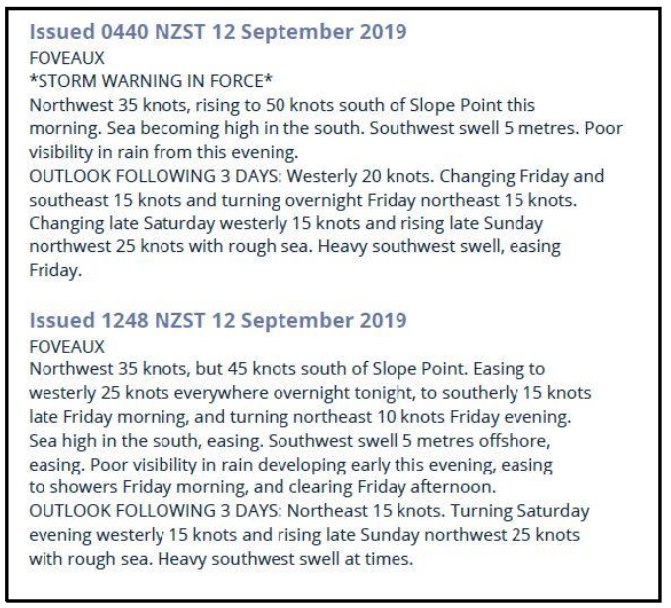
- Weather forecasts for 12 September 2019 consistently predicted gale north-westerlies with gusts to 110 kilometres per hour (59 knots).
Survival aspects
- The passengers and the skipper were not wearing lifejackets at the time of the capsize. The passengers were able to hold on to the hull of the upturned vessel because the cut-outs where the topside was welded onto the pontoons happened to provide, by chance, makeshift handholds.
Tests and research
- Data stored in the memory card of the outboard motor was retrieved and assessed. The data included the total engine run time, but there was no other information.
Similar occurrence
- In 2004 a 7.4-metre pontoon boat capsized while operating as a water taxi in Abel Tasman National Park. It was picking up passengers from a beach in poor sea conditions when it was overwhelmed and capsized with 13 passengers on board. The vessel had an anchor set but was unable to maintain its bow-to-sea orientation. As it rolled the hull struck the seabed, contributing to its capsize.
Organisational information
- The skipper of the Henerata was the owner and operator of Rakiura Charters Limited. The business operated under the Maritime Operator Safety System (MOSS) as specified by Maritime Rules Part 19: Maritime Transport Operator – Certification and Responsibilities (Maritime Rules Part 19: Maritime Transport Operator – Certification and Responsibilities. MNZ Consolidation, 1 January 2015). Under the MOSS framework, an operator is required to develop an appropriate safety system and prepare a Maritime Transport Operator Plan (MTOP). With an approved MTOP and vessels meeting all survey requirements, the operator is issued with a Maritime Transport Operator Certificate. Rakiura Charters held a Maritime Transport Operator Certificate, which had been issued by Maritime New Zealand in June 2015.
Analysis Tātaritanga
Introduction
- Operating a boat in adverse weather conditions, particularly when carrying passengers, can be hazardous. The Henerata was operating a water taxi service in the Paterson Inlet area of Stewart Island when it capsized. The skipper and six passengers remained in the water for over an hour, holding on to the hull of the upturned vessel. Three local vessels assisted in recovering everyone from the water, and a fourth vessel righted the Henerata and towed it back to Golden Bay.
- The following section analyses the circumstances surrounding the event to identify those factors that increased the likelihood of the event occurring or increased the severity of its outcome. It also examines any safety issues that have the potential to adversely affect future operations.
Planning and decision to operate the service
- A large proportion of accidents involving small vessels are weather related. Bad weather can make the environment on board a vessel extremely hazardous. It can also place a lot of strain on the vessel’s structure and equipment and the people on board (Maritime New Zealand).
- Therefore, prior to sailing, a skipper should develop a plan for the voyage and determine whether it is safe to sail. It is essential that as part of this planning the skipper obtain an up-to-date marine weather forecast and tidal information for their boating area. This information should be considered in conjunction with:
- the vessel and its capabilities
- the intended operations
- the operating area.
- The operator’s MTOP required skippers to take weather and sea conditions into consideration for ensuring passenger safety. The MTOP specified, as a minimum, the following decision criteria for skippers:
- the current and forecast weather conditions and sea state
- visibility
- tidal flows (including any changes that could result in wind against tide)
- traffic density
- the health, mobility and comfort of all persons on board
- any other information relevant to the safety of the operation.
- On the day of the accident the skipper obtained and considered the information identified in the MTOP to assist them in making a decision on whether to proceed. Having operated the Henerata in similar weather conditions many times, the skipper recalled determining that it was safe to proceed based on their knowledge and experience. The operator’s MTOP had no defined weather criteria against which skippers could assess the forecast weather. This is discussed further in ‘Operator’s Maritime Transport Operator Plan considerations’.
- The Henerata’s design approval and Certificate of Survey included operating limits expressed as a wave height versus speed table. The maximum wave height on the table was two metres. While the nearest swell forecast for the Foveaux Strait area was above the specified wave height, the Paterson Inlet area’s location and topography meant its conditions would have likely differed from those forecast. Some parts of the voyage would very likely have been milder than the nearest swell forecast due to the protection afforded by the local area. Conditions in other parts, such as those in the position of the accident, may have been closer to those forecast.
-
The accident area was known locally to be subject to steep, confused seas, particularly when the tidal flow acted in the opposite direction to the wind. The boundary between the channelled sand bars of the Freshwater Flats and the deeper water in Paterson Inlet created variable interactions between the seabed and water flow.
- MetService carried out a forensic weather assessment for the Transport Accident Investigation Commission (Commission) to try to determine the expected sea conditions for the forecast wind speed on the day of the accident. Its report stated that wave heights should have been an estimated three-quarters of a metre. While the forensic weather assessment did not appear to match the actual conditions on the day, it did show that conditions in the inlet were difficult to predict.
- To mitigate some of the risks associated with the weather conditions, the skipper planned the Henerata’s schedule to ensure that the pick-up time for the passengers from Freshwater Hut coincided with the high-water time at Bluff, which was predicted to occur at 1252. This was to ensure, so far as possible, that the outgoing tide and the prevailing wind would act in the same direction for the eastbound return trip through Paterson Inlet. Sea conditions should have been calmer during this period, helping to reduce the risk to passengers of vessel movements in rough conditions associated with wind against tide. This shows that the skipper had considered the intended operations and the operation area and attempted to mitigate the risks associated with the weather conditions.
Self-perceived pressure
- As there were no communication facilities available at Freshwater Hut, there was no way for the skipper to contact the passengers awaiting the water taxi service. The skipper reported that although drop-off trips to Freshwater Hut were often cancelled, passenger pick-ups were rarely cancelled due to the lack of communication facilities.
- This lack of communication was about as likely as not to have resulted in a self-perceived pressure on the skipper to pick up the passengers. The operator has since amended its booking information provided to passengers to notify them that cancellations are possible and that they should be prepared to stay overnight should cancellations occur.
Conduct of the service and capsize
-
While exiting the Freshwater River and crossing the Freshwater Flats on the return journey, the skipper observed that the wind speed had increased and sea conditions had worsened since the outward trip. Although the predicted time of high water had already passed, it is about as likely as not that there was still some residual flood tide. The skipper considered, but decided against, diverting to Freds Camp and waiting to ensure that the tide had turned to reduce the risk from adverse sea conditions.
The skipper’s decision to carry on should have prompted a re-examination of the risks to which the passengers were potentially exposed. Ideally the passengers would have been provided with and donned lifejackets and mustered in the most appropriate position; any safety instructions would have been repeated; and a safety call would have been made using VHF radio.
- The skipper and the passengers recalled the sea conditions just before the Henerata capsized as confused, with breaking waves about two to three metres in height. With the offshore wind at the western end of Paterson Inlet, the waves would have been in a developing phase and therefore choppy and asymmetric. The combination of wind speed, the nature of the seabed and the tidal flow created steeper-than-normal and unpredictable seas. In summary, it is about as likely as not that the sea conditions at the time of the accident were considerably more severe than predicted in the weather forecast.
- An inspection of the vessel by the Commission’s investigators found no anomalies that would have prevented it operating correctly. An inspection of the engine found no defects that would have prevented it producing power. Similarly, the skipper did not recall any mechanical issues and recalled the vessel becoming overwhelmed by the steep and unpredictable seas. Therefore, the Commission found that the vessel capsize was almost certainly a result of the vessel broaching in the steep and unpredictable seas.
Events after the capsize
- At the time of the capsize the passengers were not wearing their lifejackets. It is to the skipper’s credit that they re-entered the upturned hull and guided the passengers out through the forward hatch. Had the skipper not done so, the consequences of this accident could have been more severe.
- While the vessel had an EPIRB on board, the skipper was unable to reach and activate it when the vessel capsized. Had the vessel been fitted with a float-free EPIRB it would have automatically notified authorities once the capsize occurred. The operator has since relocated the EPIRBs on its vessels closer to the helm position and fitted the vessels with float-free EPIRBs.
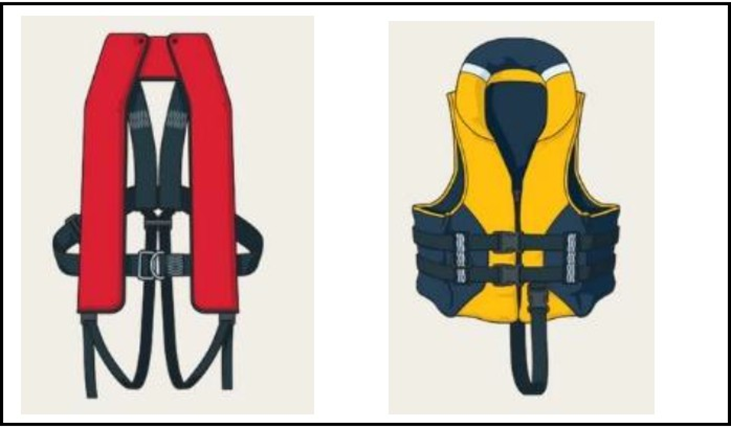
- While the passengers were not wearing lifejackets at the time, had they been they may have had problems in their egress from the upturned hull. The permanent buoyancy of the lifejackets would have made it difficult for the passengers to swim down and out of the forward hatch. The operator has since changed the lifejackets on board to manually inflatable ones that are less bulky (see Figure 8) and in the event of a capsize can be inflated after escaping the vessel.
- Once outside the vessel, the design of the cut-outs on the Henerata's hull allowed for makeshift handholds and helped to keep the skipper and the passengers, who were not wearing lifejackets, afloat and increased their chance of rescue.
- There is no requirement for domestic commercial passenger vessels to have handholds or becket lines (a line of looped rope that runs around the outside of a ship's lifeboat to provide handholds for survivors in the water) to help survivors stay in the vicinity of a capsized vessel. The provision of handholds or similar is an important survivability item that is worthy of consideration and inclusion in the revised Maritime Rules Part 40.
- There were no emergency procedures for the skipper to follow in the event of a capsize. This is further discussed in the section below.
Operator's Maritime Transport Operator Plan considerations
Safety issue: The operator's MTOP did not assess the risks associated with capsize, nordid it provide skippers with weathercriteria to assist in deciding when it was safe to operate the vessel.
- Maritime Rules Part 19 requires operators to develop, and operate in accordance with, safety systems that are specific and appropriate to the maritime transport operation. The appendix to Maritime Rules Part 19 also requires operators to develop emergency procedures, including for vessels stricken due to grounding, collision, capsize and sinking.
- MOSS requires maritime operators to establish risk-based safety management systems relevant to their operations.
- In this section the Commission identifies two aspects of the operator's MTOP that could be improved. It has issued a recommendation to the operator to address these issues.
Weather criteria
- Established weather criteria take into consideration a vessel and its capabilities, along with information on the intended operations, and provide crew with the worst weather (limits) in which an operation can be safely performed (The Norwegian Commission of Inquiry into the loss of the “Bourbon Dolphin”, 2008). If the operator had developed and set predefined weather criteria, all the appropriate considerations in this incident would have been taken into account, resulting in a more consistent approach to deciding when to sail. Weather criteria should be set cautiously to ensure they take into account any limitations in the information available to skippers. Weather criteria do not preclude skippers cancelling operations in less severe weather conditions based on their own judgement.
- The operator had not included predefined weather criteria in its MTOP. This resulted in the skipper having to make a critical safety decision on the weather without any criteria against which to assess it. While the operator had cancellation criteria, they were solely based on getting passengers on and off vessels safely and not on the limitations of the vessels or the weather.
- As there were no set weather criteria, the Commission was unable to determine whether weather criteria would have prevented the water taxi service operating. However, having weather criteria in place is an important risk control.
Risk of capsize
- The operator of the Henerata had not assessed the risk of a capsize occurring. As a result there were no documented controls for preventing one occurring or for minimising the consequences should one occur. A fulsome assessment would have likely resulted in a review of its operations to assess how best to prevent one from occurring. Similarly, it would have aimed to minimise the consequences if one were to occur, such as through the provision of a float-free EPIRB, handholds and emergency procedures to assist skippers in their actions and directions to passengers.
- There were limitations in the information available to the operator to assess the vessel’s capabilities and risk of capsizing. These are further discussed in ‘Regulatory requirements for stability and buoyancy’.
Regulatory requirements for stability and buoyancy
Safety issue: Operators have insufficient stability information to make informed decisions, because there is no requirement for small commercial craft to be provided with stability data.
- The Henerata was designed and built by Osprey Boats/Alloyd Engineering (Osprey). Osprey had been producing collared vessels, known in New Zealand as pontoon boats, for more than 20 years. The design is a deep vee hull surrounded by partitioned alloy air chambers that provide additional buoyancy. The Henerata’s design was based on a model first approved in 2005.
- Maritime Rules Part 40A prescribes the requirements for design, construction and equipment on New Zealand passenger ships that are not subject to the requirements of the International Convention for the Safety of Life at Sea. The 2005 design approval was made to cover a range of Osprey vessels from 6 to 8.5 metres in length. The design approval described an ‘aluminium monohull sportsfisher/cabin cruiser vessel with enclosed accommodation forward and open deck aft’. The intended service and operating limits were to be finalised between the owner and the surveyor based on the following:
- restricted coastal – limit to be determined by fuel capacity and location. Anticipate six passengers
- inshore limits – depending upon stability for the length of the vessel
- enclosed waters – as above
- limits are subject to the carriage of sufficient [life-saving apparatus] and sufficient stability.
- The Henerata was constructed under survey and assigned inshore and enclosed waters operating limits. Maritime Rules Part 40 had been updated since the 2005 design approval. The classification of the Osprey vessels had changed, so that under the revised rule the Osprey was considered to be a well-decked vessel and treated as an open boat. This change in classification brought the Osprey vessels that were longer than six metres into a category for which the swamp test requirements were unclear. However, the Henerata did undergo swamp testing under Maritime Rules Part 40A.13 (Stability), 4. This section of the rule allowed for the use of an approved swamp test or calculation that demonstrated that a boat, when fully swamped, had sufficient buoyancy to stay afloat and in good trim.
- The Henerata’s stability assessment, as attached to its original survey documents, was a combination of a July 2009 swamp test report for a 7.5-metre Osprey and buoyancy calculations for the 6.5-metre and eight-metre Osprey hulls. Both calculations showed that the airtight volume of the hull significantly exceeded the weight of the hull and therefore the vessels were considered to be very buoyant.
- Although Maritime Rules Part 40A does not state the reasoning behind the flotation and stability requirements, the Australian National Standard for Commercial Vessels describes the risk, the risk controls and the performance requirements behind the flotation tests. All vessels have a risk of capsizing that needs to be controlled. Depending on a vessel’s operation, size and flooding-risk category, scaled requirements are prescribed to prevent and control the likelihood of flooding and capsize. Two basic requirements are prescribed for a vessel such as the Henerata:
- basic flotation, which has a primary function of keeping the vessel afloat in the event of swamping or capsize
- level flotation, which has primary functions of keeping the vessel afloat and upright in the event of swamping and, in the event of capsize, afloat.
- New Zealand legislation does not require passenger vessels under 15 metres in length to have stability data booklets. The data contained in a stability booklet can help a vessel’s crew to estimate the vessel’s stability and how it could be affected by changes in operating conditions or damage.
- By meeting the requirements of the swamp test and/or the swamp test calculation, the vessel is deemed to satisfy all stability requirements and no further stability information is required. However, swamp tests are carried out in calm waters and static conditions. In reality, the conditions that are likely to overwhelm a vessel tend to include strong dynamic forces from wind and seas.
- The Henerata’s buoyancy was proven by the fact that it remained afloat after capsizing. The original design approval required the vessel’s stability to be taken into account for determining its operating limits. Without conducting an inclining experiment24 required for larger vessels, which is impractical for many small commercial vessels, there was no way to assess the actual stability of the Henerata.
- It is therefore difficult for operators of small domestic commercial vessels to define safe operating limits when they have no way of measuring the margin by which a vessel may be approaching or exceeding the designed buoyancy and stability criteria.
- On the one hand, operators are expected to assess vessels’ suitability and limitations for intended operations. On the other hand, boat manufacturers are not currently required to provide stability information that would better assist operators in determining vessels’ operating parameters.
- The Maritime Rules Part 40 series is currently under revision. Therefore the Commission has issued a recommendation to Maritime New Zealand that it ensure future Maritime Rules require appropriate stability and buoyancy testing, with respect to a vessels area of operation, for domestic commercial passenger vessels of all sizes and risk profiles, and consider introducing survivability measures to assist survivors in the water after a capsize event.